

Story Classic
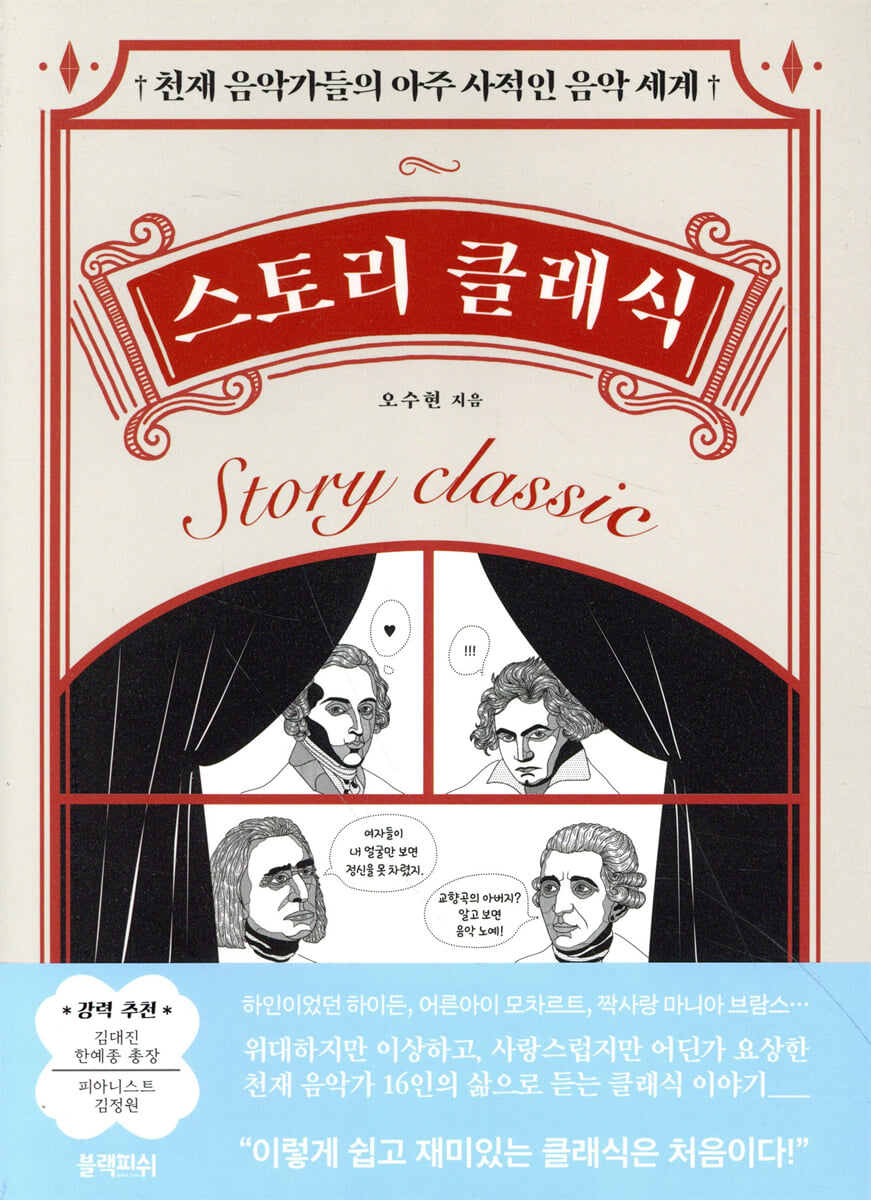 |
Description
Book Introduction
*** Highly recommended! ***
President Kim Dae-jin of the Korea National University of Arts and pianist Kim Jeong-won
Great but strange, lovely but somehow strange
Classical Stories from the Lives of 16 Genius Musicians
“From classical music to romantic music
“A very personal musical world of the most beloved classical masters of all time!”
There are countless classical introductory books in the world.
Oddly enough, these books are often difficult and tedious, no matter how easy the explanations! "Story Classics" breaks away from the textbook-like focus on music theory and the characteristics of each era, presenting "classical stories heard through the lives" of 16 of the world's greatest figures in classical music history, beloved geniuses who transcend time.
The fact that Haydn, known as the father of the symphony, was a servant in his time, the origin of the 'villain' sought in Beethoven, the story of Mahler, who was such a workaholic that he got married while conducting and returned to conducting, the sad love story of Brahms and Schumann, who loved the same woman, etc.
We aim to show their secret stories and real-life experiences that have been hidden behind the majesty of classical music.
The thrilling storyline, which captures and smoothly unfolds the private moments of those who created these exquisite works despite their intense struggles, helps anyone easily understand the world of classical music.
Moreover, QR codes are included at each point in the text where the work appears, allowing you to feel the emotion of the music throughout the book while reading the story.
As you follow the stories behind these immortal masterpieces through the eyes of these geniuses—great yet sometimes a little strange, lovable yet somehow bizarre—you'll finally hear the captivating classics like never before.
"Story Classics" will reveal the true and profound meaning of their works, revealing why they have been lauded for nearly 300 years.
I will also teach you the best way to truly savor each and every phrase of the classical music you hear today.
President Kim Dae-jin of the Korea National University of Arts and pianist Kim Jeong-won
Great but strange, lovely but somehow strange
Classical Stories from the Lives of 16 Genius Musicians
“From classical music to romantic music
“A very personal musical world of the most beloved classical masters of all time!”
There are countless classical introductory books in the world.
Oddly enough, these books are often difficult and tedious, no matter how easy the explanations! "Story Classics" breaks away from the textbook-like focus on music theory and the characteristics of each era, presenting "classical stories heard through the lives" of 16 of the world's greatest figures in classical music history, beloved geniuses who transcend time.
The fact that Haydn, known as the father of the symphony, was a servant in his time, the origin of the 'villain' sought in Beethoven, the story of Mahler, who was such a workaholic that he got married while conducting and returned to conducting, the sad love story of Brahms and Schumann, who loved the same woman, etc.
We aim to show their secret stories and real-life experiences that have been hidden behind the majesty of classical music.
The thrilling storyline, which captures and smoothly unfolds the private moments of those who created these exquisite works despite their intense struggles, helps anyone easily understand the world of classical music.
Moreover, QR codes are included at each point in the text where the work appears, allowing you to feel the emotion of the music throughout the book while reading the story.
As you follow the stories behind these immortal masterpieces through the eyes of these geniuses—great yet sometimes a little strange, lovable yet somehow bizarre—you'll finally hear the captivating classics like never before.
"Story Classics" will reveal the true and profound meaning of their works, revealing why they have been lauded for nearly 300 years.
I will also teach you the best way to truly savor each and every phrase of the classical music you hear today.
- You can preview some of the book's contents.
Preview
index
Recommendation
prolog
Classic Q&A
Franz Joseph Haydn
Back then, there were servants in uniforms
#Classic Notes
Wolfgang Amadeus Mozart
A sad adult child whose body and mind have stopped growing
#Classic Notes
Ludwig van Beethoven
A life of moving over 60 times over 35 years
#Classic Notes
Franz Schubert
A genius who ruined his life by making the wrong friends
#Classic Notes
Felix Mendelssohn-Bartholdi
A young man who grew old too early from overwork
#Classic Notes
Frederic Chopin
A man who longed for love but was weak and imperfect
#Classic Notes
Robert Schumann
A master who collapsed before mental illness
#Classic Notes
Franz Liszt
I didn't stop the woman who came and I didn't catch the woman who left.
#Classic Notes
Richard Wagner
The worst soap opera protagonist
#Classic Notes
Johannes Brahms
The unfortunate man who had only one-sided love his entire life
#Classic Notes
Pyotr Ilyich Tchaikovsky
The story of a man who exchanged letters with a woman for 13 years
#Classic Notes
Giacomo Puccini
A marriage more tragic than an opera
#Classic Notes
Gustav Mahler
A workaholic who returned from conducting and then got married
#Classic Notes
Claude Debussy
A rare evil man who drove women to suicide
#Classic Notes
Eric Satie
The founder of BGM
#Classic Notes
Sergei Rachmaninoff
The sad story of an introverted musician
#Classic Notes
References
prolog
Classic Q&A
Franz Joseph Haydn
Back then, there were servants in uniforms
#Classic Notes
Wolfgang Amadeus Mozart
A sad adult child whose body and mind have stopped growing
#Classic Notes
Ludwig van Beethoven
A life of moving over 60 times over 35 years
#Classic Notes
Franz Schubert
A genius who ruined his life by making the wrong friends
#Classic Notes
Felix Mendelssohn-Bartholdi
A young man who grew old too early from overwork
#Classic Notes
Frederic Chopin
A man who longed for love but was weak and imperfect
#Classic Notes
Robert Schumann
A master who collapsed before mental illness
#Classic Notes
Franz Liszt
I didn't stop the woman who came and I didn't catch the woman who left.
#Classic Notes
Richard Wagner
The worst soap opera protagonist
#Classic Notes
Johannes Brahms
The unfortunate man who had only one-sided love his entire life
#Classic Notes
Pyotr Ilyich Tchaikovsky
The story of a man who exchanged letters with a woman for 13 years
#Classic Notes
Giacomo Puccini
A marriage more tragic than an opera
#Classic Notes
Gustav Mahler
A workaholic who returned from conducting and then got married
#Classic Notes
Claude Debussy
A rare evil man who drove women to suicide
#Classic Notes
Eric Satie
The founder of BGM
#Classic Notes
Sergei Rachmaninoff
The sad story of an introverted musician
#Classic Notes
References
Detailed image
.jpg)
Into the book
Haydn left behind 108 symphonies during his lifetime.
When we see that Haydn's contemporary composer Mozart left behind 41 symphonies, his later successor Beethoven left behind 9 symphonies, and Brahms left behind 4 symphonies, we can see how diligently Haydn wrote symphonies.
Haydn is called the 'Father of the Symphony' not simply because he left behind so many symphonies.
The term symphony, which refers to a sonata or work for orchestra, originally has its roots in the overture (sinfonia) of Italian opera.
He also left behind 68 string quartets, 26 operas, and countless concertos, serenades, baritone trios, etc.
Looking at the number of works he left behind, one gets the feeling that he was just composing without rest.
What was the driving force behind his leaving behind so many works?
A burgeoning creative force? An overflowing passion for music? Of course, Haydn was a conscientious genius, so this interpretation is not unreasonable, but the real reason lay in his social standing.
---From "Franz Joseph Haydn, a Servant in Uniform in Those Days"
Who would have the guts to play the piano past midnight?
In Korea, I wouldn't have the courage to play the piano even after 9 PM.
If you do that, the doorbell will ring soon.
However, the musical saint Ludwig van Beethoven was a man who played the piano regardless of whether it was late at night or early in the morning.
Beethoven was born in Bonn, Germany, but moved to Vienna, Austria at the age of twenty-two and lived there for 35 years until his death.
Beethoven, who was a lifelong bachelor, lived as a boarder in a shared apartment complex, and was notorious for the noise between floors.
If you lived below Beethoven, you probably couldn't stand it anymore and would have moved.
---From "Ludwig van Beethoven, a life of moving more than 60 times in 35 years"
Some of the great musicians of the 19th century, including Beethoven, Haydn, Liszt, and Wagner, left behind death masks.
Thanks to this, we can vaguely guess what their faces looked like in their later years.
Among them is the death mask of Felix Mendelssohn-Bartholdi, a genius musician who died at the age of 38.
Looking at Mendelssohn's death mask, it's hard to believe that it's the face of a man not yet forty.
He looks older than his actual age, to the point where he appears to be in his mid-50s.
It is said that Mendelssohn had a lot of gray hair even in his 30s.
Why did he get so old?
---From "Felix Mendelssohn-Bartholdi, A Young Man Who Grew Old Too Early from Overwork"
An aristocratic mansion in Paris, on an October night in 1836, with the autumn mood deepening.
Here, the celebrities who dominated the social world held gatherings.
Also present was the 26-year-old Polish musician Frédéric Chopin, who was making a name for himself in the Parisian music world with his outstanding piano playing.
He was playing the piano to liven up the atmosphere and having a good time chatting with the attendees.
Then, a woman caught Chopin's eye.
It was none other than the female writer George Sand.
Chopin didn't stare at her for a long time because he was attracted to her beauty.
Because her appearance was very unique, wearing riding pants and disguising herself as a man.
Sand smoked cigarettes, hung out with men, and often spoke harshly.
Her name, Georges, was a pen name, which was also a male name.
Chopin said to his friend next to him:
“I really hate women like that.
“I wonder if she’s really a woman!” The first meeting between Chopin and Sand, a couple whose namesake in art history, was filled with such antipathy.
How did these two become the couple of the century that captured the attention of 19th century Europeans?
---From "Frederic Chopin, a man who longed for love but was weak and imperfect"
Austrian composer Gustav Mahler was a workaholic.
He worked as a conductor all his life, and in his spare time he created great works, including ten symphonies, which are landmarks of late Romanticism.
The conductor of an opera company's orchestra is a position that drains energy just by preparing for a performance.
Mahler's happiest time was when he spent his summer vacation in the Alps after the opera season, devoting himself to composing symphonies.
He was always strict with himself and pushed himself to the point of cruelty.
There is a representative episode that shows Mahler's workaholic tendencies.
He was a strict conductor who never left the podium for even a minute during practice.
The orchestra members respected Mahler, but also feared him.
Then one day, during practice, Mahler said this to the members.
“I’ll be away for just an hour.” Mahler returned to his seat exactly an hour later.
After practice, when one of the members asked where he had been, he answered like this.
“I heard you just got married.”
When we see that Haydn's contemporary composer Mozart left behind 41 symphonies, his later successor Beethoven left behind 9 symphonies, and Brahms left behind 4 symphonies, we can see how diligently Haydn wrote symphonies.
Haydn is called the 'Father of the Symphony' not simply because he left behind so many symphonies.
The term symphony, which refers to a sonata or work for orchestra, originally has its roots in the overture (sinfonia) of Italian opera.
He also left behind 68 string quartets, 26 operas, and countless concertos, serenades, baritone trios, etc.
Looking at the number of works he left behind, one gets the feeling that he was just composing without rest.
What was the driving force behind his leaving behind so many works?
A burgeoning creative force? An overflowing passion for music? Of course, Haydn was a conscientious genius, so this interpretation is not unreasonable, but the real reason lay in his social standing.
---From "Franz Joseph Haydn, a Servant in Uniform in Those Days"
Who would have the guts to play the piano past midnight?
In Korea, I wouldn't have the courage to play the piano even after 9 PM.
If you do that, the doorbell will ring soon.
However, the musical saint Ludwig van Beethoven was a man who played the piano regardless of whether it was late at night or early in the morning.
Beethoven was born in Bonn, Germany, but moved to Vienna, Austria at the age of twenty-two and lived there for 35 years until his death.
Beethoven, who was a lifelong bachelor, lived as a boarder in a shared apartment complex, and was notorious for the noise between floors.
If you lived below Beethoven, you probably couldn't stand it anymore and would have moved.
---From "Ludwig van Beethoven, a life of moving more than 60 times in 35 years"
Some of the great musicians of the 19th century, including Beethoven, Haydn, Liszt, and Wagner, left behind death masks.
Thanks to this, we can vaguely guess what their faces looked like in their later years.
Among them is the death mask of Felix Mendelssohn-Bartholdi, a genius musician who died at the age of 38.
Looking at Mendelssohn's death mask, it's hard to believe that it's the face of a man not yet forty.
He looks older than his actual age, to the point where he appears to be in his mid-50s.
It is said that Mendelssohn had a lot of gray hair even in his 30s.
Why did he get so old?
---From "Felix Mendelssohn-Bartholdi, A Young Man Who Grew Old Too Early from Overwork"
An aristocratic mansion in Paris, on an October night in 1836, with the autumn mood deepening.
Here, the celebrities who dominated the social world held gatherings.
Also present was the 26-year-old Polish musician Frédéric Chopin, who was making a name for himself in the Parisian music world with his outstanding piano playing.
He was playing the piano to liven up the atmosphere and having a good time chatting with the attendees.
Then, a woman caught Chopin's eye.
It was none other than the female writer George Sand.
Chopin didn't stare at her for a long time because he was attracted to her beauty.
Because her appearance was very unique, wearing riding pants and disguising herself as a man.
Sand smoked cigarettes, hung out with men, and often spoke harshly.
Her name, Georges, was a pen name, which was also a male name.
Chopin said to his friend next to him:
“I really hate women like that.
“I wonder if she’s really a woman!” The first meeting between Chopin and Sand, a couple whose namesake in art history, was filled with such antipathy.
How did these two become the couple of the century that captured the attention of 19th century Europeans?
---From "Frederic Chopin, a man who longed for love but was weak and imperfect"
Austrian composer Gustav Mahler was a workaholic.
He worked as a conductor all his life, and in his spare time he created great works, including ten symphonies, which are landmarks of late Romanticism.
The conductor of an opera company's orchestra is a position that drains energy just by preparing for a performance.
Mahler's happiest time was when he spent his summer vacation in the Alps after the opera season, devoting himself to composing symphonies.
He was always strict with himself and pushed himself to the point of cruelty.
There is a representative episode that shows Mahler's workaholic tendencies.
He was a strict conductor who never left the podium for even a minute during practice.
The orchestra members respected Mahler, but also feared him.
Then one day, during practice, Mahler said this to the members.
“I’ll be away for just an hour.” Mahler returned to his seat exactly an hour later.
After practice, when one of the members asked where he had been, he answered like this.
“I heard you just got married.”
---From "Gustav Mahler, a workaholic who returned from conducting to getting married"
Publisher's Review
★★★ Highly recommended ★★★
Kim Dae-jin, President of Korea National University of Arts
Pianist Kim Jeong-won
16 genius musicians who led the world music history
Growing up in the midst of the ups and downs of life
"The easiest and most enjoyable classic story you'll ever encounter."
In the summer of 2022, newspaper pages are ablaze with the K-classical craze.
From pianist Lim Yun-chan, the youngest winner of the Van Cliburn Competition, to cellist Choi Ha-young, and violinist Yang In-mo…
In particular, Rachmaninoff's "Piano Concerto No. 3" performed by Lim Yun-chan is a formidable piece with the subtitle "the most difficult piece in the world."
There is one problem here, though.
'Did we truly feel 200% of the emotion of Lim Yoon-chan's performance, which has been acclaimed by the world?'
Although Lim Yoon-chan's technique seems amazing, many people find it difficult to grasp at what point in this song they should be moved to tears and how difficult and special this song is.
This book, "Story Classic," is intended to tell the world's most delightful and exciting classical stories to those who are classical music lovers and want to deepen their knowledge, or to those who want to know about classical music but feel it is far away.
The storytelling of this book, which unfolds smoothly like a drama, provides an immersive classic experience like never before.
From classical music to romantic music
"The breathtaking inside story of the most beloved masters of all time."
+ Stories of how beautiful music was created within it
"Story Classics" captures the significant moments in the lives of 16 of the most beloved genius musicians of all time, helping us understand classical music through the most intimate and personal stories of their lives.
The fact that Haydn, known as the father of the great symphony, was a servant in his time; the story of Beethoven, who had to move more than 60 times in his lifetime; the workaholic Mahler, who even got married and returned home after conducting; and the love scandal that shook the social world of Liszt, nicknamed the devil's piano player.
We take a look into the strange and bizarre lives of these people, which have been obscured by the inexplicable solemnity of classical music.
It explains the process of creating the masterpieces that blossomed within it, along with the greatness of their works that have lasted for nearly 300 years.
The stories of classical music, told by masters whose names are known to everyone, while also being told in the harsh yet no different daily lives of ours, lower the barriers to classical music that have been perceived as high.
Additionally, through the arrangement of each musician's birth order, you can naturally learn about the flow of world history and even look into the humorous happenings of musicians who lived in the same era.
The charm of classics that both beginners and experts can enjoy
"Read the story and immediately fall in love with the music!"
+ Includes 120 carefully selected immortal masterpieces and QR codes for classical basic knowledge
"Story Classic" is not a stiff and boring theory book or music appreciation guide.
Anyone can easily get into the story and naturally learn about his musical worldview and how to appreciate music, as it focuses on the life of the musician who wrote the famous song that everyone has heard at least once, and what kind of person he was and what kind of mindset he had when he created the song.
QR codes are included at every point in the text where an explanation of the work appears, allowing the reader to continue the emotion of the famous song throughout the book, and historical references are added to facilitate easy understanding of the content.
Also, it includes 'Classical Q&A' that easily explains classical terminology, and 'Classical Notes' that organizes the characteristics of each musician, carefully selected major works, and appreciation tips, so anyone can easily organize and acquire basic knowledge of classical music.
A very personal story of geniuses who created exquisite songs despite the intense struggles of life.
If you follow their great but slightly strange musical gaze, you will naturally hear classical music that you have never heard before.
Immerse yourself in the world's easiest and most enjoyable classics through "Story Classics"!
Kim Dae-jin, President of Korea National University of Arts
Pianist Kim Jeong-won
16 genius musicians who led the world music history
Growing up in the midst of the ups and downs of life
"The easiest and most enjoyable classic story you'll ever encounter."
In the summer of 2022, newspaper pages are ablaze with the K-classical craze.
From pianist Lim Yun-chan, the youngest winner of the Van Cliburn Competition, to cellist Choi Ha-young, and violinist Yang In-mo…
In particular, Rachmaninoff's "Piano Concerto No. 3" performed by Lim Yun-chan is a formidable piece with the subtitle "the most difficult piece in the world."
There is one problem here, though.
'Did we truly feel 200% of the emotion of Lim Yoon-chan's performance, which has been acclaimed by the world?'
Although Lim Yoon-chan's technique seems amazing, many people find it difficult to grasp at what point in this song they should be moved to tears and how difficult and special this song is.
This book, "Story Classic," is intended to tell the world's most delightful and exciting classical stories to those who are classical music lovers and want to deepen their knowledge, or to those who want to know about classical music but feel it is far away.
The storytelling of this book, which unfolds smoothly like a drama, provides an immersive classic experience like never before.
From classical music to romantic music
"The breathtaking inside story of the most beloved masters of all time."
+ Stories of how beautiful music was created within it
"Story Classics" captures the significant moments in the lives of 16 of the most beloved genius musicians of all time, helping us understand classical music through the most intimate and personal stories of their lives.
The fact that Haydn, known as the father of the great symphony, was a servant in his time; the story of Beethoven, who had to move more than 60 times in his lifetime; the workaholic Mahler, who even got married and returned home after conducting; and the love scandal that shook the social world of Liszt, nicknamed the devil's piano player.
We take a look into the strange and bizarre lives of these people, which have been obscured by the inexplicable solemnity of classical music.
It explains the process of creating the masterpieces that blossomed within it, along with the greatness of their works that have lasted for nearly 300 years.
The stories of classical music, told by masters whose names are known to everyone, while also being told in the harsh yet no different daily lives of ours, lower the barriers to classical music that have been perceived as high.
Additionally, through the arrangement of each musician's birth order, you can naturally learn about the flow of world history and even look into the humorous happenings of musicians who lived in the same era.
The charm of classics that both beginners and experts can enjoy
"Read the story and immediately fall in love with the music!"
+ Includes 120 carefully selected immortal masterpieces and QR codes for classical basic knowledge
"Story Classic" is not a stiff and boring theory book or music appreciation guide.
Anyone can easily get into the story and naturally learn about his musical worldview and how to appreciate music, as it focuses on the life of the musician who wrote the famous song that everyone has heard at least once, and what kind of person he was and what kind of mindset he had when he created the song.
QR codes are included at every point in the text where an explanation of the work appears, allowing the reader to continue the emotion of the famous song throughout the book, and historical references are added to facilitate easy understanding of the content.
Also, it includes 'Classical Q&A' that easily explains classical terminology, and 'Classical Notes' that organizes the characteristics of each musician, carefully selected major works, and appreciation tips, so anyone can easily organize and acquire basic knowledge of classical music.
A very personal story of geniuses who created exquisite songs despite the intense struggles of life.
If you follow their great but slightly strange musical gaze, you will naturally hear classical music that you have never heard before.
Immerse yourself in the world's easiest and most enjoyable classics through "Story Classics"!
GOODS SPECIFICS
- Publication date: August 10, 2022
- Page count, weight, size: 336 pages | 550g | 152*210*20mm
- ISBN13: 9788968333897
- ISBN10: 8968333890
You may also like
카테고리
korean


korean

![GQ KOREA Mark (Monthly): December [2025]](http://librairie.coreenne.fr/cdn/shop/files/8ef265dbbfbf186523ed75ba7319009d.jpg?v=1765340328&width=3840)


