

The world of landscapes and scenery
 |
Description
Book Introduction
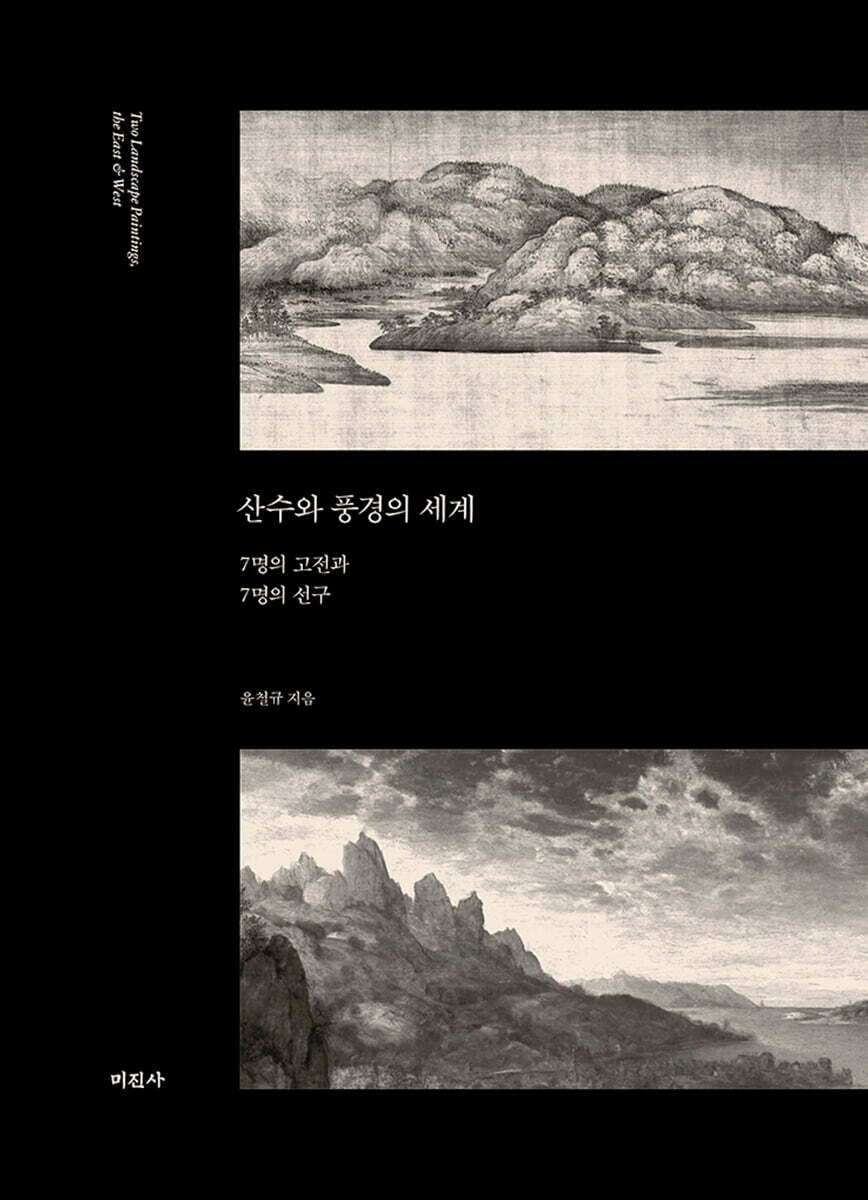
A textbook that explains the development of Eastern landscape painting and Western landscape painting, and guides readers to understand the flow of the two worlds of painting.
Eastern and Western paintings have developed and converged, overcoming geographical differences.
This book sheds new light on Eastern landscape painting and Western landscape painting through the author's unique perspective.
As each world of painting has a vast history and content, it is a collection of painters who created their own unique painting styles in each era.
Through the universal human emotions contained in the paintings, readers are able to encounter themselves.
Nature, harmoniously depicted on the canvas, will harmonize our consciousness and deeply engage our perspective and perception of the world, consciously or unconsciously.
This book is recommended for those who want to understand Eastern landscape painting and Western landscape painting, and for those who enjoy the hidden stories in paintings.
Eastern and Western paintings have developed and converged, overcoming geographical differences.
This book sheds new light on Eastern landscape painting and Western landscape painting through the author's unique perspective.
As each world of painting has a vast history and content, it is a collection of painters who created their own unique painting styles in each era.
Through the universal human emotions contained in the paintings, readers are able to encounter themselves.
Nature, harmoniously depicted on the canvas, will harmonize our consciousness and deeply engage our perspective and perception of the world, consciously or unconsciously.
This book is recommended for those who want to understand Eastern landscape painting and Western landscape painting, and for those who enjoy the hidden stories in paintings.
- You can preview some of the book's contents.
Preview
index
Preface | Chronology
Chapter 1: Ancient Nature
arithmetic
The Afterlife and Kunlun Mountain
Description of the bounty of nature
sight
Scenery in the mythical world
A simple depiction of nature
Chapter 2: The Development of Nature Description
arithmetic
Inheritance of ancient depictions
Changes in portrait production
The first landscape painting theory
Various external stimuli
Changes in arithmetic
sight
The spread of ancient depictions
Fresco and Change
The role of the city council
Transformation of painting
Chapter 3: The Completion of the Classics and the Beginning of a New Era
arithmetic
Unified landscape atmosphere
Chill in the Fog - Reason
A place to hang out and a place to live
Simple naturalness - Dongwon
Strong Line and Food - Lee Dang
The Four Great Masters of the Yuan Dynasty and the Completion of Classics - Huang Gongwang, Wu Jin, Ye Chan, and Wang Meng
sight
Unity through Light - Jan van Eyck
Ordered Space - Joachim Patinir
Landscape drawing and perspective
Parerga's fashion
The Rise of Classical Landscape Painting - Nicolas Poussin
Claude Lorrain, the pioneer of pastoral landscape painting
Chapter 4: The Establishment of Classics and the Discovery of Landscape
arithmetic
Professional painter and sculptor
Rediscovery of the classics
Completion of the literati's theory of landscape painting
The golden age of classical brushwork
sight
Landscapes for Civil Society
Landscape background and landmark scenery
Discovery of Landscape
New Pioneers - John Constable and JMW
Turner
Chapter 5: The End and New Exploration
arithmetic
rejection of the classics
The tastes of the consumer city of Yangju
The beginning of a new era
sight
A premonition of an unexpected era
The Perfection of Landscape - Jean-Baptiste Camille Corot
The Pursuit of Urban Landscape and Light
Back to form and parting
List of Plates | References | Biographical Dictionary
Chapter 1: Ancient Nature
arithmetic
The Afterlife and Kunlun Mountain
Description of the bounty of nature
sight
Scenery in the mythical world
A simple depiction of nature
Chapter 2: The Development of Nature Description
arithmetic
Inheritance of ancient depictions
Changes in portrait production
The first landscape painting theory
Various external stimuli
Changes in arithmetic
sight
The spread of ancient depictions
Fresco and Change
The role of the city council
Transformation of painting
Chapter 3: The Completion of the Classics and the Beginning of a New Era
arithmetic
Unified landscape atmosphere
Chill in the Fog - Reason
A place to hang out and a place to live
Simple naturalness - Dongwon
Strong Line and Food - Lee Dang
The Four Great Masters of the Yuan Dynasty and the Completion of Classics - Huang Gongwang, Wu Jin, Ye Chan, and Wang Meng
sight
Unity through Light - Jan van Eyck
Ordered Space - Joachim Patinir
Landscape drawing and perspective
Parerga's fashion
The Rise of Classical Landscape Painting - Nicolas Poussin
Claude Lorrain, the pioneer of pastoral landscape painting
Chapter 4: The Establishment of Classics and the Discovery of Landscape
arithmetic
Professional painter and sculptor
Rediscovery of the classics
Completion of the literati's theory of landscape painting
The golden age of classical brushwork
sight
Landscapes for Civil Society
Landscape background and landmark scenery
Discovery of Landscape
New Pioneers - John Constable and JMW
Turner
Chapter 5: The End and New Exploration
arithmetic
rejection of the classics
The tastes of the consumer city of Yangju
The beginning of a new era
sight
A premonition of an unexpected era
The Perfection of Landscape - Jean-Baptiste Camille Corot
The Pursuit of Urban Landscape and Light
Back to form and parting
List of Plates | References | Biographical Dictionary
Detailed image

Into the book
Dongwon was a writer and painter of the Southern Tang Dynasty.
Jinling served as the deputy director of the Imperial Garden, located north of Nanjing, present-day Nanjing, and was also called Dongbei Garden.
In addition to landscapes, the painting also depicts cows, tigers, and court ladies.
However, it was the landscape painting that left its mark on later generations.
Dongwon's landscape paintings have served as a model for almost all literati painters since the Yuan Dynasty.
And it has been influential for hundreds of years and has become a classic.
But it was almost unknown until Mibul discovered it.
It was just a little bit unusual.
What Mibul found in his paintings was a sense of calm and innocence.
He admired, “(Dongwon’s) valley bridge, fishing port, sandbar in the middle of the water, and each and every shade are all part of a Gangnam landscape.”
He said that in it, “there is an innocence that is ordinary, simple, and close to nature.”
In other words, it is Dongwon's unique characteristic to naturally depict the Gangnam scenery as it is.
---From "Simple Naturalness"
In Gangnam, the main players in the painting activities were writers outside the field.
In the Yuan Dynasty, even writers were targets of discrimination.
It was placed just above the beggars, the lowest of the 10 social classes.
These writers, who were blocked from entering society and suffered discrimination, expressed their suppressed and resentful emotions in their paintings.
They thought of the pictures as poetry or writing.
It was considered as a tool to convey emotions and thoughts.
It is against this backdrop that literati painters emerged in large numbers in Yuan.
In fact, in these paintings, it is easy to read the emotions of the artist.
---From "The Completion of the Classics and the Four Great Masters of the Original Language"
Wang Won-gi (王原祁, 1642-1715, pen name Lutai) was the last painter of the Four Kings.
He is the grandson of Wang Shimin.
He also showed talent for painting from an early age.
Wang Shimin learned of this and said, “If you pass the civil service examination, devote yourself to painting.”
He passed the civil service examination after Wang Shimin died.
He rose to the position of Left Secretary of the Ministry of Taxation.
Apart from his official position, he was favored by the Kangxi Emperor for his paintings.
He also respected Hwang Gong-mang the most.
He painted dozens of “Wandering Landscapes” throughout his life.
He experimented with his paintings through drawing.
That is, it pursued the internal order of the painting itself.
So to speak, the lines and shapes of the Hwanggongwang were experimental tools.
With this, the composition and arrangement were sometimes made simple, and sometimes they were made densely.
In it, we confirmed how the order of balance and imbalance is created.
In that respect, he is sometimes compared to Paul Cezanne, who pursued order and autonomy in his paintings by repeating apple still lifes countless times.
---From "The Golden Age of Classical Brushwork"
China's majestic mountains and diverse nature have been a source of inspiration since ancient times.
On the one hand, it was recognized as a great soul in itself.
People regarded nature, a spiritual being, as a symbol of comfort and freedom.
And I wanted to express the subjective spirit and objective natural world felt from all things in heaven and earth on the painting.
That is the birth of landscape painting.
In landscape painting, a balance between the subjective mind and the objective world has always been pursued.
It has stimulated development in every era.
At times, the balance would tilt to one side.
This was especially true in the late Ming Dynasty.
At this time, Dong Ki-chang's theory of literati painting was held to be an absolute value.
Therefore, the balance between the subjective mind and the objective world is tilted toward the subjective side.
It was during the mid-Qing period that this balance was restored.
Yangju Palgwae restored balance by reviving the world of senses based on facts.
And in the late Qing Dynasty and early Republic of China, Je Baek-Seok attempted to reconcile the objective world and subjective spirit with his unique writing style.
It was also passed down through the modern era to the present through disciples such as Lee Ga-yeom.
---From "The Beginning of a New Era"
『Hwaeo-rok』 is famous as a painting theory written by a painter, along with Hyung-ho's "Pilbeop-gi" and Gwak Hui's "Imcheon-gochi."
It contains many famous quotes that have been frequently quoted in later generations.
Among them, there is this one.
“(Painting) is borrowing brush and ink to draw all things in the world and let myself play happily in it.”
This is in line with Dong Chi-chang’s saying, “I find pleasure in painting (以畵爲樂).”
In addition to self-indulgence, Seokdo, who emphasized his own world, greatly impressed the younger painters of Yangju.
---From "Rejection of the Classics"
In Plato's philosophy, beauty was said to be the best form of an idea.
Because beauty is inherent in mathematical principles such as balance, proportion, and equality.
And in reality, beauty is seen as being present in living things.
So in ancient times, beauty was represented by things like women, birds, and flowers.
This is also related to the fact that desolate, irregular, and rugged mountains were considered ugly.
Poussin added nature to it.
It is said that nature can reveal classical beauty if repackaged with proportion and balance.
This was realized in his classical landscape paintings.
---From "New Pioneers"
Turner's transformation of the light changes in the steam into variations of color was groundbreaking.
This was particularly striking to the French painters who had taken refuge in London during the Franco-Prussian War (1870-1871).
This later led them to believe that light could be expressed through variations in color.
Daubigny and Monet at this time later became the main players in the formation of the Impressionist movement.
In that respect, Turner also became one of the pioneers who prepared for a new era.
The achievement of Romantic landscape painting is often cited as surpassing the status of historical painting.
This applies to Turner.
---From "New Pioneers"
(…) In addition to the decomposition of colors, they were fascinated by working outdoors, the technique of maximizing bright colors with small touches, and the vision of finding beauty in nature as it is.
Although he remained a realist landscape painter, his attempts served as a stepping stone for the Impressionist painters.
Pissarro, Monet, and Cézanne interacted directly with him.
Even Degas and Picasso, who rarely painted landscapes, were greatly influenced by his depictions of people.
---From "The Completion of Landscape Painting"
Western landscape paintings were painted later than Chinese landscape paintings.
The first depiction of landscapes appeared in the 14th century.
It began with illustrations and frescoes in the poems.
And through the Renaissance and Baroque periods, realistic depiction techniques were acquired.
However, even at this time, the discovery of landscapes like those in Chinese landscape painting that were conscious of landscapes in nature had not been made.
The discovery of landscape was made by John Constable in the 19th century.
By painting the Suffolk landscape with a loving gaze, I achieved a true discovery of landscape.
And the era of landscape painting, which sought to unite the subjective and objective worlds, finally began.
Jinling served as the deputy director of the Imperial Garden, located north of Nanjing, present-day Nanjing, and was also called Dongbei Garden.
In addition to landscapes, the painting also depicts cows, tigers, and court ladies.
However, it was the landscape painting that left its mark on later generations.
Dongwon's landscape paintings have served as a model for almost all literati painters since the Yuan Dynasty.
And it has been influential for hundreds of years and has become a classic.
But it was almost unknown until Mibul discovered it.
It was just a little bit unusual.
What Mibul found in his paintings was a sense of calm and innocence.
He admired, “(Dongwon’s) valley bridge, fishing port, sandbar in the middle of the water, and each and every shade are all part of a Gangnam landscape.”
He said that in it, “there is an innocence that is ordinary, simple, and close to nature.”
In other words, it is Dongwon's unique characteristic to naturally depict the Gangnam scenery as it is.
---From "Simple Naturalness"
In Gangnam, the main players in the painting activities were writers outside the field.
In the Yuan Dynasty, even writers were targets of discrimination.
It was placed just above the beggars, the lowest of the 10 social classes.
These writers, who were blocked from entering society and suffered discrimination, expressed their suppressed and resentful emotions in their paintings.
They thought of the pictures as poetry or writing.
It was considered as a tool to convey emotions and thoughts.
It is against this backdrop that literati painters emerged in large numbers in Yuan.
In fact, in these paintings, it is easy to read the emotions of the artist.
---From "The Completion of the Classics and the Four Great Masters of the Original Language"
Wang Won-gi (王原祁, 1642-1715, pen name Lutai) was the last painter of the Four Kings.
He is the grandson of Wang Shimin.
He also showed talent for painting from an early age.
Wang Shimin learned of this and said, “If you pass the civil service examination, devote yourself to painting.”
He passed the civil service examination after Wang Shimin died.
He rose to the position of Left Secretary of the Ministry of Taxation.
Apart from his official position, he was favored by the Kangxi Emperor for his paintings.
He also respected Hwang Gong-mang the most.
He painted dozens of “Wandering Landscapes” throughout his life.
He experimented with his paintings through drawing.
That is, it pursued the internal order of the painting itself.
So to speak, the lines and shapes of the Hwanggongwang were experimental tools.
With this, the composition and arrangement were sometimes made simple, and sometimes they were made densely.
In it, we confirmed how the order of balance and imbalance is created.
In that respect, he is sometimes compared to Paul Cezanne, who pursued order and autonomy in his paintings by repeating apple still lifes countless times.
---From "The Golden Age of Classical Brushwork"
China's majestic mountains and diverse nature have been a source of inspiration since ancient times.
On the one hand, it was recognized as a great soul in itself.
People regarded nature, a spiritual being, as a symbol of comfort and freedom.
And I wanted to express the subjective spirit and objective natural world felt from all things in heaven and earth on the painting.
That is the birth of landscape painting.
In landscape painting, a balance between the subjective mind and the objective world has always been pursued.
It has stimulated development in every era.
At times, the balance would tilt to one side.
This was especially true in the late Ming Dynasty.
At this time, Dong Ki-chang's theory of literati painting was held to be an absolute value.
Therefore, the balance between the subjective mind and the objective world is tilted toward the subjective side.
It was during the mid-Qing period that this balance was restored.
Yangju Palgwae restored balance by reviving the world of senses based on facts.
And in the late Qing Dynasty and early Republic of China, Je Baek-Seok attempted to reconcile the objective world and subjective spirit with his unique writing style.
It was also passed down through the modern era to the present through disciples such as Lee Ga-yeom.
---From "The Beginning of a New Era"
『Hwaeo-rok』 is famous as a painting theory written by a painter, along with Hyung-ho's "Pilbeop-gi" and Gwak Hui's "Imcheon-gochi."
It contains many famous quotes that have been frequently quoted in later generations.
Among them, there is this one.
“(Painting) is borrowing brush and ink to draw all things in the world and let myself play happily in it.”
This is in line with Dong Chi-chang’s saying, “I find pleasure in painting (以畵爲樂).”
In addition to self-indulgence, Seokdo, who emphasized his own world, greatly impressed the younger painters of Yangju.
---From "Rejection of the Classics"
In Plato's philosophy, beauty was said to be the best form of an idea.
Because beauty is inherent in mathematical principles such as balance, proportion, and equality.
And in reality, beauty is seen as being present in living things.
So in ancient times, beauty was represented by things like women, birds, and flowers.
This is also related to the fact that desolate, irregular, and rugged mountains were considered ugly.
Poussin added nature to it.
It is said that nature can reveal classical beauty if repackaged with proportion and balance.
This was realized in his classical landscape paintings.
---From "New Pioneers"
Turner's transformation of the light changes in the steam into variations of color was groundbreaking.
This was particularly striking to the French painters who had taken refuge in London during the Franco-Prussian War (1870-1871).
This later led them to believe that light could be expressed through variations in color.
Daubigny and Monet at this time later became the main players in the formation of the Impressionist movement.
In that respect, Turner also became one of the pioneers who prepared for a new era.
The achievement of Romantic landscape painting is often cited as surpassing the status of historical painting.
This applies to Turner.
---From "New Pioneers"
(…) In addition to the decomposition of colors, they were fascinated by working outdoors, the technique of maximizing bright colors with small touches, and the vision of finding beauty in nature as it is.
Although he remained a realist landscape painter, his attempts served as a stepping stone for the Impressionist painters.
Pissarro, Monet, and Cézanne interacted directly with him.
Even Degas and Picasso, who rarely painted landscapes, were greatly influenced by his depictions of people.
---From "The Completion of Landscape Painting"
Western landscape paintings were painted later than Chinese landscape paintings.
The first depiction of landscapes appeared in the 14th century.
It began with illustrations and frescoes in the poems.
And through the Renaissance and Baroque periods, realistic depiction techniques were acquired.
However, even at this time, the discovery of landscapes like those in Chinese landscape painting that were conscious of landscapes in nature had not been made.
The discovery of landscape was made by John Constable in the 19th century.
By painting the Suffolk landscape with a loving gaze, I achieved a true discovery of landscape.
And the era of landscape painting, which sought to unite the subjective and objective worlds, finally began.
---From "Back to Form and Separation"
Publisher's Review
“There is an external appearance in mountains and rivers, and this leads to the spiritual world.”
_Jongbyeong (宗炳, 375-443)
“When the intellect or emotions of a culture find special meaning in the landscape and it matures,
“Only then can a landscape be painted.”
_Alexander von Humboldt (1769-1859)
A narrative of nature with proportion, balance and harmony,
The world of light and tranquility contained in landscape paintings and landscape paintings
The East and the West have overcome geographical differences and developed together.
The same goes for Eastern landscape paintings and Western landscape paintings.
The dynamics of balance and imbalance between landscape and landscape painting provide readers with a variety of aesthetic experiences.
Landscape paintings and watercolours sometimes depict what is seen, but they also capture universal human emotions such as resistance, praise, dreams and frustration.
Although landscape painting has been explained through a Chinese lens, this book sheds new light on Eastern landscape painting and Western landscape painting through the author's unique perspective.
Additionally, as each painting world has a vast history and content, it is organized around painters who played important roles in each era.
In the field of landscape painting, we introduce seven painters, including Lee Seong, who had their own unique painting style, and in the field of landscape painting, we introduce seven painters, including Jan van Eyck, who opened up a new world of painting with his unique perspective that had never been seen before.
Meanwhile, the author adds explanations of painting trends that developed in the East and West to help readers understand.
Chapters 1 and 2 examine the birth of landscape painting and landscape painting.
Chapter 1, “Ancient Nature,” tells how the concept and image of nature were formed in ancient China and the West.
Chapter 2, “The Development of Nature Depiction,” examines the descriptive techniques accumulated in the process of depicting ancient concepts of nature in pictorial form.
Chapters 3 and 4 introduce the pioneering works of seven Eastern and Western painters, and explain the development of landscape painting and landscape painting.
In China, landscape painting originated from the Jongbyeong of the Northern and Southern Dynasties.
China's majestic mountains and ever-changing nature have been a source of inspiration since ancient times, and the subjective emotions felt from all things in heaven and earth and the objective natural world have been expressed in paintings.
After that, during the Five Dynasties and Ten Kingdoms period, the literati Dongwon created the 'epitome of simple naturalness', Lee Seong created the 'chill of a foggy plain', and Lee Dang created 'strong lines and ink', and were recognized for their excellence.
If Huang Gongwang perfected the 'atmosphere of gentleness and generosity', Ye Chan exemplified the 'atmosphere of quietness in solitude', Wu Jin exemplified 'self-esteem in silence', and Wang Meng perfected 'the world of life where humans, nature, and the universe are one'.
Western landscape painting first appeared in the 14th century, later than landscape painting.
Van Eyck expressed the unity of space by using 'light', and Patinir presented an expressive technique that creates the unity of space and a sense of distance by using 'color'.
Poussin established 'classical landscape painting' as a model, and Lorrain pioneered 'pastoral landscape painting'.
In the 19th century, Constable established landscape painting as a full-fledged genre of painting, and then Turner and Corot led the development of landscape painting by focusing on the ‘romantic spirit’ and ‘reproduction of light’, respectively.
The final chapter, Chapter 5, “The End and New Exploration,” discusses the end of landscape painting and watercolour painting through a paradigm shift from “what to paint” to “how to paint.”
Nature harmoniously captured on canvas harmonizes our consciousness.
It will also be deeply involved, consciously or unconsciously, in our perspective and perception of the world.
Isn't that why we appreciate paintings?
_Jongbyeong (宗炳, 375-443)
“When the intellect or emotions of a culture find special meaning in the landscape and it matures,
“Only then can a landscape be painted.”
_Alexander von Humboldt (1769-1859)
A narrative of nature with proportion, balance and harmony,
The world of light and tranquility contained in landscape paintings and landscape paintings
The East and the West have overcome geographical differences and developed together.
The same goes for Eastern landscape paintings and Western landscape paintings.
The dynamics of balance and imbalance between landscape and landscape painting provide readers with a variety of aesthetic experiences.
Landscape paintings and watercolours sometimes depict what is seen, but they also capture universal human emotions such as resistance, praise, dreams and frustration.
Although landscape painting has been explained through a Chinese lens, this book sheds new light on Eastern landscape painting and Western landscape painting through the author's unique perspective.
Additionally, as each painting world has a vast history and content, it is organized around painters who played important roles in each era.
In the field of landscape painting, we introduce seven painters, including Lee Seong, who had their own unique painting style, and in the field of landscape painting, we introduce seven painters, including Jan van Eyck, who opened up a new world of painting with his unique perspective that had never been seen before.
Meanwhile, the author adds explanations of painting trends that developed in the East and West to help readers understand.
Chapters 1 and 2 examine the birth of landscape painting and landscape painting.
Chapter 1, “Ancient Nature,” tells how the concept and image of nature were formed in ancient China and the West.
Chapter 2, “The Development of Nature Depiction,” examines the descriptive techniques accumulated in the process of depicting ancient concepts of nature in pictorial form.
Chapters 3 and 4 introduce the pioneering works of seven Eastern and Western painters, and explain the development of landscape painting and landscape painting.
In China, landscape painting originated from the Jongbyeong of the Northern and Southern Dynasties.
China's majestic mountains and ever-changing nature have been a source of inspiration since ancient times, and the subjective emotions felt from all things in heaven and earth and the objective natural world have been expressed in paintings.
After that, during the Five Dynasties and Ten Kingdoms period, the literati Dongwon created the 'epitome of simple naturalness', Lee Seong created the 'chill of a foggy plain', and Lee Dang created 'strong lines and ink', and were recognized for their excellence.
If Huang Gongwang perfected the 'atmosphere of gentleness and generosity', Ye Chan exemplified the 'atmosphere of quietness in solitude', Wu Jin exemplified 'self-esteem in silence', and Wang Meng perfected 'the world of life where humans, nature, and the universe are one'.
Western landscape painting first appeared in the 14th century, later than landscape painting.
Van Eyck expressed the unity of space by using 'light', and Patinir presented an expressive technique that creates the unity of space and a sense of distance by using 'color'.
Poussin established 'classical landscape painting' as a model, and Lorrain pioneered 'pastoral landscape painting'.
In the 19th century, Constable established landscape painting as a full-fledged genre of painting, and then Turner and Corot led the development of landscape painting by focusing on the ‘romantic spirit’ and ‘reproduction of light’, respectively.
The final chapter, Chapter 5, “The End and New Exploration,” discusses the end of landscape painting and watercolour painting through a paradigm shift from “what to paint” to “how to paint.”
Nature harmoniously captured on canvas harmonizes our consciousness.
It will also be deeply involved, consciously or unconsciously, in our perspective and perception of the world.
Isn't that why we appreciate paintings?
GOODS SPECIFICS
- Publication date: June 23, 2022
- Page count, weight, size: 352 pages | 762g | 170*235*30mm
- ISBN13: 9788940806630
- ISBN10: 8940806638
You may also like
카테고리
korean


korean

![GQ KOREA Mark (Monthly): December [2025]](http://librairie.coreenne.fr/cdn/shop/files/8ef265dbbfbf186523ed75ba7319009d.jpg?v=1765340328&width=3840)


