

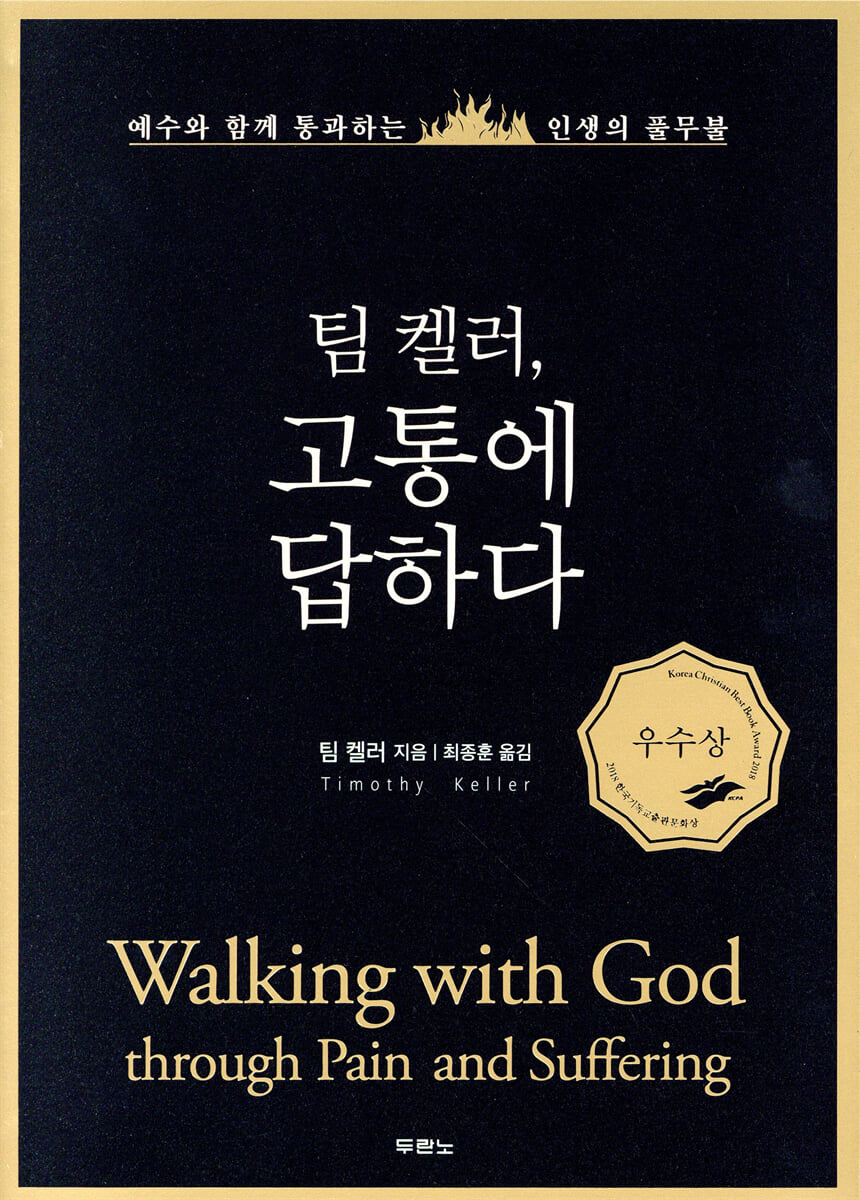
Tim Keller: Answering Pain
 |
Description
Book Introduction
Facing personal, social, and temporal pain Tim Keller's compelling reading and powerful challenge! Tim Keller, who has thoroughly addressed various issues of modern Christianity, such as marriage, work, prayer, idolatry, and secularism, from a gospel-centered perspective, has now taken up the weighty and unavoidable subject of human history: the problem of suffering. It is an era where pain and suffering have become part of everyday life. Every day, we hear news of tragic incidents and accidents through the media. As we live, we all face hardships, big and small. Some turn away from their faith because of these hardships, while others encounter the living God. Tim Keller, through his many years of ministry, has discovered that in many cases, suffering is the very basis for people's acceptance or rejection of God. The trials that beset life, the problem of unsolvable evil To those who struggle and worry alone Modern people try to bury their fear of the suffering and evil that pervades the world, and they rush about, filling their anxious minds with all sorts of things. Then one day, when hardship suddenly strikes, only then do we stop and realize that we cannot control our own lives. How should we view, welcome, and navigate this crucible of life, where our true nature is revealed? This book argues that, to avoid succumbing to despair in this dark world, we absolutely need help, and ultimately, true help cannot be found in human knowledge, experience, wealth, or ability, but only in a spiritual sense. A dark, sleepless night, no comfort, Think deeply about Jesus who came into our world This book is divided into three parts, approaching the subject from various angles: from the perspective of an outside observer of the problem of suffering and from the perspective of someone who is experiencing it directly. Part 1 introduces cultural, temporal, and philosophical attempts to interpret and resolve the problems of suffering and evil, and sharply points out their respective blind spots. Part 2 introduces a biblical theology of suffering, guiding us to prepare for and confront suffering. Finally, Part 3 presents practical methods to help those facing immediate trials overcome them. Above all, Tim Keller challenges us throughout the book to always look to Jesus, who, despite his sovereignty over all things, even over suffering, jumped into the fire of our lives and suffered himself. Through His suffering, we too can walk through our own fires with Him! |
- You can preview some of the book's contents.
Preview
index
prolog.
Either you leave your faith through suffering, or you meet God through suffering.
Part 1.
The unsolvable riddle of suffering
? Various attempts to interpret suffering
1.
The interpretation of suffering varies depending on one's "purpose in life."
― Cultural perspectives on suffering
2.
There was no magic key to comforting and managing pain.
― Prescriptions for pain in each era
3.
Both humanism and atheism are powerless in the face of real suffering.
― Spiritual needs that grow in suffering
4.
If there is no God, there is no reason to be angry at 'evil'.
― Philosophical Thoughts on 'Evil, Suffering, and the Existence of God'
Part 2.
The Bible Answers Suffering
? Learning the right 'theology of suffering'
5.
Establish a framework of mind with the doctrines of life.
―The core doctrine of Christianity: Light in the midst of suffering
6.
Suffering is both just and unjust.
―God's sovereignty
7.
God is the sovereign who "rules over suffering" and at the same time "personally" suffered.
― God who suffered
8.
Is all suffering meaningful?
― The Mystery of Suffering
9.
Learn to walk with Jesus 'everyday'
― Simple but crucial preparations
10.
Don't judge someone's suffering rashly.
― Each race of pain is different
Part 3.
When pain became mine
? Moments of pain that make you want to ask "why" - Passing through them with Jesus
11.
I must walk through it
― One small step starting with Jesus
12.
Now, I can cry before Jesus.
―To be deeply sad yet deeply happy
13.
Now, you can believe in and rely on Jesus.
― Hold on to the faithfulness that uses every moment of life.
14.
Now, you can pray to Jesus
― Stop wrestling with your circumstances
15.
Now, I can think of Jesus, be thankful, and love him.
― Seeking the 'presence of God' rather than the 'absence of worry'
16.
Now, we can hope in Jesus
―Looking at the present through the lens of eternity
Epilogue: Today's Step: Transforming "Deep Sorrow" into "Song"
Acknowledgements
main
Either you leave your faith through suffering, or you meet God through suffering.
Part 1.
The unsolvable riddle of suffering
? Various attempts to interpret suffering
1.
The interpretation of suffering varies depending on one's "purpose in life."
― Cultural perspectives on suffering
2.
There was no magic key to comforting and managing pain.
― Prescriptions for pain in each era
3.
Both humanism and atheism are powerless in the face of real suffering.
― Spiritual needs that grow in suffering
4.
If there is no God, there is no reason to be angry at 'evil'.
― Philosophical Thoughts on 'Evil, Suffering, and the Existence of God'
Part 2.
The Bible Answers Suffering
? Learning the right 'theology of suffering'
5.
Establish a framework of mind with the doctrines of life.
―The core doctrine of Christianity: Light in the midst of suffering
6.
Suffering is both just and unjust.
―God's sovereignty
7.
God is the sovereign who "rules over suffering" and at the same time "personally" suffered.
― God who suffered
8.
Is all suffering meaningful?
― The Mystery of Suffering
9.
Learn to walk with Jesus 'everyday'
― Simple but crucial preparations
10.
Don't judge someone's suffering rashly.
― Each race of pain is different
Part 3.
When pain became mine
? Moments of pain that make you want to ask "why" - Passing through them with Jesus
11.
I must walk through it
― One small step starting with Jesus
12.
Now, I can cry before Jesus.
―To be deeply sad yet deeply happy
13.
Now, you can believe in and rely on Jesus.
― Hold on to the faithfulness that uses every moment of life.
14.
Now, you can pray to Jesus
― Stop wrestling with your circumstances
15.
Now, I can think of Jesus, be thankful, and love him.
― Seeking the 'presence of God' rather than the 'absence of worry'
16.
Now, we can hope in Jesus
―Looking at the present through the lens of eternity
Epilogue: Today's Step: Transforming "Deep Sorrow" into "Song"
Acknowledgements
main
Into the book
Answering the questions of both the observer and the protagonist in one book is no easy task.
Even if those who pass through the deep valley of suffering ask the philosophical question, “God, why did you let this happen?” their real concern is survival itself.
"How can I survive?" "How can I overcome adversity without losing my dignity as a human being?" It's cruel to talk philosophically about hardship to those who are actually experiencing it.
But it is clear that suffering leads to “big questions” about God and the nature of life.
As I continued to study suffering, it became clear that a prescription tied to a single point in time could never answer the insoluble riddle of suffering.
So I decided to divide this book into three parts, each using different tools to tackle this topic.
The unifying element of the three is the image of suffering as a 'hot blazing fire'.
This is a very rich metaphor that the Bible shows.
--- pp.
19-20
Traditional views of suffering hold that the responsibility for navigating dark times lies with the sufferer.
The work required of them also takes the form of 'mental work' that takes place within, such as patience, wisdom, and sincerity.
But modern culture does not view suffering as punishment, nor does it see it as an opportunity or a test.
Those who suffer are victims of an impersonal universe, and so they should seek professional help to alleviate their suffering by eliminating stressors as much as possible, whether medical, psychological, social, or national.
However, this movement of leaving pain to the experts has brought about great confusion in our society.
This is because the prescriptions given to those suffering by different groups of experts are very different.
--- p.
44
From a worldly perspective, suffering can never be a meaningful part of life; it is merely a stumbling block.
As long as you hold that perspective, there are only two things you can do when suffering and pain strike.
The first priority is to manage and reduce pain.
Over the past two generations, most professional services provided to those experiencing difficulties have shifted from discussing the causes of suffering to discussing ways to reduce stress.
Experts no longer talk about how to endure adversity patiently.
Instead, he uses terms drawn from business, psychology, and medicine to say that stress, tension, and trauma can be managed, reversed, and overcome.
For those suffering, I advise them to avoid negative thoughts and rely on rest, exercise, and supportive relationships to protect themselves.
Focus solely on controlling painful emotions.
--- pp.
46-47
From Luther's perspective, suffering plays a dual role.
Before suffering can give us the joy and love that will help us overcome it, suffering must first empty us of our pride.
Luther declares:
“If God takes away all our possessions and lives through countless trials, there is no way to endure hardships with a calm heart without clinging to something more precious, that is, without becoming one with the Lord through faith.” Suffering dispels the delusion that “I have the power and authority to rule and save my life.”
As humans “pass through adversity, they become emptied,” leaving room for God and grace to fill them.
Luther says:
“It is God’s nature to create something out of nothing.
Therefore, if it is not yet completely empty, the Lord cannot create anything from it.”
--- pp.
82-83
Hardship does not automatically or as some kind of compensation produce this freedom or happiness.
Suffering produces growth only when we properly understand Christ's suffering and ministry for humanity.
Luther asserts that “we cannot suffer with Christ (i.e., follow his example and love in suffering) until we fully accept the benefits of his suffering.”
Luther knew firsthand how suffering can tear us apart when we are uncertain of God's love.
The medieval church's teaching that enduring hardship would bring God's grace was completely out of the question.
No matter how hard I tried, my conscience didn't feel at ease.
Because there is no way to gauge whether one is suffering with a heart of complete obedience and purity.
Luther believed that in order to properly face suffering, a 'clear conscience' must be the most important prerequisite.
We must not try to use patience to make peace with Christ.
To endure trials, you must already be at peace with Christ.
Only when we deeply trust that the Lord has suffered so much for us can we begin to pretend to endure hardships like Him.
--- p.
87
While hardships can bring about changes in personal growth and discipline, they should not be viewed as mere means of self-improvement.
Such a view is no different from a kind of masochism that enjoys pain.
Because only when you are in pain both physically and mentally can you feel noble.
Even without necessarily having that perspective, suffering has a tendency to make us self-absorbed.
When we become obsessed with ourselves and our own growth, adversity truly becomes a strangling noose.
Suffering must be accepted as a way to know God better than before, and a way to serve and become more like the Lord.
--- p.
296
Suffering does not exist solely as an intellectual issue, such as, "Why is there so much evil and suffering in life?"
Adversity is also a personal problem, such as 'How can I overcome this situation?'
The first and second questions represent different worlds.
Therefore, we must not only prepare intellectually for hardship, but also prepare our hearts.
This means that we must consistently live a prayer life that is both theologically deep and existentially rich.
--- pp.
312-313
The Lord was thrown into a fiery furnace.
It was the fire we should have entered.
Because the Lord walked into the fiery furnace, mankind was saved.
But what if we believe God saves only those who live exceedingly good lives? Each time the waves of trial surge, we will either hate God or loathe ourselves.
“I lived a good life, so I deserve a better life. Why is God treating me like this?” you mutter, or “I should have lived a good life, but it’s clear I didn’t.
Either you mutter, “I’m a worthless person.”
Either way, it leads to deep frustration.
A soul that has forgotten the gospel cannot help but waver between anger and guilt.
--- pp.
368-369
The apostle said, “Until now you rejoiced in Christ, but now you have entered a time of suffering and adversity.
But don't worry.
It does not say, “You will be happy again.”
Or, it is not that “it is better not to be sad or distressed during these trials and tribulations, but to rejoice in Jesus.”
Peter doesn't pit the two against each other.
It says, "Either rejoice in Christ, or cry out in pain," not "either one or the other," but "both."
It teaches us that not only can we do both, but that they must go together so that we can trudge through adversity without being shattered by it.
Even if those who pass through the deep valley of suffering ask the philosophical question, “God, why did you let this happen?” their real concern is survival itself.
"How can I survive?" "How can I overcome adversity without losing my dignity as a human being?" It's cruel to talk philosophically about hardship to those who are actually experiencing it.
But it is clear that suffering leads to “big questions” about God and the nature of life.
As I continued to study suffering, it became clear that a prescription tied to a single point in time could never answer the insoluble riddle of suffering.
So I decided to divide this book into three parts, each using different tools to tackle this topic.
The unifying element of the three is the image of suffering as a 'hot blazing fire'.
This is a very rich metaphor that the Bible shows.
--- pp.
19-20
Traditional views of suffering hold that the responsibility for navigating dark times lies with the sufferer.
The work required of them also takes the form of 'mental work' that takes place within, such as patience, wisdom, and sincerity.
But modern culture does not view suffering as punishment, nor does it see it as an opportunity or a test.
Those who suffer are victims of an impersonal universe, and so they should seek professional help to alleviate their suffering by eliminating stressors as much as possible, whether medical, psychological, social, or national.
However, this movement of leaving pain to the experts has brought about great confusion in our society.
This is because the prescriptions given to those suffering by different groups of experts are very different.
--- p.
44
From a worldly perspective, suffering can never be a meaningful part of life; it is merely a stumbling block.
As long as you hold that perspective, there are only two things you can do when suffering and pain strike.
The first priority is to manage and reduce pain.
Over the past two generations, most professional services provided to those experiencing difficulties have shifted from discussing the causes of suffering to discussing ways to reduce stress.
Experts no longer talk about how to endure adversity patiently.
Instead, he uses terms drawn from business, psychology, and medicine to say that stress, tension, and trauma can be managed, reversed, and overcome.
For those suffering, I advise them to avoid negative thoughts and rely on rest, exercise, and supportive relationships to protect themselves.
Focus solely on controlling painful emotions.
--- pp.
46-47
From Luther's perspective, suffering plays a dual role.
Before suffering can give us the joy and love that will help us overcome it, suffering must first empty us of our pride.
Luther declares:
“If God takes away all our possessions and lives through countless trials, there is no way to endure hardships with a calm heart without clinging to something more precious, that is, without becoming one with the Lord through faith.” Suffering dispels the delusion that “I have the power and authority to rule and save my life.”
As humans “pass through adversity, they become emptied,” leaving room for God and grace to fill them.
Luther says:
“It is God’s nature to create something out of nothing.
Therefore, if it is not yet completely empty, the Lord cannot create anything from it.”
--- pp.
82-83
Hardship does not automatically or as some kind of compensation produce this freedom or happiness.
Suffering produces growth only when we properly understand Christ's suffering and ministry for humanity.
Luther asserts that “we cannot suffer with Christ (i.e., follow his example and love in suffering) until we fully accept the benefits of his suffering.”
Luther knew firsthand how suffering can tear us apart when we are uncertain of God's love.
The medieval church's teaching that enduring hardship would bring God's grace was completely out of the question.
No matter how hard I tried, my conscience didn't feel at ease.
Because there is no way to gauge whether one is suffering with a heart of complete obedience and purity.
Luther believed that in order to properly face suffering, a 'clear conscience' must be the most important prerequisite.
We must not try to use patience to make peace with Christ.
To endure trials, you must already be at peace with Christ.
Only when we deeply trust that the Lord has suffered so much for us can we begin to pretend to endure hardships like Him.
--- p.
87
While hardships can bring about changes in personal growth and discipline, they should not be viewed as mere means of self-improvement.
Such a view is no different from a kind of masochism that enjoys pain.
Because only when you are in pain both physically and mentally can you feel noble.
Even without necessarily having that perspective, suffering has a tendency to make us self-absorbed.
When we become obsessed with ourselves and our own growth, adversity truly becomes a strangling noose.
Suffering must be accepted as a way to know God better than before, and a way to serve and become more like the Lord.
--- p.
296
Suffering does not exist solely as an intellectual issue, such as, "Why is there so much evil and suffering in life?"
Adversity is also a personal problem, such as 'How can I overcome this situation?'
The first and second questions represent different worlds.
Therefore, we must not only prepare intellectually for hardship, but also prepare our hearts.
This means that we must consistently live a prayer life that is both theologically deep and existentially rich.
--- pp.
312-313
The Lord was thrown into a fiery furnace.
It was the fire we should have entered.
Because the Lord walked into the fiery furnace, mankind was saved.
But what if we believe God saves only those who live exceedingly good lives? Each time the waves of trial surge, we will either hate God or loathe ourselves.
“I lived a good life, so I deserve a better life. Why is God treating me like this?” you mutter, or “I should have lived a good life, but it’s clear I didn’t.
Either you mutter, “I’m a worthless person.”
Either way, it leads to deep frustration.
A soul that has forgotten the gospel cannot help but waver between anger and guilt.
--- pp.
368-369
The apostle said, “Until now you rejoiced in Christ, but now you have entered a time of suffering and adversity.
But don't worry.
It does not say, “You will be happy again.”
Or, it is not that “it is better not to be sad or distressed during these trials and tribulations, but to rejoice in Jesus.”
Peter doesn't pit the two against each other.
It says, "Either rejoice in Christ, or cry out in pain," not "either one or the other," but "both."
It teaches us that not only can we do both, but that they must go together so that we can trudge through adversity without being shattered by it.
--- p.
398
398
GOODS SPECIFICS
- Date of publication: February 26, 2018
- Page count, weight, size: 544 pages | 713g | 150*210*34mm
- ISBN13: 9788953130586
- ISBN10: 8953130581
You may also like
카테고리
korean


korean

![GQ KOREA Mark (Monthly): December [2025]](http://librairie.coreenne.fr/cdn/shop/files/8ef265dbbfbf186523ed75ba7319009d.jpg?v=1765340328&width=3840)


