

The Prodigal Son's Homecoming Special Commemorative Edition
 |
Description
Book Introduction
“Where will we stay forever?”
Special commemorative edition commemorating the 24th anniversary of the publication of "The Return of the Prodigal Son" and the 20th anniversary of Henri Nouwen's death.
The Prodigal Son's Return and The Road Home in One Volume
"The Return of the Prodigal Son" is a book that clearly shows the trajectory of Nouwen's spiritual life and is his representative work.
Inspired by Rembrandt's painting, which faithfully depicts the Parable of the Prodigal Son from Luke 15 in the New Testament, Henri Nouwen delves into the series of movements that lead to the younger son's dissolute life and return, the older son's profound sense of loss and anger, and the father's forgiveness and welcome.
Analyzing the work within its biblical, historical, and psychological contexts, his writings demonstrate that all people are on a spiritual journey home, challenging us to move from the position of son to that of father.
"The Way Home" is Henri Nouwen's last work, a compilation of recordings of a workshop he held with L'Arche Daybreak volunteers three years before writing "The Return of the Prodigal Son." The book guides readers to bring the biblical story of the "Prodigal Son" from the outside in, from the head to the heart.
The 'Special Commemorative Edition' includes a new foreword by James Martin and a bibliography and chronology by Henri Nouwen.
Special commemorative edition commemorating the 24th anniversary of the publication of "The Return of the Prodigal Son" and the 20th anniversary of Henri Nouwen's death.
The Prodigal Son's Return and The Road Home in One Volume
"The Return of the Prodigal Son" is a book that clearly shows the trajectory of Nouwen's spiritual life and is his representative work.
Inspired by Rembrandt's painting, which faithfully depicts the Parable of the Prodigal Son from Luke 15 in the New Testament, Henri Nouwen delves into the series of movements that lead to the younger son's dissolute life and return, the older son's profound sense of loss and anger, and the father's forgiveness and welcome.
Analyzing the work within its biblical, historical, and psychological contexts, his writings demonstrate that all people are on a spiritual journey home, challenging us to move from the position of son to that of father.
"The Way Home" is Henri Nouwen's last work, a compilation of recordings of a workshop he held with L'Arche Daybreak volunteers three years before writing "The Return of the Prodigal Son." The book guides readers to bring the biblical story of the "Prodigal Son" from the outside in, from the head to the heart.
The 'Special Commemorative Edition' includes a new foreword by James Martin and a bibliography and chronology by Henri Nouwen.
index
Preface to the Special Commemorative Edition: To Immerse Yourself Deeply in a Text and Live Out What You Contemplate
Volume 1_The Prodigal Son's Return
The story of two sons and their father
Prologue_ Captivated at First Encounter
Opening remarks: The younger son, the older son, and the father
Part 1_The Younger Son
Chapter 1: Rembrandt and the Younger Son
Chapter 2: The Younger Son Leaves Home
Chapter 3 The Younger Son, Back Home
Part 2_Eldest Son
Chapter 4: Rembrandt and his eldest son
Chapter 5: The Eldest Son Leaves Home
Chapter 6: The Eldest Son Returns Home
Part 3_Father
Chapter 7 Rembrandt and the Father
Chapter 8: The Father Who Welcomes Us
Chapter 9: Father Throws a Feast
Conclusion_Becoming a Father
Epilogue_Living a Painting with Your Body
A Letter of Gratitude_A Gift of Friendship and Love
Note
Volume 2_The Way Home
Introduction_Are you going to be home tonight?
Prologue_Shall we dive into the story together?
Part 1: Running away from home and returning home
Chapter 1: From Loneliness to L'Arche
Chapter 2 The Younger Son
Chapter 3 From L'Arche to the Second Loneliness
Part 2: Resentment, Invisible Exile
Chapter 4: The Eldest Son
Chapter 5: Invisible Exile
Chapter 6: Returning Home, to a House Called Gratitude
Part 3: Home, a space for giving and receiving love
Chapter 7: Primal and Important Relationships
Chapter 8: Touching and Bestowing Grace
Chapter 9: Unconditional Love
Epilogue_Letter to Henri Nouwen
Note
Appendix 1_ List of Henri Nouwen's Writings
Appendix 2_Henry Nouwen Chronology
Translator's Note: Wandering between the lines of one's own and one's own children
Volume 1_The Prodigal Son's Return
The story of two sons and their father
Prologue_ Captivated at First Encounter
Opening remarks: The younger son, the older son, and the father
Part 1_The Younger Son
Chapter 1: Rembrandt and the Younger Son
Chapter 2: The Younger Son Leaves Home
Chapter 3 The Younger Son, Back Home
Part 2_Eldest Son
Chapter 4: Rembrandt and his eldest son
Chapter 5: The Eldest Son Leaves Home
Chapter 6: The Eldest Son Returns Home
Part 3_Father
Chapter 7 Rembrandt and the Father
Chapter 8: The Father Who Welcomes Us
Chapter 9: Father Throws a Feast
Conclusion_Becoming a Father
Epilogue_Living a Painting with Your Body
A Letter of Gratitude_A Gift of Friendship and Love
Note
Volume 2_The Way Home
Introduction_Are you going to be home tonight?
Prologue_Shall we dive into the story together?
Part 1: Running away from home and returning home
Chapter 1: From Loneliness to L'Arche
Chapter 2 The Younger Son
Chapter 3 From L'Arche to the Second Loneliness
Part 2: Resentment, Invisible Exile
Chapter 4: The Eldest Son
Chapter 5: Invisible Exile
Chapter 6: Returning Home, to a House Called Gratitude
Part 3: Home, a space for giving and receiving love
Chapter 7: Primal and Important Relationships
Chapter 8: Touching and Bestowing Grace
Chapter 9: Unconditional Love
Epilogue_Letter to Henri Nouwen
Note
Appendix 1_ List of Henri Nouwen's Writings
Appendix 2_Henry Nouwen Chronology
Translator's Note: Wandering between the lines of one's own and one's own children
Detailed image

Into the book
The book you are reading now has changed the lives of countless people.
There are many people around me who consider "The Return of the Prodigal Son" to be their most treasured book on spirituality.
There are Christians and there are Jews.
Some are deeply religious, others are skeptical.
There are agnostics and there are seekers.
Many consider The Return of the Prodigal Son to be Henri Nouwen's most powerful work.
Ironically, in this piece, which honestly reveals his inner thoughts as if turning over a pair of shoes, the author confesses, in a tone of deep guilt, his desire to be remembered long after death.
I could not have imagined that this book would come to occupy a place of its own in the history of Christian spirituality.
--- p.6
By the time he painted [The Return of the Prodigal Son], Rembrandt was getting closer to death day by day.
In fact, this painting is part of the artist's posthumous work.
The more I read related articles and look at the pictures, the more I feel like these are the last words of a master who lived a life full of words and hardships.
Along with [Simeon and the Baby Jesus], which was never completed, [The Return of the Prodigal Son] shows the self-consciousness of the author in his twilight years.
--- p.52
The prodigal son's path home is filled with uncertainty.
I know it's going in the right direction, but I can't believe how confusing it is.
Even though he admits that he cannot overcome the difficult situation on his own and confesses that it would be better to return to his father's house and be treated as a servant than to live as a vagabond in a foreign land, he still cannot shake off his doubts about his father's love.
--- p.89
One thing is clear.
The thing about complaining is that it is repetitive and completely unproductive.
If you whine out of greed to provoke sympathy and get something you desperately want, the result will inevitably be completely different from what you expected.
It's a pain to hang out with someone who's always complaining.
Few people have mastered the art of dealing with the constant complaints of self-defeating people.
The tragic thing is that once you start complaining, you're soon in the most dreaded situation.
You will face even more severe rejection.
--- p.117
Observing Rembrandt's technique in portraying his father gave me a whole new understanding of qualities like gentleness, mercy, and forgiveness.
I wonder if there is another work that expresses the infinite love of God in such a poignant way.
This is because every detail of the father figure—his facial expressions, his posture, the color of his clothes, and above all, his hand movements—eloquently speaks of the love God pours out toward humanity, God's affection that has existed from the beginning and will never change.
--- p.145
How you respond to unjust suffering will vary greatly depending on whether you choose to live a life of debauchery or a life of restraint.
Those who live a disciplined life with a proper sense of self-identity overcome difficulties in a whole new way.
For example, if a relationship goes wrong and you get hurt, you will naturally become insecure and experience not only a drop in self-esteem and hurt, but also a sense of defeat.
You may feel like you want to die, but that in itself is a measure of how much you value life.
It's a feeling of mixed good and bad, confusing but all very urgent.
But even in situations where you suffer unbearable wounds and are sucked into deep despair, the amazing truth that explains your true self remains unchanged.
What matters is that you are loved.
There are many people around me who consider "The Return of the Prodigal Son" to be their most treasured book on spirituality.
There are Christians and there are Jews.
Some are deeply religious, others are skeptical.
There are agnostics and there are seekers.
Many consider The Return of the Prodigal Son to be Henri Nouwen's most powerful work.
Ironically, in this piece, which honestly reveals his inner thoughts as if turning over a pair of shoes, the author confesses, in a tone of deep guilt, his desire to be remembered long after death.
I could not have imagined that this book would come to occupy a place of its own in the history of Christian spirituality.
--- p.6
By the time he painted [The Return of the Prodigal Son], Rembrandt was getting closer to death day by day.
In fact, this painting is part of the artist's posthumous work.
The more I read related articles and look at the pictures, the more I feel like these are the last words of a master who lived a life full of words and hardships.
Along with [Simeon and the Baby Jesus], which was never completed, [The Return of the Prodigal Son] shows the self-consciousness of the author in his twilight years.
--- p.52
The prodigal son's path home is filled with uncertainty.
I know it's going in the right direction, but I can't believe how confusing it is.
Even though he admits that he cannot overcome the difficult situation on his own and confesses that it would be better to return to his father's house and be treated as a servant than to live as a vagabond in a foreign land, he still cannot shake off his doubts about his father's love.
--- p.89
One thing is clear.
The thing about complaining is that it is repetitive and completely unproductive.
If you whine out of greed to provoke sympathy and get something you desperately want, the result will inevitably be completely different from what you expected.
It's a pain to hang out with someone who's always complaining.
Few people have mastered the art of dealing with the constant complaints of self-defeating people.
The tragic thing is that once you start complaining, you're soon in the most dreaded situation.
You will face even more severe rejection.
--- p.117
Observing Rembrandt's technique in portraying his father gave me a whole new understanding of qualities like gentleness, mercy, and forgiveness.
I wonder if there is another work that expresses the infinite love of God in such a poignant way.
This is because every detail of the father figure—his facial expressions, his posture, the color of his clothes, and above all, his hand movements—eloquently speaks of the love God pours out toward humanity, God's affection that has existed from the beginning and will never change.
--- p.145
How you respond to unjust suffering will vary greatly depending on whether you choose to live a life of debauchery or a life of restraint.
Those who live a disciplined life with a proper sense of self-identity overcome difficulties in a whole new way.
For example, if a relationship goes wrong and you get hurt, you will naturally become insecure and experience not only a drop in self-esteem and hurt, but also a sense of defeat.
You may feel like you want to die, but that in itself is a measure of how much you value life.
It's a feeling of mixed good and bad, confusing but all very urgent.
But even in situations where you suffer unbearable wounds and are sucked into deep despair, the amazing truth that explains your true self remains unchanged.
What matters is that you are loved.
--- p.300
Publisher's Review
The story of the 'Prodigal Son' in the New Testament, an inspiring painting by Rembrandt,
And a masterpiece created by the profound insight of Henri Nouwen.
This book is a special commemorative edition published to commemorate the 24th anniversary of the publication of 『The Return of the Prodigal Son』, a representative work of Henri Nouwen (1932-1996), who left us with an outstanding spiritual legacy, and to mark the 20th anniversary of his death. It combines 『The Return of the Prodigal Son』 and 『The Way Home』 into one volume.
"The Return of the Prodigal Son" is a book that clearly shows the trajectory of his spiritual life. Inspired by Rembrandt's painting that faithfully portrays the Parable of the Prodigal Son in Luke 15 of the New Testament, it delves deeply into the series of movements that lead to the younger son's prodigal life and return, the older son's deep sense of loss and anger, and the father's forgiveness and hospitality.
Analyzing the work within its biblical, historical, and psychological contexts, his writings demonstrate that all people are on a spiritual journey home, challenging us to move from the position of son to that of father.
Ultimately, it persuasively shows that the Christian life is a process of moving from a younger son kneeling in shabby clothes to a father standing crookedly, from a place of 'receiving blessings' to a place of 'bestowing grace.'
It was in 1983 that Henri Nouwen, a priest and university professor, first encountered Rembrandt's painting, The Return of the Prodigal Son.
At the time, he had just returned from a grueling speaking tour across the United States, preaching the message that Christian communities must do whatever they can to end the violence and wars taking place in Central America.
I had been staying for several months at the L'Arche community in Trozzily, France, which provides a warm home for people with intellectual disabilities.
One day, I visited a friend's office within the community and discovered a large poster posted on the door. This was our first meeting.
“I couldn’t take my eyes off it.
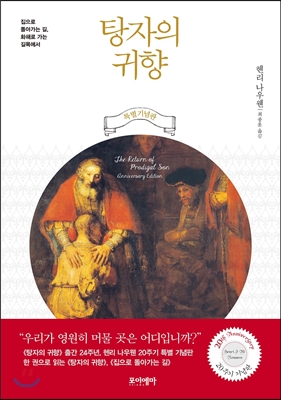
“I felt drawn into the warm intimacy flowing between them, the gentle tone of the red cloak, the golden light reflecting off the boy’s outer garment, and the mysterious glow that enveloped them both at once” (p. 19).
That's how the 'long pilgrimage of the soul' began.
Three years later, I had the opportunity to visit Russia and encounter the original work.
Then, shortly after, Nouwen resigned from his professorship and chose a completely different path.
He gave up his professorship at Harvard University to join a community for people with intellectual disabilities.
The Prodigal Son's Return was published in 1992.
In 1996, ten years after moving, while preparing to visit the Hermitage for a television special on The Return of the Prodigal Son, he suffered a heart attack and was carried back to the "arms of his father" that he had longed for.
"The Way Home" is his posthumous work, compiled from the recordings of a workshop he held with L'Arche Daybreak volunteers three years before he wrote "The Return of the Prodigal Son," where he meditated and reflected on Rembrandt's "The Return of the Prodigal Son" and the parable of Luke 15 after suffering from a nervous breakdown and entering a life of seclusion to heal his mind and body.
The author, who went from Yale to Harvard and lived a successful life as a priest and psychologist, reveals his inner struggle with loneliness and his constant yearning for intimacy in his relationships with others. At the same time, he candidly shares his inner story, including the conflict he had to face in his relationship with his father, the resulting resentment and sense of loss, and his desire to run away from home and live freely in a place where no one knew him.
On the other hand, it encourages readers to put into practice the three-step spiritual discipline of listening, journaling, and meditating as they follow the workshop process.
At the end of each chapter, helpful tips are provided to highlight points that pilgrims returning to the 'House of the Spirit' should not miss.
The 'Special Commemorative Edition' includes a new foreword by James Martin and a bibliography and chronology by Henri Nouwen.
And a masterpiece created by the profound insight of Henri Nouwen.
This book is a special commemorative edition published to commemorate the 24th anniversary of the publication of 『The Return of the Prodigal Son』, a representative work of Henri Nouwen (1932-1996), who left us with an outstanding spiritual legacy, and to mark the 20th anniversary of his death. It combines 『The Return of the Prodigal Son』 and 『The Way Home』 into one volume.
"The Return of the Prodigal Son" is a book that clearly shows the trajectory of his spiritual life. Inspired by Rembrandt's painting that faithfully portrays the Parable of the Prodigal Son in Luke 15 of the New Testament, it delves deeply into the series of movements that lead to the younger son's prodigal life and return, the older son's deep sense of loss and anger, and the father's forgiveness and hospitality.
Analyzing the work within its biblical, historical, and psychological contexts, his writings demonstrate that all people are on a spiritual journey home, challenging us to move from the position of son to that of father.
Ultimately, it persuasively shows that the Christian life is a process of moving from a younger son kneeling in shabby clothes to a father standing crookedly, from a place of 'receiving blessings' to a place of 'bestowing grace.'
It was in 1983 that Henri Nouwen, a priest and university professor, first encountered Rembrandt's painting, The Return of the Prodigal Son.
At the time, he had just returned from a grueling speaking tour across the United States, preaching the message that Christian communities must do whatever they can to end the violence and wars taking place in Central America.
I had been staying for several months at the L'Arche community in Trozzily, France, which provides a warm home for people with intellectual disabilities.
One day, I visited a friend's office within the community and discovered a large poster posted on the door. This was our first meeting.
“I couldn’t take my eyes off it.
“I felt drawn into the warm intimacy flowing between them, the gentle tone of the red cloak, the golden light reflecting off the boy’s outer garment, and the mysterious glow that enveloped them both at once” (p. 19).
That's how the 'long pilgrimage of the soul' began.
Three years later, I had the opportunity to visit Russia and encounter the original work.
Then, shortly after, Nouwen resigned from his professorship and chose a completely different path.
He gave up his professorship at Harvard University to join a community for people with intellectual disabilities.
The Prodigal Son's Return was published in 1992.
In 1996, ten years after moving, while preparing to visit the Hermitage for a television special on The Return of the Prodigal Son, he suffered a heart attack and was carried back to the "arms of his father" that he had longed for.
"The Way Home" is his posthumous work, compiled from the recordings of a workshop he held with L'Arche Daybreak volunteers three years before he wrote "The Return of the Prodigal Son," where he meditated and reflected on Rembrandt's "The Return of the Prodigal Son" and the parable of Luke 15 after suffering from a nervous breakdown and entering a life of seclusion to heal his mind and body.
The author, who went from Yale to Harvard and lived a successful life as a priest and psychologist, reveals his inner struggle with loneliness and his constant yearning for intimacy in his relationships with others. At the same time, he candidly shares his inner story, including the conflict he had to face in his relationship with his father, the resulting resentment and sense of loss, and his desire to run away from home and live freely in a place where no one knew him.
On the other hand, it encourages readers to put into practice the three-step spiritual discipline of listening, journaling, and meditating as they follow the workshop process.
At the end of each chapter, helpful tips are provided to highlight points that pilgrims returning to the 'House of the Spirit' should not miss.
The 'Special Commemorative Edition' includes a new foreword by James Martin and a bibliography and chronology by Henri Nouwen.
GOODS SPECIFICS
- Date of issue: November 30, 2016
- Page count, weight, size: 452 pages | 700g | 152*216*30mm
- ISBN13: 9791158090661
- ISBN10: 1158090668
You may also like
카테고리
korean


korean

![GQ KOREA Mark (Monthly): December [2025]](http://librairie.coreenne.fr/cdn/shop/files/8ef265dbbfbf186523ed75ba7319009d.jpg?v=1765340328&width=3840)


