

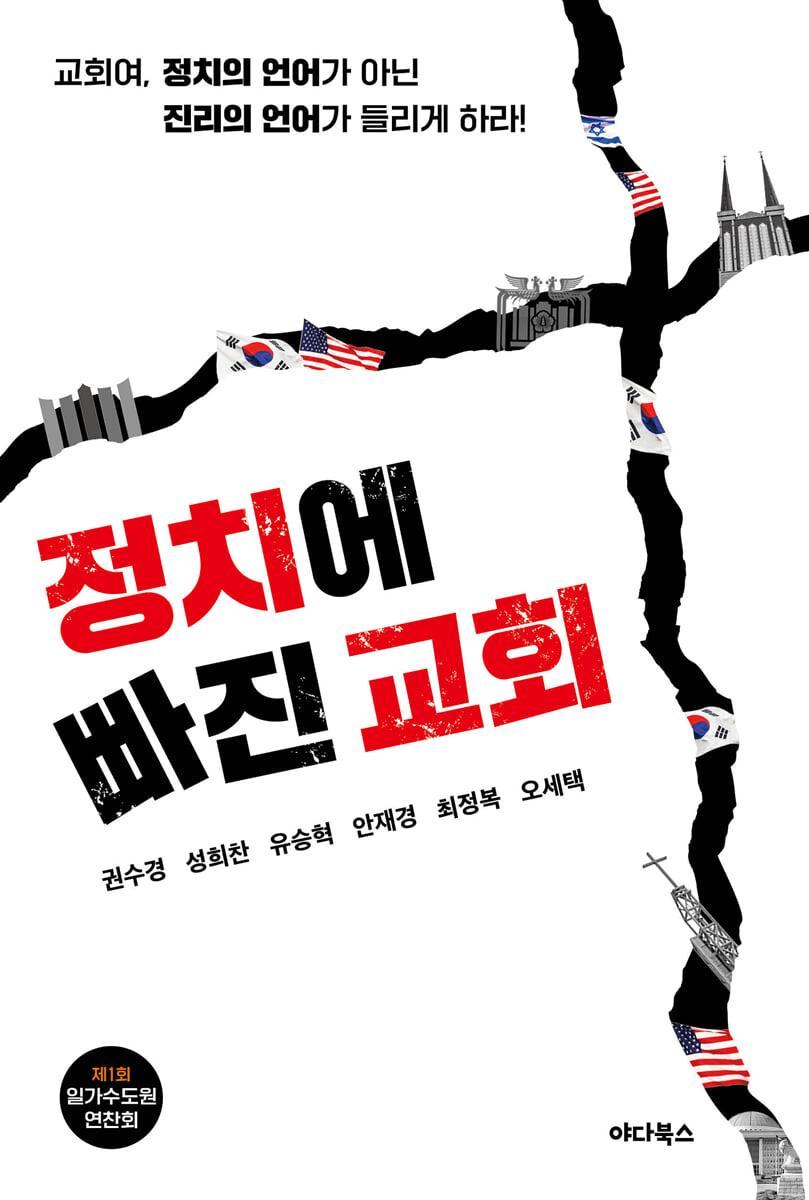
A church mired in politics
 |
Description
Book Introduction
“I write and publish this book with the same concern and prayers as all believers who are concerned about the distorted relationship between the church and political power.
I hope to restore the pulpit where the language of truth, not the language of politics, is proclaimed, and that a church that moves with truth, not one mired in politics, is established.”
Beginning with the President's declaration of martial law on December 3, 2025, and continuing through the lifting of martial law, the impeachment and dismissal of the President, and the 21st presidential election, Korean society was plunged into extreme chaos.
At the center of this, there have been repeated unfortunate incidents of some churches becoming politically involved and playing a role in inciting social unrest.
Not only in the squares, but even from the pulpits where the word of God should be preached, we had to witness the outrageous practice of shouting out political slogans criticizing specific politicians and supporting specific political parties in the form of sermons.
In the midst of the vortex of politics and church, six pastors from conservative denominations sharply diagnose the reality of the Korean church, which is obsessed with the "language of politics."
The first article, “The Church’s Political Intervention and the Preacher’s Responsibility,” denounces how the far-right fervor sweeping the globe is turning churches into battlegrounds for ideological propaganda, and reminds us why pastors must hold on solely to the gospel of the cross.
The second article, “Why and How Did the Church Surrender to Politicization?” traces the repeated failures of politicization across Nazi Germany, the Trump-era United States, and the Korean church in the 1930s.
The third article, “The Historical Roots of the Politicization of the Church: Christian Nation-building Theory,” dissects the discourse of the “Christian nation” advocated by Syngman Rhee and Han Kyung-jik, and analyzes how the gospel and nationalism colluded.
The fourth article, “Anti-communism, the Key Player in the Politicization of the Korean Church,” exposes how the anti-communist ideology born of division and the Cold War has contaminated the church.
In the fifth article, “How far can political issues be included in the pulpit?”, I caution against the provocative sermons of Jeon Gwang-hoon and Son Hyeon-bo, and propose a “confessional political sermon” that contains reconciliation and criticism.
The sixth article, “Kim Yong-gi’s Perception of the Times and Religious Actions,” highlights the example of a pastor who pursued only the gospel from the Japanese colonial period through the Park Chung-hee regime.
W. included as an appendix.
H. Feilerma's "Political Preaching" clearly presents the boundaries that pastors must keep at the intersection of politics and the gospel.
The language that the pulpit must reclaim is truth, not politics.
This book asks and answers questions for the church itself, and suggests a way to recover the lost voice of the gospel.
I hope to restore the pulpit where the language of truth, not the language of politics, is proclaimed, and that a church that moves with truth, not one mired in politics, is established.”
Beginning with the President's declaration of martial law on December 3, 2025, and continuing through the lifting of martial law, the impeachment and dismissal of the President, and the 21st presidential election, Korean society was plunged into extreme chaos.
At the center of this, there have been repeated unfortunate incidents of some churches becoming politically involved and playing a role in inciting social unrest.
Not only in the squares, but even from the pulpits where the word of God should be preached, we had to witness the outrageous practice of shouting out political slogans criticizing specific politicians and supporting specific political parties in the form of sermons.
In the midst of the vortex of politics and church, six pastors from conservative denominations sharply diagnose the reality of the Korean church, which is obsessed with the "language of politics."
The first article, “The Church’s Political Intervention and the Preacher’s Responsibility,” denounces how the far-right fervor sweeping the globe is turning churches into battlegrounds for ideological propaganda, and reminds us why pastors must hold on solely to the gospel of the cross.
The second article, “Why and How Did the Church Surrender to Politicization?” traces the repeated failures of politicization across Nazi Germany, the Trump-era United States, and the Korean church in the 1930s.
The third article, “The Historical Roots of the Politicization of the Church: Christian Nation-building Theory,” dissects the discourse of the “Christian nation” advocated by Syngman Rhee and Han Kyung-jik, and analyzes how the gospel and nationalism colluded.
The fourth article, “Anti-communism, the Key Player in the Politicization of the Korean Church,” exposes how the anti-communist ideology born of division and the Cold War has contaminated the church.
In the fifth article, “How far can political issues be included in the pulpit?”, I caution against the provocative sermons of Jeon Gwang-hoon and Son Hyeon-bo, and propose a “confessional political sermon” that contains reconciliation and criticism.
The sixth article, “Kim Yong-gi’s Perception of the Times and Religious Actions,” highlights the example of a pastor who pursued only the gospel from the Japanese colonial period through the Park Chung-hee regime.
W. included as an appendix.
H. Feilerma's "Political Preaching" clearly presents the boundaries that pastors must keep at the intersection of politics and the gospel.
The language that the pulpit must reclaim is truth, not politics.
This book asks and answers questions for the church itself, and suggests a way to recover the lost voice of the gospel.
index
Editor's Note 5
Authors 10
Preface 10
Chapter 1: The Church's Political Intervention and the Preacher's Responsibilities _Kwon Soo-kyung, 17
Chapter 2: Why and How Did the Church Surrender to Politicization? _Seong Hee-chan 51
Chapter 3: The Historical Roots of Church Politicization and Christian National Foundation Theory _Yoo Seung-hyuk 85
Chapter 4: Anti-Communism: The Main Criminal of the Politicization of the Korean Church _ Jae-kyung Ahn 149
Chapter 5: How Far Can Political Issues Be Included in the Pulpit? _Choi Jeong-bok 181
Chapter 6: Kim Yong-gi's Perception of the Times and His Religious Behavior _ Oh Se-taek 121
Appendix “Political Preaching” (Politieke prediking) _W.
H. Feilerma 227
Authors 10
Preface 10
Chapter 1: The Church's Political Intervention and the Preacher's Responsibilities _Kwon Soo-kyung, 17
Chapter 2: Why and How Did the Church Surrender to Politicization? _Seong Hee-chan 51
Chapter 3: The Historical Roots of Church Politicization and Christian National Foundation Theory _Yoo Seung-hyuk 85
Chapter 4: Anti-Communism: The Main Criminal of the Politicization of the Korean Church _ Jae-kyung Ahn 149
Chapter 5: How Far Can Political Issues Be Included in the Pulpit? _Choi Jeong-bok 181
Chapter 6: Kim Yong-gi's Perception of the Times and His Religious Behavior _ Oh Se-taek 121
Appendix “Political Preaching” (Politieke prediking) _W.
H. Feilerma 227
Detailed image
Into the book
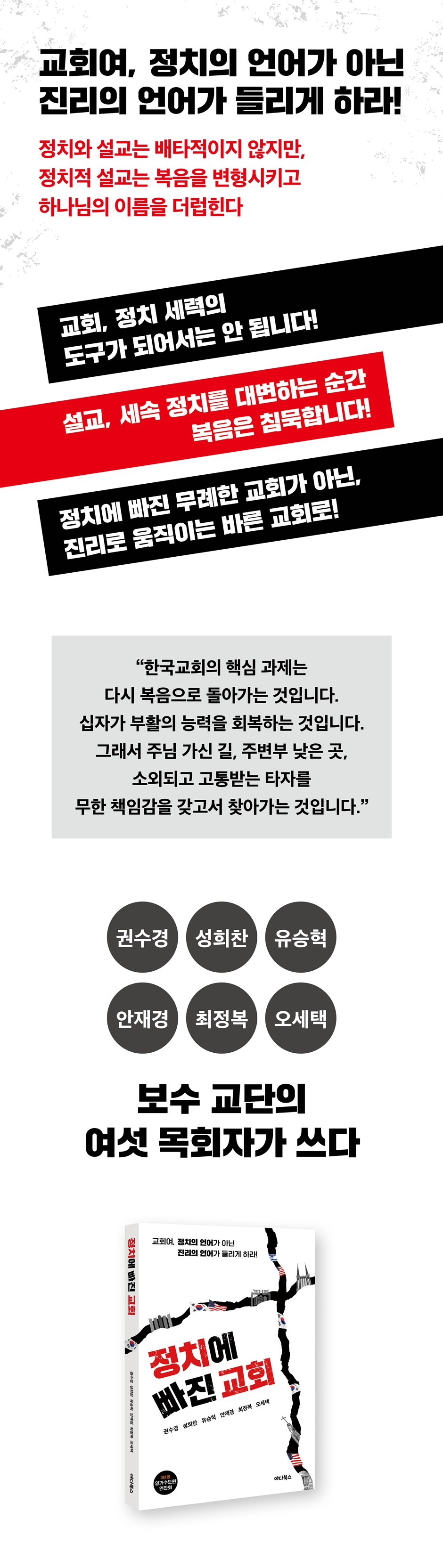
In conclusion, politics and preaching are not exclusive, but political preaching distorts the gospel and tarnishes God's name.
Reflecting on this article will help pastors understand what they should preach and how they can support their congregations politically.
--- p.8
The core task of the Korean church is to return to the gospel.
It is to restore the power of the resurrection of the cross.
So, we must follow the path the Lord took, seeking out the marginalized, the suffering, and the downtrodden with a sense of infinite responsibility.
--- p.14
As extremist tendencies become stronger, they spread lies and even resort to violence to achieve their goals.
When this kind of extreme right-wing ideology is combined with religion, it becomes fundamentalism.
Fundamentalism is a very good word that says to be faithful to the fundamentals of religion itself, but it has become corrupted over time and has now degenerated into a conquest-ism that believes that only one religion is right and therefore other religions must be conquered and dominated by non-religious means.
That was the case with the Crusades in the Middle Ages, and that is the case with Islamic fundamentalism today.
And recently, quite a few churches in the United States and Korea are trying to follow that path.
--- p.24
The Korean church, which has served power and money, is now making the mistake of equating extreme right-wing ideology with biblical faith, a continuation of its history.
South Korea's far-right ideology has continuity with the past because it has ideological ties to the mainstream with money and power.
--- p.34
It's because of YouTube's ideological spiritualism.
The result is always the same.
Past Gnosticism did not acknowledge that Jesus was the Christ.
The digital spiritualism of our time is also completely obsessed with its own knowledge, tearing apart the body of Jesus Christ and trampling on the gospel of the cross.
--- p.40
The new work of God that we proclaim and spread widely is not about becoming friends or enemies with any particular regime, nor is it about leading or rejecting any ideology, but rather the proclamation and realization of the gospel of the cross of Jesus Christ.
It is our responsibility to make ideologies and politics kneel only at the feet of Christ, and this is obedience to the will of the Lord who established the church on this earth.
--- p.49
Why, in this modern age of advanced science and advancements like artificial intelligence, do witch hunts and demonization occur? It's because, to protect their own ideals of the highest good, they must create the worst possible beings.
A good example is that some Korean churches, immersed in politicization, consider “liberal democracy,” “building a Christian nation,” “anti-homosexuality,” “anti-communism,” “anti-China,” and “anti-Islam” to be the highest good, and in order to protect these, they have created the highest evils such as “anti-state forces,” “reds,” spies, “devils,” Satan, demons, and “forces of darkness.”
What is the mission of the church in these times? It is to "make the church truly church."
--- p.82
The square is not a church! Going out to the square is a matter of individual conscience as a citizen.
Pastors cannot use their religious authority to incite their followers to go out into the square or make violent remarks toward their neighbors.
Also, inciting people to shout political slogans in a place of worship is not preaching.
We must learn from Jesus, the Son of God, who was a victim of violence but did not become the perpetrator, and who entrusted everything to the Father.
--- p.145
The main culprit behind the politicization of the Korean church is anti-communism.
…we must not forget that the church is an institution of the gospel.
The gospel is not a political platform.
Liberal democracy is the identity of the Republic of Korea, not the identity of the church.
We must resist those who seek to divide and bury people through anti-communism.
It is most un-Christian to try to eliminate people who were created in the image of God for political reasons.
--- p.177
We know that God is above all political parties.
…our goal is to have the teachings of the Bible take root in the hearts and lives of believers, enabling them to become beneficial political participants in the world.
When the gospel of the kingdom of God is most prosperous, not only will souls be led to salvation, but social benefits will also increase.
With these expectations and hopes, we must preach 'biblical' political sermons.
For our King has authority over heaven and earth.
Reflecting on this article will help pastors understand what they should preach and how they can support their congregations politically.
--- p.8
The core task of the Korean church is to return to the gospel.
It is to restore the power of the resurrection of the cross.
So, we must follow the path the Lord took, seeking out the marginalized, the suffering, and the downtrodden with a sense of infinite responsibility.
--- p.14
As extremist tendencies become stronger, they spread lies and even resort to violence to achieve their goals.
When this kind of extreme right-wing ideology is combined with religion, it becomes fundamentalism.
Fundamentalism is a very good word that says to be faithful to the fundamentals of religion itself, but it has become corrupted over time and has now degenerated into a conquest-ism that believes that only one religion is right and therefore other religions must be conquered and dominated by non-religious means.
That was the case with the Crusades in the Middle Ages, and that is the case with Islamic fundamentalism today.
And recently, quite a few churches in the United States and Korea are trying to follow that path.
--- p.24
The Korean church, which has served power and money, is now making the mistake of equating extreme right-wing ideology with biblical faith, a continuation of its history.
South Korea's far-right ideology has continuity with the past because it has ideological ties to the mainstream with money and power.
--- p.34
It's because of YouTube's ideological spiritualism.
The result is always the same.
Past Gnosticism did not acknowledge that Jesus was the Christ.
The digital spiritualism of our time is also completely obsessed with its own knowledge, tearing apart the body of Jesus Christ and trampling on the gospel of the cross.
--- p.40
The new work of God that we proclaim and spread widely is not about becoming friends or enemies with any particular regime, nor is it about leading or rejecting any ideology, but rather the proclamation and realization of the gospel of the cross of Jesus Christ.
It is our responsibility to make ideologies and politics kneel only at the feet of Christ, and this is obedience to the will of the Lord who established the church on this earth.
--- p.49
Why, in this modern age of advanced science and advancements like artificial intelligence, do witch hunts and demonization occur? It's because, to protect their own ideals of the highest good, they must create the worst possible beings.
A good example is that some Korean churches, immersed in politicization, consider “liberal democracy,” “building a Christian nation,” “anti-homosexuality,” “anti-communism,” “anti-China,” and “anti-Islam” to be the highest good, and in order to protect these, they have created the highest evils such as “anti-state forces,” “reds,” spies, “devils,” Satan, demons, and “forces of darkness.”
What is the mission of the church in these times? It is to "make the church truly church."
--- p.82
The square is not a church! Going out to the square is a matter of individual conscience as a citizen.
Pastors cannot use their religious authority to incite their followers to go out into the square or make violent remarks toward their neighbors.
Also, inciting people to shout political slogans in a place of worship is not preaching.
We must learn from Jesus, the Son of God, who was a victim of violence but did not become the perpetrator, and who entrusted everything to the Father.
--- p.145
The main culprit behind the politicization of the Korean church is anti-communism.
…we must not forget that the church is an institution of the gospel.
The gospel is not a political platform.
Liberal democracy is the identity of the Republic of Korea, not the identity of the church.
We must resist those who seek to divide and bury people through anti-communism.
It is most un-Christian to try to eliminate people who were created in the image of God for political reasons.
--- p.177
We know that God is above all political parties.
…our goal is to have the teachings of the Bible take root in the hearts and lives of believers, enabling them to become beneficial political participants in the world.
When the gospel of the kingdom of God is most prosperous, not only will souls be led to salvation, but social benefits will also increase.
With these expectations and hopes, we must preach 'biblical' political sermons.
For our King has authority over heaven and earth.
--- p.208~209
Publisher's Review
Not a church swayed by worldly ideologies and political powers,
Dreaming of a church that seeks God's kingdom and righteousness first.
ㆍThe church must not become a tool of political power!
ㆍThe moment a sermon represents secular politics, the gospel becomes silent!
ㆍNot a rude church mired in politics, but a proper church that moves with truth!
Let us read the writings and proposals of six pastors of the Kosin Church, written with the hope of restoring the essence of the church that heals the pain of the times, and let us pray and act together.
Boldly, without hesitation!
Dreaming of a church that seeks God's kingdom and righteousness first.
ㆍThe church must not become a tool of political power!
ㆍThe moment a sermon represents secular politics, the gospel becomes silent!
ㆍNot a rude church mired in politics, but a proper church that moves with truth!
Let us read the writings and proposals of six pastors of the Kosin Church, written with the hope of restoring the essence of the church that heals the pain of the times, and let us pray and act together.
Boldly, without hesitation!
GOODS SPECIFICS
- Date of issue: September 12, 2025
- Page count, weight, size: 256 pages | 145*215*20mm
- ISBN13: 9791199079960
- ISBN10: 1199079960
You may also like
카테고리
korean


korean

![GQ KOREA Mark (Monthly): December [2025]](http://librairie.coreenne.fr/cdn/shop/files/8ef265dbbfbf186523ed75ba7319009d.jpg?v=1765340328&width=3840)


