

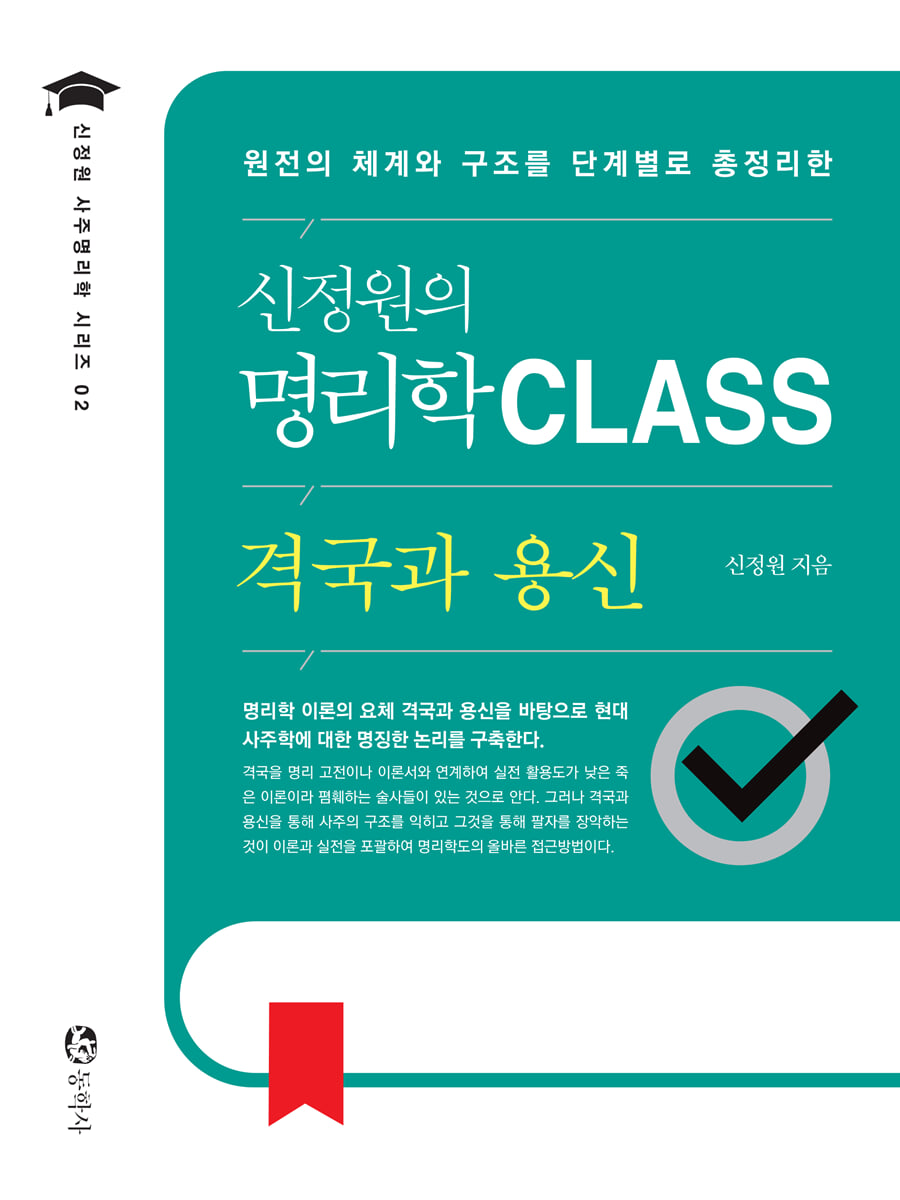
Shin Jeong-won's Myeongrihak CLASS: Geokguk and Yongsin
 |
Description
Book Introduction
Based on the essentials of the theory of fortune telling, the country of origin and the dragon god
Building a clear logic for modern fortune telling
There are some fortune tellers who disparage the theory of the country by linking it to the classics or theoretical books of fortune telling, calling it a dead theory with little practical application.
However, learning the structure of the four pillars of destiny through the geokguk and yongsin and mastering the eight characters through that is the correct approach for a student of fortune telling, encompassing both theory and practice.
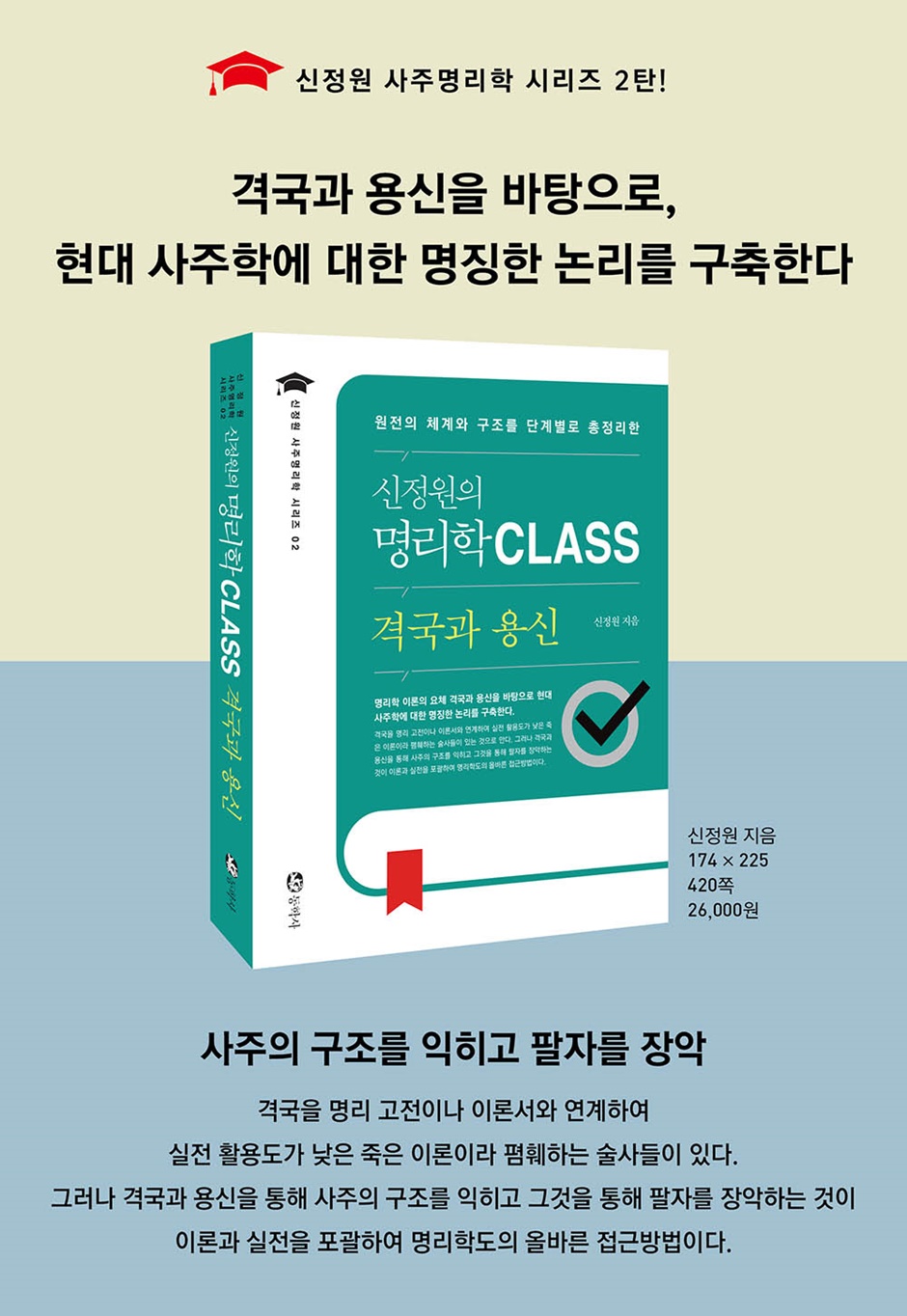
Building a clear logic for modern fortune telling
There are some fortune tellers who disparage the theory of the country by linking it to the classics or theoretical books of fortune telling, calling it a dead theory with little practical application.
However, learning the structure of the four pillars of destiny through the geokguk and yongsin and mastering the eight characters through that is the correct approach for a student of fortune telling, encompassing both theory and practice.
- You can preview some of the book's contents.
Preview
index
PART 01 The Basics and Understanding of the Yongsin Theory
CHAPTER 1 Basic Theory of Dragon God Theory
01 The ontological significance of the creation of the heavenly stems and earthly branches
02 The Five Elements' Generation and Repression
03 Relatives
The theory of the six kinships in 『Yeonhaejapyeong』 and 『Samyeongtonghoe』 / The theory of the six kinships in 『Jeokcheonsu』 and 『Japyeongjinjeon』 / The interpretation of the six kinships
CHAPTER 2 The Relationship Between the Ganji
01 Life and Death of Yin-Yang and the Five Elements
The Five Elements of Life and Death / Fire and Earth's Companions and Water and Earth's Companions / The Heavenly Stems of Life and Death / The Yang-Sun-Eum Reverse / Characteristics of the Twelve Zodiac Signs
02 Hyungchung Meeting
The establishment and changes of the Hyeongchung meeting / The resolution and interpretation of the Hyeongchung meeting / The Hyeongchung meeting of the years of Jin, Sul, Chou, and Mi
PART 02 The Establishment and Change of the Gyeokguk
CHAPTER 1 The Structure of the Four Pillars of Destiny
01 Before you start
02 days in a row
The theory of work-centeredness in 『Yeonhaejapyeong』 / The theory of work-centeredness in 『Samyeongtonghoe』
03 Monthly Steel
Month of the Rat / Month of the Ox / Month of the Tiger / Month of the Rabbit / Month of the Dragon / Month of the Si / Month of the Horse / Month of the Goat / Month of the Monkey / Month of the Yoo / Month of the Dog / Month of the Pig
04 Gaining Time and Losing Time
05 Structure of the four pillars and the four pillars of destiny
CHAPTER 2 Key Concepts of the Gyeokguk and Yongsin
01 Comparison of Key Concepts
02 Lucky God and Evil God
03 Body and Use
CHAPTER 3: The rise and fall of the warring nations and their changes
01 Success and failure of the war
02 Rescue
03 Changes in the situation
PART 03 General Theory of the Battle of Gyeokguk
CHAPTER 1 Classification of the Battlefields
01 Before you start
02 Classification of the states of 『Japyeongjinjeon』 and 『Jeokcheonsu』
03 Rating (internal rating)
Mechanism of rating classification / Establishment and characteristics of the eight ratings
04 Change (External case)
Final / Fire / Special External
CHAPTER 2 How to Determine the Battlefield
01 Monthly Branch Conflict
02 How to catch the dragon god
CHAPTER 3: Using the Interpretation of the Gyeokguk and Yongsin
01 Before you start
02 Neutralization of the four pillars of destiny
03 The rich and poor of the country and the nobility and the common people and the requests
04 Geummyohwasil and Ganji 10-Star Operation Method
05 The arguments of the two countries
CHAPTER 1 Basic Theory of Dragon God Theory
01 The ontological significance of the creation of the heavenly stems and earthly branches
02 The Five Elements' Generation and Repression
03 Relatives
The theory of the six kinships in 『Yeonhaejapyeong』 and 『Samyeongtonghoe』 / The theory of the six kinships in 『Jeokcheonsu』 and 『Japyeongjinjeon』 / The interpretation of the six kinships
CHAPTER 2 The Relationship Between the Ganji
01 Life and Death of Yin-Yang and the Five Elements
The Five Elements of Life and Death / Fire and Earth's Companions and Water and Earth's Companions / The Heavenly Stems of Life and Death / The Yang-Sun-Eum Reverse / Characteristics of the Twelve Zodiac Signs
02 Hyungchung Meeting
The establishment and changes of the Hyeongchung meeting / The resolution and interpretation of the Hyeongchung meeting / The Hyeongchung meeting of the years of Jin, Sul, Chou, and Mi
PART 02 The Establishment and Change of the Gyeokguk
CHAPTER 1 The Structure of the Four Pillars of Destiny
01 Before you start
02 days in a row
The theory of work-centeredness in 『Yeonhaejapyeong』 / The theory of work-centeredness in 『Samyeongtonghoe』
03 Monthly Steel
Month of the Rat / Month of the Ox / Month of the Tiger / Month of the Rabbit / Month of the Dragon / Month of the Si / Month of the Horse / Month of the Goat / Month of the Monkey / Month of the Yoo / Month of the Dog / Month of the Pig
04 Gaining Time and Losing Time
05 Structure of the four pillars and the four pillars of destiny
CHAPTER 2 Key Concepts of the Gyeokguk and Yongsin
01 Comparison of Key Concepts
02 Lucky God and Evil God
03 Body and Use
CHAPTER 3: The rise and fall of the warring nations and their changes
01 Success and failure of the war
02 Rescue
03 Changes in the situation
PART 03 General Theory of the Battle of Gyeokguk
CHAPTER 1 Classification of the Battlefields
01 Before you start
02 Classification of the states of 『Japyeongjinjeon』 and 『Jeokcheonsu』
03 Rating (internal rating)
Mechanism of rating classification / Establishment and characteristics of the eight ratings
04 Change (External case)
Final / Fire / Special External
CHAPTER 2 How to Determine the Battlefield
01 Monthly Branch Conflict
02 How to catch the dragon god
CHAPTER 3: Using the Interpretation of the Gyeokguk and Yongsin
01 Before you start
02 Neutralization of the four pillars of destiny
03 The rich and poor of the country and the nobility and the common people and the requests
04 Geummyohwasil and Ganji 10-Star Operation Method
05 The arguments of the two countries
Detailed image
Publisher's Review
[Features of this book]
1.
This book is a concrete theoretical book that corrects errors and mistranslations in the classics of fortune-telling and focuses on the use of language, sentence structure, and practicality of logic.
2.
The significance of the main concepts that make up the Yongshin, such as the heavenly stems, earthly branches, five elements, and six relatives, which are the basis of the eight-character fortune-telling, was revealed.
3.
We examined the process by which the daily horoscope became dominant in the history of fortune telling, and organized the daily horoscope theory and monthly horoscope analysis of Samyeong Tonghoe.
Regarding the establishment of a quarrel, the success and failure and the response were explained, and then the changes in the quarrel were discussed.
4.
It covers the classification of the country, methods for determining the country, and the use of the interpretation of the country and the dragon god.
1.
This book is a concrete theoretical book that corrects errors and mistranslations in the classics of fortune-telling and focuses on the use of language, sentence structure, and practicality of logic.
2.
The significance of the main concepts that make up the Yongshin, such as the heavenly stems, earthly branches, five elements, and six relatives, which are the basis of the eight-character fortune-telling, was revealed.
3.
We examined the process by which the daily horoscope became dominant in the history of fortune telling, and organized the daily horoscope theory and monthly horoscope analysis of Samyeong Tonghoe.
Regarding the establishment of a quarrel, the success and failure and the response were explained, and then the changes in the quarrel were discussed.
4.
It covers the classification of the country, methods for determining the country, and the use of the interpretation of the country and the dragon god.
GOODS SPECIFICS
- Date of issue: August 14, 2024
- Page count, weight, size: 420 pages | 174*225*20mm
- ISBN13: 9788971908914
- ISBN10: 8971908912
You may also like
카테고리
korean


korean

![GQ KOREA Mark (Monthly): December [2025]](http://librairie.coreenne.fr/cdn/shop/files/8ef265dbbfbf186523ed75ba7319009d.jpg?v=1765340328&width=3840)


