

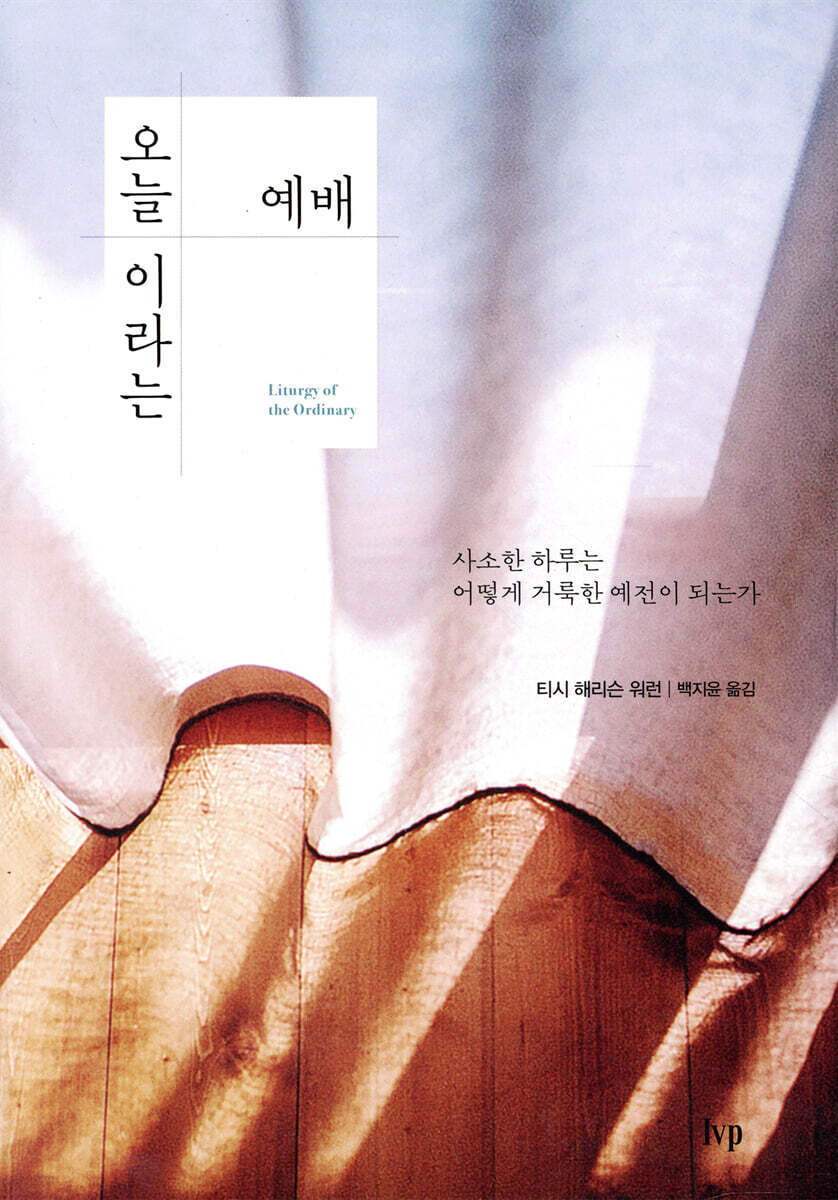
Today's worship
 |
Description
Book Introduction
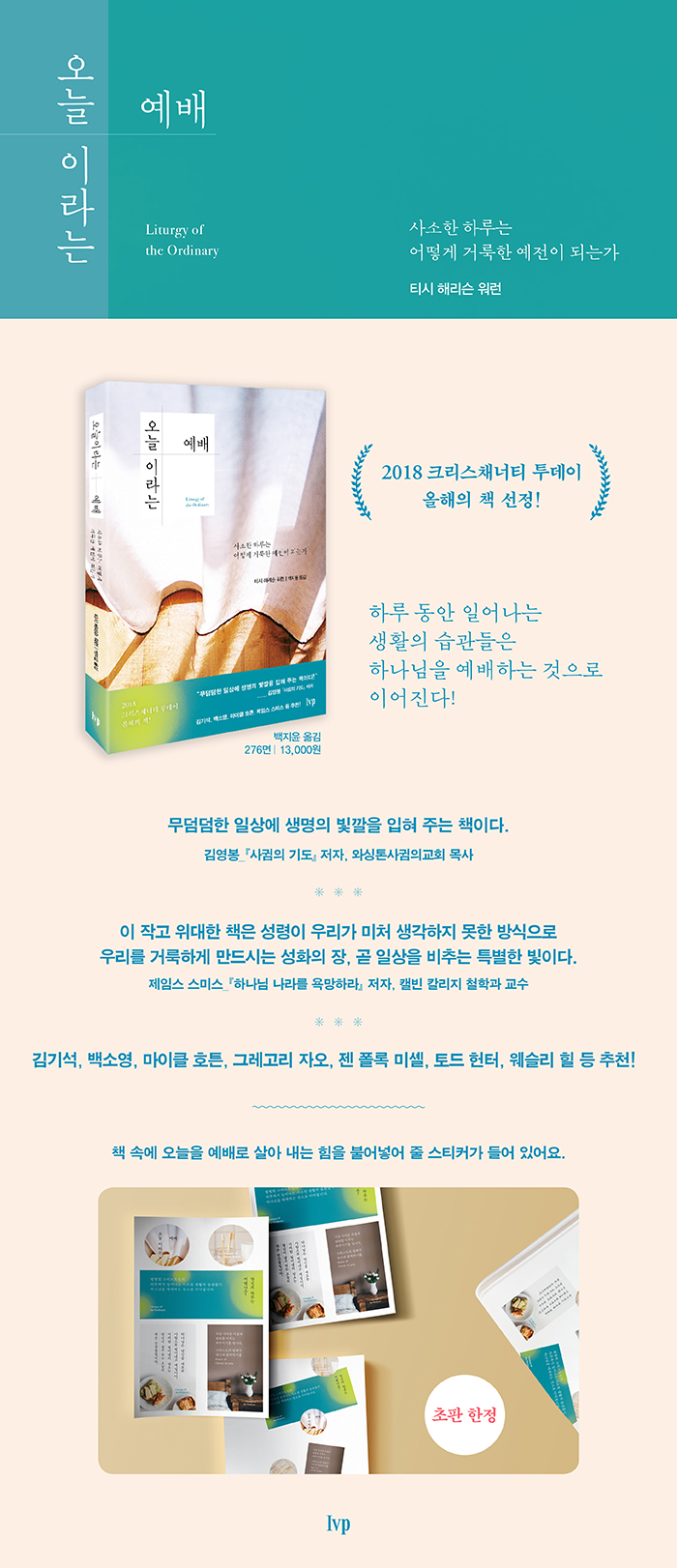
Selected as Christianity Today's 2018 Book of the Year! “This book brings color to life in the dullness of everyday life.” _Kim Young-bong, author of “Prayer of Intimacy” “This great little book is a special light that illuminates our daily lives, a chapter of sanctification in which the Holy Spirit makes us holy.” —James Smith, Professor of Philosophy, Calvin College, and author of Desire the Kingdom of God What determines the direction of our lives is not grand ideas or grand slogans, but rather the habits we unconsciously repeat every day. We can learn to worship God and live as Christians throughout our lives by changing our daily habits. The author offers theological insights into how we can live as worshippers in the seemingly meaningless repetitions of everyday life: waking up, brushing teeth, forgetting your keys in the morning, checking email. Even words that seem special, like worship, ritual, and spiritual training, are ultimately made up of ordinary elements and ordinary people. No part of our lives is sacred. We can worship even in the most messy and unpleasant places of everyday life. |
- You can preview some of the book's contents.
Preview
index
Foreword _ Andy Crouch
01 Waking Up: Baptism, Learning to Live as a Beloved One
02 Making the Bed: The Past, Ritual, and What Shapes Life
03 Brushing: Standing, kneeling, and bowing, living in the body
04 Lost Keys: Confessions and the Truth About Ourselves
05 Eating Leftovers: Word and Sacrament, the Overlooked Nourishment
06 Fighting with your husband: Saying hello to peace, a daily routine that creates peace
07 Check Email: Blessing, Send
08 Braving Traffic Jams: The Old Times and the Unhurried God
09 Talking to Friends: Congregation and Community
10. Drinking Tea: Sanctuary, Savoring
11 Sleep: Rest, Peace, and God's Work
Acknowledgements
For discussion
01 Waking Up: Baptism, Learning to Live as a Beloved One
02 Making the Bed: The Past, Ritual, and What Shapes Life
03 Brushing: Standing, kneeling, and bowing, living in the body
04 Lost Keys: Confessions and the Truth About Ourselves
05 Eating Leftovers: Word and Sacrament, the Overlooked Nourishment
06 Fighting with your husband: Saying hello to peace, a daily routine that creates peace
07 Check Email: Blessing, Send
08 Braving Traffic Jams: The Old Times and the Unhurried God
09 Talking to Friends: Congregation and Community
10. Drinking Tea: Sanctuary, Savoring
11 Sleep: Rest, Peace, and God's Work
Acknowledgements
For discussion
Detailed image
Into the book
I always want to lie in bed a little longer.
My body is begging to sleep.
“Just a few more minutes!” But it’s not just about wanting to sleep more.
I want to stay in that middle realm, on the edge of consciousness, where I can enjoy comfort without being distracted by the demands that await me.
I don't want to face the big and small troubles that lie ahead in my life.
I don't want to wear my identity yet.
I want to stay in that blanket like in my mother's womb a little longer.
…Martin Luther taught each member of the community to regard baptism as “a daily garment to be worn at all times.”
We enter each new day by remembering our baptism as we enter a chapel.
Marty himself makes the sign of the cross every morning.
He calls this “silent prayer.”
He remembers once again that he has been forgiven for all that has happened before, and that there is grace enough to cover all that will happen in the future.
---From "01 Waking Up: Baptism, Learning to Live as a Beloved One"
When I open my eyes in the morning, I pick up my smartphone as if it were my daily routine.
It was a stimulant, like digital caffeine, that brought coherence and activity to my foggy, hazy head. … We don't wake up every morning and start from scratch to shape our way of being in the world.
It's not like we do every action in our daily lives with thorough thought.
We move according to patterns that have developed over time.
These habits and practices shape our loves and desires, ultimately determining who we are and what we worship.
On Sundays, we participate in the liturgy (a ritualized form of worship) at church, repeat the liturgy every week, and are transformed through the liturgy.
Through the ages, the congregation has been formed as a people who exist in a certain way in the world.
Even in traditional worship that claims to be free and non-liturgical, certain practices and forms follow.
The question is not whether we do what we used to do or not.
The problem is, 'what kind of people has our past shaped us into?
Is it a success?
---From "02 Making the Bed: The Past, Ritual, and What Shapes Life"
If the church doesn't teach us why our bodies exist, our culture will.
If we do not learn to worship God as physical beings, to care for the good gift of our bodies, and to live as Christians, we will be taught a false gospel, a different body.
We will come to see our bodies first as a means to fulfill our needs and desires, rather than as temples of the Holy Spirit.
Or we will spend endless time and money on creams, botox, and surgeries to avoid the reality that our bodies are weakening and aging, believing they must be perfect.
Or we can try to ignore the fact that we have a body altogether, eating and drinking as we please and not caring whether or not those choices violate the calling to care for the body we have been given as a gift.
---From "03 Brushing: Standing, Kneeling, Bowing, Living in the Body"
I spent several months in a war-torn area.
But I was surprised to discover that I was much more at peace in the midst of all that tension and danger than I was as an ordinary American, spending my days at home with a newborn and a toddler.
I had a theology of suffering that called me to attention in times of crisis and sought small sparkles of mercy in the midst of deep darkness.
But my theology was too big to fit into my repetitive daily life.
I had developed a habit of ignoring God in my monotonous daily life.
---From "04 Lost Keys: Confession and the Truth About Ourselves"
Christian worship, centered on Word and Sacrament, reminds me that being a consumer is not at the core of my identity.
I am a worshiper, a being made in the image of God, created to know, delight in, and glorify God, and to know and love those around me.
This anonymous bean says that buying things is the most important thing to survive.
But God knows those who harvested these beans and is concerned about justice.
And God created us not to be mere consumers, but to be cultivators, caregivers, and blessings.
---From "05 Eating Leftovers: Word and Sacrament, the Overlooked Nourishment"
Actually, I get along well with everyone.
Usually, conflicts arise in my relationships with the people I love most.
Most of the times when I have to fight to “love thy neighbor” I find myself at home, with my husband and children, when I’m tired, scared, discouraged, not feeling well, or just wanting to be alone.… Even now, as a wife and mother, the shining vision of God’s kingdom still captivates me.
But even though I champion grand ideals like the beauty of shalom and the peace ministry of Christ penetrating the world, I often find myself engaging in petty arguments and quarrels all day long with those I love most.
I am a pacifist who yells at my husband.… I am slowly realizing that pursuing God's peace and mission in the world must begin with my relationships with the people right next to me, in my home, my neighborhood, and my church.
---From "06 Quarrel with my husband: Saying hello to peace, the daily routine of achieving peace"
There is a profound sense of purposelessness in modern work, where the day begins and ends with a clock in and out.
We live in a world where we sit at our desks, discuss work via email with people we've never met, and then do it all again while looking at our computer screens.
We must fight against the injustices and inhumane conditions that make modern work unbearable.
But at the same time, we must avoid the mistake of inadvertently creating a new "hierarchy of holiness" by elevating old-world work above modern occupations.
As believers sent by the Church for Missio Dei, one of the specific tasks we are called to undertake is to learn how to embody holiness not only in blacksmithing or cheesemaking, but also in and through the work that has inevitably arisen through modernity and technology.
I have to check my email.
This is the time, this is what God has given me to do.
---From "07 Email Verification: Blessing, Sending"
We live in a world of waiting, a world where time, along with all creation, awaits the birth of something and suffers the pain of childbirth.
When I'm stuck in traffic, neither at the starting point nor the destination, I dwell in the old rhythm of waiting and hoping that I've practiced over the years.
Fundamentally, my present reality is oriented toward what is to come.
I am going somewhere.
Therefore, waiting is an act of faith that looks toward the future.
But the assurance of our hope is grounded in the past, in the person of Jesus of Nazareth, and in his promises and resurrection.
Thus, like time, waiting is centered on Christ, the axis of time.
---From "08 Enduring Traffic Jams: The Old Times and the Unhurried God"
The Psalms we read every Sunday do not provide easy answers.
The Psalms cover the full range of emotions, from triumphant praise to the deepest melancholy.
We acknowledge the fact that we are complex beings.
Christian friends are just like this.
They call to us and answer us when we say, “O Lord our God, how majestic is your name in all the earth!” (Psalm 8:1), or “Lord, why have you forsaken me and hidden your face from me?” (Psalm 88:14).
---From "09 Talking to a Friend: Congregation and Community"
A few years ago, when my first child was just a few months old, I was completely exhausted.
It felt like my life and my body had become the property of a tiny, adorable little dictator.
Besides being a first-time mother, my life was full of upheaval and chaos during that time.
It was then that I met Father Kenny, a wise friend and mentor.
I complained to him that I didn't know what to give up during Lent.
I was in an extremely difficult situation.
The priest said to me:
“You don’t have to give up anything.
“Because your whole life is Lent now,” the priest advised me to practice joy, that is, to begin to consciously train myself to enjoy joy.
---From "10 Drinks: A Sanctuary, Savoring"
Our sleep habits also reveal and shape what we trust.
We lose sleep over worries about our jobs, our health, or the people we love.
We wrestle with the problem and our inability to solve it until dawn.
What we trust, that is, lying down in bed after a long day, is where our hearts truly lie.
The psalmist declares:
“Unless the Lord guards the city, the watchman stays awake in vain.
Getting up early and going to bed late, all the hard work to make a living is in vain.
“Surely the Lord blesses those he loves even in their sleep” (Psalm 127:1-2).
It is God who protects the city we live in and ultimately determines our safety.
God has called us to be His beloved people, and because He faithfully protects and provides for His people, we can enjoy the good rest He gives us.
My body is begging to sleep.
“Just a few more minutes!” But it’s not just about wanting to sleep more.
I want to stay in that middle realm, on the edge of consciousness, where I can enjoy comfort without being distracted by the demands that await me.
I don't want to face the big and small troubles that lie ahead in my life.
I don't want to wear my identity yet.
I want to stay in that blanket like in my mother's womb a little longer.
…Martin Luther taught each member of the community to regard baptism as “a daily garment to be worn at all times.”
We enter each new day by remembering our baptism as we enter a chapel.
Marty himself makes the sign of the cross every morning.
He calls this “silent prayer.”
He remembers once again that he has been forgiven for all that has happened before, and that there is grace enough to cover all that will happen in the future.
---From "01 Waking Up: Baptism, Learning to Live as a Beloved One"
When I open my eyes in the morning, I pick up my smartphone as if it were my daily routine.
It was a stimulant, like digital caffeine, that brought coherence and activity to my foggy, hazy head. … We don't wake up every morning and start from scratch to shape our way of being in the world.
It's not like we do every action in our daily lives with thorough thought.
We move according to patterns that have developed over time.
These habits and practices shape our loves and desires, ultimately determining who we are and what we worship.
On Sundays, we participate in the liturgy (a ritualized form of worship) at church, repeat the liturgy every week, and are transformed through the liturgy.
Through the ages, the congregation has been formed as a people who exist in a certain way in the world.
Even in traditional worship that claims to be free and non-liturgical, certain practices and forms follow.
The question is not whether we do what we used to do or not.
The problem is, 'what kind of people has our past shaped us into?
Is it a success?
---From "02 Making the Bed: The Past, Ritual, and What Shapes Life"
If the church doesn't teach us why our bodies exist, our culture will.
If we do not learn to worship God as physical beings, to care for the good gift of our bodies, and to live as Christians, we will be taught a false gospel, a different body.
We will come to see our bodies first as a means to fulfill our needs and desires, rather than as temples of the Holy Spirit.
Or we will spend endless time and money on creams, botox, and surgeries to avoid the reality that our bodies are weakening and aging, believing they must be perfect.
Or we can try to ignore the fact that we have a body altogether, eating and drinking as we please and not caring whether or not those choices violate the calling to care for the body we have been given as a gift.
---From "03 Brushing: Standing, Kneeling, Bowing, Living in the Body"
I spent several months in a war-torn area.
But I was surprised to discover that I was much more at peace in the midst of all that tension and danger than I was as an ordinary American, spending my days at home with a newborn and a toddler.
I had a theology of suffering that called me to attention in times of crisis and sought small sparkles of mercy in the midst of deep darkness.
But my theology was too big to fit into my repetitive daily life.
I had developed a habit of ignoring God in my monotonous daily life.
---From "04 Lost Keys: Confession and the Truth About Ourselves"
Christian worship, centered on Word and Sacrament, reminds me that being a consumer is not at the core of my identity.
I am a worshiper, a being made in the image of God, created to know, delight in, and glorify God, and to know and love those around me.
This anonymous bean says that buying things is the most important thing to survive.
But God knows those who harvested these beans and is concerned about justice.
And God created us not to be mere consumers, but to be cultivators, caregivers, and blessings.
---From "05 Eating Leftovers: Word and Sacrament, the Overlooked Nourishment"
Actually, I get along well with everyone.
Usually, conflicts arise in my relationships with the people I love most.
Most of the times when I have to fight to “love thy neighbor” I find myself at home, with my husband and children, when I’m tired, scared, discouraged, not feeling well, or just wanting to be alone.… Even now, as a wife and mother, the shining vision of God’s kingdom still captivates me.
But even though I champion grand ideals like the beauty of shalom and the peace ministry of Christ penetrating the world, I often find myself engaging in petty arguments and quarrels all day long with those I love most.
I am a pacifist who yells at my husband.… I am slowly realizing that pursuing God's peace and mission in the world must begin with my relationships with the people right next to me, in my home, my neighborhood, and my church.
---From "06 Quarrel with my husband: Saying hello to peace, the daily routine of achieving peace"
There is a profound sense of purposelessness in modern work, where the day begins and ends with a clock in and out.
We live in a world where we sit at our desks, discuss work via email with people we've never met, and then do it all again while looking at our computer screens.
We must fight against the injustices and inhumane conditions that make modern work unbearable.
But at the same time, we must avoid the mistake of inadvertently creating a new "hierarchy of holiness" by elevating old-world work above modern occupations.
As believers sent by the Church for Missio Dei, one of the specific tasks we are called to undertake is to learn how to embody holiness not only in blacksmithing or cheesemaking, but also in and through the work that has inevitably arisen through modernity and technology.
I have to check my email.
This is the time, this is what God has given me to do.
---From "07 Email Verification: Blessing, Sending"
We live in a world of waiting, a world where time, along with all creation, awaits the birth of something and suffers the pain of childbirth.
When I'm stuck in traffic, neither at the starting point nor the destination, I dwell in the old rhythm of waiting and hoping that I've practiced over the years.
Fundamentally, my present reality is oriented toward what is to come.
I am going somewhere.
Therefore, waiting is an act of faith that looks toward the future.
But the assurance of our hope is grounded in the past, in the person of Jesus of Nazareth, and in his promises and resurrection.
Thus, like time, waiting is centered on Christ, the axis of time.
---From "08 Enduring Traffic Jams: The Old Times and the Unhurried God"
The Psalms we read every Sunday do not provide easy answers.
The Psalms cover the full range of emotions, from triumphant praise to the deepest melancholy.
We acknowledge the fact that we are complex beings.
Christian friends are just like this.
They call to us and answer us when we say, “O Lord our God, how majestic is your name in all the earth!” (Psalm 8:1), or “Lord, why have you forsaken me and hidden your face from me?” (Psalm 88:14).
---From "09 Talking to a Friend: Congregation and Community"
A few years ago, when my first child was just a few months old, I was completely exhausted.
It felt like my life and my body had become the property of a tiny, adorable little dictator.
Besides being a first-time mother, my life was full of upheaval and chaos during that time.
It was then that I met Father Kenny, a wise friend and mentor.
I complained to him that I didn't know what to give up during Lent.
I was in an extremely difficult situation.
The priest said to me:
“You don’t have to give up anything.
“Because your whole life is Lent now,” the priest advised me to practice joy, that is, to begin to consciously train myself to enjoy joy.
---From "10 Drinks: A Sanctuary, Savoring"
Our sleep habits also reveal and shape what we trust.
We lose sleep over worries about our jobs, our health, or the people we love.
We wrestle with the problem and our inability to solve it until dawn.
What we trust, that is, lying down in bed after a long day, is where our hearts truly lie.
The psalmist declares:
“Unless the Lord guards the city, the watchman stays awake in vain.
Getting up early and going to bed late, all the hard work to make a living is in vain.
“Surely the Lord blesses those he loves even in their sleep” (Psalm 127:1-2).
It is God who protects the city we live in and ultimately determines our safety.
God has called us to be His beloved people, and because He faithfully protects and provides for His people, we can enjoy the good rest He gives us.
---From “11 Sleep: Rest, Relaxation, and God’s Work”
Publisher's Review
The time called 'one day' given to everyone
From the time we open our eyes in the morning until we fall asleep, we live our 'day'.
No one is an exception.
Our reactions and thoughts about the things we do, the people we meet, and the events we experience throughout the day shape us.
Even at this very moment, as you read this, we are forming ourselves.
The author writes, “No matter who we are, what we believe, where we live, or what our spending habits are, we spend our days doing something.
He expresses it as “living a daily life formed by habits and practices.”
But what if that habit, that day, not only shapes who we are, but also becomes our worship to God?
Each day shapes us and our habits lead to worship!
Here is a book that connects everyday life with special patterns of worship.
The author, who had a habit of checking her smartphone as soon as she woke up, says she realized that this habit was unknowingly developing a ritual that trained her to use technology for entertainment and stimulation.
So, the author decided to start his day by making his bed instead of using his smartphone, but it didn't make a huge difference for him.
However, his day began to be imprinted on the author himself in a different way.
I came to accept myself as a partner with God, not a consumer, and instead of craving endless news and instant information (as a reflection of my resistance to and fear of boredom), I began to sit still for a moment, remember God who gave me the day, and invite Him into my day.
From the ordinary to the sacred, from the sacred to the ordinary!
The work goes on.
I brush my teeth even though it's annoying, lose my keys right before going out, eat leftovers from yesterday, and argue with my husband.
I have to do things I don't want to do, and sometimes I get stuck in traffic jams against my will.
By writing about his day in its entirety—from intentional breaks in the midst of his busy schedule, to conversations with friends, to the moment he finally goes to bed—the author demonstrates how all these everyday rituals are connected to the communal liturgy of Sunday.
Most importantly, it is the quiet, repetitive, and ordinary daily life, not the thrilling, fleeting, and extraordinary events, that shape us, and it is these everyday acts that lead to spiritual practice and worship.
The author unfolds the theology of everyday life within the diversity of her life as an Anglican priest, a university missionary, a friend, a wife, and a mother.
He explains theology in a fun and calm way without using difficult theological terms, and he gains readers' sympathy by honestly revealing even his own shortcomings rather than being pretentious.
And so we come to know.
No part of our lives is sacred.
We can worship even in the most messy and unpleasant places of everyday life.
The habits of our daily lives ultimately lead to worshipping God!
From the time we open our eyes in the morning until we fall asleep, we live our 'day'.
No one is an exception.
Our reactions and thoughts about the things we do, the people we meet, and the events we experience throughout the day shape us.
Even at this very moment, as you read this, we are forming ourselves.
The author writes, “No matter who we are, what we believe, where we live, or what our spending habits are, we spend our days doing something.
He expresses it as “living a daily life formed by habits and practices.”
But what if that habit, that day, not only shapes who we are, but also becomes our worship to God?
Each day shapes us and our habits lead to worship!
Here is a book that connects everyday life with special patterns of worship.
The author, who had a habit of checking her smartphone as soon as she woke up, says she realized that this habit was unknowingly developing a ritual that trained her to use technology for entertainment and stimulation.
So, the author decided to start his day by making his bed instead of using his smartphone, but it didn't make a huge difference for him.
However, his day began to be imprinted on the author himself in a different way.
I came to accept myself as a partner with God, not a consumer, and instead of craving endless news and instant information (as a reflection of my resistance to and fear of boredom), I began to sit still for a moment, remember God who gave me the day, and invite Him into my day.
From the ordinary to the sacred, from the sacred to the ordinary!
The work goes on.
I brush my teeth even though it's annoying, lose my keys right before going out, eat leftovers from yesterday, and argue with my husband.
I have to do things I don't want to do, and sometimes I get stuck in traffic jams against my will.
By writing about his day in its entirety—from intentional breaks in the midst of his busy schedule, to conversations with friends, to the moment he finally goes to bed—the author demonstrates how all these everyday rituals are connected to the communal liturgy of Sunday.
Most importantly, it is the quiet, repetitive, and ordinary daily life, not the thrilling, fleeting, and extraordinary events, that shape us, and it is these everyday acts that lead to spiritual practice and worship.
The author unfolds the theology of everyday life within the diversity of her life as an Anglican priest, a university missionary, a friend, a wife, and a mother.
He explains theology in a fun and calm way without using difficult theological terms, and he gains readers' sympathy by honestly revealing even his own shortcomings rather than being pretentious.
And so we come to know.
No part of our lives is sacred.
We can worship even in the most messy and unpleasant places of everyday life.
The habits of our daily lives ultimately lead to worshipping God!
GOODS SPECIFICS
- Date of issue: May 13, 2019
- Page count, weight, size: 276 pages | 326g | 141*196*15mm
- ISBN13: 9788932816142
- ISBN10: 893281614X
You may also like
카테고리
korean


korean

![GQ KOREA Mark (Monthly): December [2025]](http://librairie.coreenne.fr/cdn/shop/files/8ef265dbbfbf186523ed75ba7319009d.jpg?v=1765340328&width=3840)


