

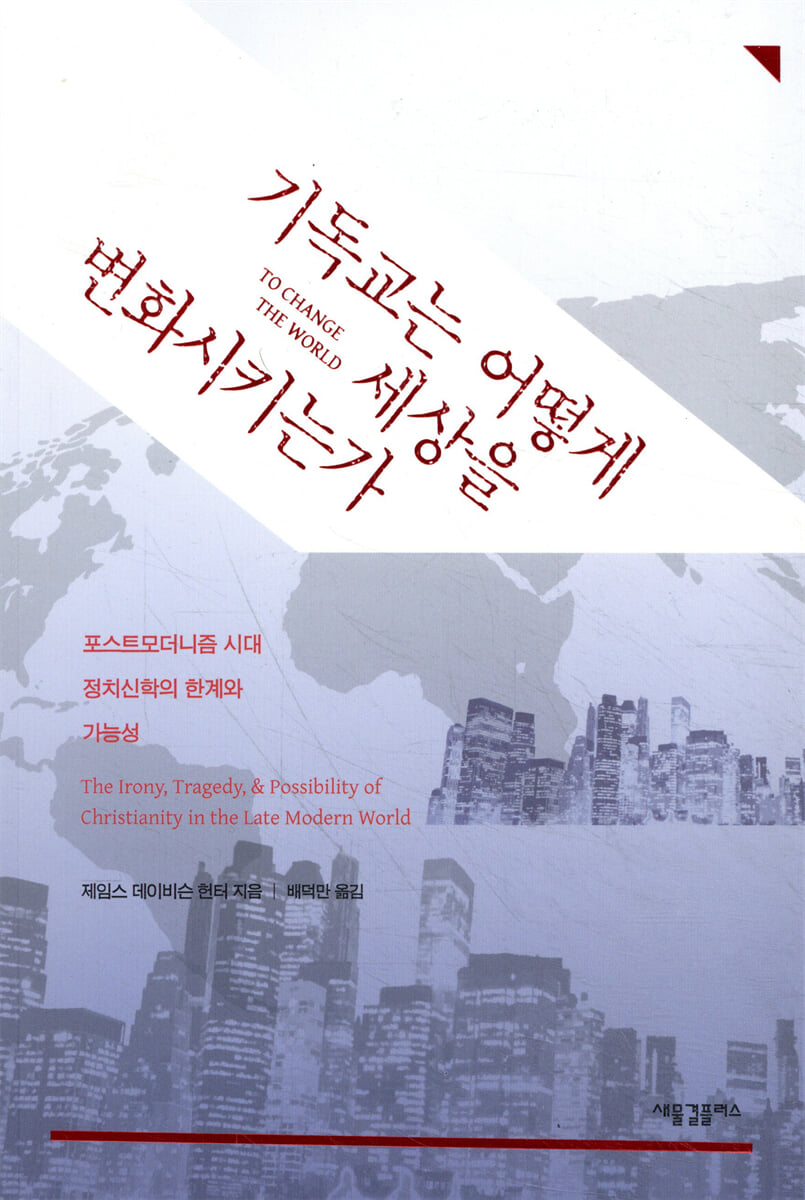
How Christianity Changes the World
 |
Description
Book Introduction
How should Christians behave in the world?
Presenting a new paradigm for world transformation that Christianity dreams of!
This book offers a scathing and thorough critique of the political theology of the Christian Right, the Christian Left, and the Neo-Anabaptists, including such respected leaders in American Christianity today as Charles Colson, Jim Wallis, and Stanley Hauerwas.
These three political theologies paradoxically exacerbate many of the problems they were designed to solve.
They even undermine the message of the gospel of Jesus Christ, which they cherish and wish to develop.
So how can Christians engage with culture today?
Hunter proposes a new paradigm called “faithful presence.”
The important thing is that it is based not on a desire to change the world, but on a desire to glorify God.
Hunter's argument is fresh and compelling, offering an excellent solution for any Christian who believes that Christianity should change the world for the better.
By the time readers close the final chapter of this book, their hearts will be racing with Hunter's insightful challenges and suggestions that defy familiar conventions.
Presenting a new paradigm for world transformation that Christianity dreams of!
This book offers a scathing and thorough critique of the political theology of the Christian Right, the Christian Left, and the Neo-Anabaptists, including such respected leaders in American Christianity today as Charles Colson, Jim Wallis, and Stanley Hauerwas.
These three political theologies paradoxically exacerbate many of the problems they were designed to solve.
They even undermine the message of the gospel of Jesus Christ, which they cherish and wish to develop.
So how can Christians engage with culture today?
Hunter proposes a new paradigm called “faithful presence.”
The important thing is that it is based not on a desire to change the world, but on a desire to glorify God.
Hunter's argument is fresh and compelling, offering an excellent solution for any Christian who believes that Christianity should change the world for the better.
By the time readers close the final chapter of this book, their hearts will be racing with Hunter's insightful challenges and suggestions that defy familiar conventions.
- You can preview some of the book's contents.
Preview
index
introduction
Part 1: Christianity and World Transformation
Chapter 1: Christian Faith and the Task of World Transformation
Chapter 2 Culture: Common Views
Chapter 3: The Failure of Common Views
Chapter 4: Alternative Views on Culture and Cultural Transformation:
11 propositions
Chapter 5: Evidence from History
Chapter 6: The Cultural Economy of American Christianity
Chapter 7: For and Against the Creation Mandate
Part 2: Rethinking Power
Chapter 1: The Problem of Power
Chapter 2 Power and Politics in American Culture
Chapter 3 The Christian Right
Chapter 4: The Christian Left
Chapter 5: Neo-Anabaptists
Chapter 6: Fantasy, Irony, and Tragedy
Chapter 7 Rethinking Power: A Theological Reflection
Part 3: Towards a New City Square:
Meditations on the Theology of Faithful Presence
Chapter 1: The Challenge of Faithfulness
Chapter 2: Old Cultural Wineskins
Chapter 3: Foundations for Alternative Paths
Chapter 4: Towards a Theology of Faithful Presence
Chapter 5: The Burden of Leadership: Practicing a Theology of Faithful Presence
Chapter 6 Towards a New City Square
main
References
Biographical Index
Part 1: Christianity and World Transformation
Chapter 1: Christian Faith and the Task of World Transformation
Chapter 2 Culture: Common Views
Chapter 3: The Failure of Common Views
Chapter 4: Alternative Views on Culture and Cultural Transformation:
11 propositions
Chapter 5: Evidence from History
Chapter 6: The Cultural Economy of American Christianity
Chapter 7: For and Against the Creation Mandate
Part 2: Rethinking Power
Chapter 1: The Problem of Power
Chapter 2 Power and Politics in American Culture
Chapter 3 The Christian Right
Chapter 4: The Christian Left
Chapter 5: Neo-Anabaptists
Chapter 6: Fantasy, Irony, and Tragedy
Chapter 7 Rethinking Power: A Theological Reflection
Part 3: Towards a New City Square:
Meditations on the Theology of Faithful Presence
Chapter 1: The Challenge of Faithfulness
Chapter 2: Old Cultural Wineskins
Chapter 3: Foundations for Alternative Paths
Chapter 4: Towards a Theology of Faithful Presence
Chapter 5: The Burden of Leadership: Practicing a Theology of Faithful Presence
Chapter 6 Towards a New City Square
main
References
Biographical Index
Into the book
This book is interested in various forms of Christianity.
It includes moderate and progressive groups within Catholicism and Protestantism, as well as conservative groups.
The theme of this book is the social imaginary that underpins the way most people in America who call themselves Christians engage with the world.
I argue that the dominant ways of thinking about culture and cultural change are flawed because they are based on specious social science and pragmatic theology.
Simply put, the model on which various strategies are based not only does not work, but cannot work.
Based on this working hypothesis, Christians cannot “change the world” in their diversity in the way they wish.
---From “Part 1, Chapter 1: Christian Faith and the Task of World Transformation”
Any tactics and strategies that attempt to change the world based on these fundamental theories of culture and cultural transformation will fail.
Most, if not all, will fail.
As I said at the beginning of this chapter, this is not to say that the renewal of one's mind and thoughts is not important.
This does not mean that worldview education is bad or that it does not have any positive effects.
Nor is this to say that social reform and political participation are worthless goals.
However, this does not mean that these are critical to the goal of changing the world.
So if we're really serious about changing the world, the first step is to abandon our conventional view of culture and cultural transformation and start from scratch.
---From "Chapter 3: Failure of a Shared View"
For most theological conservatives, the main challenge posed by the modern world was secularity.
Their solution, therefore, is the resacralization of society, that is, bringing God back into every sphere of social activity.
For most theological and political progressives, the primary challenge was inequality.
It is a problem that has expanded globally over the past two centuries as the imbalance of wealth and power under capitalism has deepened and become more international.
So, for progressives, the solution is a redistribution of wealth and power that prioritizes the poor and marginalized.
For many neo-Anabaptists, the most important challenge of our time is the violence and coercion that have become part of liberal democracy and global capitalism.
Therefore, their solution is koinonia, the peace-loving community of faith.
All these theological and political communities understand the challenges of the modern world in their own way.
This challenge was correctly identified as a problem, and at least the solution to it was correct.
But their mistake is to assume (explicitly or implicitly) that the challenge they witness is the only challenge (to the exclusion of others).
---From “Chapter 1, Part 3: The Challenge of Faithfulness”
All three of these paradigms have something important to say about the experience, life, identity, and witness of the church.
The concern for being “fit” for the world, “defensive” against the world, and “clean” from the world all speak in certain ways to genuinely biblical concerns.
But the desire to “fit in” with the world comes at the cost of sacrificing uniqueness.
The desire to be “defensive” about the world is rooted in the desire to preserve one’s uniqueness.
But this is expressed in a way that is both aggressive and hostile, and at the same time culturally banal and unimportant.
Finally, the desire to be “clean” from the world is associated with detachment and withdrawal rather than active participation in the vast sphere of social life.
Everyone wants to participate faithfully in the world, but they pursue that goal while minimizing the tension that arises from the call to be “in the world but not of the world.”
My point is not that all of these engagement paradigms are equally problematic, but that none of them is a sufficiently adequate way for us to understand or pursue faithfulness in the world.
---From "Chapter 2: Old Cultural Wineskins"
A theology of faithful presence is a theology that engages the world around us.
It is a theology of commitment and a theology of promise.
Although the theological concept is quite simple, its underlying implications challenge the dominant paradigm of the church's cultural engagement.
Fundamentally, a theology of faithful presence begins with the recognition that God is faithfully present to us and that our calling to him is to faithfully participate in his presence.
---From “Chapter 4: Towards a Theology of Faithful Presence”
Faithful presence means that we must be fully present to one another in our faith community and to those who are not present.
Whether we are within the community of believers or outside the church, we are to imitate our Creator and Savior.
That is, we must seek each other, identify with each other, and adjust our lives to flourish through each other's sacrificial love.
It includes moderate and progressive groups within Catholicism and Protestantism, as well as conservative groups.
The theme of this book is the social imaginary that underpins the way most people in America who call themselves Christians engage with the world.
I argue that the dominant ways of thinking about culture and cultural change are flawed because they are based on specious social science and pragmatic theology.
Simply put, the model on which various strategies are based not only does not work, but cannot work.
Based on this working hypothesis, Christians cannot “change the world” in their diversity in the way they wish.
---From “Part 1, Chapter 1: Christian Faith and the Task of World Transformation”
Any tactics and strategies that attempt to change the world based on these fundamental theories of culture and cultural transformation will fail.
Most, if not all, will fail.
As I said at the beginning of this chapter, this is not to say that the renewal of one's mind and thoughts is not important.
This does not mean that worldview education is bad or that it does not have any positive effects.
Nor is this to say that social reform and political participation are worthless goals.
However, this does not mean that these are critical to the goal of changing the world.
So if we're really serious about changing the world, the first step is to abandon our conventional view of culture and cultural transformation and start from scratch.
---From "Chapter 3: Failure of a Shared View"
For most theological conservatives, the main challenge posed by the modern world was secularity.
Their solution, therefore, is the resacralization of society, that is, bringing God back into every sphere of social activity.
For most theological and political progressives, the primary challenge was inequality.
It is a problem that has expanded globally over the past two centuries as the imbalance of wealth and power under capitalism has deepened and become more international.
So, for progressives, the solution is a redistribution of wealth and power that prioritizes the poor and marginalized.
For many neo-Anabaptists, the most important challenge of our time is the violence and coercion that have become part of liberal democracy and global capitalism.
Therefore, their solution is koinonia, the peace-loving community of faith.
All these theological and political communities understand the challenges of the modern world in their own way.
This challenge was correctly identified as a problem, and at least the solution to it was correct.
But their mistake is to assume (explicitly or implicitly) that the challenge they witness is the only challenge (to the exclusion of others).
---From “Chapter 1, Part 3: The Challenge of Faithfulness”
All three of these paradigms have something important to say about the experience, life, identity, and witness of the church.
The concern for being “fit” for the world, “defensive” against the world, and “clean” from the world all speak in certain ways to genuinely biblical concerns.
But the desire to “fit in” with the world comes at the cost of sacrificing uniqueness.
The desire to be “defensive” about the world is rooted in the desire to preserve one’s uniqueness.
But this is expressed in a way that is both aggressive and hostile, and at the same time culturally banal and unimportant.
Finally, the desire to be “clean” from the world is associated with detachment and withdrawal rather than active participation in the vast sphere of social life.
Everyone wants to participate faithfully in the world, but they pursue that goal while minimizing the tension that arises from the call to be “in the world but not of the world.”
My point is not that all of these engagement paradigms are equally problematic, but that none of them is a sufficiently adequate way for us to understand or pursue faithfulness in the world.
---From "Chapter 2: Old Cultural Wineskins"
A theology of faithful presence is a theology that engages the world around us.
It is a theology of commitment and a theology of promise.
Although the theological concept is quite simple, its underlying implications challenge the dominant paradigm of the church's cultural engagement.
Fundamentally, a theology of faithful presence begins with the recognition that God is faithfully present to us and that our calling to him is to faithfully participate in his presence.
---From “Chapter 4: Towards a Theology of Faithful Presence”
Faithful presence means that we must be fully present to one another in our faith community and to those who are not present.
Whether we are within the community of believers or outside the church, we are to imitate our Creator and Savior.
That is, we must seek each other, identify with each other, and adjust our lives to flourish through each other's sacrificial love.
---From "Chapter 6: Towards a New City Square"
Publisher's Review
How should Christians behave in the world?
Presenting a new paradigm for world transformation, a dream of Christianity!
Christianity teaches Christians a calling to make the world a better place than it is now.
Faithful Christians who have received this calling try to transform the fallen world's culture according to God's will, but they often fail and become discouraged.
How can we live lives more faithfully obeying and practicing the Great Commission Jesus commanded? In this book, James Davidson Hunter offers a compelling answer to this question.
First, Hunter sharply analyzes the most popular models for pursuing world transformation within Christianity.
He categorizes the common premises and characteristics of each model and explores the nature of power and politics as they appear in Christian life and thought.
Most Christian models of world transformation are built on the belief that Christianity can transform a morally corrupt world culture by changing people's hearts and minds.
But Hunter argues that popular models are inherently corrupt and incapable of creating world change.
Political power is hidden in every Christian strategy for bringing about world transformation.
This book offers a scathing and thorough critique of the political theology of the Christian Right, the Christian Left, and the Neo-Anabaptists, including such respected leaders in American Christianity today as Charles Colson, Jim Wallis, and Stanley Hauerwas.
These three political theologies paradoxically exacerbate many of the problems they were designed to solve.
They even undermine the message of the gospel of Jesus Christ, which they cherish and wish to develop.
So how can Christians engage with culture today?
Hunter proposes a new paradigm called “faithful presence.”
The important thing is that it is based not on a desire to change the world, but on a desire to glorify God.
Hunter's argument is fresh and compelling, offering an excellent solution for any Christian who believes that Christianity should change the world for the better.
By the time readers close the final chapter of this book, their hearts will be racing with Hunter's insightful challenges and suggestions that defy familiar conventions.
Presenting a new paradigm for world transformation, a dream of Christianity!
Christianity teaches Christians a calling to make the world a better place than it is now.
Faithful Christians who have received this calling try to transform the fallen world's culture according to God's will, but they often fail and become discouraged.
How can we live lives more faithfully obeying and practicing the Great Commission Jesus commanded? In this book, James Davidson Hunter offers a compelling answer to this question.
First, Hunter sharply analyzes the most popular models for pursuing world transformation within Christianity.
He categorizes the common premises and characteristics of each model and explores the nature of power and politics as they appear in Christian life and thought.
Most Christian models of world transformation are built on the belief that Christianity can transform a morally corrupt world culture by changing people's hearts and minds.
But Hunter argues that popular models are inherently corrupt and incapable of creating world change.
Political power is hidden in every Christian strategy for bringing about world transformation.
This book offers a scathing and thorough critique of the political theology of the Christian Right, the Christian Left, and the Neo-Anabaptists, including such respected leaders in American Christianity today as Charles Colson, Jim Wallis, and Stanley Hauerwas.
These three political theologies paradoxically exacerbate many of the problems they were designed to solve.
They even undermine the message of the gospel of Jesus Christ, which they cherish and wish to develop.
So how can Christians engage with culture today?
Hunter proposes a new paradigm called “faithful presence.”
The important thing is that it is based not on a desire to change the world, but on a desire to glorify God.
Hunter's argument is fresh and compelling, offering an excellent solution for any Christian who believes that Christianity should change the world for the better.
By the time readers close the final chapter of this book, their hearts will be racing with Hunter's insightful challenges and suggestions that defy familiar conventions.
GOODS SPECIFICS
- Date of issue: July 30, 2014
- Page count, weight, size: 500 pages | 743g | 153*224*23mm
- ISBN13: 9788994752747
- ISBN10: 8994752749
You may also like
카테고리
korean


korean

![GQ KOREA Mark (Monthly): December [2025]](http://librairie.coreenne.fr/cdn/shop/files/8ef265dbbfbf186523ed75ba7319009d.jpg?v=1765340328&width=3840)


