

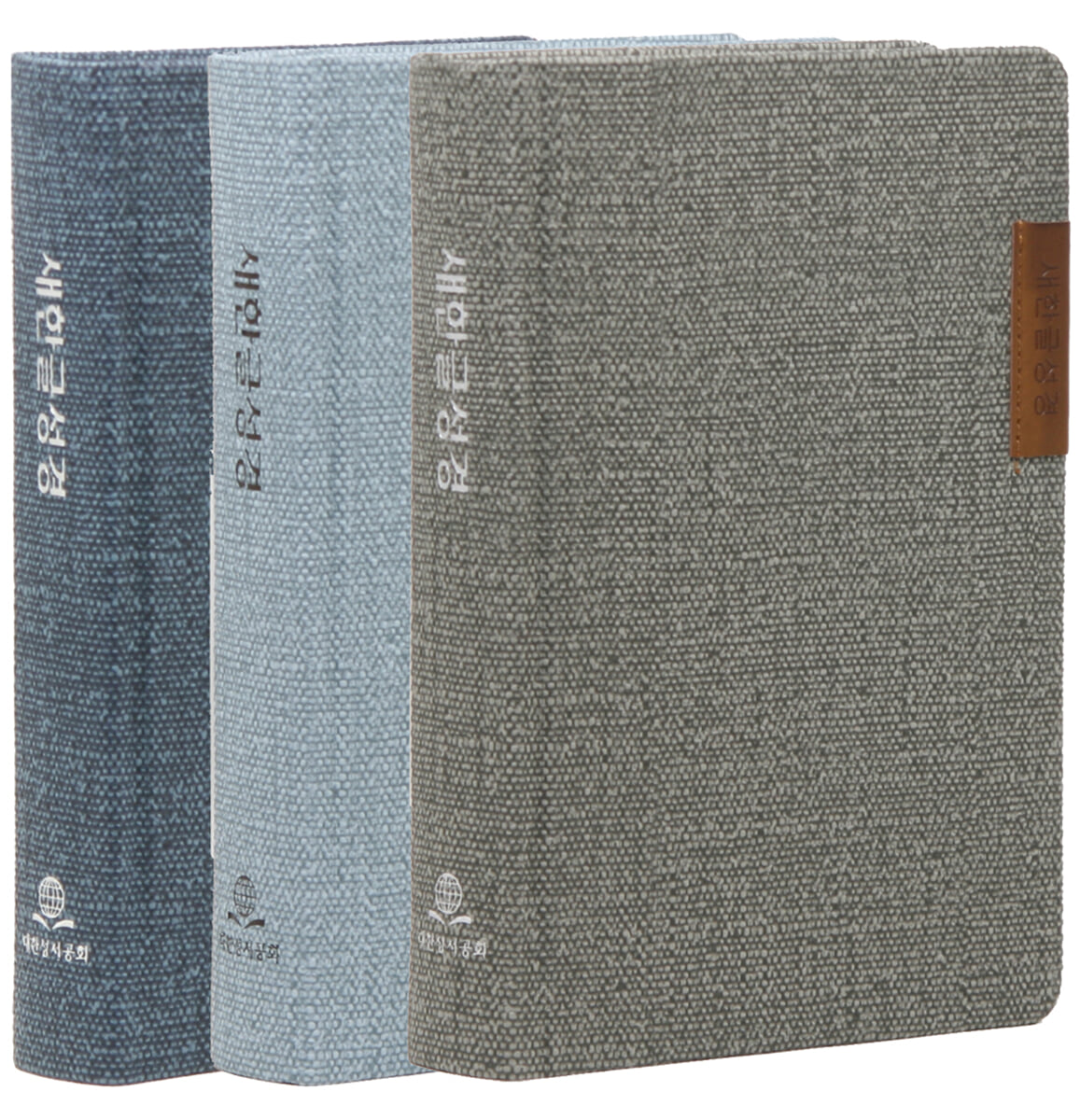
New Korean Bible NKT73TI (Middle/Single/Crescent Index/Hardcover/Kanapa/Wrapping)
 |
Description
Book Introduction
Authorized Version Bible
This Bible was published by the Korean Bible Society for the next generation, and was translated over 12 years by 30 Bible scholars and 3 Korean language scholars from various denominations through several stages.
The "New Korean Bible," the official translation of the Bible for the next generation, was completed over 12 years through several stages of translation by 36 Bible scholars and 3 Korean language scholars from various denominations.
The Bible Society of Korea has prepared the "New Korean Bible," a new translation faithful to the original text while also conforming to Korean grammar, to help Sunday school students and young people more easily understand the Bible and apply it to their lives.
The newly published "New Korean Bible" can be read alongside the "Revised Version of the Bible" or other existing translations to help you better understand the rich meaning and atmosphere of the original Hebrew text of the Old Testament and the original Greek text of the New Testament.
We expect it to be particularly useful for pastors for comparing translations, for laypeople for home worship, and for children and youth for educational purposes.
This Bible was published by the Korean Bible Society for the next generation, and was translated over 12 years by 30 Bible scholars and 3 Korean language scholars from various denominations through several stages.
The "New Korean Bible," the official translation of the Bible for the next generation, was completed over 12 years through several stages of translation by 36 Bible scholars and 3 Korean language scholars from various denominations.
The Bible Society of Korea has prepared the "New Korean Bible," a new translation faithful to the original text while also conforming to Korean grammar, to help Sunday school students and young people more easily understand the Bible and apply it to their lives.
The newly published "New Korean Bible" can be read alongside the "Revised Version of the Bible" or other existing translations to help you better understand the rich meaning and atmosphere of the original Hebrew text of the Old Testament and the original Greek text of the New Testament.
We expect it to be particularly useful for pastors for comparing translations, for laypeople for home worship, and for children and youth for educational purposes.
Detailed image

Publisher's Review
Translation Features of the New Korean Bible
1.
Long sentences in the original text should be divided into several shorter sentences and translated. If possible, each sentence should be no longer than 50 characters or 16 words, making it suitable for reading on digital media.
2.
The translation preserves the characteristics of the original text's literary genre as much as possible, allowing the original text's diverse writing style to be revealed in the translation.
In particular, poetry is translated in a way that maximizes the formal characteristics of the original text so that its meaning and rhythm can come alive.
3.
Instead of using the old-style ending '-neura', use the modern Korean ending '-ida/-hada', but when necessary, use '-iteum/-hada'.
4.
The dialogue is translated into spoken language appropriate to the situation, and honorifics are used in accordance with Korean grammar.
Jesus' words to the public are written in the formal 'hasacheoche' style, while his prayers and words to individuals are written in the more intimate 'hayoche' style.
In the Psalms, different endings are used depending on whether it is a prayer to God, a conversation with oneself, or a speech to others. In the prophetic books, different endings are used depending on the words of the prophet, the words of God, and the words of the people.
5.
If part of a sentence is emphasized in the original text through changes in word order, etc., this should be reflected as much as possible in the translation.
6.
Words that were used in the past but are not widely used today are translated by finding new words and expressions used by young people today, if possible. When necessary, traditional translations are indicated in parentheses or in footnotes.
7.
In the case of texts where it is difficult to convey the meaning due to differences in language or culture, the meaning shall be translated so that it is understandable, but the exact expression of the original text shall be indicated in a footnote.
8.
Metaphors and euphemisms in the original text are translated so that their meaning is understandable, and expressions that are literal in the original text are indicated in footnotes.
9.
Words or expressions that are derogatory to women, the disabled, patients, or people from certain social classes are translated into their official, commonly used terms unless the context requires it.
10.
Convert weights and measures (weight, length, volume, etc.), currency units, time, and days of the week into familiar terms that can be understood by Korean speakers in the multimedia age.
However, if it is more familiar and concise to translate it according to the original text's units, such as talents or denarius, then translate it according to the original text's units.
11.
Numbers appearing outside of the text should be written in Arabic numerals unless it is too awkward or impossible.
12.
The Korean phonetic transcription of proper nouns respects the phonetic transcription of the Revised Version of the Bible, but the words in elementary, middle, and high school textbooks follow the 'Foreign Language Spelling' regulations of the National Institute of the Korean Language.
13.
Punctuation follows the current 'Korean Spelling' rules.
14.
Footnotes are concise in print, but more extensive and detailed in digital media.
15.
The most recent critical edition of the original text is used as the translation script.
For the Old Testament, the 5th edition (1997) of the Biblia Hebraica Stuttgartensia (BHS) is used as the text, and the Biblia Hebraica Quinta (BHQ, published individually) and the Hebrew University Bible are referenced.
For the New Testament, the 5th edition (2014) of the United Bible Societies' Greek New Testament (GNT) and the 28th edition (2012) of Nestlé-Aland's Greek New Testament (NTG) are used as the texts, and the Comparative Critical Version of the Greek New Testament is also used.
16.
Refer to new translation trends that have appeared in recent Western foreign language translations or revised editions published, especially in the 2000s.
1.
Long sentences in the original text should be divided into several shorter sentences and translated. If possible, each sentence should be no longer than 50 characters or 16 words, making it suitable for reading on digital media.
2.
The translation preserves the characteristics of the original text's literary genre as much as possible, allowing the original text's diverse writing style to be revealed in the translation.
In particular, poetry is translated in a way that maximizes the formal characteristics of the original text so that its meaning and rhythm can come alive.
3.
Instead of using the old-style ending '-neura', use the modern Korean ending '-ida/-hada', but when necessary, use '-iteum/-hada'.
4.
The dialogue is translated into spoken language appropriate to the situation, and honorifics are used in accordance with Korean grammar.
Jesus' words to the public are written in the formal 'hasacheoche' style, while his prayers and words to individuals are written in the more intimate 'hayoche' style.
In the Psalms, different endings are used depending on whether it is a prayer to God, a conversation with oneself, or a speech to others. In the prophetic books, different endings are used depending on the words of the prophet, the words of God, and the words of the people.
5.
If part of a sentence is emphasized in the original text through changes in word order, etc., this should be reflected as much as possible in the translation.
6.
Words that were used in the past but are not widely used today are translated by finding new words and expressions used by young people today, if possible. When necessary, traditional translations are indicated in parentheses or in footnotes.
7.
In the case of texts where it is difficult to convey the meaning due to differences in language or culture, the meaning shall be translated so that it is understandable, but the exact expression of the original text shall be indicated in a footnote.
8.
Metaphors and euphemisms in the original text are translated so that their meaning is understandable, and expressions that are literal in the original text are indicated in footnotes.
9.
Words or expressions that are derogatory to women, the disabled, patients, or people from certain social classes are translated into their official, commonly used terms unless the context requires it.
10.
Convert weights and measures (weight, length, volume, etc.), currency units, time, and days of the week into familiar terms that can be understood by Korean speakers in the multimedia age.
However, if it is more familiar and concise to translate it according to the original text's units, such as talents or denarius, then translate it according to the original text's units.
11.
Numbers appearing outside of the text should be written in Arabic numerals unless it is too awkward or impossible.
12.
The Korean phonetic transcription of proper nouns respects the phonetic transcription of the Revised Version of the Bible, but the words in elementary, middle, and high school textbooks follow the 'Foreign Language Spelling' regulations of the National Institute of the Korean Language.
13.
Punctuation follows the current 'Korean Spelling' rules.
14.
Footnotes are concise in print, but more extensive and detailed in digital media.
15.
The most recent critical edition of the original text is used as the translation script.
For the Old Testament, the 5th edition (1997) of the Biblia Hebraica Stuttgartensia (BHS) is used as the text, and the Biblia Hebraica Quinta (BHQ, published individually) and the Hebrew University Bible are referenced.
For the New Testament, the 5th edition (2014) of the United Bible Societies' Greek New Testament (GNT) and the 28th edition (2012) of Nestlé-Aland's Greek New Testament (NTG) are used as the texts, and the Comparative Critical Version of the Greek New Testament is also used.
16.
Refer to new translation trends that have appeared in recent Western foreign language translations or revised editions published, especially in the 2000s.
GOODS SPECIFICS
- Date of issue: July 30, 2025
- Page count, weight, size: 1,600 pages | 683g | 138*199*37mm
- ISBN13: 9788941250494
- ISBN10: 8941250498
You may also like
카테고리
korean


korean

![GQ KOREA Mark (Monthly): December [2025]](http://librairie.coreenne.fr/cdn/shop/files/8ef265dbbfbf186523ed75ba7319009d.jpg?v=1765340328&width=3840)


