

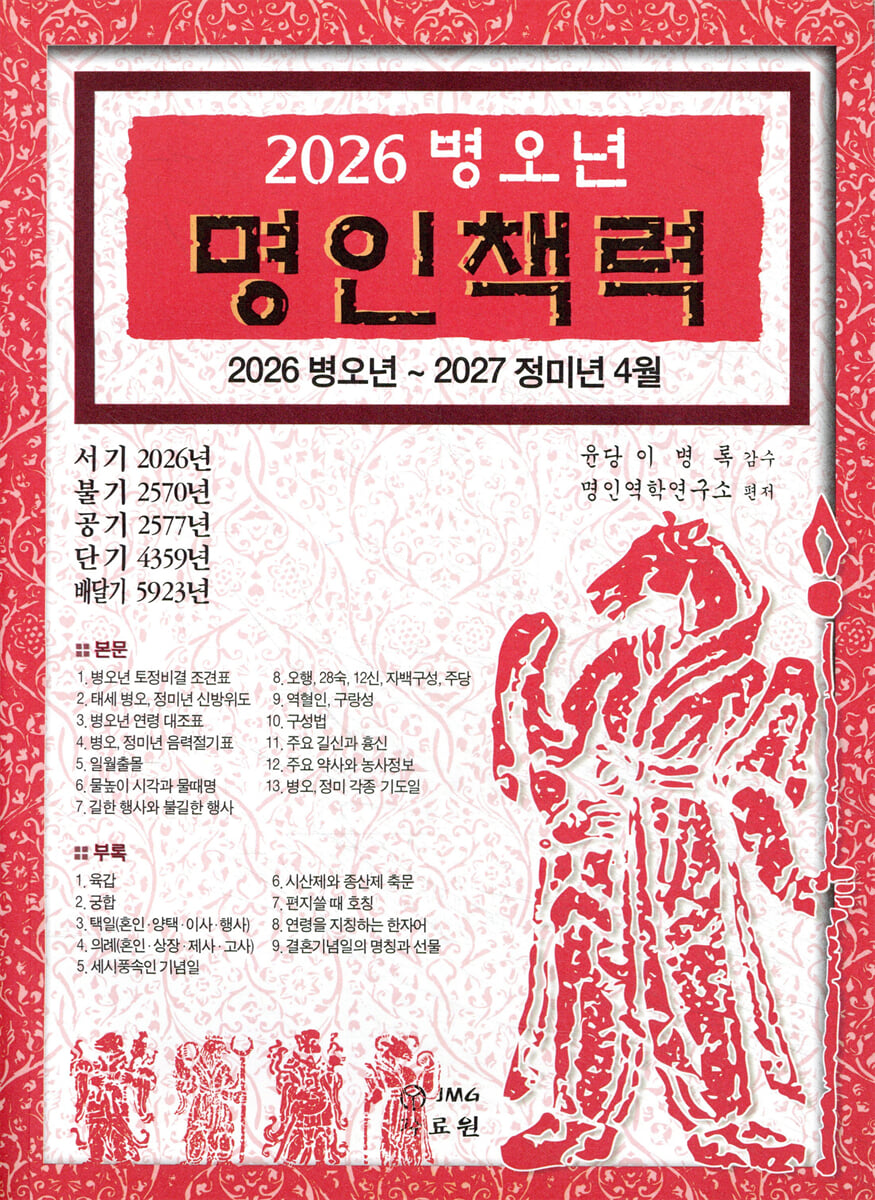
2026 Byung-o Year Myungin Book of Changes
 |
Description
Book Introduction
A new calendar containing various monthly prayer days and ancestral rites for the year 2026?
The new Myungin Book of Fortune for the year 2026, Byung-o, has been released.
The 『2026 Byeong-o Year Myeong-in Book of Changes』 published by the Myeong-in Institute of Divination was supervised by Mr. Lee Byeong-rok of Yundang and supervised by Mr. Kim Cheol-hoe of Jisong and Mr. Kim Du-jeong of Myeong-in. It covers a total of 16 months until April of the year of Jeongmi in 2027, including ▷Tojeong Bigyeol Jogyeonpyo, ▷New direction chart, ▷Age comparison table, ▷Sunrise and sunset, ▷Water level time and tide name, ▷Auspicious and inauspicious events, ▷Five elements, 28 constellations, 12 gods, Jabak composition, Judang, ▷Yeokhyeol-in, Gurangseong, ▷Composition method, ▷Major auspicious and inauspicious gods, ▷Major pharmacists and farming information, ▷Various prayer days for the years of Byeong-o and Jeongmi, etc., organized in an easy-to-see and understandable manner.
The previous 12-month text has been expanded to include 4 more months of content, up to April of the year of the Jeongmi, for a total of 16 months.
The appendix, which contains easy-to-understand Korean summary of essential ceremonial forms used in the daily lives of modern people, as well as ceremonies for childbirth, adulthood, marriage, weddings, ancestral rites, and ancestral rites, is also a valuable resource for family life.
In particular, in the fields of shamanism, fortune telling, and traditional folklore, such as the six gap-o elements, compatibility between men and women, choosing a wedding date, choosing a prayer date, choosing a moving date, and other large and small events within the household, as well as groundbreaking ceremonies, completion ceremonies, opening ceremonies, and unveiling ceremonies for various buildings and facilities, the Chinese congratulatory messages for traditional ancestral rites, Korean congratulatory messages for the new generation, and congratulatory messages for sisanje and jongsanje are so well organized that even professional fortune tellers should keep one or two copies at the head of their desks and refer to them frequently.
The agricultural cooperatives affiliated with local governments across the country and the Jeju Hyanggyo have adopted it as a teaching tool and are using it to educate workers in related fields and for events such as weddings, moving, and choosing a day for prayer.
The new Myungin Book of Fortune for the year 2026, Byung-o, has been released.
The 『2026 Byeong-o Year Myeong-in Book of Changes』 published by the Myeong-in Institute of Divination was supervised by Mr. Lee Byeong-rok of Yundang and supervised by Mr. Kim Cheol-hoe of Jisong and Mr. Kim Du-jeong of Myeong-in. It covers a total of 16 months until April of the year of Jeongmi in 2027, including ▷Tojeong Bigyeol Jogyeonpyo, ▷New direction chart, ▷Age comparison table, ▷Sunrise and sunset, ▷Water level time and tide name, ▷Auspicious and inauspicious events, ▷Five elements, 28 constellations, 12 gods, Jabak composition, Judang, ▷Yeokhyeol-in, Gurangseong, ▷Composition method, ▷Major auspicious and inauspicious gods, ▷Major pharmacists and farming information, ▷Various prayer days for the years of Byeong-o and Jeongmi, etc., organized in an easy-to-see and understandable manner.
The previous 12-month text has been expanded to include 4 more months of content, up to April of the year of the Jeongmi, for a total of 16 months.
The appendix, which contains easy-to-understand Korean summary of essential ceremonial forms used in the daily lives of modern people, as well as ceremonies for childbirth, adulthood, marriage, weddings, ancestral rites, and ancestral rites, is also a valuable resource for family life.
In particular, in the fields of shamanism, fortune telling, and traditional folklore, such as the six gap-o elements, compatibility between men and women, choosing a wedding date, choosing a prayer date, choosing a moving date, and other large and small events within the household, as well as groundbreaking ceremonies, completion ceremonies, opening ceremonies, and unveiling ceremonies for various buildings and facilities, the Chinese congratulatory messages for traditional ancestral rites, Korean congratulatory messages for the new generation, and congratulatory messages for sisanje and jongsanje are so well organized that even professional fortune tellers should keep one or two copies at the head of their desks and refer to them frequently.
The agricultural cooperatives affiliated with local governments across the country and the Jeju Hyanggyo have adopted it as a teaching tool and are using it to educate workers in related fields and for events such as weddings, moving, and choosing a day for prayer.
index
1.
Year of the Ox Tojeong Bigyeol Jogyeonpyo
2.
Taese Byeong-o, Jeongmi-nyeon Shinbangwido
3.
Byung-o year age group chart
4.
Lunar calendar for the year of Byung-o and Jeong-mi
5.
sunrise and sunset, moonrise and sunset
6.
Water level time and tide name
7.
Auspicious and inauspicious events
8.
Five elements, 28 constellations, 12 gods, self-confession, and divination
9.
Bloodthirsty, Gurangseong
10.
Composition
11.
Major auspicious and inauspicious gods
12.
Key pharmacists and agricultural information
13.
Various prayer days in the year of Byung-o and Jeong-mi
supplement?
1.
Six armors
2.
Compatibility
3.
Choosing a date (wedding, moving, event)
4.
Ceremonies (weddings, funerals, ancestral rites, and ancestral rites)
5.
Seasonal customs and anniversaries
6.
Prayers for the ancestral rites and the ancestral rites
7.
Title when writing a letter
8.
Chinese characters indicating age
9.
Wedding Anniversary Names and Gifts
Year of the Ox Tojeong Bigyeol Jogyeonpyo
2.
Taese Byeong-o, Jeongmi-nyeon Shinbangwido
3.
Byung-o year age group chart
4.
Lunar calendar for the year of Byung-o and Jeong-mi
5.
sunrise and sunset, moonrise and sunset
6.
Water level time and tide name
7.
Auspicious and inauspicious events
8.
Five elements, 28 constellations, 12 gods, self-confession, and divination
9.
Bloodthirsty, Gurangseong
10.
Composition
11.
Major auspicious and inauspicious gods
12.
Key pharmacists and agricultural information
13.
Various prayer days in the year of Byung-o and Jeong-mi
supplement?
1.
Six armors
2.
Compatibility
3.
Choosing a date (wedding, moving, event)
4.
Ceremonies (weddings, funerals, ancestral rites, and ancestral rites)
5.
Seasonal customs and anniversaries
6.
Prayers for the ancestral rites and the ancestral rites
7.
Title when writing a letter
8.
Chinese characters indicating age
9.
Wedding Anniversary Names and Gifts
Into the book
An example of a traditional Chinese congratulatory message for a ancestral rite?
Building? Facility groundbreaking ceremony congratulatory message?
維
you
歲次 壬辰 (week ①) 7 months (week ②) 丁酉 (week ③) 朔 seven days (week ④) 癸卯 (week ⑤)
Secha Imjin July 7th Jeongyu Sak Seventh Day Gyeyu
Confucianism ○○○(Note⑥) 敢昭告于
Studying abroad ○○○ reduction high school
God of the Earth 今爲 607-12 Ganseok 4-dong, Namdong-gu, Incheon Metropolitan City (Main ⑦)
Land Guardian Geumwi, 607-12, Ganseok 4-dong, Namdong-gu, Incheon
○○○ Building (Co. ⑧) 起工 God's family trust ? No later date 仍舊是依 永久保全 尙
○○○ Building Groundbreaking Ceremony, Shin Gi-bou, Bimuhugan, Ingushi's Permanent Preservation Award
饗
incense
Three bows = Heaven, Earth, and Man (After reciting the prayer in the ⑨th paragraph, bow three times (Heaven, Earth, and Man))
Sambae = Heaven, Earth, and Man
Week ①: 12 Ganji of the current year
Week 2: The month of the exam
Week ③: The first day of the month of the exam
Week 4: The day of the exam
Week 5: (Day of the exam)
Note 6: Enter the names of the deceased, Jeju, etc.
Note ⑦: Enter the administrative address of the building facility in question.
Note ⑧: Enter the name of the building facility in question.
Note 9: After reciting the prayer, bow three times (Heaven? Earth? Man)
※ The above [Yundang Prayer] is a Chinese prayer written by Mr. Lee Byeong-rok, the editor of this book, for use at the site of various ancestral rites at the request of visitors to the philosophy center while running the Yundang Gimun Dun-gap Philosophy Center for several decades. The copyright belongs to the Myeongin Book Research Institute and Mr. Lee Byeong-rok, and all or part of this prayer cannot be copied or reproduced without the permission of the publisher and the author, except for the purpose of being used for ancestral rites by the holders (readers) of this book.
Building? Facility Completion Ceremony
維
you
歲次 壬辰 (week ①) 7 months (week ②) 丁酉 (week ③) 朔 seven days (week ④) 癸卯 (week ⑤)
Secha Imjin July 7th Jeongyu Sak Seventh Day Gyeyu
Confucianism ○○○(Note⑥) 敢昭告于
Studying abroad ○○○ reduction high school
God of the Earth 今爲 607-12 Ganseok 4-dong, Namdong-gu, Incheon Metropolitan City (Main ⑦)
Land Guardian Geumwi, 607-12, Ganseok 4-dong, Namdong-gu, Incheon
○○○ Building (Note ⑧) 成主大聖 ? King's God ?
○○○ Building Seongjudaeseong Jowangjisin Shingibou Bimuhugan Geunicheonjak Gongsinjeonheon Sang
饗
incense
Three bows = Heaven, Earth, and Man (After reciting the prayer in the ⑨th paragraph, bow three times (Heaven, Earth, and Man))
Sambae = Heaven, Earth, and Man
Week ①: 12 Ganji of the current year
Week 2: The month of the exam
Week ③: The first day of the month of the exam
Week 4: The day of the exam
Week 5: (Day of the exam)
Note 6: Enter the names of the deceased, Jeju, etc.
Note 7: Enter the administrative address of the building where the housewarming ceremony is held.
Note ⑧: Enter the name of the building where the housewarming, opening, or unification ceremony is held.
Note 9: After reciting the prayer, bow three times (Heaven? Earth? Man)
※ The above [Yundang Prayer] is a Chinese prayer written by Mr. Lee Byeong-rok, the editor of this book, for use at the site of various ancestral rites at the request of visitors to the philosophy center while running the Yundang Gimun Dun-gap Philosophy Center for several decades. The copyright belongs to the Myeongin Book Research Institute and Mr. Lee Byeong-rok, and all or part of this prayer cannot be copied or reproduced without the permission of the publisher and the author, except for the purpose of being used for ancestral rites by the holders (readers) of this book.
Find a prayer day for the first lunar month of 2026 (year of the Ox) (choose a day)
?
* Good and bad days for ancestral rites: Good and bad days for all ancestral rites.
Lucky days: 2nd, 4th, 6th, 7th, 9th, 10th, 12th, 14th, 16th.
Bad day: 5th.?
* Good and bad days for prayer: Good and bad days for all prayers.
Lucky days: 4th, 6th, 7th, 9th, 10th, 12th, 16th.
Bad days: December 22nd, December 28th.
* Good days for offering Buddhist offerings: Good days and bad days for offering Buddhist offerings.
Lucky days: 3rd, 4th, 5th, 9th, 13th.
Bad days: 6th, 14th.
* Good and bad days for mountain rites: Good and bad days for mountain rites or mountain climbing.
Lucky days: 4th, 6th, 7th, 11th, 13th, 14th.
Bad days: 2nd, 10th.?
* Good and bad days for offering sacrifices to the guardian deity: Good and bad days for offering sacrifices to the guardian deity.
Lucky days: 6th, 7th, 9th, 10th, 12th.
Bad day: December 28th.
* Good and bad days for offering sacrifices to the Earth God: Good and bad days for offering sacrifices to the Earth God.
Lucky days: 3rd, 15th.
Bad day: 13th.?
* Good and bad days for praying to the sky and mountains: Good and bad days for praying to the sky and mountains.
Lucky days: 3rd, 7th, 11th, 12th, 13th, 14th, 15th.
* New Year's Day: A good day to pray at a shrine or shrine where a spirit tablet is enshrined.
Lucky days: 1st, 3rd, 4th, 7th, 8th, 14th, 15th, 16th.
?* Opening day of the new statue: A good day to carve and draw a statue of the new statue and erect it.
Lucky days: 7th, 14th.
?
* Inauspicious days for merger:
A bad day for a child born from a union.
Bad days: 1st, 3rd, 8th, 14th, 15th, 16th, eclipse, moon eclipse, heat wave, heavy rain, thick fog, thunder, lightning, rainbow, earthquake, Honmiya day.
?* Landlord's descent day: If you commit a crime here, it will be an inauspicious day.
Bad day: 1st kitchen(?).
?
* Day of the Kitchen God Assembly: A good day to offer sacrifices to the Kitchen God.
Lucky days: 6th, 12th.
?
* Jo-wang Sangcheon-il: A good day to repair the kitchen.
Lucky day: 4th.
Building? Facility groundbreaking ceremony congratulatory message?
維
you
歲次 壬辰 (week ①) 7 months (week ②) 丁酉 (week ③) 朔 seven days (week ④) 癸卯 (week ⑤)
Secha Imjin July 7th Jeongyu Sak Seventh Day Gyeyu
Confucianism ○○○(Note⑥) 敢昭告于
Studying abroad ○○○ reduction high school
God of the Earth 今爲 607-12 Ganseok 4-dong, Namdong-gu, Incheon Metropolitan City (Main ⑦)
Land Guardian Geumwi, 607-12, Ganseok 4-dong, Namdong-gu, Incheon
○○○ Building (Co. ⑧) 起工 God's family trust ? No later date 仍舊是依 永久保全 尙
○○○ Building Groundbreaking Ceremony, Shin Gi-bou, Bimuhugan, Ingushi's Permanent Preservation Award
饗
incense
Three bows = Heaven, Earth, and Man (After reciting the prayer in the ⑨th paragraph, bow three times (Heaven, Earth, and Man))
Sambae = Heaven, Earth, and Man
Week ①: 12 Ganji of the current year
Week 2: The month of the exam
Week ③: The first day of the month of the exam
Week 4: The day of the exam
Week 5: (Day of the exam)
Note 6: Enter the names of the deceased, Jeju, etc.
Note ⑦: Enter the administrative address of the building facility in question.
Note ⑧: Enter the name of the building facility in question.
Note 9: After reciting the prayer, bow three times (Heaven? Earth? Man)
※ The above [Yundang Prayer] is a Chinese prayer written by Mr. Lee Byeong-rok, the editor of this book, for use at the site of various ancestral rites at the request of visitors to the philosophy center while running the Yundang Gimun Dun-gap Philosophy Center for several decades. The copyright belongs to the Myeongin Book Research Institute and Mr. Lee Byeong-rok, and all or part of this prayer cannot be copied or reproduced without the permission of the publisher and the author, except for the purpose of being used for ancestral rites by the holders (readers) of this book.
Building? Facility Completion Ceremony
維
you
歲次 壬辰 (week ①) 7 months (week ②) 丁酉 (week ③) 朔 seven days (week ④) 癸卯 (week ⑤)
Secha Imjin July 7th Jeongyu Sak Seventh Day Gyeyu
Confucianism ○○○(Note⑥) 敢昭告于
Studying abroad ○○○ reduction high school
God of the Earth 今爲 607-12 Ganseok 4-dong, Namdong-gu, Incheon Metropolitan City (Main ⑦)
Land Guardian Geumwi, 607-12, Ganseok 4-dong, Namdong-gu, Incheon
○○○ Building (Note ⑧) 成主大聖 ? King's God ?
○○○ Building Seongjudaeseong Jowangjisin Shingibou Bimuhugan Geunicheonjak Gongsinjeonheon Sang
饗
incense
Three bows = Heaven, Earth, and Man (After reciting the prayer in the ⑨th paragraph, bow three times (Heaven, Earth, and Man))
Sambae = Heaven, Earth, and Man
Week ①: 12 Ganji of the current year
Week 2: The month of the exam
Week ③: The first day of the month of the exam
Week 4: The day of the exam
Week 5: (Day of the exam)
Note 6: Enter the names of the deceased, Jeju, etc.
Note 7: Enter the administrative address of the building where the housewarming ceremony is held.
Note ⑧: Enter the name of the building where the housewarming, opening, or unification ceremony is held.
Note 9: After reciting the prayer, bow three times (Heaven? Earth? Man)
※ The above [Yundang Prayer] is a Chinese prayer written by Mr. Lee Byeong-rok, the editor of this book, for use at the site of various ancestral rites at the request of visitors to the philosophy center while running the Yundang Gimun Dun-gap Philosophy Center for several decades. The copyright belongs to the Myeongin Book Research Institute and Mr. Lee Byeong-rok, and all or part of this prayer cannot be copied or reproduced without the permission of the publisher and the author, except for the purpose of being used for ancestral rites by the holders (readers) of this book.
Find a prayer day for the first lunar month of 2026 (year of the Ox) (choose a day)
?
* Good and bad days for ancestral rites: Good and bad days for all ancestral rites.
Lucky days: 2nd, 4th, 6th, 7th, 9th, 10th, 12th, 14th, 16th.
Bad day: 5th.?
* Good and bad days for prayer: Good and bad days for all prayers.
Lucky days: 4th, 6th, 7th, 9th, 10th, 12th, 16th.
Bad days: December 22nd, December 28th.
* Good days for offering Buddhist offerings: Good days and bad days for offering Buddhist offerings.
Lucky days: 3rd, 4th, 5th, 9th, 13th.
Bad days: 6th, 14th.
* Good and bad days for mountain rites: Good and bad days for mountain rites or mountain climbing.
Lucky days: 4th, 6th, 7th, 11th, 13th, 14th.
Bad days: 2nd, 10th.?
* Good and bad days for offering sacrifices to the guardian deity: Good and bad days for offering sacrifices to the guardian deity.
Lucky days: 6th, 7th, 9th, 10th, 12th.
Bad day: December 28th.
* Good and bad days for offering sacrifices to the Earth God: Good and bad days for offering sacrifices to the Earth God.
Lucky days: 3rd, 15th.
Bad day: 13th.?
* Good and bad days for praying to the sky and mountains: Good and bad days for praying to the sky and mountains.
Lucky days: 3rd, 7th, 11th, 12th, 13th, 14th, 15th.
* New Year's Day: A good day to pray at a shrine or shrine where a spirit tablet is enshrined.
Lucky days: 1st, 3rd, 4th, 7th, 8th, 14th, 15th, 16th.
?* Opening day of the new statue: A good day to carve and draw a statue of the new statue and erect it.
Lucky days: 7th, 14th.
?
* Inauspicious days for merger:
A bad day for a child born from a union.
Bad days: 1st, 3rd, 8th, 14th, 15th, 16th, eclipse, moon eclipse, heat wave, heavy rain, thick fog, thunder, lightning, rainbow, earthquake, Honmiya day.
?* Landlord's descent day: If you commit a crime here, it will be an inauspicious day.
Bad day: 1st kitchen(?).
?
* Day of the Kitchen God Assembly: A good day to offer sacrifices to the Kitchen God.
Lucky days: 6th, 12th.
?
* Jo-wang Sangcheon-il: A good day to repair the kitchen.
Lucky day: 4th.
--- From the text
Publisher's Review
Awesome date selection for various groundbreaking ceremonies, completion ceremonies, opening ceremonies, ancestral rites, etc., and Chinese congratulatory messages for traditional ancestral rites are included.
The almanac is a calendar that organizes in a clear manner the dates and times of sunrise and sunset, moonrise and sunset, conjunction, new moon, first quarter, last quarter, solar eclipse, and lunar eclipse, the size of the solar and lunar months, and leap years, based on data measured at an astronomical observatory.
Our ancestors called this calendar a book calendar for over 500 years.
In the past, it was also called the official calendar because it was published by interpreters working for a government agency called the Gwansanggam (觀象監).
However, after the Joseon Dynasty was occupied by Japan, the Japanese Government-General of Korea abolished the lunar calendar and created a calendar based on the solar calendar, changing its name to “Joseon Minyeok (朝鮮民曆)” and calling it that. After liberation, it was reverted back to “Chaekyeok” and has continued to this day.
Author's Note
The calendar is a calendar that was created by organizing the dates and times of sunrise and sunset, moonrise and sunset, conjunction, new moon, first quarter, last quarter, solar eclipse, lunar eclipse, the size of the solar and lunar months, leap years, etc., based on data measured at an astronomical observatory. Our ancestors have called this the calendar for the past 500 years.
In the past, this calendar was published by an interpreter working for a government agency called the Gwansanggam (觀象監), so it was also called an official calendar.
However, after the Joseon Dynasty was occupied by Japan, the Japanese Government-General of Korea abolished the lunar calendar and created a calendar based on the solar calendar, changing its name to “Joseon Minyeok (朝鮮民曆)” and calling it that. After liberation, it was reverted back to “Chaekyeok” and has continued to this day.
Also, since the Joseon Dynasty, the Minyeok has been widely used for selecting dates for family events and social events such as compatibility, fortune telling, four pillars of destiny, childbirth, moving, marriage, and ancestral rites, so our ancestors also called the Minyeok the Taekilryeok (擇日曆).
The 〈2026 Byeong-o Year Myeong-in Book of Changes〉, recently published by the Myeong-in Institute of Divination, was supervised by Master Lee Byeong-rok of Yundang and supervised by Master Kim Du-jeong and Master Ji-song Kim Cheol-hoe. It includes information on the Byeong-o Year ▷Tojeong Bigyeol Jogyeonpyo, ▷New Directions, ▷Age Comparison Table, ▷Sunrise and Sunset, ▷Water Level Times and Tides, ▷Auspicious and Inauspicious Events, ▷Five Elements, 28 Constellations, 12 Gods, ▷Jabakseong Judang, ▷Yeokhyeolin, Gurangseong, Amdosal, ▷Composition Method, ▷Major Auspicious and Inauspicious Gods, ▷Major Pharmacists and Farming Information, ▷Seasonal Customs and Commemorative Days, ▷Various Prayer Days for Byeong-o and Jeongmi, etc., organized in an easy-to-see and understandable manner.
What stands out is that the original 12-month text has been supplemented and expanded this time, covering an additional 4 months, up to April of the year of the Jeongmi, for a total of 16 months.
It is also receiving favorable reviews for being a valuable guide to family life, as it contains an appendix that easily summarizes in Korean the ceremonial forms essential to the daily lives of modern people, as well as ceremonial rites for childbirth, adulthood, marriage, weddings, ancestral rites, and ancestral rites.
In particular, in the field of shamanic fortune telling, such as the six gaps and five elements, compatibility between men and women, choosing a date for marriage, choosing a date for prayer, choosing a date for moving, and other large and small events within the household, groundbreaking ceremonies, completion ceremonies, opening ceremonies, unveiling ceremonies for various buildings and facilities, and traditional ancestral rites such as Sisanje and Jongsanje, the Chinese characters for the traditional ancestral rites, Hangul ceremonies for the new generation, and Sinsalpuri for the new year are so well organized that even professional fortune tellers should keep one or two copies at the head of their desks and refer to them frequently.
June 10, 2025?, Myungin Dynamics Research Institute
The almanac is a calendar that organizes in a clear manner the dates and times of sunrise and sunset, moonrise and sunset, conjunction, new moon, first quarter, last quarter, solar eclipse, and lunar eclipse, the size of the solar and lunar months, and leap years, based on data measured at an astronomical observatory.
Our ancestors called this calendar a book calendar for over 500 years.
In the past, it was also called the official calendar because it was published by interpreters working for a government agency called the Gwansanggam (觀象監).
However, after the Joseon Dynasty was occupied by Japan, the Japanese Government-General of Korea abolished the lunar calendar and created a calendar based on the solar calendar, changing its name to “Joseon Minyeok (朝鮮民曆)” and calling it that. After liberation, it was reverted back to “Chaekyeok” and has continued to this day.
Author's Note
The calendar is a calendar that was created by organizing the dates and times of sunrise and sunset, moonrise and sunset, conjunction, new moon, first quarter, last quarter, solar eclipse, lunar eclipse, the size of the solar and lunar months, leap years, etc., based on data measured at an astronomical observatory. Our ancestors have called this the calendar for the past 500 years.
In the past, this calendar was published by an interpreter working for a government agency called the Gwansanggam (觀象監), so it was also called an official calendar.
However, after the Joseon Dynasty was occupied by Japan, the Japanese Government-General of Korea abolished the lunar calendar and created a calendar based on the solar calendar, changing its name to “Joseon Minyeok (朝鮮民曆)” and calling it that. After liberation, it was reverted back to “Chaekyeok” and has continued to this day.
Also, since the Joseon Dynasty, the Minyeok has been widely used for selecting dates for family events and social events such as compatibility, fortune telling, four pillars of destiny, childbirth, moving, marriage, and ancestral rites, so our ancestors also called the Minyeok the Taekilryeok (擇日曆).
The 〈2026 Byeong-o Year Myeong-in Book of Changes〉, recently published by the Myeong-in Institute of Divination, was supervised by Master Lee Byeong-rok of Yundang and supervised by Master Kim Du-jeong and Master Ji-song Kim Cheol-hoe. It includes information on the Byeong-o Year ▷Tojeong Bigyeol Jogyeonpyo, ▷New Directions, ▷Age Comparison Table, ▷Sunrise and Sunset, ▷Water Level Times and Tides, ▷Auspicious and Inauspicious Events, ▷Five Elements, 28 Constellations, 12 Gods, ▷Jabakseong Judang, ▷Yeokhyeolin, Gurangseong, Amdosal, ▷Composition Method, ▷Major Auspicious and Inauspicious Gods, ▷Major Pharmacists and Farming Information, ▷Seasonal Customs and Commemorative Days, ▷Various Prayer Days for Byeong-o and Jeongmi, etc., organized in an easy-to-see and understandable manner.
What stands out is that the original 12-month text has been supplemented and expanded this time, covering an additional 4 months, up to April of the year of the Jeongmi, for a total of 16 months.
It is also receiving favorable reviews for being a valuable guide to family life, as it contains an appendix that easily summarizes in Korean the ceremonial forms essential to the daily lives of modern people, as well as ceremonial rites for childbirth, adulthood, marriage, weddings, ancestral rites, and ancestral rites.
In particular, in the field of shamanic fortune telling, such as the six gaps and five elements, compatibility between men and women, choosing a date for marriage, choosing a date for prayer, choosing a date for moving, and other large and small events within the household, groundbreaking ceremonies, completion ceremonies, opening ceremonies, unveiling ceremonies for various buildings and facilities, and traditional ancestral rites such as Sisanje and Jongsanje, the Chinese characters for the traditional ancestral rites, Hangul ceremonies for the new generation, and Sinsalpuri for the new year are so well organized that even professional fortune tellers should keep one or two copies at the head of their desks and refer to them frequently.
June 10, 2025?, Myungin Dynamics Research Institute
GOODS SPECIFICS
- Date of issue: June 15, 2025
- Page count, weight, size: 112 pages | 192g | 190*260*20mm
- ISBN13: 9791187715177
- ISBN10: 1187715174
You may also like
카테고리
korean


korean

![GQ KOREA Mark (Monthly): December [2025]](http://librairie.coreenne.fr/cdn/shop/files/8ef265dbbfbf186523ed75ba7319009d.jpg?v=1765340328&width=3840)


