

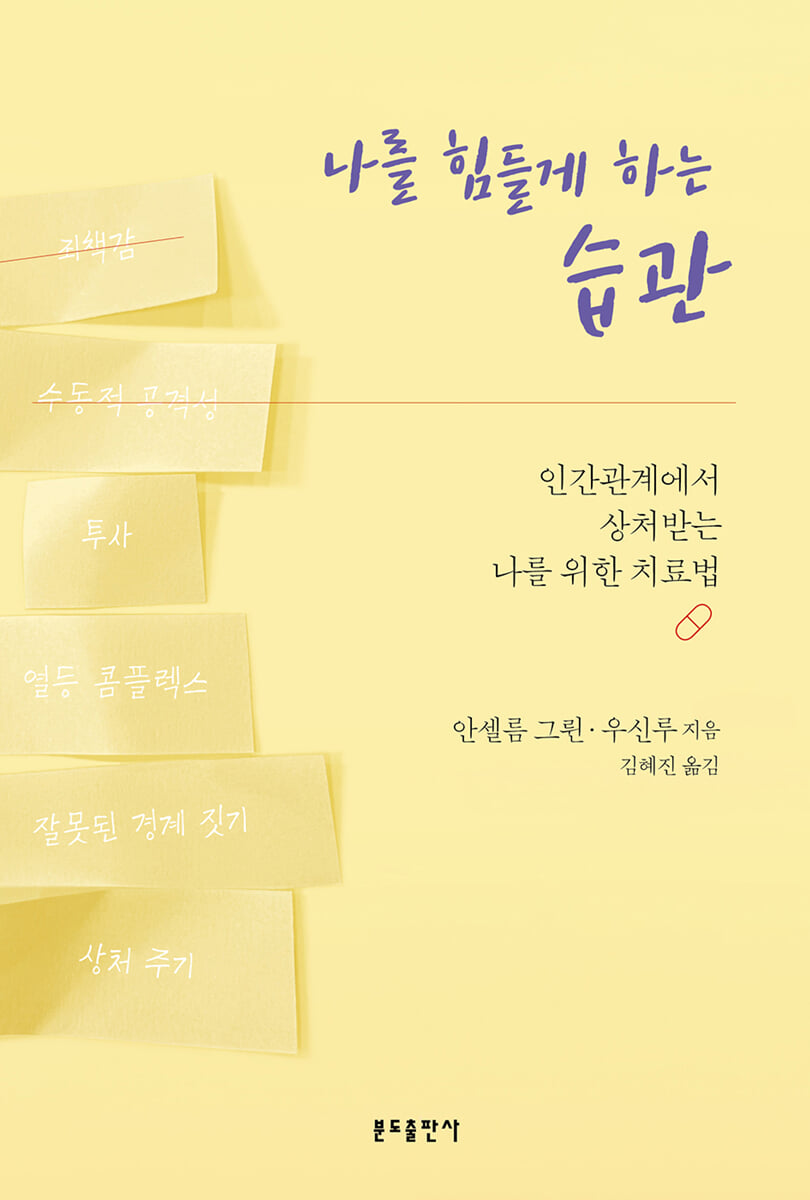
Habits that make me suffer
 |
Description
Book Introduction
There are bad habits that affect our relationships and prevent us from living in harmony with ourselves.
Guilt, passive-aggressiveness, projection, inferiority complex, setting false boundaries, and hurting others are some of them.
These are mechanisms that cause us to hurt others and get hurt ourselves without even realizing it.
This book combines psychological insights with biblical wisdom to offer ways to break free from these mechanisms and heal the wounds of relationships.
Guilt, passive-aggressiveness, projection, inferiority complex, setting false boundaries, and hurting others are some of them.
These are mechanisms that cause us to hurt others and get hurt ourselves without even realizing it.
This book combines psychological insights with biblical wisdom to offer ways to break free from these mechanisms and heal the wounds of relationships.
- You can preview some of the book's contents.
Preview
index
Introduction
1. Guilt
How does guilt arise?
Guilt and guilt
Guilt instillation
Guilt and self-esteem
emotional blackmail
spiritual abuse
Guilt Therapy
Biblical Treatment for Guilt
Emotional Blackmail Therapy
Biblical Treatment for Emotional Blackmail
Spiritual Abuse Treatment
Biblical Treatment for Spiritual Abuse
Questions about guilt
2 Passive Aggression
cure
Biblical Therapy
Questions about passive aggression
3 projections
cure
Biblical Therapy
Questions about projection
4 Inferiority complex
cure
Biblical Therapy
Questions about inferiority complex
5. Setting False Boundaries
cure
Biblical Therapy
Questions about boundary setting
6. Give a wound
cure
Biblical Therapy
Questions about wounds
7 Christian Healing: Forgiveness, Reconciliation, and Healthy Self-Esteem
forgiveness
reconciliation
self-esteem
Going out words
References
1. Guilt
How does guilt arise?
Guilt and guilt
Guilt instillation
Guilt and self-esteem
emotional blackmail
spiritual abuse
Guilt Therapy
Biblical Treatment for Guilt
Emotional Blackmail Therapy
Biblical Treatment for Emotional Blackmail
Spiritual Abuse Treatment
Biblical Treatment for Spiritual Abuse
Questions about guilt
2 Passive Aggression
cure
Biblical Therapy
Questions about passive aggression
3 projections
cure
Biblical Therapy
Questions about projection
4 Inferiority complex
cure
Biblical Therapy
Questions about inferiority complex
5. Setting False Boundaries
cure
Biblical Therapy
Questions about boundary setting
6. Give a wound
cure
Biblical Therapy
Questions about wounds
7 Christian Healing: Forgiveness, Reconciliation, and Healthy Self-Esteem
forgiveness
reconciliation
self-esteem
Going out words
References
Into the book
In this book, we present six mechanisms or types that disrupt relationships.
This book encourages you to question these mechanisms at least once.
Under no circumstances should the insights contained in this book be used to criticize others.
Of course, the mechanisms this book talks about tell us something about other people too.
Then you can understand what is happening to the other person and why your relationship is difficult.
However, we should not judge others based on what we read.
“You are projecting your problems onto me now.
You should not use this book to say, “You are emotionally abusing me.”
The most important thing is to know yourself well and free yourself from the mechanisms that sabotage your relationships.
The description of the mechanism should be like a mirror in which we recognize ourselves.
The idea is not to judge, but to understand.
Only by knowing what mechanisms are at work within us can we escape from them.
--- p.11~12
Psychology tells us that we feel guilty when we break the commandments or rules that apply to us in society or at home.
The rules that apply to families have nothing to do with real guilt.
Yet, we internalize these rules as children.
Later, these rules form the so-called 'superego', which gives us clear rules.
This superego fosters feelings of guilt.
For example, mothers of young children feel guilty when they take a break.
Because the superego demands that the child be present 24 hours a day only for the child and does not allow the child to take care of itself.
Some people feel guilty about not meeting the expectations of their family, colleagues, employers, or friends.
--- p.13~14
Many stories in the Bible deal with the theme of sin and guilt.
By interpreting the text against a background of psychological knowledge, we can discover a treatment that still heals us today and provides very specific guidance on how to deal with guilt and emotional blackmail.
Let's look at three Bible stories that deal with guilt.
This book encourages you to question these mechanisms at least once.
Under no circumstances should the insights contained in this book be used to criticize others.
Of course, the mechanisms this book talks about tell us something about other people too.
Then you can understand what is happening to the other person and why your relationship is difficult.
However, we should not judge others based on what we read.
“You are projecting your problems onto me now.
You should not use this book to say, “You are emotionally abusing me.”
The most important thing is to know yourself well and free yourself from the mechanisms that sabotage your relationships.
The description of the mechanism should be like a mirror in which we recognize ourselves.
The idea is not to judge, but to understand.
Only by knowing what mechanisms are at work within us can we escape from them.
--- p.11~12
Psychology tells us that we feel guilty when we break the commandments or rules that apply to us in society or at home.
The rules that apply to families have nothing to do with real guilt.
Yet, we internalize these rules as children.
Later, these rules form the so-called 'superego', which gives us clear rules.
This superego fosters feelings of guilt.
For example, mothers of young children feel guilty when they take a break.
Because the superego demands that the child be present 24 hours a day only for the child and does not allow the child to take care of itself.
Some people feel guilty about not meeting the expectations of their family, colleagues, employers, or friends.
--- p.13~14
Many stories in the Bible deal with the theme of sin and guilt.
By interpreting the text against a background of psychological knowledge, we can discover a treatment that still heals us today and provides very specific guidance on how to deal with guilt and emotional blackmail.
Let's look at three Bible stories that deal with guilt.
--- p.29
Publisher's Review
“Why is it always me who gets hurt?”
Developing Mental Strength to Break Free from Bad Relationships
Everyone has experienced at least once that they were unable to maintain a good relationship with their family, lover, friend, or colleague.
However, if you are having a hard time in a relationship and cannot get out of it, or if the relationship ends in the same bad way every time, you need to find the cause.
When we experience conflict and hurt in relationships, it's easy to blame ourselves or others.
'What's wrong with me? What did I do wrong to him? I should have treated him better.
No, that person is the problem.
'That person is always like that.' You end up blaming yourself and then blaming the other person, and you end up stuck in the shackles of the relationship.
Blaming yourself and others won't make things better.
If you are hurt repeatedly in your relationships, your relationship with yourself will eventually collapse.
There are bad habits that affect our relationships and prevent us from living in harmony with ourselves.
Guilt, passive-aggressiveness, projection, inferiority complex, setting false boundaries, and hurting others are some of them.
These are mechanisms that cause us to hurt others and get hurt ourselves without even realizing it.
To break free from a bad relationship, you need to recognize and learn to deal with the mechanisms that operate unconsciously and hurt yourself and others.
Habits that make me suffer
We feel guilty and are affected by guilt.
We project onto others the aspects of ourselves that we cannot accept.
We suffer from feelings of inferiority.
I'm also struggling with how to relate to people while setting appropriate boundaries.
I feel passive-aggressiveness brewing inside me because of people who are outwardly friendly but then make me aggressive.
We all hurt and are hurt.
People sometimes express their hurt in inappropriate ways and sometimes hurt others.
A variety of psychological and Christian methods can be used to heal these mechanisms.
This book explains the mechanisms that disrupt relationships, using specific examples, and offers readers a spiritual path they can implement in their own lives.
Forgiveness, reconciliation, and healthy self-esteem
Losing the power of these mechanisms and creating a prerequisite for good relationships.
It's forgiveness, reconciliation, and healthy self-esteem.
If you forgive yourself more than anyone else, make peace with yourself, and develop healthy self-esteem, you can wisely deal with hurt feelings in relationships.
This book combines psychological insights with biblical wisdom to offer ways to break free from mechanisms and build self-esteem.
To help readers easily understand psychological insights, the authors illustrate them with specific examples they have experienced and learned through counseling.
We also want to convey to our readers the healing power of the Word by interpreting the stories in the Bible from a psychological perspective.
Jesus came to heal people and free them from the bondage caused by mechanisms that hinder their lives.
Jesus' healing words will give you the courage to overcome the mechanisms that make relationships difficult and sometimes even destroy them.
Developing Mental Strength to Break Free from Bad Relationships
Everyone has experienced at least once that they were unable to maintain a good relationship with their family, lover, friend, or colleague.
However, if you are having a hard time in a relationship and cannot get out of it, or if the relationship ends in the same bad way every time, you need to find the cause.
When we experience conflict and hurt in relationships, it's easy to blame ourselves or others.
'What's wrong with me? What did I do wrong to him? I should have treated him better.
No, that person is the problem.
'That person is always like that.' You end up blaming yourself and then blaming the other person, and you end up stuck in the shackles of the relationship.
Blaming yourself and others won't make things better.
If you are hurt repeatedly in your relationships, your relationship with yourself will eventually collapse.
There are bad habits that affect our relationships and prevent us from living in harmony with ourselves.
Guilt, passive-aggressiveness, projection, inferiority complex, setting false boundaries, and hurting others are some of them.
These are mechanisms that cause us to hurt others and get hurt ourselves without even realizing it.
To break free from a bad relationship, you need to recognize and learn to deal with the mechanisms that operate unconsciously and hurt yourself and others.
Habits that make me suffer
We feel guilty and are affected by guilt.
We project onto others the aspects of ourselves that we cannot accept.
We suffer from feelings of inferiority.
I'm also struggling with how to relate to people while setting appropriate boundaries.
I feel passive-aggressiveness brewing inside me because of people who are outwardly friendly but then make me aggressive.
We all hurt and are hurt.
People sometimes express their hurt in inappropriate ways and sometimes hurt others.
A variety of psychological and Christian methods can be used to heal these mechanisms.
This book explains the mechanisms that disrupt relationships, using specific examples, and offers readers a spiritual path they can implement in their own lives.
Forgiveness, reconciliation, and healthy self-esteem
Losing the power of these mechanisms and creating a prerequisite for good relationships.
It's forgiveness, reconciliation, and healthy self-esteem.
If you forgive yourself more than anyone else, make peace with yourself, and develop healthy self-esteem, you can wisely deal with hurt feelings in relationships.
This book combines psychological insights with biblical wisdom to offer ways to break free from mechanisms and build self-esteem.
To help readers easily understand psychological insights, the authors illustrate them with specific examples they have experienced and learned through counseling.
We also want to convey to our readers the healing power of the Word by interpreting the stories in the Bible from a psychological perspective.
Jesus came to heal people and free them from the bondage caused by mechanisms that hinder their lives.
Jesus' healing words will give you the courage to overcome the mechanisms that make relationships difficult and sometimes even destroy them.
GOODS SPECIFICS
- Date of issue: March 20, 2025
- Page count, weight, size: 172 pages | 222g | 135*200*12mm
- ISBN13: 9788941925033
- ISBN10: 8941925037
You may also like
카테고리
korean


korean

![GQ KOREA Mark (Monthly): December [2025]](http://librairie.coreenne.fr/cdn/shop/files/8ef265dbbfbf186523ed75ba7319009d.jpg?v=1765340328&width=3840)


