

When fortune meets MBTI
 |
Description
Book Introduction
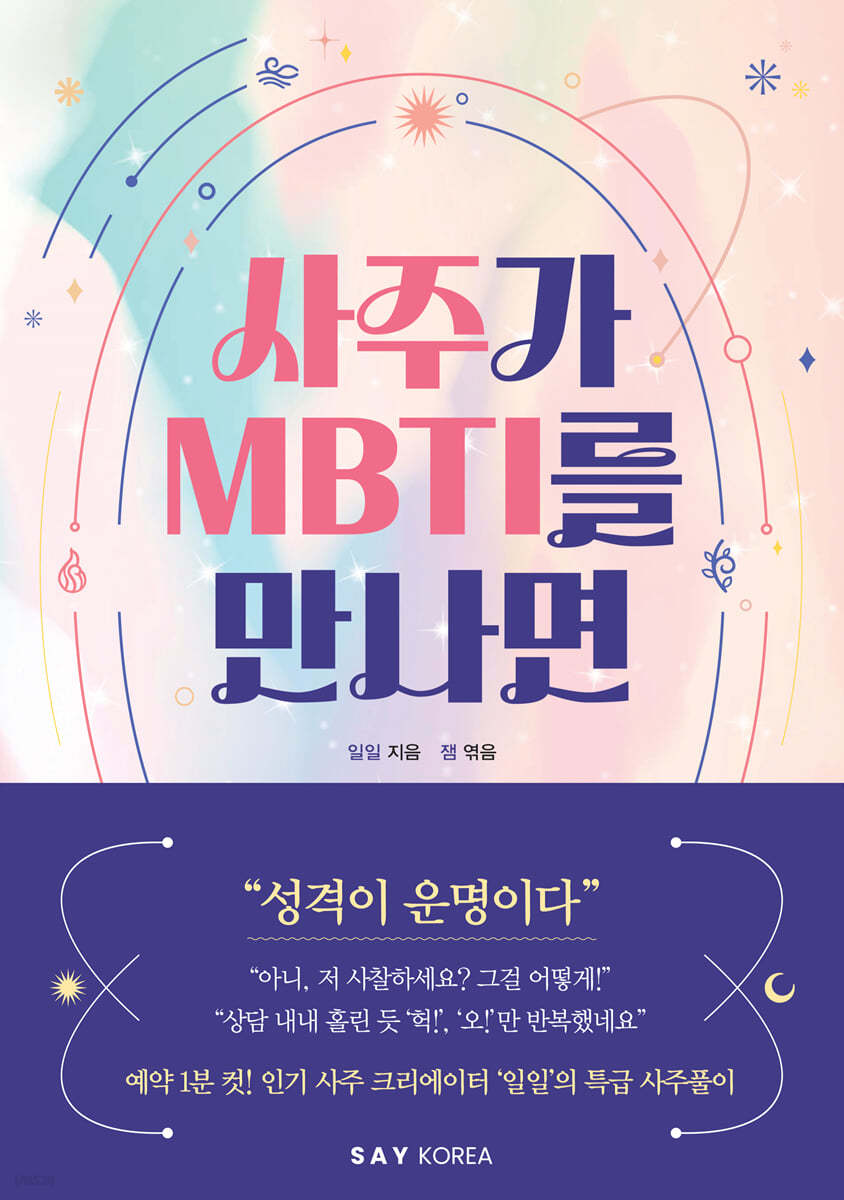
“No, you’re going to do that temple? How can you do that!”
“Throughout the consultation, I kept repeating ‘Gasp!’ and ‘Oh!’ as if I was possessed.”
“Please recommend novels, movies, or dramas featuring Intije!”
NO to difficult fortune telling, NO to superficial MBTI!
The Chinese character-filled fortune telling has become easy and fun with MBTI.
Now let's understand the four pillars of destiny, apply them to our relationships, and enjoy them as part of our everyday lives!
In the past, people used to memorize things like the characteristics of a B-type man or an O-type woman.
These days, people walk around memorizing their MBTI types.
Recently, a documentary program called “MBTI vs Sajoo” (TVING) was produced and became a huge topic of conversation.
From the ancient Sajoo chart to the most recent MBTI, the desire to “know myself” is a desire that embraces everyone, regardless of era.
A book has been published that will delight the eyes and ears of these people.
"When Four Pillars of Destiny Meet MBTI" is a book that uses the MBTI we are familiar with to explain the concept and function of Four Pillars of Destiny in an easy-to-understand way.
The author, 'Il-il', is a fortune teller and influencer who is active on social media.
Living as an ordinary office worker, I conducted paid consultations for thousands of people in a short period of time through my fortune telling service as a side job.
Daily fortune telling consultations close almost as soon as the monthly reservation schedule opens.
The first secret to the author's popularity is 'trendiness'.
Daily fortune telling, which is full of Chinese characters, provides a new way to understand the difficult fortune by incorporating MBTI.
This book explains the concepts and functions of the four pillars of destiny, which were difficult to understand in terms of meaning and function, such as yin-yang and the five elements, the heavenly stems, the earthly branches, the ten gods, and harmony and conflict, by relating them to the eight letters and 16 combinations of MBTI, such as E/I, N/S, T/F, and P/J.
In addition, it provides a formula for deriving MBTI type from one's innate fortune.
The second secret is ‘hitting the taste’.
Daily provides customized character interpretations for MZ generation, who live their lives by being obsessed with celebrities such as actors and idols, as well as characters from dramas and webtoons.
According to this book, you can get a rough idea of your fortune just by knowing your date of birth.
The text contains the fortune telling and MBTI analysis of idols and artists, such as SHINee, Seventeen, IU, and Lee Hyo-ri, as interpreted by the author himself, and also provides fortune telling for characters such as Tony Stark, the 'Iron Man' of the Marvel Universe, and Song Tae-seop of Slam Dunk.
Even the fortune telling of Yong-in Pu-si Pu-bao is included.
If you are a creator of any content with a story and characters, such as dramas, web novels, or webtoons, you should pay attention to this book.
The biggest challenge for content creators in the early stages is creating compelling characters and putting them into a believable story.
At this time, you can randomly enter your date of birth on the fortune-telling website, extract the fortune-telling origin, and analyze it to create a template that contains the person's three-dimensional tendencies and destiny.
Also, if you compare this with other four pillars of destiny, you can see the structure of conflict between characters.
This book contains everything about the fortune telling conducted by 'Il-il'.
If you read and understand carefully, you can personally interpret your own or your family's fortune, the fortune of a close friend or coworker, the fortune of your favorite idol or character, and even the fortune of your one-of-a-kind pet.
Also, if you get your fortune told by an expert after reading the book, your understanding will be greatly expanded.
Now, let's understand the four pillars of destiny, apply them to relationships, and enjoy them as a fun part of everyday life through 『When Four Pillars of Destiny Meet MBTI』.
“Throughout the consultation, I kept repeating ‘Gasp!’ and ‘Oh!’ as if I was possessed.”
“Please recommend novels, movies, or dramas featuring Intije!”
NO to difficult fortune telling, NO to superficial MBTI!
The Chinese character-filled fortune telling has become easy and fun with MBTI.
Now let's understand the four pillars of destiny, apply them to our relationships, and enjoy them as part of our everyday lives!
In the past, people used to memorize things like the characteristics of a B-type man or an O-type woman.
These days, people walk around memorizing their MBTI types.
Recently, a documentary program called “MBTI vs Sajoo” (TVING) was produced and became a huge topic of conversation.
From the ancient Sajoo chart to the most recent MBTI, the desire to “know myself” is a desire that embraces everyone, regardless of era.
A book has been published that will delight the eyes and ears of these people.
"When Four Pillars of Destiny Meet MBTI" is a book that uses the MBTI we are familiar with to explain the concept and function of Four Pillars of Destiny in an easy-to-understand way.
The author, 'Il-il', is a fortune teller and influencer who is active on social media.
Living as an ordinary office worker, I conducted paid consultations for thousands of people in a short period of time through my fortune telling service as a side job.
Daily fortune telling consultations close almost as soon as the monthly reservation schedule opens.
The first secret to the author's popularity is 'trendiness'.
Daily fortune telling, which is full of Chinese characters, provides a new way to understand the difficult fortune by incorporating MBTI.
This book explains the concepts and functions of the four pillars of destiny, which were difficult to understand in terms of meaning and function, such as yin-yang and the five elements, the heavenly stems, the earthly branches, the ten gods, and harmony and conflict, by relating them to the eight letters and 16 combinations of MBTI, such as E/I, N/S, T/F, and P/J.
In addition, it provides a formula for deriving MBTI type from one's innate fortune.
The second secret is ‘hitting the taste’.
Daily provides customized character interpretations for MZ generation, who live their lives by being obsessed with celebrities such as actors and idols, as well as characters from dramas and webtoons.
According to this book, you can get a rough idea of your fortune just by knowing your date of birth.
The text contains the fortune telling and MBTI analysis of idols and artists, such as SHINee, Seventeen, IU, and Lee Hyo-ri, as interpreted by the author himself, and also provides fortune telling for characters such as Tony Stark, the 'Iron Man' of the Marvel Universe, and Song Tae-seop of Slam Dunk.
Even the fortune telling of Yong-in Pu-si Pu-bao is included.
If you are a creator of any content with a story and characters, such as dramas, web novels, or webtoons, you should pay attention to this book.
The biggest challenge for content creators in the early stages is creating compelling characters and putting them into a believable story.
At this time, you can randomly enter your date of birth on the fortune-telling website, extract the fortune-telling origin, and analyze it to create a template that contains the person's three-dimensional tendencies and destiny.
Also, if you compare this with other four pillars of destiny, you can see the structure of conflict between characters.
This book contains everything about the fortune telling conducted by 'Il-il'.
If you read and understand carefully, you can personally interpret your own or your family's fortune, the fortune of a close friend or coworker, the fortune of your favorite idol or character, and even the fortune of your one-of-a-kind pet.
Also, if you get your fortune told by an expert after reading the book, your understanding will be greatly expanded.
Now, let's understand the four pillars of destiny, apply them to relationships, and enjoy them as a fun part of everyday life through 『When Four Pillars of Destiny Meet MBTI』.
- You can preview some of the book's contents.
Preview
index
Introduction: We interpret your "character" using your four pillars of destiny and MBTI.
Key terms to know first
If you don't know MBTI yet, read this!
Part 1.
congratulations.
Born as an INFP: Understanding the Essence That Makes Me
Chapter 1.
Sajupalja: Living according to one's destiny
rendition
Wolju
week
dole
Chapter 2.
Yin and Yang: To know your destiny, start with Yin and Yang.
The basics of the four pillars of destiny, yin and yang
The nature of yin and yang
Yin and Yang in real fortune telling
Chapter 3.
Five Elements: The Bundle of Bullshit and the Earth
Wood: Spring, the energy that begins everything
Fire: Summer, intense and pure energy
Earth: Between seasons, unchanging foundation
Gold: Autumn, the fruition of energy
Water: Winter, stagnant energy
Chapter 4.
Heavenly Stems: Shining Solo
What are the Heavenly Stems?
Gapmok {甲}: A sturdy tree
Eulmok {乙}: Clematis
Binghwa {丙}: The bright light of the sun
Jeonghwa {丁}: Boiling magma
Muto {戊}: Vast desert
Gito {己}: fertile garden
Gyeonggeum: a huge rock
Shin-geum {辛}: a well-polished gem
Imsu {壬}: vast sea
Gyesu {癸}: clear stream water
Chapter 5.
Support: Duet or Trio
To know support, you must know the Ji Jang Gan
Origin: The energy of the reverse horse
Wangji: The energy of the peach blossom
Notice: The spirit of fire
Part 2.
Stuck here? I'll tell you everything!: My daily life and the relationship between the other five elements, the ten gods
Chapter 6.
Sipshin: Stop talking about civil servants' fate!
What are the Ten Gods?
The mutual generation and mutual inhibition of the five elements and the ten gods
Xinjiang and Xinyak
Inertia: The force with which the world pulls me
Jae-seong: Unquenchable thirst
Personality: Heaven-given intelligence
Food: The Power to Make the World Recognize Me
Cowardice: Friend or Rival
Part 3.
Knowing this, you too can become a fortune teller: A deep understanding of the four pillars of destiny and the method of improving your fortune.
Chapter 7.
Hap and Chong: Why doesn't he and I get along so well?
The sum of the heavenly stems
Clash of the Heavenly Stems
Sum of support
Support of the enemy
Samhap and Banghap
Finding harmony and conflict
Samhyeongsal and Jahyeong
Chapter 8.
Dragon God, Fortune Telling, and Wealth: I forge my own destiny.
What is a dragon god?
billionaire
Cho Hu-yong-shin
Clearing method
fortune
Chapter 9.
Muwa and Gwadwa: What's missing? What's too much? What's that?
Indifference: Free Spirit
Mujaeseong: What is jealousy?
Unmanned: Heading into the bare ground
Mubigyeop: The only one in heaven and earth
Immigration: Model Student Elite
Love fortune of the four pillars of indifference and innocence
Inertia: Why do you give me this ordeal?
Jaeseong: Where's the time to rest now?
Insane: When will the apples fall?
Cowardice: It will come back to haunt you someday.
Overeating: Where are you looking, look at me!
[Appendix 1] Guessing MBTI through Sajoo
[Appendix 2] Fubao's fortune telling
Conclusion: Knowing myself is the beginning.
Editor's Note: For those who are anxious about tomorrow and anxious about today
Key terms to know first
If you don't know MBTI yet, read this!
Part 1.
congratulations.
Born as an INFP: Understanding the Essence That Makes Me
Chapter 1.
Sajupalja: Living according to one's destiny
rendition
Wolju
week
dole
Chapter 2.
Yin and Yang: To know your destiny, start with Yin and Yang.
The basics of the four pillars of destiny, yin and yang
The nature of yin and yang
Yin and Yang in real fortune telling
Chapter 3.
Five Elements: The Bundle of Bullshit and the Earth
Wood: Spring, the energy that begins everything
Fire: Summer, intense and pure energy
Earth: Between seasons, unchanging foundation
Gold: Autumn, the fruition of energy
Water: Winter, stagnant energy
Chapter 4.
Heavenly Stems: Shining Solo
What are the Heavenly Stems?
Gapmok {甲}: A sturdy tree
Eulmok {乙}: Clematis
Binghwa {丙}: The bright light of the sun
Jeonghwa {丁}: Boiling magma
Muto {戊}: Vast desert
Gito {己}: fertile garden
Gyeonggeum: a huge rock
Shin-geum {辛}: a well-polished gem
Imsu {壬}: vast sea
Gyesu {癸}: clear stream water
Chapter 5.
Support: Duet or Trio
To know support, you must know the Ji Jang Gan
Origin: The energy of the reverse horse
Wangji: The energy of the peach blossom
Notice: The spirit of fire
Part 2.
Stuck here? I'll tell you everything!: My daily life and the relationship between the other five elements, the ten gods
Chapter 6.
Sipshin: Stop talking about civil servants' fate!
What are the Ten Gods?
The mutual generation and mutual inhibition of the five elements and the ten gods
Xinjiang and Xinyak
Inertia: The force with which the world pulls me
Jae-seong: Unquenchable thirst
Personality: Heaven-given intelligence
Food: The Power to Make the World Recognize Me
Cowardice: Friend or Rival
Part 3.
Knowing this, you too can become a fortune teller: A deep understanding of the four pillars of destiny and the method of improving your fortune.
Chapter 7.
Hap and Chong: Why doesn't he and I get along so well?
The sum of the heavenly stems
Clash of the Heavenly Stems
Sum of support
Support of the enemy
Samhap and Banghap
Finding harmony and conflict
Samhyeongsal and Jahyeong
Chapter 8.
Dragon God, Fortune Telling, and Wealth: I forge my own destiny.
What is a dragon god?
billionaire
Cho Hu-yong-shin
Clearing method
fortune
Chapter 9.
Muwa and Gwadwa: What's missing? What's too much? What's that?
Indifference: Free Spirit
Mujaeseong: What is jealousy?
Unmanned: Heading into the bare ground
Mubigyeop: The only one in heaven and earth
Immigration: Model Student Elite
Love fortune of the four pillars of indifference and innocence
Inertia: Why do you give me this ordeal?
Jaeseong: Where's the time to rest now?
Insane: When will the apples fall?
Cowardice: It will come back to haunt you someday.
Overeating: Where are you looking, look at me!
[Appendix 1] Guessing MBTI through Sajoo
[Appendix 2] Fubao's fortune telling
Conclusion: Knowing myself is the beginning.
Editor's Note: For those who are anxious about tomorrow and anxious about today
Detailed image
.jpg)
Into the book
Both Sajoo and MBTI are tools that reveal my true nature and personality.
However, the four pillars of destiny are difficult and unfamiliar, and the MBTI is too brief to fully satisfy us.
This is to provide a clearer and more concrete understanding of the spectrum of my personality and essence, which was difficult to fully grasp with just the four pillars of destiny or MBTI alone, by utilizing both simultaneously.
This is the core of the 'Daily Fortune-telling Consultation' that I conduct.
--- p.13~14
If someone were to ask me, “If you could study just one element of the Four Pillars of Destiny for 15 minutes to read a person’s fortune, what would it be?” I would answer, “The Five Elements.”
(Of course, I will tell you first that there is no such method in the first place.) That is why the Five Elements are the core of the core in fortune telling based on the study of fortune telling.
--- p.72
People with a lot of gold are often of the T type.
There is a perception that people with strong T tendencies are somewhat selfish and lack empathy towards others, to the point that the meme “Are you a T?” became popular.
Likewise, if there is a lot of gold in the four pillars of destiny and the influence of the four pillars of destiny overlaps and acts even stronger, the person may be perceived as a so-called 'unlucky' person who is not considerate of other people's values and circumstances.
--- p.80
Since we can only live our own lives, once we become accustomed to our own perspective, it becomes difficult to understand the lives of others.
But there are definitely people in the world who live with different values than me.
We also have to live with such people.
It is the role of the fortune teller and the role of the fortune teller to help us understand ourselves and others.
--- p.82
People born with the energy of water have a true poker face.
When dealing with such people, you may think they are 'dishonest' and avoid them, or on the contrary, you may think they are 'mysterious' and become curious and want to know them better.
Especially in the latter case, it is interpreted that the number is born with the nature of a 'peach blossom' that scatters charm.
A characteristic of people with strong shou energy is that they tend to become popular even if they have no intention of attracting attention.
--- p.109
Although Haesu is a reverse horse, its nature is not as prominent as that of the other three.
The reason is because of the characteristic of the five elements, ‘water’.
… However, these people do have a certain energy of a foreigner, so they show activity through the internet or social media at home, or they are seen ‘fanatics’ of foreign celebrities.
I interpret this in modern terms as 'online reverse horse'.
--- p.122
Inertia clearly has an impact on the areas of study, academics, and exams.
People with inertia in their four pillars of destiny often hear things like, “They have a knack for studying” or “They have good luck on exams.”
They have a good understanding of what the testing system requires and what kind of study methods they should use.
However, people without inertia tend not to view studying for exams as studying to 'get a grade.'
--- p.150
From the standpoint of inertia, Inseong may seem lazy and like he doesn't do anything, but when you look at the results, he is a 'trustworthy man' who handles things smartly and well.
Compared to humanity, talent is like 'hands and feet without a head'.
If the phrase "he works hard" is used to describe the subordinate of inertia, then the phrase "he does a good job anyway" is used to describe the subordinate of personality.
--- p.162~163
The answer to the question, "What kind of horoscope makes the most money?" is a question many people are curious about, and even fortune tellers have different opinions.
… Recently, in the field of fortune telling, there is a growing opinion that the ‘Inseong’, which will be explained from now on, plays a decisive role.
--- p.173
If, looking at the client's fortune, there is only one lover who is far from the daily life, I would say to him, "Congratulations.
You are a 'Muggle'."
People like this don't get too immersed in a drama and quickly return to their daily lives.
On the other hand, if the person is close to the daily or there are many people with bias in the entire Sajoowon country, this person will start to 'obsess' with the drama as soon as it ends.
--- p.182
Even if it's a fictional character like Tony Stark, you can look at his fortune if he has a set date of birth.
Of course, it's not 100% accurate because the writer or director doesn't create characters with the four pillars of destiny in mind, but it's surprising how accurate it is.
Above all, it's a lot of fun to do this kind of character analysis with friends.
--- p.188
In the past, passing the civil service examination and becoming a government official was considered the best way to achieve fame and fortune, but these days, people may have different interpretations of whether going to a good university, passing the civil service exam, earning a decent salary, saving money, and living a life without experiencing any major troubles is truly a good thing.
Also, in the past, a superior was interpreted as a bad thing, but in modern times, it is interpreted as a talent that can bring great success through expressing oneself through YouTube.
--- p.202
The talent for self-expression, Sik-sang, is revealed in the form of a large ocean called Im-su, and in a way that stands out, so it is bound to be special in everyone's eyes.
However, since there is a bias, there will be adversity rather than smooth life.
The owner of this fortune is Dokyeom of the idol group Seventeen.
It is a well-known fact that Seventeen went through a tough training period.
--- p.215
The conflict between the Heavenly Stems is the most 'ridiculous' conflict.
Jeong-hwa has an inner stubbornness that never deviates from her own beliefs, and Gye-su pursues inner cleanliness and hates to even meet someone who doesn't agree with her.
In short, the antagonism between seemingly docile introverts who can never become close is a hallmark of the political world. To use an MBTI metaphor, it's like the stubborn INTJ and the self-confident INFJ deciding "I'm not compatible" and avoiding any chance of encountering each other.
--- p.222
What if the Inmok, Sahwa, Singeum, and Haesu of the four pillars of destiny were all present in the supporting pillars of the four pillars of destiny, or the Chukto, Sulto, Mito, and Jinto of the four pillars of destiny were all present? Two well-known Korean celebrities had such a chart, and surprisingly, both were presidents.
--- p.246~247
The Samhyeongsal itself is powerful enough to shake up one's entire life.
If the conflict between the two letters discussed above has the effect of making your mind complicated or causing conflict with those around you, then the Samhyeongsal can have a truly great impact on your life by appearing in the form of incidents, accidents, lawsuits, disputes, illness, etc.
--- p.247
The method of opening is not simply about physically getting close to something.
The core of the action that occurs in the four pillars of destiny is ultimately people or their actions.
So, to get closer to the dragon god, you need to meet someone who has the energy of your dragon god, or you need to act in a way that corresponds to the energy of your dragon god when you are in a difficult or stressful situation.
…I call the Gaeun method ‘stress relief’.
When I meet someone I like, spend time with them, and do things I like to my heart's content, my stress naturally goes away and I feel refreshed.
--- p.267
Some might genuinely wonder to these people, “Why can’t you just live your life and assert yourself?”
But that is the nature we are born with.
That's why they say fortune telling is scary.
…Watching other people’s fates from the sidelines and making comments about them is not helpful to either party.
The thoughts and actions we must take are to understand that 'there are people whose innate nature is to live that way' and to understand 'why and how others are different from me'.
However, the four pillars of destiny are difficult and unfamiliar, and the MBTI is too brief to fully satisfy us.
This is to provide a clearer and more concrete understanding of the spectrum of my personality and essence, which was difficult to fully grasp with just the four pillars of destiny or MBTI alone, by utilizing both simultaneously.
This is the core of the 'Daily Fortune-telling Consultation' that I conduct.
--- p.13~14
If someone were to ask me, “If you could study just one element of the Four Pillars of Destiny for 15 minutes to read a person’s fortune, what would it be?” I would answer, “The Five Elements.”
(Of course, I will tell you first that there is no such method in the first place.) That is why the Five Elements are the core of the core in fortune telling based on the study of fortune telling.
--- p.72
People with a lot of gold are often of the T type.
There is a perception that people with strong T tendencies are somewhat selfish and lack empathy towards others, to the point that the meme “Are you a T?” became popular.
Likewise, if there is a lot of gold in the four pillars of destiny and the influence of the four pillars of destiny overlaps and acts even stronger, the person may be perceived as a so-called 'unlucky' person who is not considerate of other people's values and circumstances.
--- p.80
Since we can only live our own lives, once we become accustomed to our own perspective, it becomes difficult to understand the lives of others.
But there are definitely people in the world who live with different values than me.
We also have to live with such people.
It is the role of the fortune teller and the role of the fortune teller to help us understand ourselves and others.
--- p.82
People born with the energy of water have a true poker face.
When dealing with such people, you may think they are 'dishonest' and avoid them, or on the contrary, you may think they are 'mysterious' and become curious and want to know them better.
Especially in the latter case, it is interpreted that the number is born with the nature of a 'peach blossom' that scatters charm.
A characteristic of people with strong shou energy is that they tend to become popular even if they have no intention of attracting attention.
--- p.109
Although Haesu is a reverse horse, its nature is not as prominent as that of the other three.
The reason is because of the characteristic of the five elements, ‘water’.
… However, these people do have a certain energy of a foreigner, so they show activity through the internet or social media at home, or they are seen ‘fanatics’ of foreign celebrities.
I interpret this in modern terms as 'online reverse horse'.
--- p.122
Inertia clearly has an impact on the areas of study, academics, and exams.
People with inertia in their four pillars of destiny often hear things like, “They have a knack for studying” or “They have good luck on exams.”
They have a good understanding of what the testing system requires and what kind of study methods they should use.
However, people without inertia tend not to view studying for exams as studying to 'get a grade.'
--- p.150
From the standpoint of inertia, Inseong may seem lazy and like he doesn't do anything, but when you look at the results, he is a 'trustworthy man' who handles things smartly and well.
Compared to humanity, talent is like 'hands and feet without a head'.
If the phrase "he works hard" is used to describe the subordinate of inertia, then the phrase "he does a good job anyway" is used to describe the subordinate of personality.
--- p.162~163
The answer to the question, "What kind of horoscope makes the most money?" is a question many people are curious about, and even fortune tellers have different opinions.
… Recently, in the field of fortune telling, there is a growing opinion that the ‘Inseong’, which will be explained from now on, plays a decisive role.
--- p.173
If, looking at the client's fortune, there is only one lover who is far from the daily life, I would say to him, "Congratulations.
You are a 'Muggle'."
People like this don't get too immersed in a drama and quickly return to their daily lives.
On the other hand, if the person is close to the daily or there are many people with bias in the entire Sajoowon country, this person will start to 'obsess' with the drama as soon as it ends.
--- p.182
Even if it's a fictional character like Tony Stark, you can look at his fortune if he has a set date of birth.
Of course, it's not 100% accurate because the writer or director doesn't create characters with the four pillars of destiny in mind, but it's surprising how accurate it is.
Above all, it's a lot of fun to do this kind of character analysis with friends.
--- p.188
In the past, passing the civil service examination and becoming a government official was considered the best way to achieve fame and fortune, but these days, people may have different interpretations of whether going to a good university, passing the civil service exam, earning a decent salary, saving money, and living a life without experiencing any major troubles is truly a good thing.
Also, in the past, a superior was interpreted as a bad thing, but in modern times, it is interpreted as a talent that can bring great success through expressing oneself through YouTube.
--- p.202
The talent for self-expression, Sik-sang, is revealed in the form of a large ocean called Im-su, and in a way that stands out, so it is bound to be special in everyone's eyes.
However, since there is a bias, there will be adversity rather than smooth life.
The owner of this fortune is Dokyeom of the idol group Seventeen.
It is a well-known fact that Seventeen went through a tough training period.
--- p.215
The conflict between the Heavenly Stems is the most 'ridiculous' conflict.
Jeong-hwa has an inner stubbornness that never deviates from her own beliefs, and Gye-su pursues inner cleanliness and hates to even meet someone who doesn't agree with her.
In short, the antagonism between seemingly docile introverts who can never become close is a hallmark of the political world. To use an MBTI metaphor, it's like the stubborn INTJ and the self-confident INFJ deciding "I'm not compatible" and avoiding any chance of encountering each other.
--- p.222
What if the Inmok, Sahwa, Singeum, and Haesu of the four pillars of destiny were all present in the supporting pillars of the four pillars of destiny, or the Chukto, Sulto, Mito, and Jinto of the four pillars of destiny were all present? Two well-known Korean celebrities had such a chart, and surprisingly, both were presidents.
--- p.246~247
The Samhyeongsal itself is powerful enough to shake up one's entire life.
If the conflict between the two letters discussed above has the effect of making your mind complicated or causing conflict with those around you, then the Samhyeongsal can have a truly great impact on your life by appearing in the form of incidents, accidents, lawsuits, disputes, illness, etc.
--- p.247
The method of opening is not simply about physically getting close to something.
The core of the action that occurs in the four pillars of destiny is ultimately people or their actions.
So, to get closer to the dragon god, you need to meet someone who has the energy of your dragon god, or you need to act in a way that corresponds to the energy of your dragon god when you are in a difficult or stressful situation.
…I call the Gaeun method ‘stress relief’.
When I meet someone I like, spend time with them, and do things I like to my heart's content, my stress naturally goes away and I feel refreshed.
--- p.267
Some might genuinely wonder to these people, “Why can’t you just live your life and assert yourself?”
But that is the nature we are born with.
That's why they say fortune telling is scary.
…Watching other people’s fates from the sidelines and making comments about them is not helpful to either party.
The thoughts and actions we must take are to understand that 'there are people whose innate nature is to live that way' and to understand 'why and how others are different from me'.
--- p.303
Publisher's Review
“There has never been a fortune telling book like this before!”
For you who are curious about me and the solutions to life,
Customized fortune telling & MBTI consultation from popular fortune teller 'Il-il'!
“Four Pillars of Destiny? I’m curious, but isn’t it too difficult?”
Meet the easiest, cutest, and most fun fortune telling guide!
The study of fortune telling has been with us for a very long time and has deeply permeated our lives.
The term 'palja (八字)', which is often used together with the four pillars of destiny, is used in everyday life to mean 'fate'.
Among the days of the week, 'Sun, Mon' represent the yang and yin of the four pillars, and 'Tue, Wed, Thu, Fri, Sat' represent the five elements of the four pillars.
Idiomatic expressions such as “good luck” or “break the cycle of labor” also originated from the four pillars of destiny.
However, these days, it is receiving attention from the younger generation for a different meaning beyond history and culture.
It is receiving renewed attention following MBTI as a means of expression that tells us who we are and explains our tendencies.
However, compared to the attention paid to it, the number of people who understand the four pillars of destiny is not that great.
Compared to the simple and intuitive MBTI, the Sajoo system is much more sophisticated and complex, and above all, the terms used in Sajoo are full of Chinese characters whose meanings are difficult to immediately understand.
"When Sajoo Meets MBTI" is a book created for people who are curious about Sajoo but have found it difficult to approach because of the difficult terminology and system.
This book explains the system of the four pillars of destiny in a simple yet clear manner, including the concepts of yin and yang, the five elements, the heavenly stems, the earthly branches, the ten gods, and harmony and conflict.
- He explained that knowing the Five Elements and the Heavenly Stems is like understanding the meaning of a character, knowing the Earthly Branches is like understanding words, and knowing the Ten Gods is like understanding grammar.
From now on, the '합합' and '충沖', '살煞' and '자형' that will be explained are meant to understand the meaning of sentences that are created by combining the elements explained so far.
And each term in the four pillars is explained with easy-to-understand explanations, familiar and everyday analogies, and concepts of MBTI that we are familiar with.
- I'm an extrovert, but I once attended a gathering where there were only extroverts.
… He asked anyone who had something to say to raise their hand, but in the end, everyone just raised their hand and started talking about what they wanted to say, and the meeting ended.
We parted ways, saying that a gathering of only extroverts was really awkward.
The four pillars of destiny follow this principle.
The Four Pillars of Destiny (Saju) considers a state of harmony, where the yin and yang energies complement each other, to be desirable. To use an MBTI analogy, the ideal state is when your I and E, S and N, T and F, and P and J tendencies all blend together in a perfect 50:50 balance.
This book is rich in examples of dozens of fortune-tellings, including those of famous people like idols and actors, as well as characters like Iron Man and Song Tae-seop.
If previous fortune-telling books had the atmosphere of boring 'academics' derived from the past, this book aims to be a 'play' that we can enjoy and utilize now.
You will be able to easily understand and enjoy fortune telling through pretty colors, cute illustrations, and friendly and familiar examples and explanations.
"Four Pillars of Destiny and MBTI? Are they connected?"
Both Sajoo and MBTI reveal our innate nature.
The desire to understand oneself and life is a natural human desire.
And both Sajoo and MBTI are tools that reveal my true nature and personality.
These days, people often ask, “What is your MBTI?” even when meeting someone for the first time.
Then, some people answer with something like, “I used to be an ENFP, but now I’ve changed to an ISFP.”
In fact, the MBTI test tells you what tendencies a person exhibits when they are most comfortable, and since it corresponds to an innate nature, it does not change over time.
This is exactly what MBTI and Sajoo have in common.
This is because the four pillars of destiny believe that a person's innate year, month, day, and time of birth determines his or her nature and destiny.
Therefore, it is also possible to guess the MBTI type from the four pillars of destiny.
However, this book states that a simple interpretation such as “I am T because I am daily gold” is difficult.
Of course, the daily is the basis that forms the essence of a person, but through interaction with other letters in the four pillars of destiny, many different types can be expressed.
So the author repeatedly emphasizes that one should not interpret the four pillars based on just a part of them, but rather look at their overall function.
This book includes an appendix on how to guess your MBTI based on your fortune.
You can find out your type by calculating the score for each MBTI letter according to the formula.
Of course, since this is an MBTI type derived from nature, it cannot capture the point where it changes due to acquired factors.
However, if the MBTI derived from the four pillars of destiny is different from the MBTI I know, finding out the cause can be a good clue to understanding your current life.
“Who am I? Where am I?”
A navigation system that tells us our location and direction to go.
Sajoo and MBTI are explorations into the question, "What kind of person am I?"
Before we can pursue happiness and create meaning in life, we must first explore ourselves: what we like and enjoy, what kind of people we want to be close to, and what kind of work style is appropriate for us.
The reason why people constantly seek fortune telling is because the question of 'who I am and what path I should take' comes to everyone and never ceases throughout their lives.
Eight out of ten people who seek fortune telling talk about their concerns about their future path.
The questions about which college to go to, what career to choose after graduation, whether to change jobs, and whether this career is the right one to pursue for the rest of my life continue to haunt me from my teens to my sixties.
You can find exclamation marks that complement these question marks.
It clarifies the phenomenon and simplifies choices by informing you of what your innate nature is and how it works.
“What is the happiest fortune?”
Understanding your own nature and destiny leads to happiness.
Another role of the four pillars is to ‘help in resenting heaven.’
The four pillars of destiny give people an excuse to find fault with the person by saying, “What sin did I commit in being born on this date in this year that you have given me this fate to suffer?”
In these times, when we must endure each day with anxiety and uncertainty about the future, if fortune telling can provide solace, this book can do so.
However, the message that this book emphasizes is that you should not let your fortune dictate your entire life.
There is only a thin line between using Sajoo and MBTI as tools to understand yourself and your life and falling into attitudes like, “I can’t help it because my daily life is gold” or “You’re xNFx, so we don’t get along well.”
This book warns us to always be wary of over-immersion and to never forget that we can walk through life at our own pace.
There is no such thing as an absolutely good fortune or an absolutely bad fortune.
There are people who are born with a very good fortune but go through very difficult times because they do not make choices that will make the most of it, and there are also people who are born with a very difficult fortune but choose careers that will make the most of it and do well.
Ultimately, the best fortune-telling is “the fortune-telling that finds a good job while doing a lot of things that you like.”
Understanding your innate nature and destiny and expressing it in the way that best suits you.
That is the way to lead our lives to happiness.
This book will show you the way through the four pillars of destiny and MBTI.
For you who are curious about me and the solutions to life,
Customized fortune telling & MBTI consultation from popular fortune teller 'Il-il'!
“Four Pillars of Destiny? I’m curious, but isn’t it too difficult?”
Meet the easiest, cutest, and most fun fortune telling guide!
The study of fortune telling has been with us for a very long time and has deeply permeated our lives.
The term 'palja (八字)', which is often used together with the four pillars of destiny, is used in everyday life to mean 'fate'.
Among the days of the week, 'Sun, Mon' represent the yang and yin of the four pillars, and 'Tue, Wed, Thu, Fri, Sat' represent the five elements of the four pillars.
Idiomatic expressions such as “good luck” or “break the cycle of labor” also originated from the four pillars of destiny.
However, these days, it is receiving attention from the younger generation for a different meaning beyond history and culture.
It is receiving renewed attention following MBTI as a means of expression that tells us who we are and explains our tendencies.
However, compared to the attention paid to it, the number of people who understand the four pillars of destiny is not that great.
Compared to the simple and intuitive MBTI, the Sajoo system is much more sophisticated and complex, and above all, the terms used in Sajoo are full of Chinese characters whose meanings are difficult to immediately understand.
"When Sajoo Meets MBTI" is a book created for people who are curious about Sajoo but have found it difficult to approach because of the difficult terminology and system.
This book explains the system of the four pillars of destiny in a simple yet clear manner, including the concepts of yin and yang, the five elements, the heavenly stems, the earthly branches, the ten gods, and harmony and conflict.
- He explained that knowing the Five Elements and the Heavenly Stems is like understanding the meaning of a character, knowing the Earthly Branches is like understanding words, and knowing the Ten Gods is like understanding grammar.
From now on, the '합합' and '충沖', '살煞' and '자형' that will be explained are meant to understand the meaning of sentences that are created by combining the elements explained so far.
And each term in the four pillars is explained with easy-to-understand explanations, familiar and everyday analogies, and concepts of MBTI that we are familiar with.
- I'm an extrovert, but I once attended a gathering where there were only extroverts.
… He asked anyone who had something to say to raise their hand, but in the end, everyone just raised their hand and started talking about what they wanted to say, and the meeting ended.
We parted ways, saying that a gathering of only extroverts was really awkward.
The four pillars of destiny follow this principle.
The Four Pillars of Destiny (Saju) considers a state of harmony, where the yin and yang energies complement each other, to be desirable. To use an MBTI analogy, the ideal state is when your I and E, S and N, T and F, and P and J tendencies all blend together in a perfect 50:50 balance.
This book is rich in examples of dozens of fortune-tellings, including those of famous people like idols and actors, as well as characters like Iron Man and Song Tae-seop.
If previous fortune-telling books had the atmosphere of boring 'academics' derived from the past, this book aims to be a 'play' that we can enjoy and utilize now.
You will be able to easily understand and enjoy fortune telling through pretty colors, cute illustrations, and friendly and familiar examples and explanations.
"Four Pillars of Destiny and MBTI? Are they connected?"
Both Sajoo and MBTI reveal our innate nature.
The desire to understand oneself and life is a natural human desire.
And both Sajoo and MBTI are tools that reveal my true nature and personality.
These days, people often ask, “What is your MBTI?” even when meeting someone for the first time.
Then, some people answer with something like, “I used to be an ENFP, but now I’ve changed to an ISFP.”
In fact, the MBTI test tells you what tendencies a person exhibits when they are most comfortable, and since it corresponds to an innate nature, it does not change over time.
This is exactly what MBTI and Sajoo have in common.
This is because the four pillars of destiny believe that a person's innate year, month, day, and time of birth determines his or her nature and destiny.
Therefore, it is also possible to guess the MBTI type from the four pillars of destiny.
However, this book states that a simple interpretation such as “I am T because I am daily gold” is difficult.
Of course, the daily is the basis that forms the essence of a person, but through interaction with other letters in the four pillars of destiny, many different types can be expressed.
So the author repeatedly emphasizes that one should not interpret the four pillars based on just a part of them, but rather look at their overall function.
This book includes an appendix on how to guess your MBTI based on your fortune.
You can find out your type by calculating the score for each MBTI letter according to the formula.
Of course, since this is an MBTI type derived from nature, it cannot capture the point where it changes due to acquired factors.
However, if the MBTI derived from the four pillars of destiny is different from the MBTI I know, finding out the cause can be a good clue to understanding your current life.
“Who am I? Where am I?”
A navigation system that tells us our location and direction to go.
Sajoo and MBTI are explorations into the question, "What kind of person am I?"
Before we can pursue happiness and create meaning in life, we must first explore ourselves: what we like and enjoy, what kind of people we want to be close to, and what kind of work style is appropriate for us.
The reason why people constantly seek fortune telling is because the question of 'who I am and what path I should take' comes to everyone and never ceases throughout their lives.
Eight out of ten people who seek fortune telling talk about their concerns about their future path.
The questions about which college to go to, what career to choose after graduation, whether to change jobs, and whether this career is the right one to pursue for the rest of my life continue to haunt me from my teens to my sixties.
You can find exclamation marks that complement these question marks.
It clarifies the phenomenon and simplifies choices by informing you of what your innate nature is and how it works.
“What is the happiest fortune?”
Understanding your own nature and destiny leads to happiness.
Another role of the four pillars is to ‘help in resenting heaven.’
The four pillars of destiny give people an excuse to find fault with the person by saying, “What sin did I commit in being born on this date in this year that you have given me this fate to suffer?”
In these times, when we must endure each day with anxiety and uncertainty about the future, if fortune telling can provide solace, this book can do so.
However, the message that this book emphasizes is that you should not let your fortune dictate your entire life.
There is only a thin line between using Sajoo and MBTI as tools to understand yourself and your life and falling into attitudes like, “I can’t help it because my daily life is gold” or “You’re xNFx, so we don’t get along well.”
This book warns us to always be wary of over-immersion and to never forget that we can walk through life at our own pace.
There is no such thing as an absolutely good fortune or an absolutely bad fortune.
There are people who are born with a very good fortune but go through very difficult times because they do not make choices that will make the most of it, and there are also people who are born with a very difficult fortune but choose careers that will make the most of it and do well.
Ultimately, the best fortune-telling is “the fortune-telling that finds a good job while doing a lot of things that you like.”
Understanding your innate nature and destiny and expressing it in the way that best suits you.
That is the way to lead our lives to happiness.
This book will show you the way through the four pillars of destiny and MBTI.
GOODS SPECIFICS
- Date of issue: December 17, 2024
- Page count, weight, size: 336 pages | 534g | 148*210*22mm
- ISBN13: 9791193239186
- ISBN10: 1193239184
You may also like
카테고리
korean


korean

![GQ KOREA Mark (Monthly): December [2025]](http://librairie.coreenne.fr/cdn/shop/files/8ef265dbbfbf186523ed75ba7319009d.jpg?v=1765340328&width=3840)


