

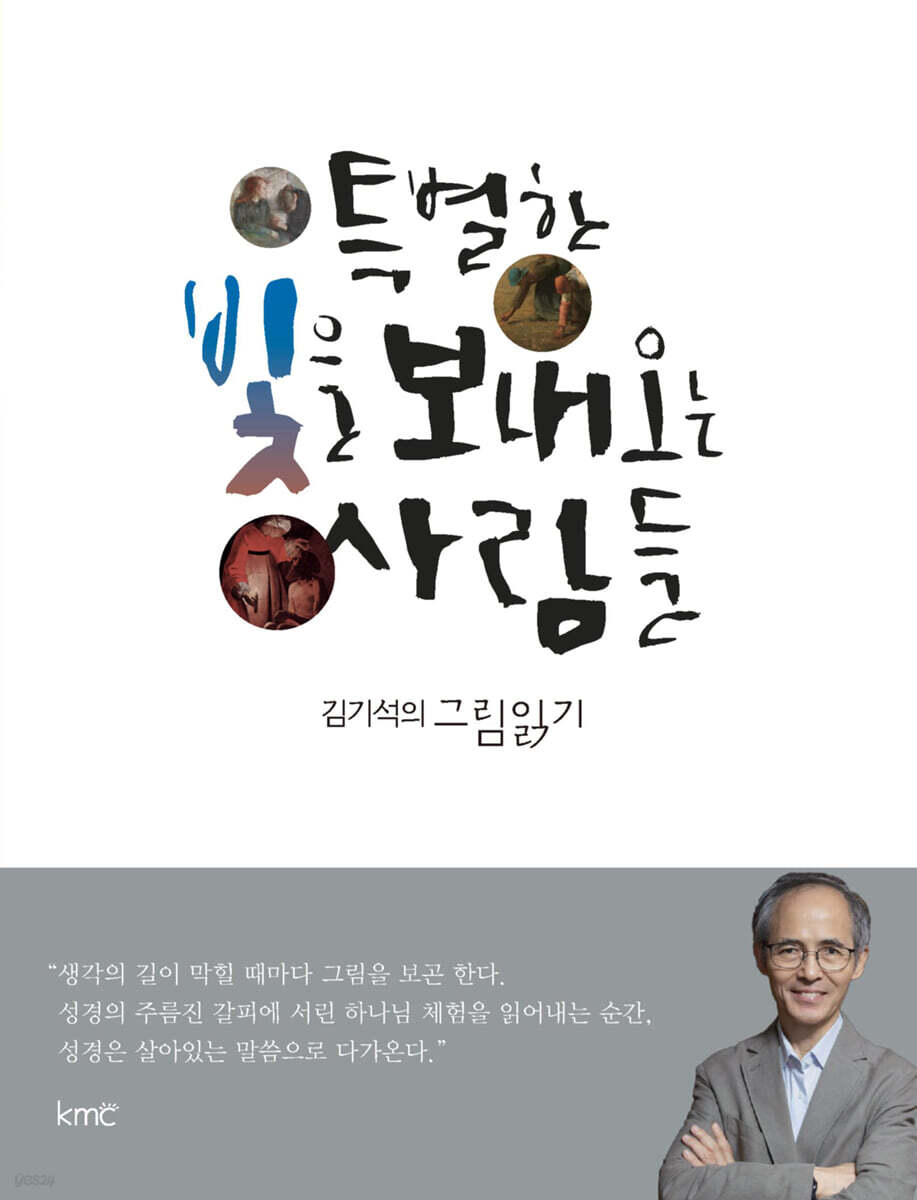
People who send special light
 |
Description
Book Introduction
“Whenever my thoughts get blocked, I look at a picture.
The moment we read the experience of God written in the wrinkled pages of the Bible,
“The Bible comes to us as a living word.”
Pastor Kim Ki-seok of Cheongpa Church, renowned for his spiritual preaching and writing, has published his new book, “People Who Send Special Light.”
In this book, the author begins with a painting and expands his theological thinking by approaching the essence of faith.
From Millet's "The Gleaners" to Rodin's "The Cathedral" and Chagall's "The Sacrifice of Isaac," the story told through 22 paintings broadly displays the hardships of life, the suffering of others, and the paradox of faith.
As we look deeper, our awareness of God in our ambiguous lives deepens, and our ability to imagine and understand others grows.
You can also feel the joy of the Bible coming to you as a living word.
Starting from a painting, it broadens the horizon of thought by moving between the mysterious and the everyday.
Part 1, "Where is the Holy Life?" and Part 2, "Because We Are All Shaken," unfold the ordinary yet sacred moments of everyday life and carefully examine the anxieties, greed, doubts, anger, and despair that we try to cover up.
In Part 3, “Finding Balance in a Noisy World,” a low, resonant voice conveys the message that even if we are shaken, we must not lose our center and enter into stillness.
In Part 4, “From Birth to Resurrection,” the image of Jesus carrying the sorrows of the world and conquering death makes me reflect on myself, my life, and my faith.
In Part 5, “At Last with God’s Heart,” we come to understand how to live in a life where light and darkness, the sacred and the profane, good and evil are intertwined.
The meeting of message and picture.
In order to fully convey the emotion of the famous painting containing the story of the Bible, it was made into a nude four-season binding that opens 180 degrees and is of a size that can be opened anytime, anywhere.
The moment we read the experience of God written in the wrinkled pages of the Bible,
“The Bible comes to us as a living word.”
Pastor Kim Ki-seok of Cheongpa Church, renowned for his spiritual preaching and writing, has published his new book, “People Who Send Special Light.”
In this book, the author begins with a painting and expands his theological thinking by approaching the essence of faith.
From Millet's "The Gleaners" to Rodin's "The Cathedral" and Chagall's "The Sacrifice of Isaac," the story told through 22 paintings broadly displays the hardships of life, the suffering of others, and the paradox of faith.
As we look deeper, our awareness of God in our ambiguous lives deepens, and our ability to imagine and understand others grows.
You can also feel the joy of the Bible coming to you as a living word.
Starting from a painting, it broadens the horizon of thought by moving between the mysterious and the everyday.
Part 1, "Where is the Holy Life?" and Part 2, "Because We Are All Shaken," unfold the ordinary yet sacred moments of everyday life and carefully examine the anxieties, greed, doubts, anger, and despair that we try to cover up.
In Part 3, “Finding Balance in a Noisy World,” a low, resonant voice conveys the message that even if we are shaken, we must not lose our center and enter into stillness.
In Part 4, “From Birth to Resurrection,” the image of Jesus carrying the sorrows of the world and conquering death makes me reflect on myself, my life, and my faith.
In Part 5, “At Last with God’s Heart,” we come to understand how to live in a life where light and darkness, the sacred and the profane, good and evil are intertwined.
The meeting of message and picture.
In order to fully convey the emotion of the famous painting containing the story of the Bible, it was made into a nude four-season binding that opens 180 degrees and is of a size that can be opened anytime, anywhere.
- You can preview some of the book's contents.
Preview
index
introduction.
People who send special light
Part 1.
Where is the holy life?
Life is sublime, even if it's hard: Jean-François Millet, The Gleaners
People who work silently today: Georges de La Tour, Saint Joseph the Carpenter
There are no boundaries between performance and art: Bartolome Esteban Murillo, The Kitchen of Angels
The Profane Embracing the Sacred: Vincent van Gogh, Still Life with a Bible
Part 2.
We are all shaken
Beyond the Denial of the Typewriter: Titian Vecellio, Cain and Abel
Greed Blinds: Pieter Bruegel the Elder, The Parable of the Blind
Doubt is a gateway to deeper understanding: Michelangelo Merisi da Caravaggio, Doubting Thomas
Anger at Injustice, Compassion for the Weak: Sandro Botticelli, The Temptation and Calling of Moses
Hope blossoms in the crashing waves: Tintoretto, Christ on the Sea of Galilee
Part 3.
Finding Balance in a Noisy World
Things You Have to Stop to See: Giovanni Bellini, "Madonna of the Meadow"
To avoid being shaken by the noise of the world: Fra Angelico, The Mocking of Christ
Invitation to Silence: Johannes Vermeer, "Woman with Scales"
God's Grace Saves the World: Georges Rouault, The War Mothers Hate
Part 4.
From birth to resurrection
How Jesus Came to Earth: Henry Ossawa and Tanner, The Annunciation
Behold, the Son of God: Piero della Francesca, The Baptism of Christ
Carrying All the Sorrows of the World: Michelangelo Buonarroti, Rondanini Pietà
Life Conquering Death: Lavinia Fontana, "Hands Off Me"
Part 5.
Only then with God's heart
A Time to Face Pain: Edvard Munch, The Sick Child
Read God's Heart: Sieghar Köder, "You Gave Me Food"
Experience the Presence of Christ: Lucas Cranach, The Reformation Altarpiece
Hands Outstretched: Auguste Rodin, The Cathedral
From Pain to Joy: Marc Chagall, The Sacrifice of Isaac
People who send special light
Part 1.
Where is the holy life?
Life is sublime, even if it's hard: Jean-François Millet, The Gleaners
People who work silently today: Georges de La Tour, Saint Joseph the Carpenter
There are no boundaries between performance and art: Bartolome Esteban Murillo, The Kitchen of Angels
The Profane Embracing the Sacred: Vincent van Gogh, Still Life with a Bible
Part 2.
We are all shaken
Beyond the Denial of the Typewriter: Titian Vecellio, Cain and Abel
Greed Blinds: Pieter Bruegel the Elder, The Parable of the Blind
Doubt is a gateway to deeper understanding: Michelangelo Merisi da Caravaggio, Doubting Thomas
Anger at Injustice, Compassion for the Weak: Sandro Botticelli, The Temptation and Calling of Moses
Hope blossoms in the crashing waves: Tintoretto, Christ on the Sea of Galilee
Part 3.
Finding Balance in a Noisy World
Things You Have to Stop to See: Giovanni Bellini, "Madonna of the Meadow"
To avoid being shaken by the noise of the world: Fra Angelico, The Mocking of Christ
Invitation to Silence: Johannes Vermeer, "Woman with Scales"
God's Grace Saves the World: Georges Rouault, The War Mothers Hate
Part 4.
From birth to resurrection
How Jesus Came to Earth: Henry Ossawa and Tanner, The Annunciation
Behold, the Son of God: Piero della Francesca, The Baptism of Christ
Carrying All the Sorrows of the World: Michelangelo Buonarroti, Rondanini Pietà
Life Conquering Death: Lavinia Fontana, "Hands Off Me"
Part 5.
Only then with God's heart
A Time to Face Pain: Edvard Munch, The Sick Child
Read God's Heart: Sieghar Köder, "You Gave Me Food"
Experience the Presence of Christ: Lucas Cranach, The Reformation Altarpiece
Hands Outstretched: Auguste Rodin, The Cathedral
From Pain to Joy: Marc Chagall, The Sacrifice of Isaac
Into the book
The apron tied tightly around her hips to hold the harvest is still empty.
Your face looks gloomy.
However, the appearance of women is very closely connected to the earth.
Could the pink sky perhaps be a symbol of hope amidst arduous labor?
When people see this picture, they immediately think of Ruth.
People see holiness in Ruth, who could not bear to turn away from her mother-in-law who asked her to be called Mara (bitterness) instead of Naomi (joy), so she moved to a foreign land and did not shy away from suffering.
--- p.22-23, from “Life is Magnificent, Even if It Is Hard: Millet, The Gleaners”
What we should notice in this picture is the Lord's hand guiding Thomas' hand.
The Lord willingly reveals His wounds to lead us into a deeper realm of understanding.
It is not a condemnation or a scolding, but a sign that affirms that one must go through the meeting to reach faith.
Meetings can be channels of grace, not signs of irreverence or unbelief.
--- p86, from “Doubt is a Pathway to Deeper Awareness: Caravaggio, Doubting Thomas”
In a world where being busy has become a status symbol, we race to keep up.
Breathing becomes rapid and vision narrows.
When we cannot afford to savor the fragrance of time, inner desolation begins.
This painting by Bellini invites us into silence.
The Virgin Mary praying with her eyes closed, and the baby Jesus, who seems to show us what true rest is.
When we look at the two of you, the rough emotions that were stirring within us subside, and the weight of life that was weighing on our shoulders becomes lighter.
--- p118-119, from “Things You Can See Only When You Stop: Giovanni Bellini, “Madonna of the Meadow”
Mother Mary is holding her son Jesus, who has turned into a corpse, from behind.
The naturally bent back clearly reveals the sorrow of a mother who has lost her beloved son.
It's amazing how sadness can be expressed just by looking at someone's back.
But because the expression of sadness is not overt, it touches the heart.
But if you look closely at the work, it looks as if the dead Jesus is carrying his grieving mother.
I wonder if that was Michelangelo's intention.
The mother tries to lift her son up by hugging him, but the son is carrying the weight of his mother's sorrow.
Isn't this the mystery of the cross?
Your face looks gloomy.
However, the appearance of women is very closely connected to the earth.
Could the pink sky perhaps be a symbol of hope amidst arduous labor?
When people see this picture, they immediately think of Ruth.
People see holiness in Ruth, who could not bear to turn away from her mother-in-law who asked her to be called Mara (bitterness) instead of Naomi (joy), so she moved to a foreign land and did not shy away from suffering.
--- p.22-23, from “Life is Magnificent, Even if It Is Hard: Millet, The Gleaners”
What we should notice in this picture is the Lord's hand guiding Thomas' hand.
The Lord willingly reveals His wounds to lead us into a deeper realm of understanding.
It is not a condemnation or a scolding, but a sign that affirms that one must go through the meeting to reach faith.
Meetings can be channels of grace, not signs of irreverence or unbelief.
--- p86, from “Doubt is a Pathway to Deeper Awareness: Caravaggio, Doubting Thomas”
In a world where being busy has become a status symbol, we race to keep up.
Breathing becomes rapid and vision narrows.
When we cannot afford to savor the fragrance of time, inner desolation begins.
This painting by Bellini invites us into silence.
The Virgin Mary praying with her eyes closed, and the baby Jesus, who seems to show us what true rest is.
When we look at the two of you, the rough emotions that were stirring within us subside, and the weight of life that was weighing on our shoulders becomes lighter.
--- p118-119, from “Things You Can See Only When You Stop: Giovanni Bellini, “Madonna of the Meadow”
Mother Mary is holding her son Jesus, who has turned into a corpse, from behind.
The naturally bent back clearly reveals the sorrow of a mother who has lost her beloved son.
It's amazing how sadness can be expressed just by looking at someone's back.
But because the expression of sadness is not overt, it touches the heart.
But if you look closely at the work, it looks as if the dead Jesus is carrying his grieving mother.
I wonder if that was Michelangelo's intention.
The mother tries to lift her son up by hugging him, but the son is carrying the weight of his mother's sorrow.
Isn't this the mystery of the cross?
--- p180-181, from “Carrying All the Sorrows of the World: Michelangelo, Rondanini Pietà”
Publisher's Review
God who still shapes me
About 40 paintings are spread out in one book.
You can appreciate famous biblical paintings by world-famous artists in one place.
This alone will give the reader a great deal of luxury.
The text of the Bible was absorbed into the artist's mind early on.
It met the artist's imagination and was reconstructed into a unique composition and color for each.
Depending on the reader, the visualized text may become audible and spoken words.
Pastor Kim Ki-seok, the author, calls those who put the Word on canvas “people who send special light.”
The author, who has been captivated by the Word throughout his life and has guided audiences and readers into the mysterious world of the Bible through his sermons, first reveals his own experiences on how Bible readers should approach the text and encounter the artist's work.
The author is convinced that the biblical text can take on a lifelike meaning depending on the reader's imagination.
So the author does not miss to introduce the fact that even painters have repeatedly painted the same text and subject using different painting techniques and materials.
The author's concern about 'open books, closed reading' is not unique.
We too see examples of people who read the same Torah (book of the law) but had different beliefs and lived different lives, such as the Pharisees and Jesus of Nazareth.
While reading the same words, “Keep the Sabbath day,” the Pharisees lived a life of persecuting and killing people, while Jesus, who healed on the Sabbath, said, “The Sabbath was made for man,” not “man for the Sabbath,” and responded, “The Son of Man is Lord even of the Sabbath.”
There is closed reading, which reads open words as closed legal texts and thus confines oneself to the words, while there is open reading, which reads the message of liberation from the open text of the Bible.
The author says, “Imagination is necessary to interpret the Bible.
“That is why we pay attention to works of art (page 7).”
The books of the law, the prophets, and the writings that formed the Old Testament are works handed down by priests, prophets, and writers.
These three leading classes of Judaism were in polar opposites.
However, Rabbinic Judaism did not choose one of the three traditions or reject the others.
It was judged that three traditions with different functions must be combined to form a complete scripture.
Early Christianity, which was born around the same time, accepted the scriptures of rabbinic Judaism as they were, and combined them with the Gospels, Acts, Epistles, and Revelation.
The Hebrew Bible taken from Judaism was called the Old Testament, and the Greek Bible collected and canonized by Christianity was called the New Testament.
Early Christianity combined the Old and New Covenants into a scripture called the Bible.
Without prophetic imagination, these different and contrasting traditions could not have been combined into one scripture.
If, while reading the Bible, we choose only the passages that support our beliefs, such as supporting verses, rather than paying attention to the overall context and text itself, and ultimately make them the dominant text and use them as the standard for interpreting the rest of the text, the mysterious world of the Bible will turn into a barren desert.
But readers of this book, with the help of their artistic imagination and the "special light senders," will discover the dynamic meaning of the Bible.
_ Min Yeong-jin (former general secretary of the Korean Bible Society)
About 40 paintings are spread out in one book.
You can appreciate famous biblical paintings by world-famous artists in one place.
This alone will give the reader a great deal of luxury.
The text of the Bible was absorbed into the artist's mind early on.
It met the artist's imagination and was reconstructed into a unique composition and color for each.
Depending on the reader, the visualized text may become audible and spoken words.
Pastor Kim Ki-seok, the author, calls those who put the Word on canvas “people who send special light.”
The author, who has been captivated by the Word throughout his life and has guided audiences and readers into the mysterious world of the Bible through his sermons, first reveals his own experiences on how Bible readers should approach the text and encounter the artist's work.
The author is convinced that the biblical text can take on a lifelike meaning depending on the reader's imagination.
So the author does not miss to introduce the fact that even painters have repeatedly painted the same text and subject using different painting techniques and materials.
The author's concern about 'open books, closed reading' is not unique.
We too see examples of people who read the same Torah (book of the law) but had different beliefs and lived different lives, such as the Pharisees and Jesus of Nazareth.
While reading the same words, “Keep the Sabbath day,” the Pharisees lived a life of persecuting and killing people, while Jesus, who healed on the Sabbath, said, “The Sabbath was made for man,” not “man for the Sabbath,” and responded, “The Son of Man is Lord even of the Sabbath.”
There is closed reading, which reads open words as closed legal texts and thus confines oneself to the words, while there is open reading, which reads the message of liberation from the open text of the Bible.
The author says, “Imagination is necessary to interpret the Bible.
“That is why we pay attention to works of art (page 7).”
The books of the law, the prophets, and the writings that formed the Old Testament are works handed down by priests, prophets, and writers.
These three leading classes of Judaism were in polar opposites.
However, Rabbinic Judaism did not choose one of the three traditions or reject the others.
It was judged that three traditions with different functions must be combined to form a complete scripture.
Early Christianity, which was born around the same time, accepted the scriptures of rabbinic Judaism as they were, and combined them with the Gospels, Acts, Epistles, and Revelation.
The Hebrew Bible taken from Judaism was called the Old Testament, and the Greek Bible collected and canonized by Christianity was called the New Testament.
Early Christianity combined the Old and New Covenants into a scripture called the Bible.
Without prophetic imagination, these different and contrasting traditions could not have been combined into one scripture.
If, while reading the Bible, we choose only the passages that support our beliefs, such as supporting verses, rather than paying attention to the overall context and text itself, and ultimately make them the dominant text and use them as the standard for interpreting the rest of the text, the mysterious world of the Bible will turn into a barren desert.
But readers of this book, with the help of their artistic imagination and the "special light senders," will discover the dynamic meaning of the Bible.
_ Min Yeong-jin (former general secretary of the Korean Bible Society)
GOODS SPECIFICS
- Date of issue: October 31, 2023
- Page count, weight, size: 244 pages | 582g | 150*197*20mm
- ISBN13: 9788984308961
- ISBN10: 898430896X
You may also like
카테고리
korean


korean

![GQ KOREA Mark (Monthly): December [2025]](http://librairie.coreenne.fr/cdn/shop/files/8ef265dbbfbf186523ed75ba7319009d.jpg?v=1765340328&width=3840)


