

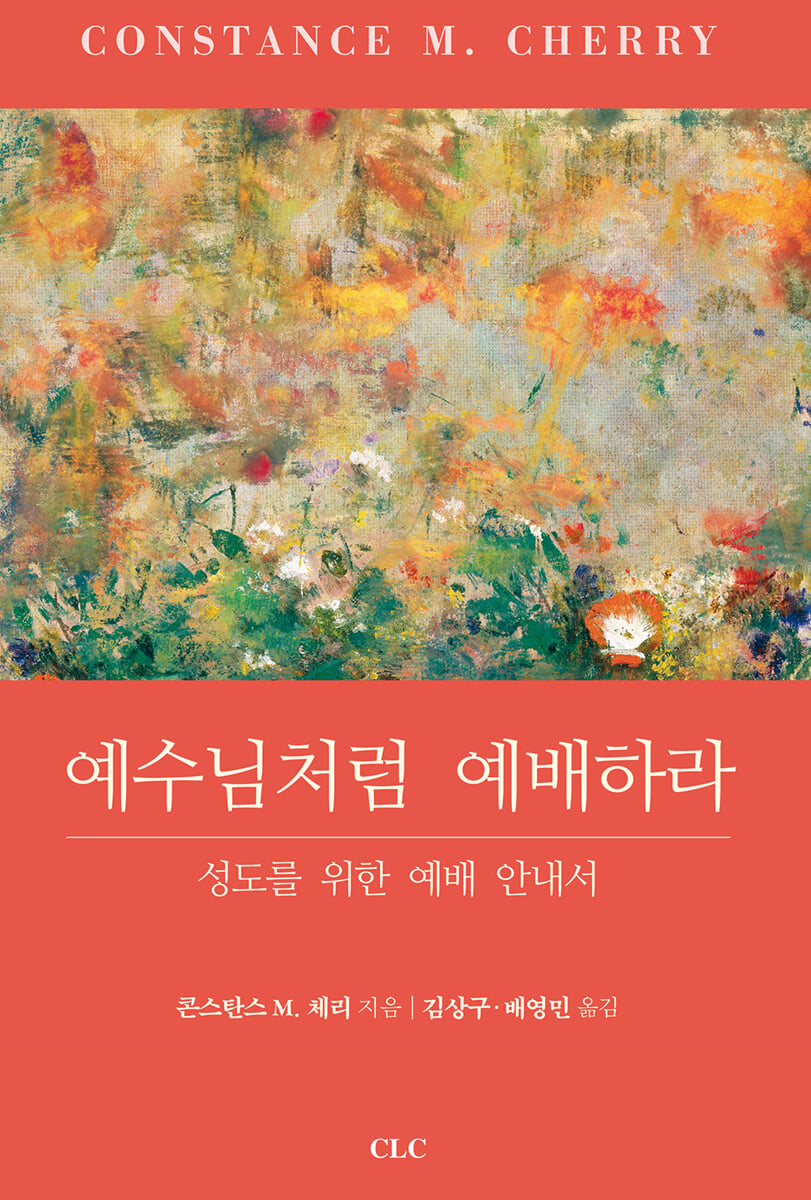
Worship like Jesus
 |
Description
Book Introduction
This book is about how a disciple of Christ learns to worship God correctly. It looks at Jesus from the perspective of a worshiper and presents the way Jesus set an example as a worshiper.
The Gospels focus on Jesus' participation in worship rather than his teachings on worship.
By examining how the worship taught in the Bible was realized through Jesus as a worshiper, it shows how the church today should learn, practice, and practice worship.
The Gospels focus on Jesus' participation in worship rather than his teachings on worship.
By examining how the worship taught in the Bible was realized through Jesus as a worshiper, it shows how the church today should learn, practice, and practice worship.
- You can preview some of the book's contents.
Preview
index
Recommendation 1 Dr. Seungjin Lee│Professor of Worship and Homiletics, Union Theological Seminary 1
Recommendation 2 Dr. Joo Jong-hoon│Professor of Worship Studies, Graduate School of Theology, Chongshin University 3
Acknowledgements 11
Translator's Preface 13
Introduction 15
Chapter 1 Our Role Models for Worship 19
Chapter 2: Priorities in Worship 35
Chapter 3: Objects of Worship 54
Chapter 4: Christ, the Center of Worship 70
Chapter 5: God's Narrative on Worship 91
Chapter 6: Conversations in Worship 112
Chapter 7: Disciples Participating in Worship 130
Chapter 8: The Worshiping Community 153
Conclusion 173
Recommendation 2 Dr. Joo Jong-hoon│Professor of Worship Studies, Graduate School of Theology, Chongshin University 3
Acknowledgements 11
Translator's Preface 13
Introduction 15
Chapter 1 Our Role Models for Worship 19
Chapter 2: Priorities in Worship 35
Chapter 3: Objects of Worship 54
Chapter 4: Christ, the Center of Worship 70
Chapter 5: God's Narrative on Worship 91
Chapter 6: Conversations in Worship 112
Chapter 7: Disciples Participating in Worship 130
Chapter 8: The Worshiping Community 153
Conclusion 173
Into the book
I have found that when worshippers faithfully and devotedly participate in the worship service (every church has its own liturgy), they are molded into true worshippers through their words and actions.
Because worship continually reframes our perspective on God and the world, it becomes the most important means of our faith.
But it's not just our view that changes.
More importantly, through true worship our affections—our love for things or people—are refined.
Corporate worship makes us disciples in the realm of faith and love.
The discipleship that worship teaches can be summarized in the following way:
Do as I do, come and believe what I believe and love what I love.
--- p.30
Jesus further emphasized that the Father accepts worship by saying that the Father seeks worshippers (John 4:23).
While on earth, Jesus worshipped the Father as a human being.
This bond between the Father and the Son formed the essence of the relationship between the two as declared in Jesus' baptism.
To Jesus, God was the Father.
Moreover, because Jesus was still incarnate—God in the flesh—he continued to worship the Father.
--- p.60
A second way in which Jesus' worship was filled with the story of God was by his observance of Jewish holy days and festivals.
Over the centuries, the weekly unit of time expanded into many days and seasons to mark how God continued to act in significant ways for His people.
From Genesis to Revelation, we see God intervening in human history to accomplish His purposes.
--- p.100
As time went on, Jesus showed a growing interest in his faith.
A classic example is found in the story of Jesus' adventure in the temple during his family's annual journey to Jerusalem for Passover (see Luke 2:41-52).
One year the boy Jesus made the most of the opportunity to raise his faith to a new level.
For several days he sat among the religious teachers in the temple where the rabbis had taught.
There Jesus listened to their teaching and asked them questions.
The rabbis will then present a counterargument for the student to answer.
This methodology for religious instruction was very common in Jewish culture and helps explain Luke's account:
--- p.134
Jesus served as a lector, reading the Scriptures in the synagogue.
A rector is a designated Bible reader.
Consider one instance, where Luke describes a dramatic moment when Jesus stands and reads the assigned passage of Scripture.
Ironically, the passage is a quote from Isaiah and describes Jesus' ministry.
“The Spirit of the Lord is upon me, because he has anointed me to preach the gospel to the poor. He has sent me to heal the brokenhearted, to proclaim liberty to the captives and recovery of sight to the blind, to set at liberty those who are oppressed, to proclaim the year of the Lord’s favor (Luke 4:18-19).”
--- p.158
Camps have the potential to lead the Christian community in these areas.
Nature studies that are seamlessly integrated with the biblical teachings on creation can have a profound impact on young people.
Another unique activity at campsites that can help with this process is having campers participate in service projects that help restore or prevent environmental damage.
--- p.420
Individuals who have been able to travel abroad to observe missionary work have had their perspectives significantly changed by that experience.
Nothing can affect people so dramatically as seeing ministry firsthand.
Transportation costs for one or two adults to travel anywhere on Earth are usually not that expensive.
Another way to experience the mission field is through business travel, which has a defined purpose of accomplishing a task on behalf of the ministry.
Because worship continually reframes our perspective on God and the world, it becomes the most important means of our faith.
But it's not just our view that changes.
More importantly, through true worship our affections—our love for things or people—are refined.
Corporate worship makes us disciples in the realm of faith and love.
The discipleship that worship teaches can be summarized in the following way:
Do as I do, come and believe what I believe and love what I love.
--- p.30
Jesus further emphasized that the Father accepts worship by saying that the Father seeks worshippers (John 4:23).
While on earth, Jesus worshipped the Father as a human being.
This bond between the Father and the Son formed the essence of the relationship between the two as declared in Jesus' baptism.
To Jesus, God was the Father.
Moreover, because Jesus was still incarnate—God in the flesh—he continued to worship the Father.
--- p.60
A second way in which Jesus' worship was filled with the story of God was by his observance of Jewish holy days and festivals.
Over the centuries, the weekly unit of time expanded into many days and seasons to mark how God continued to act in significant ways for His people.
From Genesis to Revelation, we see God intervening in human history to accomplish His purposes.
--- p.100
As time went on, Jesus showed a growing interest in his faith.
A classic example is found in the story of Jesus' adventure in the temple during his family's annual journey to Jerusalem for Passover (see Luke 2:41-52).
One year the boy Jesus made the most of the opportunity to raise his faith to a new level.
For several days he sat among the religious teachers in the temple where the rabbis had taught.
There Jesus listened to their teaching and asked them questions.
The rabbis will then present a counterargument for the student to answer.
This methodology for religious instruction was very common in Jewish culture and helps explain Luke's account:
--- p.134
Jesus served as a lector, reading the Scriptures in the synagogue.
A rector is a designated Bible reader.
Consider one instance, where Luke describes a dramatic moment when Jesus stands and reads the assigned passage of Scripture.
Ironically, the passage is a quote from Isaiah and describes Jesus' ministry.
“The Spirit of the Lord is upon me, because he has anointed me to preach the gospel to the poor. He has sent me to heal the brokenhearted, to proclaim liberty to the captives and recovery of sight to the blind, to set at liberty those who are oppressed, to proclaim the year of the Lord’s favor (Luke 4:18-19).”
--- p.158
Camps have the potential to lead the Christian community in these areas.
Nature studies that are seamlessly integrated with the biblical teachings on creation can have a profound impact on young people.
Another unique activity at campsites that can help with this process is having campers participate in service projects that help restore or prevent environmental damage.
--- p.420
Individuals who have been able to travel abroad to observe missionary work have had their perspectives significantly changed by that experience.
Nothing can affect people so dramatically as seeing ministry firsthand.
Transportation costs for one or two adults to travel anywhere on Earth are usually not that expensive.
Another way to experience the mission field is through business travel, which has a defined purpose of accomplishing a task on behalf of the ministry.
--- p.501
GOODS SPECIFICS
- Date of issue: March 10, 2023
- Page count, weight, size: 176 pages | 153*224*20mm
- ISBN13: 9788934125273
- ISBN10: 8934125276
You may also like
카테고리
korean


korean

![GQ KOREA Mark (Monthly): December [2025]](http://librairie.coreenne.fr/cdn/shop/files/8ef265dbbfbf186523ed75ba7319009d.jpg?v=1765340328&width=3840)


