

Nag Hammadi Documents
 |
Description
Book Introduction
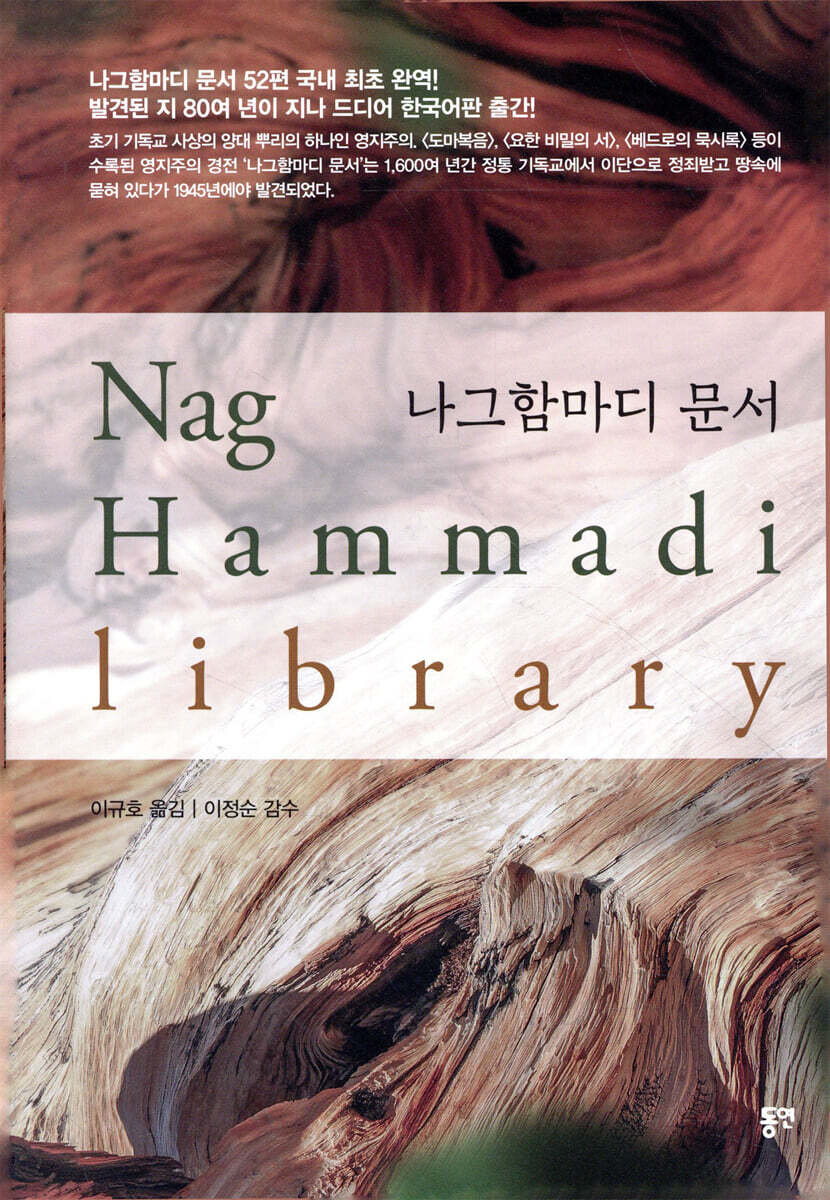
Nag Hammadi documents, the original source of Gnosticism from the 4th century AD
Gnosticism, one of the two major roots of early Christian thought.
The Nag Hammadi Scrolls, a Gnostic scripture that includes the Gospel of Thomas, the Secret Book of John, and the Apocalypse of Peter, were condemned as heresy by orthodox Christianity for over 1,600 years and buried underground until they were discovered in 1945.
After another 80 years, the Korean version was finally published.
Although there have been a few fragmentary translations of the Gospel of Thomas, this book is the first complete translation in Korea that includes all 52 Nag Hammadi documents.
In general, Gnosticism, which dualistically divides soul and matter, has had a lasting influence and formed a minority within the Christian community since the first century when early Christian thought was being established.
Then, at the Council of Nicaea, also known as the Trinity Controversy, he was excommunicated for denying the divinity of Jesus and only recognizing his humanity (321).
Gnosticism, led by Arius (250 or 256-336), was condemned as a heretical ideology by the majority centered around Athanasius (295-373), and was subsequently excluded from orthodox Christianity and eradicated.
After that, around 367, not only were the followers of Gnosticism excommunicated and burned at the stake, but all Gnostic scriptures were eradicated and destroyed.
The Nag Hammadi manuscripts were kept sealed in jars in the Pachomian monastery near the Egyptian village of Nag Hammadi, but were discovered by chance in 1945 by a farmer named Mohammad Ali.
In fact, some of those originals, such as the Gospel of Thomas, the Gospel of Veritate, and the Gospel of the Egyptians, were written by early church founders such as Clement of Alexandria, Irenaeus, and Origen, and modern scholars believe that some of those copies were made as early as 150 AD.
Meanwhile, during the Crusades that took place from the 11th to the 13th centuries, a large-scale purification of Gnosticism was carried out, no less than the war against Islam.
Thus, although it was defined as heresy, a large-scale eradication effort was carried out against Gnosticism, which remained within the Christian community as monasteries and various sectarian movements.
If the Nag Hammadi texts had been discovered in the Middle Ages, rather than during the time of the early Christian Fathers, they would likely have been destroyed and forever lost.
The Nag Hammadi manuscripts were internationally recognized as authentic Gnostic texts, and it was not until 1970 that the Egyptian Ministry of Culture and UNESCO began publishing them in manuscript form, and American biblical scholar James M.
Robinson) formed a joint translation team of experts and published the first English translation in 1977.
Afterwards, scholars around the world translated it into various languages, and it is currently published in many languages around the world, and the translated version is available along with the Coptic original on many websites, including the website of the American Gnostic Church.
In Korea, where orthodox and conservative theology dominates, this document was known only as a research paper to some biblical theologians, especially New Testament scholars, and was not known to the general public or readers of humanities.
Then, as translations of the Gospel of Thomas were published several times, interest in the original text, the Nag Hammadi Document, which contained different Gnostic ideas, also increased.
However, the complete translation was not published in the Korean church culture that still denied the Trinity and the divinity of Jesus, disparaged it as an unorthodox Christian thought that shared Buddhist thought, and even research or introduction of it was taboo.
This book is significant as a cornerstone for the introduction and exploration of the Nag Hammadi Documents as an axis of Christian thought and an axis that constitutes the history of human thought.
Gnosticism, one of the two major roots of early Christian thought.
The Nag Hammadi Scrolls, a Gnostic scripture that includes the Gospel of Thomas, the Secret Book of John, and the Apocalypse of Peter, were condemned as heresy by orthodox Christianity for over 1,600 years and buried underground until they were discovered in 1945.
After another 80 years, the Korean version was finally published.
Although there have been a few fragmentary translations of the Gospel of Thomas, this book is the first complete translation in Korea that includes all 52 Nag Hammadi documents.
In general, Gnosticism, which dualistically divides soul and matter, has had a lasting influence and formed a minority within the Christian community since the first century when early Christian thought was being established.
Then, at the Council of Nicaea, also known as the Trinity Controversy, he was excommunicated for denying the divinity of Jesus and only recognizing his humanity (321).
Gnosticism, led by Arius (250 or 256-336), was condemned as a heretical ideology by the majority centered around Athanasius (295-373), and was subsequently excluded from orthodox Christianity and eradicated.
After that, around 367, not only were the followers of Gnosticism excommunicated and burned at the stake, but all Gnostic scriptures were eradicated and destroyed.
The Nag Hammadi manuscripts were kept sealed in jars in the Pachomian monastery near the Egyptian village of Nag Hammadi, but were discovered by chance in 1945 by a farmer named Mohammad Ali.
In fact, some of those originals, such as the Gospel of Thomas, the Gospel of Veritate, and the Gospel of the Egyptians, were written by early church founders such as Clement of Alexandria, Irenaeus, and Origen, and modern scholars believe that some of those copies were made as early as 150 AD.
Meanwhile, during the Crusades that took place from the 11th to the 13th centuries, a large-scale purification of Gnosticism was carried out, no less than the war against Islam.
Thus, although it was defined as heresy, a large-scale eradication effort was carried out against Gnosticism, which remained within the Christian community as monasteries and various sectarian movements.
If the Nag Hammadi texts had been discovered in the Middle Ages, rather than during the time of the early Christian Fathers, they would likely have been destroyed and forever lost.
The Nag Hammadi manuscripts were internationally recognized as authentic Gnostic texts, and it was not until 1970 that the Egyptian Ministry of Culture and UNESCO began publishing them in manuscript form, and American biblical scholar James M.
Robinson) formed a joint translation team of experts and published the first English translation in 1977.
Afterwards, scholars around the world translated it into various languages, and it is currently published in many languages around the world, and the translated version is available along with the Coptic original on many websites, including the website of the American Gnostic Church.
In Korea, where orthodox and conservative theology dominates, this document was known only as a research paper to some biblical theologians, especially New Testament scholars, and was not known to the general public or readers of humanities.
Then, as translations of the Gospel of Thomas were published several times, interest in the original text, the Nag Hammadi Document, which contained different Gnostic ideas, also increased.
However, the complete translation was not published in the Korean church culture that still denied the Trinity and the divinity of Jesus, disparaged it as an unorthodox Christian thought that shared Buddhist thought, and even research or introduction of it was taboo.
This book is significant as a cornerstone for the introduction and exploration of the Nag Hammadi Documents as an axis of Christian thought and an axis that constitutes the history of human thought.
- You can preview some of the book's contents.
Preview
index
Recommendation
In publishing the book
Translator's Note
Codex I
1.
Apostle Paul's Prayer
2.
The Secret Book of James
3.
The Gospel of Truth
4.
Resurrection
5.
Tripartite
Codex II
6.
The Secret Book of John
7.
Gospel of Thomas
8.
Gospel of Philip
9.
The essence of the Archons
10.
The origin of the world
11.
Interpretation of the Soul
12.
The Book of Thomas the Disputant
Codex III
13.
The Gospel of the Egyptians
14.
Blessed Eugnostus
15.
Sophia of Jesus Christ
16.
The Savior's Dialogue
(The Book of John)
Codex IV
(The Book of John)
(Gospel of the Egyptians)
Codex V
17.
Paul's Revelation
18.
First Revelation of James
19.
The Second Revelation of James
20.
The Apocalypse of Adam
(Blessed Eugnostus)
Codex VI
21.
The Acts of Peter and the Twelve Apostles
22.
Thunder, perfect mind
23.
Authoritative teachings
24.
The concept of our great power
25.
Plato's Republic, 588B-589B
26.
Teachings on the Eighth and Ninth Worlds
27.
Prayer of Thanksgiving
28.
Asclepius 21-29
Codex VII
29.
Shem's message
30.
The Second Writing of the Great Three
31.
The Apocalypse of Peter
32.
The Teachings of Silvanus
33.
Three Pillars of Three
Codex VIII
34.
Zostrianos
35.
Peter's Letter to Philip
Codex IX
36.
Melchizedek
37.
Norea's thoughts
38.
Testimony of the truth
Codex Codex X
39.
Marsanes
Codex XI
40.
Interpretation of knowledge
41~45.
Valentinian Explanation: About Anointing, About Baptism, A and B, About the Eucharist, A and B
46.
Allogenes
47.
Whipsyphron
Codex XII
48.
Quotes of Sextus
49.
snippet
(Gospel of Truth)
Codex XIII
50.
Protennoia of the Three Forms
(Origin of the World)
BG(Berolinensis Gnosticus) 8502
51.
Gospel of Mary
52.
Acts of Peter
(The Book of John)
(Sophia of Jesus Christ)
In publishing the book
Translator's Note
Codex I
1.
Apostle Paul's Prayer
2.
The Secret Book of James
3.
The Gospel of Truth
4.
Resurrection
5.
Tripartite
Codex II
6.
The Secret Book of John
7.
Gospel of Thomas
8.
Gospel of Philip
9.
The essence of the Archons
10.
The origin of the world
11.
Interpretation of the Soul
12.
The Book of Thomas the Disputant
Codex III
13.
The Gospel of the Egyptians
14.
Blessed Eugnostus
15.
Sophia of Jesus Christ
16.
The Savior's Dialogue
(The Book of John)
Codex IV
(The Book of John)
(Gospel of the Egyptians)
Codex V
17.
Paul's Revelation
18.
First Revelation of James
19.
The Second Revelation of James
20.
The Apocalypse of Adam
(Blessed Eugnostus)
Codex VI
21.
The Acts of Peter and the Twelve Apostles
22.
Thunder, perfect mind
23.
Authoritative teachings
24.
The concept of our great power
25.
Plato's Republic, 588B-589B
26.
Teachings on the Eighth and Ninth Worlds
27.
Prayer of Thanksgiving
28.
Asclepius 21-29
Codex VII
29.
Shem's message
30.
The Second Writing of the Great Three
31.
The Apocalypse of Peter
32.
The Teachings of Silvanus
33.
Three Pillars of Three
Codex VIII
34.
Zostrianos
35.
Peter's Letter to Philip
Codex IX
36.
Melchizedek
37.
Norea's thoughts
38.
Testimony of the truth
Codex Codex X
39.
Marsanes
Codex XI
40.
Interpretation of knowledge
41~45.
Valentinian Explanation: About Anointing, About Baptism, A and B, About the Eucharist, A and B
46.
Allogenes
47.
Whipsyphron
Codex XII
48.
Quotes of Sextus
49.
snippet
(Gospel of Truth)
Codex XIII
50.
Protennoia of the Three Forms
(Origin of the World)
BG(Berolinensis Gnosticus) 8502
51.
Gospel of Mary
52.
Acts of Peter
(The Book of John)
(Sophia of Jesus Christ)
Into the book
The Gospel of Thomas
The Gospel of Thomas is a book that contains the words of Jesus.
This Coptic Gospel of Thomas is a translation from Greek.
A few fragments of the Greek version of the Gospel of Thomas survive, which are thought to date back to around 200 AD.
Therefore, the Greek (or Syriac or Aramaic) collection of sayings is thought to have been composed before 200 AD, perhaps in the late 1st century, in Syria, Palestine or Mesopotamia.
The author of the Gospel of Thomas is Didymus Judas Thomas, or Judas “the Twin,” who is considered, especially in the Syriac Church, to be an apostle and twin brother of Jesus.
The relationship between the Gospel of Thomas and the New Testament gospels is of particular interest.
Several passages from the Gospel of Thomas have parallel passages in the Synoptic Gospels (Matthew, Mark, and Luke).
If we compare the words of the Gospel of Thomas with the parallel passages in the Synoptic Gospels, we can assume that the words in the Gospel of Thomas are either an earlier form or a development of an earlier form of such words.
The Gospel of Thomas is similar to the “Q” source (from the German word Quelle, meaning “source”), which is believed to be a source commonly used by Matthew and Luke.
Therefore, the Gospel of Thomas and the material that formed the basis of this article are closely related to the materials of the New Testament gospels.
Although the Gospel of Thomas cannot be considered the work of a specific Gnostic school or sect, the influence of Gnostic theology is clearly evident in the Gospel of Thomas.
This collection of sayings is titled “The Secret Words of the Living Jesus.”
In this way, the Gospel of Thomas has a relatively (esoteric) tendency.
The key to understanding this passage is to interpret it and know its secret meaning, for it says, “Whoever finds the interpretation of this passage will not experience death.”
The numbers given to the 114 quotes included here are not from the manuscript but were assigned by scholars.
Most scholars today follow this distinction.
---From "The Gospel of Thomas (II, 2)"
Unlocking the Book of John
The Secret Book of John contains the revelations given by the resurrected Christ to John the son of Zebedee regarding the creation, fall, and salvation of mankind.
A look at the writings of the Church Fathers reveals that some of them were well aware of the contents of the Secret Book of John.
The teachings of some of the Gnostics in Irenaeus' writings are very similar to the cosmological teachings in this text.
However, it is not known whether Irenaeus knew the Secret Book of John as it is here.
Since Irenaeus wrote his "Criticism of Heresies" in 185 AD, it is clear that teachings similar to those in the "Secret Book of John" were prevalent among Gnostics before then.
The Secret Book of John was used by the Audienians in Mesopotamia until the 8th century.
The Secret Book of John answers two fundamental questions: "What is evil?" and "How can we escape from this evil world to our heavenly home?"
The cosmogony presented here also attempts to answer these questions.
Here, the supreme deity is defined as an abstract, Hellenic concept of perfection, a perfection that transcends all anthropomorphic concepts and is completely unrelated to this world.
This supreme divinity radiates a series of beings of light, including Christ and Sophia.
According to the Book of the Secret, the fall occurred when Sophia attempted to give birth to a being without the consent of the Great Spirit or her spouse.
Eventually, she gives birth to the monstrous creator Yaldabaoth, who possesses some of his mother's light power.
Yaldabaoth creates angels to rule the world and assists in the creation of humans.
But man himself is created in the image of the perfect Father reflected in the water.
When Yaldabaoth is deceived and breathes the power of light into humanity, humanity gains life.
Thus begins the struggle between the powers of light and the powers of darkness for the divine fragments within man.
Evil powers imprison humans by putting them into material bodies.
It also creates women and sexual desires, scattering fragments of light to make it more difficult for them to escape the body and the world.
Finally, Christ is sent to the world below to save humanity by reminding them that their origins are in heaven.
Only those who possess this knowledge and live an ascetic life can return to the realm of light.
Others reincarnate until they attain the knowledge of salvation.
---From "The Book of John's Secret (II, 1 / III, 1 / IV, 1 and BG 8502, 2)"
Unpacking the Apocalypse of Peter
The Apocalypse of Peter is an anonymous Christian Gnostic document, a revelation given to the Apostle Peter.
Here is what the Savior Jesus explained.
The persecution Jesus endured became the basis for understanding the history of early Christianity, when a remnant of Gnostics who had kept their faith were persecuted.
This material belongs to the apocalyptic genre.
This passage centers around Peter's report of three visions he claims to have seen, and Jesus' explanation of them.
This text tells us that in a prophecy reflecting past events, the early church was divided into several sects opposing the Gnostic community.
For the spiritualists, the world's environment is hostile.
The Gnostics long to receive knowledge of the heavenly origins and to return to the Son of Man in heaven.
He is the one who will come as an eschatological savior to judge the oppressors and defend the gnostics.
The apocalyptic form of this text was adopted to provide a gnostic understanding of the Christian tradition about Jesus.
In this article, traditional theology is interpreted in line with Gnostic theology.
The first vision (72:4-9), which describes those who want to kill Jesus and the hostile priests, is interpreted from the perspective of six groups, who are called “blind people without a guide.”
Many of this group appear to have belonged to the orthodox church of the time, but some can also be seen as members of competing Gnostic sects.
The second part (81:3-14) describes Peter's vision of Jesus' crucifixion.
The subsequent interpretation of Jesus distinguishes between the physical form and the living Jesus.
The latter stands beside them, laughing at their ignorant persecutors.
The third visionary section (82:4-16) is highly gnostic in its interpretation of the reunion of the light of knowledge of the heavenly pleroma with the spiritual body of Jesus.
The Apocalypse of Peter contains important material on Gnostic Christology, which views Jesus as a hypostatic savior.
This document also provides insight into the relationship between Peter, whom they regard as their originator, and the Gnostics, as well as the views of the Gnostic community.
The Apocalypse of Peter is thought to have been written in the 3rd century, when the distinction between orthodoxy and heresy became clearer.
---From "The Apocalypse of Peter (VII, 3)"
Release of "Testimony of Truth"
The Testimony of Truth is a Christian Gnostic document of didactic and polemical character.
The title is based on the content.
It is believed to have been originally written in Greek in Alexandria, Egypt.
The author is not known for certain, but it is thought to have been either Julius Cassian (c. 190 AD) or Hieracas of Leontopolis (c. 300 AD).
This fragmentary document, "The Testimony of Truth," can be divided into two parts.
The first part (29:6-45:6) is a self-contained exhortation, addressing a spiritually awakened group on a variety of topics.
These themes are truth in contrast to the law, knowledge in contrast to martyrdom and the vain hope of bodily resurrection, purity in contrast to the corruption of the body, and the life of a wise and perfect gnostic.
The rest of this article is much more controversial.
At the time, he was sharply critical not only of the Catholic Church, but also of various Gnostic groups such as the Valentinians, the Basilides, and the Simonians.
This section seems to be aimed particularly at the Catholic Church and those at risk of falling into certain types of gnostic errors.
"The Testimony of Truth" draws on numerous sources, including a Midrash that contains particularly interesting material about the serpent in Genesis 3 (45:23-49:7).
This article also quotes or alludes to passages from the Old and New Testaments (especially Paul and John) and the Apocrypha.
Although the Valentinians are attacked as “heretics,” the influence of Valentinian Gnosticism is evident throughout the document.
The most striking feature of "The Testimony of Truth" is its radical insistence on the utter rejection of the world and everything belonging to it.
The Gospel of Thomas is a book that contains the words of Jesus.
This Coptic Gospel of Thomas is a translation from Greek.
A few fragments of the Greek version of the Gospel of Thomas survive, which are thought to date back to around 200 AD.
Therefore, the Greek (or Syriac or Aramaic) collection of sayings is thought to have been composed before 200 AD, perhaps in the late 1st century, in Syria, Palestine or Mesopotamia.
The author of the Gospel of Thomas is Didymus Judas Thomas, or Judas “the Twin,” who is considered, especially in the Syriac Church, to be an apostle and twin brother of Jesus.
The relationship between the Gospel of Thomas and the New Testament gospels is of particular interest.
Several passages from the Gospel of Thomas have parallel passages in the Synoptic Gospels (Matthew, Mark, and Luke).
If we compare the words of the Gospel of Thomas with the parallel passages in the Synoptic Gospels, we can assume that the words in the Gospel of Thomas are either an earlier form or a development of an earlier form of such words.
The Gospel of Thomas is similar to the “Q” source (from the German word Quelle, meaning “source”), which is believed to be a source commonly used by Matthew and Luke.
Therefore, the Gospel of Thomas and the material that formed the basis of this article are closely related to the materials of the New Testament gospels.
Although the Gospel of Thomas cannot be considered the work of a specific Gnostic school or sect, the influence of Gnostic theology is clearly evident in the Gospel of Thomas.
This collection of sayings is titled “The Secret Words of the Living Jesus.”
In this way, the Gospel of Thomas has a relatively (esoteric) tendency.
The key to understanding this passage is to interpret it and know its secret meaning, for it says, “Whoever finds the interpretation of this passage will not experience death.”
The numbers given to the 114 quotes included here are not from the manuscript but were assigned by scholars.
Most scholars today follow this distinction.
---From "The Gospel of Thomas (II, 2)"
Unlocking the Book of John
The Secret Book of John contains the revelations given by the resurrected Christ to John the son of Zebedee regarding the creation, fall, and salvation of mankind.
A look at the writings of the Church Fathers reveals that some of them were well aware of the contents of the Secret Book of John.
The teachings of some of the Gnostics in Irenaeus' writings are very similar to the cosmological teachings in this text.
However, it is not known whether Irenaeus knew the Secret Book of John as it is here.
Since Irenaeus wrote his "Criticism of Heresies" in 185 AD, it is clear that teachings similar to those in the "Secret Book of John" were prevalent among Gnostics before then.
The Secret Book of John was used by the Audienians in Mesopotamia until the 8th century.
The Secret Book of John answers two fundamental questions: "What is evil?" and "How can we escape from this evil world to our heavenly home?"
The cosmogony presented here also attempts to answer these questions.
Here, the supreme deity is defined as an abstract, Hellenic concept of perfection, a perfection that transcends all anthropomorphic concepts and is completely unrelated to this world.
This supreme divinity radiates a series of beings of light, including Christ and Sophia.
According to the Book of the Secret, the fall occurred when Sophia attempted to give birth to a being without the consent of the Great Spirit or her spouse.
Eventually, she gives birth to the monstrous creator Yaldabaoth, who possesses some of his mother's light power.
Yaldabaoth creates angels to rule the world and assists in the creation of humans.
But man himself is created in the image of the perfect Father reflected in the water.
When Yaldabaoth is deceived and breathes the power of light into humanity, humanity gains life.
Thus begins the struggle between the powers of light and the powers of darkness for the divine fragments within man.
Evil powers imprison humans by putting them into material bodies.
It also creates women and sexual desires, scattering fragments of light to make it more difficult for them to escape the body and the world.
Finally, Christ is sent to the world below to save humanity by reminding them that their origins are in heaven.
Only those who possess this knowledge and live an ascetic life can return to the realm of light.
Others reincarnate until they attain the knowledge of salvation.
---From "The Book of John's Secret (II, 1 / III, 1 / IV, 1 and BG 8502, 2)"
Unpacking the Apocalypse of Peter
The Apocalypse of Peter is an anonymous Christian Gnostic document, a revelation given to the Apostle Peter.
Here is what the Savior Jesus explained.
The persecution Jesus endured became the basis for understanding the history of early Christianity, when a remnant of Gnostics who had kept their faith were persecuted.
This material belongs to the apocalyptic genre.
This passage centers around Peter's report of three visions he claims to have seen, and Jesus' explanation of them.
This text tells us that in a prophecy reflecting past events, the early church was divided into several sects opposing the Gnostic community.
For the spiritualists, the world's environment is hostile.
The Gnostics long to receive knowledge of the heavenly origins and to return to the Son of Man in heaven.
He is the one who will come as an eschatological savior to judge the oppressors and defend the gnostics.
The apocalyptic form of this text was adopted to provide a gnostic understanding of the Christian tradition about Jesus.
In this article, traditional theology is interpreted in line with Gnostic theology.
The first vision (72:4-9), which describes those who want to kill Jesus and the hostile priests, is interpreted from the perspective of six groups, who are called “blind people without a guide.”
Many of this group appear to have belonged to the orthodox church of the time, but some can also be seen as members of competing Gnostic sects.
The second part (81:3-14) describes Peter's vision of Jesus' crucifixion.
The subsequent interpretation of Jesus distinguishes between the physical form and the living Jesus.
The latter stands beside them, laughing at their ignorant persecutors.
The third visionary section (82:4-16) is highly gnostic in its interpretation of the reunion of the light of knowledge of the heavenly pleroma with the spiritual body of Jesus.
The Apocalypse of Peter contains important material on Gnostic Christology, which views Jesus as a hypostatic savior.
This document also provides insight into the relationship between Peter, whom they regard as their originator, and the Gnostics, as well as the views of the Gnostic community.
The Apocalypse of Peter is thought to have been written in the 3rd century, when the distinction between orthodoxy and heresy became clearer.
---From "The Apocalypse of Peter (VII, 3)"
Release of "Testimony of Truth"
The Testimony of Truth is a Christian Gnostic document of didactic and polemical character.
The title is based on the content.
It is believed to have been originally written in Greek in Alexandria, Egypt.
The author is not known for certain, but it is thought to have been either Julius Cassian (c. 190 AD) or Hieracas of Leontopolis (c. 300 AD).
This fragmentary document, "The Testimony of Truth," can be divided into two parts.
The first part (29:6-45:6) is a self-contained exhortation, addressing a spiritually awakened group on a variety of topics.
These themes are truth in contrast to the law, knowledge in contrast to martyrdom and the vain hope of bodily resurrection, purity in contrast to the corruption of the body, and the life of a wise and perfect gnostic.
The rest of this article is much more controversial.
At the time, he was sharply critical not only of the Catholic Church, but also of various Gnostic groups such as the Valentinians, the Basilides, and the Simonians.
This section seems to be aimed particularly at the Catholic Church and those at risk of falling into certain types of gnostic errors.
"The Testimony of Truth" draws on numerous sources, including a Midrash that contains particularly interesting material about the serpent in Genesis 3 (45:23-49:7).
This article also quotes or alludes to passages from the Old and New Testaments (especially Paul and John) and the Apocrypha.
Although the Valentinians are attacked as “heretics,” the influence of Valentinian Gnosticism is evident throughout the document.
The most striking feature of "The Testimony of Truth" is its radical insistence on the utter rejection of the world and everything belonging to it.
---From "Explanation of the Testimony of Truth (IX, 3)"
Publisher's Review
What about the Nag Hammadi Documents?
The Nag Hammadi Documents are a collection of early Christian Gnostic gospels discovered near the Egyptian village of Nag Hammadi in 1945.
A farmer discovered a sealed jar containing twelve leather-bound papyrus codexes.
The documents included 52 Gnostic texts, three Hermetica texts, and a translation of Plato's Republic.
The codex was originally located in the Pachomian monastery near the town of Nag Hammadi, but is believed to have been buried to avoid being condemned by Archbishop Athanasius in 367 AD, when he began to condemn non-canonical texts.
The documents in these codexes are all written in Coptic, and are believed to be Coptic translations of Greek originals.
Representative examples of these include the Gospel of Thomas, a Gnostic gospel containing only the sayings of Jesus, and the Secret Teachings of John, which shows the Gnostic cosmology and worldview.
Currently, all of the Nag Hammadi documents are preserved in the Coptic Museum in Cairo, Egypt.
(Wikipedia)
It consists of 13 Coptic papyrus codices (codices, Cod. XII, I is their abbreviation) written in the 3rd or 4th century AD, and contains at least 52 documents.
Most of them are Gnostic documents, but they also include Christian documents unrelated to Gnosticism, notably the Apocrypha (Cod. VI ①, VII ④), a collection of Hellenistic sayings (Cod. II), and even a Coptic translation of Plato's Republic (Cod. VI ⑤).
…all the other 47 documents are Gnotic documents.
These are the Hermetic documents, 〈cod. VII ①〉, 〈cod. VIII ①〉, 〈cod.
X ①〉 is a Gnostic document unrelated to Christianity, and all others are Christian Gnostic documents.
Due to the lack of original Gnostic sources, Gnostic thought was mainly restored indirectly through anti-heretic literature by the Church Fathers.
Therefore, the discovery of the Nag Hammadi (Nag Hammadi) documents has provided the most important source material for the study of Gnostic thought and for elucidating the relationship between orthodoxy (early Catholicism) and heresy (Gnosticism) in early Christianity.
(Encyclopedia of Religious Abuse, 1998.
8. 20.)
Gnosticism has been a target of criticism from so-called orthodox Christianity since ancient times and has been subject to harsh suppression.
Even in the Middle Ages, they formed a force more powerful than Christianity in the form of 'Catharism' in southern France and northern Italy, but the Pope mobilized the Crusades and mercilessly destroyed them.
They persecuted and executed Gnostics as 'heretics' and burned Gnostic documents.
The Gnostics went underground or disappeared.
However, the influence of Gnosticism has never disappeared from history.
Sufis, Islamic mystics, are also called Islamic gnostics.
They embraced Gnosticism, especially the Hermetic idea.
Jewish mysticism, Kabbalah (more precisely, 'Kabbalism') and Hasidism emerged under the influence of Gnosticism.
Although often overlooked, medieval Christian mysticism was strongly influenced by Gnosticism.
The Italian Renaissance, which advocated for the 'restoration of humanity', is known to have emerged under the influence of Greco-Roman classical thought, but in fact, at the core of its thought were Platonic thought, Kabbalah, and Hermetic thought.
The Hermetic Documents, which were brought to Italy with the fall of the Byzantine Empire, had the greatest influence on this movement.
As seen above, the Hermetic texts speak of humans as God, and thus stand in direct opposition to the medieval authoritarian view of God and the world.
The Reformation was not simply brought about by Luther's influence on mysticism.
The background was Kabbalah and Hermetic thought.
Reformer Roichlin was a Christian Kabbalist and a student of Hermetic thought.
Now, with the discovery of the Nag Hammadi texts, we can see Gnosticism not simply as a heresy within Christianity, but as a unique religious ideology or theology.
Through these Nag Hammadi documents, readers will be able to experience the essence of Christian Gnosticism and have the opportunity to reflect deeply on the nature of God, the world, and ourselves.
The Nag Hammadi texts were discovered (in 1945) and were not published in manuscript form until 1970 by the Egyptian Ministry of Culture and UNESCO, and by American biblical scholar James M.
Robinson) and many scholars around the world translated it into various languages.
The Nag Hammadi manuscripts are currently published in many languages around the world, and translations of the original Coptic text are available on many websites, including those of the American Gnostic Church.
(From the translator's note)
The Nag Hammadi Documents are a collection of early Christian Gnostic gospels discovered near the Egyptian village of Nag Hammadi in 1945.
A farmer discovered a sealed jar containing twelve leather-bound papyrus codexes.
The documents included 52 Gnostic texts, three Hermetica texts, and a translation of Plato's Republic.
The codex was originally located in the Pachomian monastery near the town of Nag Hammadi, but is believed to have been buried to avoid being condemned by Archbishop Athanasius in 367 AD, when he began to condemn non-canonical texts.
The documents in these codexes are all written in Coptic, and are believed to be Coptic translations of Greek originals.
Representative examples of these include the Gospel of Thomas, a Gnostic gospel containing only the sayings of Jesus, and the Secret Teachings of John, which shows the Gnostic cosmology and worldview.
Currently, all of the Nag Hammadi documents are preserved in the Coptic Museum in Cairo, Egypt.
(Wikipedia)
It consists of 13 Coptic papyrus codices (codices, Cod. XII, I is their abbreviation) written in the 3rd or 4th century AD, and contains at least 52 documents.
Most of them are Gnostic documents, but they also include Christian documents unrelated to Gnosticism, notably the Apocrypha (Cod. VI ①, VII ④), a collection of Hellenistic sayings (Cod. II), and even a Coptic translation of Plato's Republic (Cod. VI ⑤).
…all the other 47 documents are Gnotic documents.
These are the Hermetic documents, 〈cod. VII ①〉, 〈cod. VIII ①〉, 〈cod.
X ①〉 is a Gnostic document unrelated to Christianity, and all others are Christian Gnostic documents.
Due to the lack of original Gnostic sources, Gnostic thought was mainly restored indirectly through anti-heretic literature by the Church Fathers.
Therefore, the discovery of the Nag Hammadi (Nag Hammadi) documents has provided the most important source material for the study of Gnostic thought and for elucidating the relationship between orthodoxy (early Catholicism) and heresy (Gnosticism) in early Christianity.
(Encyclopedia of Religious Abuse, 1998.
8. 20.)
Gnosticism has been a target of criticism from so-called orthodox Christianity since ancient times and has been subject to harsh suppression.
Even in the Middle Ages, they formed a force more powerful than Christianity in the form of 'Catharism' in southern France and northern Italy, but the Pope mobilized the Crusades and mercilessly destroyed them.
They persecuted and executed Gnostics as 'heretics' and burned Gnostic documents.
The Gnostics went underground or disappeared.
However, the influence of Gnosticism has never disappeared from history.
Sufis, Islamic mystics, are also called Islamic gnostics.
They embraced Gnosticism, especially the Hermetic idea.
Jewish mysticism, Kabbalah (more precisely, 'Kabbalism') and Hasidism emerged under the influence of Gnosticism.
Although often overlooked, medieval Christian mysticism was strongly influenced by Gnosticism.
The Italian Renaissance, which advocated for the 'restoration of humanity', is known to have emerged under the influence of Greco-Roman classical thought, but in fact, at the core of its thought were Platonic thought, Kabbalah, and Hermetic thought.
The Hermetic Documents, which were brought to Italy with the fall of the Byzantine Empire, had the greatest influence on this movement.
As seen above, the Hermetic texts speak of humans as God, and thus stand in direct opposition to the medieval authoritarian view of God and the world.
The Reformation was not simply brought about by Luther's influence on mysticism.
The background was Kabbalah and Hermetic thought.
Reformer Roichlin was a Christian Kabbalist and a student of Hermetic thought.
Now, with the discovery of the Nag Hammadi texts, we can see Gnosticism not simply as a heresy within Christianity, but as a unique religious ideology or theology.
Through these Nag Hammadi documents, readers will be able to experience the essence of Christian Gnosticism and have the opportunity to reflect deeply on the nature of God, the world, and ourselves.
The Nag Hammadi texts were discovered (in 1945) and were not published in manuscript form until 1970 by the Egyptian Ministry of Culture and UNESCO, and by American biblical scholar James M.
Robinson) and many scholars around the world translated it into various languages.
The Nag Hammadi manuscripts are currently published in many languages around the world, and translations of the original Coptic text are available on many websites, including those of the American Gnostic Church.
(From the translator's note)
GOODS SPECIFICS
- Publication date: April 15, 2022
- Format: Hardcover book binding method guide
- Page count, weight, size: 752 pages | 1,202g | 152*224*40mm
- ISBN13: 9788964477700
- ISBN10: 8964477707
You may also like
카테고리
korean


korean

![GQ KOREA Mark (Monthly): December [2025]](http://librairie.coreenne.fr/cdn/shop/files/8ef265dbbfbf186523ed75ba7319009d.jpg?v=1765340328&width=3840)


