

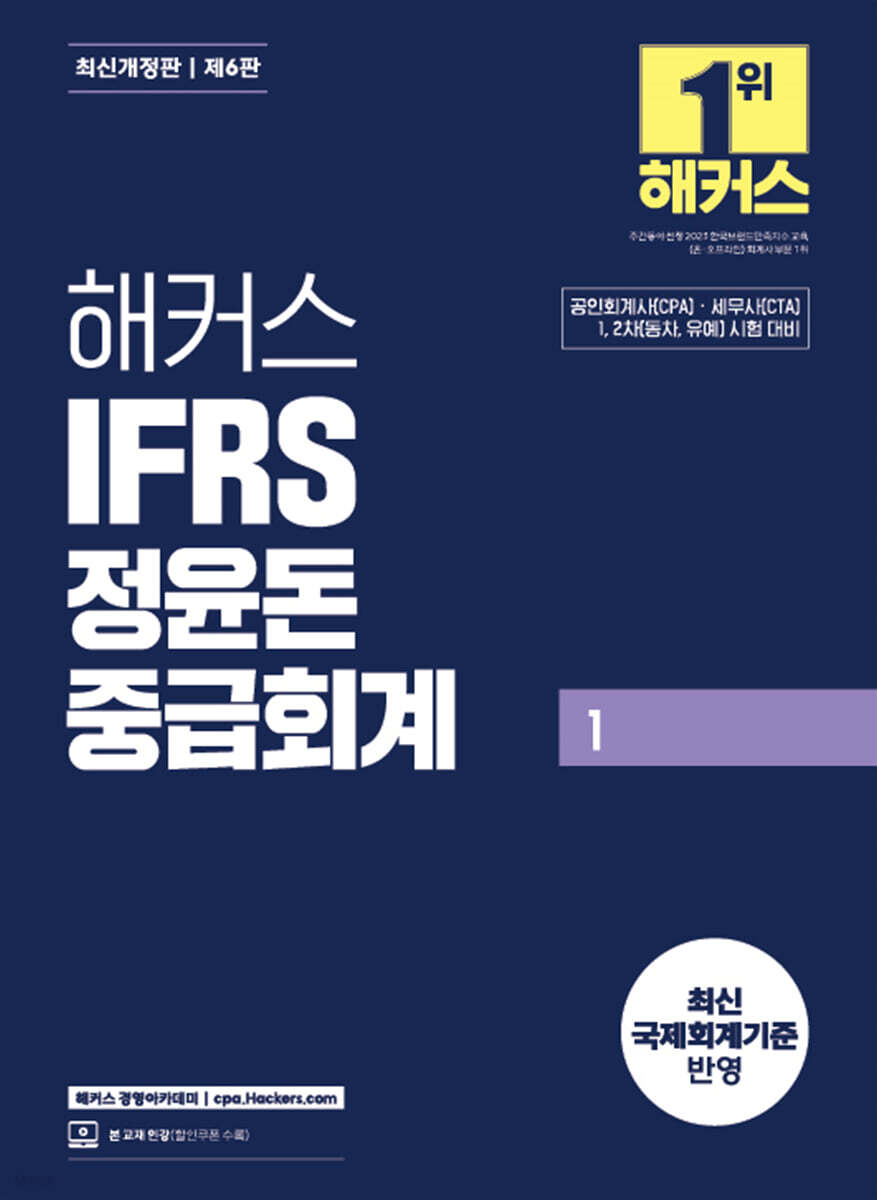
2025 Hackers IFRS Jung Yoon-don Intermediate Accounting 1
 |
Description
Book Introduction
Reflecting the latest international accounting standards!
CPA/Tax Accountant Exam Preparation for Level 1 and 2
An intermediate accounting textbook that focuses on core theories with a high probability of appearing on the exam.
It fully reflects the latest trends in CPA/CPA exams and international accounting standards.
It is structured to enable efficient learning of key theories with a high probability of appearing on the exam.
It contains not only abundant problems but also know-how on shortening problem-solving time and case studies.
CPA/Tax Accountant Exam Preparation for Level 1 and 2
An intermediate accounting textbook that focuses on core theories with a high probability of appearing on the exam.
It fully reflects the latest trends in CPA/CPA exams and international accounting standards.
It is structured to enable efficient learning of key theories with a high probability of appearing on the exam.
It contains not only abundant problems but also know-how on shortening problem-solving time and case studies.
- You can preview some of the book's contents.
Preview
index
Chapter 1 Financial Accounting and Accounting Principles
1.
The significance of financial accounting
Ⅰ.
Definition of Accounting
Ⅱ.
Classification of Accounting Information Users and Accounting
Ⅲ.
financial reporting
Ⅳ.
The social role of accounting
2.
Generally Accepted Accounting Principles (GAAP) and Korean International Financial Reporting Standards (K-IFRS)
Ⅰ.
Generally Accepted Accounting Principles
Ⅱ.
Korean Adoption of International Financial Reporting Standards
Key frequently occurring sentences
Multiple choice questions
subjective questions
Chapter 2 Conceptual Framework for Financial Reporting
1.
Purpose and status of the conceptual framework
Ⅰ.
The significance and necessity of the conceptual system
Ⅱ.
Purpose of the conceptual framework
Ⅲ.
The status of the conceptual framework (the relationship between the conceptual framework and international accounting standards)
Ⅳ.
Official duties of the Korean Accounting Standards Board
V.
Structure of the conceptual system
2.
Purpose of general purpose financial reporting
Ⅰ.
The significance, purpose, reporting targets, and limitations of general purpose financial reporting
Ⅱ.
Information provided by general purpose financial reports
3.
Qualitative characteristics of useful financial information (criteria for judging the usefulness of information)
Ⅰ.
The significance, application procedures, and hierarchical relationships of fundamental and supplementary qualitative characteristics.
Ⅱ.
Sub-items of fundamental qualitative characteristics
Ⅲ.
Detailed items of reinforcing qualitative characteristics
Ⅳ.
Cost Constraints on Useful Financial Reporting
4.
Reporting entity
Ⅰ.
Purpose and Scope of Financial Statements
Ⅱ.
Reporting period (period for preparing financial statements)
Ⅲ.
Views adopted in the financial statements
Ⅳ.
Reporting company
V.
Basic assumptions for preparing financial statements: going concern assumption
5.
Elements of Financial Statements
Ⅰ.
asset
Ⅱ.
fan
Ⅲ.
Choosing an accounting unit for assets and liabilities
Ⅳ.
Definition and Characteristics of Capital
V.
Definition and Characteristics of Revenue and Expenses
6.
Recognition and Derecognition of Financial Statement Elements
Ⅰ.
Recognition of financial statement elements
Ⅱ.
Recognition criteria
Ⅲ.
Removal criteria
7.
Measurement of financial statement elements
Ⅰ.
Measurement Basis - Historical Cost
Ⅱ.
Measurement standard - current value
Ⅲ.
The nature of the information provided by specific measurement criteria
Ⅳ.
Factors to consider when choosing a specific metric
V.
Measurement of capital
Ⅵ.
Cash flow-based measurement technique
Ⅶ.
Presentation and disclosure of financial statements
8.
Capital and capital maintenance concepts
Ⅰ.
The concept of capital
Ⅱ.
Types of capital maintenance concepts
Ⅲ.
Measurement criteria and profit of the capital maintenance concept
Key frequently occurring sentences
Multiple choice questions
subjective questions
Chapter 3 Financial Statement Presentation and Fair Value
1.
Purpose of Financial Statements and Complete Financial Statements, General Matters, Identification of Financial Statements
Ⅰ.
Purpose of Financial Statements
Ⅱ.
Full financial statements
Ⅲ.
general details
Ⅳ.
Identification of financial statements
2.
financial statements
Ⅰ.
The meaning and format of the financial statements and the information displayed in the financial statements
Ⅱ.
Current and non-current classification of assets and liabilities
Ⅲ.
Information presented in the financial statements or notes
3.
Comprehensive Income Statement
Ⅰ.
The meaning of the statement of comprehensive income and the information displayed in it
Ⅱ.
Comprehensive income statement presentation method and expense classification
4.
Other financial statements
Ⅰ.
Statement of changes in equity
Ⅱ.
Cash flow statement
Ⅲ.
annotation
5.
fair value
Ⅰ.
Definition and Measurement of Fair Value
Ⅱ.
Application of fair value measurement
6.
Present value measurement
Ⅰ.
Understanding the Time Value of Money
Ⅱ.
Application of Present Value Assessment to Financial Accounting
Ⅲ.
Applying present value to each type of cash flow
Key frequently occurring sentences
Multiple choice questions
subjective questions
Chapter 4 Inventory Assets
1.
Definition and Classification of Inventory Assets
Ⅰ.
Definition of inventory assets
Ⅱ.
Classification of inventory assets
2.
Adjustment of acquisition cost of inventory assets and ending inventory assets
Ⅰ.
Acquisition cost of inventory assets
Ⅱ.
Allocation of ending inventory assets
3.
Method for determining unit cost of inventory assets
Ⅰ.
Consideration of quantity and unit price in cost allocation of inventory assets
Ⅱ.
Determining unit costs (assuming cost flow)
Ⅲ.
Method for determining unit cost
4.
Depreciation and valuation losses on inventory assets
Ⅰ.
Inventory asset write-down loss
Ⅱ.
Inventory valuation loss and application of the lower-of-value method
5.
Special cost allocation method
Ⅰ.
Gross profit margin method
Ⅱ.
Retail Inventory Act
6.
Agriculture, forestry and fisheries
Ⅰ.
Meaning
Ⅱ.
Recognition and Measurement
Ⅲ.
government subsidies
Key frequently occurring sentences
Multiple choice questions
subjective questions
Chapter 5 Tangible Assets
1.
The significance of tangible assets
Ⅰ.
Definition and characteristics of tangible assets
Ⅱ.
Classification of tangible assets
2.
Initial recognition and measurement of tangible assets
Ⅰ.
Recognition criteria
Ⅱ.
Measurement at first recognition
3.
Depreciation and subsequent cost of tangible assets, and elimination
Ⅰ.
The essence of depreciation
Ⅱ.
Accounting for depreciation units and depreciation amounts
Ⅲ.
Basic elements of depreciation
Ⅳ.
Calculation of depreciation expense
V.
follow-up costs
Ⅵ.
Removal of tangible assets
4.
Cost of assets by type
Ⅰ.
Installment purchase
Ⅱ.
Purchase of land and bulk purchase of land and buildings
Ⅲ.
Government bonds inevitably acquired in connection with asset acquisition
Ⅳ.
Exchange acquisition
V.
Acquisition by type of guitar
5.
Recovery costs and government subsidies
Ⅰ.
restoration cost
Ⅱ.
government subsidies
6.
Reevaluation model
Ⅰ.
Significance of the reevaluation model
Ⅱ.
Accounting for revaluation of non-depreciable assets
Ⅲ.
Accounting for revaluation of depreciable assets
7.
Impairment of tangible assets
Ⅰ.
The meaning and scope of damage, and the recognition process
Ⅱ.
Damage to the cost model
Ⅲ.
Damage to the revaluation model
Key frequently occurring sentences
Multiple choice questions
subjective questions
Chapter 6 Capitalization of Borrowing Costs
1.
Basis of borrowing costs
Ⅰ.
Borrowing costs and borrowing cost capitalization
Ⅱ.
Qualifying assets
Ⅲ.
Borrowing costs subject to capitalization
Ⅳ.
Capitalization period
2.
Capitalization of borrowing costs
Ⅰ.
Understanding the Calculation of Borrowing Cost Capitalization
Ⅱ.
Calculation structure of borrowing cost capitalization
Ⅲ.
Step 1: Average annual expenditure on eligible assets
Ⅳ.
Step 2: Borrowing costs associated with specific borrowings
V.
Step 3: Borrowing costs related to general borrowings
3.
Other details of borrowing costs
Ⅰ.
Debate on capitalization of borrowing costs
Ⅱ.
Capitalized borrowing costs among foreign exchange differences related to foreign currency borrowings
Ⅲ.
Other
Key frequently occurring sentences
Multiple choice questions
subjective questions
Chapter 7 Other Assets
1.
Investment real estate
Ⅰ.
Definition and Classification of Investment Property
Ⅱ.
Initial recognition, initial measurement, and subsequent cost of investment property
Ⅲ.
Follow-up measurement of investment property
Ⅳ.
Removal of investment property
V.
Transfer of investment property accounts
2.
Intangible assets
Ⅰ.
Definition, identification, and initial recognition of intangible assets
Ⅱ.
Subsequent measurement of intangible assets
Ⅲ.
Internally generated intangible assets
3.
Exploration and evaluation assets, stripping costs, and website costs
Ⅰ.
Exploration and Evaluation Assets
Ⅱ.
Park To-won
4.
Non-current assets held for sale and discontinued operations
Ⅰ.
Non-current assets held for sale
Ⅱ.
Discontinued business
Key frequently occurring sentences
Multiple choice questions
subjective questions
Chapter 8 Financial Debt
1.
Definition and Classification of Financial Liabilities
Ⅰ.
Definition of financial debt
Ⅱ.
Classification of financial liabilities
2.
Financial liabilities measured at amortized cost
Ⅰ.
The meaning and initial recognition of private debt
Ⅱ.
Accounting treatment by type of bond issuance
Ⅲ.
Transaction costs, market interest rates, and effective interest rates
Ⅳ.
Issuance of bonds between interest payment dates
V.
repayment of private debt
Ⅵ.
Other details about the loan
Ⅶ.
Change in terms of financial debt
3.
Financial liabilities not subsequently measured at amortized cost
Ⅰ.
Financial liabilities measured at fair value (FVPL)
Ⅱ.
Financial liabilities recognized when the transfer of financial assets does not meet the derecognition criteria
Ⅲ.
Financial liabilities recognized under the continuing involvement approach
Ⅳ.
Financial guarantee contract
V.
Financial liabilities based on an agreement to lend at an interest rate lower than the market rate
Ⅵ.
Contingent consideration recognized by the acquirer in a business combination
Key frequently occurring sentences
Multiple choice questions
subjective questions
Chapter 9 Provisions and Other Disclosures
1.
The meaning, recognition, and measurement of accrued liabilities
Ⅰ.
The meaning of reserve liabilities
Ⅱ.
Recognition of provisions and contingent liabilities and contingent assets
Ⅲ.
Measurement of liabilities
Ⅳ.
Use, changes, and repayment of reserve liabilities
2.
Application of Recognition and Measurement Criteria for Provisions
Ⅰ.
Loss burden contract
Ⅱ.
restructuring
Ⅲ.
Product warranty reserve liabilities
3.
Post-reporting period events
Ⅰ.
Meaning
Ⅱ.
Post-reporting event requiring correction
Ⅲ.
Post-reporting event that does not require correction
Ⅳ.
Going concern
4.
Interim Financial Reporting and Related Party Disclosure
Ⅰ.
Interim Financial Report
Ⅱ.
Disclosure of special related parties
Key frequently occurring sentences
Multiple choice questions
subjective questions
Chapter 10 Capital
1.
The meaning and classification of capital
Ⅰ.
The meaning and measurement of capital
Ⅱ.
Classification of capital
2.
capital
Ⅰ.
The meaning of capital
Ⅱ.
Types of stocks
3.
capital transactions
Ⅰ.
Capital increase transaction (capital increase)
Ⅱ.
Capital reduction transaction (reduction)
Ⅲ.
Treasury stock
4.
Profit and loss transactions
Ⅰ.
The meaning and types of retained earnings
Ⅱ.
Changes in retained earnings
Ⅲ.
Timing of disposal and accounting treatment of retained earnings, statement of disposal of retained earnings
Ⅳ.
Accumulated other comprehensive income
5.
preferred stock
Ⅰ.
Dividend preferred stock
Ⅱ.
redeemable preferred stock
Ⅲ.
convertible preferred stock
6.
Statement of changes in equity
Ⅰ.
Significance of the statement of changes in equity
Ⅱ.
Format of statement of changes in equity
Key frequently occurring sentences
Multiple choice questions
subjective questions
[Appendix] Present Value Coefficient Table
1.
The significance of financial accounting
Ⅰ.
Definition of Accounting
Ⅱ.
Classification of Accounting Information Users and Accounting
Ⅲ.
financial reporting
Ⅳ.
The social role of accounting
2.
Generally Accepted Accounting Principles (GAAP) and Korean International Financial Reporting Standards (K-IFRS)
Ⅰ.
Generally Accepted Accounting Principles
Ⅱ.
Korean Adoption of International Financial Reporting Standards
Key frequently occurring sentences
Multiple choice questions
subjective questions
Chapter 2 Conceptual Framework for Financial Reporting
1.
Purpose and status of the conceptual framework
Ⅰ.
The significance and necessity of the conceptual system
Ⅱ.
Purpose of the conceptual framework
Ⅲ.
The status of the conceptual framework (the relationship between the conceptual framework and international accounting standards)
Ⅳ.
Official duties of the Korean Accounting Standards Board
V.
Structure of the conceptual system
2.
Purpose of general purpose financial reporting
Ⅰ.
The significance, purpose, reporting targets, and limitations of general purpose financial reporting
Ⅱ.
Information provided by general purpose financial reports
3.
Qualitative characteristics of useful financial information (criteria for judging the usefulness of information)
Ⅰ.
The significance, application procedures, and hierarchical relationships of fundamental and supplementary qualitative characteristics.
Ⅱ.
Sub-items of fundamental qualitative characteristics
Ⅲ.
Detailed items of reinforcing qualitative characteristics
Ⅳ.
Cost Constraints on Useful Financial Reporting
4.
Reporting entity
Ⅰ.
Purpose and Scope of Financial Statements
Ⅱ.
Reporting period (period for preparing financial statements)
Ⅲ.
Views adopted in the financial statements
Ⅳ.
Reporting company
V.
Basic assumptions for preparing financial statements: going concern assumption
5.
Elements of Financial Statements
Ⅰ.
asset
Ⅱ.
fan
Ⅲ.
Choosing an accounting unit for assets and liabilities
Ⅳ.
Definition and Characteristics of Capital
V.
Definition and Characteristics of Revenue and Expenses
6.
Recognition and Derecognition of Financial Statement Elements
Ⅰ.
Recognition of financial statement elements
Ⅱ.
Recognition criteria
Ⅲ.
Removal criteria
7.
Measurement of financial statement elements
Ⅰ.
Measurement Basis - Historical Cost
Ⅱ.
Measurement standard - current value
Ⅲ.
The nature of the information provided by specific measurement criteria
Ⅳ.
Factors to consider when choosing a specific metric
V.
Measurement of capital
Ⅵ.
Cash flow-based measurement technique
Ⅶ.
Presentation and disclosure of financial statements
8.
Capital and capital maintenance concepts
Ⅰ.
The concept of capital
Ⅱ.
Types of capital maintenance concepts
Ⅲ.
Measurement criteria and profit of the capital maintenance concept
Key frequently occurring sentences
Multiple choice questions
subjective questions
Chapter 3 Financial Statement Presentation and Fair Value
1.
Purpose of Financial Statements and Complete Financial Statements, General Matters, Identification of Financial Statements
Ⅰ.
Purpose of Financial Statements
Ⅱ.
Full financial statements
Ⅲ.
general details
Ⅳ.
Identification of financial statements
2.
financial statements
Ⅰ.
The meaning and format of the financial statements and the information displayed in the financial statements
Ⅱ.
Current and non-current classification of assets and liabilities
Ⅲ.
Information presented in the financial statements or notes
3.
Comprehensive Income Statement
Ⅰ.
The meaning of the statement of comprehensive income and the information displayed in it
Ⅱ.
Comprehensive income statement presentation method and expense classification
4.
Other financial statements
Ⅰ.
Statement of changes in equity
Ⅱ.
Cash flow statement
Ⅲ.
annotation
5.
fair value
Ⅰ.
Definition and Measurement of Fair Value
Ⅱ.
Application of fair value measurement
6.
Present value measurement
Ⅰ.
Understanding the Time Value of Money
Ⅱ.
Application of Present Value Assessment to Financial Accounting
Ⅲ.
Applying present value to each type of cash flow
Key frequently occurring sentences
Multiple choice questions
subjective questions
Chapter 4 Inventory Assets
1.
Definition and Classification of Inventory Assets
Ⅰ.
Definition of inventory assets
Ⅱ.
Classification of inventory assets
2.
Adjustment of acquisition cost of inventory assets and ending inventory assets
Ⅰ.
Acquisition cost of inventory assets
Ⅱ.
Allocation of ending inventory assets
3.
Method for determining unit cost of inventory assets
Ⅰ.
Consideration of quantity and unit price in cost allocation of inventory assets
Ⅱ.
Determining unit costs (assuming cost flow)
Ⅲ.
Method for determining unit cost
4.
Depreciation and valuation losses on inventory assets
Ⅰ.
Inventory asset write-down loss
Ⅱ.
Inventory valuation loss and application of the lower-of-value method
5.
Special cost allocation method
Ⅰ.
Gross profit margin method
Ⅱ.
Retail Inventory Act
6.
Agriculture, forestry and fisheries
Ⅰ.
Meaning
Ⅱ.
Recognition and Measurement
Ⅲ.
government subsidies
Key frequently occurring sentences
Multiple choice questions
subjective questions
Chapter 5 Tangible Assets
1.
The significance of tangible assets
Ⅰ.
Definition and characteristics of tangible assets
Ⅱ.
Classification of tangible assets
2.
Initial recognition and measurement of tangible assets
Ⅰ.
Recognition criteria
Ⅱ.
Measurement at first recognition
3.
Depreciation and subsequent cost of tangible assets, and elimination
Ⅰ.
The essence of depreciation
Ⅱ.
Accounting for depreciation units and depreciation amounts
Ⅲ.
Basic elements of depreciation
Ⅳ.
Calculation of depreciation expense
V.
follow-up costs
Ⅵ.
Removal of tangible assets
4.
Cost of assets by type
Ⅰ.
Installment purchase
Ⅱ.
Purchase of land and bulk purchase of land and buildings
Ⅲ.
Government bonds inevitably acquired in connection with asset acquisition
Ⅳ.
Exchange acquisition
V.
Acquisition by type of guitar
5.
Recovery costs and government subsidies
Ⅰ.
restoration cost
Ⅱ.
government subsidies
6.
Reevaluation model
Ⅰ.
Significance of the reevaluation model
Ⅱ.
Accounting for revaluation of non-depreciable assets
Ⅲ.
Accounting for revaluation of depreciable assets
7.
Impairment of tangible assets
Ⅰ.
The meaning and scope of damage, and the recognition process
Ⅱ.
Damage to the cost model
Ⅲ.
Damage to the revaluation model
Key frequently occurring sentences
Multiple choice questions
subjective questions
Chapter 6 Capitalization of Borrowing Costs
1.
Basis of borrowing costs
Ⅰ.
Borrowing costs and borrowing cost capitalization
Ⅱ.
Qualifying assets
Ⅲ.
Borrowing costs subject to capitalization
Ⅳ.
Capitalization period
2.
Capitalization of borrowing costs
Ⅰ.
Understanding the Calculation of Borrowing Cost Capitalization
Ⅱ.
Calculation structure of borrowing cost capitalization
Ⅲ.
Step 1: Average annual expenditure on eligible assets
Ⅳ.
Step 2: Borrowing costs associated with specific borrowings
V.
Step 3: Borrowing costs related to general borrowings
3.
Other details of borrowing costs
Ⅰ.
Debate on capitalization of borrowing costs
Ⅱ.
Capitalized borrowing costs among foreign exchange differences related to foreign currency borrowings
Ⅲ.
Other
Key frequently occurring sentences
Multiple choice questions
subjective questions
Chapter 7 Other Assets
1.
Investment real estate
Ⅰ.
Definition and Classification of Investment Property
Ⅱ.
Initial recognition, initial measurement, and subsequent cost of investment property
Ⅲ.
Follow-up measurement of investment property
Ⅳ.
Removal of investment property
V.
Transfer of investment property accounts
2.
Intangible assets
Ⅰ.
Definition, identification, and initial recognition of intangible assets
Ⅱ.
Subsequent measurement of intangible assets
Ⅲ.
Internally generated intangible assets
3.
Exploration and evaluation assets, stripping costs, and website costs
Ⅰ.
Exploration and Evaluation Assets
Ⅱ.
Park To-won
4.
Non-current assets held for sale and discontinued operations
Ⅰ.
Non-current assets held for sale
Ⅱ.
Discontinued business
Key frequently occurring sentences
Multiple choice questions
subjective questions
Chapter 8 Financial Debt
1.
Definition and Classification of Financial Liabilities
Ⅰ.
Definition of financial debt
Ⅱ.
Classification of financial liabilities
2.
Financial liabilities measured at amortized cost
Ⅰ.
The meaning and initial recognition of private debt
Ⅱ.
Accounting treatment by type of bond issuance
Ⅲ.
Transaction costs, market interest rates, and effective interest rates
Ⅳ.
Issuance of bonds between interest payment dates
V.
repayment of private debt
Ⅵ.
Other details about the loan
Ⅶ.
Change in terms of financial debt
3.
Financial liabilities not subsequently measured at amortized cost
Ⅰ.
Financial liabilities measured at fair value (FVPL)
Ⅱ.
Financial liabilities recognized when the transfer of financial assets does not meet the derecognition criteria
Ⅲ.
Financial liabilities recognized under the continuing involvement approach
Ⅳ.
Financial guarantee contract
V.
Financial liabilities based on an agreement to lend at an interest rate lower than the market rate
Ⅵ.
Contingent consideration recognized by the acquirer in a business combination
Key frequently occurring sentences
Multiple choice questions
subjective questions
Chapter 9 Provisions and Other Disclosures
1.
The meaning, recognition, and measurement of accrued liabilities
Ⅰ.
The meaning of reserve liabilities
Ⅱ.
Recognition of provisions and contingent liabilities and contingent assets
Ⅲ.
Measurement of liabilities
Ⅳ.
Use, changes, and repayment of reserve liabilities
2.
Application of Recognition and Measurement Criteria for Provisions
Ⅰ.
Loss burden contract
Ⅱ.
restructuring
Ⅲ.
Product warranty reserve liabilities
3.
Post-reporting period events
Ⅰ.
Meaning
Ⅱ.
Post-reporting event requiring correction
Ⅲ.
Post-reporting event that does not require correction
Ⅳ.
Going concern
4.
Interim Financial Reporting and Related Party Disclosure
Ⅰ.
Interim Financial Report
Ⅱ.
Disclosure of special related parties
Key frequently occurring sentences
Multiple choice questions
subjective questions
Chapter 10 Capital
1.
The meaning and classification of capital
Ⅰ.
The meaning and measurement of capital
Ⅱ.
Classification of capital
2.
capital
Ⅰ.
The meaning of capital
Ⅱ.
Types of stocks
3.
capital transactions
Ⅰ.
Capital increase transaction (capital increase)
Ⅱ.
Capital reduction transaction (reduction)
Ⅲ.
Treasury stock
4.
Profit and loss transactions
Ⅰ.
The meaning and types of retained earnings
Ⅱ.
Changes in retained earnings
Ⅲ.
Timing of disposal and accounting treatment of retained earnings, statement of disposal of retained earnings
Ⅳ.
Accumulated other comprehensive income
5.
preferred stock
Ⅰ.
Dividend preferred stock
Ⅱ.
redeemable preferred stock
Ⅲ.
convertible preferred stock
6.
Statement of changes in equity
Ⅰ.
Significance of the statement of changes in equity
Ⅱ.
Format of statement of changes in equity
Key frequently occurring sentences
Multiple choice questions
subjective questions
[Appendix] Present Value Coefficient Table
Publisher's Review
Hackers Management Academy, the #1 Accountant
Ranked #1 in the Accounting category of the 2023 Korea Brand Satisfaction Index Education (Online/Offline) by Weekly Donga
Reflecting the latest international accounting standards!
CPA/Tax Accountant Exam Preparation for Level 1 and 2
An intermediate accounting textbook that focuses on core theories with a high probability of appearing on the exam.
[Recommended for these people]
1.
Everyone preparing for the first and second CPA/Tax Accountant exams
2.
Those who want to finish everything from summarizing key theories to solving practical problems in one go.
[Hacker's Textbook's Unique Features]
1.
It fully reflects the latest trends in CPA/CPA exams and international accounting standards.
1) We analyzed the latest trends in questions for the Certified Public Accountant/Tax Accountant exam and included all important content that is likely to appear on the exam.
2) You can thoroughly prepare for the Certified Public Accountant/Tax Accountant exam by faithfully reflecting the latest international accounting standards.
2.
It is structured to enable efficient learning of key theories that are likely to appear on the exam.
1) We've organized the key theories that are likely to appear on the exam, and marked past exam passages and important sentences in purple so you can focus on studying the parts you absolutely need to know.
2) You can systematically organize the theory through [Self Study], which summarizes the core theory, and [Additional Comment], which summarizes additional explanations.
3) By detailing the format in which each account is recorded in the balance sheet and comprehensive income statement, you can easily organize the accounting treatment method for each business partner and the impact on the financial statements.
4) You can memorize important sentences and solidify your theories through [Key Frequently Appearing Sentences], which summarizes key passages that frequently appear on exams.
3.
It contains not only a wealth of problems, but also know-how on shortening problem-solving time and case studies.
1) You can maximize your sense of the actual exam with [Previous Exam Questions Check] that reflects the types of questions that will appear on the actual exam and multiple-choice/subjective questions that are abundantly included by topic.
2) You can acquire the know-how to shorten problem-solving time through [Solving Tool], which can solve calculation problems more easily than basic formulas.
3) You can prepare more thoroughly for the CPA/Tax Accountant exam by using [Case Study], which organizes cases that will appear on the exam.
Hackers' Additional Learning Content for Passing the CPA Exam - Hackers Management Academy (cpa.Hackers.com)
1.
Professor Jeong Yun-don's online lectures on this textbook (discount coupons included in the textbook)
Ranked #1 in the Accounting category of the 2023 Korea Brand Satisfaction Index Education (Online/Offline) by Weekly Donga
Reflecting the latest international accounting standards!
CPA/Tax Accountant Exam Preparation for Level 1 and 2
An intermediate accounting textbook that focuses on core theories with a high probability of appearing on the exam.
[Recommended for these people]
1.
Everyone preparing for the first and second CPA/Tax Accountant exams
2.
Those who want to finish everything from summarizing key theories to solving practical problems in one go.
[Hacker's Textbook's Unique Features]
1.
It fully reflects the latest trends in CPA/CPA exams and international accounting standards.
1) We analyzed the latest trends in questions for the Certified Public Accountant/Tax Accountant exam and included all important content that is likely to appear on the exam.
2) You can thoroughly prepare for the Certified Public Accountant/Tax Accountant exam by faithfully reflecting the latest international accounting standards.
2.
It is structured to enable efficient learning of key theories that are likely to appear on the exam.
1) We've organized the key theories that are likely to appear on the exam, and marked past exam passages and important sentences in purple so you can focus on studying the parts you absolutely need to know.
2) You can systematically organize the theory through [Self Study], which summarizes the core theory, and [Additional Comment], which summarizes additional explanations.
3) By detailing the format in which each account is recorded in the balance sheet and comprehensive income statement, you can easily organize the accounting treatment method for each business partner and the impact on the financial statements.
4) You can memorize important sentences and solidify your theories through [Key Frequently Appearing Sentences], which summarizes key passages that frequently appear on exams.
3.
It contains not only a wealth of problems, but also know-how on shortening problem-solving time and case studies.
1) You can maximize your sense of the actual exam with [Previous Exam Questions Check] that reflects the types of questions that will appear on the actual exam and multiple-choice/subjective questions that are abundantly included by topic.
2) You can acquire the know-how to shorten problem-solving time through [Solving Tool], which can solve calculation problems more easily than basic formulas.
3) You can prepare more thoroughly for the CPA/Tax Accountant exam by using [Case Study], which organizes cases that will appear on the exam.
Hackers' Additional Learning Content for Passing the CPA Exam - Hackers Management Academy (cpa.Hackers.com)
1.
Professor Jeong Yun-don's online lectures on this textbook (discount coupons included in the textbook)
GOODS SPECIFICS
- Date of issue: February 20, 2025
- Page count, weight, size: 804 pages | 188*257*40mm
- ISBN13: 9791172445133
- ISBN10: 1172445133
You may also like
카테고리
korean


korean

![GQ KOREA Mark (Monthly): December [2025]](http://librairie.coreenne.fr/cdn/shop/files/8ef265dbbfbf186523ed75ba7319009d.jpg?v=1765340328&width=3840)


