

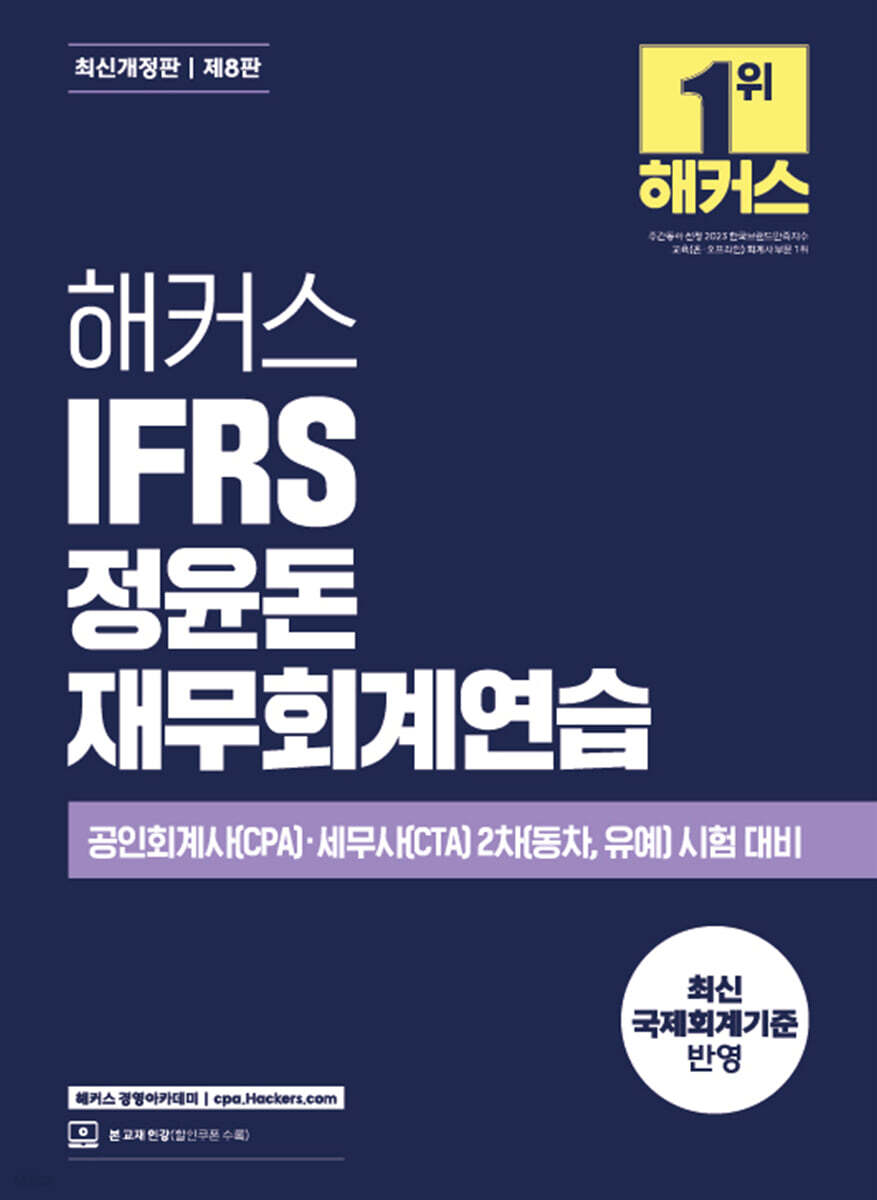
Hackers IFRS Jeong Yun-don Financial Accounting Practice
 |
Description
Book Introduction
Reflecting the latest international accounting standards and analysis of exam trends!
Financial Accounting Practice Book for the CPA/CPA 2nd Exam (Autonomous Vehicle, Deferred)
1.
It reflects the latest trends in CPA/CPA exams and international accounting standards.
2.
You can develop a practical sense through solving a wealth of topic-based problems.
3.
You can learn more effectively by dividing problems into levels of difficulty.
4.
We provide an explanation method using the balance sheet and comprehensive income statement, making it easy to understand changes in financial statements for each transaction.
5.
Effective exam preparation is possible with detailed explanations and theories that summarize only the key points.
Financial Accounting Practice Book for the CPA/CPA 2nd Exam (Autonomous Vehicle, Deferred)
1.
It reflects the latest trends in CPA/CPA exams and international accounting standards.
2.
You can develop a practical sense through solving a wealth of topic-based problems.
3.
You can learn more effectively by dividing problems into levels of difficulty.
4.
We provide an explanation method using the balance sheet and comprehensive income statement, making it easy to understand changes in financial statements for each transaction.
5.
Effective exam preparation is possible with detailed explanations and theories that summarize only the key points.
- You can preview some of the book's contents.
Preview
index
Chapter 1 Revenue from Contracts with Customers
Ⅰ Five Steps to Recognizing Revenue from Contracts with Customers
Show Problem 1
Ⅱ Step 1: Identifying the Contract
Problem 2: Change of Contract (Sale of Goods)
Issue 3: Changes to the Contract (Provision of Services)
Ⅲ Step 2: Identifying Performance Obligations
Problem 4: Identifying the Performance Obligation
Problem 5: Profit by Transaction Type (Guarantee Obligation)
Ⅳ Step 3: Calculating the Transaction Price
Problem 6: Calculating the transaction price (variable price)
Problem 7: Calculating the Transaction Price (Non-Cash Consideration)
Problem 8: Calculating the Transaction Price (Change in Estimate)
Problem 9: Calculating the Transaction Price (the Price to be Paid to the Customer)
Problem 10: Calculating the Transaction Price (Significant Financial Elements Included in the Contract)
Ⅴ Step 4: Distribution of Transaction Price
Problem 11: Distribution of transaction prices (changes in transaction prices, changes in transaction prices after contract changes)
Problem 12: Distribution of transaction price (discount distribution, variable cost distribution)
Problem 13: Distribution of Transaction Price (Discount Coupon)
Ⅵ Step 5: Revenue Recognition
Problem 14: Revenue Recognition (Performance Timing, Significant Financial Elements, Financial Statement Presentation)
Problem 15 Revenue Recognition (Percentage of Completion of Performance Obligation)
Ⅶ Contract cost
Problem 16 Contract Costs (Incremental Contract Conclusion Costs and Contract Performance Costs)
Ⅷ Profit by Transaction Type
Problem 17: Profit by Transaction Type (Principal, Agent, and Consignment Sales)
Problem 18: Profit by Transaction Type (Principal and Agent, Consignment Sales, Gift Certificates)
Problem 19: Profit by Transaction Type (Sales with Return Rights)
Problem 20: Profit by Transaction Type (Repurchase Agreement)
Problem 21: Profit by Transaction Type (Undelivered Billing Agreement Sales)
Problem 22 Revenue by Transaction Type (Licensing)
Problem 23: Revenue by Transaction Type (Exchange of Goods or Services)
Problem 24: Sales subject to return, sales with a repurchase agreement, consideration paid to customers, and changes to contracts
Issue 25 Maintenance Renewal Options, Discounts, Significant Financial Elements, and Repurchase Agreements
Problem 26: Fluctuations in Transaction Prices
Ⅸ Customer Loyalty System
Problem 27 Customer Loyalty Program
Ⅹ Licensing
Issue 28 Licensing - Franchising and Customer Loyalty Programs
Issue 29 Licensing
ⅩⅠ Construction Contract
Problem 30 Accounting for construction contracts and construction contracts with expected losses
Problem 31 Construction Contracts (When Progress Cannot Be Reasonably Measured)
Problem 32 Construction Contracts (Prepaid Construction Costs, Unused Materials Costs, and Cases Where Progress Cannot Be Reasonably Estimated)
Problem 33 Construction Contracts (Unused Materials, Prepaid Construction Costs, Cases with Low Recoverability, Cases with Expected Losses)
Problem 34 Construction Contracts (Special Contract Costs)
Problem 35: Construction Contracts (Contract Modifications and Capitalization of Borrowing Costs)
Problem 36 Construction Contracts (Special Contract Costs, Expected Losses)
Chapter 2 Inventory Assets
Ⅰ Purchase of inventory assets and adjustment of ending inventory assets
Problem 1: Purchase of Inventory Assets and Adjustment of Ending Inventory Assets
Ⅱ Assumption of cost flow of inventory assets
Problem 2: Assumptions of Cost Flow of Inventory Assets, Accounting Changes, and Error Corrections
Ⅲ Depreciation and valuation losses on inventory assets
Problem 3: Inventory Asset Summary (Ending Inventory Asset Adjustment, Cost Flow Assumptions, Obsolescence and Valuation Losses)
Problem 4: Depreciation and valuation losses on inventory assets
Problem 5: Inventory Asset Summary (Low Cost Method)
Problem 6: Inventory Assets (Purchases, Impairment Losses and Valuation Losses, Error Correction)
Problem 7: Acquisition cost, foreign currency translation, depreciation loss, and valuation loss of inventory assets
Problem 8: Inventory Asset Summary (1)
Problem 9: Inventory Asset Summary (2)
Problem 10: Inventory Asset Summary (3)
Ⅳ Special cost allocation method
Problem 11 Gross Profit Margin Method
Problem 12 Retail Inventory Method
Problem 13: Inventory Asset Summary (Inventory Asset Adjustment, Gross Profit Margin Method, Cost Flow Assumptions, Impairment and Valuation Losses, Error Correction, Retail Inventory Method)
V Agriculture, Forestry and Fisheries
Problem 14 Agriculture, Forestry and Fisheries
Chapter 3 Tangible Assets
Ⅰ Initial recognition and measurement
Problem 1: Acquisition cost of tangible assets (bulk purchase)
Problem 2: Acquisition cost of tangible assets (acquisition through exchange)
Problem 3: Total Acquisition Cost of Tangible Assets (Blank Acquisition, Loss on Purchase of Government Bonds)
Ⅱ Recovery cost
Problem 4: Cost of Recovery (Recovery Timing, Remeasurement of Recovery Liabilities, Error Correction)
Problem 5 Remeasurement of Recovery Liabilities
Ⅲ Government subsidies
Problem 6: Government Subsidies (Comparison of the Asset Deduction Method and the Deferred Income Method, Impairment Losses, and Government Subsidies with Repayment Obligations)
Problem 7 Government Subsidies (Impairment Losses and Depreciation)
Problem 8 Government Subsidies (Other Government Subsidies, Government Subsidies and Revaluation)
Problem 9 Government Subsidies and Recovery Liabilities
Ⅳ Follow-up measurement
Problem 10 Depreciation and Impairment Losses
Problem 11 Subsequent Costs and Impairment Losses
Problem 12: Revaluation Models, Impairment, and Foreign Currency Translation
Problem 13: Proportional Modification of Revaluation Surplus
Problem 14 Revaluation Model, Exchange Acquisition, Changes in Depreciation, and Impairment
Problem 15: Exchange Acquisition, Revaluation Model, and Impairment
Problem 16: Recovery Liabilities, Government Subsidies, Impairment, Revaluation, and Error Correction
Problem 17: Comprehensive Tangible Assets
Ⅴ Capitalization of Borrowing Costs
Problem 18: Capitalization of Borrowing Costs (Government Subsidies, Foreign Currency Borrowings)
Problem 19: Capitalization of Borrowing Costs (Borrowing Costs of Specific Borrowings after the Capitalization Period Ends)
Problem 20: Capitalization of Borrowing Costs (Capitalization Period, Equity Expenditures, Government Subsidies)
Problem 21: Capitalization of Borrowing Costs (Foreign Currency Borrowings)
Problem 22: Capitalizing Borrowing Costs (Constructing a Building After Acquiring Land)
Problem 23: Capitalization of Borrowing Costs (Construction Contracts)
Problem 24: Capitalization of Borrowing Costs and Error Correction
Chapter 4 Other Assets
Ⅰ Investment Real Estate
Problem 1: Definition, Subsequent Measurement, and Account Reclassification of Investment Property
Problem 2: Revaluation, Impairment, and Reclassification of Investment Property Accounts
Problem 3: Investment Real Estate and Error Correction
Ⅱ Initial acquisition and subsequent measurement of intangible assets
Problem 4 Recognition requirements and amortization of intangible assets, goodwill
Problem 5 Impairment Loss of Intangible Assets
Problem 6 Internally Generated Intangible Assets
Problem 7: Internally Generated Intangible Assets, Impairment Losses, and Revaluation Models
Ⅲ Non-current assets held for sale and disposal asset groups
Problem 8 Non-current assets held for sale
Chapter 5 Reserve Liabilities
Ⅰ Recognition and Measurement of Accrued Liabilities
Problem 1 Recognition of Provisions (Single Accounting Period)
Problem 2 Recognition of Provisions (Consecutive Fiscal Years)
Problem 3: Measurement of Accrued Liabilities
Ⅱ Case of reserve liabilities
Problem 4 Loss-bearing contract
Problem 5: Restructuring Provisions
Problem 6: Joint and several guarantee obligations, financial guarantee liabilities, and events after the reporting period
Problem 7: Summary of Provisions
Problem 8 Post-reporting Events
Problem 9: Product Warranty Reserve (Conviction-Type Warranty)
Chapter 6 Capital
Ⅰ Capital Transactions
Problem 1 Treasury stock
Problem 2: Conversion of investment
Ⅱ Retained earnings
Problem 3 Retained Earnings
Problem 4: Retained earnings, total capital, and dividends available
Ⅲ Preferred Stock
Problem 5: Dividend-bearing preferred stock, accounting changes and error corrections, redeemable preferred stock, and contribution in kind
Problem 6 Redeemable Preferred Stock
Ⅳ Comprehensive Capital Problem
Problem 7: In-kind contribution, treasury stock, dividend-paying preferred stock, new stock subscription
Problem 8: Treasury Stock and Dividends
Problem 9: Capital Transactions and Disposition of Undistributed Earnings Retained
Problem 10: Capital increase, disposal of surplus, redeemable preferred stock, treasury stock
Problem 11: Capital Synthesis (1)
Problem 12: Capital Synthesis (2)
Problem 13: Capital Synthesis (3)
Problem 14: Comprehensive Capital (4) Capital transactions, convertible preferred stock, redeemable preferred stock, dividend preferred stock
Problem 15 Dividend Preferred Stock, Capital Transactions
Chapter 7 Financial Assets
Ⅰ Initial recognition and measurement of financial assets and equity instruments
Problem 1: Comparison of FVPL Financial Assets (Equity Products) and FVOCI Financial Assets (Equity Products) (1)
Problem 2: Comparison of FVPL Financial Assets (Equity Products) and FVOCI Financial Assets (Equity Products) (2)
Problem 3: Comparison of FVPL Financial Assets (Equity Products) and FVOCI Financial Assets (Equity Products) (3)
Ⅱ Debt Products
Problem 4 AC Financial Assets (Acquisition and Disposal)
Problem 5 FVOCI Financial Assets (Debt Instruments)
Ⅲ Expected Loss Model
Problem 6: Debt Instruments (Comparison of AC Financial Assets and FVOCI Financial Assets)
Problem 7: Comparison of Debt Instruments (FVPL, AC, and FVOCI Financial Assets)
Ⅳ Reclassification of financial assets
Problem 8 Reclassification of Debt Instruments
Problem 9 Impairment and Reclassification of Debt Instruments (1)
Problem 10 Impairment and Reclassification of Debt Instruments (2)
Problem 11: Valuation, Impairment, and Reclassification of Debt Instruments
Ⅴ Other topics of financial assets
Problem 12 Conditions for Provision of Management Services when Transferring Financial Assets
Problem 13: Changes in the terms of financial liabilities, reclassification of financial assets, and changes in contractual cash flows
Problem 14 Derecognition of Financial Assets
Problem 15 Derecognition and Impairment of Financial Assets
Chapter 8 Financial Debt
Ⅰ AC Financial Liabilities
Problem 1: AC Financial Liabilities (Bond Issuance Costs, Over-the-Counter Issuance, Over-the-Counter Redemption, Treasury Bonds, Foreign Currency Bonds, FVPL Financial Liabilities)
Problem 2: AC Financial Liabilities (Issued During the Period, Repayable During the Period, Continuous Repayment, Treasury Bonds)
Problem 3: Estimation of AC Financial Liabilities
Problem 4: Comparison of Accounting Treatments for Financial Assets and Financial Liabilities
Ⅱ FVPL Financial Liabilities
Problem 5 FVPL Financial Liabilities
Ⅲ Changes in the terms of financial liabilities
Problem 6: Changes in the terms of financial liabilities
Problem 7: Changes in the terms of financial liabilities and changes in contractual cash flows of financial assets
Problem 8 Changes in the Terms of Financial Liabilities and Financial Assets
Problem 9 Condition Changes and Error Corrections
Problem 10: Changes in Conditions, Financial Guarantee Liabilities
Problem 11: Comprehensive Financial Debt, Short Selling
Chapter 9 Complex Financial Products
Ⅰ Convertible Bonds General
Problem 1: Convertible Bonds (Comprehensive Par Value Issuance)
Problem 2 Convertible Bonds (Discount Issue)
Problem 3: Estimating the value of the conversion right
Ⅱ Convertible bonds with warrants
Issue 4 Convertible Bonds (Issued at Par Value)
Problem 5: Comparison of Convertible Bonds and Bonds with Warrants
Problem 6 Convertible Bonds (Estimation of Redemption Premium)
Ⅲ Special circumstances of complex financial products
Problem 7: Special Circumstances of Convertible Bonds (Transaction Costs, Changes in Terms, Repurchase)
Problem 8: Special circumstances of convertible bonds (transaction costs, repurchase)
Issue 9: Events, Conversion, Repurchase, and Condition Changes
Problem 10: Comparison of convertible bonds and bonds with warrants, repurchase + exercise, change of terms, conversion/exercise during the term
Problem 11: Conversion, Lifting Events, and Condition Changes
Problem 12: Error Correction in Compound Financial Products
Chapter 10 Leases
Ⅰ Lessor
Problem 1: Lessor (Assumption of Fixed Lease Payments and Transfer of Ownership of the Underlying Asset)
Problem 2: Lessor (if lease receivables are impaired and underlying assets are recovered)
Issue 3: Manufacturing? If the seller is also the lessor
Problem 4: Lessor (Accounting for Operating Leases)
Problem 5: Lessor (Change in Financial Lease)
Problem 6 Lessor (Change in Operating Lease)
Ⅱ Lease users
Problem 7 Separation or integration of lease and non-lease elements
Problem 8: Lessee (Initial Measurement of Lease Liabilities)
Problem 9: Leaseholders (Initial Measurement of Right-of-Use Assets)
Problem 10: Comparison of Lessor and Lessee Accounting
Problem 11: Summary of Changes in Lease Liabilities
Problem 12 Error Correction
Ⅲ Other details of the lease
Problem 13: Comprehensive Sales and Lease
Problem 14: After-sales lease
Issue 15 Sale-Leaseback (When Lease Fees Change)
Problem 16: Lease modification as a separate contract
Issue 17 Changes to narrow the scope of the lease (1)
Issue 18 Changes to narrow the scope of the lease (2)
Issue 19: Changes that only change the price
Issue 20: Changes that broaden and narrow the scope of the lease
Problem 21 Lease Change Summary
Problem 22: Sublease
Problem 23 Lease Deposit
Chapter 11 Employee Compensation and Stock-Based Compensation Transactions
Ⅰ Employee Salary
Problem 1: Short-term employee benefits, severance pay
Ⅱ Retirement benefits
Problem 2: Predictive Unit Accumulation Method
Problem 3: Defined Benefit Obligation
Problem 4: Defined Benefit Obligations (Prepayment, Baseline Revised Past Service Cost, Estimation of the Asset Recognition Ceiling Effect)
Problem 5: Defined Benefit Obligation (Prepayment, Settlement)
Problem 6: Defined Benefit Liability (Prepayments/Contributions, System Settlement, Asset Recognition Ceiling Effect)
Ⅲ Stock-settled stock-based compensation transactions
Issue 7: Stock-Settled Stock-Based Compensation Transactions (Non-Market Performance Conditions, Market Performance Conditions, Service Provision Conditions)
Ⅳ Special circumstances of stock-based compensation transactions with stock settlement
Problem 8: Stock-Settled Stock-Based Compensation Transactions (Estimating the Number of Exercises, Measuring Intrinsic Value)
Problem 9: Mid-term liquidation
Problem 10 Stock Options (Changes in Exercise Price and Quantity)
Ⅴ Cash-settled stock-based compensation transactions
Problem 11 Cash-Settled Stock-Based Compensation Transaction (1)
Problem 12 Cash-Settled Stock-Based Compensation Transactions (2)
Ⅵ Optional stock-based compensation transactions
Problem 13: Stock-based payment transactions in which the counterparty can choose the payment method
Problem 14: If a cash payment option is added subsequently
Problem 15: Cash Payment Option, Early Settlement
Problem 16: Change of conditions for changing classification from cash settlement type to stock settlement type
Chapter 12 Corporate Tax Accounting
Ⅰ Inter-period distribution of corporate tax
Problem 1: Inter-period distribution of corporate tax (average effective tax rate, loss carryforward deduction, tax carryforward deduction)
Ⅱ Distribution of corporate tax within the period
Problem 2: Distribution of corporate tax within the period (gains on disposal of treasury stock, gains on valuation of FVOCI financial assets (equity and debt instruments), revaluation surplus, convertible bonds)
Problem 3: Distribution of corporate tax within the period (FVOCI financial assets, error correction, convertible bonds)
Problem 4: Distribution of corporate tax within a period
Issue 5 Distribution within the period (revaluation surplus of depreciable assets, conversion right consideration)
Problem 6 Corporate Tax Accounting (Comprehensive) (1)
Problem 7 Corporate Tax Accounting (Comprehensive) (2)
Problem 8 Corporate Tax Accounting (Comprehensive) (3)
Problem 9 Corporate Tax Accounting (Comprehensive) (4)
Problem 10 Corporate Tax Accounting (Comprehensive) (5)
Problem 11: Corporate Tax Accounting (Comprehensive) and Corporate Tax Effects of Error Correction
Problem 12 Corporate Tax Accounting (Comprehensive) (6)
Problem 13 Corporate Tax Accounting (Comprehensive) (7)
Chapter 13 Earnings per Share
Ⅰ Basic earnings per share
Problem 1: Net income for common stock
Problem 2: Basic Earnings Per Share and Stock Options Potential Common Stock
Ⅱ Diluted earnings per share
Problem 3: Criteria for Judging the Dilution Effect of Basic and Diluted Earnings Per Share
Problem 4: Basic and Diluted Earnings Per Share (Calculation of Convertible Bonds)
Problem 5: Basic and Diluted Earnings Per Share (Cumulative Preferred Dividends)
Problem 6: Diluted Earnings Per Share (Convertible Preferred Stock, Stock Options)
Problem 7: Other Topics on Earnings Per Share (Participating Preferred Stock)
Problem 8: Earnings per Share Other Topics (Conditionally Issuable Common Stock)
Problem 9: Compound Financial Products, Stock-Based Payment Transactions, Equity, and Earnings Per Share
Problem 10: Compound Financial Products, Stock Options
Problem 11 Comprehensive Earnings Per Share (1)
Problem 12 Contracts that can be settled in common stock or cash
Problem 13: Comprehensive Earnings Per Share (2)
Chapter 14 Accounting Changes and Error Corrections
Ⅰ Changes in accounting estimates
Problem 1: Change in Estimate
Ⅱ Changes in Accounting Policies
Issue 2 Policy Changes
Ⅲ Error correction
Problem 3 Error Correction (Error Correction Indignation)
Problem 4 Error Correction (Comprehensive) (1)
Problem 5 Error Correction (Comprehensive) (2)
Problem 6 Error Correction (Comprehensive) (3)
Problem 7 Error Correction (Comprehensive) (4)
Problem 8 Error Correction (Comprehensive) (5)
Problem 9: Accounting Changes and Error Corrections (Comprehensive)
Problem 10: Corporate Tax Effects of Accounting Changes and Error Corrections
Chapter 15 Cash Flow Statement
Ⅰ Cash flow from operating activities - direct method
Problem 1: Cash Flow from Operating Activities: Direct Method (Item-by-Item Breakdown)
Problem 2: Direct method of cash flow from operating activities (trial balance presentation)
Ⅱ Investment? Cash flow from financing activities
Problem 3: Investment? Cash Flows from Financing Activities (Tangible Assets, Bonds, Dividend Payments)
Problem 4 __________ cash flow of AC financial liabilities
Problem 5: Investment? Cash Flow from Financing Activities (Comprehensive) (1)
Problem 6: Investment? Cash Flow from Financing Activities (Comprehensive) (2)
Ⅲ Cash Flow from Operating Activities - Indirect Method
Problem 7: Preparing a Statement of Cash Flows Using the Direct and Indirect Methods (1)
Problem 8: Preparing a Statement of Cash Flows Using the Direct and Indirect Methods (2)
Problem 9: Cash flow from operating activities: Indirect method notation, impact by activity
Problem 10 Indirect Method
Problem 11 Cash Flow Statement (Comprehensive) (1)
Problem 12 Cash Flow Statement (Comprehensive) (2)
Problem 13 Cash Flow Statement (Comprehensive) (3)
Chapter 16 Business Combinations and Merger Accounting
Ⅰ Business combination and merger accounting
Problem 1: Assets and Liabilities Recognized in a Business Combination
Problem 2: Assets and Liabilities Recognized in a Business Combination (Deferred Income Tax)
Problem 3: Transfer consideration and separate transaction, transfer consideration including non-monetary assets
Problem 4: Goodwill and Bargain Purchase Gains (Net Asset Measurement and Merger Costs)
Problem 5: Goodwill and Bargain Purchase Gains (Adjusting the Measurement Period and Provisional Amount)
Problem 6: Goodwill and Bargain Purchase Gains (Changes in Fair Value of Contingent Consideration)
Problem 7 Distinguishing between reacquired rights and business combination transactions and separate transactions
Problem 8: Business combinations that occur in stages
Problem 9: Business Combination (Conditional Consideration)
Problem 10 Impairment of Cash-Generating Units
Problem 11 Disposal Asset Group
Problem 12: Business Combination (Step-by-Step Acquisition)
Problem 13 Business Combination (Comprehensive) (1)
Problem 14 Business Combination (Comprehensive) (2)
Problem 15 Business Combination (Comprehensive) (3)
Problem 16 Business Combination (Comprehensive) (4)
Problem 17 Business Combination (Comprehensive) (5)
Problem 18 Business Combination (Comprehensive) (6)
Problem 19 Business Combination (Comprehensive) (7)
Problem 20 Business Combination (Reverse Acquisition) (1)
Problem 21 Business Combination (Reverse Acquisition) (2)
Chapter 17 Investment in Affiliated Companies
Ⅰ Investment in related company stocks
Problem 1: Equity Method Accounting (1)
Problem 2: Equity Method Accounting (2)
Problem 3: Equity Method Accounting (Contribution in Kind)
Problem 4: Equity Method Accounting (Step-by-Step Acquisition)
Issue 5: Staged Disposition (Loss of Significant Influence, Maintenance)
Problem 6: Equity Method Accounting (Comprehensive)
Problem 7: Excessive loss of related companies
Problem 8: Equity Method Accounting (Comprehensive, Non-Current Assets Held for Sale) (1)
Problem 9: Equity Method Accounting (Comprehensive, Non-Current Assets Held for Sale) (2)
Problem 10: Acquisition of Investment in Affiliates through Contribution of Non-monetary Assets (1)
Problem 11: Acquisition of Investment in Affiliates through Contribution of Non-monetary Assets (2)
Problem 12: Equity Method Accounting (Comprehensive) (1)
Problem 13 Joint Agreement
Problem 14: Equity Method Accounting (Step-by-Step Acquisition and Step-by-Step Disposal)
Problem 15: Equity Method Accounting (Comprehensive) (2)
Problem 16: Equity Method Accounting (Comprehensive) (3)
Chapter 18 Consolidated Accounting
Ⅰ Consolidated Accounting
Problem 1: Comprehensive Internal Transactions (1)
Problem 2: Comprehensive Internal Transactions (2)
Problem 3: Preparing Consolidated Financial Statements (Investments, Valuation Differences, Elimination of Internal Transactions, Dividends)
Problem 4: Estimating Consolidated Financial Statements Account Balances (1)
Problem 5: Estimating Consolidated Financial Statements Account Balances (2)
Problem 6: Step-by-step acquisition of subsidiary shares
Problem 7: Acquisition of Treasury Stock by Subsidiaries and Consolidated Cash Flow Statements
Problem 8 Changes in the controlling company's shareholding ratio (additional acquisition, paid-in capital increase, treasury stock acquisition)
Problem 9: Consolidated Consolidation (Internal Transactions, Changes in Shareholding Ratio)
Problem 10: Linking Indirect Control
Problem 11: Consolidated Financial Statements of Jointly Controlled Entities
Problem 12 Multiple Subsidiaries
Problem 13 Consolidated Statement of Cash Flows (1)
Problem 14 Consolidated Statement of Cash Flows (2)
Problem 15: Consolidation of Overseas Subsidiaries (1)
Problem 16: Consolidation of Overseas Subsidiaries (2)
Chapter 19 Foreign Currency Conversion and Derivatives
Ⅰ Foreign currency conversion and derivatives
Problem 1: Comprehensive foreign currency conversion
Problem 2 Foreign currency bonds
Problem 3: Forward currency trading for trading purposes
Problem 4: Exchange Rate Fluctuation Effects and Cash Flow Risk Hedging (Expected Transactions)
Problem 5: Interest Rate Swaps - Cash Flow Risk Hedging
Problem 6: Currency forwards and cash flow risk avoidance
Problem 7: Comparison of Risk Aversion Accounting
Problem 8: Interest Rate Swap Summary
Ⅰ Five Steps to Recognizing Revenue from Contracts with Customers
Show Problem 1
Ⅱ Step 1: Identifying the Contract
Problem 2: Change of Contract (Sale of Goods)
Issue 3: Changes to the Contract (Provision of Services)
Ⅲ Step 2: Identifying Performance Obligations
Problem 4: Identifying the Performance Obligation
Problem 5: Profit by Transaction Type (Guarantee Obligation)
Ⅳ Step 3: Calculating the Transaction Price
Problem 6: Calculating the transaction price (variable price)
Problem 7: Calculating the Transaction Price (Non-Cash Consideration)
Problem 8: Calculating the Transaction Price (Change in Estimate)
Problem 9: Calculating the Transaction Price (the Price to be Paid to the Customer)
Problem 10: Calculating the Transaction Price (Significant Financial Elements Included in the Contract)
Ⅴ Step 4: Distribution of Transaction Price
Problem 11: Distribution of transaction prices (changes in transaction prices, changes in transaction prices after contract changes)
Problem 12: Distribution of transaction price (discount distribution, variable cost distribution)
Problem 13: Distribution of Transaction Price (Discount Coupon)
Ⅵ Step 5: Revenue Recognition
Problem 14: Revenue Recognition (Performance Timing, Significant Financial Elements, Financial Statement Presentation)
Problem 15 Revenue Recognition (Percentage of Completion of Performance Obligation)
Ⅶ Contract cost
Problem 16 Contract Costs (Incremental Contract Conclusion Costs and Contract Performance Costs)
Ⅷ Profit by Transaction Type
Problem 17: Profit by Transaction Type (Principal, Agent, and Consignment Sales)
Problem 18: Profit by Transaction Type (Principal and Agent, Consignment Sales, Gift Certificates)
Problem 19: Profit by Transaction Type (Sales with Return Rights)
Problem 20: Profit by Transaction Type (Repurchase Agreement)
Problem 21: Profit by Transaction Type (Undelivered Billing Agreement Sales)
Problem 22 Revenue by Transaction Type (Licensing)
Problem 23: Revenue by Transaction Type (Exchange of Goods or Services)
Problem 24: Sales subject to return, sales with a repurchase agreement, consideration paid to customers, and changes to contracts
Issue 25 Maintenance Renewal Options, Discounts, Significant Financial Elements, and Repurchase Agreements
Problem 26: Fluctuations in Transaction Prices
Ⅸ Customer Loyalty System
Problem 27 Customer Loyalty Program
Ⅹ Licensing
Issue 28 Licensing - Franchising and Customer Loyalty Programs
Issue 29 Licensing
ⅩⅠ Construction Contract
Problem 30 Accounting for construction contracts and construction contracts with expected losses
Problem 31 Construction Contracts (When Progress Cannot Be Reasonably Measured)
Problem 32 Construction Contracts (Prepaid Construction Costs, Unused Materials Costs, and Cases Where Progress Cannot Be Reasonably Estimated)
Problem 33 Construction Contracts (Unused Materials, Prepaid Construction Costs, Cases with Low Recoverability, Cases with Expected Losses)
Problem 34 Construction Contracts (Special Contract Costs)
Problem 35: Construction Contracts (Contract Modifications and Capitalization of Borrowing Costs)
Problem 36 Construction Contracts (Special Contract Costs, Expected Losses)
Chapter 2 Inventory Assets
Ⅰ Purchase of inventory assets and adjustment of ending inventory assets
Problem 1: Purchase of Inventory Assets and Adjustment of Ending Inventory Assets
Ⅱ Assumption of cost flow of inventory assets
Problem 2: Assumptions of Cost Flow of Inventory Assets, Accounting Changes, and Error Corrections
Ⅲ Depreciation and valuation losses on inventory assets
Problem 3: Inventory Asset Summary (Ending Inventory Asset Adjustment, Cost Flow Assumptions, Obsolescence and Valuation Losses)
Problem 4: Depreciation and valuation losses on inventory assets
Problem 5: Inventory Asset Summary (Low Cost Method)
Problem 6: Inventory Assets (Purchases, Impairment Losses and Valuation Losses, Error Correction)
Problem 7: Acquisition cost, foreign currency translation, depreciation loss, and valuation loss of inventory assets
Problem 8: Inventory Asset Summary (1)
Problem 9: Inventory Asset Summary (2)
Problem 10: Inventory Asset Summary (3)
Ⅳ Special cost allocation method
Problem 11 Gross Profit Margin Method
Problem 12 Retail Inventory Method
Problem 13: Inventory Asset Summary (Inventory Asset Adjustment, Gross Profit Margin Method, Cost Flow Assumptions, Impairment and Valuation Losses, Error Correction, Retail Inventory Method)
V Agriculture, Forestry and Fisheries
Problem 14 Agriculture, Forestry and Fisheries
Chapter 3 Tangible Assets
Ⅰ Initial recognition and measurement
Problem 1: Acquisition cost of tangible assets (bulk purchase)
Problem 2: Acquisition cost of tangible assets (acquisition through exchange)
Problem 3: Total Acquisition Cost of Tangible Assets (Blank Acquisition, Loss on Purchase of Government Bonds)
Ⅱ Recovery cost
Problem 4: Cost of Recovery (Recovery Timing, Remeasurement of Recovery Liabilities, Error Correction)
Problem 5 Remeasurement of Recovery Liabilities
Ⅲ Government subsidies
Problem 6: Government Subsidies (Comparison of the Asset Deduction Method and the Deferred Income Method, Impairment Losses, and Government Subsidies with Repayment Obligations)
Problem 7 Government Subsidies (Impairment Losses and Depreciation)
Problem 8 Government Subsidies (Other Government Subsidies, Government Subsidies and Revaluation)
Problem 9 Government Subsidies and Recovery Liabilities
Ⅳ Follow-up measurement
Problem 10 Depreciation and Impairment Losses
Problem 11 Subsequent Costs and Impairment Losses
Problem 12: Revaluation Models, Impairment, and Foreign Currency Translation
Problem 13: Proportional Modification of Revaluation Surplus
Problem 14 Revaluation Model, Exchange Acquisition, Changes in Depreciation, and Impairment
Problem 15: Exchange Acquisition, Revaluation Model, and Impairment
Problem 16: Recovery Liabilities, Government Subsidies, Impairment, Revaluation, and Error Correction
Problem 17: Comprehensive Tangible Assets
Ⅴ Capitalization of Borrowing Costs
Problem 18: Capitalization of Borrowing Costs (Government Subsidies, Foreign Currency Borrowings)
Problem 19: Capitalization of Borrowing Costs (Borrowing Costs of Specific Borrowings after the Capitalization Period Ends)
Problem 20: Capitalization of Borrowing Costs (Capitalization Period, Equity Expenditures, Government Subsidies)
Problem 21: Capitalization of Borrowing Costs (Foreign Currency Borrowings)
Problem 22: Capitalizing Borrowing Costs (Constructing a Building After Acquiring Land)
Problem 23: Capitalization of Borrowing Costs (Construction Contracts)
Problem 24: Capitalization of Borrowing Costs and Error Correction
Chapter 4 Other Assets
Ⅰ Investment Real Estate
Problem 1: Definition, Subsequent Measurement, and Account Reclassification of Investment Property
Problem 2: Revaluation, Impairment, and Reclassification of Investment Property Accounts
Problem 3: Investment Real Estate and Error Correction
Ⅱ Initial acquisition and subsequent measurement of intangible assets
Problem 4 Recognition requirements and amortization of intangible assets, goodwill
Problem 5 Impairment Loss of Intangible Assets
Problem 6 Internally Generated Intangible Assets
Problem 7: Internally Generated Intangible Assets, Impairment Losses, and Revaluation Models
Ⅲ Non-current assets held for sale and disposal asset groups
Problem 8 Non-current assets held for sale
Chapter 5 Reserve Liabilities
Ⅰ Recognition and Measurement of Accrued Liabilities
Problem 1 Recognition of Provisions (Single Accounting Period)
Problem 2 Recognition of Provisions (Consecutive Fiscal Years)
Problem 3: Measurement of Accrued Liabilities
Ⅱ Case of reserve liabilities
Problem 4 Loss-bearing contract
Problem 5: Restructuring Provisions
Problem 6: Joint and several guarantee obligations, financial guarantee liabilities, and events after the reporting period
Problem 7: Summary of Provisions
Problem 8 Post-reporting Events
Problem 9: Product Warranty Reserve (Conviction-Type Warranty)
Chapter 6 Capital
Ⅰ Capital Transactions
Problem 1 Treasury stock
Problem 2: Conversion of investment
Ⅱ Retained earnings
Problem 3 Retained Earnings
Problem 4: Retained earnings, total capital, and dividends available
Ⅲ Preferred Stock
Problem 5: Dividend-bearing preferred stock, accounting changes and error corrections, redeemable preferred stock, and contribution in kind
Problem 6 Redeemable Preferred Stock
Ⅳ Comprehensive Capital Problem
Problem 7: In-kind contribution, treasury stock, dividend-paying preferred stock, new stock subscription
Problem 8: Treasury Stock and Dividends
Problem 9: Capital Transactions and Disposition of Undistributed Earnings Retained
Problem 10: Capital increase, disposal of surplus, redeemable preferred stock, treasury stock
Problem 11: Capital Synthesis (1)
Problem 12: Capital Synthesis (2)
Problem 13: Capital Synthesis (3)
Problem 14: Comprehensive Capital (4) Capital transactions, convertible preferred stock, redeemable preferred stock, dividend preferred stock
Problem 15 Dividend Preferred Stock, Capital Transactions
Chapter 7 Financial Assets
Ⅰ Initial recognition and measurement of financial assets and equity instruments
Problem 1: Comparison of FVPL Financial Assets (Equity Products) and FVOCI Financial Assets (Equity Products) (1)
Problem 2: Comparison of FVPL Financial Assets (Equity Products) and FVOCI Financial Assets (Equity Products) (2)
Problem 3: Comparison of FVPL Financial Assets (Equity Products) and FVOCI Financial Assets (Equity Products) (3)
Ⅱ Debt Products
Problem 4 AC Financial Assets (Acquisition and Disposal)
Problem 5 FVOCI Financial Assets (Debt Instruments)
Ⅲ Expected Loss Model
Problem 6: Debt Instruments (Comparison of AC Financial Assets and FVOCI Financial Assets)
Problem 7: Comparison of Debt Instruments (FVPL, AC, and FVOCI Financial Assets)
Ⅳ Reclassification of financial assets
Problem 8 Reclassification of Debt Instruments
Problem 9 Impairment and Reclassification of Debt Instruments (1)
Problem 10 Impairment and Reclassification of Debt Instruments (2)
Problem 11: Valuation, Impairment, and Reclassification of Debt Instruments
Ⅴ Other topics of financial assets
Problem 12 Conditions for Provision of Management Services when Transferring Financial Assets
Problem 13: Changes in the terms of financial liabilities, reclassification of financial assets, and changes in contractual cash flows
Problem 14 Derecognition of Financial Assets
Problem 15 Derecognition and Impairment of Financial Assets
Chapter 8 Financial Debt
Ⅰ AC Financial Liabilities
Problem 1: AC Financial Liabilities (Bond Issuance Costs, Over-the-Counter Issuance, Over-the-Counter Redemption, Treasury Bonds, Foreign Currency Bonds, FVPL Financial Liabilities)
Problem 2: AC Financial Liabilities (Issued During the Period, Repayable During the Period, Continuous Repayment, Treasury Bonds)
Problem 3: Estimation of AC Financial Liabilities
Problem 4: Comparison of Accounting Treatments for Financial Assets and Financial Liabilities
Ⅱ FVPL Financial Liabilities
Problem 5 FVPL Financial Liabilities
Ⅲ Changes in the terms of financial liabilities
Problem 6: Changes in the terms of financial liabilities
Problem 7: Changes in the terms of financial liabilities and changes in contractual cash flows of financial assets
Problem 8 Changes in the Terms of Financial Liabilities and Financial Assets
Problem 9 Condition Changes and Error Corrections
Problem 10: Changes in Conditions, Financial Guarantee Liabilities
Problem 11: Comprehensive Financial Debt, Short Selling
Chapter 9 Complex Financial Products
Ⅰ Convertible Bonds General
Problem 1: Convertible Bonds (Comprehensive Par Value Issuance)
Problem 2 Convertible Bonds (Discount Issue)
Problem 3: Estimating the value of the conversion right
Ⅱ Convertible bonds with warrants
Issue 4 Convertible Bonds (Issued at Par Value)
Problem 5: Comparison of Convertible Bonds and Bonds with Warrants
Problem 6 Convertible Bonds (Estimation of Redemption Premium)
Ⅲ Special circumstances of complex financial products
Problem 7: Special Circumstances of Convertible Bonds (Transaction Costs, Changes in Terms, Repurchase)
Problem 8: Special circumstances of convertible bonds (transaction costs, repurchase)
Issue 9: Events, Conversion, Repurchase, and Condition Changes
Problem 10: Comparison of convertible bonds and bonds with warrants, repurchase + exercise, change of terms, conversion/exercise during the term
Problem 11: Conversion, Lifting Events, and Condition Changes
Problem 12: Error Correction in Compound Financial Products
Chapter 10 Leases
Ⅰ Lessor
Problem 1: Lessor (Assumption of Fixed Lease Payments and Transfer of Ownership of the Underlying Asset)
Problem 2: Lessor (if lease receivables are impaired and underlying assets are recovered)
Issue 3: Manufacturing? If the seller is also the lessor
Problem 4: Lessor (Accounting for Operating Leases)
Problem 5: Lessor (Change in Financial Lease)
Problem 6 Lessor (Change in Operating Lease)
Ⅱ Lease users
Problem 7 Separation or integration of lease and non-lease elements
Problem 8: Lessee (Initial Measurement of Lease Liabilities)
Problem 9: Leaseholders (Initial Measurement of Right-of-Use Assets)
Problem 10: Comparison of Lessor and Lessee Accounting
Problem 11: Summary of Changes in Lease Liabilities
Problem 12 Error Correction
Ⅲ Other details of the lease
Problem 13: Comprehensive Sales and Lease
Problem 14: After-sales lease
Issue 15 Sale-Leaseback (When Lease Fees Change)
Problem 16: Lease modification as a separate contract
Issue 17 Changes to narrow the scope of the lease (1)
Issue 18 Changes to narrow the scope of the lease (2)
Issue 19: Changes that only change the price
Issue 20: Changes that broaden and narrow the scope of the lease
Problem 21 Lease Change Summary
Problem 22: Sublease
Problem 23 Lease Deposit
Chapter 11 Employee Compensation and Stock-Based Compensation Transactions
Ⅰ Employee Salary
Problem 1: Short-term employee benefits, severance pay
Ⅱ Retirement benefits
Problem 2: Predictive Unit Accumulation Method
Problem 3: Defined Benefit Obligation
Problem 4: Defined Benefit Obligations (Prepayment, Baseline Revised Past Service Cost, Estimation of the Asset Recognition Ceiling Effect)
Problem 5: Defined Benefit Obligation (Prepayment, Settlement)
Problem 6: Defined Benefit Liability (Prepayments/Contributions, System Settlement, Asset Recognition Ceiling Effect)
Ⅲ Stock-settled stock-based compensation transactions
Issue 7: Stock-Settled Stock-Based Compensation Transactions (Non-Market Performance Conditions, Market Performance Conditions, Service Provision Conditions)
Ⅳ Special circumstances of stock-based compensation transactions with stock settlement
Problem 8: Stock-Settled Stock-Based Compensation Transactions (Estimating the Number of Exercises, Measuring Intrinsic Value)
Problem 9: Mid-term liquidation
Problem 10 Stock Options (Changes in Exercise Price and Quantity)
Ⅴ Cash-settled stock-based compensation transactions
Problem 11 Cash-Settled Stock-Based Compensation Transaction (1)
Problem 12 Cash-Settled Stock-Based Compensation Transactions (2)
Ⅵ Optional stock-based compensation transactions
Problem 13: Stock-based payment transactions in which the counterparty can choose the payment method
Problem 14: If a cash payment option is added subsequently
Problem 15: Cash Payment Option, Early Settlement
Problem 16: Change of conditions for changing classification from cash settlement type to stock settlement type
Chapter 12 Corporate Tax Accounting
Ⅰ Inter-period distribution of corporate tax
Problem 1: Inter-period distribution of corporate tax (average effective tax rate, loss carryforward deduction, tax carryforward deduction)
Ⅱ Distribution of corporate tax within the period
Problem 2: Distribution of corporate tax within the period (gains on disposal of treasury stock, gains on valuation of FVOCI financial assets (equity and debt instruments), revaluation surplus, convertible bonds)
Problem 3: Distribution of corporate tax within the period (FVOCI financial assets, error correction, convertible bonds)
Problem 4: Distribution of corporate tax within a period
Issue 5 Distribution within the period (revaluation surplus of depreciable assets, conversion right consideration)
Problem 6 Corporate Tax Accounting (Comprehensive) (1)
Problem 7 Corporate Tax Accounting (Comprehensive) (2)
Problem 8 Corporate Tax Accounting (Comprehensive) (3)
Problem 9 Corporate Tax Accounting (Comprehensive) (4)
Problem 10 Corporate Tax Accounting (Comprehensive) (5)
Problem 11: Corporate Tax Accounting (Comprehensive) and Corporate Tax Effects of Error Correction
Problem 12 Corporate Tax Accounting (Comprehensive) (6)
Problem 13 Corporate Tax Accounting (Comprehensive) (7)
Chapter 13 Earnings per Share
Ⅰ Basic earnings per share
Problem 1: Net income for common stock
Problem 2: Basic Earnings Per Share and Stock Options Potential Common Stock
Ⅱ Diluted earnings per share
Problem 3: Criteria for Judging the Dilution Effect of Basic and Diluted Earnings Per Share
Problem 4: Basic and Diluted Earnings Per Share (Calculation of Convertible Bonds)
Problem 5: Basic and Diluted Earnings Per Share (Cumulative Preferred Dividends)
Problem 6: Diluted Earnings Per Share (Convertible Preferred Stock, Stock Options)
Problem 7: Other Topics on Earnings Per Share (Participating Preferred Stock)
Problem 8: Earnings per Share Other Topics (Conditionally Issuable Common Stock)
Problem 9: Compound Financial Products, Stock-Based Payment Transactions, Equity, and Earnings Per Share
Problem 10: Compound Financial Products, Stock Options
Problem 11 Comprehensive Earnings Per Share (1)
Problem 12 Contracts that can be settled in common stock or cash
Problem 13: Comprehensive Earnings Per Share (2)
Chapter 14 Accounting Changes and Error Corrections
Ⅰ Changes in accounting estimates
Problem 1: Change in Estimate
Ⅱ Changes in Accounting Policies
Issue 2 Policy Changes
Ⅲ Error correction
Problem 3 Error Correction (Error Correction Indignation)
Problem 4 Error Correction (Comprehensive) (1)
Problem 5 Error Correction (Comprehensive) (2)
Problem 6 Error Correction (Comprehensive) (3)
Problem 7 Error Correction (Comprehensive) (4)
Problem 8 Error Correction (Comprehensive) (5)
Problem 9: Accounting Changes and Error Corrections (Comprehensive)
Problem 10: Corporate Tax Effects of Accounting Changes and Error Corrections
Chapter 15 Cash Flow Statement
Ⅰ Cash flow from operating activities - direct method
Problem 1: Cash Flow from Operating Activities: Direct Method (Item-by-Item Breakdown)
Problem 2: Direct method of cash flow from operating activities (trial balance presentation)
Ⅱ Investment? Cash flow from financing activities
Problem 3: Investment? Cash Flows from Financing Activities (Tangible Assets, Bonds, Dividend Payments)
Problem 4 __________ cash flow of AC financial liabilities
Problem 5: Investment? Cash Flow from Financing Activities (Comprehensive) (1)
Problem 6: Investment? Cash Flow from Financing Activities (Comprehensive) (2)
Ⅲ Cash Flow from Operating Activities - Indirect Method
Problem 7: Preparing a Statement of Cash Flows Using the Direct and Indirect Methods (1)
Problem 8: Preparing a Statement of Cash Flows Using the Direct and Indirect Methods (2)
Problem 9: Cash flow from operating activities: Indirect method notation, impact by activity
Problem 10 Indirect Method
Problem 11 Cash Flow Statement (Comprehensive) (1)
Problem 12 Cash Flow Statement (Comprehensive) (2)
Problem 13 Cash Flow Statement (Comprehensive) (3)
Chapter 16 Business Combinations and Merger Accounting
Ⅰ Business combination and merger accounting
Problem 1: Assets and Liabilities Recognized in a Business Combination
Problem 2: Assets and Liabilities Recognized in a Business Combination (Deferred Income Tax)
Problem 3: Transfer consideration and separate transaction, transfer consideration including non-monetary assets
Problem 4: Goodwill and Bargain Purchase Gains (Net Asset Measurement and Merger Costs)
Problem 5: Goodwill and Bargain Purchase Gains (Adjusting the Measurement Period and Provisional Amount)
Problem 6: Goodwill and Bargain Purchase Gains (Changes in Fair Value of Contingent Consideration)
Problem 7 Distinguishing between reacquired rights and business combination transactions and separate transactions
Problem 8: Business combinations that occur in stages
Problem 9: Business Combination (Conditional Consideration)
Problem 10 Impairment of Cash-Generating Units
Problem 11 Disposal Asset Group
Problem 12: Business Combination (Step-by-Step Acquisition)
Problem 13 Business Combination (Comprehensive) (1)
Problem 14 Business Combination (Comprehensive) (2)
Problem 15 Business Combination (Comprehensive) (3)
Problem 16 Business Combination (Comprehensive) (4)
Problem 17 Business Combination (Comprehensive) (5)
Problem 18 Business Combination (Comprehensive) (6)
Problem 19 Business Combination (Comprehensive) (7)
Problem 20 Business Combination (Reverse Acquisition) (1)
Problem 21 Business Combination (Reverse Acquisition) (2)
Chapter 17 Investment in Affiliated Companies
Ⅰ Investment in related company stocks
Problem 1: Equity Method Accounting (1)
Problem 2: Equity Method Accounting (2)
Problem 3: Equity Method Accounting (Contribution in Kind)
Problem 4: Equity Method Accounting (Step-by-Step Acquisition)
Issue 5: Staged Disposition (Loss of Significant Influence, Maintenance)
Problem 6: Equity Method Accounting (Comprehensive)
Problem 7: Excessive loss of related companies
Problem 8: Equity Method Accounting (Comprehensive, Non-Current Assets Held for Sale) (1)
Problem 9: Equity Method Accounting (Comprehensive, Non-Current Assets Held for Sale) (2)
Problem 10: Acquisition of Investment in Affiliates through Contribution of Non-monetary Assets (1)
Problem 11: Acquisition of Investment in Affiliates through Contribution of Non-monetary Assets (2)
Problem 12: Equity Method Accounting (Comprehensive) (1)
Problem 13 Joint Agreement
Problem 14: Equity Method Accounting (Step-by-Step Acquisition and Step-by-Step Disposal)
Problem 15: Equity Method Accounting (Comprehensive) (2)
Problem 16: Equity Method Accounting (Comprehensive) (3)
Chapter 18 Consolidated Accounting
Ⅰ Consolidated Accounting
Problem 1: Comprehensive Internal Transactions (1)
Problem 2: Comprehensive Internal Transactions (2)
Problem 3: Preparing Consolidated Financial Statements (Investments, Valuation Differences, Elimination of Internal Transactions, Dividends)
Problem 4: Estimating Consolidated Financial Statements Account Balances (1)
Problem 5: Estimating Consolidated Financial Statements Account Balances (2)
Problem 6: Step-by-step acquisition of subsidiary shares
Problem 7: Acquisition of Treasury Stock by Subsidiaries and Consolidated Cash Flow Statements
Problem 8 Changes in the controlling company's shareholding ratio (additional acquisition, paid-in capital increase, treasury stock acquisition)
Problem 9: Consolidated Consolidation (Internal Transactions, Changes in Shareholding Ratio)
Problem 10: Linking Indirect Control
Problem 11: Consolidated Financial Statements of Jointly Controlled Entities
Problem 12 Multiple Subsidiaries
Problem 13 Consolidated Statement of Cash Flows (1)
Problem 14 Consolidated Statement of Cash Flows (2)
Problem 15: Consolidation of Overseas Subsidiaries (1)
Problem 16: Consolidation of Overseas Subsidiaries (2)
Chapter 19 Foreign Currency Conversion and Derivatives
Ⅰ Foreign currency conversion and derivatives
Problem 1: Comprehensive foreign currency conversion
Problem 2 Foreign currency bonds
Problem 3: Forward currency trading for trading purposes
Problem 4: Exchange Rate Fluctuation Effects and Cash Flow Risk Hedging (Expected Transactions)
Problem 5: Interest Rate Swaps - Cash Flow Risk Hedging
Problem 6: Currency forwards and cash flow risk avoidance
Problem 7: Comparison of Risk Aversion Accounting
Problem 8: Interest Rate Swap Summary
Publisher's Review
Hackers Management Academy, the #1 Accountant
Ranked #1 in the Accounting category of the 2023 Korea Brand Satisfaction Index Education (Online/Offline) by Weekly Donga
Reflecting the latest international accounting standards and analysis of exam trends!
Financial Accounting Practice Book for the CPA/CPA 2nd Exam (Autonomous Vehicle, Deferred)
[Recommended for these people]
1.
All those preparing for the second round of the Certified Public Accountant/Tax Accountant exam (autonomous, deferred)
2.
Those who want to develop a practical sense by solving a variety of subject-specific problems
[Hacker's Textbook's Unique Features]
1.
It reflects the latest trends in CPA/CPA exams and international accounting standards.
1) We have carefully selected and included questions with a high probability of appearing on the CPA/Tax Accountant 2nd Exam by analyzing the latest trends in questions.
2) You can thoroughly prepare for the Certified Public Accountant/Tax Accountant exam by faithfully reflecting the latest international accounting standards.
2.
You can develop a practical sense through solving a variety of topic-based problems.
By solving comprehensive problems, which are richly organized by topic, you can organize account-specific issues that are likely to appear on the second CPA/Tax Accountant exam and develop a practical sense.
3.
You can learn more effectively by dividing problems into levels of difficulty.
1) Level 1
It consists of problems of similar difficulty to those included in the textbook, allowing you to review the theories you have learned.
2) Level 2~3
It consists of basic/applied problems suitable for preparing for the driving test. By repeatedly solving problems of a similar difficulty level to the actual test, you can learn the correct solution methods and efficiently prepare for the actual test.
3) Level 4
It consists of comprehensive problems suitable for preparing for the grace period exam, so you can systematically learn how to solve complex problems.
4) Level 5
It consists of difficult questions that were on the CPA exam and minor questions that appear less frequently, allowing you to solve difficult problems and study in depth.
4.
We provide an explanation method using the balance sheet and comprehensive income statement, making it easy to understand changes in financial statements for each transaction.
5.
Effective exam preparation is possible with detailed explanations and theories that summarize only the key points.
1) All problems include detailed, easy-to-understand explanations.
2) You can learn theories that will help you solve problems through 'Self Study', which summarizes theories related to the problem, so you can prepare for the test more effectively.
Hackers' Additional Learning Content for Passing the CPA Exam - Hackers Management Academy (cpa.Hackers.com)
This textbook lecture (discount coupon included in the textbook)
Ranked #1 in the Accounting category of the 2023 Korea Brand Satisfaction Index Education (Online/Offline) by Weekly Donga
Reflecting the latest international accounting standards and analysis of exam trends!
Financial Accounting Practice Book for the CPA/CPA 2nd Exam (Autonomous Vehicle, Deferred)
[Recommended for these people]
1.
All those preparing for the second round of the Certified Public Accountant/Tax Accountant exam (autonomous, deferred)
2.
Those who want to develop a practical sense by solving a variety of subject-specific problems
[Hacker's Textbook's Unique Features]
1.
It reflects the latest trends in CPA/CPA exams and international accounting standards.
1) We have carefully selected and included questions with a high probability of appearing on the CPA/Tax Accountant 2nd Exam by analyzing the latest trends in questions.
2) You can thoroughly prepare for the Certified Public Accountant/Tax Accountant exam by faithfully reflecting the latest international accounting standards.
2.
You can develop a practical sense through solving a variety of topic-based problems.
By solving comprehensive problems, which are richly organized by topic, you can organize account-specific issues that are likely to appear on the second CPA/Tax Accountant exam and develop a practical sense.
3.
You can learn more effectively by dividing problems into levels of difficulty.
1) Level 1
It consists of problems of similar difficulty to those included in the textbook, allowing you to review the theories you have learned.
2) Level 2~3
It consists of basic/applied problems suitable for preparing for the driving test. By repeatedly solving problems of a similar difficulty level to the actual test, you can learn the correct solution methods and efficiently prepare for the actual test.
3) Level 4
It consists of comprehensive problems suitable for preparing for the grace period exam, so you can systematically learn how to solve complex problems.
4) Level 5
It consists of difficult questions that were on the CPA exam and minor questions that appear less frequently, allowing you to solve difficult problems and study in depth.
4.
We provide an explanation method using the balance sheet and comprehensive income statement, making it easy to understand changes in financial statements for each transaction.
5.
Effective exam preparation is possible with detailed explanations and theories that summarize only the key points.
1) All problems include detailed, easy-to-understand explanations.
2) You can learn theories that will help you solve problems through 'Self Study', which summarizes theories related to the problem, so you can prepare for the test more effectively.
Hackers' Additional Learning Content for Passing the CPA Exam - Hackers Management Academy (cpa.Hackers.com)
This textbook lecture (discount coupon included in the textbook)
GOODS SPECIFICS
- Date of issue: January 5, 2026
- Page count, weight, size: 1,028 pages | 188*257*60mm
- ISBN13: 9791174045720
- ISBN10: 1174045728
You may also like
카테고리
korean


korean

![ELLE 엘르 스페셜 에디션 A형 : 12월 [2025]](http://librairie.coreenne.fr/cdn/shop/files/b8e27a3de6c9538896439686c6b0e8fb.jpg?v=1766436872&width=3840)


