

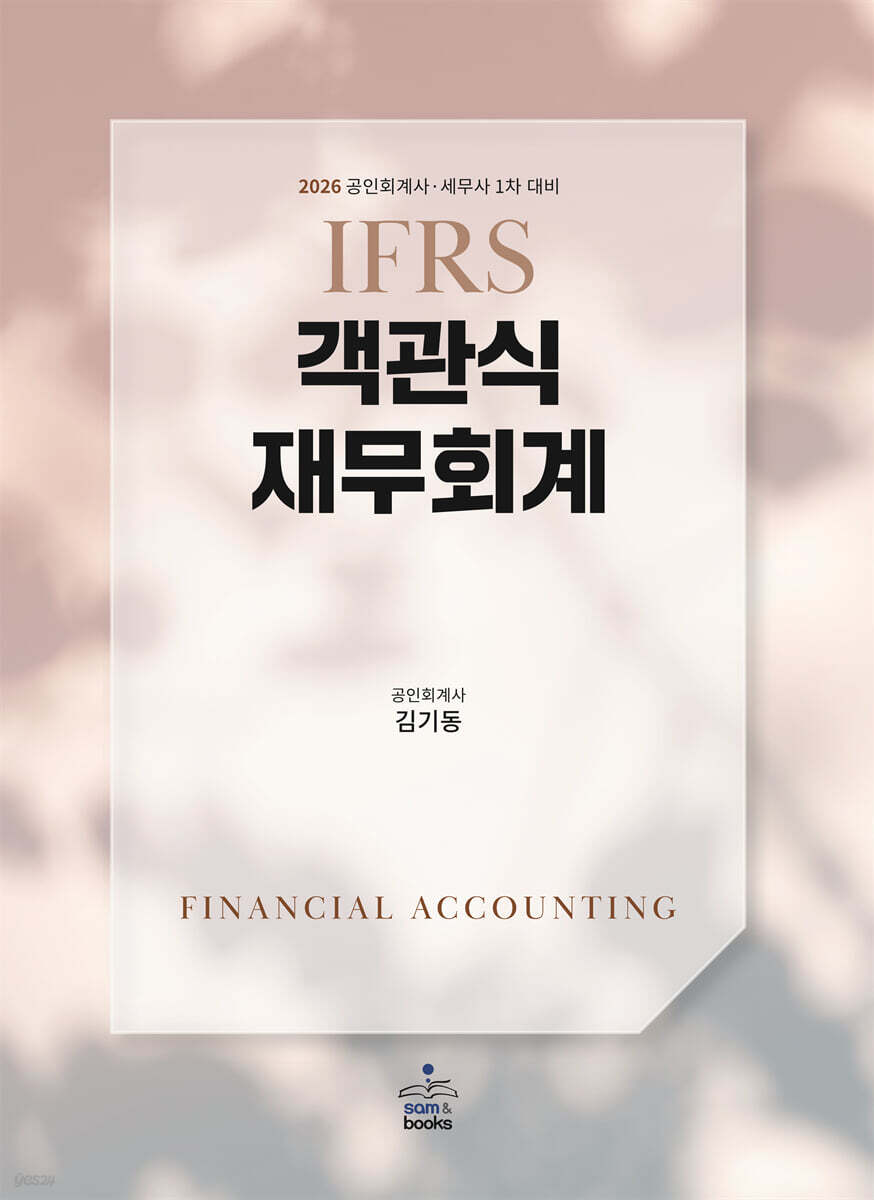
2026 IFRS Multiple Choice Financial Accounting
 |
Description
Book Introduction
1.
Learning linked to the Financial Accounting Workbook
The summary of each chapter was published separately as a financial accounting workbook to enable students to cover both the first and second exams for the Certified Public Accountant and Tax Accountant exams in a single volume.
Therefore, the summary of the contents of each chapter was organized using the workbook, and the objective book was used to ensure sufficient practice in solving problems.
2.
Perfect response to recent exam trends
The characteristic of recent trends in financial accounting questions in the CPA and CPA exams can be summarized in one word: 'uncertainty of difficulty.'
To cope with this uncertainty of unpredictable difficulty, multiple-choice practice problems were divided into basic and advanced problems.
If you want to secure a stable score in financial accounting, I recommend solving advanced problems.
3.
Indication of required questions and checkboxes
Among the basic and advanced problems, those that are deemed essential for the purpose of the exam are marked as required problems.
Additionally, due to the nature of objective textbooks that require continuous, repetitive learning, a checkbox was created at the top of each question to allow students to check whether their answer is correct or incorrect for each round of problem solving.
Through this, you can judge that your skills are improving as the number of readings increases, and I am confident that it will become an important indicator for correcting your approach to problems that you repeatedly make mistakes on.
4.
Theoretical and computational problems
Unlike existing objective textbooks, theoretical and computational problems are separated.
When analyzing past exam questions, we found that many of the questions were theoretical questions using sentences from the standard textbook, so we created a separate set of theoretical questions to prepare for them.
Additionally, it is expected that practicing computational problems to develop skills and then separately prepare for theoretical problems based on these skills will be an effective test-taking strategy.
5.
Attachment of the final mock exam
In the 2026 edition, 7 additional mock exams were attached.
The multiple choice questions included in each chapter are designed to help students understand the content of the chapter, so it is true that they are insufficient for practicing problem solving within a limited time frame in a situation where questions are presented randomly as in a real exam.
Therefore, after completing the study from Chapter 1 to Chapter 25, I am confident that if you check your improvement through a final mock exam and repeat the process of supplementing any shortcomings through practice problems for each chapter, it will be sufficiently suitable for preparing for the first exam.
Learning linked to the Financial Accounting Workbook
The summary of each chapter was published separately as a financial accounting workbook to enable students to cover both the first and second exams for the Certified Public Accountant and Tax Accountant exams in a single volume.
Therefore, the summary of the contents of each chapter was organized using the workbook, and the objective book was used to ensure sufficient practice in solving problems.
2.
Perfect response to recent exam trends
The characteristic of recent trends in financial accounting questions in the CPA and CPA exams can be summarized in one word: 'uncertainty of difficulty.'
To cope with this uncertainty of unpredictable difficulty, multiple-choice practice problems were divided into basic and advanced problems.
If you want to secure a stable score in financial accounting, I recommend solving advanced problems.
3.
Indication of required questions and checkboxes
Among the basic and advanced problems, those that are deemed essential for the purpose of the exam are marked as required problems.
Additionally, due to the nature of objective textbooks that require continuous, repetitive learning, a checkbox was created at the top of each question to allow students to check whether their answer is correct or incorrect for each round of problem solving.
Through this, you can judge that your skills are improving as the number of readings increases, and I am confident that it will become an important indicator for correcting your approach to problems that you repeatedly make mistakes on.
4.
Theoretical and computational problems
Unlike existing objective textbooks, theoretical and computational problems are separated.
When analyzing past exam questions, we found that many of the questions were theoretical questions using sentences from the standard textbook, so we created a separate set of theoretical questions to prepare for them.
Additionally, it is expected that practicing computational problems to develop skills and then separately prepare for theoretical problems based on these skills will be an effective test-taking strategy.
5.
Attachment of the final mock exam
In the 2026 edition, 7 additional mock exams were attached.
The multiple choice questions included in each chapter are designed to help students understand the content of the chapter, so it is true that they are insufficient for practicing problem solving within a limited time frame in a situation where questions are presented randomly as in a real exam.
Therefore, after completing the study from Chapter 1 to Chapter 25, I am confident that if you check your improvement through a final mock exam and repeat the process of supplementing any shortcomings through practice problems for each chapter, it will be sufficiently suitable for preparing for the first exam.
index
Table of Contents
Chapter 1 Conceptual Framework for Financial Reporting 1-1
Chapter 2: Profit Concepts and Measurement Criteria 2-1
Chapter 3 Financial Statements and Disclosures 3-1
Chapter 4 Revenue Recognition 4-1
Chapter 5 Cash and Cash Equivalents and Receivables 5-1
Chapter 6 Inventory Assets 6-1
Chapter 7 Tangible Assets and Investment Property 7-1
Chapter 8 Capitalization of Borrowing Costs 8-1
Chapter 9 Intangible Assets and Other Assets 9-1
Chapter 10 Financial Debt and Private Debt 10-1
Chapter 11 Provisions and Employee Benefits 11-1
Chapter 12 Capital 12-1
Chapter 13 Financial Assets for Investment Purposes 13-1
Chapter 14 Compound Financial Products 14-1
Chapter 15 Stock-Based Compensation Transactions 15-1
Chapter 16 Earnings per Share 16-1
Chapter 17 Reese 17-1
Chapter 18 Corporate Tax Accounting 18-1
Chapter 19 Accounting Changes and Error Corrections 19-1
Chapter 20 Statement of Cash Flows 20-1
Chapter 21 Other Matters of Financial Accounting 21-1
Chapter 22: Accounting for Exchange Rate Fluctuations and Derivatives 22-1
Chapter 23 Investments in Associates and Joint Ventures 23-1
Chapter 24 Business Combinations and Merger Accounting 24-1
Chapter 25 Consolidated Accounting 25-1
Appendix Mock Exams/Previous Exam Questions
Table of Contents
Chapter 1 Conceptual Framework for Financial Reporting 5
Chapter 2: Profit Concepts and Measurement Criteria 13
Chapter 3 Financial Statements and Disclosures 19
Chapter 4 Revenue Recognition 23
Chapter 5 Cash and Cash Equivalents and Receivables 31
Chapter 6 Inventory Assets 50
Chapter 7 Tangible Assets and Investment Property 68
Chapter 8 Capitalization of Borrowing Costs 76
Chapter 9 Intangible Assets and Other Assets 85
Chapter 10 Financial Debt and Private Debt 95
Chapter 11 Accrued Liabilities and Employee Benefits 108
Chapter 12 Capital 116
Chapter 13 Financial Assets for Investment Purposes 133
Chapter 14 Complex Financial Products 147
Chapter 15 Stock-Based Compensation Transactions 155
Chapter 16 Earnings Per Share 167
Chapter 17 Lees 175
Chapter 18 Corporate Tax Accounting 188
Chapter 19 Accounting Changes and Error Corrections 200
Chapter 20 Statement of Cash Flows 211
Chapter 21 Other Matters of Financial Accounting 226
Chapter 22: Accounting for Exchange Rate Fluctuations and Derivatives 233
Chapter 23 Investments in Associates and Joint Ventures 247
Chapter 24 Business Combinations and Merger Accounting 257
Chapter 25 Consolidated Accounting 268
Appendix Mock Exam / Past Exam Questions 284
Chapter 1 Conceptual Framework for Financial Reporting 1-1
Chapter 2: Profit Concepts and Measurement Criteria 2-1
Chapter 3 Financial Statements and Disclosures 3-1
Chapter 4 Revenue Recognition 4-1
Chapter 5 Cash and Cash Equivalents and Receivables 5-1
Chapter 6 Inventory Assets 6-1
Chapter 7 Tangible Assets and Investment Property 7-1
Chapter 8 Capitalization of Borrowing Costs 8-1
Chapter 9 Intangible Assets and Other Assets 9-1
Chapter 10 Financial Debt and Private Debt 10-1
Chapter 11 Provisions and Employee Benefits 11-1
Chapter 12 Capital 12-1
Chapter 13 Financial Assets for Investment Purposes 13-1
Chapter 14 Compound Financial Products 14-1
Chapter 15 Stock-Based Compensation Transactions 15-1
Chapter 16 Earnings per Share 16-1
Chapter 17 Reese 17-1
Chapter 18 Corporate Tax Accounting 18-1
Chapter 19 Accounting Changes and Error Corrections 19-1
Chapter 20 Statement of Cash Flows 20-1
Chapter 21 Other Matters of Financial Accounting 21-1
Chapter 22: Accounting for Exchange Rate Fluctuations and Derivatives 22-1
Chapter 23 Investments in Associates and Joint Ventures 23-1
Chapter 24 Business Combinations and Merger Accounting 24-1
Chapter 25 Consolidated Accounting 25-1
Appendix Mock Exams/Previous Exam Questions
Table of Contents
Chapter 1 Conceptual Framework for Financial Reporting 5
Chapter 2: Profit Concepts and Measurement Criteria 13
Chapter 3 Financial Statements and Disclosures 19
Chapter 4 Revenue Recognition 23
Chapter 5 Cash and Cash Equivalents and Receivables 31
Chapter 6 Inventory Assets 50
Chapter 7 Tangible Assets and Investment Property 68
Chapter 8 Capitalization of Borrowing Costs 76
Chapter 9 Intangible Assets and Other Assets 85
Chapter 10 Financial Debt and Private Debt 95
Chapter 11 Accrued Liabilities and Employee Benefits 108
Chapter 12 Capital 116
Chapter 13 Financial Assets for Investment Purposes 133
Chapter 14 Complex Financial Products 147
Chapter 15 Stock-Based Compensation Transactions 155
Chapter 16 Earnings Per Share 167
Chapter 17 Lees 175
Chapter 18 Corporate Tax Accounting 188
Chapter 19 Accounting Changes and Error Corrections 200
Chapter 20 Statement of Cash Flows 211
Chapter 21 Other Matters of Financial Accounting 226
Chapter 22: Accounting for Exchange Rate Fluctuations and Derivatives 233
Chapter 23 Investments in Associates and Joint Ventures 247
Chapter 24 Business Combinations and Merger Accounting 257
Chapter 25 Consolidated Accounting 268
Appendix Mock Exam / Past Exam Questions 284
Publisher's Review
Thanks to the support of our students, we have been continuously updating the IFRS Financial Accounting series for several years.
The author promises to continue this series with all his heart, so that these works will not be a disgrace.
This book features:
1.
Learning linked to the Financial Accounting Workbook
The summary of each chapter can be compiled into a single book for both the first and second exams of the CPA and CPA exams.
It was published separately as a financial accounting workbook.
Therefore, the summary of the contents of each chapter was organized using the workbook, and the objective book was used to ensure sufficient practice in solving problems.
2.
Perfect response to recent exam trends
The characteristic of recent trends in financial accounting questions in the CPA and CPA exams can be summarized in one word: 'uncertainty of difficulty.'
To cope with this uncertainty of unpredictable difficulty, multiple-choice practice problems were divided into basic and advanced problems.
If you want to secure a stable score in financial accounting, I recommend solving advanced problems.
3.
Indication of required questions and checkboxes
Among the basic and advanced problems, those that are deemed essential for the purpose of the exam are marked as required problems.
Additionally, due to the nature of objective textbooks that require continuous, repetitive learning, a checkbox was created at the top of each question to allow students to check whether their answer is correct or incorrect for each round of problem solving.
Through this, you can judge that your skills are improving as the number of readings increases, and I am confident that it will become an important indicator for correcting your approach to problems that you repeatedly make mistakes on.
4.
Theoretical and computational problems
Unlike existing objective textbooks, theoretical and computational problems are separated.
When analyzing past exam questions, we found that many of the questions were theoretical questions using sentences from the standard textbook, so we created a separate set of theoretical questions to prepare for them.
Additionally, it is expected that practicing computational problems to develop skills and then separately prepare for theoretical problems based on these skills will be an effective test-taking strategy.
5.
Attachment of the final mock exam
In the 2026 edition, 7 additional mock exams were attached.
The multiple choice questions included in each chapter are designed to help students understand the content of the chapter, so it is true that they are insufficient for practicing problem solving within a limited time frame in a situation where questions are presented randomly as in a real exam.
Therefore, after completing study from Chapter 1 to Chapter 25, check whether your skills have improved through a final mock exam and review the chapters again to see if you have any shortcomings.
I am confident that repeating the process of supplementing through practice problems will be sufficient for preparing for the first test.
I feel very lonely when I study.
Also, there are many temptations around us.
But the person who makes my future self competitive is not the people around me now, but my current self.
I think that if you keep in mind that ultimately winning the battle with yourself is the most important thing and stay true to the present, you will achieve good results.
I received help from many people before publishing this textbook.
I would like to express my gratitude to CEO Lee Nak-gyu and his staff at Sam & Books, who edited and published this book to make it a readable book.
Above all, I would like to thank all the students and KDianS members who have continued to follow me, believing in the name ‘Kim Ki-dong.’
I know full well that without you all, this book and I would be meaningless.
I bow my head and thank you.
Kim Ki-dong, Certified Public Accountant, August 2025
The author promises to continue this series with all his heart, so that these works will not be a disgrace.
This book features:
1.
Learning linked to the Financial Accounting Workbook
The summary of each chapter can be compiled into a single book for both the first and second exams of the CPA and CPA exams.
It was published separately as a financial accounting workbook.
Therefore, the summary of the contents of each chapter was organized using the workbook, and the objective book was used to ensure sufficient practice in solving problems.
2.
Perfect response to recent exam trends
The characteristic of recent trends in financial accounting questions in the CPA and CPA exams can be summarized in one word: 'uncertainty of difficulty.'
To cope with this uncertainty of unpredictable difficulty, multiple-choice practice problems were divided into basic and advanced problems.
If you want to secure a stable score in financial accounting, I recommend solving advanced problems.
3.
Indication of required questions and checkboxes
Among the basic and advanced problems, those that are deemed essential for the purpose of the exam are marked as required problems.
Additionally, due to the nature of objective textbooks that require continuous, repetitive learning, a checkbox was created at the top of each question to allow students to check whether their answer is correct or incorrect for each round of problem solving.
Through this, you can judge that your skills are improving as the number of readings increases, and I am confident that it will become an important indicator for correcting your approach to problems that you repeatedly make mistakes on.
4.
Theoretical and computational problems
Unlike existing objective textbooks, theoretical and computational problems are separated.
When analyzing past exam questions, we found that many of the questions were theoretical questions using sentences from the standard textbook, so we created a separate set of theoretical questions to prepare for them.
Additionally, it is expected that practicing computational problems to develop skills and then separately prepare for theoretical problems based on these skills will be an effective test-taking strategy.
5.
Attachment of the final mock exam
In the 2026 edition, 7 additional mock exams were attached.
The multiple choice questions included in each chapter are designed to help students understand the content of the chapter, so it is true that they are insufficient for practicing problem solving within a limited time frame in a situation where questions are presented randomly as in a real exam.
Therefore, after completing study from Chapter 1 to Chapter 25, check whether your skills have improved through a final mock exam and review the chapters again to see if you have any shortcomings.
I am confident that repeating the process of supplementing through practice problems will be sufficient for preparing for the first test.
I feel very lonely when I study.
Also, there are many temptations around us.
But the person who makes my future self competitive is not the people around me now, but my current self.
I think that if you keep in mind that ultimately winning the battle with yourself is the most important thing and stay true to the present, you will achieve good results.
I received help from many people before publishing this textbook.
I would like to express my gratitude to CEO Lee Nak-gyu and his staff at Sam & Books, who edited and published this book to make it a readable book.
Above all, I would like to thank all the students and KDianS members who have continued to follow me, believing in the name ‘Kim Ki-dong.’
I know full well that without you all, this book and I would be meaningless.
I bow my head and thank you.
Kim Ki-dong, Certified Public Accountant, August 2025
GOODS SPECIFICS
- Date of issue: August 27, 2025
- Page count, weight, size: 1,160 pages | 188*258*46mm
- ISBN13: 9791156265689
You may also like
카테고리
korean


korean

![GQ KOREA Mark (Monthly): December [2025]](http://librairie.coreenne.fr/cdn/shop/files/8ef265dbbfbf186523ed75ba7319009d.jpg?v=1765340328&width=3840)


