

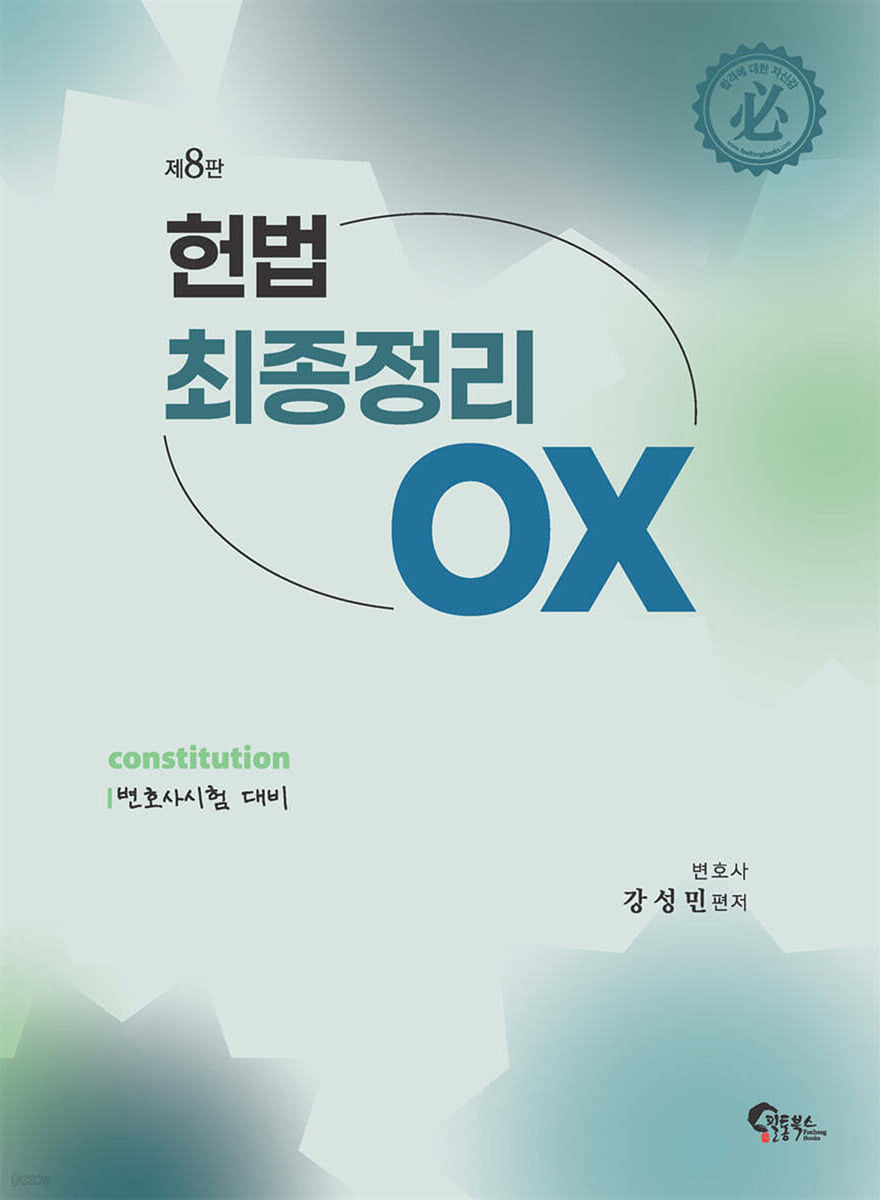
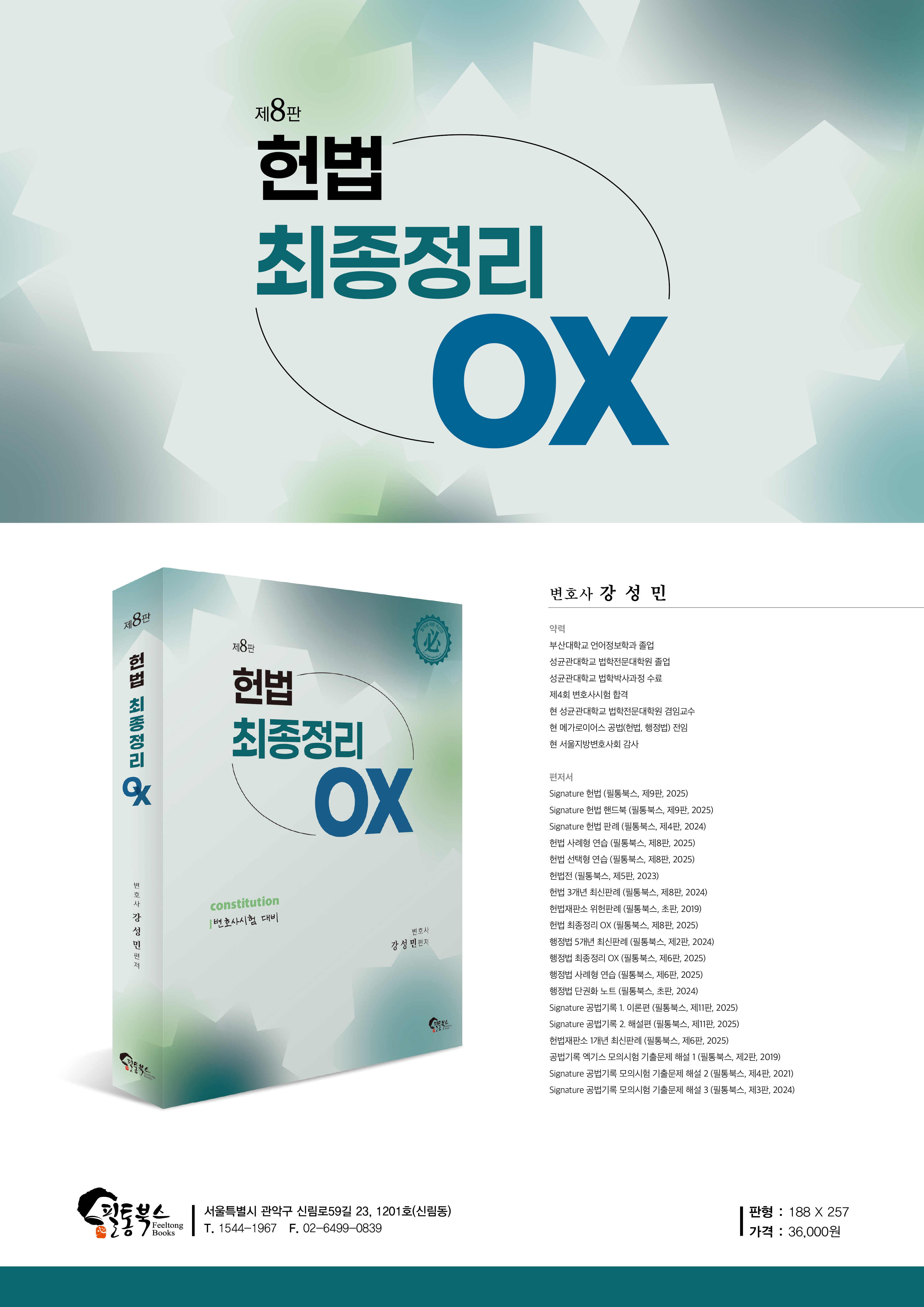
Final revision of the Constitution OX
 |
Description
Book Introduction
This book was created to enable efficient multiple-choice preparation by allowing you to intuitively memorize important passages and important precedents that frequently appear in the lead-up to the bar exam.
- You can preview some of the book's contents.
Preview
index
Part 1: Constitutional Court
Chapter 1: General Theory of the Constitutional Court System 2
Chapter 2 Special Trial Procedures 10
Section 1: Unconstitutionality Review 10
|The Objectivity of Judgment 10
| Court's Request 14
| Premise of the Trial 17
|Review of the Constitutional Court's Unconstitutionality 21
|Transformation Decision 22
|Effect of Decisions on Unconstitutionality 23
Section 2 Constitutional Petition for Unconstitutionality Review 30
|The Objectivity of Judgment 30
|Court's decision to reject the petition 30
|The Premise of Trial 31
|Billing period 33
|Judgment Procedure 34
|Retrial 34
Section 3 Constitutional Petition for Remedy of Rights 39
|General Theory 39
|Claimant's Competence 39
|Exercise or non-exercise of public power 40
| Claims of Violation of Fundamental Rights and Possible Violations 50
|Self-relevance 51
|Directness 57
|Present 61
|Supplementaryness 62
|Rights Protection Interest 66
|Billing period 68
|Lawyer Mandatory Rule 71
|Procedures for Constitutional Petition Review, etc. 72
Section 4 Judgment on Disputes over Authority 73
|Party Capacity 73
|Party Qualification 78
|The defendant's actions or inactions 80
|81 Infringement or concern that rights granted by the Constitution or law may be infringed
|Rights Protection Interest 84
|Billing period 84
|Decision on the Authority Dispute 85
Part 2: Fundamental Rights
Chapter 1: General Fundamental Rights 88
Section 1 General Fundamental Rights 88
Section 2: The Nature of Fundamental Rights 88
Section 3: Fundamental Rights and Institutional Guarantees 88
Section 4 Subjects of Fundamental Rights 88
|General Theory 88
|Foreigner 89
|Corporation 92
Political Party 94
Section 5. The Ambassadorial Effect of Fundamental Rights 95
Section 6: Conflict of Fundamental Rights 96
Section 7 Conflicts of Fundamental Rights 97
Section 8 Restrictions and Limitations of Fundamental Rights 99
|Principle of Legal Reservation 99
|Principle of Clarity 100
|Principle of Prohibition of Excessive Support 110
|Principle 112 of Prohibition of Infringement of Essential Content
|Administrative Legislative Power 112
|Special Power Relations 120
Section 9 Duty to Protect Fundamental Rights 124
Chapter 2: Human Dignity and Value, and the Right to the Pursuit of Happiness 130
Section 1: Human Dignity and Value 130
Section 2: The Right to Pursuit of Happiness 134
|General Freedom of Action 136
|The Principle of Self-Responsibility 141
|Right to Self-Determination 142
Chapter 3: Right to Equality 146
|Violation of the Principle of Equality 151
Chapter 4: Fundamental Rights of Liberty 164
Section 1: Personal Freedom 164
Article 1, Right to Life, Article 164
Article 2 Right to be free from bodily harm 164
Article 3, Freedom of the Body 164
|Principle of Legality 167
|Principle of Non-Retroactivity of Punishment 168
|Principle of Prohibition of Double Denial (Principle of Negligence of Double Denial) 171
|Prohibition of Guilt by Association 173
|Responsibility for Punishment 174
|Principle of Due Process 177
|Warrant 181
|Right to Request Review of the Legitimacy of Arrest and Detention 185
|Right to be informed of the reasons for arrest or detention, etc. 185
|Right to Assistance of Counsel 186
|Principle of Presumption of Innocence 190
|Right to Remain 192
|Right to be free from torture 193
|Limitations on the evidentiary power and probative value of confessions 193
Section 2 Freedom of Private Life 194
Article 1, Privacy and Freedom of Life 194
Article 2, Right to Self-Determination of Personal Information 197
Article 3 Freedom of Residence 206
Article 4 Freedom of Residence and Movement 207
Article 5: Secrecy and Freedom of Communication 210
Section 3: Freedom in the Realm of Mental Life 214
Article 1 Freedom of Conscience 214
Article 2 Freedom of Religion 221
Article 3 Freedom of the Press and Publication 226
|Right to Know 238
|Access Rights 239
Freedom of the Press 239
Article 4 Freedom of Assembly and Association 240
Freedom of Assembly 240
Freedom of Association 247
Article 5 Freedom of Academics and the Arts 249
Section 4 Freedom in Economic Life 252
Article 1 Property Rights 252
Article 2, Freedom of Occupational Choice 272
Article 3 Consumer Rights 287
Chapter 5: Fundamental Political Rights 288
Section 1: Right to Vote 288
|National Referendum 288
Section 2 Right to Hold Public Office 292
Chapter 6 Fundamental Rights of Claim 302
Section 1 Right to Petition 302
Section 2 Right to Request a Trial 304
|Criminal Victim's Right to State Trial Proceedings 316
Section 3 Claims for State Compensation 318
Section 4: Right to Claim Criminal Compensation 321
Section 5: Crime Victims' Right to Claim Relief 323
Chapter 7: Basic Social Rights 324
Section 1: General Theory of Social Fundamental Rights 324
Section 2: The Right to a Humane Life 324
Section 3: Right to Education 332
|The right to equal education according to ability 332
| The Obligation to Learn and Free Compulsory Education 335
|Freedom of Private School Operations 337
| Guaranteeing the Education System 338
Section 4: Right to Work 342
Section 5, Labor Rights 347
Section 6 Environmental Rights 354
Section 7: Guarantee of Marriage and Family Life 355
Section 8: Protection of Motherhood 367
Section 9 Right to Health 367
Chapter 8: Basic Duties of Citizens 368
Part 3 General Provisions of the Constitution
Chapter 1: Constitution and Constitutional Law 370
Section 1 General Constitution 370
Section 2 Interpretation of the Constitution 371
|Constitutional Legal Interpretation 372
Section 3: Establishment of the Constitution 374
Section 4 Amendment of the Constitution 374
Section 5: Changes to the Constitution 376
Section 6: Protection of the Constitution 376
Chapter 2 General Provisions of the Constitution of the Republic of Korea 378
Section 1: Constitutional History of the Republic of Korea 378
|The First Republic Constitution (1948) 378
|First Amendment to the Constitution of the First Republic (1952) - Excerpt from Amendment 381
|The Second Amendment to the Constitution of the First Republic (1954) - Amendment No. 382
|Second Republic Constitution, Third Amendment (1960) - Parliamentary Cabinet System Amendment 384
|The 4th Amendment to the Constitution of the Second Republic (1960) - Supplementary Provisions Amendment (Retroactive Punishment for Election Fraud) 386
|Fifth Amendment to the Constitution of the Third Republic (1962) - 386 Amendments to the Constitution after the May 16 Coup
|6th Amendment to the Constitution of the Third Republic (1969) - 3rd Amendment 389
|The 7th Amendment to the Constitution of the Fourth Republic (1972) - Yushin Amendment 389
|8th Amendment to the Constitution of the Fifth Republic (1980) 391
|9th Amendment to the Constitution of the Sixth Republic (1987) - Current Constitution (Direct Election Amendment) 394
Section 2: The State Form of the Republic of Korea 395
Section 3 Components of the Republic of Korea 396
|Sovereignty 396
|National 396
|Territorial Provisions and Peaceful Unification Provisions 402
Section 4: Basic Principles of the Korean Constitution 406
Article 1, Preamble to the Constitution, Article 406
Article 2, Principle of Popular Sovereignty, Article 409
Article 3, Principle of Democracy 411
Article 4, Principle of the Rule of Law, Article 412
Article 5: Principles of the Social State 423
Article 6: Principle of a Cultural State 429
Article 7 International Pacifism 431
Section 5: Basic Systems of the Korean Constitution 434
Article 1, Party System 434
Political Parties and Political Funds 444
Article 2 Electoral System 448
|Voting Rights 449
|Principles of General Election 450
|Principle of Equal Elections 456
|Principle of Direct Election 457
|Principle of Secret Election 458
|Principle of Free Elections 458
Freedom of Election Campaigning 459
|Contents of the Electoral System 465
Public Election System 466
Article 3 Civil Service System 467
Article 471 Local Autonomy System
Part 4: Governing Structure
Chapter 1: Principles of Governing Structure 486
Section 1: The Principle of Representative Democracy 486
Section 2: Principle of Separation of Powers 488
Section 3: Form of Government 492
Parliamentary Cabinet System 492
|Presidential System 493
|Two-member government system 493
Chapter 2 National Assembly 494
Section 1 Parliamentarism 494
Section 2: Composition and Organization of the National Assembly 494
|Speaker and Vice Speaker of the National Assembly 494
|National Assembly Committee 499
Negotiating Group 505
Section 3 Operation and Procedures of the National Assembly 507
|Majority Rule 508
|Principle of Disclosure 510
|Principle of Session Continuation 513
|Principle of Absence of Sunlight 514
|Principles on Speaking and Voting 514
Section 4 Powers of the National Assembly 517
Article 517 of the Legislative Powers of the First Amendment
Dispositional Law 517
|Law Enactment Procedure 518
Article 523, Powers Concerning Finance
|Tax Legislation Power 523
Budget Voting Rights 527
Article 531, Paragraph 3, Authority to Control State Affairs
|Impeachment Power 531
|National Audit and Investigation Authority 538
|Right to Request Appearance and Question the Government 541
Article 4 Authority over Personnel 542
|Right to propose the dismissal of the Prime Minister and State Council members 543
Article 5, Section 544, Autonomy of the National Assembly
Section 5: Members of the National Assembly 546
Ⅰ Status and Status of Members of the National Assembly 546
Ⅱ Constitutional Privileges of Members of the National Assembly 548
|Immunity from Arrest 548
|Immunity 550
|Duties of Members of the National Assembly 552
Chapter 3: The President and the Government 556
Section 1 President 556
Ⅰ The Constitutional Status and Position of the President 556
Ⅱ Presidential Powers 560
Criminal Privilege - Non-Prosecution Privilege 560
|National Emergency Powers 561
|Legislative Power 566
|The President's Duties 569
|Authority Regarding Execution 569
|Judicial Powers 569
|Control over the President's Powers 573
Section 2 Government 574
Article 1 Prime Minister 574
Article 2, State Council Member 577
Article 3 State Council 578
Article 4, Administrative Department 581
Article 5, Presidential Advisory Body 582
Article 6 Board of Audit and Inspection 583
Section 3 Election Management Committee 588
Chapter 4: The Law 592
Section 1: Independence of the Judiciary 592
Section 2: Composition and Organization of the Court 599
Section 3 Judicial Procedure and Administration 602
Section 4. Court Powers 605
Chapter 1: General Theory of the Constitutional Court System 2
Chapter 2 Special Trial Procedures 10
Section 1: Unconstitutionality Review 10
|The Objectivity of Judgment 10
| Court's Request 14
| Premise of the Trial 17
|Review of the Constitutional Court's Unconstitutionality 21
|Transformation Decision 22
|Effect of Decisions on Unconstitutionality 23
Section 2 Constitutional Petition for Unconstitutionality Review 30
|The Objectivity of Judgment 30
|Court's decision to reject the petition 30
|The Premise of Trial 31
|Billing period 33
|Judgment Procedure 34
|Retrial 34
Section 3 Constitutional Petition for Remedy of Rights 39
|General Theory 39
|Claimant's Competence 39
|Exercise or non-exercise of public power 40
| Claims of Violation of Fundamental Rights and Possible Violations 50
|Self-relevance 51
|Directness 57
|Present 61
|Supplementaryness 62
|Rights Protection Interest 66
|Billing period 68
|Lawyer Mandatory Rule 71
|Procedures for Constitutional Petition Review, etc. 72
Section 4 Judgment on Disputes over Authority 73
|Party Capacity 73
|Party Qualification 78
|The defendant's actions or inactions 80
|81 Infringement or concern that rights granted by the Constitution or law may be infringed
|Rights Protection Interest 84
|Billing period 84
|Decision on the Authority Dispute 85
Part 2: Fundamental Rights
Chapter 1: General Fundamental Rights 88
Section 1 General Fundamental Rights 88
Section 2: The Nature of Fundamental Rights 88
Section 3: Fundamental Rights and Institutional Guarantees 88
Section 4 Subjects of Fundamental Rights 88
|General Theory 88
|Foreigner 89
|Corporation 92
Political Party 94
Section 5. The Ambassadorial Effect of Fundamental Rights 95
Section 6: Conflict of Fundamental Rights 96
Section 7 Conflicts of Fundamental Rights 97
Section 8 Restrictions and Limitations of Fundamental Rights 99
|Principle of Legal Reservation 99
|Principle of Clarity 100
|Principle of Prohibition of Excessive Support 110
|Principle 112 of Prohibition of Infringement of Essential Content
|Administrative Legislative Power 112
|Special Power Relations 120
Section 9 Duty to Protect Fundamental Rights 124
Chapter 2: Human Dignity and Value, and the Right to the Pursuit of Happiness 130
Section 1: Human Dignity and Value 130
Section 2: The Right to Pursuit of Happiness 134
|General Freedom of Action 136
|The Principle of Self-Responsibility 141
|Right to Self-Determination 142
Chapter 3: Right to Equality 146
|Violation of the Principle of Equality 151
Chapter 4: Fundamental Rights of Liberty 164
Section 1: Personal Freedom 164
Article 1, Right to Life, Article 164
Article 2 Right to be free from bodily harm 164
Article 3, Freedom of the Body 164
|Principle of Legality 167
|Principle of Non-Retroactivity of Punishment 168
|Principle of Prohibition of Double Denial (Principle of Negligence of Double Denial) 171
|Prohibition of Guilt by Association 173
|Responsibility for Punishment 174
|Principle of Due Process 177
|Warrant 181
|Right to Request Review of the Legitimacy of Arrest and Detention 185
|Right to be informed of the reasons for arrest or detention, etc. 185
|Right to Assistance of Counsel 186
|Principle of Presumption of Innocence 190
|Right to Remain 192
|Right to be free from torture 193
|Limitations on the evidentiary power and probative value of confessions 193
Section 2 Freedom of Private Life 194
Article 1, Privacy and Freedom of Life 194
Article 2, Right to Self-Determination of Personal Information 197
Article 3 Freedom of Residence 206
Article 4 Freedom of Residence and Movement 207
Article 5: Secrecy and Freedom of Communication 210
Section 3: Freedom in the Realm of Mental Life 214
Article 1 Freedom of Conscience 214
Article 2 Freedom of Religion 221
Article 3 Freedom of the Press and Publication 226
|Right to Know 238
|Access Rights 239
Freedom of the Press 239
Article 4 Freedom of Assembly and Association 240
Freedom of Assembly 240
Freedom of Association 247
Article 5 Freedom of Academics and the Arts 249
Section 4 Freedom in Economic Life 252
Article 1 Property Rights 252
Article 2, Freedom of Occupational Choice 272
Article 3 Consumer Rights 287
Chapter 5: Fundamental Political Rights 288
Section 1: Right to Vote 288
|National Referendum 288
Section 2 Right to Hold Public Office 292
Chapter 6 Fundamental Rights of Claim 302
Section 1 Right to Petition 302
Section 2 Right to Request a Trial 304
|Criminal Victim's Right to State Trial Proceedings 316
Section 3 Claims for State Compensation 318
Section 4: Right to Claim Criminal Compensation 321
Section 5: Crime Victims' Right to Claim Relief 323
Chapter 7: Basic Social Rights 324
Section 1: General Theory of Social Fundamental Rights 324
Section 2: The Right to a Humane Life 324
Section 3: Right to Education 332
|The right to equal education according to ability 332
| The Obligation to Learn and Free Compulsory Education 335
|Freedom of Private School Operations 337
| Guaranteeing the Education System 338
Section 4: Right to Work 342
Section 5, Labor Rights 347
Section 6 Environmental Rights 354
Section 7: Guarantee of Marriage and Family Life 355
Section 8: Protection of Motherhood 367
Section 9 Right to Health 367
Chapter 8: Basic Duties of Citizens 368
Part 3 General Provisions of the Constitution
Chapter 1: Constitution and Constitutional Law 370
Section 1 General Constitution 370
Section 2 Interpretation of the Constitution 371
|Constitutional Legal Interpretation 372
Section 3: Establishment of the Constitution 374
Section 4 Amendment of the Constitution 374
Section 5: Changes to the Constitution 376
Section 6: Protection of the Constitution 376
Chapter 2 General Provisions of the Constitution of the Republic of Korea 378
Section 1: Constitutional History of the Republic of Korea 378
|The First Republic Constitution (1948) 378
|First Amendment to the Constitution of the First Republic (1952) - Excerpt from Amendment 381
|The Second Amendment to the Constitution of the First Republic (1954) - Amendment No. 382
|Second Republic Constitution, Third Amendment (1960) - Parliamentary Cabinet System Amendment 384
|The 4th Amendment to the Constitution of the Second Republic (1960) - Supplementary Provisions Amendment (Retroactive Punishment for Election Fraud) 386
|Fifth Amendment to the Constitution of the Third Republic (1962) - 386 Amendments to the Constitution after the May 16 Coup
|6th Amendment to the Constitution of the Third Republic (1969) - 3rd Amendment 389
|The 7th Amendment to the Constitution of the Fourth Republic (1972) - Yushin Amendment 389
|8th Amendment to the Constitution of the Fifth Republic (1980) 391
|9th Amendment to the Constitution of the Sixth Republic (1987) - Current Constitution (Direct Election Amendment) 394
Section 2: The State Form of the Republic of Korea 395
Section 3 Components of the Republic of Korea 396
|Sovereignty 396
|National 396
|Territorial Provisions and Peaceful Unification Provisions 402
Section 4: Basic Principles of the Korean Constitution 406
Article 1, Preamble to the Constitution, Article 406
Article 2, Principle of Popular Sovereignty, Article 409
Article 3, Principle of Democracy 411
Article 4, Principle of the Rule of Law, Article 412
Article 5: Principles of the Social State 423
Article 6: Principle of a Cultural State 429
Article 7 International Pacifism 431
Section 5: Basic Systems of the Korean Constitution 434
Article 1, Party System 434
Political Parties and Political Funds 444
Article 2 Electoral System 448
|Voting Rights 449
|Principles of General Election 450
|Principle of Equal Elections 456
|Principle of Direct Election 457
|Principle of Secret Election 458
|Principle of Free Elections 458
Freedom of Election Campaigning 459
|Contents of the Electoral System 465
Public Election System 466
Article 3 Civil Service System 467
Article 471 Local Autonomy System
Part 4: Governing Structure
Chapter 1: Principles of Governing Structure 486
Section 1: The Principle of Representative Democracy 486
Section 2: Principle of Separation of Powers 488
Section 3: Form of Government 492
Parliamentary Cabinet System 492
|Presidential System 493
|Two-member government system 493
Chapter 2 National Assembly 494
Section 1 Parliamentarism 494
Section 2: Composition and Organization of the National Assembly 494
|Speaker and Vice Speaker of the National Assembly 494
|National Assembly Committee 499
Negotiating Group 505
Section 3 Operation and Procedures of the National Assembly 507
|Majority Rule 508
|Principle of Disclosure 510
|Principle of Session Continuation 513
|Principle of Absence of Sunlight 514
|Principles on Speaking and Voting 514
Section 4 Powers of the National Assembly 517
Article 517 of the Legislative Powers of the First Amendment
Dispositional Law 517
|Law Enactment Procedure 518
Article 523, Powers Concerning Finance
|Tax Legislation Power 523
Budget Voting Rights 527
Article 531, Paragraph 3, Authority to Control State Affairs
|Impeachment Power 531
|National Audit and Investigation Authority 538
|Right to Request Appearance and Question the Government 541
Article 4 Authority over Personnel 542
|Right to propose the dismissal of the Prime Minister and State Council members 543
Article 5, Section 544, Autonomy of the National Assembly
Section 5: Members of the National Assembly 546
Ⅰ Status and Status of Members of the National Assembly 546
Ⅱ Constitutional Privileges of Members of the National Assembly 548
|Immunity from Arrest 548
|Immunity 550
|Duties of Members of the National Assembly 552
Chapter 3: The President and the Government 556
Section 1 President 556
Ⅰ The Constitutional Status and Position of the President 556
Ⅱ Presidential Powers 560
Criminal Privilege - Non-Prosecution Privilege 560
|National Emergency Powers 561
|Legislative Power 566
|The President's Duties 569
|Authority Regarding Execution 569
|Judicial Powers 569
|Control over the President's Powers 573
Section 2 Government 574
Article 1 Prime Minister 574
Article 2, State Council Member 577
Article 3 State Council 578
Article 4, Administrative Department 581
Article 5, Presidential Advisory Body 582
Article 6 Board of Audit and Inspection 583
Section 3 Election Management Committee 588
Chapter 4: The Law 592
Section 1: Independence of the Judiciary 592
Section 2: Composition and Organization of the Court 599
Section 3 Judicial Procedure and Administration 602
Section 4. Court Powers 605
Detailed image
Publisher's Review
[preface]
From the perspective of a student preparing for the bar exam, adjusting the intensity of important passages is a very difficult and unsettling task until the very end.
The Constitution, in particular, is a subject where multiple-choice questions are particularly difficult.
This book was created to help you intuitively memorize important passages and important precedents frequently used in the lead-up to the bar exam, enabling you to efficiently prepare for multiple-choice exams.
1.
I have marked each fingerprint with a ★ according to its importance.
Questions that frequently appear in various tests, including ours, are marked with one asterisk, like ★, and those that are more important are marked with two asterisks, like ★★.
You must study the passages without asterisks, but as you get closer to the test, you can adjust the intensity by referring to the asterisks above.
2.
In the case of a sentence that corresponds to the text or article of a case law itself, only the case law number or article number is indicated, and parts that require explanation are added.
In the case of Ojimun, we have included the minimum amount of explanation necessary to understand the text.
3.
We have analyzed and included over 4,000 passages, including 14 bar exams (approximately 20 questions and 100 passages per exam), the bar exam, the 5th-grade civil service examination, the legislative examination, and the recently administered 7th-grade national civil service examination, 7th-grade local civil service examination, and the court administrative examination.
However, for those who want to adjust the amount, the fingerprints that were only tested in other series are shaded separately.
4.
We've analyzed 24 mock bar exam questions from 2017 to 2024 and included important example questions for additional study.
The mock exam questions from 2017 to 2024 are marked as (example questions), and from the 2022 mock exam questions onwards, they are marked as 22-1 (1st), 22-2 (2nd), and 22-3 (3rd).
5.
Previous passages on the same issue with the same or similar expressions were combined into one representative passage.
The representative text was selected based on the selection paper as much as possible, but for issues where the staff paper has important meaning, the staff paper was selected as the representative text.
Depending on the learning needs, there are cases where two or more items are combined into one.
6.
From this edition onwards, the problems and explanations are separated within one page.
① To enable more practical practice by not showing the correct answer right away, and ② To organize the problems well so that you can read them through quickly the last time you read them.
We listened to the opinions of many test takers to create this structure, and the publisher also put in considerable effort.
However, we decided that this was a necessary change and will be implemented starting with this edition.
The original intention of this book was to be a textbook for the final multiple-choice constitutional exam right before the exam, but many test takers loved this textbook, and the number of test takers who used this book to prepare for the multiple-choice constitutional exam from the beginning increased, so the publication date was brought forward.
However, I will leave the original closing remarks of this book as they are.
“Thank you for coming all the way here.
I know better than anyone how hard you have worked.
They're all coming now.
As long as you don't get tired, that's fine.
Good luck!
2025.
5. 20.
Attorney Kang Seong-min
From the perspective of a student preparing for the bar exam, adjusting the intensity of important passages is a very difficult and unsettling task until the very end.
The Constitution, in particular, is a subject where multiple-choice questions are particularly difficult.
This book was created to help you intuitively memorize important passages and important precedents frequently used in the lead-up to the bar exam, enabling you to efficiently prepare for multiple-choice exams.
1.
I have marked each fingerprint with a ★ according to its importance.
Questions that frequently appear in various tests, including ours, are marked with one asterisk, like ★, and those that are more important are marked with two asterisks, like ★★.
You must study the passages without asterisks, but as you get closer to the test, you can adjust the intensity by referring to the asterisks above.
2.
In the case of a sentence that corresponds to the text or article of a case law itself, only the case law number or article number is indicated, and parts that require explanation are added.
In the case of Ojimun, we have included the minimum amount of explanation necessary to understand the text.
3.
We have analyzed and included over 4,000 passages, including 14 bar exams (approximately 20 questions and 100 passages per exam), the bar exam, the 5th-grade civil service examination, the legislative examination, and the recently administered 7th-grade national civil service examination, 7th-grade local civil service examination, and the court administrative examination.
However, for those who want to adjust the amount, the fingerprints that were only tested in other series are shaded separately.
4.
We've analyzed 24 mock bar exam questions from 2017 to 2024 and included important example questions for additional study.
The mock exam questions from 2017 to 2024 are marked as (example questions), and from the 2022 mock exam questions onwards, they are marked as 22-1 (1st), 22-2 (2nd), and 22-3 (3rd).
5.
Previous passages on the same issue with the same or similar expressions were combined into one representative passage.
The representative text was selected based on the selection paper as much as possible, but for issues where the staff paper has important meaning, the staff paper was selected as the representative text.
Depending on the learning needs, there are cases where two or more items are combined into one.
6.
From this edition onwards, the problems and explanations are separated within one page.
① To enable more practical practice by not showing the correct answer right away, and ② To organize the problems well so that you can read them through quickly the last time you read them.
We listened to the opinions of many test takers to create this structure, and the publisher also put in considerable effort.
However, we decided that this was a necessary change and will be implemented starting with this edition.
The original intention of this book was to be a textbook for the final multiple-choice constitutional exam right before the exam, but many test takers loved this textbook, and the number of test takers who used this book to prepare for the multiple-choice constitutional exam from the beginning increased, so the publication date was brought forward.
However, I will leave the original closing remarks of this book as they are.
“Thank you for coming all the way here.
I know better than anyone how hard you have worked.
They're all coming now.
As long as you don't get tired, that's fine.
Good luck!
2025.
5. 20.
Attorney Kang Seong-min
GOODS SPECIFICS
- Date of issue: May 28, 2025
- Page count, weight, size: 618 pages | 188*257*24mm
- ISBN13: 9791167922229
- ISBN10: 1167922220
You may also like
카테고리
korean


korean

![ELLE 엘르 스페셜 에디션 A형 : 12월 [2025]](http://librairie.coreenne.fr/cdn/shop/files/b8e27a3de6c9538896439686c6b0e8fb.jpg?v=1766436872&width=3840)


