

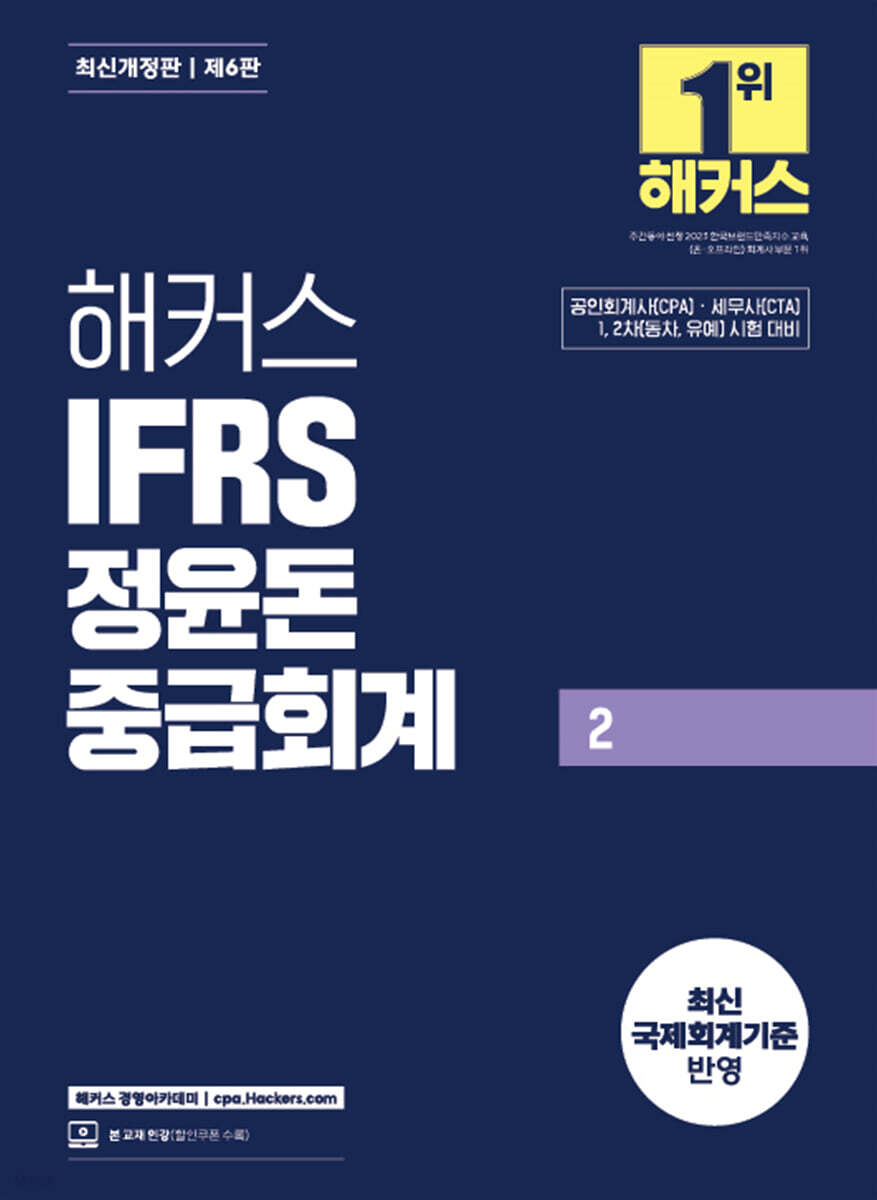
Hackers IFRS Jung Yoon-don Intermediate Accounting 2
 |
Description
Book Introduction
Reflecting the latest international accounting standards!
CPA/Tax Accountant Exam Preparation for Level 1 and 2
An intermediate accounting textbook that focuses on core theories with a high probability of appearing on the exam.
It fully reflects the latest trends in CPA/CPA exams and international accounting standards.
It is structured to enable efficient learning of key theories with a high probability of appearing on the exam.
It contains not only abundant problems but also know-how on shortening problem-solving time and case studies.
CPA/Tax Accountant Exam Preparation for Level 1 and 2
An intermediate accounting textbook that focuses on core theories with a high probability of appearing on the exam.
It fully reflects the latest trends in CPA/CPA exams and international accounting standards.
It is structured to enable efficient learning of key theories with a high probability of appearing on the exam.
It contains not only abundant problems but also know-how on shortening problem-solving time and case studies.
- You can preview some of the book's contents.
Preview
index
Chapter 11 Financial Assets (Ⅰ)
1.
General financial assets
Ⅰ.
The significance of financial assets and criteria for classification
Ⅱ.
Classification and subsequent measurement of financial assets
Ⅲ.
Initial recognition and derecognition of financial assets
2.
Investment Equity Products
Ⅰ.
Classification and characteristics of investment equity products
Ⅱ. Classification and Measurement of FVPL Financial Assets (Equity Products)
Ⅲ. Classification and Measurement of FVOCI Financial Assets (Equity Instruments)
3.
Investment debt products
Ⅰ.
Classification and Characteristics of Investment Debt Products
Ⅱ. Classification and Measurement of FVPL Financial Assets (Debt Instruments)
Ⅲ. Classification and Measurement of AC Financial Assets (Debt Instruments)
Ⅳ. Classification and Measurement of FVOCI Financial Assets (Debt Instruments)
V.
Impairment of financial assets
4.
Other matters regarding financial assets
Ⅰ.
Reclassification of financial assets
Ⅱ.
Changes in contractual cash flows
Key frequently occurring sentences
Multiple choice questions
subjective questions
Chapter 12 Financial Assets (Ⅱ)
1.
Cash and cash equivalents and bank account reconciliation
Ⅰ.
Cash and cash equivalents
Ⅱ.
Bank account reconciliation
2.
Impairment of receivables
Ⅰ.
Impairment of receivables
Ⅱ.
Accounting for impairment
3.
Derecognition of financial assets
Ⅰ.
Determination of whether or not to remove financial assets
Ⅱ.
Transfer that satisfies the removal conditions
Ⅲ.
Transfers that do not meet the removal conditions
Ⅳ.
Accounting for ongoing assets
V.
Discount of bills receivable
Multiple choice questions
subjective questions
Chapter 13 Complex Financial Products
1.
Meaning and types of complex financial products
Ⅰ.
The significance of compound financial products
Ⅱ.
Types of compound financial products
2.
convertible bonds
Ⅰ.
Conditions for issuing convertible bonds
Ⅱ.
Cash Flow Analysis of Convertible Bonds
Ⅲ.
Issuance of convertible bonds at par
Ⅳ.
Discounted issuance of convertible bonds
3.
convertible bonds
Ⅰ.
Conditions for issuing convertible bonds
Ⅱ.
Cash Flow Analysis of Convertible Bonds
Ⅲ.
Issuance of convertible bonds at par value
Ⅳ.
Comparison of convertible bonds and bonds with warrants
4.
Special circumstances of convertible bonds
Ⅰ.
Change in terms of convertible bonds
Ⅱ.
Repurchase of convertible bonds
Ⅲ.
Transaction costs
Ⅳ.
Conversion and exercise of compound financial products during the fiscal year
Multiple choice questions
subjective questions
Chapter 14 Revenue from Contracts with Customers
1.
The meaning of profit
Ⅰ.
Definition of profit
Ⅱ.
Classification of income
Ⅲ.
Traditional revenue recognition method
2.
Revenue from contracts with customers
Ⅰ.
Application of Standard No. 1115, “Revenue from Contracts with Customers”
Ⅱ.
5 Steps to Recognizing Revenue from Customer Contracts
Ⅲ.
mark
3.
Step 1: Identifying the Contract
Ⅰ.
Definition and existence of a contract
Ⅱ.
Identification requirements for contracts and determination of whether or not a contract exists
Ⅲ.
Changes to the contract and combinations of contracts
4.
Step 2: Identifying Performance Obligations
Ⅰ.
The meaning of the duty of performance
Ⅱ.
Precautions when applying the performance obligation
Ⅲ.
A promise to transfer distinct goods or services
Ⅳ.
A promise to transfer a series of distinct goods or services (≒ a promise to transfer in series)
5.
Step 3: Calculating the transaction price
Ⅰ.
Definition of transaction price
Ⅱ.
Variable price
Ⅲ.
Non-cash consideration
Ⅳ.
Significant financial elements in the contract
V.
Price to be paid to customers
6.
Step 4: Allocation of transaction price
Ⅰ.
Distribution based on individual selling price
Ⅱ.
Distribution of discount amount
Ⅲ.
Distribution of variable compensation
Ⅳ.
Fluctuations in transaction prices
7.
Step 5: Revenue Recognition
Ⅰ.
Performance of performance obligations (transfer of control over assets)
Ⅱ.
Performance obligations fulfilled at a point in time
Ⅲ.
Performance obligations that are fulfilled over a period of time
Ⅳ.
Measurement of progress and recognition of revenue based on progress criteria
8.
Contract cost
Ⅰ.
Incremental cost of contract conclusion
Ⅱ.
Contract performance cost
Ⅲ.
Depreciation and impairment
9.
Revenue Recognition Application Examples by Transaction Type
10.
Customer loyalty system
Key frequently occurring sentences
Multiple choice questions
subjective questions
Chapter 15 Construction Contracts
1.
General construction contracts
Ⅰ.
Significance of construction contracts
Ⅱ.
Contract revenue
Ⅲ.
Contract cost
Ⅳ.
Progress
2.
Accounting for construction contracts
Ⅰ.
Recognition of contract revenue
Ⅱ.
Disclosure of financial statements for construction contracts
Ⅲ.
Accounting and calculation of construction contracts
3.
Special circumstances of construction contracts
Ⅰ.
Construction contracts with expected losses
Ⅱ.
When the progress criteria cannot be applied
Ⅲ.
When using a progress rate other than cost-based
Ⅳ.
Merger and division of construction contracts
V.
Special contract costs
Multiple choice questions
subjective questions
Chapter 16 Lease
1.
Lease accounting concepts
Ⅰ.
Lease Accounting Basics
2.
Lessor - Finance Lease
Ⅰ.
Definition of Financial Lease Terms
Ⅱ.
Financial Lease Analysis and Accounting Treatment of Financial Lease Providers
3.
Lessor - Operating Lease
Ⅰ.
Accounting for operating leases
Ⅱ.
Precautions for operating leases
4.
Finance lease where the lessor is a manufacturer or seller
Ⅰ.
The significance of a financial lease (sales lease) in which the lessor is a manufacturer or seller
Ⅱ.
Accounting for finance leases where the lessor is a manufacturer or seller
Ⅲ.
Operating lease where the lessor is a manufacturer or seller
5.
Lease users
Ⅰ.
First measurement
Ⅱ.
Follow-up measurements
Ⅲ.
Revaluation of lease liabilities
Ⅳ.
Variable lease fee
6.
Other details about the lease
Ⅰ.
Lease change
Ⅱ.
Sale and Lease
Ⅲ.
Sublease
Key frequently occurring sentences
Multiple choice questions
subjective questions
Chapter 17 Employee Compensation
1.
Meaning and classification of employee compensation
Ⅰ.
The significance of employee compensation
Ⅱ.
Classification of employee benefits
2.
Retirement benefit system
Ⅰ.
Significance of the retirement benefit system
Ⅱ.
Classification of retirement benefit systems
3.
defined benefit system
Ⅰ.
Calculation Tool and Understanding of Defined Benefit Plans
Ⅱ.
Accounting for defined benefit obligations
Key frequently occurring sentences
Multiple choice questions
subjective questions
Chapter 18 Stock-Based Compensation Transactions
1.
Understanding Stock-Based Compensation Transactions
Ⅰ.
Meaning
Ⅱ.
Types of stock-based compensation transactions
2.
Stock-settled stock-based compensation transactions
Ⅰ.
Definition of terms
Ⅱ.
Recognition and Measurement of Equity-Settled Stock-Based Payment Transactions
Ⅲ.
Classification by full conditions
Ⅳ.
F/S Analysis and Accounting for Stock-Settled Stock-Based Compensation Transactions
3.
Special circumstances of stock-settled stock-based compensation transactions
Ⅰ.
When the fair value of equity instruments cannot be reliably estimated
Ⅱ.
Change in the terms of the granted equity product
Ⅲ.
Early liquidation of granted equity instruments by the company
4.
Cash-settled stock-based compensation transactions
Ⅰ.
Meaning
Ⅱ.
Recognition and measurement of compensation cost per unit
Ⅲ.
Accounting for cash-settled stock-based compensation transactions
5.
Optional stock-based compensation transactions
Ⅰ.
Share-based payment transactions in which the counterparty can choose the payment method
Ⅱ.
Stock-based compensation transactions where the company can choose the payment method
Ⅲ.
If a cash settlement option is subsequently added to the granted stocks
Ⅳ.
Change of terms from cash settlement to stock settlement
Key frequently occurring sentences
Multiple choice questions
subjective questions
Chapter 19 Corporate Tax Accounting
1.
Fundamentals of Corporate Tax Accounting
Ⅰ.
The significance of corporate tax accounting
Ⅱ.
Accounting profit and taxable income
Ⅲ.
Income disposal
Ⅳ.
Temporary and permanent differences
V.
Corporate tax reporting/payment timing and accounting processing
2.
Inter-period distribution of corporate tax
Ⅰ.
The significance of inter-period distribution
Ⅱ.
Deferred tax assets
Ⅲ.
Deferred corporate tax liabilities
Ⅳ.
Tax rate to be applied
V.
Procedure for allocating corporate tax periods in multiple periods
Ⅵ.
Tax effects of deficits, etc.
Ⅶ.
Disclosure of the Effects of Corporate Tax in Financial Statements
3.
Distribution of corporate tax within the period
Ⅰ.
The significance of distribution within the period
Ⅱ.
Distribution of current income tax within the period
Ⅲ.
Distribution of deferred income tax within the period
Ⅳ.
Distribution within the period by type
Key frequently occurring sentences
Multiple choice questions
subjective questions
Chapter 20 Earnings per Share
1.
The basis of earnings per share
Ⅰ.
The meaning and use of earnings per share
Ⅱ.
Types of earnings per share
Ⅲ.
Financial Statement Disclosure
2.
Basic earnings per share
Ⅰ.
The significance of basic earnings per share
Ⅱ.
Net income attributable to common stock and income from continuing operations attributable to common stock
Ⅲ.
Weighted average number of common shares outstanding
3.
Diluted earnings per share
Ⅰ.
Basis of diluted earnings per share
Ⅱ.
Calculating the potential common stock dilution effect
Ⅲ.
Determining the potential dilution effect of common stock
4.
Earnings per share and other topics
Key frequently occurring sentences
Multiple choice questions
subjective questions
Chapter 21 Accounting Changes and Error Corrections
1.
Fundamentals of Accounting Changes and Error Correction
Ⅰ.
Accounting changes
Ⅱ.
Error correction
Ⅲ.
Accounting method
2.
Application of accounting policy changes
Ⅰ.
principle
Ⅱ.
Exception - Limitations of retroactive application
3.
Application of changes in accounting estimates
4.
Applying error correction
Ⅰ.
Accounting for error correction
Ⅱ.
Types of Accounting Errors
5.
Special circumstances of accounting changes and error corrections
Ⅰ.
Restatement of the previous financial statements
Ⅱ.
Corporate tax effects of accounting changes and corrections of prior period errors
Key frequently occurring sentences
Multiple choice questions
subjective questions
Chapter 22 Statement of Cash Flows
1.
Basics of the Cash Flow Statement
Ⅰ.
Definition of Cash Flow Statement
Ⅱ.
Usefulness of the Cash Flow Statement
Ⅲ.
The concept of cash
Ⅳ.
Business activity classification
V.
Cash flow statement format and other details
2.
How to prepare a statement of cash flows
3.
Cash flow from operating activities
Ⅰ.
direct method
Ⅱ.
indirect method
4.
Cash flow from investing activities
5.
Cash flows from financing activities
Ⅰ.
Cash flow related to private debt
Ⅱ.
Cash flow related to capital transactions
Ⅲ.
Effect of exchange rate fluctuations on cash and cash equivalents
Key frequently occurring sentences
Multiple choice questions
subjective questions
[Appendix] Present Value Coefficient Table
1.
General financial assets
Ⅰ.
The significance of financial assets and criteria for classification
Ⅱ.
Classification and subsequent measurement of financial assets
Ⅲ.
Initial recognition and derecognition of financial assets
2.
Investment Equity Products
Ⅰ.
Classification and characteristics of investment equity products
Ⅱ. Classification and Measurement of FVPL Financial Assets (Equity Products)
Ⅲ. Classification and Measurement of FVOCI Financial Assets (Equity Instruments)
3.
Investment debt products
Ⅰ.
Classification and Characteristics of Investment Debt Products
Ⅱ. Classification and Measurement of FVPL Financial Assets (Debt Instruments)
Ⅲ. Classification and Measurement of AC Financial Assets (Debt Instruments)
Ⅳ. Classification and Measurement of FVOCI Financial Assets (Debt Instruments)
V.
Impairment of financial assets
4.
Other matters regarding financial assets
Ⅰ.
Reclassification of financial assets
Ⅱ.
Changes in contractual cash flows
Key frequently occurring sentences
Multiple choice questions
subjective questions
Chapter 12 Financial Assets (Ⅱ)
1.
Cash and cash equivalents and bank account reconciliation
Ⅰ.
Cash and cash equivalents
Ⅱ.
Bank account reconciliation
2.
Impairment of receivables
Ⅰ.
Impairment of receivables
Ⅱ.
Accounting for impairment
3.
Derecognition of financial assets
Ⅰ.
Determination of whether or not to remove financial assets
Ⅱ.
Transfer that satisfies the removal conditions
Ⅲ.
Transfers that do not meet the removal conditions
Ⅳ.
Accounting for ongoing assets
V.
Discount of bills receivable
Multiple choice questions
subjective questions
Chapter 13 Complex Financial Products
1.
Meaning and types of complex financial products
Ⅰ.
The significance of compound financial products
Ⅱ.
Types of compound financial products
2.
convertible bonds
Ⅰ.
Conditions for issuing convertible bonds
Ⅱ.
Cash Flow Analysis of Convertible Bonds
Ⅲ.
Issuance of convertible bonds at par
Ⅳ.
Discounted issuance of convertible bonds
3.
convertible bonds
Ⅰ.
Conditions for issuing convertible bonds
Ⅱ.
Cash Flow Analysis of Convertible Bonds
Ⅲ.
Issuance of convertible bonds at par value
Ⅳ.
Comparison of convertible bonds and bonds with warrants
4.
Special circumstances of convertible bonds
Ⅰ.
Change in terms of convertible bonds
Ⅱ.
Repurchase of convertible bonds
Ⅲ.
Transaction costs
Ⅳ.
Conversion and exercise of compound financial products during the fiscal year
Multiple choice questions
subjective questions
Chapter 14 Revenue from Contracts with Customers
1.
The meaning of profit
Ⅰ.
Definition of profit
Ⅱ.
Classification of income
Ⅲ.
Traditional revenue recognition method
2.
Revenue from contracts with customers
Ⅰ.
Application of Standard No. 1115, “Revenue from Contracts with Customers”
Ⅱ.
5 Steps to Recognizing Revenue from Customer Contracts
Ⅲ.
mark
3.
Step 1: Identifying the Contract
Ⅰ.
Definition and existence of a contract
Ⅱ.
Identification requirements for contracts and determination of whether or not a contract exists
Ⅲ.
Changes to the contract and combinations of contracts
4.
Step 2: Identifying Performance Obligations
Ⅰ.
The meaning of the duty of performance
Ⅱ.
Precautions when applying the performance obligation
Ⅲ.
A promise to transfer distinct goods or services
Ⅳ.
A promise to transfer a series of distinct goods or services (≒ a promise to transfer in series)
5.
Step 3: Calculating the transaction price
Ⅰ.
Definition of transaction price
Ⅱ.
Variable price
Ⅲ.
Non-cash consideration
Ⅳ.
Significant financial elements in the contract
V.
Price to be paid to customers
6.
Step 4: Allocation of transaction price
Ⅰ.
Distribution based on individual selling price
Ⅱ.
Distribution of discount amount
Ⅲ.
Distribution of variable compensation
Ⅳ.
Fluctuations in transaction prices
7.
Step 5: Revenue Recognition
Ⅰ.
Performance of performance obligations (transfer of control over assets)
Ⅱ.
Performance obligations fulfilled at a point in time
Ⅲ.
Performance obligations that are fulfilled over a period of time
Ⅳ.
Measurement of progress and recognition of revenue based on progress criteria
8.
Contract cost
Ⅰ.
Incremental cost of contract conclusion
Ⅱ.
Contract performance cost
Ⅲ.
Depreciation and impairment
9.
Revenue Recognition Application Examples by Transaction Type
10.
Customer loyalty system
Key frequently occurring sentences
Multiple choice questions
subjective questions
Chapter 15 Construction Contracts
1.
General construction contracts
Ⅰ.
Significance of construction contracts
Ⅱ.
Contract revenue
Ⅲ.
Contract cost
Ⅳ.
Progress
2.
Accounting for construction contracts
Ⅰ.
Recognition of contract revenue
Ⅱ.
Disclosure of financial statements for construction contracts
Ⅲ.
Accounting and calculation of construction contracts
3.
Special circumstances of construction contracts
Ⅰ.
Construction contracts with expected losses
Ⅱ.
When the progress criteria cannot be applied
Ⅲ.
When using a progress rate other than cost-based
Ⅳ.
Merger and division of construction contracts
V.
Special contract costs
Multiple choice questions
subjective questions
Chapter 16 Lease
1.
Lease accounting concepts
Ⅰ.
Lease Accounting Basics
2.
Lessor - Finance Lease
Ⅰ.
Definition of Financial Lease Terms
Ⅱ.
Financial Lease Analysis and Accounting Treatment of Financial Lease Providers
3.
Lessor - Operating Lease
Ⅰ.
Accounting for operating leases
Ⅱ.
Precautions for operating leases
4.
Finance lease where the lessor is a manufacturer or seller
Ⅰ.
The significance of a financial lease (sales lease) in which the lessor is a manufacturer or seller
Ⅱ.
Accounting for finance leases where the lessor is a manufacturer or seller
Ⅲ.
Operating lease where the lessor is a manufacturer or seller
5.
Lease users
Ⅰ.
First measurement
Ⅱ.
Follow-up measurements
Ⅲ.
Revaluation of lease liabilities
Ⅳ.
Variable lease fee
6.
Other details about the lease
Ⅰ.
Lease change
Ⅱ.
Sale and Lease
Ⅲ.
Sublease
Key frequently occurring sentences
Multiple choice questions
subjective questions
Chapter 17 Employee Compensation
1.
Meaning and classification of employee compensation
Ⅰ.
The significance of employee compensation
Ⅱ.
Classification of employee benefits
2.
Retirement benefit system
Ⅰ.
Significance of the retirement benefit system
Ⅱ.
Classification of retirement benefit systems
3.
defined benefit system
Ⅰ.
Calculation Tool and Understanding of Defined Benefit Plans
Ⅱ.
Accounting for defined benefit obligations
Key frequently occurring sentences
Multiple choice questions
subjective questions
Chapter 18 Stock-Based Compensation Transactions
1.
Understanding Stock-Based Compensation Transactions
Ⅰ.
Meaning
Ⅱ.
Types of stock-based compensation transactions
2.
Stock-settled stock-based compensation transactions
Ⅰ.
Definition of terms
Ⅱ.
Recognition and Measurement of Equity-Settled Stock-Based Payment Transactions
Ⅲ.
Classification by full conditions
Ⅳ.
F/S Analysis and Accounting for Stock-Settled Stock-Based Compensation Transactions
3.
Special circumstances of stock-settled stock-based compensation transactions
Ⅰ.
When the fair value of equity instruments cannot be reliably estimated
Ⅱ.
Change in the terms of the granted equity product
Ⅲ.
Early liquidation of granted equity instruments by the company
4.
Cash-settled stock-based compensation transactions
Ⅰ.
Meaning
Ⅱ.
Recognition and measurement of compensation cost per unit
Ⅲ.
Accounting for cash-settled stock-based compensation transactions
5.
Optional stock-based compensation transactions
Ⅰ.
Share-based payment transactions in which the counterparty can choose the payment method
Ⅱ.
Stock-based compensation transactions where the company can choose the payment method
Ⅲ.
If a cash settlement option is subsequently added to the granted stocks
Ⅳ.
Change of terms from cash settlement to stock settlement
Key frequently occurring sentences
Multiple choice questions
subjective questions
Chapter 19 Corporate Tax Accounting
1.
Fundamentals of Corporate Tax Accounting
Ⅰ.
The significance of corporate tax accounting
Ⅱ.
Accounting profit and taxable income
Ⅲ.
Income disposal
Ⅳ.
Temporary and permanent differences
V.
Corporate tax reporting/payment timing and accounting processing
2.
Inter-period distribution of corporate tax
Ⅰ.
The significance of inter-period distribution
Ⅱ.
Deferred tax assets
Ⅲ.
Deferred corporate tax liabilities
Ⅳ.
Tax rate to be applied
V.
Procedure for allocating corporate tax periods in multiple periods
Ⅵ.
Tax effects of deficits, etc.
Ⅶ.
Disclosure of the Effects of Corporate Tax in Financial Statements
3.
Distribution of corporate tax within the period
Ⅰ.
The significance of distribution within the period
Ⅱ.
Distribution of current income tax within the period
Ⅲ.
Distribution of deferred income tax within the period
Ⅳ.
Distribution within the period by type
Key frequently occurring sentences
Multiple choice questions
subjective questions
Chapter 20 Earnings per Share
1.
The basis of earnings per share
Ⅰ.
The meaning and use of earnings per share
Ⅱ.
Types of earnings per share
Ⅲ.
Financial Statement Disclosure
2.
Basic earnings per share
Ⅰ.
The significance of basic earnings per share
Ⅱ.
Net income attributable to common stock and income from continuing operations attributable to common stock
Ⅲ.
Weighted average number of common shares outstanding
3.
Diluted earnings per share
Ⅰ.
Basis of diluted earnings per share
Ⅱ.
Calculating the potential common stock dilution effect
Ⅲ.
Determining the potential dilution effect of common stock
4.
Earnings per share and other topics
Key frequently occurring sentences
Multiple choice questions
subjective questions
Chapter 21 Accounting Changes and Error Corrections
1.
Fundamentals of Accounting Changes and Error Correction
Ⅰ.
Accounting changes
Ⅱ.
Error correction
Ⅲ.
Accounting method
2.
Application of accounting policy changes
Ⅰ.
principle
Ⅱ.
Exception - Limitations of retroactive application
3.
Application of changes in accounting estimates
4.
Applying error correction
Ⅰ.
Accounting for error correction
Ⅱ.
Types of Accounting Errors
5.
Special circumstances of accounting changes and error corrections
Ⅰ.
Restatement of the previous financial statements
Ⅱ.
Corporate tax effects of accounting changes and corrections of prior period errors
Key frequently occurring sentences
Multiple choice questions
subjective questions
Chapter 22 Statement of Cash Flows
1.
Basics of the Cash Flow Statement
Ⅰ.
Definition of Cash Flow Statement
Ⅱ.
Usefulness of the Cash Flow Statement
Ⅲ.
The concept of cash
Ⅳ.
Business activity classification
V.
Cash flow statement format and other details
2.
How to prepare a statement of cash flows
3.
Cash flow from operating activities
Ⅰ.
direct method
Ⅱ.
indirect method
4.
Cash flow from investing activities
5.
Cash flows from financing activities
Ⅰ.
Cash flow related to private debt
Ⅱ.
Cash flow related to capital transactions
Ⅲ.
Effect of exchange rate fluctuations on cash and cash equivalents
Key frequently occurring sentences
Multiple choice questions
subjective questions
[Appendix] Present Value Coefficient Table
Publisher's Review
Hackers Management Academy, the #1 Accountant
Ranked #1 in the Accounting category of the 2023 Korea Brand Satisfaction Index Education (Online/Offline) by Weekly Donga
Reflecting the latest international accounting standards!
CPA/Tax Accountant Exam Preparation for Level 1 and 2
An intermediate accounting textbook that focuses on core theories with a high probability of appearing on the exam.
[Recommended for these people]
1.
Everyone preparing for the first and second CPA/Tax Accountant exams
2.
Those who want to finish everything from summarizing key theories to solving practical problems in one go.
[Hacker's Textbook's Unique Features]
1.
It fully reflects the latest trends in CPA/CPA exams and international accounting standards.
1) We analyzed the latest trends in questions for the Certified Public Accountant/Tax Accountant exam and included all important content that is likely to appear on the exam.
2) You can thoroughly prepare for the Certified Public Accountant/Tax Accountant exam by faithfully reflecting the latest international accounting standards.
2.
It is structured to enable efficient learning of key theories that are likely to appear on the exam.
1) We've organized the key theories that are likely to appear on the exam, and marked past exam passages and important sentences in purple so you can focus on studying the parts you absolutely need to know.
2) You can systematically organize the theory through [Self Study], which summarizes the core theory, and [Additional Comment], which summarizes additional explanations.
3) By detailing the format in which each account is recorded in the balance sheet and comprehensive income statement, you can easily organize the accounting treatment method for each business partner and the impact on the financial statements.
4) You can memorize important sentences and solidify your theories through [Key Frequently Appearing Sentences], which summarizes key passages that frequently appear on exams.
3.
It contains not only a wealth of problems, but also know-how on shortening problem-solving time and case studies.
1) You can maximize your sense of the actual exam with [Previous Exam Questions Check] that reflects the types of questions that will appear on the actual exam and multiple-choice/subjective questions that are abundantly included by topic.
2) You can acquire the know-how to shorten problem-solving time through [Solving Tool], which can solve calculation problems more easily than basic formulas.
3) You can prepare more thoroughly for the CPA/Tax Accountant exam by using [Case Study], which organizes cases that will appear on the exam.
Hackers' Additional Learning Content for Passing the CPA Exam - Hackers Management Academy (cpa.Hackers.com)
1.
Professor Jeong Yun-don's online lectures on this textbook (discount coupons included in the textbook)
Ranked #1 in the Accounting category of the 2023 Korea Brand Satisfaction Index Education (Online/Offline) by Weekly Donga
Reflecting the latest international accounting standards!
CPA/Tax Accountant Exam Preparation for Level 1 and 2
An intermediate accounting textbook that focuses on core theories with a high probability of appearing on the exam.
[Recommended for these people]
1.
Everyone preparing for the first and second CPA/Tax Accountant exams
2.
Those who want to finish everything from summarizing key theories to solving practical problems in one go.
[Hacker's Textbook's Unique Features]
1.
It fully reflects the latest trends in CPA/CPA exams and international accounting standards.
1) We analyzed the latest trends in questions for the Certified Public Accountant/Tax Accountant exam and included all important content that is likely to appear on the exam.
2) You can thoroughly prepare for the Certified Public Accountant/Tax Accountant exam by faithfully reflecting the latest international accounting standards.
2.
It is structured to enable efficient learning of key theories that are likely to appear on the exam.
1) We've organized the key theories that are likely to appear on the exam, and marked past exam passages and important sentences in purple so you can focus on studying the parts you absolutely need to know.
2) You can systematically organize the theory through [Self Study], which summarizes the core theory, and [Additional Comment], which summarizes additional explanations.
3) By detailing the format in which each account is recorded in the balance sheet and comprehensive income statement, you can easily organize the accounting treatment method for each business partner and the impact on the financial statements.
4) You can memorize important sentences and solidify your theories through [Key Frequently Appearing Sentences], which summarizes key passages that frequently appear on exams.
3.
It contains not only a wealth of problems, but also know-how on shortening problem-solving time and case studies.
1) You can maximize your sense of the actual exam with [Previous Exam Questions Check] that reflects the types of questions that will appear on the actual exam and multiple-choice/subjective questions that are abundantly included by topic.
2) You can acquire the know-how to shorten problem-solving time through [Solving Tool], which can solve calculation problems more easily than basic formulas.
3) You can prepare more thoroughly for the CPA/Tax Accountant exam by using [Case Study], which organizes cases that will appear on the exam.
Hackers' Additional Learning Content for Passing the CPA Exam - Hackers Management Academy (cpa.Hackers.com)
1.
Professor Jeong Yun-don's online lectures on this textbook (discount coupons included in the textbook)
GOODS SPECIFICS
- Date of issue: March 28, 2025
- Page count, weight, size: 932 pages | 188*257*40mm
- ISBN13: 9791172445140
- ISBN10: 1172445141
You may also like
카테고리
korean


korean

![GQ KOREA Mark (Monthly): December [2025]](http://librairie.coreenne.fr/cdn/shop/files/8ef265dbbfbf186523ed75ba7319009d.jpg?v=1765340328&width=3840)


