

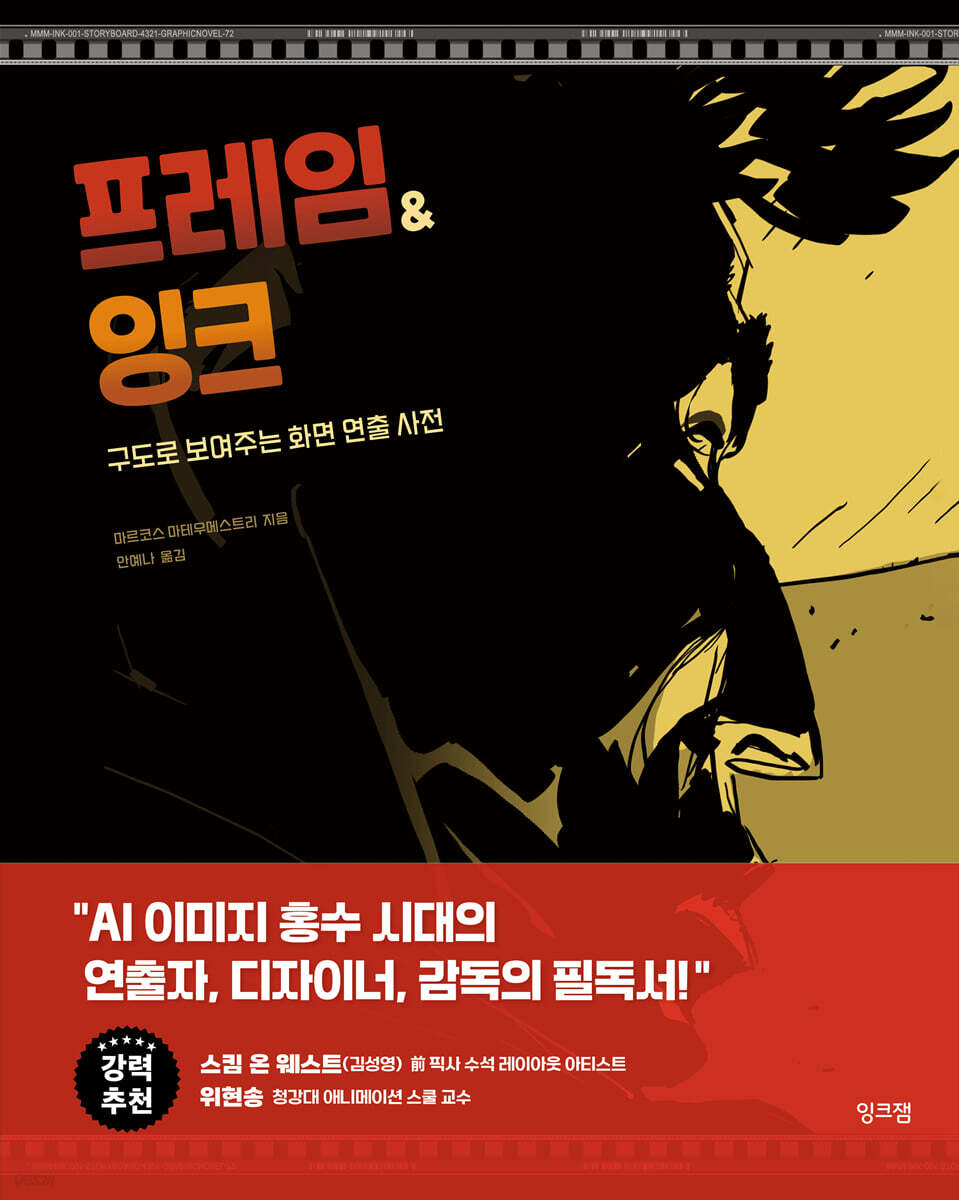
Frame & Ink
 |
Description
Book Introduction
One frame
The key to success in visual storytelling
“You’d be hard-pressed to find a better teacher.” Frame & Ink is a masterclass in visual storytelling, as lauded by DreamWorks Animation CEO Jeffrey Katzenberg.
It contains the abundant know-how of veteran artist Marcos Mateumestri, who has been active in feature-length animation for over 30 years, including Balto, The Prince of Egypt, How to Train Your Dragon 2, and Puss in Boots: The Ultimate Adventure.
It covers a wide range of topics, from basic composition settings to changes in direction according to camera movement, expression of climax, and even the unique expression methods of graphic novels, and includes practical techniques proven in the field through collaborations with DreamWorks, Netflix, and Sony Pictures Animation.
It will serve as a solid mentor for creators in various fields, including movies, games, comics, webtoons, and graphic novels, in terms of visual expression and storytelling.
The key to success in visual storytelling
“You’d be hard-pressed to find a better teacher.” Frame & Ink is a masterclass in visual storytelling, as lauded by DreamWorks Animation CEO Jeffrey Katzenberg.
It contains the abundant know-how of veteran artist Marcos Mateumestri, who has been active in feature-length animation for over 30 years, including Balto, The Prince of Egypt, How to Train Your Dragon 2, and Puss in Boots: The Ultimate Adventure.
It covers a wide range of topics, from basic composition settings to changes in direction according to camera movement, expression of climax, and even the unique expression methods of graphic novels, and includes practical techniques proven in the field through collaborations with DreamWorks, Netflix, and Sony Pictures Animation.
It will serve as a solid mentor for creators in various fields, including movies, games, comics, webtoons, and graphic novels, in terms of visual expression and storytelling.
- You can preview some of the book's contents.
Preview
index
Recommendation 11
Entering 15
Chapter 1: What is Narrative Art? 17
18 Things You Need for Visual Storytelling
To draw people into the world of your work, you need 18
Maintain consistency with the overall tone of the story 19
Don't just say it, make them feel it 19
Chapter 2 Drawing Individual Cuts and Composition Basics 21
Mood 22
Lighting 23
24 Reasons Why Chiaroscuro Is Necessary
Let's take a good look around 25
28 Things to Consider Before Setting Up a Composition
The Importance of Lenses 32
Chapter 3 Narrative-Driven Shot Composition 37
Setting the basic composition comes first 38
PART 1: 40 Visual Messages in Still Composition
Restaurant (general case) 40
Setting Shot 42
Bringing Movement to a Scene 43
Pressure and helplessness 44
Intense Up Shot 45
Utilizing Negative Space 46
Order and Chaos 48
Complexity and Simplicity 49
Big and small 50
Angular and round shapes 51
The effect of suggesting the whole through a part 52
Large, medium, small 53
Landscape as a Person 54
Hiding and Revealing (Emotional Issues) 55
Unnatural Composition 56
Point of View Shot 57
Day and Night 58
Maintaining Focus 59
Gradual size change 60
Knowing and Not Knowing (Intercutting) 61
Exploiting Outside Your Main Interests 62
Action Shot 63
PART 2: Composition and Expression through Movement 64
Intention of Camera Movement 64
Horizontal Panning (Train Station) 64
Vertical Panning (Grand Shot) 66
Mood Change (A Man's Visit) 68
Reveal (New World) 70
Camera Fixed (Travelers' Dinner) 72
Camera Fixed (Encounter in the Desert) 74
Chapter 4 Screen Composition for Scene Connection 77
Think in terms of continuity 79
Why Create a Climax? 79
80 Trains viewed from the side heading to the climax 1
Heading to Climax 2 A Train Approaching from a Distance 82
How to Convey a Different Message with the Same Element 84
84 when the Cowboy 1 camera is fixed in the same position
Cowboy 2 When the camera position was changed with intention 87
How to Convey a Completely Different Message by Changing Perspectives 88
Bikers' first stop: The Mysterious House 88
Bikers' Second Location: Attic Gang 91
What is the 180-degree rule? 93
Chapter 5 Graphic Novel 97
Introduction 98
PART 1 CHARACTER DESIGN 99
Head Silhouette 100
Full body silhouette 104
Facial Expressions 106
Body Expression 108
PART 2 Column and Page Structure 111
Divide by 112
Page Layout 115
Speech Bubbles and Onomatopoeia 120
In conclusion 123
Search 130
Entering 15
Chapter 1: What is Narrative Art? 17
18 Things You Need for Visual Storytelling
To draw people into the world of your work, you need 18
Maintain consistency with the overall tone of the story 19
Don't just say it, make them feel it 19
Chapter 2 Drawing Individual Cuts and Composition Basics 21
Mood 22
Lighting 23
24 Reasons Why Chiaroscuro Is Necessary
Let's take a good look around 25
28 Things to Consider Before Setting Up a Composition
The Importance of Lenses 32
Chapter 3 Narrative-Driven Shot Composition 37
Setting the basic composition comes first 38
PART 1: 40 Visual Messages in Still Composition
Restaurant (general case) 40
Setting Shot 42
Bringing Movement to a Scene 43
Pressure and helplessness 44
Intense Up Shot 45
Utilizing Negative Space 46
Order and Chaos 48
Complexity and Simplicity 49
Big and small 50
Angular and round shapes 51
The effect of suggesting the whole through a part 52
Large, medium, small 53
Landscape as a Person 54
Hiding and Revealing (Emotional Issues) 55
Unnatural Composition 56
Point of View Shot 57
Day and Night 58
Maintaining Focus 59
Gradual size change 60
Knowing and Not Knowing (Intercutting) 61
Exploiting Outside Your Main Interests 62
Action Shot 63
PART 2: Composition and Expression through Movement 64
Intention of Camera Movement 64
Horizontal Panning (Train Station) 64
Vertical Panning (Grand Shot) 66
Mood Change (A Man's Visit) 68
Reveal (New World) 70
Camera Fixed (Travelers' Dinner) 72
Camera Fixed (Encounter in the Desert) 74
Chapter 4 Screen Composition for Scene Connection 77
Think in terms of continuity 79
Why Create a Climax? 79
80 Trains viewed from the side heading to the climax 1
Heading to Climax 2 A Train Approaching from a Distance 82
How to Convey a Different Message with the Same Element 84
84 when the Cowboy 1 camera is fixed in the same position
Cowboy 2 When the camera position was changed with intention 87
How to Convey a Completely Different Message by Changing Perspectives 88
Bikers' first stop: The Mysterious House 88
Bikers' Second Location: Attic Gang 91
What is the 180-degree rule? 93
Chapter 5 Graphic Novel 97
Introduction 98
PART 1 CHARACTER DESIGN 99
Head Silhouette 100
Full body silhouette 104
Facial Expressions 106
Body Expression 108
PART 2 Column and Page Structure 111
Divide by 112
Page Layout 115
Speech Bubbles and Onomatopoeia 120
In conclusion 123
Search 130
Detailed image

Publisher's Review
A practical guide packed with 30 years of Hollywood know-how.
Only by penetrating the essence of narrative can true creation begin!
Visual storytelling is a method of effectively expressing emotions, mood, and a character's psychological state through visual elements such as camera angles, composition, lighting, background, and color.
If you're a creator struggling to properly convey your story's intent to the viewer during the creative process, you'll find surprising inspiration and solutions in this book.
This book is broadly divided into five parts: the basic concepts of narrative art, the basics of drawing and composition of individual cuts, composing shots centered on the narrative, composing screens for connecting scenes, and graphic novels.
As a veteran animator and illustrator who has taught visual storytelling for over a decade, the author conveys the core principles of making readers "feel the story while reading it."
What sets this book apart is that it provides clear guidance on directing methods for characters, lighting, locations, backgrounds, camera movements, etc. through specific frame example illustrations.
Additionally, you can grasp the flow and light and shade within the frame at a glance through simplified thumbnails with shapes and lines, and effectively set the basic composition.
It helps to construct a narrative-centered frame through various methods such as establishing shots that establish the work's worldview, strong up shots that create a sense of oppression, the use of negative space, conveying messages through contrasting shapes, and setting up foreshadowing through unnatural composition.
From movies to webtoons, it applies to all genres.
Professional creative techniques that achieve both speed and quality
Since its first publication in the United States, this book has been consistently loved and translated into many countries, including Canada, the United Kingdom, France, Germany, and Japan. The true strength of this book lies in its 'universality' that transcends genre.
One of them is a specific scene analysis based on a hypothetical scenario.
It systematically guides you through placing characters in various settings such as restaurants, train stations, deserts, ships, and cabins, and expressing how to express when the subject moves and the composition changes, and when the subject remains fixed and only the camera moves.
Creators who have struggled with shifting perspectives, connecting scenes, or especially adapting to the rhythm of a narrative will find practical solutions in this book.
Another versatility of this book is that it covers not only productions featuring real-life or realistic characters, but also graphic novels.
A separate chapter on graphic novels covers the basics of character design, paneling, page layout, and more, exploring similarities and differences with what you've learned before.
The author emphasizes that “as an artist, you must clearly know what you want to say and what you must say.”
Accordingly, this book goes beyond simply listing techniques; it offers a method for quickly and accurately translating abstract ideas into concrete form.
Discover practical visual storytelling techniques that have been praised by global readers through this book.
Only by penetrating the essence of narrative can true creation begin!
Visual storytelling is a method of effectively expressing emotions, mood, and a character's psychological state through visual elements such as camera angles, composition, lighting, background, and color.
If you're a creator struggling to properly convey your story's intent to the viewer during the creative process, you'll find surprising inspiration and solutions in this book.
This book is broadly divided into five parts: the basic concepts of narrative art, the basics of drawing and composition of individual cuts, composing shots centered on the narrative, composing screens for connecting scenes, and graphic novels.
As a veteran animator and illustrator who has taught visual storytelling for over a decade, the author conveys the core principles of making readers "feel the story while reading it."
What sets this book apart is that it provides clear guidance on directing methods for characters, lighting, locations, backgrounds, camera movements, etc. through specific frame example illustrations.
Additionally, you can grasp the flow and light and shade within the frame at a glance through simplified thumbnails with shapes and lines, and effectively set the basic composition.
It helps to construct a narrative-centered frame through various methods such as establishing shots that establish the work's worldview, strong up shots that create a sense of oppression, the use of negative space, conveying messages through contrasting shapes, and setting up foreshadowing through unnatural composition.
From movies to webtoons, it applies to all genres.
Professional creative techniques that achieve both speed and quality
Since its first publication in the United States, this book has been consistently loved and translated into many countries, including Canada, the United Kingdom, France, Germany, and Japan. The true strength of this book lies in its 'universality' that transcends genre.
One of them is a specific scene analysis based on a hypothetical scenario.
It systematically guides you through placing characters in various settings such as restaurants, train stations, deserts, ships, and cabins, and expressing how to express when the subject moves and the composition changes, and when the subject remains fixed and only the camera moves.
Creators who have struggled with shifting perspectives, connecting scenes, or especially adapting to the rhythm of a narrative will find practical solutions in this book.
Another versatility of this book is that it covers not only productions featuring real-life or realistic characters, but also graphic novels.
A separate chapter on graphic novels covers the basics of character design, paneling, page layout, and more, exploring similarities and differences with what you've learned before.
The author emphasizes that “as an artist, you must clearly know what you want to say and what you must say.”
Accordingly, this book goes beyond simply listing techniques; it offers a method for quickly and accurately translating abstract ideas into concrete form.
Discover practical visual storytelling techniques that have been praised by global readers through this book.
GOODS SPECIFICS
- Date of issue: September 10, 2025
- Page count, weight, size: 130 pages | 880g | 215*280*20mm
- ISBN13: 9788979294613
- ISBN10: 8979294611
You may also like
카테고리
korean


korean

![GQ KOREA Mark (Monthly): December [2025]](http://librairie.coreenne.fr/cdn/shop/files/8ef265dbbfbf186523ed75ba7319009d.jpg?v=1765340328&width=3840)


