

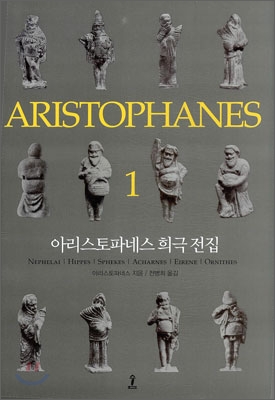
Aristophanes' Complete Comedies, Vol. 1
 |
Description
Book Introduction
The first complete Korean translation of Aristophanes' masterpiece
When it comes to Greek comedy, Aristophanes cannot be mentioned.
Born in Athens in the 5th century BC, Aristophanes earned the title of the greatest comic poet of ancient Greece for his sharp satire embedded in his witty wit.
With a sharp pen, he vividly wrote criticisms of politics and academia in the form of comedy, providing contemporary Greeks with an opportunity to examine society anew through satire and humor.
And even after several centuries, the tip of his pen reflects the reality of the world with a sharpness that has not dulled.
When it comes to Greek comedy, Aristophanes cannot be mentioned.
Born in Athens in the 5th century BC, Aristophanes earned the title of the greatest comic poet of ancient Greece for his sharp satire embedded in his witty wit.
With a sharp pen, he vividly wrote criticisms of politics and academia in the form of comedy, providing contemporary Greeks with an opportunity to examine society anew through satire and humor.
And even after several centuries, the tip of his pen reflects the reality of the world with a sharpness that has not dulled.
- You can preview some of the book's contents.
Preview
index
Note
Translator's Preface: Aristophanes, the Greatest Comedian in World Literature
cloud
article
punishment
Acharnai district residents
peace
bird
Translator's Preface: Aristophanes, the Greatest Comedian in World Literature
cloud
article
punishment
Acharnai district residents
peace
bird
Publisher's Review
The ancient Greeks created not only tragedy but also comedy.
Comedy, as a dramatic form intended to make the audience laugh, like tragedy, dates back to ancient Greece.
In the late 5th century BC, Greece reached the peak of its military, economic, and diplomatic power under the rule of Pericles.
Culturally, the essence of tragedy was produced, such as Aeschylus' Oresteia trilogy around 458 and Sophocles' Oedipus the King in 435.
After the death of Pericles in 429, defeat in the Peloponnesian War, and the death of Socrates, democratic Greece gradually fell into the shadow of Sparta and Persia, and was unable to flourish until it was conquered by Philip II of Macedon.
Aristophanes, who lived in Athens from 445 to 385 BC, wrote comedies filled with nostalgia for ancient Greece as he observed its declining glory.
During the golden age of Athens, the activities of tragedians who reflected on sorrow (Aeschylus, Sophocles, Euripides) shone, while during a time of public unrest, the masterpieces of Aristophanes, a representative comedian who satirized the self-portrait of the times, poured out, and comedy became established as a literary genre.
Of the 44 comedies of Aristophanes, 11 remain, and the first complete translation of all 11 plays in Korea, “The Complete Works of Aristophanes Comedy” 1, 2 (translated by Cheon Byeong-hee/Soop Publishing Co.) has been published.
Aristophanes, the founder of satire who focused on the function of laughter
The joy of humor comes when proper norms and serious values are challenged and the hierarchical order is reversed.
In the realm of humor, formal order is distorted and serious and solemn characters act foolishly.
So, let's meet Aristophanes, an ancient Greek who focused on the functions of laughter and satire.
Born the son of a wealthy family, he was raised and educated in the prosperous middle class of Athens.
However, as Athens fought the Peloponnesian War, a new order and new learning emerged, and the simple, stable, and moral Athens was rapidly changing.
Seeing the public's unrest, the conservative Aristophanes wrote comedies that ridiculed anyone he thought had a detrimental influence on the community, including the new-style education of the Sophists.
The era in which he was born did not know the concerns of morality or face.
So his words were direct, he didn't hide his swearing, and he didn't hesitate to use obscenities.
Despite his lively dialogue, his spiteful yet refreshing satire that the public longs for, and his endless imagination, Aristophanes adopted consistent dramatic action and added his own arguments to the dramatic action.
Unlike tragedies, which consistently deal with solemn and extremely serious stories of gods and heroes, Aristophanes' comedies were based on realistic life of the time and presented audiences with laughter based on actual events, providing an opportunity to examine society in a new way.
Aristophanes, who focused on the powerful function of laughter, earned the title of the greatest comic poet of ancient Greece with his ingenious wit and sharp satire.
Plato presented a literary monument by featuring Aristophanes in the Symposium and the Apology.
cloud
In this work, Socrates, a philosopher whose beliefs no one can deny today, is put on the chopping block and becomes a cruel object of ridicule.
Socrates, depicted in 'The Clouds' (422 BC), is not a great philosopher, but a pseudo-teacher who teaches how to reverse right and wrong with wordplay for money.
The protagonist, Strepsiades, is trying to figure out a way to repay the debt he owes his son, who is obsessed with chariot racing. He is fascinated by Socrates's horsemanship and sends his son to Socrates' academy.
Thanks to his son's enlightenment, he is able to avoid his creditors, but soon the tables are turned and Strepsiades, enraged by the son's attack on his father and denial of Zeus using the same logic, sets Socrates's library on fire.
article
'The Knight Hippeis' (424 BC) attacks the demagogue Cleon through allegory.
In this work, Cleon is a slave who is favored by his foolish and short-tempered master, Demos (meaning 'the people'), and rises to a position of influence and power, but is replaced by a blood sausage vendor who is far more villainous and shameless.
The two compete to win Demos' favor, using flattery, bribery, and mutual slander.
The two then go to the parliament and have the same competition, but the sundae vendor wins and is eventually kicked out.
Although he was harshly retaliated against for harshly ridiculing Cleon, the man in power at the time, Aristophanes continued to make sharp comments about society, showing that he was not only exceptionally witty but also had a wide range of opinions.
punishment
'Sphkes' (422 BC) satirizes the Athenian penchant for taunting through the eyes of an old juror named Philocleon (meaning 'the lover of Cleon').
Philocleon's son, Bdellycleon (meaning 'the one who hates Cleon'), plans to hold a 'court' for his father at home.
However, the first 'case' heard in this court was a case where a family dog was accused of stealing a piece of cheese.
Philocleon falls for his son's ruse and acquits the dog, the first defendant he has ever acquitted.
Philocleon, despite his passion for the court, cannot abandon his rough and violent attitude and his inconsiderate attitude towards others.
French classical playwright Racine's 'The Litigation Mania' is a copy of this work.
Acharnai district residents
'Acharnes' (425 BC) is the oldest of the eleven poems and satirizes the folly of war head-on.
As the play begins, a farmer named Dikaiopolis is waiting for the assembly to convene, longing for the peaceful old days.
Then, Amphiotheos, sent by the gods to conclude a truce with Sparta, appears, but he has no money for travel.
The protagonist pays him for his travel expenses and orders him to conclude a private truce between himself and Sparta.
Despite fierce opposition from the belligerent and hostile Acharnian population, he concludes a private peace treaty.
The work contains two poignant and humorous scenes set in the private marketplace of Dikaiopolis, which illustrate the many benefits of peace.
One scene is of a poor Megara disguising her two daughters as pigs and selling them at the market rather than leaving them to starve at home.
Another scene is where a wealthy Boeotian, searching for something truly Athenian, buys the Athenian specialty, the "snake."
peace
After the Peloponnesian War had been going on for ten years, the atmosphere for peace negotiations began to ripen when Cleon and Brasidas, who had been the advocates of the belligerent policies of Athens and Sparta, were both killed.
'Eirn the Peace' (421 BC) was performed just ten days before the ratification of the Treaty of Nicias, which ended hostilities between Athens and Sparta for six years.
As the war continued and food became scarce, Trygaeus, a vinedresser, suffered greatly. He imitated Bellerophon, who tried to ascend to the sky on the winged horse Pegasus, by growing a dung beetle to an enormous size and traveling on it.
However, Zeus and the other gods went to another place because of the war between humans, and now 'War' is in charge of that place. When Hermes hears that 'War' has imprisoned 'Peace' deep in a cave, he rescues 'Peace' and takes her to Greece.
bird
'The Bird Ornithes' (414 BC) is a 'comedy of fantasy', but some scholars consider it to be a political satire, satirizing the Athenians' imperialist dreams that led them to embark on an ill-fated expedition to capture the Sicilian port city of Syracuse in 415 BC.
This fleet was destroyed in 413 BC, dealing a fatal blow to Athens, but the outcome was not yet decided.
Athenian escapists Peicetairos and Euelpides, disillusioned with the Athenian way of life and the frenzied fervor of the courts, seek out the newly transformed Tereus, hoping he can show them where to live.
When he doesn't like the place he recommends, Peysetairos makes an ingenious suggestion.
The idea is that the birds will join forces to build a castle city in the sky and rule over both humans and gods by intercepting the smoke of the sacrifices humans make to the gods.
Thus, they established the 'Cloud Country'.
This work is about the main characters leaving their hometowns and going in search of a 'land of peace'.
The Athenian audience of 414 BC would have been critical of their situation, as the protagonists decided to emigrate to establish a new nation where they could realize a new community and regain their true humanity, leaving behind a chaotic reality filled with controversy.
Comedy, as a dramatic form intended to make the audience laugh, like tragedy, dates back to ancient Greece.
In the late 5th century BC, Greece reached the peak of its military, economic, and diplomatic power under the rule of Pericles.
Culturally, the essence of tragedy was produced, such as Aeschylus' Oresteia trilogy around 458 and Sophocles' Oedipus the King in 435.
After the death of Pericles in 429, defeat in the Peloponnesian War, and the death of Socrates, democratic Greece gradually fell into the shadow of Sparta and Persia, and was unable to flourish until it was conquered by Philip II of Macedon.
Aristophanes, who lived in Athens from 445 to 385 BC, wrote comedies filled with nostalgia for ancient Greece as he observed its declining glory.
During the golden age of Athens, the activities of tragedians who reflected on sorrow (Aeschylus, Sophocles, Euripides) shone, while during a time of public unrest, the masterpieces of Aristophanes, a representative comedian who satirized the self-portrait of the times, poured out, and comedy became established as a literary genre.
Of the 44 comedies of Aristophanes, 11 remain, and the first complete translation of all 11 plays in Korea, “The Complete Works of Aristophanes Comedy” 1, 2 (translated by Cheon Byeong-hee/Soop Publishing Co.) has been published.
Aristophanes, the founder of satire who focused on the function of laughter
The joy of humor comes when proper norms and serious values are challenged and the hierarchical order is reversed.
In the realm of humor, formal order is distorted and serious and solemn characters act foolishly.
So, let's meet Aristophanes, an ancient Greek who focused on the functions of laughter and satire.
Born the son of a wealthy family, he was raised and educated in the prosperous middle class of Athens.
However, as Athens fought the Peloponnesian War, a new order and new learning emerged, and the simple, stable, and moral Athens was rapidly changing.
Seeing the public's unrest, the conservative Aristophanes wrote comedies that ridiculed anyone he thought had a detrimental influence on the community, including the new-style education of the Sophists.
The era in which he was born did not know the concerns of morality or face.
So his words were direct, he didn't hide his swearing, and he didn't hesitate to use obscenities.
Despite his lively dialogue, his spiteful yet refreshing satire that the public longs for, and his endless imagination, Aristophanes adopted consistent dramatic action and added his own arguments to the dramatic action.
Unlike tragedies, which consistently deal with solemn and extremely serious stories of gods and heroes, Aristophanes' comedies were based on realistic life of the time and presented audiences with laughter based on actual events, providing an opportunity to examine society in a new way.
Aristophanes, who focused on the powerful function of laughter, earned the title of the greatest comic poet of ancient Greece with his ingenious wit and sharp satire.
Plato presented a literary monument by featuring Aristophanes in the Symposium and the Apology.
cloud
In this work, Socrates, a philosopher whose beliefs no one can deny today, is put on the chopping block and becomes a cruel object of ridicule.
Socrates, depicted in 'The Clouds' (422 BC), is not a great philosopher, but a pseudo-teacher who teaches how to reverse right and wrong with wordplay for money.
The protagonist, Strepsiades, is trying to figure out a way to repay the debt he owes his son, who is obsessed with chariot racing. He is fascinated by Socrates's horsemanship and sends his son to Socrates' academy.
Thanks to his son's enlightenment, he is able to avoid his creditors, but soon the tables are turned and Strepsiades, enraged by the son's attack on his father and denial of Zeus using the same logic, sets Socrates's library on fire.
article
'The Knight Hippeis' (424 BC) attacks the demagogue Cleon through allegory.
In this work, Cleon is a slave who is favored by his foolish and short-tempered master, Demos (meaning 'the people'), and rises to a position of influence and power, but is replaced by a blood sausage vendor who is far more villainous and shameless.
The two compete to win Demos' favor, using flattery, bribery, and mutual slander.
The two then go to the parliament and have the same competition, but the sundae vendor wins and is eventually kicked out.
Although he was harshly retaliated against for harshly ridiculing Cleon, the man in power at the time, Aristophanes continued to make sharp comments about society, showing that he was not only exceptionally witty but also had a wide range of opinions.
punishment
'Sphkes' (422 BC) satirizes the Athenian penchant for taunting through the eyes of an old juror named Philocleon (meaning 'the lover of Cleon').
Philocleon's son, Bdellycleon (meaning 'the one who hates Cleon'), plans to hold a 'court' for his father at home.
However, the first 'case' heard in this court was a case where a family dog was accused of stealing a piece of cheese.
Philocleon falls for his son's ruse and acquits the dog, the first defendant he has ever acquitted.
Philocleon, despite his passion for the court, cannot abandon his rough and violent attitude and his inconsiderate attitude towards others.
French classical playwright Racine's 'The Litigation Mania' is a copy of this work.
Acharnai district residents
'Acharnes' (425 BC) is the oldest of the eleven poems and satirizes the folly of war head-on.
As the play begins, a farmer named Dikaiopolis is waiting for the assembly to convene, longing for the peaceful old days.
Then, Amphiotheos, sent by the gods to conclude a truce with Sparta, appears, but he has no money for travel.
The protagonist pays him for his travel expenses and orders him to conclude a private truce between himself and Sparta.
Despite fierce opposition from the belligerent and hostile Acharnian population, he concludes a private peace treaty.
The work contains two poignant and humorous scenes set in the private marketplace of Dikaiopolis, which illustrate the many benefits of peace.
One scene is of a poor Megara disguising her two daughters as pigs and selling them at the market rather than leaving them to starve at home.
Another scene is where a wealthy Boeotian, searching for something truly Athenian, buys the Athenian specialty, the "snake."
peace
After the Peloponnesian War had been going on for ten years, the atmosphere for peace negotiations began to ripen when Cleon and Brasidas, who had been the advocates of the belligerent policies of Athens and Sparta, were both killed.
'Eirn the Peace' (421 BC) was performed just ten days before the ratification of the Treaty of Nicias, which ended hostilities between Athens and Sparta for six years.
As the war continued and food became scarce, Trygaeus, a vinedresser, suffered greatly. He imitated Bellerophon, who tried to ascend to the sky on the winged horse Pegasus, by growing a dung beetle to an enormous size and traveling on it.
However, Zeus and the other gods went to another place because of the war between humans, and now 'War' is in charge of that place. When Hermes hears that 'War' has imprisoned 'Peace' deep in a cave, he rescues 'Peace' and takes her to Greece.
bird
'The Bird Ornithes' (414 BC) is a 'comedy of fantasy', but some scholars consider it to be a political satire, satirizing the Athenians' imperialist dreams that led them to embark on an ill-fated expedition to capture the Sicilian port city of Syracuse in 415 BC.
This fleet was destroyed in 413 BC, dealing a fatal blow to Athens, but the outcome was not yet decided.
Athenian escapists Peicetairos and Euelpides, disillusioned with the Athenian way of life and the frenzied fervor of the courts, seek out the newly transformed Tereus, hoping he can show them where to live.
When he doesn't like the place he recommends, Peysetairos makes an ingenious suggestion.
The idea is that the birds will join forces to build a castle city in the sky and rule over both humans and gods by intercepting the smoke of the sacrifices humans make to the gods.
Thus, they established the 'Cloud Country'.
This work is about the main characters leaving their hometowns and going in search of a 'land of peace'.
The Athenian audience of 414 BC would have been critical of their situation, as the protagonists decided to emigrate to establish a new nation where they could realize a new community and regain their true humanity, leaving behind a chaotic reality filled with controversy.
GOODS SPECIFICS
- Publication date: November 10, 2010
- Format: Hardcover book binding method guide
- Page count, weight, size: 527 pages | 791g | 160*230*35mm
- ISBN13: 9788991290389
- ISBN10: 8991290388
You may also like
카테고리
korean


korean

![GQ KOREA Mark (Monthly): December [2025]](http://librairie.coreenne.fr/cdn/shop/files/8ef265dbbfbf186523ed75ba7319009d.jpg?v=1765340328&width=3840)


