

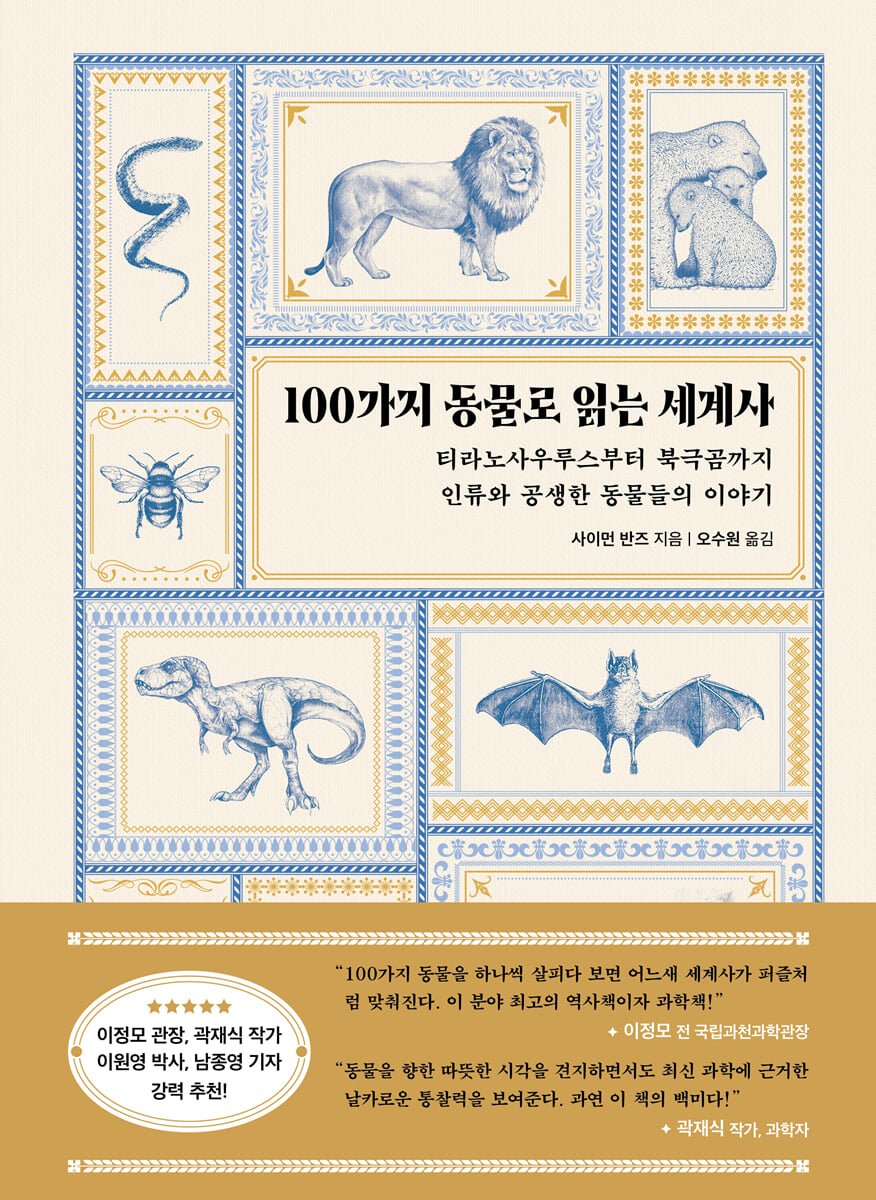
World History Through 100 Animals
 |
Description
Book Introduction
“Animals have been the protagonists of at least half of world history.”
We've only known 'half' of history so far.
Summoning animals marginalized throughout history
*** Highly recommended by Director Lee Jeong-mo, Writer Kwak Jae-sik, Dr. Lee Won-young, and Reporter Nam Jong-young!
*** An exclusive “Encyclopedia of Animal World History” featuring 200 colorful, high-quality images.
“If you examine each of the 100 animals, the history of the world will soon fit together like a puzzle.”
_Lee Jeong-mo, former director of the National Gwacheon Science Museum
“It maintains a warm perspective on animals while also providing sharp insights based on cutting-edge science.”
_Writer Kwak Jae-sik
Charles Darwin said this:
“The difference between humans and animals is great, but it is a quantitative difference, not a qualitative difference.” (The Descent of Man and Sexual Selection) For a long time, we thought that there was a ‘qualitative difference’ between humans and animals.
Humans and animals were defined as superior-inferior, dominant-subordinate, human-nonhuman, and animals were treated as inferior beings.
This is reflected in our view of history, which has consciously (or unconsciously) marginalized animals in world history.
But we humans are ultimately animals, just like dogs, cats, cows, fish, bees, and ticks.
Humans are vertebrates, mammals, and primates.
It is an ape that shares more than 98 percent of its DNA with chimpanzees.
Humans and animals are equal.
Now we must write a new history.
We must break away from a human-centered history.
History is inseparable from the 'non-human' animals that coexist on Earth.
Animals have been the main characters in at least half of world history.
This book boldly overturns the old dichotomous view of history that distinguishes between 'humans' and 'non-humans.'
The author has carefully selected 100 animals that have had a major impact on world history.
From Tyrannosaurus and Archaeopteryx to cockroaches and earthworms, we are bringing back to life the protagonists of history that we have neglected.
As you examine each of the 100 animals, world history will soon fit together like a puzzle.
Readers of this book will gain a new perspective on the animals that have coexisted with humans throughout history.
Moreover, we will have a valuable opportunity to explore ways to coexist with animals on Earth in the future.
The author, a former senior reporter for The Times of London, presents a uniquely warm perspective on each animal species in each of the 100 chapters, while also providing sharp insights based on the latest science.
As expected from a veteran reporter, his writing style stands out with its vivid sense of the scene and witty wit.
The knowledge and information covered are vast, spanning a total of 728 pages.
It achieves a grand integration of knowledge across the humanities and natural sciences.
It can be said to be a truly unique “encyclopedia of animal world history.”
It includes 200 colorful, high-quality images, adding to the visual pleasure of 'reading' the book.
For readers interested in animals and history, the environment and ecology, anthropology, and evolution, this book will be an excellent reference that they will want to read whenever they need it.
We've only known 'half' of history so far.
Summoning animals marginalized throughout history
*** Highly recommended by Director Lee Jeong-mo, Writer Kwak Jae-sik, Dr. Lee Won-young, and Reporter Nam Jong-young!
*** An exclusive “Encyclopedia of Animal World History” featuring 200 colorful, high-quality images.
“If you examine each of the 100 animals, the history of the world will soon fit together like a puzzle.”
_Lee Jeong-mo, former director of the National Gwacheon Science Museum
“It maintains a warm perspective on animals while also providing sharp insights based on cutting-edge science.”
_Writer Kwak Jae-sik
Charles Darwin said this:
“The difference between humans and animals is great, but it is a quantitative difference, not a qualitative difference.” (The Descent of Man and Sexual Selection) For a long time, we thought that there was a ‘qualitative difference’ between humans and animals.
Humans and animals were defined as superior-inferior, dominant-subordinate, human-nonhuman, and animals were treated as inferior beings.
This is reflected in our view of history, which has consciously (or unconsciously) marginalized animals in world history.
But we humans are ultimately animals, just like dogs, cats, cows, fish, bees, and ticks.
Humans are vertebrates, mammals, and primates.
It is an ape that shares more than 98 percent of its DNA with chimpanzees.
Humans and animals are equal.
Now we must write a new history.
We must break away from a human-centered history.
History is inseparable from the 'non-human' animals that coexist on Earth.
Animals have been the main characters in at least half of world history.
This book boldly overturns the old dichotomous view of history that distinguishes between 'humans' and 'non-humans.'
The author has carefully selected 100 animals that have had a major impact on world history.
From Tyrannosaurus and Archaeopteryx to cockroaches and earthworms, we are bringing back to life the protagonists of history that we have neglected.
As you examine each of the 100 animals, world history will soon fit together like a puzzle.
Readers of this book will gain a new perspective on the animals that have coexisted with humans throughout history.
Moreover, we will have a valuable opportunity to explore ways to coexist with animals on Earth in the future.
The author, a former senior reporter for The Times of London, presents a uniquely warm perspective on each animal species in each of the 100 chapters, while also providing sharp insights based on the latest science.
As expected from a veteran reporter, his writing style stands out with its vivid sense of the scene and witty wit.
The knowledge and information covered are vast, spanning a total of 728 pages.
It achieves a grand integration of knowledge across the humanities and natural sciences.
It can be said to be a truly unique “encyclopedia of animal world history.”
It includes 200 colorful, high-quality images, adding to the visual pleasure of 'reading' the book.
For readers interested in animals and history, the environment and ecology, anthropology, and evolution, this book will be an excellent reference that they will want to read whenever they need it.
- You can preview some of the book's contents.
Preview
index
introduction
001 Lion
002 Cat
003 Gorilla
004 Mimicking Blackbird
005 Buffalo
006 Flea
007 cow
008 Blue Whale
009 Coral
010 Eagle
011 Platypus
012 Bee
013 Tyrannosaurus
014 Shark
015 Cockroach
016 Panda
017 Daegu
018 White Heron
019 Dodo
020 Donkey
021 Wolf
022 Pigeon
023 Mosquito
024 Tiger
025 Rat
026 Wasp
027 Earthworm
028 Snake
029 Chicken
030 Monkey
031 Archaeopteryx
032 Housefly
033 dogs
034 Bear
035 Camel
036 Penguin
037 Octopus
038 Dolphin
039 Rhinoceros
040 Nightingale
041 Pig
042 Chimpanzee
043 Albatross
044 Passenger Pigeon
045 Tsetse fly
046 Duck
047 Kangaroo
048 Tasmanian devil
049 Crocodile
050 words
051 Owl
052 Seal
053 Bowerbird
054 Elephant
055 Piranha
056 White-crowned Crane
057 Spider
058 Silkworm
059 sheets
060 Pheasant
061 barnacle
062 Head lice
063 Crow
064 Bat
065 Backward Blight
066 Salmon
067 Oryx
068 sheep
069 Hawaiian Goose
070 Orangutan
071 Parrot
072 Colorado potato beetle
073 Grasshopper
074 Yangtze River Dolphin
075 Crane
076 Mammoth
077 Goat
078 Loa's disease
079 Duke
080 Goldfish
081 Canary
082 Reindeer
083 Turkey
084 Deer
085 Rabbit
086 Sparrow
087 Butterfly
088 Fruit fly
089 Saola
090 Giant Squid
091 Beaver
092 Guano cormorant
093 Mouse
094 Stork
095 Oyster
096 Jaguar
097 Pink Dove
098 Bakita
099 ants
100 polar bears
Epilogue
Search
Copyright holder of the illustration
Acknowledgements
001 Lion
002 Cat
003 Gorilla
004 Mimicking Blackbird
005 Buffalo
006 Flea
007 cow
008 Blue Whale
009 Coral
010 Eagle
011 Platypus
012 Bee
013 Tyrannosaurus
014 Shark
015 Cockroach
016 Panda
017 Daegu
018 White Heron
019 Dodo
020 Donkey
021 Wolf
022 Pigeon
023 Mosquito
024 Tiger
025 Rat
026 Wasp
027 Earthworm
028 Snake
029 Chicken
030 Monkey
031 Archaeopteryx
032 Housefly
033 dogs
034 Bear
035 Camel
036 Penguin
037 Octopus
038 Dolphin
039 Rhinoceros
040 Nightingale
041 Pig
042 Chimpanzee
043 Albatross
044 Passenger Pigeon
045 Tsetse fly
046 Duck
047 Kangaroo
048 Tasmanian devil
049 Crocodile
050 words
051 Owl
052 Seal
053 Bowerbird
054 Elephant
055 Piranha
056 White-crowned Crane
057 Spider
058 Silkworm
059 sheets
060 Pheasant
061 barnacle
062 Head lice
063 Crow
064 Bat
065 Backward Blight
066 Salmon
067 Oryx
068 sheep
069 Hawaiian Goose
070 Orangutan
071 Parrot
072 Colorado potato beetle
073 Grasshopper
074 Yangtze River Dolphin
075 Crane
076 Mammoth
077 Goat
078 Loa's disease
079 Duke
080 Goldfish
081 Canary
082 Reindeer
083 Turkey
084 Deer
085 Rabbit
086 Sparrow
087 Butterfly
088 Fruit fly
089 Saola
090 Giant Squid
091 Beaver
092 Guano cormorant
093 Mouse
094 Stork
095 Oyster
096 Jaguar
097 Pink Dove
098 Bakita
099 ants
100 polar bears
Epilogue
Search
Copyright holder of the illustration
Acknowledgements
Detailed image

Into the book
We tend to think of lions as having significance only in the distant past of our species.
Before agriculture began, before humans settled down, before civilization began.
A look at the historical distribution of lions reveals that this idea is a prejudice.
Lions were once wild beasts that lived in 'Europe'.
Surprisingly, lions were seen in Spain, France, Italy and Greece.
European lions lived in the Caucasus Mountains until the 10th century.
Lions have already been found in Turkey and across Asia, down to India.
The fact that lions have retreated from their habitat also means that humans have encroached on their habitat.
---From "001 Lion"
Corals are the largest builders in the animal kingdom.
The range and breadth of coral far exceeds that of humans.
The largest coral reef on Earth is the Great Barrier Reef off the coast of Queensland, Australia, stretching 2,300 kilometers.
It is famous for being visible from space.
The Great Barrier Reef consists of approximately 2,900 coral reef communities spread over an area of 344,400 square kilometers.
A fierce competition to build the tallest building took place around the world, a competition that Freud would have dismissed as a foolish competition driven by the Oedipus complex.
But humanity's efforts to show off its best architecture pale in comparison to the works of animals the size of a little finger.
---From "009 Coral"
The first Tyrannosaurus teeth were discovered in North America in 1874.
The vertebrae were discovered in 1892.
In 1900, paleontologist Barnum Brown discovered part of the skeleton in eastern Wyoming, and in 1902, he discovered it in the Hell Creek Formation of Montana (a Late Cretaceous and Paleocene formation in the western United States).
Another skeleton part was discovered in the last layer of the dinosaur era.
The fossil was named Tyrannosaurus in 1905.
This name is an achievement that reveals genius creativity.
The person who gave it its name was Henry Fairfield Osborn, a paleontologist and director of the American Museum of Natural History.
The mystery emanating from the dinosaur's name is also part of its charm.
All dinosaurs are known by their scientific names.
There is no common name that can be used to refer to dinosaurs.
The scientific name for the sparrow is Passer domesticus, but most people don't say that name.
However, the scientific name Tyrannosaurus rex is the name that everyone, whether scientists or ordinary people, calls it.
This difficult Latin comes out naturally.
It means 'King of Tyrant Lizards'.
---From "013 Tyrannosaurus"
So, what was the first animal humans willingly brought into their homes? The wolf.
We filled our homes and lives with wolves.
As a single species, the wolf is probably the most beloved animal on Earth by humans (see Chapter 21).
All domestic dogs are animals whose ancestors are wolves.
The scientific name for the wolf is Canis lupus.
The domestic dog is usually called Canis lupus familiaris, meaning 'friendly wolf'.
It's a somewhat different type of wolf.
We hug the wolf, let him lick us, and encourage the children to play together.
As a result, the domestic dog became the most widely distributed terrestrial carnivore on Earth (which means it is classified as a carnivore rather than a meat-eater).
Some consider the house dog to be the first domesticated animal.
There's a wolf over there.
Let's try growing it at home!
---From "033"
There is one animal that we look at while maintaining this fundamental contradiction.
It's a camel.
Camels are seen as ships of the desert, creatures optimized for moving through arid regions, but also as monsters created when too many sailors take the ship to the mountains, a clumsy and careless failure of nature.
Again, the truth is that evolution does not pursue perfection.
The idea that evolution progresses toward perfection is false.
Anyone who suffers from back pain due to walking with both feet on the ground with their soles pressed against the ground can easily understand this truth.
Evolution does not tend toward perfection, but it does not produce hopeless creatures either.
Evolution, as we have seen, is the process of producing life forms with the capacity to produce offspring.
Why haven't humans adapted to develop immunity to cancer? If they had, we'd be on the right track to perfection.
However, cancer is a disease that mostly strikes after a woman is old enough to have children.
Therefore, immunity to cancer is not a factor considered by natural selection.
This is the reality of evolution.
---From "035 Camel"
We've also learned quite a bit from captive chimpanzees.
The notion that language is a means of demonstrating human uniqueness has also been called into question by chimpanzees.
First, a chimpanzee named Washoe learned English sign language.
He has acquired at least 340 sign language words, some of which he has taught to his adopted son, Louis.
As soon as Warshaw saw the swan, he used sign language for "water" and then signed for "bird."
When I put the doll in Washo's glass of water, he started putting words together almost to form sentences.
The expression was 'baby in a cup'.
Another time, Warshaw said in sign language:
“You go out,” he said, signing to Warshaw, “Okay, but get dressed.”
Then the guy immediately put on his jacket.
One of Warshaw's teachers suffered a miscarriage and was unable to attend class for some time.
The teacher returned and informed Washoe in sign language.
“Our baby is dead.” Then Washoe signed the word for “cry.”
Then I traced the tear stains on the teacher's face with my hand.
This is a miraculous empathy that transcends the species.
Because chimpanzees don't cry.
---From "042 Chimpanzee"
Because language has been so important to humanity, word-related vocabulary is hidden like fossils throughout English expressions.
For example, it is like this.
“After doing the groundwork, I will take a breather.
If he is not too long in the tooth (the word "old" comes from the fact that as a horse ages, its gums recede, making its teeth appear longer - translator's note) and does not get winded (get the wind up), he will put someone through his paces (put someone through his paces - translator's note), and then he will have completely achieved his goal (home and dry).
I am sure that if he gets the bit between his teeth, he will be full of beans.
“I could give you more examples, but there’s no use in fumbling with a dead horse.”
---From "050 Words"
Hunting and gathering sustained early humans for countless centuries, but as civilization developed, we increasingly moved away from these activities.
Crops and livestock provided the wealthy with all their nutritional needs.
At this point, it became clear to everyone what had to be done.
It became clear what those with wealth and power should do.
It was hunting, of course.
Of all the animals a hunter could catch, the deer was by far the best.
It was also important to show the hunter's masculinity and nobility by catching a stag wearing a crown proudly.
The progress of civilization is ultimately a story of hunting.
Hunting for fun, not for necessity, hunting for social life, for exercise and display, hunting to display wealth and social status.
The primitive hunting that humans did to survive has now become a tool to show how truly civilized they are.
---From "084 Deer"
Beavers' earthworks also help humans manage water.
The traditional thinking about water management is to get rid of water as quickly as possible.
The key is to dredge rivers and create canals to allow rainwater to flow more quickly into the sea.
These measures cause flooding in vulnerable downstream areas and lead to water shortages during droughts.
Beavers released into a protected area in Devon, England, and closely monitored, have shown that their habitats help release more water during droughts and retain more water during floods.
Re-established forests upstream absorb water and release it slowly, reducing the risk of flooding downstream.
These systems work much better when beavers live in the reservoir.
---From "091 Beaver"
Climate change is not a new phenomenon.
Rapid climate change has occurred on Earth in the past.
The best example can be found in the Early Permian.
A series of volcanic eruptions (or meteor impacts) in Siberia 251 million years ago released carbon dioxide and methane.
This is a greenhouse gas.
As a result, the rainforests were completely destroyed, their beneficial effects were lost, and the soils where they once stood were weathered.
The ocean has lost its oxygen.
96 percent of all species that ever lived on Earth have gone extinct.
The good news is that the Earth is recovering.
The bad news is that it took 20 million years to recover.
So the polar bear of the 21st century is worth paying attention to.
The polar bear continues to swim in search of an island that is nowhere to be found.
We are all heading there.
Now I really have to do something.
Unlike the creatures living on Earth at the time of the Permian extinction event, we have a choice.
Whether or not we experience mass extinction today rests in our hands.
The very beginning of extinction itself began with us.
We can prevent extinction.
Conversely, it may cause extinction.
Greta Thunberg, a teenage Earth activist, put it simply:
“We still have time to turn everything around.
…but that short time will not last forever.”
Before agriculture began, before humans settled down, before civilization began.
A look at the historical distribution of lions reveals that this idea is a prejudice.
Lions were once wild beasts that lived in 'Europe'.
Surprisingly, lions were seen in Spain, France, Italy and Greece.
European lions lived in the Caucasus Mountains until the 10th century.
Lions have already been found in Turkey and across Asia, down to India.
The fact that lions have retreated from their habitat also means that humans have encroached on their habitat.
---From "001 Lion"
Corals are the largest builders in the animal kingdom.
The range and breadth of coral far exceeds that of humans.
The largest coral reef on Earth is the Great Barrier Reef off the coast of Queensland, Australia, stretching 2,300 kilometers.
It is famous for being visible from space.
The Great Barrier Reef consists of approximately 2,900 coral reef communities spread over an area of 344,400 square kilometers.
A fierce competition to build the tallest building took place around the world, a competition that Freud would have dismissed as a foolish competition driven by the Oedipus complex.
But humanity's efforts to show off its best architecture pale in comparison to the works of animals the size of a little finger.
---From "009 Coral"
The first Tyrannosaurus teeth were discovered in North America in 1874.
The vertebrae were discovered in 1892.
In 1900, paleontologist Barnum Brown discovered part of the skeleton in eastern Wyoming, and in 1902, he discovered it in the Hell Creek Formation of Montana (a Late Cretaceous and Paleocene formation in the western United States).
Another skeleton part was discovered in the last layer of the dinosaur era.
The fossil was named Tyrannosaurus in 1905.
This name is an achievement that reveals genius creativity.
The person who gave it its name was Henry Fairfield Osborn, a paleontologist and director of the American Museum of Natural History.
The mystery emanating from the dinosaur's name is also part of its charm.
All dinosaurs are known by their scientific names.
There is no common name that can be used to refer to dinosaurs.
The scientific name for the sparrow is Passer domesticus, but most people don't say that name.
However, the scientific name Tyrannosaurus rex is the name that everyone, whether scientists or ordinary people, calls it.
This difficult Latin comes out naturally.
It means 'King of Tyrant Lizards'.
---From "013 Tyrannosaurus"
So, what was the first animal humans willingly brought into their homes? The wolf.
We filled our homes and lives with wolves.
As a single species, the wolf is probably the most beloved animal on Earth by humans (see Chapter 21).
All domestic dogs are animals whose ancestors are wolves.
The scientific name for the wolf is Canis lupus.
The domestic dog is usually called Canis lupus familiaris, meaning 'friendly wolf'.
It's a somewhat different type of wolf.
We hug the wolf, let him lick us, and encourage the children to play together.
As a result, the domestic dog became the most widely distributed terrestrial carnivore on Earth (which means it is classified as a carnivore rather than a meat-eater).
Some consider the house dog to be the first domesticated animal.
There's a wolf over there.
Let's try growing it at home!
---From "033"
There is one animal that we look at while maintaining this fundamental contradiction.
It's a camel.
Camels are seen as ships of the desert, creatures optimized for moving through arid regions, but also as monsters created when too many sailors take the ship to the mountains, a clumsy and careless failure of nature.
Again, the truth is that evolution does not pursue perfection.
The idea that evolution progresses toward perfection is false.
Anyone who suffers from back pain due to walking with both feet on the ground with their soles pressed against the ground can easily understand this truth.
Evolution does not tend toward perfection, but it does not produce hopeless creatures either.
Evolution, as we have seen, is the process of producing life forms with the capacity to produce offspring.
Why haven't humans adapted to develop immunity to cancer? If they had, we'd be on the right track to perfection.
However, cancer is a disease that mostly strikes after a woman is old enough to have children.
Therefore, immunity to cancer is not a factor considered by natural selection.
This is the reality of evolution.
---From "035 Camel"
We've also learned quite a bit from captive chimpanzees.
The notion that language is a means of demonstrating human uniqueness has also been called into question by chimpanzees.
First, a chimpanzee named Washoe learned English sign language.
He has acquired at least 340 sign language words, some of which he has taught to his adopted son, Louis.
As soon as Warshaw saw the swan, he used sign language for "water" and then signed for "bird."
When I put the doll in Washo's glass of water, he started putting words together almost to form sentences.
The expression was 'baby in a cup'.
Another time, Warshaw said in sign language:
“You go out,” he said, signing to Warshaw, “Okay, but get dressed.”
Then the guy immediately put on his jacket.
One of Warshaw's teachers suffered a miscarriage and was unable to attend class for some time.
The teacher returned and informed Washoe in sign language.
“Our baby is dead.” Then Washoe signed the word for “cry.”
Then I traced the tear stains on the teacher's face with my hand.
This is a miraculous empathy that transcends the species.
Because chimpanzees don't cry.
---From "042 Chimpanzee"
Because language has been so important to humanity, word-related vocabulary is hidden like fossils throughout English expressions.
For example, it is like this.
“After doing the groundwork, I will take a breather.
If he is not too long in the tooth (the word "old" comes from the fact that as a horse ages, its gums recede, making its teeth appear longer - translator's note) and does not get winded (get the wind up), he will put someone through his paces (put someone through his paces - translator's note), and then he will have completely achieved his goal (home and dry).
I am sure that if he gets the bit between his teeth, he will be full of beans.
“I could give you more examples, but there’s no use in fumbling with a dead horse.”
---From "050 Words"
Hunting and gathering sustained early humans for countless centuries, but as civilization developed, we increasingly moved away from these activities.
Crops and livestock provided the wealthy with all their nutritional needs.
At this point, it became clear to everyone what had to be done.
It became clear what those with wealth and power should do.
It was hunting, of course.
Of all the animals a hunter could catch, the deer was by far the best.
It was also important to show the hunter's masculinity and nobility by catching a stag wearing a crown proudly.
The progress of civilization is ultimately a story of hunting.
Hunting for fun, not for necessity, hunting for social life, for exercise and display, hunting to display wealth and social status.
The primitive hunting that humans did to survive has now become a tool to show how truly civilized they are.
---From "084 Deer"
Beavers' earthworks also help humans manage water.
The traditional thinking about water management is to get rid of water as quickly as possible.
The key is to dredge rivers and create canals to allow rainwater to flow more quickly into the sea.
These measures cause flooding in vulnerable downstream areas and lead to water shortages during droughts.
Beavers released into a protected area in Devon, England, and closely monitored, have shown that their habitats help release more water during droughts and retain more water during floods.
Re-established forests upstream absorb water and release it slowly, reducing the risk of flooding downstream.
These systems work much better when beavers live in the reservoir.
---From "091 Beaver"
Climate change is not a new phenomenon.
Rapid climate change has occurred on Earth in the past.
The best example can be found in the Early Permian.
A series of volcanic eruptions (or meteor impacts) in Siberia 251 million years ago released carbon dioxide and methane.
This is a greenhouse gas.
As a result, the rainforests were completely destroyed, their beneficial effects were lost, and the soils where they once stood were weathered.
The ocean has lost its oxygen.
96 percent of all species that ever lived on Earth have gone extinct.
The good news is that the Earth is recovering.
The bad news is that it took 20 million years to recover.
So the polar bear of the 21st century is worth paying attention to.
The polar bear continues to swim in search of an island that is nowhere to be found.
We are all heading there.
Now I really have to do something.
Unlike the creatures living on Earth at the time of the Permian extinction event, we have a choice.
Whether or not we experience mass extinction today rests in our hands.
The very beginning of extinction itself began with us.
We can prevent extinction.
Conversely, it may cause extinction.
Greta Thunberg, a teenage Earth activist, put it simply:
“We still have time to turn everything around.
…but that short time will not last forever.”
---From "100 Polar Bears"
Publisher's Review
We are not alone
Aren't animals living together?
“We are not alone.
You are not alone in space.
You are not alone on Earth.
You are not alone in the wild.
Even in rural areas, you are not alone.
Even in the city, you are not alone.
You are not alone even at home.
You are not alone even in the bathtub or shower stall.
“Aren’t demodex mites living together on our facial skin?”
_From the "Preface"
Charles Darwin said this:
“The difference between humans and animals is great, but it is a quantitative difference, not a qualitative one.” (The Descent of Man and Sexual Selection) Darwin shattered a long-standing myth that had been fixed in our consciousness.
We used to think that there was an unbridgeable 'qualitative difference' between humans and animals.
Humans were not hesitant to believe that they were superior to animals and should therefore dominate them.
Anything 'inhuman' was considered inferior and not worth dealing with.
This consciousness was also reflected in the view of history.
Throughout history, animals have coexisted with humans, but we have 'naturally' alienated them.
Because animals are 'non-human' and not human.
But ultimately, we humans are animals, just like dogs, cats, cows, fish, bees, and ticks.
Humans are vertebrates, mammals, and primates.
It is an ape that shares more than 98 percent of its DNA with chimpanzees.
Humans and animals are equal.
marginalized from history
Summon the protagonist again
Now we must write a new history.
We must break away from the human-centered history that has marginalized animals.
History is inseparable from the 'non-human' animals that coexist on Earth.
In at least half of world history, animals have been the main characters.
This book boldly overturns the old dichotomous view of history that distinguishes between 'humans' and 'non-humans.'
In order to fully restore the half-truth of world history and to break away from the false dichotomous view of the world, we attempt a new historical narrative.
The author first carefully selected 100 animals.
Among the approximately 10 million species of animals, we have selected 100 animals that have had a significant impact on world history and have developed close relationships with humans.
From Tyrannosaurus and Archaeopteryx to cockroaches and earthworms, we are summoning back the protagonists of history that we have neglected.
As you examine each of the 100 animals, world history will soon fit together like a puzzle.
Readers of this book will gain a new perspective on the animals that have coexisted with humans throughout history.
Moreover, we will have a valuable opportunity to explore ways to coexist with animals on Earth in the future.
I want to take it out and read it anytime
Encyclopedia of Animal World History
The author of this book is a former senior journalist at The Times of London with 30 years of experience.
Now a bestselling author, his works are filled with a warm affection for animals and sparkling insight.
In particular, in 『World History Through 100 Animals』, the author's extensive knowledge and keen observation skills are on par with those of any scholar, and his writing style, which blends vivid realism with witty wit as befits a veteran journalist, stands out.
Each of the 100 chapters covers a specific animal species, maintaining a uniquely warm perspective while also providing sharp insights based on the latest science.
This book covers a vast amount of knowledge and information, spanning 728 pages.
It achieves a grand integration of knowledge across the humanities and natural sciences.
It can be said to be a truly unique “encyclopedia of animal world history.”
It includes 200 colorful, high-quality images, adding to the visual pleasure of 'reading' the book.
For readers interested in animals and history, the environment and ecology, anthropology, and evolution, this book will be an excellent reference that they will want to read whenever they need it.
Aren't animals living together?
“We are not alone.
You are not alone in space.
You are not alone on Earth.
You are not alone in the wild.
Even in rural areas, you are not alone.
Even in the city, you are not alone.
You are not alone even at home.
You are not alone even in the bathtub or shower stall.
“Aren’t demodex mites living together on our facial skin?”
_From the "Preface"
Charles Darwin said this:
“The difference between humans and animals is great, but it is a quantitative difference, not a qualitative one.” (The Descent of Man and Sexual Selection) Darwin shattered a long-standing myth that had been fixed in our consciousness.
We used to think that there was an unbridgeable 'qualitative difference' between humans and animals.
Humans were not hesitant to believe that they were superior to animals and should therefore dominate them.
Anything 'inhuman' was considered inferior and not worth dealing with.
This consciousness was also reflected in the view of history.
Throughout history, animals have coexisted with humans, but we have 'naturally' alienated them.
Because animals are 'non-human' and not human.
But ultimately, we humans are animals, just like dogs, cats, cows, fish, bees, and ticks.
Humans are vertebrates, mammals, and primates.
It is an ape that shares more than 98 percent of its DNA with chimpanzees.
Humans and animals are equal.
marginalized from history
Summon the protagonist again
Now we must write a new history.
We must break away from the human-centered history that has marginalized animals.
History is inseparable from the 'non-human' animals that coexist on Earth.
In at least half of world history, animals have been the main characters.
This book boldly overturns the old dichotomous view of history that distinguishes between 'humans' and 'non-humans.'
In order to fully restore the half-truth of world history and to break away from the false dichotomous view of the world, we attempt a new historical narrative.
The author first carefully selected 100 animals.
Among the approximately 10 million species of animals, we have selected 100 animals that have had a significant impact on world history and have developed close relationships with humans.
From Tyrannosaurus and Archaeopteryx to cockroaches and earthworms, we are summoning back the protagonists of history that we have neglected.
As you examine each of the 100 animals, world history will soon fit together like a puzzle.
Readers of this book will gain a new perspective on the animals that have coexisted with humans throughout history.
Moreover, we will have a valuable opportunity to explore ways to coexist with animals on Earth in the future.
I want to take it out and read it anytime
Encyclopedia of Animal World History
The author of this book is a former senior journalist at The Times of London with 30 years of experience.
Now a bestselling author, his works are filled with a warm affection for animals and sparkling insight.
In particular, in 『World History Through 100 Animals』, the author's extensive knowledge and keen observation skills are on par with those of any scholar, and his writing style, which blends vivid realism with witty wit as befits a veteran journalist, stands out.
Each of the 100 chapters covers a specific animal species, maintaining a uniquely warm perspective while also providing sharp insights based on the latest science.
This book covers a vast amount of knowledge and information, spanning 728 pages.
It achieves a grand integration of knowledge across the humanities and natural sciences.
It can be said to be a truly unique “encyclopedia of animal world history.”
It includes 200 colorful, high-quality images, adding to the visual pleasure of 'reading' the book.
For readers interested in animals and history, the environment and ecology, anthropology, and evolution, this book will be an excellent reference that they will want to read whenever they need it.
GOODS SPECIFICS
- Date of issue: March 31, 2023
- Format: Hardcover book binding method guide
- Page count, weight, size: 728 pages | 1,458g | 170*235*50mm
- ISBN13: 9791139710762
- ISBN10: 1139710761
You may also like
카테고리
korean


korean

![GQ KOREA Mark (Monthly): December [2025]](http://librairie.coreenne.fr/cdn/shop/files/8ef265dbbfbf186523ed75ba7319009d.jpg?v=1765340328&width=3840)


