

In a broken world, we
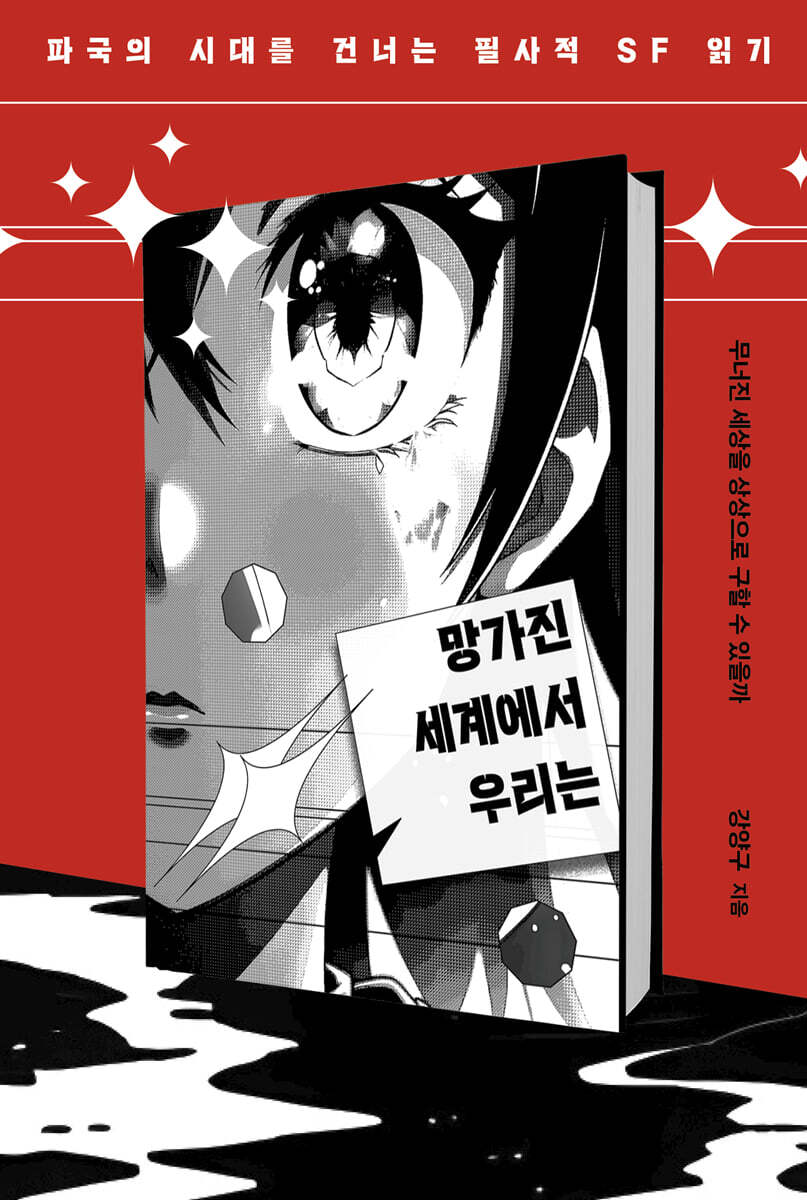 |
Description
Book Introduction
“If we keep going like this, we’ll all die!”
Extreme hatred, surveillance and control, climate catastrophe, pandemics…
Science fiction enters a world on the brink of destruction.
Humanity is going through a time of unprecedented upheaval.
We've entered an era where technology is redefining the world, with innovations in artificial intelligence and biotechnology. However, as the first 25 years of this century have passed, pessimism about the future has outpaced optimism.
Extreme inequality, escalating conflicts surrounding gender, religion, race, ethnicity, and preferences, the climate crisis unfolding as devastating disasters, and even extremism fueled by social media.
How should we envision the future of humanity in a collapsing world?
"In a Broken World, We" is an attempt to answer this question by borrowing the imagination of science fiction.
Kang Yang-gu, a long-time science fiction reader and science journalist, presents eighteen science fiction works, including Frankenstein, Brave New World, and 1984, based on the critical and reflective perspective of STS (Science, Technology, and Society), an academic discipline that examines the complex relationship between science, technology, and society.
Each work serves as a lens through which we examine, from various angles, the sharp issues raised by technological civilization, such as labor in the AI era, hyperconnectivity in the digital age, artificial wombs, and extraterrestrial intelligence. At the same time, it serves as a mirror, vividly illuminating the deep-rooted unconsciousness and inertia of our society, such as Western-centric dominant discourses, racism, the elderly, surveillance societies, inequality, and war. Using science fiction as a toolbox for imagination, this book reflects on human civilization and will serve as a guide for contemplating the future of science, technology, society, and, ultimately, humanity.
Extreme hatred, surveillance and control, climate catastrophe, pandemics…
Science fiction enters a world on the brink of destruction.
Humanity is going through a time of unprecedented upheaval.
We've entered an era where technology is redefining the world, with innovations in artificial intelligence and biotechnology. However, as the first 25 years of this century have passed, pessimism about the future has outpaced optimism.
Extreme inequality, escalating conflicts surrounding gender, religion, race, ethnicity, and preferences, the climate crisis unfolding as devastating disasters, and even extremism fueled by social media.
How should we envision the future of humanity in a collapsing world?
"In a Broken World, We" is an attempt to answer this question by borrowing the imagination of science fiction.
Kang Yang-gu, a long-time science fiction reader and science journalist, presents eighteen science fiction works, including Frankenstein, Brave New World, and 1984, based on the critical and reflective perspective of STS (Science, Technology, and Society), an academic discipline that examines the complex relationship between science, technology, and society.
Each work serves as a lens through which we examine, from various angles, the sharp issues raised by technological civilization, such as labor in the AI era, hyperconnectivity in the digital age, artificial wombs, and extraterrestrial intelligence. At the same time, it serves as a mirror, vividly illuminating the deep-rooted unconsciousness and inertia of our society, such as Western-centric dominant discourses, racism, the elderly, surveillance societies, inequality, and war. Using science fiction as a toolbox for imagination, this book reflects on human civilization and will serve as a guide for contemplating the future of science, technology, society, and, ultimately, humanity.
- You can preview some of the book's contents.
Preview
index
Entering and imagining in a broken world
Part 1: Reset: Overturning Our Society's Unconscious
01 Is Western Dominance a Historical Inevitability? _Kim Stanley Robinson, The Age of Rice and Salt
02 Are Old People Useless? _John Scalzi, "Old Man's War"
03 What good is a novel when the world is in ruins?_Emily St. John Mandel, Station Eleven
04 Is Race a Scientific Concept?_Octavia Butler, "Keene"
05 Would You Be Happy If You Live Forever?_Muneki Yamada, "The Hundred Year Law"
06 Rejecting Difference and Obsessing Over Purity_Kazuaki Takano's "Genocide"
Part 2: Exposing the Reality
07 Why You Should Always Protect Your Phone Password_Cory Doctorow, "Little Brother"
08 How Unrecorded Truths Become History_Ken Liu, "The People Who Put an End to History"
09 The City that Eats Cities_Philip Reeve's Mortal Engines
10 Ending the Forever War_Joe Haldeman, The Forever War
11 Fear the Blackout!_Mark Ellsberg, Blackout
12 What Happens When the Water Runs Off_Neal Shusterman and Jared Shusterman, Dry
Part 3: Experiment: Imagining a New World
Will We Be Happy in the AI Era? - Jang Kang-myeong, "We're Good Drivers, Too"
14 If I Could Read Other People's Minds_Connie Willis, Crosstalk
15 Are there aliens? Yes, they're under the sea! - John Wyndham, "Chokie"
16 If Humanity Had to Leave Earth_Neal Stephenson, Seveneves
If I Could Go Back in Time and Change History_Stephen King, 11/22/63
18. For Whom Is the Artificial Womb? - Sayaka Murata, "The Vanishing World"
Read together
Before this world falls apart, do something
A word of gratitude to my friends in a broken world.
Part 1: Reset: Overturning Our Society's Unconscious
01 Is Western Dominance a Historical Inevitability? _Kim Stanley Robinson, The Age of Rice and Salt
02 Are Old People Useless? _John Scalzi, "Old Man's War"
03 What good is a novel when the world is in ruins?_Emily St. John Mandel, Station Eleven
04 Is Race a Scientific Concept?_Octavia Butler, "Keene"
05 Would You Be Happy If You Live Forever?_Muneki Yamada, "The Hundred Year Law"
06 Rejecting Difference and Obsessing Over Purity_Kazuaki Takano's "Genocide"
Part 2: Exposing the Reality
07 Why You Should Always Protect Your Phone Password_Cory Doctorow, "Little Brother"
08 How Unrecorded Truths Become History_Ken Liu, "The People Who Put an End to History"
09 The City that Eats Cities_Philip Reeve's Mortal Engines
10 Ending the Forever War_Joe Haldeman, The Forever War
11 Fear the Blackout!_Mark Ellsberg, Blackout
12 What Happens When the Water Runs Off_Neal Shusterman and Jared Shusterman, Dry
Part 3: Experiment: Imagining a New World
Will We Be Happy in the AI Era? - Jang Kang-myeong, "We're Good Drivers, Too"
14 If I Could Read Other People's Minds_Connie Willis, Crosstalk
15 Are there aliens? Yes, they're under the sea! - John Wyndham, "Chokie"
16 If Humanity Had to Leave Earth_Neal Stephenson, Seveneves
If I Could Go Back in Time and Change History_Stephen King, 11/22/63
18. For Whom Is the Artificial Womb? - Sayaka Murata, "The Vanishing World"
Read together
Before this world falls apart, do something
A word of gratitude to my friends in a broken world.
Detailed image

Into the book
Since life itself is inseparable from science and technology, imagination based on science and technology overlaps with talking about life here and now.
Good science fiction pushes the imagination to its limits, breaking free from the constraints that govern and limit reality.
Also, such ‘anger’, ‘reflection’, and ‘escape’ stimulate us to imagine a life different from the present.
In that sense, if there is such a thing as a science fiction aesthetic, its core should be not a sense of wonder, but rather a sophisticated 'thought experiment'.
Science fiction should be the result of thought experiments that elaborately depict the world our desires and science and technology will bring us, and make us imagine whether that is the best possible scenario or whether there are other possibilities.
--- From "Entering: Imagining in a Broken World"
Among the scholars' opinions, the following are noteworthy:
The harsh cold environment, where it was difficult to survive, actually became a motivation for artistic activities.
In a difficult situation where people had to worry about tomorrow's survival, humanity had to find a reason for its existence in something unrelated to its immediate survival.
Surprisingly, artistic activities became the driving force of my life.
(…) Art activities were a way to celebrate their survival and dream of a better future.
Now, can you guess why Kirsten and her companions performed in a traveling troupe, and why the survivors enjoyed their performances? After the Fall, the survivors struggled to even sustain themselves (like their prehistoric ancestors).
The rare performances of traveling troupes must have been seen as a ritual that gave them meaning in life.
Of course, Kirsten and others shared that same aspiration, so they would have continued to lead extreme groups and wander around.
--- From "Chapter 3: What good is a novel when the world is in ruins"
In fact, there is a surprising secret behind Dana and Rufus's ill-fated relationship.
Why was Dana summoned to the 19th century every time Rufus's life was in danger? One of Dana's direct ancestors was Hager Wylin, born in 1831.
This is Rufus Wylin, the young white boy who was struggling in the river when Hager's father fell into the river.
(…) Does this passage seem strange? How can a black person be born to a white person? If you think about it, it's not that strange.
As humans migrated around the world (whether willingly or involuntarily), skin color changed for reasons other than sunlight and evolution.
This is because the skin colors of children born from relationships between people of different races (black-white, yellow-black, yellow-white, etc.) vary.
--- From "Chapter 4: Is Race a Scientific Concept?"
Did things change after Lillian and her family used a time travel device to return to the past and learn the truth about Unit 731? Quite the opposite.
Even though we have the opportunity to directly look into the truth of history, the controversy only grows.
Not only the Japanese government, but even many historians refute this.
"Can the accounts of the past, witnessed and recounted by a specific person like Lillian, be truly trustworthy?" "Truth cannot be guaranteed based solely on testimony unsupported by historical data." A historian in the novel firmly states this.
“We simply don’t have enough evidence to confidently describe everything that happened there.” As this backlash continues, Kirino and Way’s time travel, intended to return to the past and uncover the truth of history, is also banned.
And the truth about Unit 731 still remains shrouded in mystery.
--- From "Chapter 8: How Unrecorded Truth Becomes History"
The Manhattan Project, which aimed to end the war by creating the most horrific weapon the world had ever seen: the nuclear bomb, was a success.
But contrary to the expectations of scientists like Oppenheimer and Richard Feynman who participated in the project, the Cold War, which began immediately after the end of World War II, continued for decades until the fall of the Berlin Wall on November 9, 1989.
(…) Oppenheimer's legacy continues into the 21st century with the creation of nuclear bombs in the northern part of the Korean Peninsula.
So the idea of stopping war with a terrifying weapon that the other side does not have has effectively failed.
The best we can do is to do our best to prevent war.
Once a war starts, it becomes an eternal war.
Come to think of it, the Korean War isn't over yet (armistice).
--- From "Chapter 10: To End the Eternal War"
Humanity is literally on the edge of a precipice right now.
Conflicts arising from class, religion, and ethnicity are intensifying day by day.
In just half a century, we are snarling at each other, stockpiling nuclear bombs that could destroy the Earth several times over, and ultimately, we are even shaking the stability of the Earth's climate with all kinds of environmental destruction.
Given the reality before our eyes, will turning our eyes beyond Earth improve things? Humanity is struggling to maintain even our current civilization, let alone make contact with aliens living far into space.
Rather than pioneering space colonies, we are more likely to return to the Stone Age.
What about the circumstances of intelligent extraterrestrial life forms on the other side of the universe? If they, like humans, cultivate a civilization based on conflict rather than mutual empathy, wouldn't they be far more likely to self-destruct before they even reach the cosmos? On the other hand, after overcoming such trials and errors, achieving extraordinary civilizational achievements, and ultimately expanding their horizons to the cosmos, the mindset of extraterrestrials is bound to be extraordinary.
Choki is an example of such an alien.
--- From "Chapter 15: Are There Aliens? Yes, They're Under the Sea!"
Because pregnancy, childbirth, and childrearing play such an important role in women's lives, the image most associated with women today is 'mother' (myth of motherhood).
With these circumstances in mind, some argue that the reality that forces women to assume (traditional) maternal roles, such as care work, must change.
They welcome the artificial womb, which frees women from the burden of pregnancy and childbirth.
But there's no guarantee that things will always turn out that way.
Even now, there are many women who cannot become pregnant or refuse to give birth for various reasons.
If artificial wombs become commercially available, won't these women face social pressure to become mothers? What should we do if such blatant pressure arises: "You're not going to raise a child in your own womb anyway, so why refuse to have children?"
--- From "Chapter 18: For Whom Is the Artificial Womb?"
This is precisely where the value of reading science fiction that imagines a broken world lies.
Neither Aldous Huxley, George Orwell, Margaret Atwood, nor even Stephen King, who enjoys writing novels featuring demons and crazy murderers who wish for the world's downfall, wants the world to actually be ruined and humanity's future to be a dystopia (see Billy Summers and 11/22/63, mentioned in Chapter 17).
The very act of imagining a world in which these writers have broken down is actually an attempt to prevent such a world from ever occurring.
They are warm optimists, in that they encourage even a single reader to think, "Oh, the world shouldn't be this messed up," after reading science fiction, and to reflect, choose, and act. They also believe that if such movements begin one by one, the world can become a better place.
Good science fiction pushes the imagination to its limits, breaking free from the constraints that govern and limit reality.
Also, such ‘anger’, ‘reflection’, and ‘escape’ stimulate us to imagine a life different from the present.
In that sense, if there is such a thing as a science fiction aesthetic, its core should be not a sense of wonder, but rather a sophisticated 'thought experiment'.
Science fiction should be the result of thought experiments that elaborately depict the world our desires and science and technology will bring us, and make us imagine whether that is the best possible scenario or whether there are other possibilities.
--- From "Entering: Imagining in a Broken World"
Among the scholars' opinions, the following are noteworthy:
The harsh cold environment, where it was difficult to survive, actually became a motivation for artistic activities.
In a difficult situation where people had to worry about tomorrow's survival, humanity had to find a reason for its existence in something unrelated to its immediate survival.
Surprisingly, artistic activities became the driving force of my life.
(…) Art activities were a way to celebrate their survival and dream of a better future.
Now, can you guess why Kirsten and her companions performed in a traveling troupe, and why the survivors enjoyed their performances? After the Fall, the survivors struggled to even sustain themselves (like their prehistoric ancestors).
The rare performances of traveling troupes must have been seen as a ritual that gave them meaning in life.
Of course, Kirsten and others shared that same aspiration, so they would have continued to lead extreme groups and wander around.
--- From "Chapter 3: What good is a novel when the world is in ruins"
In fact, there is a surprising secret behind Dana and Rufus's ill-fated relationship.
Why was Dana summoned to the 19th century every time Rufus's life was in danger? One of Dana's direct ancestors was Hager Wylin, born in 1831.
This is Rufus Wylin, the young white boy who was struggling in the river when Hager's father fell into the river.
(…) Does this passage seem strange? How can a black person be born to a white person? If you think about it, it's not that strange.
As humans migrated around the world (whether willingly or involuntarily), skin color changed for reasons other than sunlight and evolution.
This is because the skin colors of children born from relationships between people of different races (black-white, yellow-black, yellow-white, etc.) vary.
--- From "Chapter 4: Is Race a Scientific Concept?"
Did things change after Lillian and her family used a time travel device to return to the past and learn the truth about Unit 731? Quite the opposite.
Even though we have the opportunity to directly look into the truth of history, the controversy only grows.
Not only the Japanese government, but even many historians refute this.
"Can the accounts of the past, witnessed and recounted by a specific person like Lillian, be truly trustworthy?" "Truth cannot be guaranteed based solely on testimony unsupported by historical data." A historian in the novel firmly states this.
“We simply don’t have enough evidence to confidently describe everything that happened there.” As this backlash continues, Kirino and Way’s time travel, intended to return to the past and uncover the truth of history, is also banned.
And the truth about Unit 731 still remains shrouded in mystery.
--- From "Chapter 8: How Unrecorded Truth Becomes History"
The Manhattan Project, which aimed to end the war by creating the most horrific weapon the world had ever seen: the nuclear bomb, was a success.
But contrary to the expectations of scientists like Oppenheimer and Richard Feynman who participated in the project, the Cold War, which began immediately after the end of World War II, continued for decades until the fall of the Berlin Wall on November 9, 1989.
(…) Oppenheimer's legacy continues into the 21st century with the creation of nuclear bombs in the northern part of the Korean Peninsula.
So the idea of stopping war with a terrifying weapon that the other side does not have has effectively failed.
The best we can do is to do our best to prevent war.
Once a war starts, it becomes an eternal war.
Come to think of it, the Korean War isn't over yet (armistice).
--- From "Chapter 10: To End the Eternal War"
Humanity is literally on the edge of a precipice right now.
Conflicts arising from class, religion, and ethnicity are intensifying day by day.
In just half a century, we are snarling at each other, stockpiling nuclear bombs that could destroy the Earth several times over, and ultimately, we are even shaking the stability of the Earth's climate with all kinds of environmental destruction.
Given the reality before our eyes, will turning our eyes beyond Earth improve things? Humanity is struggling to maintain even our current civilization, let alone make contact with aliens living far into space.
Rather than pioneering space colonies, we are more likely to return to the Stone Age.
What about the circumstances of intelligent extraterrestrial life forms on the other side of the universe? If they, like humans, cultivate a civilization based on conflict rather than mutual empathy, wouldn't they be far more likely to self-destruct before they even reach the cosmos? On the other hand, after overcoming such trials and errors, achieving extraordinary civilizational achievements, and ultimately expanding their horizons to the cosmos, the mindset of extraterrestrials is bound to be extraordinary.
Choki is an example of such an alien.
--- From "Chapter 15: Are There Aliens? Yes, They're Under the Sea!"
Because pregnancy, childbirth, and childrearing play such an important role in women's lives, the image most associated with women today is 'mother' (myth of motherhood).
With these circumstances in mind, some argue that the reality that forces women to assume (traditional) maternal roles, such as care work, must change.
They welcome the artificial womb, which frees women from the burden of pregnancy and childbirth.
But there's no guarantee that things will always turn out that way.
Even now, there are many women who cannot become pregnant or refuse to give birth for various reasons.
If artificial wombs become commercially available, won't these women face social pressure to become mothers? What should we do if such blatant pressure arises: "You're not going to raise a child in your own womb anyway, so why refuse to have children?"
--- From "Chapter 18: For Whom Is the Artificial Womb?"
This is precisely where the value of reading science fiction that imagines a broken world lies.
Neither Aldous Huxley, George Orwell, Margaret Atwood, nor even Stephen King, who enjoys writing novels featuring demons and crazy murderers who wish for the world's downfall, wants the world to actually be ruined and humanity's future to be a dystopia (see Billy Summers and 11/22/63, mentioned in Chapter 17).
The very act of imagining a world in which these writers have broken down is actually an attempt to prevent such a world from ever occurring.
They are warm optimists, in that they encourage even a single reader to think, "Oh, the world shouldn't be this messed up," after reading science fiction, and to reflect, choose, and act. They also believe that if such movements begin one by one, the world can become a better place.
--- From "Going Out: Anything Before This World Is Destroyed"
Publisher's Review
"SF has been STS SF from the beginning."
Reading science fiction that crosses science, technology, and society
Why science fiction? The author notes that science fiction is grounded in imagination, fueled by science and technology.
Today, science and technology are “constants, not variables” and “entities that influence every corner of our lives.”
In an era where science and technology act as structural forces that permeate our daily lives, the imagination built on top of them inevitably overlaps with our lives here and now.
Of course, if science fiction had simply been about reproducing the principles or theories of science and technology, it would have remained an isolated narrative within science.
However, science fiction always asks what changes the technology brings to humans, how humans live and how they change in the midst of those changes.
In "Old Man's War," the technology to revive an aged body through physical modification leads to questions about the meaning of the existence of the elderly, and in "The Vanishing World," the artificial womb completely shakes up the ethics of motherhood, family, and reproduction.
In "We Drive Well Too," the core question is not so much the transportation system of the autonomous driving era as who will determine the direction of automation technology and who will bear the cost of that change.
At the center of the story is always ‘humans’, not ‘technology’.
Kang Yang-gu, who has long reflected on the relationship between science, technology, and society, neither directly translates the voice of science nor is weighed down by its weight. Instead, he examines the inevitably shadowy shadows cast behind science and technology, while gradually overcoming the barriers of worldview to explore the complex problems and philosophical questions of our society.
The author's perspective, which has actively raised awareness of the issue of "democratic control" of science and technology and examined the social impact and meaning of science and technology in works such as "The Three-Wheel Science Bicycle" and "The Dignity of Science," continues in this book.
He says, “SF has been STS SF from the beginning,” and uses imagination based on science and technology as a starting point to boldly read reality across history, politics, economy, and culture.
Reset-Expose-Experiment!
A science fiction thought experiment that exposes the fiction of a broken world
In this book, science fiction becomes a tool for thought and a venue for elaborate thought experiments.
The author selects eighteen science fiction works under the three keywords of "reset," "exposure," and "experiment," and attempts to question the way the world works, which we have unthinkingly accepted, and to interpret reality with a new sensibility.
In addition, it broadens your reading horizons by introducing information that helps you understand each author's world of work and books that connect with the themes in the work.
Part 1, 'Reset', deals with works that boldly reset the social norms and values we have become accustomed to.
Is it natural for the West to dominate history? Are the elderly no longer useful to society? Is survival enough? Is the concept of race scientifically valid? Would we be happy if we lived forever without aging? Is difference dangerous and therefore ostracized? Six science fiction works—"The Age of Rice and Salt," "Old Man's War," "Station Eleven," "Keene," "The Hundred Year Law," and "Genocide"—start from these questions and sharply illuminate themes surrounding "Western-centrism," "old age," "survival and art," "racism," "lifespan," and "genocide."
The questions these works pose are a critical exploration of society's defaults, and in themselves serve as thought experiments for resetting.
Part 2, "Exposure," features works that persistently delve into the cracks in the social system we have believed in.
"Little Brother" exposes a society where digital surveillance has become routine, "The End of History" exposes the distorted truth of history amidst collective oblivion, and "Mortal Engines" exposes the structure of inequality, the greed of civilization and its destructive consequences.
"The Forever War" criticizes the nature of endless war by replacing the horrors of the Vietnam War with an endless space war with alien life forms, while "Blackout" and "Dry", through a blackout and a water shortage respectively, show in detail how fragile the foundation of human civilization is.
These six works capture the cracks in reality, shaking up familiar systems and senses to reveal truths we have not yet seen, becoming powerful exposés.
Part 3, "Experiments," examines six science fiction films that push current technology, science fiction, and social conditions to their limits.
These six works—"We Drive Well Too," "Crosstalk," "Choky," "Seven Eves," "11/22/63," and "Extinct World"—pose diverse questions based on AI, brain science, astrobiology, space science, time travel, and biotechnology. What if AI becomes a part of everyday life? What if technology that allows us to share others' emotions in real time becomes a reality? What if we encounter intelligent extraterrestrial life? What if humanity, on the brink of extinction, escapes into space? What if we could go back in time and prevent historical misfortunes? What if artificial wombs take the place of childbirth? These works unfold diverse scenarios, moving between the near future, a post-apocalyptic future, and historical scenes from the past.
The author closely examines how imagining alternative possibilities can reconstruct the future, presenting a three-dimensional reading that allows readers to appreciate the charm of thought experiments.
Imagine anything
Don't turn away from the truth
Don't let go of the questions until the very end!
We live in an age where disasters are repeated as if they were a daily occurrence.
From war and terrorism to various natural disasters and pandemics, the tragedies of violence and death that transcend borders are broadcast 24 hours a day through the media.
The painful reality on the screen is more bleak than the dystopia depicted in science fiction, but even that has become so familiar that it no longer resonates.
Beyond this reality of being numb to disaster, there lies an endless repetition of the collective unconscious that prevents us from exercising critical thinking.
The author recalls the insights of media critic Neil Postman in this gloomy landscape where pain and suffering are pitted against each other and reduced to entertainment.
“In ‘1984’, people are controlled by inflicting pain.
But in Brave New World, people are controlled by being showered with entertainment.
In short, Orwell feared that what we hate will destroy us.
Huxley feared that our obsession with what we like would ruin us.
“It was Huxley, not Orwell, who was right.”
- Neil Postman, Amusing Ourselves to Death
Neil Postman's prediction is becoming reality.
The deluge of information and entertainment and the resulting sensory numbness threaten democracy at its roots today.
In an era that already seems broken, what's the point of reimagining a "broken world"? The author argues that science fiction writers' imagining of catastrophe is "a desperate attempt to prevent such a world in advance."
Can they truly save a world shattered by imagination, as they hope? This book answers yes.
Even if today is the last day of the world, we must never stop imagining the 'next day', and let that imagination lead to social imagination.
That is the powerful force of science fiction.
Reading science fiction that crosses science, technology, and society
Why science fiction? The author notes that science fiction is grounded in imagination, fueled by science and technology.
Today, science and technology are “constants, not variables” and “entities that influence every corner of our lives.”
In an era where science and technology act as structural forces that permeate our daily lives, the imagination built on top of them inevitably overlaps with our lives here and now.
Of course, if science fiction had simply been about reproducing the principles or theories of science and technology, it would have remained an isolated narrative within science.
However, science fiction always asks what changes the technology brings to humans, how humans live and how they change in the midst of those changes.
In "Old Man's War," the technology to revive an aged body through physical modification leads to questions about the meaning of the existence of the elderly, and in "The Vanishing World," the artificial womb completely shakes up the ethics of motherhood, family, and reproduction.
In "We Drive Well Too," the core question is not so much the transportation system of the autonomous driving era as who will determine the direction of automation technology and who will bear the cost of that change.
At the center of the story is always ‘humans’, not ‘technology’.
Kang Yang-gu, who has long reflected on the relationship between science, technology, and society, neither directly translates the voice of science nor is weighed down by its weight. Instead, he examines the inevitably shadowy shadows cast behind science and technology, while gradually overcoming the barriers of worldview to explore the complex problems and philosophical questions of our society.
The author's perspective, which has actively raised awareness of the issue of "democratic control" of science and technology and examined the social impact and meaning of science and technology in works such as "The Three-Wheel Science Bicycle" and "The Dignity of Science," continues in this book.
He says, “SF has been STS SF from the beginning,” and uses imagination based on science and technology as a starting point to boldly read reality across history, politics, economy, and culture.
Reset-Expose-Experiment!
A science fiction thought experiment that exposes the fiction of a broken world
In this book, science fiction becomes a tool for thought and a venue for elaborate thought experiments.
The author selects eighteen science fiction works under the three keywords of "reset," "exposure," and "experiment," and attempts to question the way the world works, which we have unthinkingly accepted, and to interpret reality with a new sensibility.
In addition, it broadens your reading horizons by introducing information that helps you understand each author's world of work and books that connect with the themes in the work.
Part 1, 'Reset', deals with works that boldly reset the social norms and values we have become accustomed to.
Is it natural for the West to dominate history? Are the elderly no longer useful to society? Is survival enough? Is the concept of race scientifically valid? Would we be happy if we lived forever without aging? Is difference dangerous and therefore ostracized? Six science fiction works—"The Age of Rice and Salt," "Old Man's War," "Station Eleven," "Keene," "The Hundred Year Law," and "Genocide"—start from these questions and sharply illuminate themes surrounding "Western-centrism," "old age," "survival and art," "racism," "lifespan," and "genocide."
The questions these works pose are a critical exploration of society's defaults, and in themselves serve as thought experiments for resetting.
Part 2, "Exposure," features works that persistently delve into the cracks in the social system we have believed in.
"Little Brother" exposes a society where digital surveillance has become routine, "The End of History" exposes the distorted truth of history amidst collective oblivion, and "Mortal Engines" exposes the structure of inequality, the greed of civilization and its destructive consequences.
"The Forever War" criticizes the nature of endless war by replacing the horrors of the Vietnam War with an endless space war with alien life forms, while "Blackout" and "Dry", through a blackout and a water shortage respectively, show in detail how fragile the foundation of human civilization is.
These six works capture the cracks in reality, shaking up familiar systems and senses to reveal truths we have not yet seen, becoming powerful exposés.
Part 3, "Experiments," examines six science fiction films that push current technology, science fiction, and social conditions to their limits.
These six works—"We Drive Well Too," "Crosstalk," "Choky," "Seven Eves," "11/22/63," and "Extinct World"—pose diverse questions based on AI, brain science, astrobiology, space science, time travel, and biotechnology. What if AI becomes a part of everyday life? What if technology that allows us to share others' emotions in real time becomes a reality? What if we encounter intelligent extraterrestrial life? What if humanity, on the brink of extinction, escapes into space? What if we could go back in time and prevent historical misfortunes? What if artificial wombs take the place of childbirth? These works unfold diverse scenarios, moving between the near future, a post-apocalyptic future, and historical scenes from the past.
The author closely examines how imagining alternative possibilities can reconstruct the future, presenting a three-dimensional reading that allows readers to appreciate the charm of thought experiments.
Imagine anything
Don't turn away from the truth
Don't let go of the questions until the very end!
We live in an age where disasters are repeated as if they were a daily occurrence.
From war and terrorism to various natural disasters and pandemics, the tragedies of violence and death that transcend borders are broadcast 24 hours a day through the media.
The painful reality on the screen is more bleak than the dystopia depicted in science fiction, but even that has become so familiar that it no longer resonates.
Beyond this reality of being numb to disaster, there lies an endless repetition of the collective unconscious that prevents us from exercising critical thinking.
The author recalls the insights of media critic Neil Postman in this gloomy landscape where pain and suffering are pitted against each other and reduced to entertainment.
“In ‘1984’, people are controlled by inflicting pain.
But in Brave New World, people are controlled by being showered with entertainment.
In short, Orwell feared that what we hate will destroy us.
Huxley feared that our obsession with what we like would ruin us.
“It was Huxley, not Orwell, who was right.”
- Neil Postman, Amusing Ourselves to Death
Neil Postman's prediction is becoming reality.
The deluge of information and entertainment and the resulting sensory numbness threaten democracy at its roots today.
In an era that already seems broken, what's the point of reimagining a "broken world"? The author argues that science fiction writers' imagining of catastrophe is "a desperate attempt to prevent such a world in advance."
Can they truly save a world shattered by imagination, as they hope? This book answers yes.
Even if today is the last day of the world, we must never stop imagining the 'next day', and let that imagination lead to social imagination.
That is the powerful force of science fiction.
GOODS SPECIFICS
- Date of issue: July 10, 2025
- Page count, weight, size: 292 pages | 444g | 138*205*20mm
- ISBN13: 9791193378496
- ISBN10: 1193378494
You may also like
카테고리
korean


korean

![GQ KOREA Mark (Monthly): December [2025]](http://librairie.coreenne.fr/cdn/shop/files/8ef265dbbfbf186523ed75ba7319009d.jpg?v=1765340328&width=3840)


