

How to think mathematically
 |
Description
Book Introduction
A guide to improving your logical and analytical thinking skills!
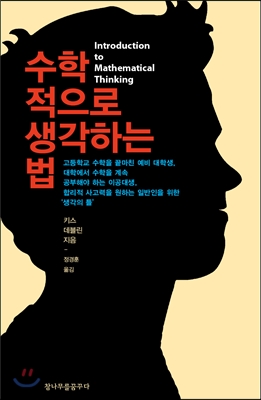
This is a book about 'thinking mathematically', not 'doing math'.
Doing mathematics often means performing difficult calculations using complex symbols and formulas.
However, thinking mathematically means understanding things that exist in the world logically, analytically, and quantitatively.
In other words, it means a framework for thinking with accuracy.
Not only mathematicians, but also scientists, engineers, etc. need to be good at mathematics.
So they learn everything they need to know to do this math through university level courses.
However, thinking mathematically as a precise framework for thinking is valuable for all of us living in the 21st century.
If you want to improve your logical, analytical, and quantitative thinking skills, and you have high school-level math skills, this book will help you improve them.
This is a book about 'thinking mathematically', not 'doing math'.
Doing mathematics often means performing difficult calculations using complex symbols and formulas.
However, thinking mathematically means understanding things that exist in the world logically, analytically, and quantitatively.
In other words, it means a framework for thinking with accuracy.
Not only mathematicians, but also scientists, engineers, etc. need to be good at mathematics.
So they learn everything they need to know to do this math through university level courses.
However, thinking mathematically as a precise framework for thinking is valuable for all of us living in the 21st century.
If you want to improve your logical, analytical, and quantitative thinking skills, and you have high school-level math skills, this book will help you improve them.
- You can preview some of the book's contents.
Preview
index
Translator's Note
introduction
What kind of book is this?
1.
What is mathematics?
1.1 More than arithmetic
1.2 Mathematical notation
1.3 University Level Modern Mathematics
1.4 Why should I learn this?
2.
To be precise in language
2.1 Mathematical propositions
2.2 Logical connectors 'is, or, not'
2.3 Meaning
2.4 Limiters
3.
proof
3.1 What is proof?
3.2 Proof by contradiction
3.3 Proving the conditional statement
3.4 Proving the finite proposition
3.5 Inductive proof
4.
Proving the result for numbers
4.1 Integer
4.2 Mistakes
4.3 Completeness
4.4 Sequence
supplement.
set theory
introduction
What kind of book is this?
1.
What is mathematics?
1.1 More than arithmetic
1.2 Mathematical notation
1.3 University Level Modern Mathematics
1.4 Why should I learn this?
2.
To be precise in language
2.1 Mathematical propositions
2.2 Logical connectors 'is, or, not'
2.3 Meaning
2.4 Limiters
3.
proof
3.1 What is proof?
3.2 Proof by contradiction
3.3 Proving the conditional statement
3.4 Proving the finite proposition
3.5 Inductive proof
4.
Proving the result for numbers
4.1 Integer
4.2 Mistakes
4.3 Completeness
4.4 Sequence
supplement.
set theory
Publisher's Review
A framework for thinking for freshmen in science and engineering colleges, prospective college students, and the general public!
This book is primarily intended for college freshmen who must study science, technology, engineering, and other science and engineering subjects, as well as high school students who wish to advance to science and engineering universities.
Many students face a number of challenges when transitioning from high school mathematics to college mathematics.
Even students who were good at math in high school fail at least once.
Because I've spent the past 12 years focusing on mastering computational procedures until I graduated from high school, I feel lost and lost in college math, which requires the ability to "think."
Of course, many capable students survive this transition, but many do not.
This book was written as a textbook for this very course.
However, this book is not just for students who wish to major in science and engineering.
This book will serve as a framework for more accurate thinking not only for those working in computer and engineering fields related to mathematics, but also for planners, policymakers, police officers, counselors, teachers, and designers.
A guide to help you break free from the frustration of feeling like it's impossible!
As a Stanford University professor and a leader in popularizing mathematics, the author strives to make this book accessible to anyone seeking to improve their logical and analytical thinking skills.
The author gets to the point as concisely as possible.
And about thinking mathematically, he says:
“Those who truly master mathematical thinking will be rewarded with benefits comparable to those accorded to 21st-century citizens.
In other words, mathematics, which was confusing, frustrating, and sometimes seemed impossible, becomes meaningful and difficult, but doable.”
For those who want to improve their mathematical thinking skills, this book will help them overcome the frustration of thinking something is impossible and gain the confidence that it is difficult but doable.
Author's advice to keep in mind before reading this book
-High school math is about solving problems, but college math is mostly about thinking.
-If you feel like things are getting more and more difficult, remember that it's because you're not motivated.
This book aims to provide a foundation for building mathematical thinking (math you don't know yet!).
There is no way to avoid the self-taught element in learning new ways of thinking.
-Focus on understanding new concepts and ideas.
-Don't rush.
There are very few new facts to learn, but much to understand.
-If you encounter any difficulties, consult with your colleagues or instructor.
Few people master major shifts in thinking on their own.
-If possible, study with others.
In high school, the focus is on solving problems, so you usually study alone. However, since this process is all about thinking, discussing what you have studied with others is a much better approach than studying alone.
Analyzing and critiquing your friends' proofs will greatly enhance your own learning and understanding.
-Don't try to finish quickly in any temple just because it seems easy at first.
This entire book covers the fundamentals required for all aspects of college mathematics.
-Don't give up.
Students around the world did it last year, and the year before that.
I did it a long time ago too.
Same goes for you!
-Oh, right.
One more time, don't rush.
-Remember.
The goal is to develop and understand new ways of thinking.
-Final advice: “Take your time.”
This book is primarily intended for college freshmen who must study science, technology, engineering, and other science and engineering subjects, as well as high school students who wish to advance to science and engineering universities.
Many students face a number of challenges when transitioning from high school mathematics to college mathematics.
Even students who were good at math in high school fail at least once.
Because I've spent the past 12 years focusing on mastering computational procedures until I graduated from high school, I feel lost and lost in college math, which requires the ability to "think."
Of course, many capable students survive this transition, but many do not.
This book was written as a textbook for this very course.
However, this book is not just for students who wish to major in science and engineering.
This book will serve as a framework for more accurate thinking not only for those working in computer and engineering fields related to mathematics, but also for planners, policymakers, police officers, counselors, teachers, and designers.
A guide to help you break free from the frustration of feeling like it's impossible!
As a Stanford University professor and a leader in popularizing mathematics, the author strives to make this book accessible to anyone seeking to improve their logical and analytical thinking skills.
The author gets to the point as concisely as possible.
And about thinking mathematically, he says:
“Those who truly master mathematical thinking will be rewarded with benefits comparable to those accorded to 21st-century citizens.
In other words, mathematics, which was confusing, frustrating, and sometimes seemed impossible, becomes meaningful and difficult, but doable.”
For those who want to improve their mathematical thinking skills, this book will help them overcome the frustration of thinking something is impossible and gain the confidence that it is difficult but doable.
Author's advice to keep in mind before reading this book
-High school math is about solving problems, but college math is mostly about thinking.
-If you feel like things are getting more and more difficult, remember that it's because you're not motivated.
This book aims to provide a foundation for building mathematical thinking (math you don't know yet!).
There is no way to avoid the self-taught element in learning new ways of thinking.
-Focus on understanding new concepts and ideas.
-Don't rush.
There are very few new facts to learn, but much to understand.
-If you encounter any difficulties, consult with your colleagues or instructor.
Few people master major shifts in thinking on their own.
-If possible, study with others.
In high school, the focus is on solving problems, so you usually study alone. However, since this process is all about thinking, discussing what you have studied with others is a much better approach than studying alone.
Analyzing and critiquing your friends' proofs will greatly enhance your own learning and understanding.
-Don't try to finish quickly in any temple just because it seems easy at first.
This entire book covers the fundamentals required for all aspects of college mathematics.
-Don't give up.
Students around the world did it last year, and the year before that.
I did it a long time ago too.
Same goes for you!
-Oh, right.
One more time, don't rush.
-Remember.
The goal is to develop and understand new ways of thinking.
-Final advice: “Take your time.”
GOODS SPECIFICS
- Date of issue: June 25, 2015
- Page count, weight, size: 212 pages | 254g | 210*130*20mm
- ISBN13: 9791195242016
- ISBN10: 1195242018
You may also like
카테고리
korean


korean

![GQ KOREA Mark (Monthly): December [2025]](http://librairie.coreenne.fr/cdn/shop/files/8ef265dbbfbf186523ed75ba7319009d.jpg?v=1765340328&width=3840)


