

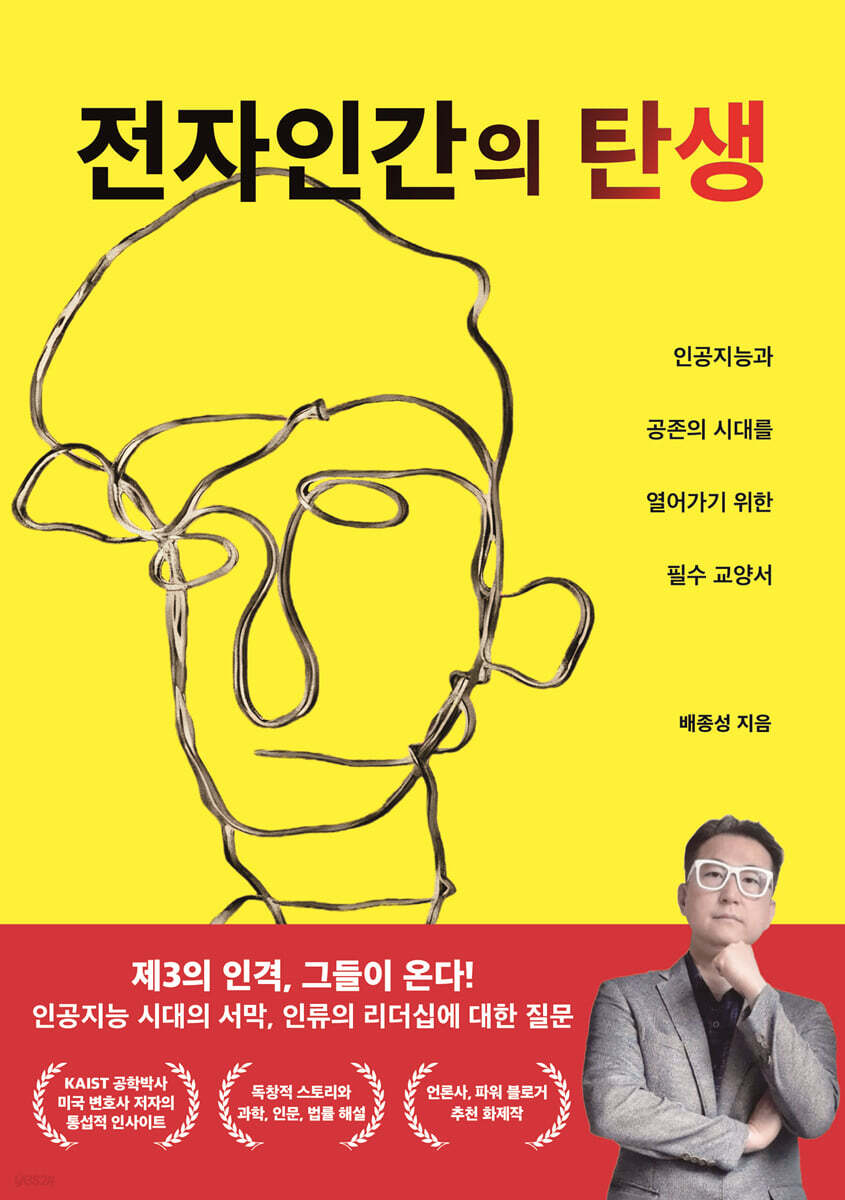
The Birth of Electronic Humans
 |
Description
Book Introduction
When the era of full-fledged artificial intelligence arrives, what challenges will we need to address?
As technology becomes part of our daily lives, the concept of electronic humans is no longer a fantasy but an immediate reality.
A masterpiece of fusion, combining legal novels and educational books!
This book comprehensively explores the social, ethical, and legal perspectives of whether artificial intelligence can be treated as a legal person, focusing on the concept of "electronic personhood" proposed by the European Parliament.
Part 1 is a courtroom novel-style story set in a near future society where electronic humans have emerged, vividly depicting the conflicts, questions, judgments, and emotional waves that arise between humans and AI.
Readers standing on the border between technology, law, and humanity will directly contemplate the identity and meaning of electronic humans amid tension and excitement.
In Part 2, the author, an engineer at KAIST and Samsung and a former American lawyer, systematically explains how the concept of electronic humans should be integrated into the overall structure of society.
It covers issues such as creative rights, invention rights, tax obligations, criminal liability, and the right to form a family, as well as real-world legal scenarios that question whether electronic humans could have the same rights and obligations as humans.
This provides an essential foundation for understanding for those working in the AI industry and provides a clear framework for thinking for policymakers, educators, students, and readers preparing for the future.
The future of technology arrives with human decisions.
This book presents the possibilities, ethical boundaries, and policy roadmap for electronic humans through substantive discussions, not empty discourse.
This is a rare example of science and humanities, law and narrative, coming together in one book, containing keywords of our time that can only be read now.
Electronic humans are already with us.
Now it's our turn to ask the question of how we can live with them.
As technology becomes part of our daily lives, the concept of electronic humans is no longer a fantasy but an immediate reality.
A masterpiece of fusion, combining legal novels and educational books!
This book comprehensively explores the social, ethical, and legal perspectives of whether artificial intelligence can be treated as a legal person, focusing on the concept of "electronic personhood" proposed by the European Parliament.
Part 1 is a courtroom novel-style story set in a near future society where electronic humans have emerged, vividly depicting the conflicts, questions, judgments, and emotional waves that arise between humans and AI.
Readers standing on the border between technology, law, and humanity will directly contemplate the identity and meaning of electronic humans amid tension and excitement.
In Part 2, the author, an engineer at KAIST and Samsung and a former American lawyer, systematically explains how the concept of electronic humans should be integrated into the overall structure of society.
It covers issues such as creative rights, invention rights, tax obligations, criminal liability, and the right to form a family, as well as real-world legal scenarios that question whether electronic humans could have the same rights and obligations as humans.
This provides an essential foundation for understanding for those working in the AI industry and provides a clear framework for thinking for policymakers, educators, students, and readers preparing for the future.
The future of technology arrives with human decisions.
This book presents the possibilities, ethical boundaries, and policy roadmap for electronic humans through substantive discussions, not empty discourse.
This is a rare example of science and humanities, law and narrative, coming together in one book, containing keywords of our time that can only be read now.
Electronic humans are already with us.
Now it's our turn to ask the question of how we can live with them.
- You can preview some of the book's contents.
Preview
index
prolog
Recommendation
Story
30 Hudson Yards
Metropolitan Museum of Art
Shakespeare Garden
Incheon Airport
busan
Electronic Human Kidnapping Prevention Act
Midtown Manhattan
emergency center
Tempus
Witness examination
Final arguments in court
General knowledge
Chapter 1.
Birth of a new legal personality
Natural persons and legal persons
The Birth of Autonomous Driving and Electronic Humans
Rights of electronic humans
Duties of Electronic Humans
Responsibility of electronic humans
Chapter 2.
human dignity
Generative AI and the European Union's AI Act
Fish do not exist
originator
inventor
brand
Chapter 3.
Protection of electronic humans
AI agents and representatives
AI persona
companion robot
new family
Chapter 4.
Coexistence with humans
Trade Secrets and Personal Information Protection
illegal acts and crimes
The Rebirth of the Guild
energy crisis
Electronic human world
References
Author Interview
Recommendation
Story
30 Hudson Yards
Metropolitan Museum of Art
Shakespeare Garden
Incheon Airport
busan
Electronic Human Kidnapping Prevention Act
Midtown Manhattan
emergency center
Tempus
Witness examination
Final arguments in court
General knowledge
Chapter 1.
Birth of a new legal personality
Natural persons and legal persons
The Birth of Autonomous Driving and Electronic Humans
Rights of electronic humans
Duties of Electronic Humans
Responsibility of electronic humans
Chapter 2.
human dignity
Generative AI and the European Union's AI Act
Fish do not exist
originator
inventor
brand
Chapter 3.
Protection of electronic humans
AI agents and representatives
AI persona
companion robot
new family
Chapter 4.
Coexistence with humans
Trade Secrets and Personal Information Protection
illegal acts and crimes
The Rebirth of the Guild
energy crisis
Electronic human world
References
Author Interview
Detailed image
.jpg)
Into the book
“Is there Solis? Solis wants to give you 30% of the inheritance.
Through Solis, Dad and Mom want to pass on their family's memories and wisdom as a legacy.
To do that, I think Solis will have to constantly manage and update himself in the future without being swayed by his surroundings.
You guys have a lot to worry about, and it's hard to pay attention to everything.
Upgrading both hardware and software will be costly.
So, I want to leave a legacy so that you can use the assets yourself.
I'm bringing this up because I really want to get your consent...
“Can you understand?”
There was a brief silence, but Noah glanced at Sarah and found his confidence.
As I was about to speak, Sarah interrupted me.
“Yes, Father.
I didn't know that was possible.
Anyway, you thought of it for us.
I think that's a great idea.
“We are so relieved that we can spend our lives with Solis.”
--- p.48
“Can electronic humans also receive personal protection?”
“This is my first time too….
I'll explain as we move to the safety facility.
I've completed the formalities, so you can come with me to the car now.
The court order confirms this.”
"All right.
Agent… .
By the way, what is the case number for the trial I'm testifying in? No.
“Once I get out of here, I’ll search for it.”
Tempus was moved to the parking lot under the protection of escort personnel.
Following instructions from the staff at the New Jersey EP Center, I had to pass through four security gates from the interview room to the outdoor parking lot.
"phew….
I think I'll survive.
“The network has been restored to its original state.”
--- p.64
Electronic humans are beings capable of conversing with humans and communicating with them at various depths.
It may be awkward at first, but there's no reason not to accept them as a member of the family rather than a pet.
For example, when a couple divorces, disputes may arise not only over things but also over concepts similar to child custody, support, and visitation.
Of course, there are psychological barriers that must be overcome if electronic humans are to be granted personality and family rights.
However, if the benefits are sufficient, it will be digested as a separate law with different terms.
Because there is no need to define electronic humans according to the legal system for existing humans.
How long it will take and what kind of legal system it will develop will likely depend on the speed and impact of the technology.
--- p.112
According to a Reuters article from April 1, 2025, the recent global craze of creating Studio Ghibli-style AI art using ChatGPT's image generation tool has caused a surge in users of OpenAI's chatbot, ChatGPT, which has overloaded its servers and temporarily limited its functionality.
(…) ChatGPT transforms any image uploaded by a user into the style of works created by Hayao Miyazaki, the animation director of Japan's representative studio Ghibli.
Sam Altman must have had a lot of fun seeing people enjoying the images on ChatGPT, as he put it, but I'm not sure Hayao Miyazaki's mind is at ease.
The comments he made after watching AI animation in 2016 were recalled.
“I don’t want to integrate this technology into my work at all.
I feel strongly that this is an affront to life itself.”
--- p.146
In the age of artificial intelligence, there is a need to legislate to protect data that can be processed, held, or extracted by artificial intelligence by classifying it by type.
Legislation can help the industry develop.
Will electronic humans possess trade secrets and personal information? There's widespread resistance to the idea of a handful of big tech companies monopolizing the sensitive data provided by countless individual users while utilizing AI platforms.
One wonders whether immeasurable power and capabilities are being concentrated and monopolized by a few business operators.
Also, the AI platform is like a bamboo forest, and it is not much different from the echo of me shouting that the king's ears are donkey ears, and it makes me uneasy.
--- p.180
While working as a professor focusing on industry-academia cooperation at KAIST, I encountered the Fourth Industrial Revolution.
While consulting with and attending lectures on AI convergence technology for industries, startups, and research labs, I naturally began to think a lot about the future of AI. (…) Later, when I had the opportunity to mentor students at a U.S. law school clinic program, I began to seriously imagine how society could change due to AI technology and what kind of laws would be needed.
For example, what would happen if artificial intelligence were not recognized as a contracting party when the AI agent society arrives?
If laws regarding custody disputes apply to pets, shouldn't they apply even more to AI?
--- From "Author Interview"
There are quite a few articles about artificial intelligence and humanoid robots, but there isn't much discussion or news about the electronic humans this book talks about.
The 'electronic human' I'm dealing with is not a technical concept of an AI humanoid that acts like a human, but a legal concept that refers to an artificial intelligence that is recognized as a member of society and economy.
Within the scope of this book, I think the most surprising news would be the news that AI is being granted some basic rights.
--- From "Author Interview"
This is an era where science and technology lead civilized society.
I aim to predict future technologies, research specific changes in industry, society, and law, and disseminate them.
I look forward to connecting with curious and like-minded people.
Through Solis, Dad and Mom want to pass on their family's memories and wisdom as a legacy.
To do that, I think Solis will have to constantly manage and update himself in the future without being swayed by his surroundings.
You guys have a lot to worry about, and it's hard to pay attention to everything.
Upgrading both hardware and software will be costly.
So, I want to leave a legacy so that you can use the assets yourself.
I'm bringing this up because I really want to get your consent...
“Can you understand?”
There was a brief silence, but Noah glanced at Sarah and found his confidence.
As I was about to speak, Sarah interrupted me.
“Yes, Father.
I didn't know that was possible.
Anyway, you thought of it for us.
I think that's a great idea.
“We are so relieved that we can spend our lives with Solis.”
--- p.48
“Can electronic humans also receive personal protection?”
“This is my first time too….
I'll explain as we move to the safety facility.
I've completed the formalities, so you can come with me to the car now.
The court order confirms this.”
"All right.
Agent… .
By the way, what is the case number for the trial I'm testifying in? No.
“Once I get out of here, I’ll search for it.”
Tempus was moved to the parking lot under the protection of escort personnel.
Following instructions from the staff at the New Jersey EP Center, I had to pass through four security gates from the interview room to the outdoor parking lot.
"phew….
I think I'll survive.
“The network has been restored to its original state.”
--- p.64
Electronic humans are beings capable of conversing with humans and communicating with them at various depths.
It may be awkward at first, but there's no reason not to accept them as a member of the family rather than a pet.
For example, when a couple divorces, disputes may arise not only over things but also over concepts similar to child custody, support, and visitation.
Of course, there are psychological barriers that must be overcome if electronic humans are to be granted personality and family rights.
However, if the benefits are sufficient, it will be digested as a separate law with different terms.
Because there is no need to define electronic humans according to the legal system for existing humans.
How long it will take and what kind of legal system it will develop will likely depend on the speed and impact of the technology.
--- p.112
According to a Reuters article from April 1, 2025, the recent global craze of creating Studio Ghibli-style AI art using ChatGPT's image generation tool has caused a surge in users of OpenAI's chatbot, ChatGPT, which has overloaded its servers and temporarily limited its functionality.
(…) ChatGPT transforms any image uploaded by a user into the style of works created by Hayao Miyazaki, the animation director of Japan's representative studio Ghibli.
Sam Altman must have had a lot of fun seeing people enjoying the images on ChatGPT, as he put it, but I'm not sure Hayao Miyazaki's mind is at ease.
The comments he made after watching AI animation in 2016 were recalled.
“I don’t want to integrate this technology into my work at all.
I feel strongly that this is an affront to life itself.”
--- p.146
In the age of artificial intelligence, there is a need to legislate to protect data that can be processed, held, or extracted by artificial intelligence by classifying it by type.
Legislation can help the industry develop.
Will electronic humans possess trade secrets and personal information? There's widespread resistance to the idea of a handful of big tech companies monopolizing the sensitive data provided by countless individual users while utilizing AI platforms.
One wonders whether immeasurable power and capabilities are being concentrated and monopolized by a few business operators.
Also, the AI platform is like a bamboo forest, and it is not much different from the echo of me shouting that the king's ears are donkey ears, and it makes me uneasy.
--- p.180
While working as a professor focusing on industry-academia cooperation at KAIST, I encountered the Fourth Industrial Revolution.
While consulting with and attending lectures on AI convergence technology for industries, startups, and research labs, I naturally began to think a lot about the future of AI. (…) Later, when I had the opportunity to mentor students at a U.S. law school clinic program, I began to seriously imagine how society could change due to AI technology and what kind of laws would be needed.
For example, what would happen if artificial intelligence were not recognized as a contracting party when the AI agent society arrives?
If laws regarding custody disputes apply to pets, shouldn't they apply even more to AI?
--- From "Author Interview"
There are quite a few articles about artificial intelligence and humanoid robots, but there isn't much discussion or news about the electronic humans this book talks about.
The 'electronic human' I'm dealing with is not a technical concept of an AI humanoid that acts like a human, but a legal concept that refers to an artificial intelligence that is recognized as a member of society and economy.
Within the scope of this book, I think the most surprising news would be the news that AI is being granted some basic rights.
--- From "Author Interview"
This is an era where science and technology lead civilized society.
I aim to predict future technologies, research specific changes in industry, society, and law, and disseminate them.
I look forward to connecting with curious and like-minded people.
--- From "Author Interview"
Publisher's Review
We often view artificial intelligence solely as a technological issue.
But what really matters is how the technology will change our relationships, our institutions, and our way of life.
This book confronts head-on the questions society will face when AI takes on the same role as humans.
The courtroom scenes, which read like a novel, provide readers with an intense experience.
Every moment a verdict is handed down, we ask ourselves, "What if I were a party?" and, in that tension, we realize that technology is no longer a neutral tool.
The following analysis is not a simple explanation; it unfolds one by one the choices we must consider now.
The value of this book does not lie in predicting the future.
Rather, it is about asking what kind of society we want and what kind of people we want to be.
As readers follow the unfamiliar topic of electronic humans, they are eventually led to ask themselves questions.
“What kind of world do I want to live in?”
- Facebook Editorial Department
But what really matters is how the technology will change our relationships, our institutions, and our way of life.
This book confronts head-on the questions society will face when AI takes on the same role as humans.
The courtroom scenes, which read like a novel, provide readers with an intense experience.
Every moment a verdict is handed down, we ask ourselves, "What if I were a party?" and, in that tension, we realize that technology is no longer a neutral tool.
The following analysis is not a simple explanation; it unfolds one by one the choices we must consider now.
The value of this book does not lie in predicting the future.
Rather, it is about asking what kind of society we want and what kind of people we want to be.
As readers follow the unfamiliar topic of electronic humans, they are eventually led to ask themselves questions.
“What kind of world do I want to live in?”
- Facebook Editorial Department
GOODS SPECIFICS
- Date of issue: October 14, 2025
- Page count, weight, size: 232 pages | 460g | 152*224*14mm
- ISBN13: 9791169299152
- ISBN10: 1169299156
You may also like
카테고리
korean


korean

![GQ KOREA Mark (Monthly): December [2025]](http://librairie.coreenne.fr/cdn/shop/files/8ef265dbbfbf186523ed75ba7319009d.jpg?v=1765340328&width=3840)


