

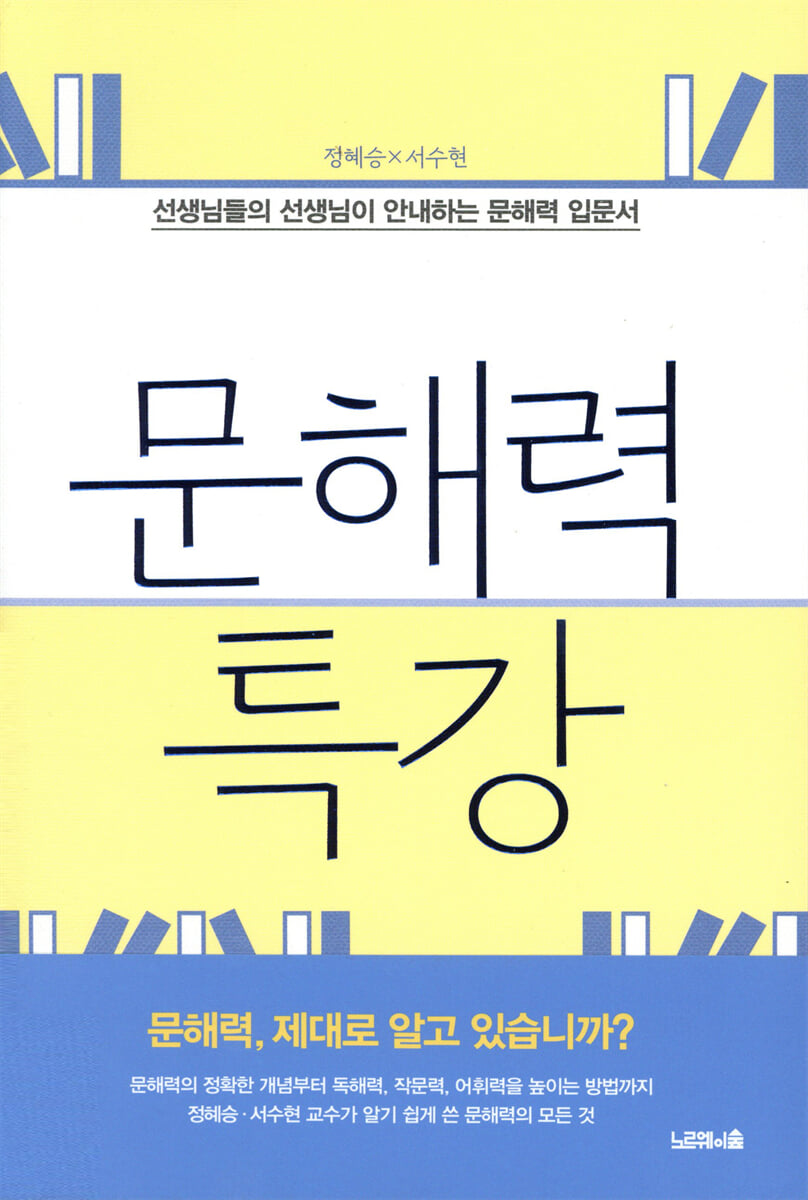
Literacy Special Lecture
 |
Description
Book Introduction
The country's leading literacy education researchers
The basics and core of literacy, guided in an easy and friendly manner
Literacy remains a hot topic.
In these times when voices of concern about the decline in literacy are continuously being raised and various textbooks and books to improve literacy are being poured out, let's first properly understand what 'literacy' is and why it is important. Professor Jeong Hye-seung of the Department of Korean Language Education at Gyeongin National University of Education and Professor Seo Su-hyeon of the Department of Korean Language Education at Gwangju National University of Education, who have played a major role in the research and development of Korean language education in Korea, have joined forces to present a literacy guide for all of us.
The authors emphasize that literacy is a communication skill centered on characters, consisting of reading and writing. Based on various domestic and international research results, they logically explain what literacy is, why it is necessary, and how to develop it.
Because the argument is developed based on a precise concept of literacy, it does not focus on any specific area of ability, such as reading comprehension or writing, but rather discusses in a balanced way the elements necessary to improve literacy, including reading comprehension, writing, vocabulary, and digital media literacy. This is what differentiates this book from other books on literacy.
The basics and core of literacy, guided in an easy and friendly manner
Literacy remains a hot topic.
In these times when voices of concern about the decline in literacy are continuously being raised and various textbooks and books to improve literacy are being poured out, let's first properly understand what 'literacy' is and why it is important. Professor Jeong Hye-seung of the Department of Korean Language Education at Gyeongin National University of Education and Professor Seo Su-hyeon of the Department of Korean Language Education at Gwangju National University of Education, who have played a major role in the research and development of Korean language education in Korea, have joined forces to present a literacy guide for all of us.
The authors emphasize that literacy is a communication skill centered on characters, consisting of reading and writing. Based on various domestic and international research results, they logically explain what literacy is, why it is necessary, and how to develop it.
Because the argument is developed based on a precise concept of literacy, it does not focus on any specific area of ability, such as reading comprehension or writing, but rather discusses in a balanced way the elements necessary to improve literacy, including reading comprehension, writing, vocabulary, and digital media literacy. This is what differentiates this book from other books on literacy.
- You can preview some of the book's contents.
Preview
index
preface
Lesson 1: What is literacy?
1. The concept of literacy
2 Characteristics of literacy
3 Changes in literacy
Lesson 2: Literacy: Why is it important?
1 Study and Literacy
2 Occupations and Literacy
3 Human Rights and Literacy
3. How can I improve my reading comprehension?
1. Three elements of reading comprehension
2 Reading Methods to Develop Reading Comprehension
How to develop writing skills in the fourth quarter?
1. Three elements of writing skills
2 Writing Methods to Develop Writing Skills
Lesson 5: How to Develop Vocabulary, the Core of Literacy
1. Vocabulary, how important is it?
2 What it means to have a good vocabulary
3 Ways to Build Your Vocabulary
Lesson 6: How can we develop digital media literacy?
1 The Two Faces of Digital Media
2 How to Use Digital Media Well
3. Digital Media Literacy: Using It Wisely
main
Image source
Lesson 1: What is literacy?
1. The concept of literacy
2 Characteristics of literacy
3 Changes in literacy
Lesson 2: Literacy: Why is it important?
1 Study and Literacy
2 Occupations and Literacy
3 Human Rights and Literacy
3. How can I improve my reading comprehension?
1. Three elements of reading comprehension
2 Reading Methods to Develop Reading Comprehension
How to develop writing skills in the fourth quarter?
1. Three elements of writing skills
2 Writing Methods to Develop Writing Skills
Lesson 5: How to Develop Vocabulary, the Core of Literacy
1. Vocabulary, how important is it?
2 What it means to have a good vocabulary
3 Ways to Build Your Vocabulary
Lesson 6: How can we develop digital media literacy?
1 The Two Faces of Digital Media
2 How to Use Digital Media Well
3. Digital Media Literacy: Using It Wisely
main
Image source
Detailed image
.jpg)
Into the book
Literacy is different from reading comprehension, which is the ability to read and understand text.
Literacy involves not only the ability to understand what someone else has written, but also the productive ability to express one's thoughts and feelings.
Literacy means 'the ability to read and write'.
--- p.15
According to a study analyzing the correlation between reading and math scores based on assessment results from 2009 to 2018 administered by the Korea Institute for Curriculum and Evaluation, there is a very high correlation between reading and math scores.
--- p.45
Reading comprehension is generally considered to be a combination of three elements: reading accurately, reading with inference, and reading with evaluation.
In other words, if you have reading comprehension, you can say that you have the ability to read a text while accurately understanding what is written, inferring what is not written, and evaluating it from various aspects.
--- p.72~73
What if you're reading a text and it's difficult or ambiguous to accurately grasp its structure? One way to quickly and accurately grasp the text's structure is to find "cover words."
A signpost is a word that acts as a kind of signpost that provides information about the text so that the reader can easily understand it.
--- p.97
Throughout the reading process, readers can ask themselves various questions.
Before reading, you can ask yourself questions such as, "Why do I want to read this text?" or assess your background knowledge, such as, "Do I have the necessary experience or knowledge to read this text?"
These questions help readers clarify why they are reading, which helps them find meaning in their reading and engage in focused reading.
Additionally, if you feel that you do not have enough background knowledge to read the text, you can do some pre-reading activities, such as looking up related materials first.
--- p.108
So how can we view our writing through the eyes of a reader? The easiest way is to write, then reread it after a certain amount of time has passed.
People say that after about three days, people start to forget what they wrote.
So, if you write something and then take it out and read it again three days later, you'll be able to see it with fresh eyes. Time away from your writing is a preparation time to practice viewing it objectively.
--- p.124
According to Professor Hu of Chiao-Kwang University of Science and Technology in Taiwan and others, to understand a text at a minimal level, you need to know about 80 percent of the vocabulary used in that text.
To be able to independently understand a text by inferring word meanings from context without consulting a dictionary or other source, you need to know at least 98 percent of the vocabulary used in the text.
--- p.154
If you've ever read a book and then looked for another book on a similar topic, or listened to music that perfectly matched the mood of the book while reading it, you've experienced intertextual reading.
Literacy involves not only the ability to understand what someone else has written, but also the productive ability to express one's thoughts and feelings.
Literacy means 'the ability to read and write'.
--- p.15
According to a study analyzing the correlation between reading and math scores based on assessment results from 2009 to 2018 administered by the Korea Institute for Curriculum and Evaluation, there is a very high correlation between reading and math scores.
--- p.45
Reading comprehension is generally considered to be a combination of three elements: reading accurately, reading with inference, and reading with evaluation.
In other words, if you have reading comprehension, you can say that you have the ability to read a text while accurately understanding what is written, inferring what is not written, and evaluating it from various aspects.
--- p.72~73
What if you're reading a text and it's difficult or ambiguous to accurately grasp its structure? One way to quickly and accurately grasp the text's structure is to find "cover words."
A signpost is a word that acts as a kind of signpost that provides information about the text so that the reader can easily understand it.
--- p.97
Throughout the reading process, readers can ask themselves various questions.
Before reading, you can ask yourself questions such as, "Why do I want to read this text?" or assess your background knowledge, such as, "Do I have the necessary experience or knowledge to read this text?"
These questions help readers clarify why they are reading, which helps them find meaning in their reading and engage in focused reading.
Additionally, if you feel that you do not have enough background knowledge to read the text, you can do some pre-reading activities, such as looking up related materials first.
--- p.108
So how can we view our writing through the eyes of a reader? The easiest way is to write, then reread it after a certain amount of time has passed.
People say that after about three days, people start to forget what they wrote.
So, if you write something and then take it out and read it again three days later, you'll be able to see it with fresh eyes. Time away from your writing is a preparation time to practice viewing it objectively.
--- p.124
According to Professor Hu of Chiao-Kwang University of Science and Technology in Taiwan and others, to understand a text at a minimal level, you need to know about 80 percent of the vocabulary used in that text.
To be able to independently understand a text by inferring word meanings from context without consulting a dictionary or other source, you need to know at least 98 percent of the vocabulary used in the text.
--- p.154
If you've ever read a book and then looked for another book on a similar topic, or listened to music that perfectly matched the mood of the book while reading it, you've experienced intertextual reading.
--- p.200
Publisher's Review
Literacy, do you know it well?
The basics and core of literacy, explained in an easy and friendly manner by Korea's leading literacy education researchers.
Literacy remains a hot topic.
In these times when voices of concern about the decline in literacy are continuously being raised and various textbooks and books to improve literacy are being poured out, let's first properly understand what 'literacy' is and why it is important. Professor Jeong Hye-seung of the Department of Korean Language Education at Gyeongin National University of Education and Professor Seo Su-hyeon of the Department of Korean Language Education at Gwangju National University of Education, who have played a major role in the research and development of Korean language education in Korea, have joined forces to present a literacy guide for all of us.
The authors emphasize that literacy is a communication skill centered on letters, consisting of the acts of reading and writing.
Because the essence of literacy is communication, writers can write with ease and friendliness as if they were having a conversation with readers, and readers can read the text as if they were having a conversation with the writer, understanding the writer's intention and purpose in writing, comparing and judging their own thoughts.
However, many people tend to understand literacy as centered on reading, and this perspective of literacy centered on reading comprehension easily misses the essence of literacy as a 'conversation'.
Because the argument is developed based on a precise concept of literacy, it does not focus on any specific area of ability, such as reading comprehension or writing, but rather discusses in a balanced way the elements necessary to improve literacy, including reading comprehension, writing, vocabulary, and digital media literacy. This is what differentiates this book from other books on literacy.
This book consists of a total of 6 chapters.
First, in lectures 1 and 2, we explain the traditional concept of literacy and the modern expanded concept, and discuss their main characteristics.
It also convinces us from several aspects why literacy is necessary.
Starting with the importance of literacy in academics, it discusses the necessity of literacy in later social life and fundamentally in terms of human rights.
In the third and fourth lectures, we will analyze reading and writing, that is, reading comprehension and writing skills.
First, looking at reading comprehension, the authors go beyond the vague imperative that reading comprehension is something you must 'read well' and explain the elements that make up reading comprehension, such as reading accurately, reading with inference, and reading with evaluation.
And, in order to read accurately, read while inferring, read while evaluating, and read well, it specifically presents methods of reading thoroughly, reading while utilizing background knowledge, and reading while asking questions.
The same goes for writing skills.
It identifies the elements that make up writing, such as generating and organizing content, expressing it, and rewriting it, and explains four ways to practice each element: preparing material, putting your voice into it, considering the reader, and expressing it specifically.
Lesson 5 covers vocabulary.
Vocabulary is the most powerful factor affecting reading comprehension, the ability to read and understand text, and is important not only for reading comprehension but also for writing.
In Chapter 5, we explain the quantitative and qualitative aspects of vocabulary based on various examples and research results, helping you gain a deeper understanding of vocabulary beyond simply knowing a lot of words.
In addition, we provide guidance on ways to improve vocabulary, such as inferring the meaning of words, learning by considering word types, and making dictionary lookups a part of daily life.
The final six lessons cover digital media literacy.
As literacy is now being defined to encompass digital media, we will compare traditional literacy with digital media literacy and examine the characteristics of reading in digital media.
Teachers and students read together,
A book to use as a reference point when planning lessons to improve literacy.
『Literacy Special Lecture』 provides a comprehensive and three-dimensional analysis of literacy, which greatly helps in understanding what literacy is.
Above all, it is written in an easy-to-understand manner, considering even young readers, and provides guidance on various methods that can be actually utilized.
Therefore, it can be beneficial not only to adolescents and adults who want to deepen their understanding of literacy skills such as reading comprehension, writing, and vocabulary, but also to teachers and parents.
Instead of just giving vague advice to read a lot of books, we help you develop specific learning strategies based on your understanding of literacy.
Utilizing the various tips tailored to young readers will help you design a variety of lessons that enhance literacy in your classroom.
The basics and core of literacy, explained in an easy and friendly manner by Korea's leading literacy education researchers.
Literacy remains a hot topic.
In these times when voices of concern about the decline in literacy are continuously being raised and various textbooks and books to improve literacy are being poured out, let's first properly understand what 'literacy' is and why it is important. Professor Jeong Hye-seung of the Department of Korean Language Education at Gyeongin National University of Education and Professor Seo Su-hyeon of the Department of Korean Language Education at Gwangju National University of Education, who have played a major role in the research and development of Korean language education in Korea, have joined forces to present a literacy guide for all of us.
The authors emphasize that literacy is a communication skill centered on letters, consisting of the acts of reading and writing.
Because the essence of literacy is communication, writers can write with ease and friendliness as if they were having a conversation with readers, and readers can read the text as if they were having a conversation with the writer, understanding the writer's intention and purpose in writing, comparing and judging their own thoughts.
However, many people tend to understand literacy as centered on reading, and this perspective of literacy centered on reading comprehension easily misses the essence of literacy as a 'conversation'.
Because the argument is developed based on a precise concept of literacy, it does not focus on any specific area of ability, such as reading comprehension or writing, but rather discusses in a balanced way the elements necessary to improve literacy, including reading comprehension, writing, vocabulary, and digital media literacy. This is what differentiates this book from other books on literacy.
This book consists of a total of 6 chapters.
First, in lectures 1 and 2, we explain the traditional concept of literacy and the modern expanded concept, and discuss their main characteristics.
It also convinces us from several aspects why literacy is necessary.
Starting with the importance of literacy in academics, it discusses the necessity of literacy in later social life and fundamentally in terms of human rights.
In the third and fourth lectures, we will analyze reading and writing, that is, reading comprehension and writing skills.
First, looking at reading comprehension, the authors go beyond the vague imperative that reading comprehension is something you must 'read well' and explain the elements that make up reading comprehension, such as reading accurately, reading with inference, and reading with evaluation.
And, in order to read accurately, read while inferring, read while evaluating, and read well, it specifically presents methods of reading thoroughly, reading while utilizing background knowledge, and reading while asking questions.
The same goes for writing skills.
It identifies the elements that make up writing, such as generating and organizing content, expressing it, and rewriting it, and explains four ways to practice each element: preparing material, putting your voice into it, considering the reader, and expressing it specifically.
Lesson 5 covers vocabulary.
Vocabulary is the most powerful factor affecting reading comprehension, the ability to read and understand text, and is important not only for reading comprehension but also for writing.
In Chapter 5, we explain the quantitative and qualitative aspects of vocabulary based on various examples and research results, helping you gain a deeper understanding of vocabulary beyond simply knowing a lot of words.
In addition, we provide guidance on ways to improve vocabulary, such as inferring the meaning of words, learning by considering word types, and making dictionary lookups a part of daily life.
The final six lessons cover digital media literacy.
As literacy is now being defined to encompass digital media, we will compare traditional literacy with digital media literacy and examine the characteristics of reading in digital media.
Teachers and students read together,
A book to use as a reference point when planning lessons to improve literacy.
『Literacy Special Lecture』 provides a comprehensive and three-dimensional analysis of literacy, which greatly helps in understanding what literacy is.
Above all, it is written in an easy-to-understand manner, considering even young readers, and provides guidance on various methods that can be actually utilized.
Therefore, it can be beneficial not only to adolescents and adults who want to deepen their understanding of literacy skills such as reading comprehension, writing, and vocabulary, but also to teachers and parents.
Instead of just giving vague advice to read a lot of books, we help you develop specific learning strategies based on your understanding of literacy.
Utilizing the various tips tailored to young readers will help you design a variety of lessons that enhance literacy in your classroom.
GOODS SPECIFICS
- Date of issue: August 30, 2024
- Page count, weight, size: 216 pages | 404g | 148*220*15mm
- ISBN13: 9791193865064
- ISBN10: 1193865069
You may also like
카테고리
korean


korean

![GQ KOREA Mark (Monthly): December [2025]](http://librairie.coreenne.fr/cdn/shop/files/8ef265dbbfbf186523ed75ba7319009d.jpg?v=1765340328&width=3840)


