

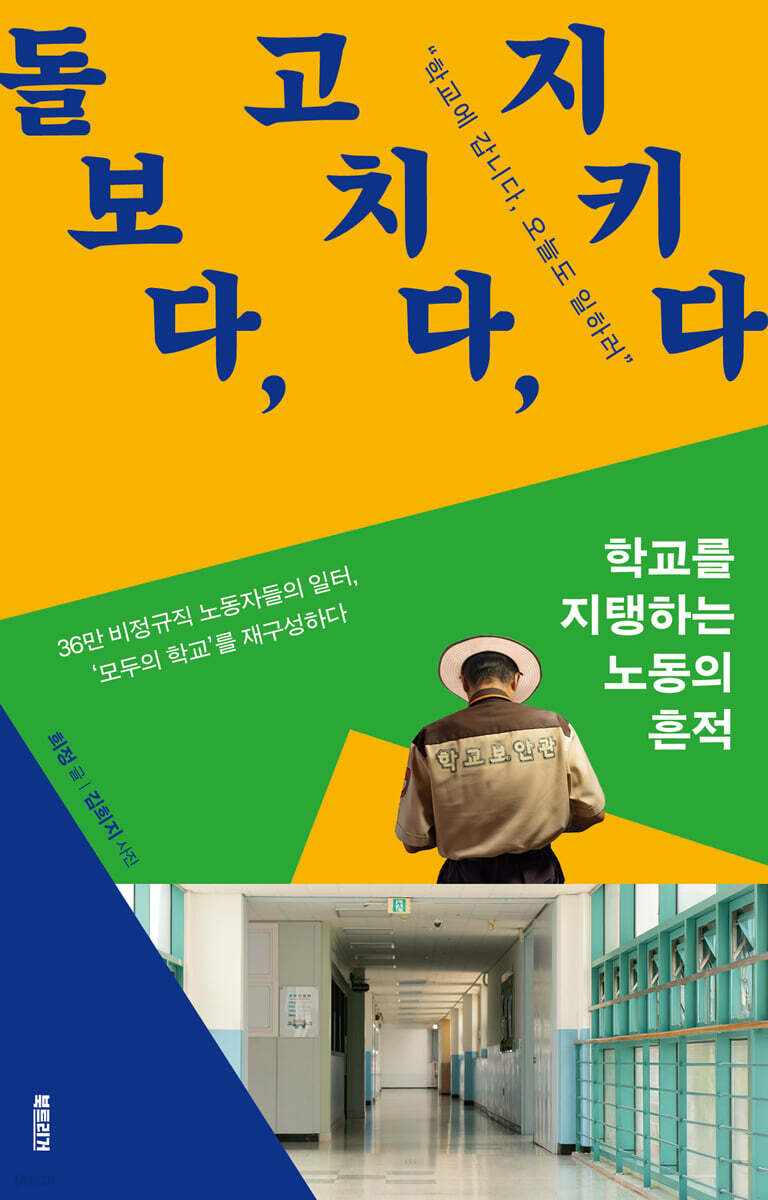
take care of, fix, protect
 |
Description
Book Introduction
- A word from MD
-
The labor that supports the schoolSchool isn't just about students and teachers.
There are many different people doing the various tasks necessary for classes to run smoothly.
There are 360,000 people working in schools.
It contains vivid stories of people working at school, from the main gate to the classrooms, cafeteria, and playground.
October 15, 2025. Min-gyu Son, Social and Political PD
“It goes without saying that a school consisting solely of classrooms cannot exist.”
How can we create a "school for everyone," where every member is respected?
Who lives in a school? Teachers and students come to mind first, but in reality, schools are a workplace where over 100 different professions intertwine.
There are approximately 170,000 people called educational civil servants, and including non-regular instructors, the number reaches approximately 360,000, making a living at schools.
This is a scale comparable to the number of teachers, which is 360,000.
Schools cannot run a single day without 'working people,' yet our gaze remains fixed on the classroom.
This book addresses various workplaces both inside and outside the classroom.
Author Heejung, who has been covering and documenting the work and lives of workers, visited 'schools' this time and interviewed 'school people' who we encounter every day but never see, who we pass by every day but are unsure of what to call them.
In this way, we are reconstructing a ‘school for everyone’ that is made possible through the labor and dedication of many people, including teachers and students.
How can we create a "school for everyone," where every member is respected?
Who lives in a school? Teachers and students come to mind first, but in reality, schools are a workplace where over 100 different professions intertwine.
There are approximately 170,000 people called educational civil servants, and including non-regular instructors, the number reaches approximately 360,000, making a living at schools.
This is a scale comparable to the number of teachers, which is 360,000.
Schools cannot run a single day without 'working people,' yet our gaze remains fixed on the classroom.
This book addresses various workplaces both inside and outside the classroom.
Author Heejung, who has been covering and documenting the work and lives of workers, visited 'schools' this time and interviewed 'school people' who we encounter every day but never see, who we pass by every day but are unsure of what to call them.
In this way, we are reconstructing a ‘school for everyone’ that is made possible through the labor and dedication of many people, including teachers and students.
- You can preview some of the book's contents.
Preview
index
Enter_ Learn, Teach, Work
Part 1│Are you a teacher too?
① Ask anyone anything _Taeyoung Jeong, librarian
② A Class Called Care _ Eunhee Choi, Care Specialist
③ From the meal plan to the plate _ Nutritionist Lee Hee-won
④ After school _ Kim Nu-ri, after-school instructor
⑤ Our Green Hero, Teacher _ School Nurse Lee Hyang-ja
*Are you a teacher too?
Part 2 | School, Where Do You Work?
⑥ A person who protects others with sincerity _ School security officer Lee Deok-yeong
⑦ If it looks easy, you're doing it right. _Yang Yun-suk, Academic Affairs Specialist
⑧ The Differences in the Dreams of K-Lunch _ Park Hwa-ja, Chef
⑨ Nothing Gets Fixed on Itself _ Jeong Hoon-rok, Facility Mobile Maintenance Team Reporter
*School, where do you work?
Part 3 | You're doing a good job.
⑩ I'll be your person _ Lee Seong-eun, school social worker
⑪ Children are not hateful colors _ Jeong Seong-hee, art therapist
⑫ 23 years of challenging work _ Kim Mi-yeon, special education teacher
⑬ Practice of giving and receiving help from each other _ Na Hyun-jin, Special Education Practitioner
*You're doing a good job
Filming Review_ Hearts revived as I pressed the shutter
Part 1│Are you a teacher too?
① Ask anyone anything _Taeyoung Jeong, librarian
② A Class Called Care _ Eunhee Choi, Care Specialist
③ From the meal plan to the plate _ Nutritionist Lee Hee-won
④ After school _ Kim Nu-ri, after-school instructor
⑤ Our Green Hero, Teacher _ School Nurse Lee Hyang-ja
*Are you a teacher too?
Part 2 | School, Where Do You Work?
⑥ A person who protects others with sincerity _ School security officer Lee Deok-yeong
⑦ If it looks easy, you're doing it right. _Yang Yun-suk, Academic Affairs Specialist
⑧ The Differences in the Dreams of K-Lunch _ Park Hwa-ja, Chef
⑨ Nothing Gets Fixed on Itself _ Jeong Hoon-rok, Facility Mobile Maintenance Team Reporter
*School, where do you work?
Part 3 | You're doing a good job.
⑩ I'll be your person _ Lee Seong-eun, school social worker
⑪ Children are not hateful colors _ Jeong Seong-hee, art therapist
⑫ 23 years of challenging work _ Kim Mi-yeon, special education teacher
⑬ Practice of giving and receiving help from each other _ Na Hyun-jin, Special Education Practitioner
*You're doing a good job
Filming Review_ Hearts revived as I pressed the shutter
Detailed image

Into the book
The school, which is a place of learning, is an actual building with a frame, columns, and window frames.
After a building is built, it needs people to paint, clean, and maintain it.
Within it, you have to provide goods and services, make plans, and manage your life.
Learning and teaching also require countless planning and planning, division of labor and cooperation, execution and implementation, to determine the shape of the vessel and its contents.
The word 'learn' requires the word 'work'.
There are people working at school.
--- From "Entering _Learning, Teaching, Working"
I wonder if this is a question that can be answered by asking, but the Board of Education keeps asking about the operation of after-school care classrooms.
The number of students using the after-care classroom by day and time period, as well as their return home status, are also items that the caregiver must submit on a daily basis.
The demand for after-school care is a major concern for local education offices.
Some city and provincial offices of education are prioritizing the goal of reducing waiting lists for childcare classes to zero.
But even just preparing a small, cute snack—a bite-sized pancake and plain milk, for example—comes with a lot of work: announcing the snack cost, narrowing down the eligibility criteria, budgeting, collecting, and processing.
Care is work.
However, the labor of the ‘caregiver’ is not taken into consideration in the care classroom.
--- From "Chapter 2: A Class Called Care _ Eunhee Choi, Caregiver"
“Guiding dietary habits is also a nutritionist’s role, but I don’t think that happens only in class.
I think that encouraging children to eat a little bit of a side dish they don't like and trying unfamiliar foods are also educational.
Eating the right amount for others, and taking responsibility for the food I eat.
“This is table manners.”
This kind of education is not something that a nutritionist can do alone.
The meal times are short, and the cafeteria is filled with hundreds of energetic students.
One nutritionist cannot handle the distribution guidance.
You need to ask the classroom teachers for help, but even that is not an easy task.
So, he said, time is short, and there are many times when he doesn't even have time to smile, let alone say a word to his students.
--- From "Chapter 3: From the Menu to the Plate _ Nutritionist Lee Hee-won"
“Children often come here with minor injuries.
You might get cut while cutting or fall and get hurt.
“Come to think of it, I’ve been getting a lot of mosquito bites lately.”
“You come here more often than I thought?”
“In the past, people would say, ‘Why are you bringing something like this?’ But not anymore.
Because I learned that children don't just come because they're sick.
Children say, "I was bitten by a mosquito and it hurt," and "It must have been itchy," and it's nice to receive that warm hand that receives attention.
Yesterday, I came here because I was bitten by a mosquito, and today, I came again because I got a bruise.
Are you really sick? No.
The child comes because he wants to be loved.
Then you have to give love.”
--- From "Chapter 5: Our Green Hero, Teacher _Hyangja Lee, School Nurse"
If you think about it, the words “That teacher is not a teacher” are a very powerful teaching.
Students learn naturally during their school life.
Who is the teacher and who is not the teacher.
What kind of authority and rights does such a distinction divide?
Students learn the difference between 'non-regular' and 'regular' employment at school, and intuitively realize that this is more than just a form of employment; it is a matter of social status and identity.
This feeling comes to me more strongly than any words spoken in class.
Unfortunately, the librarian's dream of equality has not yet been realized in our reality.
Still, there are people who want to share their learning in the workplace called school.
The learning they impart fills the space called school.
A teacher is a teacher.
--- From "Part 1 Introduction: Are you a teacher too?"
I try to understand his position, which is such that he cannot leave his seat even for a moment.
I can only imagine the pressure I would feel if I were asked to guard this door all day long.
If the safety of hundreds of children depended on my position, I would have to walk even to the bathroom.
To shorten that time, there is usually a small bathroom right next to the security office.
--- From "Chapter 6: A Person Who Protects Others with Sincerity _ School Security Officer Deok-Young Lee"
The work is not properly revealed.
So the problem is not solved.
What do we consider easy? Unimportant? Nonessential? No.
This is something we don't know very well.
(…) we are asked to be multiplayer, but the world assumes it is easy.
But everyone knows deep down.
There is nothing easy in this world.
There are just things that seem easy.
--- From "Chapter 7: If it looks easy, you're doing it right _Yang Yun-suk, a teaching assistant"
The cafeteria is currently suffering from a lack of staff.
They say they are hiring more people, but even when a vacancy arises, no new people come in.
No one applies to be a cafeteria cook, and those who do leave quickly.
Because of the rumor that the work was difficult, it became a place that people did not want to enter.
In fact, the vacancy rate for chefs has exceeded 20 percent.
In a place where ten people should be working, eight people are working (in Seoul, one cook is responsible for preparing meals for 139 people).
Park Hwa-ja feels bitter that the work she has done for a long time has become a sham that no one welcomes.
The Board of Education is trying to replace their hardship and bitterness with words like automation and artificial intelligence.
When people are scarce, machines are used.
Because machines don't have white, gassy lungs or tingling wrists.
But is it okay to consider feeding someone a simple task that can easily be replaced by a machine?
--- From "Chapter 8: The Differences in the Dreams of K-Lunch _ Park Hwa-ja, Chef"
Cooks, practitioners, and maintenance workers—that is, people who work in schools but are not teachers—all cherished the experience of receiving a carnation.
The moment when students gave me carnations was one of the precious memories that made me feel good about working at school.
They regarded the carnation bouquet they received on Teacher's Day as a symbol of recognition that they were 'members of the school.'
So, I remembered for a long time the student who gave me a carnation, even though I was not a 'teacher'.
They expressed their regret for never having attended a graduation ceremony despite working at the school for many years, and they were sad that they had to stay behind to clean the cafeteria when the faculty and staff went out for a company dinner after the ceremony. However, they forgot their sad memories with a single carnation they received on Teacher's Day.
He said it was good to work at school.
I largely agreed with the statement that the students were grateful, but at the same time, I also thought this.
A sense of belonging or membership in a group cannot be broken by a single flower.
--- From "Part 2 Introduction: School, Where Do You Work?"
“I conducted a follow-up study in Hawaii for 30 years.
We analyzed the backgrounds of those who adapted well to society among children from low-income and vulnerable families by tracing them back.
The study results pointed to 'just one person'.
'I had one person who believed in me unconditionally and supported me.' I strive to be that one person for my students.
I think that's the 'hello' I can give to my students."
--- From "Chapter 10: I'll Become One _ Lee Seong-eun, School Social Worker"
What does a child's growth mean to the world?
What efforts is the world, which tells children to change, actually making?
This question continues to hover around Kim Mi-yeon.
After asking that question, Kim Mi-yeon decided to join in changing the world.
It's not just children in inclusive classrooms who ask why we should work with students with disabilities.
There are occasional reports of local residents fiercely opposing the establishment of special schools.
The sight of parents of disabled students getting down on their knees to persuade the residents caused a brief stir, but it soon died down.
The answer to the question, 'Why should we coexist?' is something we all must find.
--- From "Chapter 12: 23 Years of Challenging Work _ Special Education Teacher Kim Mi-yeon"
For good people to go to school, they themselves must feel 'safe'.
But in the school cafeteria, white gas fills the lungs, and the person responsible for facility safety falls from a tall tree under the burden of renewing his contract.
Harsh cleaning chemicals seep through the work cloth and cause burns.
Schools are not very safe places for working people.
It's time to ask about the 'well-being' of the school members.
It's not just students who can thrive when surrounded by diverse grasses.
People working in schools also need 'diverse' respect.
Education is not limited to inside or outside the classroom, because “equal education is possible in an equal workplace.”
After a building is built, it needs people to paint, clean, and maintain it.
Within it, you have to provide goods and services, make plans, and manage your life.
Learning and teaching also require countless planning and planning, division of labor and cooperation, execution and implementation, to determine the shape of the vessel and its contents.
The word 'learn' requires the word 'work'.
There are people working at school.
--- From "Entering _Learning, Teaching, Working"
I wonder if this is a question that can be answered by asking, but the Board of Education keeps asking about the operation of after-school care classrooms.
The number of students using the after-care classroom by day and time period, as well as their return home status, are also items that the caregiver must submit on a daily basis.
The demand for after-school care is a major concern for local education offices.
Some city and provincial offices of education are prioritizing the goal of reducing waiting lists for childcare classes to zero.
But even just preparing a small, cute snack—a bite-sized pancake and plain milk, for example—comes with a lot of work: announcing the snack cost, narrowing down the eligibility criteria, budgeting, collecting, and processing.
Care is work.
However, the labor of the ‘caregiver’ is not taken into consideration in the care classroom.
--- From "Chapter 2: A Class Called Care _ Eunhee Choi, Caregiver"
“Guiding dietary habits is also a nutritionist’s role, but I don’t think that happens only in class.
I think that encouraging children to eat a little bit of a side dish they don't like and trying unfamiliar foods are also educational.
Eating the right amount for others, and taking responsibility for the food I eat.
“This is table manners.”
This kind of education is not something that a nutritionist can do alone.
The meal times are short, and the cafeteria is filled with hundreds of energetic students.
One nutritionist cannot handle the distribution guidance.
You need to ask the classroom teachers for help, but even that is not an easy task.
So, he said, time is short, and there are many times when he doesn't even have time to smile, let alone say a word to his students.
--- From "Chapter 3: From the Menu to the Plate _ Nutritionist Lee Hee-won"
“Children often come here with minor injuries.
You might get cut while cutting or fall and get hurt.
“Come to think of it, I’ve been getting a lot of mosquito bites lately.”
“You come here more often than I thought?”
“In the past, people would say, ‘Why are you bringing something like this?’ But not anymore.
Because I learned that children don't just come because they're sick.
Children say, "I was bitten by a mosquito and it hurt," and "It must have been itchy," and it's nice to receive that warm hand that receives attention.
Yesterday, I came here because I was bitten by a mosquito, and today, I came again because I got a bruise.
Are you really sick? No.
The child comes because he wants to be loved.
Then you have to give love.”
--- From "Chapter 5: Our Green Hero, Teacher _Hyangja Lee, School Nurse"
If you think about it, the words “That teacher is not a teacher” are a very powerful teaching.
Students learn naturally during their school life.
Who is the teacher and who is not the teacher.
What kind of authority and rights does such a distinction divide?
Students learn the difference between 'non-regular' and 'regular' employment at school, and intuitively realize that this is more than just a form of employment; it is a matter of social status and identity.
This feeling comes to me more strongly than any words spoken in class.
Unfortunately, the librarian's dream of equality has not yet been realized in our reality.
Still, there are people who want to share their learning in the workplace called school.
The learning they impart fills the space called school.
A teacher is a teacher.
--- From "Part 1 Introduction: Are you a teacher too?"
I try to understand his position, which is such that he cannot leave his seat even for a moment.
I can only imagine the pressure I would feel if I were asked to guard this door all day long.
If the safety of hundreds of children depended on my position, I would have to walk even to the bathroom.
To shorten that time, there is usually a small bathroom right next to the security office.
--- From "Chapter 6: A Person Who Protects Others with Sincerity _ School Security Officer Deok-Young Lee"
The work is not properly revealed.
So the problem is not solved.
What do we consider easy? Unimportant? Nonessential? No.
This is something we don't know very well.
(…) we are asked to be multiplayer, but the world assumes it is easy.
But everyone knows deep down.
There is nothing easy in this world.
There are just things that seem easy.
--- From "Chapter 7: If it looks easy, you're doing it right _Yang Yun-suk, a teaching assistant"
The cafeteria is currently suffering from a lack of staff.
They say they are hiring more people, but even when a vacancy arises, no new people come in.
No one applies to be a cafeteria cook, and those who do leave quickly.
Because of the rumor that the work was difficult, it became a place that people did not want to enter.
In fact, the vacancy rate for chefs has exceeded 20 percent.
In a place where ten people should be working, eight people are working (in Seoul, one cook is responsible for preparing meals for 139 people).
Park Hwa-ja feels bitter that the work she has done for a long time has become a sham that no one welcomes.
The Board of Education is trying to replace their hardship and bitterness with words like automation and artificial intelligence.
When people are scarce, machines are used.
Because machines don't have white, gassy lungs or tingling wrists.
But is it okay to consider feeding someone a simple task that can easily be replaced by a machine?
--- From "Chapter 8: The Differences in the Dreams of K-Lunch _ Park Hwa-ja, Chef"
Cooks, practitioners, and maintenance workers—that is, people who work in schools but are not teachers—all cherished the experience of receiving a carnation.
The moment when students gave me carnations was one of the precious memories that made me feel good about working at school.
They regarded the carnation bouquet they received on Teacher's Day as a symbol of recognition that they were 'members of the school.'
So, I remembered for a long time the student who gave me a carnation, even though I was not a 'teacher'.
They expressed their regret for never having attended a graduation ceremony despite working at the school for many years, and they were sad that they had to stay behind to clean the cafeteria when the faculty and staff went out for a company dinner after the ceremony. However, they forgot their sad memories with a single carnation they received on Teacher's Day.
He said it was good to work at school.
I largely agreed with the statement that the students were grateful, but at the same time, I also thought this.
A sense of belonging or membership in a group cannot be broken by a single flower.
--- From "Part 2 Introduction: School, Where Do You Work?"
“I conducted a follow-up study in Hawaii for 30 years.
We analyzed the backgrounds of those who adapted well to society among children from low-income and vulnerable families by tracing them back.
The study results pointed to 'just one person'.
'I had one person who believed in me unconditionally and supported me.' I strive to be that one person for my students.
I think that's the 'hello' I can give to my students."
--- From "Chapter 10: I'll Become One _ Lee Seong-eun, School Social Worker"
What does a child's growth mean to the world?
What efforts is the world, which tells children to change, actually making?
This question continues to hover around Kim Mi-yeon.
After asking that question, Kim Mi-yeon decided to join in changing the world.
It's not just children in inclusive classrooms who ask why we should work with students with disabilities.
There are occasional reports of local residents fiercely opposing the establishment of special schools.
The sight of parents of disabled students getting down on their knees to persuade the residents caused a brief stir, but it soon died down.
The answer to the question, 'Why should we coexist?' is something we all must find.
--- From "Chapter 12: 23 Years of Challenging Work _ Special Education Teacher Kim Mi-yeon"
For good people to go to school, they themselves must feel 'safe'.
But in the school cafeteria, white gas fills the lungs, and the person responsible for facility safety falls from a tall tree under the burden of renewing his contract.
Harsh cleaning chemicals seep through the work cloth and cause burns.
Schools are not very safe places for working people.
It's time to ask about the 'well-being' of the school members.
It's not just students who can thrive when surrounded by diverse grasses.
People working in schools also need 'diverse' respect.
Education is not limited to inside or outside the classroom, because “equal education is possible in an equal workplace.”
--- From "Part 3: You're doing a good job"
Publisher's Review
Beyond textbooks, questioning the meaning of learning and teaching
Illuminating 'School as Workplace'
Why go to school? Students go to learn, teachers go to teach. But the question of what to learn and how to teach remains a mystery.
It is not easy to refute the author's statement that "sometimes what we learn in school seems meaningless."
Author Heejung delves into the loopholes of the word 'learn'.
It is important to note that in order to learn something at school, a foundation for learning must first be laid.
For schools to function properly, they must provide meals for children and provide for their needs.
Broken facilities must be fixed and protected from danger.
To do that, we need people who 'work'.
School is a workplace before it is a place of learning.
There are people at school who go to work.
There is another field that makes daily school possible, yet its existence is not even well known.
There are a whopping 360,000 people working in schools.
This figure includes educational civil servants and other non-regular workers.
This is a number comparable to the 360,000 teachers, but despite their poor working conditions, they rarely receive attention.
At school, we learn that everyone has the right to basic respect, but the teachings in textbooks are not properly applied in the classroom.
Perhaps this is another reason why schools are perceived as meaningless. To prevent learning from becoming empty, teaching must extend beyond textbooks and be implemented throughout the school.
"Take Care of, Fix, Protect" is a story about people who have been working silently in the shadows of schools.
Record worker Heejung visits 13 interviewees to shed new light on the 'school as a workplace', a place where their joys and sorrows are mixed.
For them, school is not just a means of making a living.
Perhaps it is because we believe that school is “different from any other place.”
For some, school is a place to watch children grow, learn from them, and build their lives.
That's why they go to school.
Go to work.
Beyond simply documenting labor, this book poses a profound question to readers: “What values should our society truly cherish?” (Professor Seungyoon Lee’s recommendation).
From the cafeteria, health room, and library to the administrative, after-school, and special education classes,
Examining the traces of labor that have nurtured the village called school
There are about 100 different occupations at school.
There are administrative staff who handle all kinds of administrative work inside and outside of school, school security guards who are so careful not to leave their seats that they even rush to the bathroom, and kitchen staff who breathe in smoke and clean their toilets all day long to prepare 100 servings of food per person every day.
There are some who teach directly, such as school nurses or after-school instructors, but they are all in the position of 'teachers but not teachers.'
To children, it may be a 'teacher', but adults know that this is "more than just a form of employment; it is a matter of social status and identity."
Author Heejung questions this reality.
“A teacher is a teacher,” he says emphatically.
The interviewees he met were “each sharing their learning in their own way.” That’s what it means to cultivate a foundation for learning.
Despite the poor conditions and treatment, they are all proud of their work.
Of course, there are countless times when it is difficult.
As photographer Kim Hee-ji, who captured the interview scene, realized, “in order to be positive about one’s work, one’s own recognition is important, but recognition from others is also necessary.”
People usually consider their job easy.
I envy the librarian, wishing I could sit in the library and read a book, and I just smack my lips looking at the menu.
But as we all know deep down, “nothing in this world is easy.
“There are things that just seem easy.”
Even the basic duties of a librarian, such as selecting, purchasing, sorting, and stocking books, require understanding each child's accessibility and interests. Similarly, the work of a nutritionist involves countless hours of paperwork, budgeting, inspecting tools and ingredients, and developing recipes before food is even served on a plate (according to a 2023 survey, nearly half of nutritionists responded that they "work overtime every day").
Children's nutritional balance and eating habits education are also considerations.
Even in many cases, the division of labor is not clear.
Tasks with ambiguous boundaries are often delegated excessively.
This is true for almost every occupation introduced in this book.
Not only is the demand for essential human resources barely met by insufficient supply, but in many cases, the working environment is not even properly regulated.
In the case of culinary technicians, the vacancy rate already exceeds 20 percent due to the notoriety that the work is more difficult than in the private sector.
We usually take this kind of labor for granted, but if their hard work were to disappear, the immediate difficulties would be immense.
A single carnation cannot replace a right.
What kind of school do we want, what kind of society do we want to live in?
This book is divided into three parts.
The titles of each section, such as “Are you a teacher too?” “School, where do you work?” and “You’re doing a good job,” are phrases that school workers often encounter in their daily lives.
The author uses these words as a topic to unravel the reality of 'shadow labor', which we are largely unaware of.
At the end of each section are the author's thoughts on these words.
As you meet the 13 interviewees and listen to their stories, while simultaneously delving into the author's concerns, you will encounter the questions that permeate this book.
'What kind of place should school be?' This leads to the question of what kind of place our society should be.
Everyone working at the school the author met treasured the experience of receiving carnations from students on Teachers' Day.
The author takes comfort in the fact that “there are students who remember things I inadvertently passed by in the past,” and shares his gratitude, but he also painfully points out that “a sense of belonging or membership in a group cannot be broken with a single flower.”
The author says:
There should be a lot of good people in school.
The role of school is not limited to simply imparting knowledge to children.
School is a place that teaches us how to live in the world with other people.
Therefore, schools where employment status is a direct indicator of social status, schools where the "safety" of workers striving to protect the "well-being" of children cannot be guaranteed, and schools that demand only high test scores rather than diverse respect are unhealthy.
This book broadens the horizons of discussion surrounding schools by illuminating the hidden hands that support them.
Education is not determined by textbooks and curriculum alone.
A school truly becomes a place of learning when countless hands come together to safely open the school gates each morning, prepare warm meals, and care for children in the infirmary.
『To care for, to fix, to protect』 is a book that records the heart contained in those hands and the warmth of those fingertips.
And it poses a question to all of us.
What kind of school do you want, what kind of society do you want to live in?
Illuminating 'School as Workplace'
Why go to school? Students go to learn, teachers go to teach. But the question of what to learn and how to teach remains a mystery.
It is not easy to refute the author's statement that "sometimes what we learn in school seems meaningless."
Author Heejung delves into the loopholes of the word 'learn'.
It is important to note that in order to learn something at school, a foundation for learning must first be laid.
For schools to function properly, they must provide meals for children and provide for their needs.
Broken facilities must be fixed and protected from danger.
To do that, we need people who 'work'.
School is a workplace before it is a place of learning.
There are people at school who go to work.
There is another field that makes daily school possible, yet its existence is not even well known.
There are a whopping 360,000 people working in schools.
This figure includes educational civil servants and other non-regular workers.
This is a number comparable to the 360,000 teachers, but despite their poor working conditions, they rarely receive attention.
At school, we learn that everyone has the right to basic respect, but the teachings in textbooks are not properly applied in the classroom.
Perhaps this is another reason why schools are perceived as meaningless. To prevent learning from becoming empty, teaching must extend beyond textbooks and be implemented throughout the school.
"Take Care of, Fix, Protect" is a story about people who have been working silently in the shadows of schools.
Record worker Heejung visits 13 interviewees to shed new light on the 'school as a workplace', a place where their joys and sorrows are mixed.
For them, school is not just a means of making a living.
Perhaps it is because we believe that school is “different from any other place.”
For some, school is a place to watch children grow, learn from them, and build their lives.
That's why they go to school.
Go to work.
Beyond simply documenting labor, this book poses a profound question to readers: “What values should our society truly cherish?” (Professor Seungyoon Lee’s recommendation).
From the cafeteria, health room, and library to the administrative, after-school, and special education classes,
Examining the traces of labor that have nurtured the village called school
There are about 100 different occupations at school.
There are administrative staff who handle all kinds of administrative work inside and outside of school, school security guards who are so careful not to leave their seats that they even rush to the bathroom, and kitchen staff who breathe in smoke and clean their toilets all day long to prepare 100 servings of food per person every day.
There are some who teach directly, such as school nurses or after-school instructors, but they are all in the position of 'teachers but not teachers.'
To children, it may be a 'teacher', but adults know that this is "more than just a form of employment; it is a matter of social status and identity."
Author Heejung questions this reality.
“A teacher is a teacher,” he says emphatically.
The interviewees he met were “each sharing their learning in their own way.” That’s what it means to cultivate a foundation for learning.
Despite the poor conditions and treatment, they are all proud of their work.
Of course, there are countless times when it is difficult.
As photographer Kim Hee-ji, who captured the interview scene, realized, “in order to be positive about one’s work, one’s own recognition is important, but recognition from others is also necessary.”
People usually consider their job easy.
I envy the librarian, wishing I could sit in the library and read a book, and I just smack my lips looking at the menu.
But as we all know deep down, “nothing in this world is easy.
“There are things that just seem easy.”
Even the basic duties of a librarian, such as selecting, purchasing, sorting, and stocking books, require understanding each child's accessibility and interests. Similarly, the work of a nutritionist involves countless hours of paperwork, budgeting, inspecting tools and ingredients, and developing recipes before food is even served on a plate (according to a 2023 survey, nearly half of nutritionists responded that they "work overtime every day").
Children's nutritional balance and eating habits education are also considerations.
Even in many cases, the division of labor is not clear.
Tasks with ambiguous boundaries are often delegated excessively.
This is true for almost every occupation introduced in this book.
Not only is the demand for essential human resources barely met by insufficient supply, but in many cases, the working environment is not even properly regulated.
In the case of culinary technicians, the vacancy rate already exceeds 20 percent due to the notoriety that the work is more difficult than in the private sector.
We usually take this kind of labor for granted, but if their hard work were to disappear, the immediate difficulties would be immense.
A single carnation cannot replace a right.
What kind of school do we want, what kind of society do we want to live in?
This book is divided into three parts.
The titles of each section, such as “Are you a teacher too?” “School, where do you work?” and “You’re doing a good job,” are phrases that school workers often encounter in their daily lives.
The author uses these words as a topic to unravel the reality of 'shadow labor', which we are largely unaware of.
At the end of each section are the author's thoughts on these words.
As you meet the 13 interviewees and listen to their stories, while simultaneously delving into the author's concerns, you will encounter the questions that permeate this book.
'What kind of place should school be?' This leads to the question of what kind of place our society should be.
Everyone working at the school the author met treasured the experience of receiving carnations from students on Teachers' Day.
The author takes comfort in the fact that “there are students who remember things I inadvertently passed by in the past,” and shares his gratitude, but he also painfully points out that “a sense of belonging or membership in a group cannot be broken with a single flower.”
The author says:
There should be a lot of good people in school.
The role of school is not limited to simply imparting knowledge to children.
School is a place that teaches us how to live in the world with other people.
Therefore, schools where employment status is a direct indicator of social status, schools where the "safety" of workers striving to protect the "well-being" of children cannot be guaranteed, and schools that demand only high test scores rather than diverse respect are unhealthy.
This book broadens the horizons of discussion surrounding schools by illuminating the hidden hands that support them.
Education is not determined by textbooks and curriculum alone.
A school truly becomes a place of learning when countless hands come together to safely open the school gates each morning, prepare warm meals, and care for children in the infirmary.
『To care for, to fix, to protect』 is a book that records the heart contained in those hands and the warmth of those fingertips.
And it poses a question to all of us.
What kind of school do you want, what kind of society do you want to live in?
GOODS SPECIFICS
- Date of issue: October 15, 2025
- Page count, weight, size: 300 pages | 128*200*20mm
- ISBN13: 9791193378625
- ISBN10: 1193378621
You may also like
카테고리
korean


korean

![GQ KOREA Mark (Monthly): December [2025]](http://librairie.coreenne.fr/cdn/shop/files/8ef265dbbfbf186523ed75ba7319009d.jpg?v=1765340328&width=3840)


