

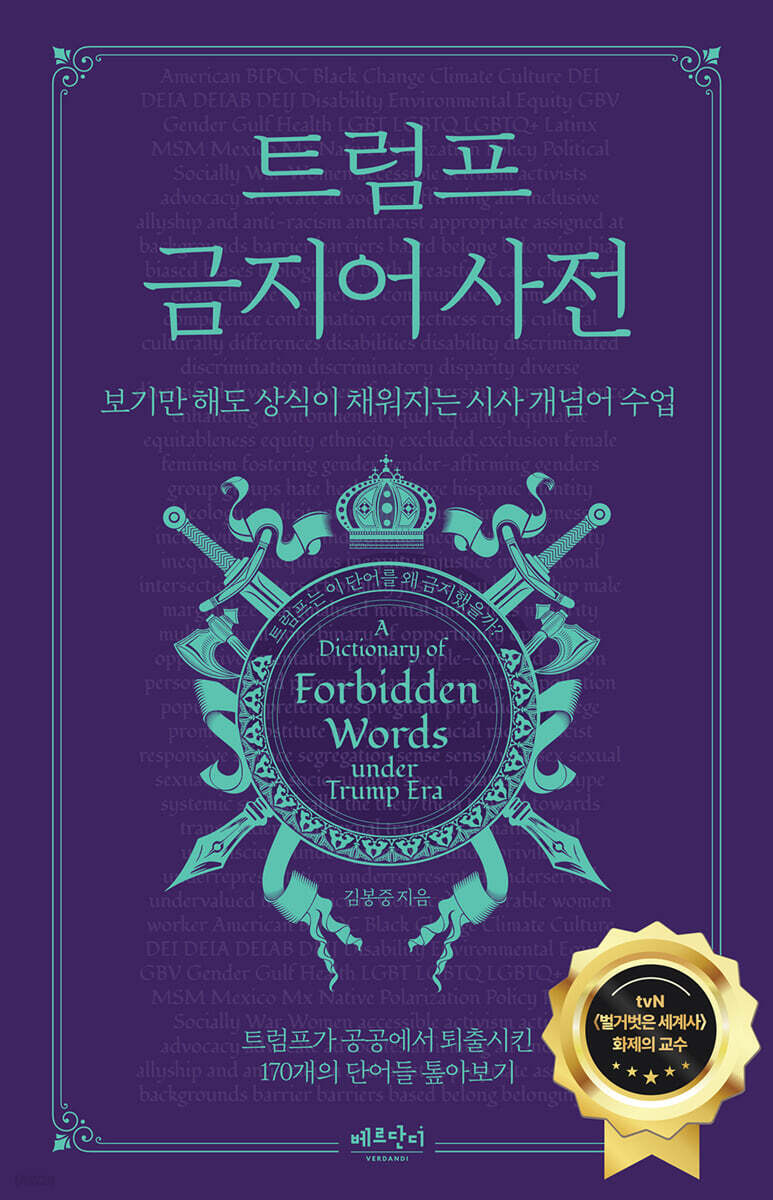
Trump's Dictionary of Banned Words
 |
Description
Book Introduction
“The use of this word is prohibited.”
170 Woke Words Trump Has Banished from Public
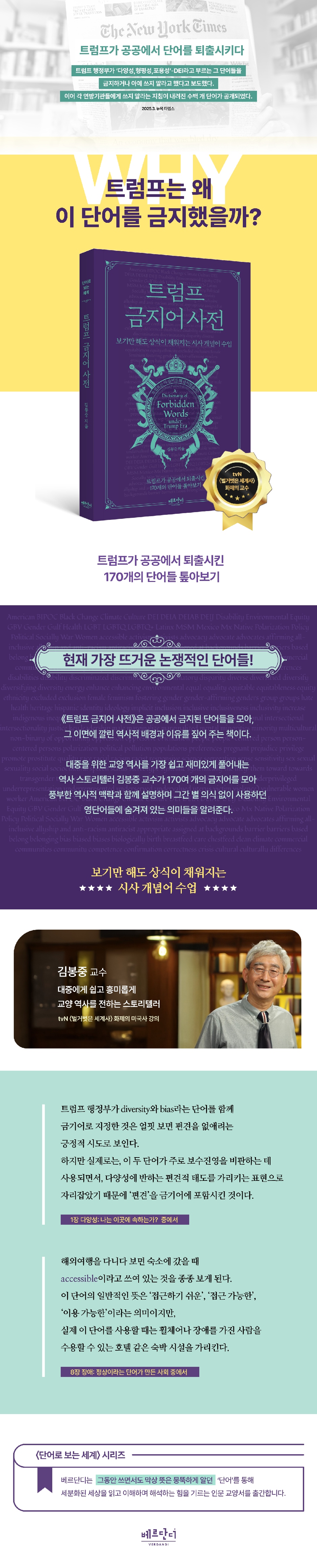
In March 2025, the News Times reported that after President Trump was elected, several public institutions in the United States had a list of words that the Trump administration had banned from use.
The list included words like “confirmation bias,” “women,” “disability,” “inequality,” “climate crisis,” “diversity,” and “marginalization.”
"Trump's Dictionary of Banned Words" is a book that explains the exact meaning and original concept of the words banned by Trump, along with their historical background, in an easy-to-understand manner.
The words included are social concepts essential for understanding not only America in the Trump era, but also modern Korean society.
It is conveniently organized so that you can build up your current affairs knowledge by turning one page per day, giving you one word per page.
Professor Bong-Joong Kim, who garnered attention for his easy-to-understand lectures on American history on tvN's "Naked World History," has selected 170 of the most controversial banned words and will open your eyes to the world with lectures at eye level on 10 topics centered around politics, society, and history.
All the words in this book are vocabulary you will continue to encounter in your future writing, academics, and work settings.
After reading this, you will feel that you have a solid foundation of prior knowledge necessary to interpret news, papers, and policy materials.
This book is for those who need the fundamentals to develop an eye for the politics of language in a noisy world and broaden the depth and breadth of their thinking.
170 Woke Words Trump Has Banished from Public
In March 2025, the News Times reported that after President Trump was elected, several public institutions in the United States had a list of words that the Trump administration had banned from use.
The list included words like “confirmation bias,” “women,” “disability,” “inequality,” “climate crisis,” “diversity,” and “marginalization.”
"Trump's Dictionary of Banned Words" is a book that explains the exact meaning and original concept of the words banned by Trump, along with their historical background, in an easy-to-understand manner.
The words included are social concepts essential for understanding not only America in the Trump era, but also modern Korean society.
It is conveniently organized so that you can build up your current affairs knowledge by turning one page per day, giving you one word per page.
Professor Bong-Joong Kim, who garnered attention for his easy-to-understand lectures on American history on tvN's "Naked World History," has selected 170 of the most controversial banned words and will open your eyes to the world with lectures at eye level on 10 topics centered around politics, society, and history.
All the words in this book are vocabulary you will continue to encounter in your future writing, academics, and work settings.
After reading this, you will feel that you have a solid foundation of prior knowledge necessary to interpret news, papers, and policy materials.
This book is for those who need the fundamentals to develop an eye for the politics of language in a noisy world and broaden the depth and breadth of their thinking.
- You can preview some of the book's contents.
Preview
index
Prologue | In the midst of a language war
Chapter 1: Expressions of Diversity That Have Become Forbidden Words
- The essence of American identity
multicultural
Diversity, Equity, and Inclusion (DEI)
diversity
Divers diverse
diverse backgrounds
diverse community
diverse group
promote diversity
community diversity
cultural heritage
cultural competence
prejudice, bias
Chapter 2: Expressions of Equity That Have Become Forbidden Words
- A beacon of democratic development
community equity
equity
intersectionality
equal opportunity
inequity
social justice
advocacy
equality
inequality
activism
Chapter 3: Inclusive Expressions That Became Forbidden Words
- A delicate touch that fosters diversity
increase diversity
enhance the diversity
All-inclusive
sociocultural
feel a sense of belonging belong
allyship
inclusion
inclusive leadership
fostering inclusivity
Chapter 4: Racial and Ethnic Expressions That Have Been Banned
- Deep-rooted wounds and recurring struggles
Latinx
Gulf of Mexico (1)
ethnicity
tribal
Native American
indigenous community
race
race and ethnicity
racist
racism
Black, Indigenous, and BIPOC people of color
Black
Hispanic minority
Chapter 5: Political Polarization and Culture War Expressions That Have Become Forbidden Words
- Challenges to overcome for consensus and coexistence
disparity
stereotype
structural systemic
unconscious bias
implicit bias
injustice
segregation
prejudice
polarization
institutional
political correctness
hate speech
status
privilege
confirmation bias
Chapter 6: Expressions of Women and Gender Inequality That Have Become Forbidden Words
- A prerequisite for the healthy development of society as a whole
breastfeed + person/people, chestfeed + person/people
Gender-based violence (GBV)
biologically + female/male
women and underrepresented
(biological or legal) female
feminism
pregnant + person/people/persons
people with a uterus people + uterus
Chapter 7: Sexual Minorities and Gender Expressions That Have Become Taboo
- The issue of recognizing human dignity and diversity
lesbian, gay, bisexual, transgender LGBT
LGBT and Queer or Questioning LGBTQ
non-binary
transgender
sexuality
sexual orientation
sexual preferences
Men who have sex with men (MSM)
Mix Mx.
social gender
gender diversity
gender identity
gender ideology
affirming care
assigned gender at birth
Chapter 8: Expressions of Disability and Health Equity That Have Become Forbidden Words
- A way to guarantee everyone's dignity and rights
health disparity
health equity
person-centered
barrier
disability
accessible
mental health
trauma
Chapter 9: Expressions of Marginalized Groups That Have Been Forbidden
- A problem that transcends the individual and affects society as a whole
underrepresented
underappreciated
exclusion, exclusion, alienation
underserved with insufficient benefits
marginalized
minority
commercial sex worker
identity
Key populations
discrimination
victim
oppression
vulnerable populations
underprivileged
Chapter 10: Climate Change and Environmental Expressions That Have Been Banned
- It is directly related to the quality of our daily lives.
climate science
climate crisis
Gulf of Mexico (2)
pollution
clean energy
environmental quality
Epilogue | A New Language to Transcend Division
Chapter 1: Expressions of Diversity That Have Become Forbidden Words
- The essence of American identity
multicultural
Diversity, Equity, and Inclusion (DEI)
diversity
Divers diverse
diverse backgrounds
diverse community
diverse group
promote diversity
community diversity
cultural heritage
cultural competence
prejudice, bias
Chapter 2: Expressions of Equity That Have Become Forbidden Words
- A beacon of democratic development
community equity
equity
intersectionality
equal opportunity
inequity
social justice
advocacy
equality
inequality
activism
Chapter 3: Inclusive Expressions That Became Forbidden Words
- A delicate touch that fosters diversity
increase diversity
enhance the diversity
All-inclusive
sociocultural
feel a sense of belonging belong
allyship
inclusion
inclusive leadership
fostering inclusivity
Chapter 4: Racial and Ethnic Expressions That Have Been Banned
- Deep-rooted wounds and recurring struggles
Latinx
Gulf of Mexico (1)
ethnicity
tribal
Native American
indigenous community
race
race and ethnicity
racist
racism
Black, Indigenous, and BIPOC people of color
Black
Hispanic minority
Chapter 5: Political Polarization and Culture War Expressions That Have Become Forbidden Words
- Challenges to overcome for consensus and coexistence
disparity
stereotype
structural systemic
unconscious bias
implicit bias
injustice
segregation
prejudice
polarization
institutional
political correctness
hate speech
status
privilege
confirmation bias
Chapter 6: Expressions of Women and Gender Inequality That Have Become Forbidden Words
- A prerequisite for the healthy development of society as a whole
breastfeed + person/people, chestfeed + person/people
Gender-based violence (GBV)
biologically + female/male
women and underrepresented
(biological or legal) female
feminism
pregnant + person/people/persons
people with a uterus people + uterus
Chapter 7: Sexual Minorities and Gender Expressions That Have Become Taboo
- The issue of recognizing human dignity and diversity
lesbian, gay, bisexual, transgender LGBT
LGBT and Queer or Questioning LGBTQ
non-binary
transgender
sexuality
sexual orientation
sexual preferences
Men who have sex with men (MSM)
Mix Mx.
social gender
gender diversity
gender identity
gender ideology
affirming care
assigned gender at birth
Chapter 8: Expressions of Disability and Health Equity That Have Become Forbidden Words
- A way to guarantee everyone's dignity and rights
health disparity
health equity
person-centered
barrier
disability
accessible
mental health
trauma
Chapter 9: Expressions of Marginalized Groups That Have Been Forbidden
- A problem that transcends the individual and affects society as a whole
underrepresented
underappreciated
exclusion, exclusion, alienation
underserved with insufficient benefits
marginalized
minority
commercial sex worker
identity
Key populations
discrimination
victim
oppression
vulnerable populations
underprivileged
Chapter 10: Climate Change and Environmental Expressions That Have Been Banned
- It is directly related to the quality of our daily lives.
climate science
climate crisis
Gulf of Mexico (2)
pollution
clean energy
environmental quality
Epilogue | A New Language to Transcend Division
Detailed image
Into the book
The 'culture war' is ultimately a 'terminology war'.
A single word, a single expression becomes an identity, and that identity becomes a battlefield.
…Some of the words that appear here are familiar to us, but others are still unfamiliar.
But those unfamiliar things will soon become our reality and a source of worry.
The primary purpose of this book is to delve into the "terminology war" taking place in the United States and prepare for it.
--- From "Epilogue"
The phrase "Trump-banned words" naturally brings to mind George Orwell's novel "1984."
Orwell's 1984, published in 1949, seems to have predicted the rise of Trump.
The Trump administration's DEI ban policy bears a striking resemblance to the novel's Newspick.
Banning a particular language is tantamount to erasing the social values and discourse embedded in those words.
…we are now in the midst of a culture war.
This culture war may seem abstract at first glance, but at its core it is a language war.
--- From the "Prologue"
“I am black, and I am a woman.
But feminists only see me as a woman, and racists only see me as a black person.
“I want to talk about the oppression we face when these two overlap.” The concept of intersectionality was first used by American legal scholar Kimberly Crenshaw in 1989.
It criticizes the situation in which the discrimination experienced by black women cannot be explained by a single cause.
--- From "Chapter 2: Expressions of Fairness That Became Forbidden Words"
In 2021, the web dictionary Dictionary.com selected allyship as the word of the year.
Solidarity is a core principle that strengthens inclusion, meaning that groups in power or individuals in relatively safe positions consciously stand on the side of and support the socially vulnerable who directly experience discrimination and inequality.
… In 2018, Nike showed solidarity by featuring Colin Kaepernick, who was effectively banned from the National Football League after kneeling during the national anthem to protest racial inequality and police brutality, in an advertising campaign.
Although the ad sparked controversy, it actually increased sales and strengthened trust in the brand.
--- From "Chapter 3: Expressions of Inclusion That Became Forbidden Words"
Historically, Hitler and the Nazi regime in Germany spread hatred against Jews, portraying them as “parasites” and “enemies of the state.”
This expression was used to justify the Holocaust.
In 1994, in Rwanda, a broadcast incited the Hutu by calling the Tutsi people "cockroaches," which became the catalyst for the genocide that killed approximately 800,000 people.
…in modern times, this battlefield has moved to the Internet.
--- From "Chapter 5: Political Polarization and Cultural War Expressions That Have Become Forbidden Words"
Entering is called access, and overseas, you can often see the word accessible written in public spaces such as hotels.
The general meaning is 'accessible', 'accessible', and 'available', but in practice, it means a facility that can be used by everyone, that is, an environment that can accommodate everyone, including people with disabilities, the elderly, pregnant women, and children.
--- From "Chapter 8: Expressions of Disability and Health Equity That Have Become Forbidden Words"
“We are the first generation to feel the impact of climate change firsthand, and the last generation that can solve the problem.” In 2023, Phoenix, Arizona, experienced a heatwave with temperatures exceeding 43 degrees Celsius for a month straight, leading to a surge in deaths.
In 2022, a heatwave in India and Pakistan, with temperatures reaching 50 degrees Celsius, killed hundreds and destroyed large swaths of crops.
A single word, a single expression becomes an identity, and that identity becomes a battlefield.
…Some of the words that appear here are familiar to us, but others are still unfamiliar.
But those unfamiliar things will soon become our reality and a source of worry.
The primary purpose of this book is to delve into the "terminology war" taking place in the United States and prepare for it.
--- From "Epilogue"
The phrase "Trump-banned words" naturally brings to mind George Orwell's novel "1984."
Orwell's 1984, published in 1949, seems to have predicted the rise of Trump.
The Trump administration's DEI ban policy bears a striking resemblance to the novel's Newspick.
Banning a particular language is tantamount to erasing the social values and discourse embedded in those words.
…we are now in the midst of a culture war.
This culture war may seem abstract at first glance, but at its core it is a language war.
--- From the "Prologue"
“I am black, and I am a woman.
But feminists only see me as a woman, and racists only see me as a black person.
“I want to talk about the oppression we face when these two overlap.” The concept of intersectionality was first used by American legal scholar Kimberly Crenshaw in 1989.
It criticizes the situation in which the discrimination experienced by black women cannot be explained by a single cause.
--- From "Chapter 2: Expressions of Fairness That Became Forbidden Words"
In 2021, the web dictionary Dictionary.com selected allyship as the word of the year.
Solidarity is a core principle that strengthens inclusion, meaning that groups in power or individuals in relatively safe positions consciously stand on the side of and support the socially vulnerable who directly experience discrimination and inequality.
… In 2018, Nike showed solidarity by featuring Colin Kaepernick, who was effectively banned from the National Football League after kneeling during the national anthem to protest racial inequality and police brutality, in an advertising campaign.
Although the ad sparked controversy, it actually increased sales and strengthened trust in the brand.
--- From "Chapter 3: Expressions of Inclusion That Became Forbidden Words"
Historically, Hitler and the Nazi regime in Germany spread hatred against Jews, portraying them as “parasites” and “enemies of the state.”
This expression was used to justify the Holocaust.
In 1994, in Rwanda, a broadcast incited the Hutu by calling the Tutsi people "cockroaches," which became the catalyst for the genocide that killed approximately 800,000 people.
…in modern times, this battlefield has moved to the Internet.
--- From "Chapter 5: Political Polarization and Cultural War Expressions That Have Become Forbidden Words"
Entering is called access, and overseas, you can often see the word accessible written in public spaces such as hotels.
The general meaning is 'accessible', 'accessible', and 'available', but in practice, it means a facility that can be used by everyone, that is, an environment that can accommodate everyone, including people with disabilities, the elderly, pregnant women, and children.
--- From "Chapter 8: Expressions of Disability and Health Equity That Have Become Forbidden Words"
“We are the first generation to feel the impact of climate change firsthand, and the last generation that can solve the problem.” In 2023, Phoenix, Arizona, experienced a heatwave with temperatures exceeding 43 degrees Celsius for a month straight, leading to a surge in deaths.
In 2022, a heatwave in India and Pakistan, with temperatures reaching 50 degrees Celsius, killed hundreds and destroyed large swaths of crops.
--- From "Chapter 10: Climate Change and Environmental Expressions That Have Been Forbidden"
Publisher's Review
“Some taboo words become positive words.”
Intelligent and beautiful expressions found in hate and loathing
“I have taken steps to eliminate all discriminatory DEI policies.”
These words, uttered by President Donald Trump on the World Economic Forum stage in January 2025, are more than just a declaration; they are an explosive declaration that starkly exposes the clash of language and power that our society faces at this very moment.
DEI (Diversity, Equity, and Inclusion), which he disparaged as “absolute nonsense,” has become established as a concept symbolizing justice and inclusion in American society today, along with the word “woke.”
However, some extreme conservatives are inciting a culture war by defining it as “left-wing language” and “anti-American expression.”
In this flow, President Donald Trump has been at the forefront of the culture war.
-From the prologue
"Trump's Dictionary of Banned Words" is a book compiled in the form of a dictionary of words and expressions that disappeared from each administrative department and public institution after the Trump administration took office in January 2025.
The sheer number of these 'woke words' being banished from public places has shocked people.
This is because all of the so-called positive words were included in the banned list, including words frequently used in recent political, social, and educational fields such as diversity, equity, and inclusion, as well as words that reveal the absurdity of society such as intersectionality, solidarity, stereotypes, unfairness, racism, minorities, prejudice, hate speech, sexual identity, confirmation bias, women, marginalized groups, barriers, undervaluation, marginalization, and climate crisis, as well as words related to personal identity.
As of December 2024, interest in and participation in politics has increased across all generations in Korean society.
The perception that being indifferent to politics was 'cool' has changed, and there is a growing number of people who seriously consider the close connection between politics and daily life.
This series of events unfolding in the United States evokes a sense of foreboding for us.
A World in Words: A Clear Introduction to Current Affairs and Culture
The ultimate goal of this book is to recognize the social implications of political actions that discourage the public use of certain words or expressions and how they impact our lives.
It is a process of finding answers to the question of how language is used as a weapon in modern politics.
The words banned by the Trump administration aren't just vocabulary; they represent a clash of ideologies and power.
The book explains in what contexts these words appear and why they have been rejected or appropriated by certain factions.
However, this does not mean that all of the 170 words included in this book are progressive positive words.
For example, the term 'cultural heritage' originally had a neutral meaning, but it was appropriated by the American far right to convey a specific political message and was included on the list of banned words.
We, who will live in this era of continued conflict and confrontation, will encounter these words in every area of our lives, no matter what we do.
Therefore, it is important to know the English expressions included in this book, but it is also important to properly understand the concepts.
"Trump's Dictionary of Banned Words" is the first book in the "World Through Words" series, which covers a variety of humanities topics from a beginner's perspective.
We will examine the meanings and actual usage of words that have become essential common sense when watching political news, reading social articles, or conducting business. We will clearly organize the meanings of words that we have vaguely known while using them by limiting them to core concepts.
Professor Kim Bong-joong, a historian who is familiar to the public through his lectures on American history on tvN's educational program "Naked World History," combines 170 English words that are currently at the center of the most heated debate into 10 topics including fairness, equity, diversity, health, sexual minorities, women, race, and the environment, and fascinatingly unravels the historical background and meaning hidden in the language we have been using without thinking.
How to be swayed by fake arguments and think smart
There is a world that can only be seen when you know the words properly.
Because language has the power to enable critical thinking, contextualize situations, and see the world from multiple perspectives.
To think inclusively and multi-layeredly, we need to clearly define the words that form the basis of our thinking.
According to an announcement from PEN America, an international writers' organization, the list of banned words in the United States has already exceeded 350.
American society is abuzz with news related to this every day.
The current controversies surrounding banned words are fake controversies created for political reasons.
To understand the true meaning of this controversy, we must look behind the scenes.
There is some background knowledge you need to know to do that.
So, this book is not just a simple English vocabulary textbook.
Beyond the definition of a word, it explains the historical background and social impact of its creation and evolution.
Understanding taboos means understanding the core values that drive modern society.
To understand America is to know the flow and direction of the world.
The language the Trump administration is banning is the name of values that will become increasingly important in our society in the future.
We are witnessing history unfolding right before our eyes.
Anyone who wants to cultivate linguistic sophistication and critical thinking without being swayed by false arguments is encouraged to participate in the language debates in this book.
As words pile up, your eyes will open to a more balanced view of the world.
I especially recommend this book to the following readers:
1.
A liberal arts intellectual interested in current affairs, politics, and society
Readers of humanities books who are sensitive to issues of ideological debate, censorship, or language control, and who are interested in woke culture, political correctness, or the backlash and distortions against them.
2.
People in their 20s, 30s, 40s, and 50s who want to develop their 'intellectual fighting power'
Readers who want to stay centered amidst the deluge of information pouring in from social media and online communities, and college students and office workers who want to build a foundation in political and social discourse.
3.
Professionals and aspiring professionals interested in the politics of language and discourse
Those who are sensitive to the relationship between language and power, the political nature and influence of language, and must immediately apply them to their work; educators, journalists, civil servants, and media workers who must prepare for the AI era and a multicultural society.
4.
Cultural connoisseurs who are aware of and interested in the term Woke
People who are sensitive to the culture war taking place in online spaces such as Netflix, X (formerly Twitter), and YouTube.
Intelligent and beautiful expressions found in hate and loathing
“I have taken steps to eliminate all discriminatory DEI policies.”
These words, uttered by President Donald Trump on the World Economic Forum stage in January 2025, are more than just a declaration; they are an explosive declaration that starkly exposes the clash of language and power that our society faces at this very moment.
DEI (Diversity, Equity, and Inclusion), which he disparaged as “absolute nonsense,” has become established as a concept symbolizing justice and inclusion in American society today, along with the word “woke.”
However, some extreme conservatives are inciting a culture war by defining it as “left-wing language” and “anti-American expression.”
In this flow, President Donald Trump has been at the forefront of the culture war.
-From the prologue
"Trump's Dictionary of Banned Words" is a book compiled in the form of a dictionary of words and expressions that disappeared from each administrative department and public institution after the Trump administration took office in January 2025.
The sheer number of these 'woke words' being banished from public places has shocked people.
This is because all of the so-called positive words were included in the banned list, including words frequently used in recent political, social, and educational fields such as diversity, equity, and inclusion, as well as words that reveal the absurdity of society such as intersectionality, solidarity, stereotypes, unfairness, racism, minorities, prejudice, hate speech, sexual identity, confirmation bias, women, marginalized groups, barriers, undervaluation, marginalization, and climate crisis, as well as words related to personal identity.
As of December 2024, interest in and participation in politics has increased across all generations in Korean society.
The perception that being indifferent to politics was 'cool' has changed, and there is a growing number of people who seriously consider the close connection between politics and daily life.
This series of events unfolding in the United States evokes a sense of foreboding for us.
A World in Words: A Clear Introduction to Current Affairs and Culture
The ultimate goal of this book is to recognize the social implications of political actions that discourage the public use of certain words or expressions and how they impact our lives.
It is a process of finding answers to the question of how language is used as a weapon in modern politics.
The words banned by the Trump administration aren't just vocabulary; they represent a clash of ideologies and power.
The book explains in what contexts these words appear and why they have been rejected or appropriated by certain factions.
However, this does not mean that all of the 170 words included in this book are progressive positive words.
For example, the term 'cultural heritage' originally had a neutral meaning, but it was appropriated by the American far right to convey a specific political message and was included on the list of banned words.
We, who will live in this era of continued conflict and confrontation, will encounter these words in every area of our lives, no matter what we do.
Therefore, it is important to know the English expressions included in this book, but it is also important to properly understand the concepts.
"Trump's Dictionary of Banned Words" is the first book in the "World Through Words" series, which covers a variety of humanities topics from a beginner's perspective.
We will examine the meanings and actual usage of words that have become essential common sense when watching political news, reading social articles, or conducting business. We will clearly organize the meanings of words that we have vaguely known while using them by limiting them to core concepts.
Professor Kim Bong-joong, a historian who is familiar to the public through his lectures on American history on tvN's educational program "Naked World History," combines 170 English words that are currently at the center of the most heated debate into 10 topics including fairness, equity, diversity, health, sexual minorities, women, race, and the environment, and fascinatingly unravels the historical background and meaning hidden in the language we have been using without thinking.
How to be swayed by fake arguments and think smart
There is a world that can only be seen when you know the words properly.
Because language has the power to enable critical thinking, contextualize situations, and see the world from multiple perspectives.
To think inclusively and multi-layeredly, we need to clearly define the words that form the basis of our thinking.
According to an announcement from PEN America, an international writers' organization, the list of banned words in the United States has already exceeded 350.
American society is abuzz with news related to this every day.
The current controversies surrounding banned words are fake controversies created for political reasons.
To understand the true meaning of this controversy, we must look behind the scenes.
There is some background knowledge you need to know to do that.
So, this book is not just a simple English vocabulary textbook.
Beyond the definition of a word, it explains the historical background and social impact of its creation and evolution.
Understanding taboos means understanding the core values that drive modern society.
To understand America is to know the flow and direction of the world.
The language the Trump administration is banning is the name of values that will become increasingly important in our society in the future.
We are witnessing history unfolding right before our eyes.
Anyone who wants to cultivate linguistic sophistication and critical thinking without being swayed by false arguments is encouraged to participate in the language debates in this book.
As words pile up, your eyes will open to a more balanced view of the world.
I especially recommend this book to the following readers:
1.
A liberal arts intellectual interested in current affairs, politics, and society
Readers of humanities books who are sensitive to issues of ideological debate, censorship, or language control, and who are interested in woke culture, political correctness, or the backlash and distortions against them.
2.
People in their 20s, 30s, 40s, and 50s who want to develop their 'intellectual fighting power'
Readers who want to stay centered amidst the deluge of information pouring in from social media and online communities, and college students and office workers who want to build a foundation in political and social discourse.
3.
Professionals and aspiring professionals interested in the politics of language and discourse
Those who are sensitive to the relationship between language and power, the political nature and influence of language, and must immediately apply them to their work; educators, journalists, civil servants, and media workers who must prepare for the AI era and a multicultural society.
4.
Cultural connoisseurs who are aware of and interested in the term Woke
People who are sensitive to the culture war taking place in online spaces such as Netflix, X (formerly Twitter), and YouTube.
GOODS SPECIFICS
- Date of issue: August 29, 2025
- Page count, weight, size: 236 pages | 366g | 135*210*16mm
- ISBN13: 9791193407424
- ISBN10: 1193407427
You may also like
카테고리
korean


korean

![GQ KOREA Mark (Monthly): December [2025]](http://librairie.coreenne.fr/cdn/shop/files/8ef265dbbfbf186523ed75ba7319009d.jpg?v=1765340328&width=3840)


