

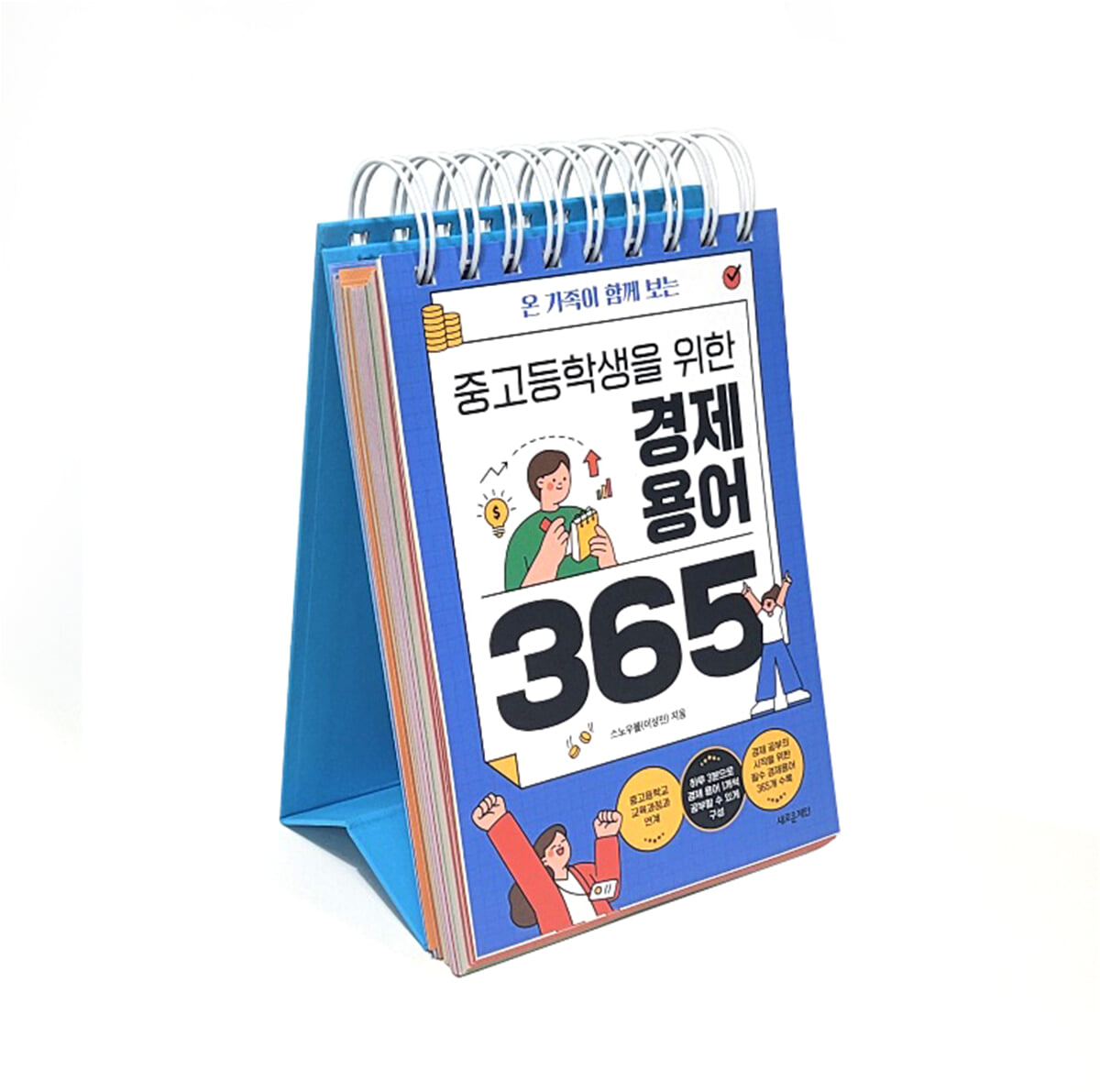
Economics Terms for Middle and High School Students 365
 |
Description
Book Introduction
The first step in studying economics is learning economic terms.
A daily economics terminology calendar that lets you learn one economic term a day with a 3-minute investment.
Taking the first step is harder than you think because the economy is complex and difficult.
And not knowing where to start is a big reason why it's difficult to get started.
When I start studying economics, I read books recommended by others or just start reading economic articles, but because of the unfamiliar terms, I get confused as to whether I'm reading Korean or English.
And most of the time, they give up soon after.
"365 Economic Terms for Middle and High School Students" is designed to help anyone learn economic terms easily and without burden.
Based on the author's know-how from running an economics term study group for three years, this book is designed in a calendar format so that you can study just one term by investing three minutes a day, so you can learn economics terms without giving up.
We've included a lot of economic terms learned in school so that the whole family can study together, and we've also included a lot of financial terminology that middle and high school students would benefit from knowing, among the terms needed for real-world investing that go beyond textbooks.
Parents can make studying economics more enjoyable if they study the terminology with their children and explain what they already know.
If you continue to study economics little by little, just by brushing your teeth in the morning and briefly looking at the calendar while having a cup of coffee at lunchtime, you will experience the experience of seeing things in books and newspapers that you previously did not understand.
A daily economics terminology calendar that lets you learn one economic term a day with a 3-minute investment.
Taking the first step is harder than you think because the economy is complex and difficult.
And not knowing where to start is a big reason why it's difficult to get started.
When I start studying economics, I read books recommended by others or just start reading economic articles, but because of the unfamiliar terms, I get confused as to whether I'm reading Korean or English.
And most of the time, they give up soon after.
"365 Economic Terms for Middle and High School Students" is designed to help anyone learn economic terms easily and without burden.
Based on the author's know-how from running an economics term study group for three years, this book is designed in a calendar format so that you can study just one term by investing three minutes a day, so you can learn economics terms without giving up.
We've included a lot of economic terms learned in school so that the whole family can study together, and we've also included a lot of financial terminology that middle and high school students would benefit from knowing, among the terms needed for real-world investing that go beyond textbooks.
Parents can make studying economics more enjoyable if they study the terminology with their children and explain what they already know.
If you continue to study economics little by little, just by brushing your teeth in the morning and briefly looking at the calendar while having a cup of coffee at lunchtime, you will experience the experience of seeing things in books and newspapers that you previously did not understand.
- You can preview some of the book's contents.
Preview
index
January Economic Knowledge, Economist
February Economic Basics
March economic indicators
April Microeconomics
May Macroeconomics
June interest rates and exchange rates (1)
July interest rates and exchange rates (2)
August Stocks and Companies (1)
September Stocks and Companies (2)
October Stocks and Companies (3)
November Real Estate (1)
December Real Estate (2)
February Economic Basics
March economic indicators
April Microeconomics
May Macroeconomics
June interest rates and exchange rates (1)
July interest rates and exchange rates (2)
August Stocks and Companies (1)
September Stocks and Companies (2)
October Stocks and Companies (3)
November Real Estate (1)
December Real Estate (2)
Detailed image

Publisher's Review
Keep it by your side and learn economic terms one by one by turning the calendar whenever you want without any burden.
If we think back to when we first learned Korean, we learned words first.
When you first start learning English, you learn basic words and simple sentences.
You can study much more efficiently if you study sentences after you have become somewhat familiar with the words.
Likewise, if you start studying economics by learning economic terminology, you will find it much easier to read books and articles.
What terms are included each month?
January Economic Knowledge, Economist
January is the time to start studying with firm determination.
However, since it is easy to quickly become exhausted if you are too passionate at this time, we have selected basic economic terms and famous economists to make it easy to start studying.
February Economic Basics
To study economics, you need to know basic terminology.
It is time to lay the foundation before starting full-scale study.
We will teach you basic economic terms to help you understand the difficult terms you will encounter in the future.
March economic indicators
Economic articles often feature content utilizing economic indicators.
Statistical data can be interpreted differently by different people, even when looking at the same figures. Knowing the terminology helps you check the facts without being swayed by sensational headlines.
In particular, these terms appear frequently in middle and high school exams, so you must know them.
April Microeconomics
Microeconomics is a representative academic discipline of economics that studies individual economic entities such as consumers and businesses.
We focus on individual economic activities such as price determination, supply and demand, and market equilibrium. We focus on terms that are important to know as they are covered in the middle and high school curriculum and appear in various certification and employment exams.
May Macroeconomics
Macroeconomics studies a wide range of indicators, including GDP, unemployment, and inflation. It's primarily used in government policymaking. Like microeconomics, it's also heavily covered in secondary school curricula, certification exams, and employment exams, so this book covers essential terminology.
June and July interest rates and exchange rates
Interest rates serve as the benchmark for all economic activity.
Since changes in the base interest rate change the flow of money and affect asset prices, it is important to be familiar with the related terminology.
And because our country is an export-oriented country, it is greatly affected by exchange rate fluctuations.
Therefore, in order to understand our country's economy, it is essential to study terms related to exchange rates.
August, September, October stocks, companies
The stock company, the most representative form of business, is a key element that drives capitalism.
So even if you don't invest in stocks, you need to understand what companies do and how they make money.
While middle and high school curricula don't cover much terminology for direct investment, they do include a wealth of terminology useful for stock investing, making it a good choice for parents and children to study together.
Real Estate in November and December
Real estate is the most popular investment product in our country, and we have included basic terms you need to know for real estate investment.
And, as the can lease is becoming a huge topic of debate, we will also provide you with essential auction-related terms that you need to know to prepare for it.
If we think back to when we first learned Korean, we learned words first.
When you first start learning English, you learn basic words and simple sentences.
You can study much more efficiently if you study sentences after you have become somewhat familiar with the words.
Likewise, if you start studying economics by learning economic terminology, you will find it much easier to read books and articles.
What terms are included each month?
January Economic Knowledge, Economist
January is the time to start studying with firm determination.
However, since it is easy to quickly become exhausted if you are too passionate at this time, we have selected basic economic terms and famous economists to make it easy to start studying.
February Economic Basics
To study economics, you need to know basic terminology.
It is time to lay the foundation before starting full-scale study.
We will teach you basic economic terms to help you understand the difficult terms you will encounter in the future.
March economic indicators
Economic articles often feature content utilizing economic indicators.
Statistical data can be interpreted differently by different people, even when looking at the same figures. Knowing the terminology helps you check the facts without being swayed by sensational headlines.
In particular, these terms appear frequently in middle and high school exams, so you must know them.
April Microeconomics
Microeconomics is a representative academic discipline of economics that studies individual economic entities such as consumers and businesses.
We focus on individual economic activities such as price determination, supply and demand, and market equilibrium. We focus on terms that are important to know as they are covered in the middle and high school curriculum and appear in various certification and employment exams.
May Macroeconomics
Macroeconomics studies a wide range of indicators, including GDP, unemployment, and inflation. It's primarily used in government policymaking. Like microeconomics, it's also heavily covered in secondary school curricula, certification exams, and employment exams, so this book covers essential terminology.
June and July interest rates and exchange rates
Interest rates serve as the benchmark for all economic activity.
Since changes in the base interest rate change the flow of money and affect asset prices, it is important to be familiar with the related terminology.
And because our country is an export-oriented country, it is greatly affected by exchange rate fluctuations.
Therefore, in order to understand our country's economy, it is essential to study terms related to exchange rates.
August, September, October stocks, companies
The stock company, the most representative form of business, is a key element that drives capitalism.
So even if you don't invest in stocks, you need to understand what companies do and how they make money.
While middle and high school curricula don't cover much terminology for direct investment, they do include a wealth of terminology useful for stock investing, making it a good choice for parents and children to study together.
Real Estate in November and December
Real estate is the most popular investment product in our country, and we have included basic terms you need to know for real estate investment.
And, as the can lease is becoming a huge topic of debate, we will also provide you with essential auction-related terms that you need to know to prepare for it.
GOODS SPECIFICS
- Date of issue: January 12, 2024
- Format: Springbook book binding method guide
- Page count, weight, size: 384 pages | 546g | 126*178*30mm
- ISBN13: 9788955336474
- ISBN10: 8955336470
You may also like
카테고리
korean


korean

![GQ KOREA Mark (Monthly): December [2025]](http://librairie.coreenne.fr/cdn/shop/files/8ef265dbbfbf186523ed75ba7319009d.jpg?v=1765340328&width=3840)


