

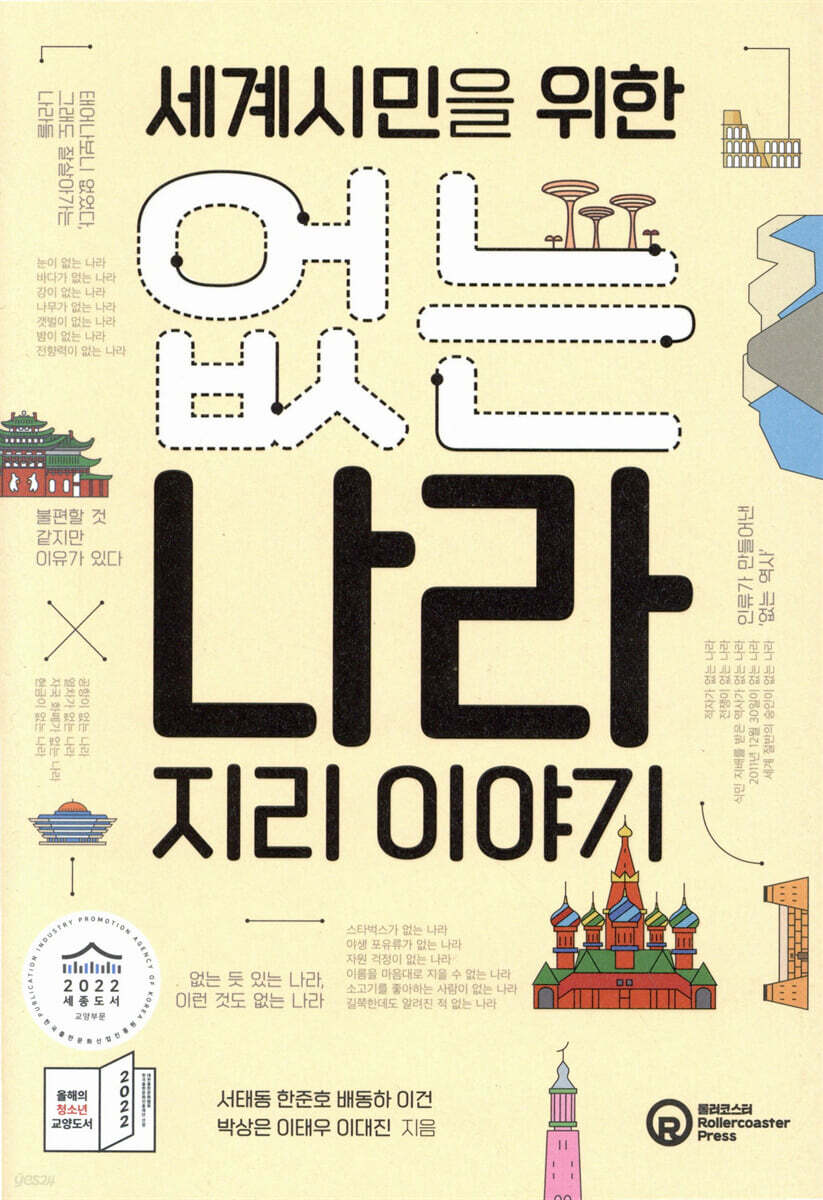
Geography of a Non-existent Country for Global Citizens
 |
Description
Book Introduction
See the world through 'what is not' rather than 'what is'!
Written by seven geography teachers dreaming of understanding and coexistence
A New Normal Geography Textbook with Reverse Thinking
There are countries without seas, and there are countries without airports.
There are countries without tidal flats, and there are countries without their own currency.
For us living in Korea, these are things that are so obvious, but for people in some countries, there are things that they never get to experience in their entire lives.
When we understand the world and study geography, we have always focused on the protagonists of each country.
When talking about polar countries, the focus was on the aurora, and when talking about Southwest Asian countries, the focus was on oil.
But there is no country that has everything, and no country that has nothing.
Therefore, to know what each country 'lacks' is to fully understand the world from various perspectives.
Seven geography teachers who teach students in schools come together to introduce the world through the lens of the reverse thinking of "what is not."
Through this, you will be able to learn about the differences in lifestyle and culture around the world, and develop empathy and consideration for others and the outside world.
Written by seven geography teachers dreaming of understanding and coexistence
A New Normal Geography Textbook with Reverse Thinking
There are countries without seas, and there are countries without airports.
There are countries without tidal flats, and there are countries without their own currency.
For us living in Korea, these are things that are so obvious, but for people in some countries, there are things that they never get to experience in their entire lives.
When we understand the world and study geography, we have always focused on the protagonists of each country.
When talking about polar countries, the focus was on the aurora, and when talking about Southwest Asian countries, the focus was on oil.
But there is no country that has everything, and no country that has nothing.
Therefore, to know what each country 'lacks' is to fully understand the world from various perspectives.
Seven geography teachers who teach students in schools come together to introduce the world through the lens of the reverse thinking of "what is not."
Through this, you will be able to learn about the differences in lifestyle and culture around the world, and develop empathy and consideration for others and the outside world.
- You can preview some of the book's contents.
Preview
index
preface
Chapter 1: Countries That Were Born Without It, Yet Still Prosper
1. A Land Without Snow: More to See, More Romance! _ Singapore
2 A country without a sea: The longing for the sea is eternal _ Mongolia
3 A Country Without Rivers: Conflicts, Disputes, and Innovations Surrounding Water _ Saudi Arabia
4 Treeless Country: A Journey to Happiness in the Harsh Permafrost _ Danish Greenland
5 Countries Without Tidal Flats: Experience the Overwhelming Charm of Coral-Clad Coasts - Tuvalu
6. The Land Without Night: A Beautiful Festival of White Nights Created by a Tilted Earth _ Russia
7. A country without a turning point: Is its name "Equator"? _ Ecuador
Chapter 2 It may seem uncomfortable, but there's a reason.
8 Countries Without Airports: Monaco: Tourism Thrives Even Without Airplanes!
9. A Country Without Trains: Let's Drive Through the Land of Ice and Fire! _ Iceland
10 Countries Without Their Own Currency: Zimbabwe Opts for Dollarization for Its Economy
11 Cashless Countries: The Future is Fast Approaching, Between Incredible Convenience and Deadly Risk _ China
Chapter 3: The "Nonexistent History" Created by Humanity
12 Countries with No Deficits: Japan Enjoyed an Economic Golden Age
13 War-Free Countries: How to Avoid Starting or Being Engaged in War? _ Sweden
14 A country without a history of colonial rule: Overcoming geopolitical crises with exquisite diplomatic strategies _ Thailand
15 December 30, 2011 A country without a day: Samoa, where time and date are determined
A country not recognized by half the world: Can it ever be recognized by the other half? _ Kosovo
Chapter 4: A country that doesn't exist, a country that doesn't have anything like this
17 Countries Without Starbucks: Serious About Coffee! _ Italy
18 A Country Without Wild Mammals: What Threatens This Isolated Island Bird Paradise? _ New Zealand
19 A Country Without Resource Concerns: The Best Gift from the Atacama Desert - Chile
20 A country that cannot be named at will: Erasing a history of domination from the very beginning _ Azerbaijan
21 A Country Where No One Likes Beef: Not Just for Hindus _ India
22 A long and narrow country that is little known: You have to measure it to know whether it is long or short _ Brazil
annotation
Search
Chapter 1: Countries That Were Born Without It, Yet Still Prosper
1. A Land Without Snow: More to See, More Romance! _ Singapore
2 A country without a sea: The longing for the sea is eternal _ Mongolia
3 A Country Without Rivers: Conflicts, Disputes, and Innovations Surrounding Water _ Saudi Arabia
4 Treeless Country: A Journey to Happiness in the Harsh Permafrost _ Danish Greenland
5 Countries Without Tidal Flats: Experience the Overwhelming Charm of Coral-Clad Coasts - Tuvalu
6. The Land Without Night: A Beautiful Festival of White Nights Created by a Tilted Earth _ Russia
7. A country without a turning point: Is its name "Equator"? _ Ecuador
Chapter 2 It may seem uncomfortable, but there's a reason.
8 Countries Without Airports: Monaco: Tourism Thrives Even Without Airplanes!
9. A Country Without Trains: Let's Drive Through the Land of Ice and Fire! _ Iceland
10 Countries Without Their Own Currency: Zimbabwe Opts for Dollarization for Its Economy
11 Cashless Countries: The Future is Fast Approaching, Between Incredible Convenience and Deadly Risk _ China
Chapter 3: The "Nonexistent History" Created by Humanity
12 Countries with No Deficits: Japan Enjoyed an Economic Golden Age
13 War-Free Countries: How to Avoid Starting or Being Engaged in War? _ Sweden
14 A country without a history of colonial rule: Overcoming geopolitical crises with exquisite diplomatic strategies _ Thailand
15 December 30, 2011 A country without a day: Samoa, where time and date are determined
A country not recognized by half the world: Can it ever be recognized by the other half? _ Kosovo
Chapter 4: A country that doesn't exist, a country that doesn't have anything like this
17 Countries Without Starbucks: Serious About Coffee! _ Italy
18 A Country Without Wild Mammals: What Threatens This Isolated Island Bird Paradise? _ New Zealand
19 A Country Without Resource Concerns: The Best Gift from the Atacama Desert - Chile
20 A country that cannot be named at will: Erasing a history of domination from the very beginning _ Azerbaijan
21 A Country Where No One Likes Beef: Not Just for Hindus _ India
22 A long and narrow country that is little known: You have to measure it to know whether it is long or short _ Brazil
annotation
Search
Detailed image

Into the book
This axial tilt of the Earth causes seasons and changes in day length depending on latitude.
Therefore, in the Arctic Ocean coast of northern Greenland and the Barrow region of Alaska, which are part of the Arctic Circle, the summer day is 24 hours long, meaning that the sun does not set even at night, a phenomenon called the midnight sun occurs.
--- p.87 A country without night
But in Monaco, there is no land available to build such a long runway.
First of all, the area is the biggest problem; if you connect the Monaco territory from one end to the other, it is less than 3,500m.
Monaco is so small that even if it were to fill its territory with runways, it wouldn't be enough.
--- p.117 A country without an airport
Eventually, the value of the Zimbabwean dollar continued to plummet, eventually leading to inflation rates exceeding 1 billion percent.
100 trillion Zimbabwean dollars could buy three eggs.
As things got to this point, the Zimbabwean government found it impossible to calculate inflation rates, and the Zimbabwean people stopped using the Zimbabwe dollar.
Eventually, the Zimbabwean government stopped using the Zimbabwean dollar in 2009, and people started using the US dollar.
--- p.146 Countries without their own currency
Sweden's neutrality was put to the test, especially during World War II, when all of Europe became a battlefield.
The Soviet Union invaded its neighboring ally Finland, and Germany occupied Denmark and Norway.
When Sweden was occupied by a major power, neighboring countries that had been close allies in the past asked for help, but Sweden did not change its neutrality and maintained its neutrality.
--- p.191 A country without war
Before saltpeter became valuable as a resource, the saltpeter zone of the Atacama Desert was nothing more than a barren desert that no one cared about.
But the Atacama Desert's salt flats were coveted and became the catalyst for Bolivia's fatal miscalculation.
Ultimately, the cornerstone of the Atacama Desert enabled Chile to become a longer country from north to south, and as a bonus, the high economic growth rate that the cornerstone helped to pave the way for Chile to take another step forward as an economic powerhouse.
Therefore, in the Arctic Ocean coast of northern Greenland and the Barrow region of Alaska, which are part of the Arctic Circle, the summer day is 24 hours long, meaning that the sun does not set even at night, a phenomenon called the midnight sun occurs.
--- p.87 A country without night
But in Monaco, there is no land available to build such a long runway.
First of all, the area is the biggest problem; if you connect the Monaco territory from one end to the other, it is less than 3,500m.
Monaco is so small that even if it were to fill its territory with runways, it wouldn't be enough.
--- p.117 A country without an airport
Eventually, the value of the Zimbabwean dollar continued to plummet, eventually leading to inflation rates exceeding 1 billion percent.
100 trillion Zimbabwean dollars could buy three eggs.
As things got to this point, the Zimbabwean government found it impossible to calculate inflation rates, and the Zimbabwean people stopped using the Zimbabwe dollar.
Eventually, the Zimbabwean government stopped using the Zimbabwean dollar in 2009, and people started using the US dollar.
--- p.146 Countries without their own currency
Sweden's neutrality was put to the test, especially during World War II, when all of Europe became a battlefield.
The Soviet Union invaded its neighboring ally Finland, and Germany occupied Denmark and Norway.
When Sweden was occupied by a major power, neighboring countries that had been close allies in the past asked for help, but Sweden did not change its neutrality and maintained its neutrality.
--- p.191 A country without war
Before saltpeter became valuable as a resource, the saltpeter zone of the Atacama Desert was nothing more than a barren desert that no one cared about.
But the Atacama Desert's salt flats were coveted and became the catalyst for Bolivia's fatal miscalculation.
Ultimately, the cornerstone of the Atacama Desert enabled Chile to become a longer country from north to south, and as a bonus, the high economic growth rate that the cornerstone helped to pave the way for Chile to take another step forward as an economic powerhouse.
--- p.271 A country without resource concerns
Publisher's Review
We are 'global citizens' of a connected planet.
The Earth remains the same, and our country's location hasn't changed, but in recent years we've felt with our whole being that the world is becoming increasingly interconnected.
As international news such as the US presidential election, the Myanmar coup, the Hong Kong democracy movement, and the Ukraine-Russia war crisis are reported more frequently, it is no longer surprising that they are having an impact on the economy, and that many people around the world are enjoying our popular culture such as movies, dramas, and K-pop.
Whether in the city or the countryside, you can easily meet people from abroad, and many Koreans work abroad or even immigrate.
This growing interconnectedness and interdependence of the world means that we are moving beyond being 'citizens' of a single country to acquiring another identity: 'global citizens.'
The reality today is that starting tomorrow, you can collaborate with people from other countries, or even become neighbors or friends.
Are we, living today, ready to become global citizens? What does it take?
What's "Not There" - A Reverse Lens for Understanding the World
The seven geography teachers who authored this book say that what global citizens need is interest in, understanding of, and empathy for people from different countries.
To do this, we look at the world through a new lens called ‘nothingness.’
There are countries on Earth without oceans and without airports.
There are countries without tidal flats, and there are countries without their own currency.
For us living in Korea, these are things that are so obvious, but for people in some countries, there are things that they never experience in their entire lives.
When we understand the world and study geography, we have always focused on the protagonists of each country.
When talking about polar countries, the focus was on the aurora, and when talking about Southwest Asian countries, the focus was on oil.
I also memorized what resources the country had and what kind of climate it had.
In comparison, it is true that we have been less interested in 'what is missing'.
Just as our country has an ocean but no tigers, looking at what other countries have and what they don't will give us a more interesting and three-dimensional understanding of their complete picture.
In "Geography of Countries That Don't Exist for Global Citizens," the "nonexistents" of twenty-two countries are presented in an interesting way.
Some things here were never there from the beginning due to climate or natural environment, while others, such as history, systems, and culture, have ceased to exist over a long period of time through the lives of the people of that country.
Additionally, there are things that are mistakenly known as not existing, or things that were not there originally but suddenly appeared at some point.
In this way, the lens of ‘nothingness’ reveals the characteristics of each country through various angles.
In the post-COVID era, we hope for a humanity of solidarity and peace.
In a time when the world was not as connected as it is today, there was a lot of prejudice and misinformation about other countries, and there were many cases of disparaging other countries' cultures or making derogatory comments about their appearance.
As international travel increases and information exchange becomes more active, such things are now decreasing significantly.
As our world becomes increasingly interconnected and dependent, we face challenges that threaten human survival, such as resource shortages, climate change, and environmental pollution.
To solve this, peace, solidarity, and cooperation must be closely pursued.
In this critical time, facing critical issues in human history and a time of crisis with the growing possibility of international conflict, geography can serve as a crucial pathway to understanding other spaces and empathizing with the people who have lived there.
This book is an interesting lens of reverse thinking, allowing us to understand and empathize with the lives of many people living somewhere in this world different from our own.
Based on this, this book hopes to contribute, even if only a small amount, to creating a society that cares for others and a world of cooperation and solidarity.
The Earth remains the same, and our country's location hasn't changed, but in recent years we've felt with our whole being that the world is becoming increasingly interconnected.
As international news such as the US presidential election, the Myanmar coup, the Hong Kong democracy movement, and the Ukraine-Russia war crisis are reported more frequently, it is no longer surprising that they are having an impact on the economy, and that many people around the world are enjoying our popular culture such as movies, dramas, and K-pop.
Whether in the city or the countryside, you can easily meet people from abroad, and many Koreans work abroad or even immigrate.
This growing interconnectedness and interdependence of the world means that we are moving beyond being 'citizens' of a single country to acquiring another identity: 'global citizens.'
The reality today is that starting tomorrow, you can collaborate with people from other countries, or even become neighbors or friends.
Are we, living today, ready to become global citizens? What does it take?
What's "Not There" - A Reverse Lens for Understanding the World
The seven geography teachers who authored this book say that what global citizens need is interest in, understanding of, and empathy for people from different countries.
To do this, we look at the world through a new lens called ‘nothingness.’
There are countries on Earth without oceans and without airports.
There are countries without tidal flats, and there are countries without their own currency.
For us living in Korea, these are things that are so obvious, but for people in some countries, there are things that they never experience in their entire lives.
When we understand the world and study geography, we have always focused on the protagonists of each country.
When talking about polar countries, the focus was on the aurora, and when talking about Southwest Asian countries, the focus was on oil.
I also memorized what resources the country had and what kind of climate it had.
In comparison, it is true that we have been less interested in 'what is missing'.
Just as our country has an ocean but no tigers, looking at what other countries have and what they don't will give us a more interesting and three-dimensional understanding of their complete picture.
In "Geography of Countries That Don't Exist for Global Citizens," the "nonexistents" of twenty-two countries are presented in an interesting way.
Some things here were never there from the beginning due to climate or natural environment, while others, such as history, systems, and culture, have ceased to exist over a long period of time through the lives of the people of that country.
Additionally, there are things that are mistakenly known as not existing, or things that were not there originally but suddenly appeared at some point.
In this way, the lens of ‘nothingness’ reveals the characteristics of each country through various angles.
In the post-COVID era, we hope for a humanity of solidarity and peace.
In a time when the world was not as connected as it is today, there was a lot of prejudice and misinformation about other countries, and there were many cases of disparaging other countries' cultures or making derogatory comments about their appearance.
As international travel increases and information exchange becomes more active, such things are now decreasing significantly.
As our world becomes increasingly interconnected and dependent, we face challenges that threaten human survival, such as resource shortages, climate change, and environmental pollution.
To solve this, peace, solidarity, and cooperation must be closely pursued.
In this critical time, facing critical issues in human history and a time of crisis with the growing possibility of international conflict, geography can serve as a crucial pathway to understanding other spaces and empathizing with the people who have lived there.
This book is an interesting lens of reverse thinking, allowing us to understand and empathize with the lives of many people living somewhere in this world different from our own.
Based on this, this book hopes to contribute, even if only a small amount, to creating a society that cares for others and a world of cooperation and solidarity.
GOODS SPECIFICS
- Date of issue: March 5, 2022
- Page count, weight, size: 324 pages | 408g | 140*205*20mm
- ISBN13: 9791191311129
- ISBN10: 1191311120
You may also like
카테고리
korean


korean

![GQ KOREA Mark (Monthly): December [2025]](http://librairie.coreenne.fr/cdn/shop/files/8ef265dbbfbf186523ed75ba7319009d.jpg?v=1765340328&width=3840)


