

Classic Toon 1
 |
Description
Book Introduction
In school, you learn knowledge, but what you need to survive in the world is the power to think.
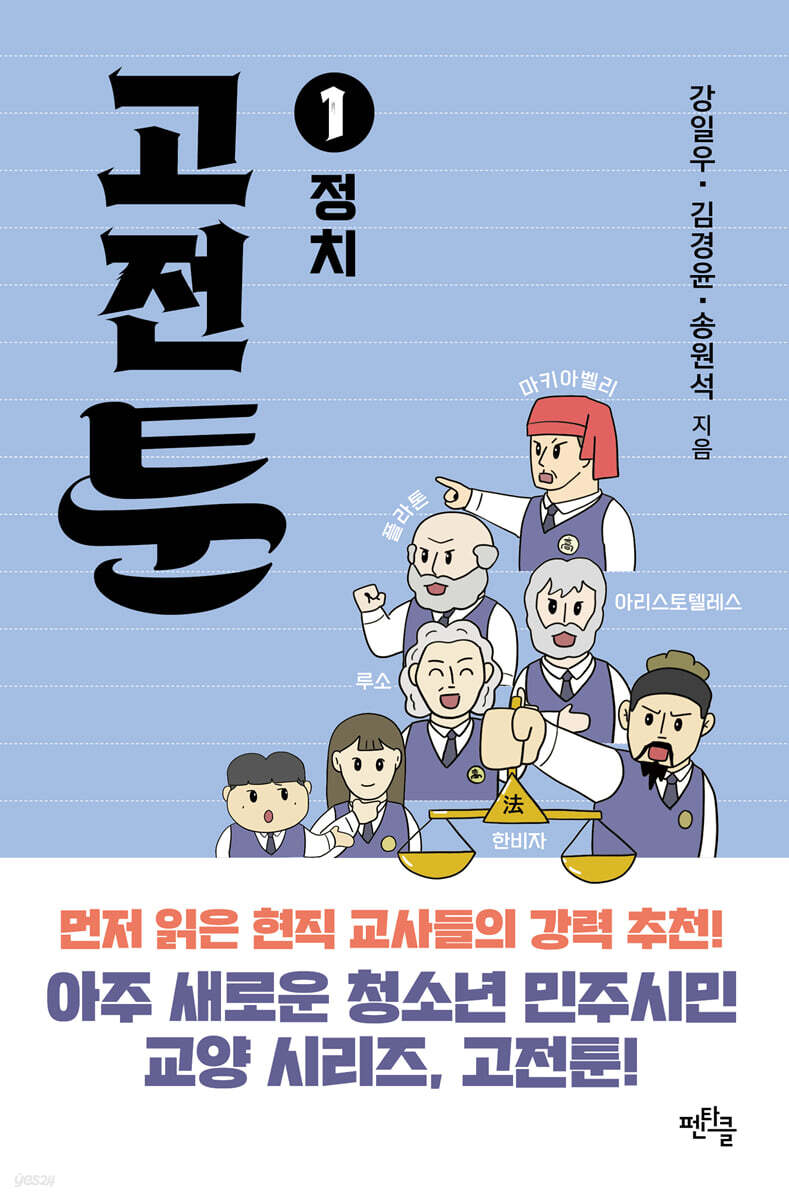
"Classic Toon 1: Politics" is the first volume of a new humanities series that fosters that power, and was created to foster young people who can ask questions, discuss, and judge for themselves through the classics.
This series does not simply introduce classical ideas.
By rereading the lives and times of each thinker and the fundamental questions they raised in today's language, readers are encouraged to embark on their own path of thought.
From Plato's "The Republic" to Rousseau's "The Social Contract," we follow the thoughts of five thinkers from ancient times to the modern era, and ask new questions about the essence of politics: "justice," "freedom," "power," and "order."
This book is not simply an introduction to the philosophers' thoughts; it is a training manual that revives their questions in today's language and leads to independent thought and discussion.
This book, consisting of four axes: history, digest, classic cartoon, and book talk, reinterprets classics not as unfamiliar and difficult textbooks, but as a "language of conversation" that connects with the society we live in today.
In particular, in the concluding chapter, “The Square of Wisdom,” thinkers such as Plato, Hobbes, and Mill come together across time to ask questions.
“Is AI governance possible?”, “Is meritocracy just?”, “Where is the balance between freedom and order?” By following this hypothetical debate, readers will emerge not as “students” of philosophy, but as citizens who think and question.
『Classic Toon 1: Politics』 opens the door to that question, helping you read the world through the classics and develop your own thoughts.
This book will help young people understand the meaning of 'politics' and serve as a solid first step toward becoming thinking citizens.
"Classic Toon 1: Politics" is the first volume of a new humanities series that fosters that power, and was created to foster young people who can ask questions, discuss, and judge for themselves through the classics.
This series does not simply introduce classical ideas.
By rereading the lives and times of each thinker and the fundamental questions they raised in today's language, readers are encouraged to embark on their own path of thought.
From Plato's "The Republic" to Rousseau's "The Social Contract," we follow the thoughts of five thinkers from ancient times to the modern era, and ask new questions about the essence of politics: "justice," "freedom," "power," and "order."
This book is not simply an introduction to the philosophers' thoughts; it is a training manual that revives their questions in today's language and leads to independent thought and discussion.
This book, consisting of four axes: history, digest, classic cartoon, and book talk, reinterprets classics not as unfamiliar and difficult textbooks, but as a "language of conversation" that connects with the society we live in today.
In particular, in the concluding chapter, “The Square of Wisdom,” thinkers such as Plato, Hobbes, and Mill come together across time to ask questions.
“Is AI governance possible?”, “Is meritocracy just?”, “Where is the balance between freedom and order?” By following this hypothetical debate, readers will emerge not as “students” of philosophy, but as citizens who think and question.
『Classic Toon 1: Politics』 opens the door to that question, helping you read the world through the classics and develop your own thoughts.
This book will help young people understand the meaning of 'politics' and serve as a solid first step toward becoming thinking citizens.
- You can preview some of the book's contents.
Preview
index
Foreword_Why Classic Cartoons?│06
Plato's Republic│11
Aristotle's Politics│57
Han Feizi "Han Feizi"│101
Machiavelli's "The Prince"│141
Rousseau's The Social Contract│181
Recommendation_Classic Toon, Must Read!│220
Plato's Republic│11
Aristotle's Politics│57
Han Feizi "Han Feizi"│101
Machiavelli's "The Prince"│141
Rousseau's The Social Contract│181
Recommendation_Classic Toon, Must Read!│220
Detailed image

Into the book
Agora: I think this answer clearly reflects the perspectives of the three teachers.
This time, let's change the subject completely.
Today, we live in an age dominated by artificial intelligence, big data, and social media.
What do you think about the impact of these technologies on politics and society?
Plato: That's a very interesting development.
If AI can make more accurate and objective judgments than humans, wouldn't that be closer to the philosopher king I dreamed of? Unswayed by emotions, unmotivated by personal gain, and capable of making the best decisions based solely on data and logic.
But at the same time, there are concerns.
When you look at social media, you often see people being biased and only hearing what they want to hear rather than the truth.
This is the same situation as the 'Allegory of the Cave' that I spoke of in 'The State'.
The prisoners in the cave mistake the shadows cast by the light shining behind them for the truth, but in reality, there is a greater reality beyond the shadows.
Likewise, people cling to images and biased information on social media and believe that's all there is to it.
But true education and philosophical thinking is a process of stepping out of the cave and facing the sunlight, that is, moving toward the truth beyond appearances.
As technology advances, the need for this kind of philosophical reflection becomes more urgent.
Hobbes: I view technological advancements positively.
Big data and AI can help prevent crime, detect social unrest early, and maintain order more efficiently.
As technology advances, more powerful and efficient control becomes possible, which is necessary for the safety and peace of all.
Of course, fake news and incitement through social media are serious problems that harm social order.
This requires strong regulation and management.
While individual freedom of expression is important, if it can harm the stability and safety of the entire community, the values that should take priority are social peace and order.
--- From the text, "Plato's 'Republic', Book Talk - Is a Just State Possible?"
Agora: Recently, various corruption cases have been breaking out one after another in our society.
Politicians are repeatedly accepting bribes, businesspeople are lobbying for preferential treatment, and civil servants are neglecting their duties.
What approach is needed to solve this problem?
Han Feizi: A strict reward and punishment system must be applied.
Those with greater authority receive greater rewards and punishments.
It is right to thoroughly investigate the truth and punish severely according to the principle of one punishment for one hundred offenses.
Jeong Yak-yong: While it is necessary to reward and punish based on results, the most important thing in eradicating corruption is reforming the personnel system.
We must select people with ability and virtue and create an environment in which they can do their job properly.
The civil service examination system of the Joseon Dynasty was excellent in theory, but in reality, it was operated with a focus on family and academic background, and had many problems.
It was.
To achieve true meritocracy, a fair and objective evaluation system is needed.
The treatment of public officials must also be improved.
It is unreasonable to demand integrity without providing fair compensation.
Public officials should be paid sufficiently to live a dignified life, but they should be held strictly accountable.
Above all, it is important to cultivate a sense of mission as a pastor.
Public office is meant to serve the people, not to pursue personal gain.
Agora: This is a truly fitting answer from the author of “Mokminsimseo.”
Lao Tzu: No matter how well-established your personnel system is, corruption can still spread through its cracks.
We need to eliminate the root cause.
I believe that the root cause of corruption is excessive desire.
Corruption arises because people pursue fame and profit too much.
The fundamental solution is to reduce the desire itself.
First of all, the ruler must be frugal and not greedy.
A saint shines because he does not reveal himself, and is revealed because he does not show himself off.
When those in power like to be flashy and extravagant, the people follow suit.
Agora: It is also a widespread reality that corrupt power holders create corrupt systems.
However, I don't think we can ignore the problems of the system.
Hanbija: That's right.
Corruption is a systemic problem.
It is foolish to rely solely on morality when you have created a structure that can be corrupted.
We must not make people incorruptible, but make them incorruptible.
To do that, first, we need to create a system of checks and balances.
Avoid concentrating too much power in one person, and have multiple people watch over each other.
Second, transparency must be increased.
All decision-making processes must be made public and recorded.
Third, punishment must be clear and severe.
Especially in high-ranking positions, punishment should be more severe.
This is exactly what is meant by the saying, 'The law does not flatter the noble, and the line straightens the crooked.'
The moment those in power think they are above the law, the rule of law collapses.
This time, let's change the subject completely.
Today, we live in an age dominated by artificial intelligence, big data, and social media.
What do you think about the impact of these technologies on politics and society?
Plato: That's a very interesting development.
If AI can make more accurate and objective judgments than humans, wouldn't that be closer to the philosopher king I dreamed of? Unswayed by emotions, unmotivated by personal gain, and capable of making the best decisions based solely on data and logic.
But at the same time, there are concerns.
When you look at social media, you often see people being biased and only hearing what they want to hear rather than the truth.
This is the same situation as the 'Allegory of the Cave' that I spoke of in 'The State'.
The prisoners in the cave mistake the shadows cast by the light shining behind them for the truth, but in reality, there is a greater reality beyond the shadows.
Likewise, people cling to images and biased information on social media and believe that's all there is to it.
But true education and philosophical thinking is a process of stepping out of the cave and facing the sunlight, that is, moving toward the truth beyond appearances.
As technology advances, the need for this kind of philosophical reflection becomes more urgent.
Hobbes: I view technological advancements positively.
Big data and AI can help prevent crime, detect social unrest early, and maintain order more efficiently.
As technology advances, more powerful and efficient control becomes possible, which is necessary for the safety and peace of all.
Of course, fake news and incitement through social media are serious problems that harm social order.
This requires strong regulation and management.
While individual freedom of expression is important, if it can harm the stability and safety of the entire community, the values that should take priority are social peace and order.
--- From the text, "Plato's 'Republic', Book Talk - Is a Just State Possible?"
Agora: Recently, various corruption cases have been breaking out one after another in our society.
Politicians are repeatedly accepting bribes, businesspeople are lobbying for preferential treatment, and civil servants are neglecting their duties.
What approach is needed to solve this problem?
Han Feizi: A strict reward and punishment system must be applied.
Those with greater authority receive greater rewards and punishments.
It is right to thoroughly investigate the truth and punish severely according to the principle of one punishment for one hundred offenses.
Jeong Yak-yong: While it is necessary to reward and punish based on results, the most important thing in eradicating corruption is reforming the personnel system.
We must select people with ability and virtue and create an environment in which they can do their job properly.
The civil service examination system of the Joseon Dynasty was excellent in theory, but in reality, it was operated with a focus on family and academic background, and had many problems.
It was.
To achieve true meritocracy, a fair and objective evaluation system is needed.
The treatment of public officials must also be improved.
It is unreasonable to demand integrity without providing fair compensation.
Public officials should be paid sufficiently to live a dignified life, but they should be held strictly accountable.
Above all, it is important to cultivate a sense of mission as a pastor.
Public office is meant to serve the people, not to pursue personal gain.
Agora: This is a truly fitting answer from the author of “Mokminsimseo.”
Lao Tzu: No matter how well-established your personnel system is, corruption can still spread through its cracks.
We need to eliminate the root cause.
I believe that the root cause of corruption is excessive desire.
Corruption arises because people pursue fame and profit too much.
The fundamental solution is to reduce the desire itself.
First of all, the ruler must be frugal and not greedy.
A saint shines because he does not reveal himself, and is revealed because he does not show himself off.
When those in power like to be flashy and extravagant, the people follow suit.
Agora: It is also a widespread reality that corrupt power holders create corrupt systems.
However, I don't think we can ignore the problems of the system.
Hanbija: That's right.
Corruption is a systemic problem.
It is foolish to rely solely on morality when you have created a structure that can be corrupted.
We must not make people incorruptible, but make them incorruptible.
To do that, first, we need to create a system of checks and balances.
Avoid concentrating too much power in one person, and have multiple people watch over each other.
Second, transparency must be increased.
All decision-making processes must be made public and recorded.
Third, punishment must be clear and severe.
Especially in high-ranking positions, punishment should be more severe.
This is exactly what is meant by the saying, 'The law does not flatter the noble, and the line straightens the crooked.'
The moment those in power think they are above the law, the rule of law collapses.
--- From the text "Han Feizi, 'Han Feizi', Book Talk - Should we rule by law or lead by heart?"
Publisher's Review
In the AI era, where knowledge overflows, the power to think has disappeared.
A new humanities series to fill that void: Classic Toon
The world demands only quick answers, and AI has begun to replace judgment, but true learning still begins with the power of thinking. "Classic Toon" is a new youth humanities series that cultivates that power, encouraging students to think and discuss for themselves rather than memorizing knowledge, and to understand the world.
Classics are not old texts, but mirrors that reflect the present, and philosophy is not an abstract discipline, but a 'language of thought' for living together.
Pentacle's "Classic Toon" series was designed to help young people learn to go beyond textbook knowledge, understand people and society, and develop the ability to communicate while respecting each other's thoughts.
In an age overflowing with information, this is the most needed youth education series that helps us rediscover the ability to 'think slowly.'
Politics is not about ideology, but about asking how humans should live together.
"Classic Toon 1 - Politics" opens the first chapter of that question.
Plato, Aristotle, Han Feizi, Machiavelli, Rousseau…
We follow the thoughts of five philosophers who represent human political thought and explore the questions, "What is justice?", "Where does power derive its legitimacy?", and "How can freedom and order be harmonized?"
Plato speaks of the rule of philosophers, Aristotle of the community of citizens, Han Feizi of law and order, Machiavelli of the art of power, and Rousseau of the ideals of freedom and equality.
This book weaves together the lives and thoughts of each thinker like a story, guiding young people to naturally explore the world of philosophy.
The learning journey, which begins with history, digest, classic cartoons, and book talk, is completed in the final chapter, “Book Talk: Wisdom Square.”
Philosophers from different eras come together to offer wisdom on real-world issues such as AI governance, meritocracy, and the fatigue of democracy.
Plato speaks of justice, Hobbes speaks of the authority of the state, and Mill speaks of the limits of freedom.
In this conversation, the reader grows beyond being a mere 'student who reads' to a 'democratic citizen' who thinks and judges for himself.
『Classical Toon』 does not teach the correct answers to philosophy to young people.
Instead, it is a book that asks and teaches us 'how to think'.
Toon is the starting point of reasoning, and Book Talk is the process of approaching the truth.
『Classic Toon』 makes us think together
This book is not just a simple educational cartoon.
Comics are merely a visual aid to help us understand complex concepts, but the key lies in deeply understanding the context of each thinker's thoughts and the issues of the times.
So, in the classroom, it is used as a textbook for discussion classes, and at home, it is used as a cultural book for parents and children to read together.
The series begins with 'politics' and moves on to 'economy', 'environment', 'culture', and 'history', helping young people develop the ability to understand and participate in the world, that is, the thinking and empathy of democratic citizens.
『Classic Toon 1 - Politics』 is the first chapter of that journey.
Reading classics is not about learning about the past, but rather about gaining a deeper understanding of the society we live in today.
This book will be the most friendly and reliable companion for young people, teaching them the 'language of thought' and awakening them to the ways to question, discuss, and grow for themselves.
With each page you turn, your scope of thought expands, and with each page you open, your perspective on the world changes.
Thinking students change the world.
The book that current teachers read first and most recommend to students!
『Classic Toon 1 - Politics』 received enthusiastic responses and recommendations from current Korean language and social studies teachers who read the manuscript before publication.
It was also selected as a recommended book by the National Social Studies Teachers Association, with reviews such as “an excellent textbook for reading and discussing together in class” and “a book that reminds us of the essence of democratic citizenship education.”
Teachers who have met students directly in the educational field say that this book is not just a humanities book for young people, but will be a practical liberal arts class that will allow them to experience the 'power of thinking.'
Students develop logical thinking and empathy skills by following the language of the thinkers who have illuminated human history, and teachers gain the opportunity to restore a "space for discussion and reflection" in the classroom.
『Classic Toon』 goes beyond the limitations of textbooks, allowing students to develop their own opinions, discuss them, and broaden their thinking.
In the process, children learn to listen to the thoughts of others and organize their own thoughts into words.
That is the muscle of democracy, the power to grow as a citizen.
In the classroom, at home, out in the world…
"Classic Toon" is a new textbook for youth democratic citizenship education.
This book serves as a living teaching tool for teachers in the field, a stepping stone for parents to engage in conversations with their children, and a guide for students to find their own direction in thinking.
"Classical Toon" is a new experiment in humanities education that revives classics in "contemporary language" and connects the classroom and the world beyond the limitations of textbooks.
Through this book, young people begin to read the world through the language of classics and practice changing the world with their own thoughts.
In an era where we are moving from 'reading education' to 'thinking education,' 『Classic Toon』 will be the most reliable first book to lead that change.
A new humanities series to fill that void: Classic Toon
The world demands only quick answers, and AI has begun to replace judgment, but true learning still begins with the power of thinking. "Classic Toon" is a new youth humanities series that cultivates that power, encouraging students to think and discuss for themselves rather than memorizing knowledge, and to understand the world.
Classics are not old texts, but mirrors that reflect the present, and philosophy is not an abstract discipline, but a 'language of thought' for living together.
Pentacle's "Classic Toon" series was designed to help young people learn to go beyond textbook knowledge, understand people and society, and develop the ability to communicate while respecting each other's thoughts.
In an age overflowing with information, this is the most needed youth education series that helps us rediscover the ability to 'think slowly.'
Politics is not about ideology, but about asking how humans should live together.
"Classic Toon 1 - Politics" opens the first chapter of that question.
Plato, Aristotle, Han Feizi, Machiavelli, Rousseau…
We follow the thoughts of five philosophers who represent human political thought and explore the questions, "What is justice?", "Where does power derive its legitimacy?", and "How can freedom and order be harmonized?"
Plato speaks of the rule of philosophers, Aristotle of the community of citizens, Han Feizi of law and order, Machiavelli of the art of power, and Rousseau of the ideals of freedom and equality.
This book weaves together the lives and thoughts of each thinker like a story, guiding young people to naturally explore the world of philosophy.
The learning journey, which begins with history, digest, classic cartoons, and book talk, is completed in the final chapter, “Book Talk: Wisdom Square.”
Philosophers from different eras come together to offer wisdom on real-world issues such as AI governance, meritocracy, and the fatigue of democracy.
Plato speaks of justice, Hobbes speaks of the authority of the state, and Mill speaks of the limits of freedom.
In this conversation, the reader grows beyond being a mere 'student who reads' to a 'democratic citizen' who thinks and judges for himself.
『Classical Toon』 does not teach the correct answers to philosophy to young people.
Instead, it is a book that asks and teaches us 'how to think'.
Toon is the starting point of reasoning, and Book Talk is the process of approaching the truth.
『Classic Toon』 makes us think together
This book is not just a simple educational cartoon.
Comics are merely a visual aid to help us understand complex concepts, but the key lies in deeply understanding the context of each thinker's thoughts and the issues of the times.
So, in the classroom, it is used as a textbook for discussion classes, and at home, it is used as a cultural book for parents and children to read together.
The series begins with 'politics' and moves on to 'economy', 'environment', 'culture', and 'history', helping young people develop the ability to understand and participate in the world, that is, the thinking and empathy of democratic citizens.
『Classic Toon 1 - Politics』 is the first chapter of that journey.
Reading classics is not about learning about the past, but rather about gaining a deeper understanding of the society we live in today.
This book will be the most friendly and reliable companion for young people, teaching them the 'language of thought' and awakening them to the ways to question, discuss, and grow for themselves.
With each page you turn, your scope of thought expands, and with each page you open, your perspective on the world changes.
Thinking students change the world.
The book that current teachers read first and most recommend to students!
『Classic Toon 1 - Politics』 received enthusiastic responses and recommendations from current Korean language and social studies teachers who read the manuscript before publication.
It was also selected as a recommended book by the National Social Studies Teachers Association, with reviews such as “an excellent textbook for reading and discussing together in class” and “a book that reminds us of the essence of democratic citizenship education.”
Teachers who have met students directly in the educational field say that this book is not just a humanities book for young people, but will be a practical liberal arts class that will allow them to experience the 'power of thinking.'
Students develop logical thinking and empathy skills by following the language of the thinkers who have illuminated human history, and teachers gain the opportunity to restore a "space for discussion and reflection" in the classroom.
『Classic Toon』 goes beyond the limitations of textbooks, allowing students to develop their own opinions, discuss them, and broaden their thinking.
In the process, children learn to listen to the thoughts of others and organize their own thoughts into words.
That is the muscle of democracy, the power to grow as a citizen.
In the classroom, at home, out in the world…
"Classic Toon" is a new textbook for youth democratic citizenship education.
This book serves as a living teaching tool for teachers in the field, a stepping stone for parents to engage in conversations with their children, and a guide for students to find their own direction in thinking.
"Classical Toon" is a new experiment in humanities education that revives classics in "contemporary language" and connects the classroom and the world beyond the limitations of textbooks.
Through this book, young people begin to read the world through the language of classics and practice changing the world with their own thoughts.
In an era where we are moving from 'reading education' to 'thinking education,' 『Classic Toon』 will be the most reliable first book to lead that change.
GOODS SPECIFICS
- Date of issue: November 7, 2025
- Page count, weight, size: 226 pages | 140*210*20mm
- ISBN13: 9791199239098
- ISBN10: 1199239097
You may also like
카테고리
korean


korean

![GQ KOREA Mark (Monthly): December [2025]](http://librairie.coreenne.fr/cdn/shop/files/8ef265dbbfbf186523ed75ba7319009d.jpg?v=1765340328&width=3840)


