

Climate Traveler
 |
Description
Book Introduction
The climate crisis that has made travel impossible for everyone
Overtourism: How Travel Ruins Travel
To continue traveling, travelers must change first.
Every year, during holidays or long vacation seasons, the airport is filled with people leaving.
Although temporarily halted by the coronavirus pandemic, the number of travelers, especially international travelers, is returning to its previous levels and is expected to continue breaking new records.
Whenever I hear news like that, it feels like everyone in the world is going on a trip.
However, only 5% of the world's population is actually able to travel abroad.
Even in countries that are part of the G20, it is a special experience that only a very small number of people can enjoy.
In the aviation sector in particular, the top 1% accounts for 50% of greenhouse gas emissions from travel, with Korean travelers accounting for a significant portion of this.
In fact, Korea has long been a so-called "climate villain," with the potential to become the world's largest emitter of carbon dioxide per capita by 2030 if things continue as they are, and some of that is due to travel.
In a world where the carbon emissions of frequent travelers are often borne by those who don't travel, an unfair burden, this book begins by asking the question, "Is it okay to continue traveling in the age of climate crisis?"
Even if climate disasters like heat waves and floods are avoided, travelers fleeing the same disasters will flock to specific destinations, competing for limited space and resources.
The climate crisis and overtourism create a vicious cycle that harms not only travelers but also local residents.
If travel, originally intended to be a pursuit of relaxation, enjoyment, new experiences, and learning, ends up ruining someone's life or destroying the natural environment, we need to change the way we travel, which is accelerating this crisis.
While travelers have primarily thought about 'where' and 'how' to go, those concerned with the sustainability of travel envision 'how little, how deeply, and how long' to stay.
The author, a long-time fair trade traveler, explores the true meaning of travel today and introduces the people, places, projects, and methods working toward sustainable travel.
The author suggests climate travel as a small milestone for travelers lost in the climate crisis and overtourism.
Climate tourism refers to fair travel in the era of climate crisis, where locals and travelers work together to create ecologically safe and socially just regions and places through travel.
Overtourism: How Travel Ruins Travel
To continue traveling, travelers must change first.
Every year, during holidays or long vacation seasons, the airport is filled with people leaving.
Although temporarily halted by the coronavirus pandemic, the number of travelers, especially international travelers, is returning to its previous levels and is expected to continue breaking new records.
Whenever I hear news like that, it feels like everyone in the world is going on a trip.
However, only 5% of the world's population is actually able to travel abroad.
Even in countries that are part of the G20, it is a special experience that only a very small number of people can enjoy.
In the aviation sector in particular, the top 1% accounts for 50% of greenhouse gas emissions from travel, with Korean travelers accounting for a significant portion of this.
In fact, Korea has long been a so-called "climate villain," with the potential to become the world's largest emitter of carbon dioxide per capita by 2030 if things continue as they are, and some of that is due to travel.
In a world where the carbon emissions of frequent travelers are often borne by those who don't travel, an unfair burden, this book begins by asking the question, "Is it okay to continue traveling in the age of climate crisis?"
Even if climate disasters like heat waves and floods are avoided, travelers fleeing the same disasters will flock to specific destinations, competing for limited space and resources.
The climate crisis and overtourism create a vicious cycle that harms not only travelers but also local residents.
If travel, originally intended to be a pursuit of relaxation, enjoyment, new experiences, and learning, ends up ruining someone's life or destroying the natural environment, we need to change the way we travel, which is accelerating this crisis.
While travelers have primarily thought about 'where' and 'how' to go, those concerned with the sustainability of travel envision 'how little, how deeply, and how long' to stay.
The author, a long-time fair trade traveler, explores the true meaning of travel today and introduces the people, places, projects, and methods working toward sustainable travel.
The author suggests climate travel as a small milestone for travelers lost in the climate crisis and overtourism.
Climate tourism refers to fair travel in the era of climate crisis, where locals and travelers work together to create ecologically safe and socially just regions and places through travel.
- You can preview some of the book's contents.
Preview
index
Introduction | New Travel in the Age of Climate Crisis
Chapter 1° Travel in an Age of Impossibility
Chapter 2° Travel: If You Can't Stop, You Have to Change
Chapter 3° Climate Crisis and Overtourism
1.
Venice, the front line of the climate crisis
2.
Barcelona, the fearless city
3.
Copenhagen, a carbon-neutral city
Chapter 4: Practices for a 1.5℃ Climate Travel
1.
How to move?
2.
Where should I stay?
3.
What should I eat?
Chapter 5: Zero-Waste Travel for the Earth
1.
Plastic and Travel
2.
People Creating a Plastic-Free Bali
3.
Zero Waste Vegan Fair Trade Travel
Chapter 6° Travel Less Frequently, Deeper, and Longer
1.
The power of staying in
2.
ViaVia, a platform connecting villages and the world
3.
A journey that connects to someone's life
Chapter 7: Nature-Positive Travel: Protecting Breath and Life
1.
If the natural ecosystem collapses, there will be no travel.
2.
People who protect the breath and life of Lapland
A Guide for Climate Travelers
America, photo source
Chapter 1° Travel in an Age of Impossibility
Chapter 2° Travel: If You Can't Stop, You Have to Change
Chapter 3° Climate Crisis and Overtourism
1.
Venice, the front line of the climate crisis
2.
Barcelona, the fearless city
3.
Copenhagen, a carbon-neutral city
Chapter 4: Practices for a 1.5℃ Climate Travel
1.
How to move?
2.
Where should I stay?
3.
What should I eat?
Chapter 5: Zero-Waste Travel for the Earth
1.
Plastic and Travel
2.
People Creating a Plastic-Free Bali
3.
Zero Waste Vegan Fair Trade Travel
Chapter 6° Travel Less Frequently, Deeper, and Longer
1.
The power of staying in
2.
ViaVia, a platform connecting villages and the world
3.
A journey that connects to someone's life
Chapter 7: Nature-Positive Travel: Protecting Breath and Life
1.
If the natural ecosystem collapses, there will be no travel.
2.
People who protect the breath and life of Lapland
A Guide for Climate Travelers
America, photo source
Detailed image
Into the book
The tourism industry has also sensed people's thirst and desire for travel and launched new marketing strategies.
Last Chance Tourism has emerged, offering a chance to experience the last of Earth's beauty before the glaciers melt, the Himalayan ice caps disappear, and the Great Barrier Reefs become extinct.
Travel to Antarctica is booming, traffic jams are appearing in the Himalayas, and cruise tours to see the Northern Lights are difficult to book.
A world where the groans of a dying Earth and the mad rush of overtourism, fearing that its appearance will disappear, coexist, the back of travel that destroys beautiful places in order to see beautiful things, is the coordinates where we stand today.
For travelers accustomed to traditional travel, the invitation to become a climate traveler can be unfamiliar and uncomfortable.
But if the one step we choose now is the only way to keep global warming within 1.5℃, if our small, insignificant choices are the only way to create a huge change, then wouldn't that unfamiliar and uncomfortable sensation be transformed into a new and meaningful one?
--- From "Introduction│New Journey in the Age of Climate Crisis"
Vacations may only last a few days of the year, but in terms of carbon emissions, a single long-haul flight can consume close to 50% of your annual allowance.
So, should we go back to a world without travel, like during the pandemic?
Koreans would need four more Earths to sustain their current lifestyle.
Unless we choose to embrace new standards and values in our daily lives and travel, we will be at the forefront of a massive acceleration that is not only causing the climate crisis but also the collapse of biodiversity and driving us toward mass extinction.
--- From "Chapter 2: Travel, If You Can't Stop, You Have to Change"
The 1.5℃ lifestyle is not a one-time campaign that stops at small practices like using tumblers and eco-bags or self-comfort.
It is a journey that encompasses climate politics, starting with individual change and transforming the systems and structures of society to create social transition.
“We are not against tourism.
“I am against giving the city itself to tourism.”
--- From "Chapter 3: Climate Crisis and Overtourism"
If we experience travel with different values and standards, we can begin a new daily routine that considers the Earth and cares for the local community even when we return.
This is because traveling is a time to make new choices about everything we normally do without thinking: eating, drinking, sleeping, and moving.
--- From "Chapter 4: Practice for a 1.5℃ Climate Travel"
“Jevi Travel is an abbreviation for ‘Zero Waste + Vegan + Fair Travel,’ and it refers to a trip that connects people and new spaces through veganism and zero waste.”
--- From "Chapter 5: Zero Waste Travel for the Earth"
“When you feel like so much is wrong with the world, it’s not easy to take action to make a difference.
But in our little world, we can do most things.
And if you don't participate in that world, you won't know why the world is changing the way it is, and you'll never be able to make a difference.”
Last Chance Tourism has emerged, offering a chance to experience the last of Earth's beauty before the glaciers melt, the Himalayan ice caps disappear, and the Great Barrier Reefs become extinct.
Travel to Antarctica is booming, traffic jams are appearing in the Himalayas, and cruise tours to see the Northern Lights are difficult to book.
A world where the groans of a dying Earth and the mad rush of overtourism, fearing that its appearance will disappear, coexist, the back of travel that destroys beautiful places in order to see beautiful things, is the coordinates where we stand today.
For travelers accustomed to traditional travel, the invitation to become a climate traveler can be unfamiliar and uncomfortable.
But if the one step we choose now is the only way to keep global warming within 1.5℃, if our small, insignificant choices are the only way to create a huge change, then wouldn't that unfamiliar and uncomfortable sensation be transformed into a new and meaningful one?
--- From "Introduction│New Journey in the Age of Climate Crisis"
Vacations may only last a few days of the year, but in terms of carbon emissions, a single long-haul flight can consume close to 50% of your annual allowance.
So, should we go back to a world without travel, like during the pandemic?
Koreans would need four more Earths to sustain their current lifestyle.
Unless we choose to embrace new standards and values in our daily lives and travel, we will be at the forefront of a massive acceleration that is not only causing the climate crisis but also the collapse of biodiversity and driving us toward mass extinction.
--- From "Chapter 2: Travel, If You Can't Stop, You Have to Change"
The 1.5℃ lifestyle is not a one-time campaign that stops at small practices like using tumblers and eco-bags or self-comfort.
It is a journey that encompasses climate politics, starting with individual change and transforming the systems and structures of society to create social transition.
“We are not against tourism.
“I am against giving the city itself to tourism.”
--- From "Chapter 3: Climate Crisis and Overtourism"
If we experience travel with different values and standards, we can begin a new daily routine that considers the Earth and cares for the local community even when we return.
This is because traveling is a time to make new choices about everything we normally do without thinking: eating, drinking, sleeping, and moving.
--- From "Chapter 4: Practice for a 1.5℃ Climate Travel"
“Jevi Travel is an abbreviation for ‘Zero Waste + Vegan + Fair Travel,’ and it refers to a trip that connects people and new spaces through veganism and zero waste.”
--- From "Chapter 5: Zero Waste Travel for the Earth"
“When you feel like so much is wrong with the world, it’s not easy to take action to make a difference.
But in our little world, we can do most things.
And if you don't participate in that world, you won't know why the world is changing the way it is, and you'll never be able to make a difference.”
--- From "Chapter 6: Travel Less Frequently, Deeper, and Longer"
Publisher's Review
In the age of mass travel, South Korea has become a climate villain.
If you want to continue traveling, you have to change your travel.
It is truly the age of great travel.
YouTube is filled with new travel information in real time, and airports are teeming with travelers every day.
In 2023, 22.7 million Koreans will have traveled abroad, a staggering number roughly equivalent to one in two Koreans.
Moreover, with 14 million people leaving the country in the first half of 2024 alone, the number of overseas travelers in 2024 could surpass the 28 million that peaked in 2019, just before the pandemic.
When I look around, it seems like everyone in the world is traveling.
However, if we look at the specific statistics, it is surprising that only about 5% of the world's population is actually able to travel abroad.
Air travel, in particular, is a special experience that only a very small number of people, even in G20 countries, can enjoy.
This reality of unequal travel also reveals discrimination in the side effects of travel.
The problem is carbon emissions.
South Korea has long been a so-called "climate villain," to the point that it is projected to rank first in the world in per capita carbon dioxide emissions by 2030.
Naturally, the tourism industry also accounts for a large portion (about 10%) here.
With so many people in the Global South who have never traveled abroad suffering devastating damage from the carbon emissions of a small number of Northern travelers, it's time for us to take a responsible look at our own travels.
Because, as we have already experienced, the time of free travel can be interrupted again at any time.
The climate crisis that has made travel impossible for everyone
Overtourism: How Travel Ruins Travel
This book begins with the question, “Is it okay to continue traveling in the era of climate crisis?”
This is a weighty question posed to himself and to all of us by the author, who has been promoting the importance and value of fair trade travel both domestically and internationally for over 20 years.
Even as climate disasters like heat waves and floods accelerate around the world, our desire to travel more often and more continues to grow.
This climate crisis and overtourism create a vicious cycle, destroying the local environment and the lives of local residents.
Will we ever be able to travel to these damaged and ruined places again? Are current travelers depriving future travelers of the rest, pleasure, new experiences, and learning opportunities they could enjoy?
We have already exhausted about 90% of the carbon budget we could use to prevent a 1.5°C rise in the global average temperature.
Of the remaining 500 billion tons, humanity uses more than 59 billion tons of carbon every year, and has less than 10 years left.
Page 49
While travelers have primarily thought about 'where' and 'how' to go, those concerned about the sustainability of travel should imagine 'how little, how deeply, and how long' they will stay.
Despite living in an era where travel is impossible, the author, determined not to give up the beautiful things he has encountered on his travels, takes steps toward sustainable travel.
That is ‘climate travel’.
Climate tourism refers to fair and responsible travel in the era of climate crisis, where locals and travelers work together to create ecologically safe and socially just regions and places through travel.
A Guide for Travelers in a 1.5℃ Climate
Dreaming of joyful sustainability
Climate travel is a travel method based on 'pleasant sustainability' above all else.
This concept, created by Danish architect Bjarke Ingels, embodies the philosophy that sustainability should not be perceived as an ethical or obligatory task or value, but as a pleasant and enjoyable everyday experience, a joy of living felt in space and place.
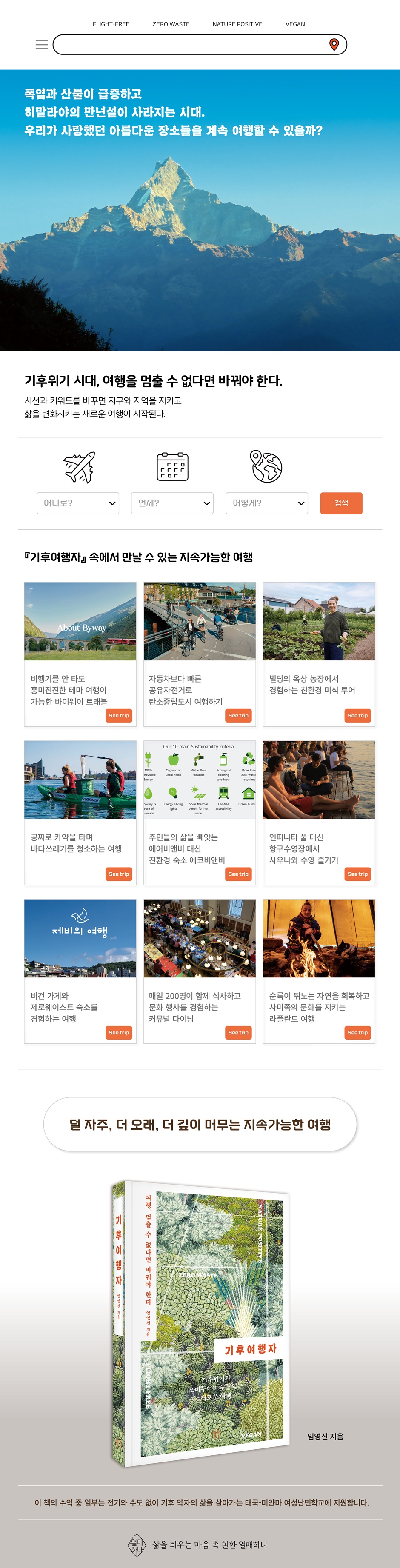
For example, Byway Travel, a UK-based travel startup that offers "flight-free travel," is a fast-growing travel startup that demonstrates that fun travel is possible in new ways, such as off-season travel, late summer travel, and overnight train travel.
Climate travel is also not limited to individual activities.
This is also possible through social enterprise activities like Fairbnb and Ecobnb, which were established to prevent the negative effects of Airbnb, or through policies in cities suffering from overtourism like Venice and Barcelona.
What's important is not to monopolize or use up all the good things for me, but to have a fun imagination and a spirit of solidarity to share them with those around me now and those to come.
The book identifies the challenges of the climate crisis, while also showing how travelers can make alternative choices and engage in new activities as they move, stay, and eat.
Information about 'Refill My Bottle', which tells you about stores where you can fill your tumbler with water instead of plastic bottles, 'Green Kayak', which lets you enjoy kayaking for free while collecting ocean trash at the same time, a project that turns discarded plastic into rice of the same weight, and 'Better Moon', a vegan cafe and accommodation that practices zero waste and uses local ingredients, will enrich our lives and travels.
Climate travelers aren't just those who pack their backpacks and head off to other cities and regions.
Climate travelers are people who welcome travelers where they live, and those who put into practice what they learned from their travels after returning to their daily lives.
If travel is inseparable from our lives, we must create beautiful changes so that travel not only saves the local community and the planet, but also enriches the lives of travelers.
I hope this book will serve as inspiration to climate citizens who will nurture the Earth for all through their own lives.
If you want to continue traveling, you have to change your travel.
It is truly the age of great travel.
YouTube is filled with new travel information in real time, and airports are teeming with travelers every day.
In 2023, 22.7 million Koreans will have traveled abroad, a staggering number roughly equivalent to one in two Koreans.
Moreover, with 14 million people leaving the country in the first half of 2024 alone, the number of overseas travelers in 2024 could surpass the 28 million that peaked in 2019, just before the pandemic.
When I look around, it seems like everyone in the world is traveling.
However, if we look at the specific statistics, it is surprising that only about 5% of the world's population is actually able to travel abroad.
Air travel, in particular, is a special experience that only a very small number of people, even in G20 countries, can enjoy.
This reality of unequal travel also reveals discrimination in the side effects of travel.
The problem is carbon emissions.
South Korea has long been a so-called "climate villain," to the point that it is projected to rank first in the world in per capita carbon dioxide emissions by 2030.
Naturally, the tourism industry also accounts for a large portion (about 10%) here.
With so many people in the Global South who have never traveled abroad suffering devastating damage from the carbon emissions of a small number of Northern travelers, it's time for us to take a responsible look at our own travels.
Because, as we have already experienced, the time of free travel can be interrupted again at any time.
The climate crisis that has made travel impossible for everyone
Overtourism: How Travel Ruins Travel
This book begins with the question, “Is it okay to continue traveling in the era of climate crisis?”
This is a weighty question posed to himself and to all of us by the author, who has been promoting the importance and value of fair trade travel both domestically and internationally for over 20 years.
Even as climate disasters like heat waves and floods accelerate around the world, our desire to travel more often and more continues to grow.
This climate crisis and overtourism create a vicious cycle, destroying the local environment and the lives of local residents.
Will we ever be able to travel to these damaged and ruined places again? Are current travelers depriving future travelers of the rest, pleasure, new experiences, and learning opportunities they could enjoy?
We have already exhausted about 90% of the carbon budget we could use to prevent a 1.5°C rise in the global average temperature.
Of the remaining 500 billion tons, humanity uses more than 59 billion tons of carbon every year, and has less than 10 years left.
Page 49
While travelers have primarily thought about 'where' and 'how' to go, those concerned about the sustainability of travel should imagine 'how little, how deeply, and how long' they will stay.
Despite living in an era where travel is impossible, the author, determined not to give up the beautiful things he has encountered on his travels, takes steps toward sustainable travel.
That is ‘climate travel’.
Climate tourism refers to fair and responsible travel in the era of climate crisis, where locals and travelers work together to create ecologically safe and socially just regions and places through travel.
A Guide for Travelers in a 1.5℃ Climate
Dreaming of joyful sustainability
Climate travel is a travel method based on 'pleasant sustainability' above all else.
This concept, created by Danish architect Bjarke Ingels, embodies the philosophy that sustainability should not be perceived as an ethical or obligatory task or value, but as a pleasant and enjoyable everyday experience, a joy of living felt in space and place.
For example, Byway Travel, a UK-based travel startup that offers "flight-free travel," is a fast-growing travel startup that demonstrates that fun travel is possible in new ways, such as off-season travel, late summer travel, and overnight train travel.
Climate travel is also not limited to individual activities.
This is also possible through social enterprise activities like Fairbnb and Ecobnb, which were established to prevent the negative effects of Airbnb, or through policies in cities suffering from overtourism like Venice and Barcelona.
What's important is not to monopolize or use up all the good things for me, but to have a fun imagination and a spirit of solidarity to share them with those around me now and those to come.
The book identifies the challenges of the climate crisis, while also showing how travelers can make alternative choices and engage in new activities as they move, stay, and eat.
Information about 'Refill My Bottle', which tells you about stores where you can fill your tumbler with water instead of plastic bottles, 'Green Kayak', which lets you enjoy kayaking for free while collecting ocean trash at the same time, a project that turns discarded plastic into rice of the same weight, and 'Better Moon', a vegan cafe and accommodation that practices zero waste and uses local ingredients, will enrich our lives and travels.
Climate travelers aren't just those who pack their backpacks and head off to other cities and regions.
Climate travelers are people who welcome travelers where they live, and those who put into practice what they learned from their travels after returning to their daily lives.
If travel is inseparable from our lives, we must create beautiful changes so that travel not only saves the local community and the planet, but also enriches the lives of travelers.
I hope this book will serve as inspiration to climate citizens who will nurture the Earth for all through their own lives.
GOODS SPECIFICS
- Date of issue: January 31, 2025
- Page count, weight, size: 252 pages | 338g | 140*210*20mm
- ISBN13: 9791190222419
- ISBN10: 1190222418
You may also like
카테고리
korean


korean

![ELLE 엘르 스페셜 에디션 A형 : 12월 [2025]](http://librairie.coreenne.fr/cdn/shop/files/b8e27a3de6c9538896439686c6b0e8fb.jpg?v=1766436872&width=3840)


