

The key to all infectious diseases
 |
Description
Book Introduction
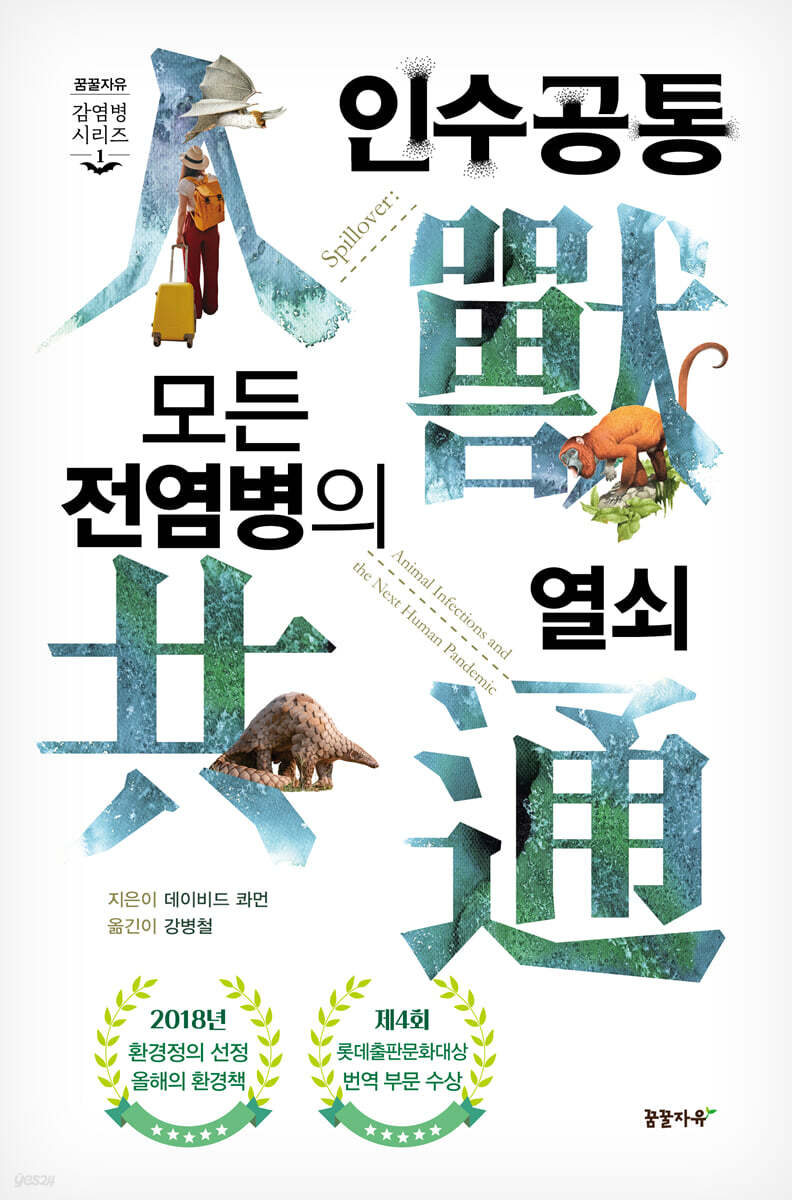
A stunning masterpiece by world-renowned science writer David Quammen, following in the footsteps of "The Song of the Dodo"!
Why are zoonotic infectious diseases important? Because they are the key to understanding all infectious diseases!
What do the following have in common: avian influenza, which comes back when we forget and annihilates chickens and threatens human health; SARS, which terrified the world; Ebola, which is causing terrible suffering and death to Africans; AIDS, the pandemic that killed 29 million people and infected over 30 million; MERS, which paralyzed our entire country in 2015; and hemolytic uremic syndrome, also known as "hamburger disease"? They are all zoonotic diseases, caused by animal pathogens crossing over to humans.
Why do animal pathogens jump to humans? Because of contact between humans and animals.
Such contacts have occurred constantly throughout human history.
But now, as human numbers and capabilities have exploded, the indiscriminate invasion of animal habitats is increasing more than ever.
This book takes us on a journey through bat caves in southern China, the food markets of Guangdong Province, remote villages along the Congo River, the jungles of Central Africa, the remote countryside of Bangladesh, the rainforests of Malaysia, and across the United States, Australia, the Netherlands, and Hong Kong, taking us into a world of colorful animals and fearsome pathogens.
The story unfolds with a gripping narrative, reminiscent of an adventure novel, vividly showing how zoonotic infectious diseases pose a significant problem to us, why we cannot completely conquer them, what catastrophe awaits us if we continue on this path, and what we must do to avoid it.
A new masterpiece by world-renowned science writer David Quammen, following the masterpiece in the fields of ecology and natural history, 『The Song of the Dodo』! ?
Why are zoonotic infectious diseases important? Because they are the key to understanding all infectious diseases!
What do the following have in common: avian influenza, which comes back when we forget and annihilates chickens and threatens human health; SARS, which terrified the world; Ebola, which is causing terrible suffering and death to Africans; AIDS, the pandemic that killed 29 million people and infected over 30 million; MERS, which paralyzed our entire country in 2015; and hemolytic uremic syndrome, also known as "hamburger disease"? They are all zoonotic diseases, caused by animal pathogens crossing over to humans.
Why do animal pathogens jump to humans? Because of contact between humans and animals.
Such contacts have occurred constantly throughout human history.
But now, as human numbers and capabilities have exploded, the indiscriminate invasion of animal habitats is increasing more than ever.
This book takes us on a journey through bat caves in southern China, the food markets of Guangdong Province, remote villages along the Congo River, the jungles of Central Africa, the remote countryside of Bangladesh, the rainforests of Malaysia, and across the United States, Australia, the Netherlands, and Hong Kong, taking us into a world of colorful animals and fearsome pathogens.
The story unfolds with a gripping narrative, reminiscent of an adventure novel, vividly showing how zoonotic infectious diseases pose a significant problem to us, why we cannot completely conquer them, what catastrophe awaits us if we continue on this path, and what we must do to avoid it.
A new masterpiece by world-renowned science writer David Quammen, following the masterpiece in the fields of ecology and natural history, 『The Song of the Dodo』! ?
- You can preview some of the book's contents.
Preview
index
Translator's Note 4
Pale Horse 11
Thirteen Gorillas 61
Everything Has an Origin 155
Dinner on the Rat Farm 207
The Deer, the Parrot, and the Kid Next Door 261
Problem 327: Virus
Winged Host 391
Chimpanzees and Rivers 481
It's all up to us 623
Week 661
Reference 669
Index 693
Pale Horse 11
Thirteen Gorillas 61
Everything Has an Origin 155
Dinner on the Rat Farm 207
The Deer, the Parrot, and the Kid Next Door 261
Problem 327: Virus
Winged Host 391
Chimpanzees and Rivers 481
It's all up to us 623
Week 661
Reference 669
Index 693
Into the book
Why do new, previously unheard-of diseases appear at specific times, in specific places, and in specific ways? Why don't they appear elsewhere, in different ways, and at different times? Are these diseases appearing more frequently than in the past? How did we inadvertently introduce them? Can we reverse or minimize these trends before another horrific global pandemic strikes? Can we do so without causing horrific harm to all the other infected species that share this planet? Without animals, there would be no zoonotic diseases.
But again, let me emphasize that without animals, Earth would no longer be a living planet.
--- p.54
He was briefly hospitalized in Bowe, but escaped to a nearby village to avoid the attention of hospital authorities and seek help from other ngangas.
However, despite the help of the sorcerer, he died, and Nganga and Nganga's nephew also met the same fate.
After that, the epidemic began to spread like a chain reaction.
It has entered the stage of human-to-human transmission.
Between October and November, there were significantly more cases in Bowe and the surrounding area.
Several patients were transferred to hospitals in the capital, Libreville, but later died.
One doctor got sick while performing a procedure on a patient, and because he had no trust in his country's medical system, he flew to Johannesburg for treatment.
He survived, but a South African nurse who cared for him contracted the virus and died.
In this way, Ebola in Central Africa spread throughout the continent.
The third wave, which affected Bouwe, Libreville and Johannesburg, has claimed 60 lives, 45 of whom have died.
It recorded a mortality rate of 75 percent.
--- p.75
Malaria caused by Plasmodium nolesi is a zoonotic disease.
A wider geographic search between 2001 and 2006 led the team to identify hundreds more cases of Plasmodium nolesi infection.
266 cases were found in Sarawak, 41 in Sabah (also in Borneo), and 5 just northeast of Kuala Lumpur in Peninsular Malaysia (where the 1965 BW outbreak likely occurred).
Additionally, Plasmodium nollesi was found in most of the long-tailed macaques tested for blood, confirming that these monkeys are the primary reservoir host.
A more dramatic incident was the discovery of four deaths: four malaria patients who had been misdiagnosed as having Plasmodium falciparum by conventional microscopic examination but who had died in hospital from severe symptoms.
Postmortem analysis of blood samples --- p.CR revealed that all four were infected with Plasmodium nollesi.
This incident served as a reminder that Plasmodium nolesi is not simply a zoonotic disease.
--- p.199
Separately from the stew, she brought out a nice plate of grilled bamboo rat.
The rat meat was soft and delicate in taste, with a slightly sweet flavor.
The femur was small and there were many ribs.
I learned that bamboo rat trotters should be fed by hand, and after the bones have been thoroughly licked clean, they should be neatly stacked on the table or dropped to the floor for the skinny cats that sleep under the table to nibble on.
(Wei's old father sat on my left, shirtless, preferring the latter.) The pot was incredibly hot.
Wei, like a model landlord, served a cold bottle of Liquan, the best beer in Guilin.
After a few rounds of drinks, I started to enjoy my meal in a relaxed manner, and before I knew it, I was looking through the plates of rat meat, choosing which parts to eat.
Only then did Alexei's words begin to make sense.
--- p.257
In two small basement rooms, stressed-out parrots were crammed into wire-bound trash cans.
Feathers and bird droppings fluttered inside the room, where the curtains were soaked with disinfectant to prevent pathogens from escaping through the air.
It was a far cry from a modern BSL-4 facility.
Armstrong also fell ill, but fortunately did not die.
Nine employees at the hygiene lab were infected, but none of them entered the underground bird room.
The director of the research institute, realizing that the entire building was contaminated with pathogens, closed the building.
Afterwards, he went down to the basement and killed all the remaining parrots, as well as the guinea pigs, pigeons, monkeys, and rats used in the same experiment, by anesthetizing them with chloroform, and threw their bodies into the incinerator.
According to records, this determined and exemplary administrator, "tall and wrinkled, like Lincoln," was none other than Dr. George McCoy.
Thanks to the wonders of the immune system and a near-miraculous stroke of luck, Dr. McCoy never got sick.
--- p.268
Another photo clearly showed what he described as a "deep-bottomed barn," a standard structure used today to raise tens of thousands of goats for dairy farming.
The barn had a concrete floor, but it was set so deep below ground level that once the straw was laid, it didn't need to be replaced for weeks or months.
When goat dung and urine seep into this thick layer of straw, the organic waste mixes together and rots, giving off a fragrant(?) smell and even emitting warm heat.
It is an excellent medium for microorganisms to grow.
Until the straw is no longer usable and can be completely removed and replaced with new straw, new straw is regularly placed on top of the straw bale to maintain its elasticity and prevent it from becoming too dirty.
“The mixture of feces, urine and straw thickens very slowly but steadily.
The environment in which animals live is also becoming increasingly deteriorating.” Females live in environments where feces reach their calves and return what they eat as milk.
As the manure slowly composts into the straw, the number of Coxiella burnetii also increases explosively.
--- p.289
Those caught in the trap were at a loss and tangled up in a mess as they bumped into the net walls and ceiling.
Outside, about 80 macaques were descending from branches, power lines, and rooftops, screaming and chattering, swarming around us and making a snarling sound as if they were about to attack.
Firoz and his students had anticipated this and were carrying large clubs.
He swung the club back and forth, pounded the floor, and shouted loudly to threaten the monkeys into retreating.
I stamped my foot on the doorway to prevent the monkeys from quickly opening the door with their hands.
But the monkeys were not easily frightened.
He was as tenacious as the winged monkeys in The Wizard of Oz, quickly dodging the club, stepping back, then jumping up and squealing louder as he lunged forward again.
Meanwhile, Gregory Engel approached the trap with a syringe and, after many twists and turns, succeeded in injecting Schwarzenegger into his thigh.
It was an incredibly quick move for a family doctor treating patients in Seattle.
--- p.355
Above my head, there were bats everywhere, and under my feet was a world of bat droppings.
According to Amon, bat droppings continued to fall from the ceiling like raindrops, and if something was left on the floor, it would be difficult to find it after a few days.
The pythons, as is common with full snakes, did not flinch at the sight of humans.
By eye, they were easily 6 meters tall and had plenty of room to spare.
The black forest cobras (also present in this cave) were avoiding crowded areas and coiling themselves in deeper corners.
While Towner was observing the python, Amon noticed something flashing on the ground.
At first glance, it looked like a gray spine covered in shit.
Amon picked it up and examined it.
It wasn't a spine.
It was a string of aluminum beads with numbers engraved on them.
It was a collar that he and Towner had attached to a bat they had caught three months earlier in Kitaka Cave, the source of Marburg disease, 50 kilometers away.
--- p.458
Just across the street, another woman was selling dead monkeys.
She was a large, middle-aged woman with cornrows and a butcher's apron over a paisley dress.
She was kind and direct, and proudly placed a smoked monkey down in front of me with a thud as she called out the price.
The monkey's face was very small and distorted.
His eyes were closed, his lips were parched and pulled back, his teeth showing in a creepy grin.
It was cut open in two and pressed to dry until flat, and its size and shape were similar to a car hubcap.
It's six thousand francs.
She picked up another one and threw it next to me, as if to let me choose the one she liked.
This one is also 6,000 francs!
--- p.572
As I emerged from the thicket of shrubs by the riverbank where I had hidden my boat, I was frozen in place as I saw someone cutting off a branch and looking inside their boat.
Again, a feeling of fear and disgust welled up in me, at myself for my foolishness, at the world, and especially at the man who coveted the precious ivory.
The traveler drew his machete and rushed forward, splitting the intruder's skull like a desiccated coconut before he could even turn halfway.
There was a horrible, nauseating sound.
He fell down with a thud.
A pink brain peeked through the shattered skull.
Blood spurted out all around me and then quickly stopped.
Before halfway through the first afternoon of my arrival in Ueso, I had killed someone.
Could it be this horrific? He turned the dead body over and was shocked once again.
--- p.580
Jane Goodall confided her worries while waiting for her connecting flight.
We knew each other from several adventures—chimpanzees in the Congo, black-footed ferrets in South Dakota, and single-malt Scotch whiskey in Montana—but now, with our flights grounded by a blizzard and sitting in a hotel room in Arlington, Virginia, it was the perfect opportunity to quietly talk about Gombe.
As the 50th anniversary of her chimpanzee research approached, National Geographic magazine commissioned an article about her.
She spoke of the people who influenced her as a child, her dream of going to Africa to become a naturalist, her mentor Louis Leakey, the early days of her fieldwork, her PhD at Cambridge, and finally, genetics and virology.
I didn't miss the opportunity to bring up SIV.
But again, let me emphasize that without animals, Earth would no longer be a living planet.
--- p.54
He was briefly hospitalized in Bowe, but escaped to a nearby village to avoid the attention of hospital authorities and seek help from other ngangas.
However, despite the help of the sorcerer, he died, and Nganga and Nganga's nephew also met the same fate.
After that, the epidemic began to spread like a chain reaction.
It has entered the stage of human-to-human transmission.
Between October and November, there were significantly more cases in Bowe and the surrounding area.
Several patients were transferred to hospitals in the capital, Libreville, but later died.
One doctor got sick while performing a procedure on a patient, and because he had no trust in his country's medical system, he flew to Johannesburg for treatment.
He survived, but a South African nurse who cared for him contracted the virus and died.
In this way, Ebola in Central Africa spread throughout the continent.
The third wave, which affected Bouwe, Libreville and Johannesburg, has claimed 60 lives, 45 of whom have died.
It recorded a mortality rate of 75 percent.
--- p.75
Malaria caused by Plasmodium nolesi is a zoonotic disease.
A wider geographic search between 2001 and 2006 led the team to identify hundreds more cases of Plasmodium nolesi infection.
266 cases were found in Sarawak, 41 in Sabah (also in Borneo), and 5 just northeast of Kuala Lumpur in Peninsular Malaysia (where the 1965 BW outbreak likely occurred).
Additionally, Plasmodium nollesi was found in most of the long-tailed macaques tested for blood, confirming that these monkeys are the primary reservoir host.
A more dramatic incident was the discovery of four deaths: four malaria patients who had been misdiagnosed as having Plasmodium falciparum by conventional microscopic examination but who had died in hospital from severe symptoms.
Postmortem analysis of blood samples --- p.CR revealed that all four were infected with Plasmodium nollesi.
This incident served as a reminder that Plasmodium nolesi is not simply a zoonotic disease.
--- p.199
Separately from the stew, she brought out a nice plate of grilled bamboo rat.
The rat meat was soft and delicate in taste, with a slightly sweet flavor.
The femur was small and there were many ribs.
I learned that bamboo rat trotters should be fed by hand, and after the bones have been thoroughly licked clean, they should be neatly stacked on the table or dropped to the floor for the skinny cats that sleep under the table to nibble on.
(Wei's old father sat on my left, shirtless, preferring the latter.) The pot was incredibly hot.
Wei, like a model landlord, served a cold bottle of Liquan, the best beer in Guilin.
After a few rounds of drinks, I started to enjoy my meal in a relaxed manner, and before I knew it, I was looking through the plates of rat meat, choosing which parts to eat.
Only then did Alexei's words begin to make sense.
--- p.257
In two small basement rooms, stressed-out parrots were crammed into wire-bound trash cans.
Feathers and bird droppings fluttered inside the room, where the curtains were soaked with disinfectant to prevent pathogens from escaping through the air.
It was a far cry from a modern BSL-4 facility.
Armstrong also fell ill, but fortunately did not die.
Nine employees at the hygiene lab were infected, but none of them entered the underground bird room.
The director of the research institute, realizing that the entire building was contaminated with pathogens, closed the building.
Afterwards, he went down to the basement and killed all the remaining parrots, as well as the guinea pigs, pigeons, monkeys, and rats used in the same experiment, by anesthetizing them with chloroform, and threw their bodies into the incinerator.
According to records, this determined and exemplary administrator, "tall and wrinkled, like Lincoln," was none other than Dr. George McCoy.
Thanks to the wonders of the immune system and a near-miraculous stroke of luck, Dr. McCoy never got sick.
--- p.268
Another photo clearly showed what he described as a "deep-bottomed barn," a standard structure used today to raise tens of thousands of goats for dairy farming.
The barn had a concrete floor, but it was set so deep below ground level that once the straw was laid, it didn't need to be replaced for weeks or months.
When goat dung and urine seep into this thick layer of straw, the organic waste mixes together and rots, giving off a fragrant(?) smell and even emitting warm heat.
It is an excellent medium for microorganisms to grow.
Until the straw is no longer usable and can be completely removed and replaced with new straw, new straw is regularly placed on top of the straw bale to maintain its elasticity and prevent it from becoming too dirty.
“The mixture of feces, urine and straw thickens very slowly but steadily.
The environment in which animals live is also becoming increasingly deteriorating.” Females live in environments where feces reach their calves and return what they eat as milk.
As the manure slowly composts into the straw, the number of Coxiella burnetii also increases explosively.
--- p.289
Those caught in the trap were at a loss and tangled up in a mess as they bumped into the net walls and ceiling.
Outside, about 80 macaques were descending from branches, power lines, and rooftops, screaming and chattering, swarming around us and making a snarling sound as if they were about to attack.
Firoz and his students had anticipated this and were carrying large clubs.
He swung the club back and forth, pounded the floor, and shouted loudly to threaten the monkeys into retreating.
I stamped my foot on the doorway to prevent the monkeys from quickly opening the door with their hands.
But the monkeys were not easily frightened.
He was as tenacious as the winged monkeys in The Wizard of Oz, quickly dodging the club, stepping back, then jumping up and squealing louder as he lunged forward again.
Meanwhile, Gregory Engel approached the trap with a syringe and, after many twists and turns, succeeded in injecting Schwarzenegger into his thigh.
It was an incredibly quick move for a family doctor treating patients in Seattle.
--- p.355
Above my head, there were bats everywhere, and under my feet was a world of bat droppings.
According to Amon, bat droppings continued to fall from the ceiling like raindrops, and if something was left on the floor, it would be difficult to find it after a few days.
The pythons, as is common with full snakes, did not flinch at the sight of humans.
By eye, they were easily 6 meters tall and had plenty of room to spare.
The black forest cobras (also present in this cave) were avoiding crowded areas and coiling themselves in deeper corners.
While Towner was observing the python, Amon noticed something flashing on the ground.
At first glance, it looked like a gray spine covered in shit.
Amon picked it up and examined it.
It wasn't a spine.
It was a string of aluminum beads with numbers engraved on them.
It was a collar that he and Towner had attached to a bat they had caught three months earlier in Kitaka Cave, the source of Marburg disease, 50 kilometers away.
--- p.458
Just across the street, another woman was selling dead monkeys.
She was a large, middle-aged woman with cornrows and a butcher's apron over a paisley dress.
She was kind and direct, and proudly placed a smoked monkey down in front of me with a thud as she called out the price.
The monkey's face was very small and distorted.
His eyes were closed, his lips were parched and pulled back, his teeth showing in a creepy grin.
It was cut open in two and pressed to dry until flat, and its size and shape were similar to a car hubcap.
It's six thousand francs.
She picked up another one and threw it next to me, as if to let me choose the one she liked.
This one is also 6,000 francs!
--- p.572
As I emerged from the thicket of shrubs by the riverbank where I had hidden my boat, I was frozen in place as I saw someone cutting off a branch and looking inside their boat.
Again, a feeling of fear and disgust welled up in me, at myself for my foolishness, at the world, and especially at the man who coveted the precious ivory.
The traveler drew his machete and rushed forward, splitting the intruder's skull like a desiccated coconut before he could even turn halfway.
There was a horrible, nauseating sound.
He fell down with a thud.
A pink brain peeked through the shattered skull.
Blood spurted out all around me and then quickly stopped.
Before halfway through the first afternoon of my arrival in Ueso, I had killed someone.
Could it be this horrific? He turned the dead body over and was shocked once again.
--- p.580
Jane Goodall confided her worries while waiting for her connecting flight.
We knew each other from several adventures—chimpanzees in the Congo, black-footed ferrets in South Dakota, and single-malt Scotch whiskey in Montana—but now, with our flights grounded by a blizzard and sitting in a hotel room in Arlington, Virginia, it was the perfect opportunity to quietly talk about Gombe.
As the 50th anniversary of her chimpanzee research approached, National Geographic magazine commissioned an article about her.
She spoke of the people who influenced her as a child, her dream of going to Africa to become a naturalist, her mentor Louis Leakey, the early days of her fieldwork, her PhD at Cambridge, and finally, genetics and virology.
I didn't miss the opportunity to bring up SIV.
--- p.596
Publisher's Review
Are humans a pandemic?
The human population has exceeded 7 billion, and is increasing by 1 billion every 13 years.
Is this a success? Just as the moon waxes and wanes, so too has the law been repeated throughout Earth's long history: over-exuberant creatures naturally perish.
We are too greedy.
They do not hesitate to cut down forests, pollute the soil and oceans, and even raise the temperature of the Earth itself, all for profit.
The animals now have nowhere to go.
Due to human-induced climate change, there is less and less space to live, and people are losing their homes to human-built houses, factories, and roads.
Humans kill animals for meat, for experimentation, and even for pleasure.
During this process, or as driven animals enter human habitations in search of food, opportunities for contact increase.
Pathogens have nowhere to go.
Every time humans cut down trees or slaughter native animals, the dust spreads around them, much like the dust that flies when a building is demolished.
Microorganisms that are pushed out and expelled must either find new hosts or become extinct.
The billions of human bodies before it are a breathtaking habitat.
They do not specifically target or favor us.
We are too present and too intrusive.
Why are zoonotic infectious diseases important? Climate change and global pandemics are cited as potential threats that could lead humanity to extinction.
At this time, the global pandemic will undoubtedly become one of the zoonotic infectious diseases.
Avian influenza, SARS, AIDS, and Ebola are all zoonotic diseases.
The same goes for MERS and hemolytic uremic syndrome, also known as 'hamburger disease'.
Zoonotic diseases are the key to understanding all infectious diseases.
Traveling the world's remotest corners in search of that key, chasing bizarre animals and terrifying pathogens, meeting scientists, and uncovering hidden histories, this book combines Indiana Jones-esque adventures with exhilarating intellectual acrobatics, blending biology, medicine, evolution, ecology, and mathematics before delivering a weighty conclusion.
It all depends on us.
The human population has exceeded 7 billion, and is increasing by 1 billion every 13 years.
Is this a success? Just as the moon waxes and wanes, so too has the law been repeated throughout Earth's long history: over-exuberant creatures naturally perish.
We are too greedy.
They do not hesitate to cut down forests, pollute the soil and oceans, and even raise the temperature of the Earth itself, all for profit.
The animals now have nowhere to go.
Due to human-induced climate change, there is less and less space to live, and people are losing their homes to human-built houses, factories, and roads.
Humans kill animals for meat, for experimentation, and even for pleasure.
During this process, or as driven animals enter human habitations in search of food, opportunities for contact increase.
Pathogens have nowhere to go.
Every time humans cut down trees or slaughter native animals, the dust spreads around them, much like the dust that flies when a building is demolished.
Microorganisms that are pushed out and expelled must either find new hosts or become extinct.
The billions of human bodies before it are a breathtaking habitat.
They do not specifically target or favor us.
We are too present and too intrusive.
Why are zoonotic infectious diseases important? Climate change and global pandemics are cited as potential threats that could lead humanity to extinction.
At this time, the global pandemic will undoubtedly become one of the zoonotic infectious diseases.
Avian influenza, SARS, AIDS, and Ebola are all zoonotic diseases.
The same goes for MERS and hemolytic uremic syndrome, also known as 'hamburger disease'.
Zoonotic diseases are the key to understanding all infectious diseases.
Traveling the world's remotest corners in search of that key, chasing bizarre animals and terrifying pathogens, meeting scientists, and uncovering hidden histories, this book combines Indiana Jones-esque adventures with exhilarating intellectual acrobatics, blending biology, medicine, evolution, ecology, and mathematics before delivering a weighty conclusion.
It all depends on us.
GOODS SPECIFICS
- Publication date: November 1, 2022
- Page count, weight, size: 708 pages | 152*225*40mm
- ISBN13: 9791187313557
- ISBN10: 1187313556
You may also like
카테고리
korean


korean

![ELLE 엘르 스페셜 에디션 A형 : 12월 [2025]](http://librairie.coreenne.fr/cdn/shop/files/b8e27a3de6c9538896439686c6b0e8fb.jpg?v=1766436872&width=3840)


