

Handwriting Korean for Seniors
 |
Description
Book Introduction
In the era of longevity, learning to write in Hangul helps restore memory and prevent dementia.
If you want to live a healthy old age, move your hands and write!
Perfecting handwriting that gives you confidence in your health and writing skills
Elderly people living in an era of longevity pay just as much attention to their brain health as to their physical health.
As older people age and their memory declines, they often vaguely worry about dementia.
Although the body can be kept healthy through exercise, it is not easy to keep the brain healthy.
The Sisa Information Research Institute and Sisa Pass, which have consistently published books on tracing Korean and Chinese handwriting, have taken an interest in the effects of handwriting on brain health and have reviewed and confirmed numerous research data showing that direct hand movements activate the brain.
Recent brain science research data shows that not only hand movements, but also foot and body movements are related to brain activation.
This is because movements of all parts of the body, such as drawing, dancing, and exercising, are connected to the brain.
Seniors can keep their brains healthy by engaging in activities such as dancing, exercising, and drawing.
From that perspective, just as children learn to write slowly and accurately, if the elderly write Hangul by hand and read it out loud, it will be very helpful in recovering memory and preventing dementia.
This is why Sisa Pass published "Handwriting Korean for Seniors" so that seniors can train their brains by following along with Korean just as children learn Korean.
If you want to live a healthy old age, move your hands and write!
Perfecting handwriting that gives you confidence in your health and writing skills
Elderly people living in an era of longevity pay just as much attention to their brain health as to their physical health.
As older people age and their memory declines, they often vaguely worry about dementia.
Although the body can be kept healthy through exercise, it is not easy to keep the brain healthy.
The Sisa Information Research Institute and Sisa Pass, which have consistently published books on tracing Korean and Chinese handwriting, have taken an interest in the effects of handwriting on brain health and have reviewed and confirmed numerous research data showing that direct hand movements activate the brain.
Recent brain science research data shows that not only hand movements, but also foot and body movements are related to brain activation.
This is because movements of all parts of the body, such as drawing, dancing, and exercising, are connected to the brain.
Seniors can keep their brains healthy by engaging in activities such as dancing, exercising, and drawing.
From that perspective, just as children learn to write slowly and accurately, if the elderly write Hangul by hand and read it out loud, it will be very helpful in recovering memory and preventing dementia.
This is why Sisa Pass published "Handwriting Korean for Seniors" so that seniors can train their brains by following along with Korean just as children learn Korean.
- You can preview some of the book's contents.
Preview
index
Preface _04
Chapter 1_ Preparatory Steps for Writing in Korean_07
Writing Preparation 08 | Line Drawing Practice 09 | Taking a Break Introducing Myself 12
Chapter 2_ Learning Korean_13
Let's write consonants in order 14 | Let's write vowels in order 19 | Let's write consonants and vowels together 23 | Let's write consonants and vowels together 28 | Writing numbers 30
Chapter 3_ Writing Korean Correctly_31
Pay attention to the positions of consonants and vowels, and write slowly and evenly along the reference line. 32 | Let's write letters without final consonants correctly. 46 | Let's write letters correctly. 48 | Let's write sentences correctly. 50 | Let's write letters with final consonants by combining consonants and vowels. 52 | Let's write letters with final consonants correctly. 54 | Let's write punctuation marks correctly. 60 | Let's write the positions and sizes of punctuation marks correctly. 61
Chapter 4: Learning Korean through Textbooks _65
Let's learn vocabulary 66 | Let's write fun words 69 | Let's practice dictation while writing correctly 73
Chapter 5: Learning Korean through Proverbs _ 79
Let's learn proverbs and use them correctly 80 | Take a break Let's write about the four seasons and things we see in nature 86
Chapter 6_ Writing a Handwritten Letter to Express My Heart_87
88 Seasonal Handwritten Letters: The First Sentence to Express Your Heart
Chapter 1_ Preparatory Steps for Writing in Korean_07
Writing Preparation 08 | Line Drawing Practice 09 | Taking a Break Introducing Myself 12
Chapter 2_ Learning Korean_13
Let's write consonants in order 14 | Let's write vowels in order 19 | Let's write consonants and vowels together 23 | Let's write consonants and vowels together 28 | Writing numbers 30
Chapter 3_ Writing Korean Correctly_31
Pay attention to the positions of consonants and vowels, and write slowly and evenly along the reference line. 32 | Let's write letters without final consonants correctly. 46 | Let's write letters correctly. 48 | Let's write sentences correctly. 50 | Let's write letters with final consonants by combining consonants and vowels. 52 | Let's write letters with final consonants correctly. 54 | Let's write punctuation marks correctly. 60 | Let's write the positions and sizes of punctuation marks correctly. 61
Chapter 4: Learning Korean through Textbooks _65
Let's learn vocabulary 66 | Let's write fun words 69 | Let's practice dictation while writing correctly 73
Chapter 5: Learning Korean through Proverbs _ 79
Let's learn proverbs and use them correctly 80 | Take a break Let's write about the four seasons and things we see in nature 86
Chapter 6_ Writing a Handwritten Letter to Express My Heart_87
88 Seasonal Handwritten Letters: The First Sentence to Express Your Heart
Detailed image
Publisher's Review
You can express your thoughts and feel the joy and satisfaction of accomplishment.
In addition to the learning effects of handwriting, the Current Affairs Information Research Institute discovered another effect of handwriting while planning and publishing a Korean handwriting book and a Chinese classic handwriting book.
That is the satisfaction and sense of accomplishment that comes from filling in the blanks with your own handwriting.
Filling in blanks or filling in the margins with meaningful handwriting is an activity that expresses one's thoughts.
Filling the margins of a piece of paper gives me a sense of accomplishment and satisfaction.
There are many benefits to be gained when seniors complete a book by moving their hands and tracing.
I hope that the book, "Handwriting Korean for Seniors," will not only help seniors recover their memories and prevent dementia, but also awaken the joy of small accomplishments.
This book is designed to help seniors recover their memory and prevent dementia.
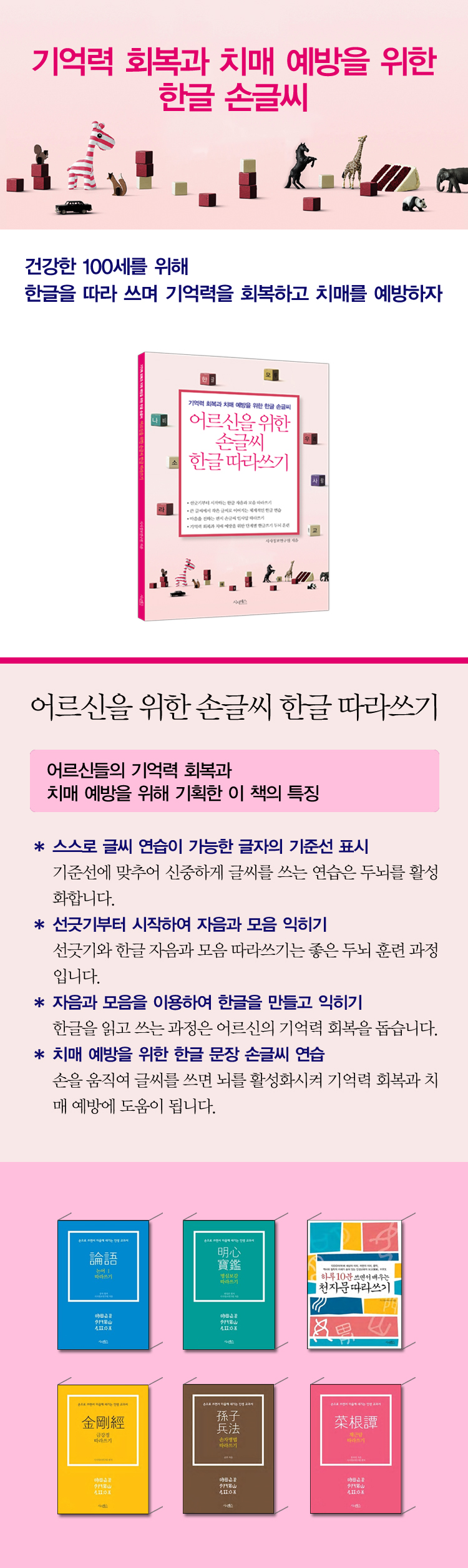
- Displaying the baseline of letters that can be practiced independently
It is designed to allow seniors to practice handwriting on their own by marking the baseline of the letters.
Practicing writing carefully along the lines activates your brain.
- Learning consonants and vowels starting from drawing lines
It is structured so that you can follow along step by step, starting from the basics of writing Korean, such as drawing lines.
Drawing lines and tracing Korean consonants and vowels is a good brain training course.
- Create and learn Hangul using consonants and vowels
It explains the process of creating letters using Korean consonants and vowels, so that anyone can read Korean.
The process of reading and writing Korean, recalling the Korean writing training that was repeated as a child, helps the elderly restore their memory.
- Handwriting practice for Korean sentences to prevent dementia
As we age and our memory declines, we become more concerned about dementia.
According to research by neuroscientists, writing with your hands can help restore your memory and significantly reduce the risk of dementia.
Reading meaningful Korean sentences slowly and repeatedly while moving your hands is a good brain training process for preventing dementia.
In addition to the learning effects of handwriting, the Current Affairs Information Research Institute discovered another effect of handwriting while planning and publishing a Korean handwriting book and a Chinese classic handwriting book.
That is the satisfaction and sense of accomplishment that comes from filling in the blanks with your own handwriting.
Filling in blanks or filling in the margins with meaningful handwriting is an activity that expresses one's thoughts.
Filling the margins of a piece of paper gives me a sense of accomplishment and satisfaction.
There are many benefits to be gained when seniors complete a book by moving their hands and tracing.
I hope that the book, "Handwriting Korean for Seniors," will not only help seniors recover their memories and prevent dementia, but also awaken the joy of small accomplishments.
This book is designed to help seniors recover their memory and prevent dementia.
- Displaying the baseline of letters that can be practiced independently
It is designed to allow seniors to practice handwriting on their own by marking the baseline of the letters.
Practicing writing carefully along the lines activates your brain.
- Learning consonants and vowels starting from drawing lines
It is structured so that you can follow along step by step, starting from the basics of writing Korean, such as drawing lines.
Drawing lines and tracing Korean consonants and vowels is a good brain training course.
- Create and learn Hangul using consonants and vowels
It explains the process of creating letters using Korean consonants and vowels, so that anyone can read Korean.
The process of reading and writing Korean, recalling the Korean writing training that was repeated as a child, helps the elderly restore their memory.
- Handwriting practice for Korean sentences to prevent dementia
As we age and our memory declines, we become more concerned about dementia.
According to research by neuroscientists, writing with your hands can help restore your memory and significantly reduce the risk of dementia.
Reading meaningful Korean sentences slowly and repeatedly while moving your hands is a good brain training process for preventing dementia.
GOODS SPECIFICS
- Publication date: April 20, 2020
- Page count, weight, size: 96 pages | 226g | 175*247*15mm
- ISBN13: 9788980974979
- ISBN10: 8980974973
You may also like
카테고리
korean


korean

![ELLE 엘르 스페셜 에디션 A형 : 12월 [2025]](http://librairie.coreenne.fr/cdn/shop/files/b8e27a3de6c9538896439686c6b0e8fb.jpg?v=1766436872&width=3840)


