

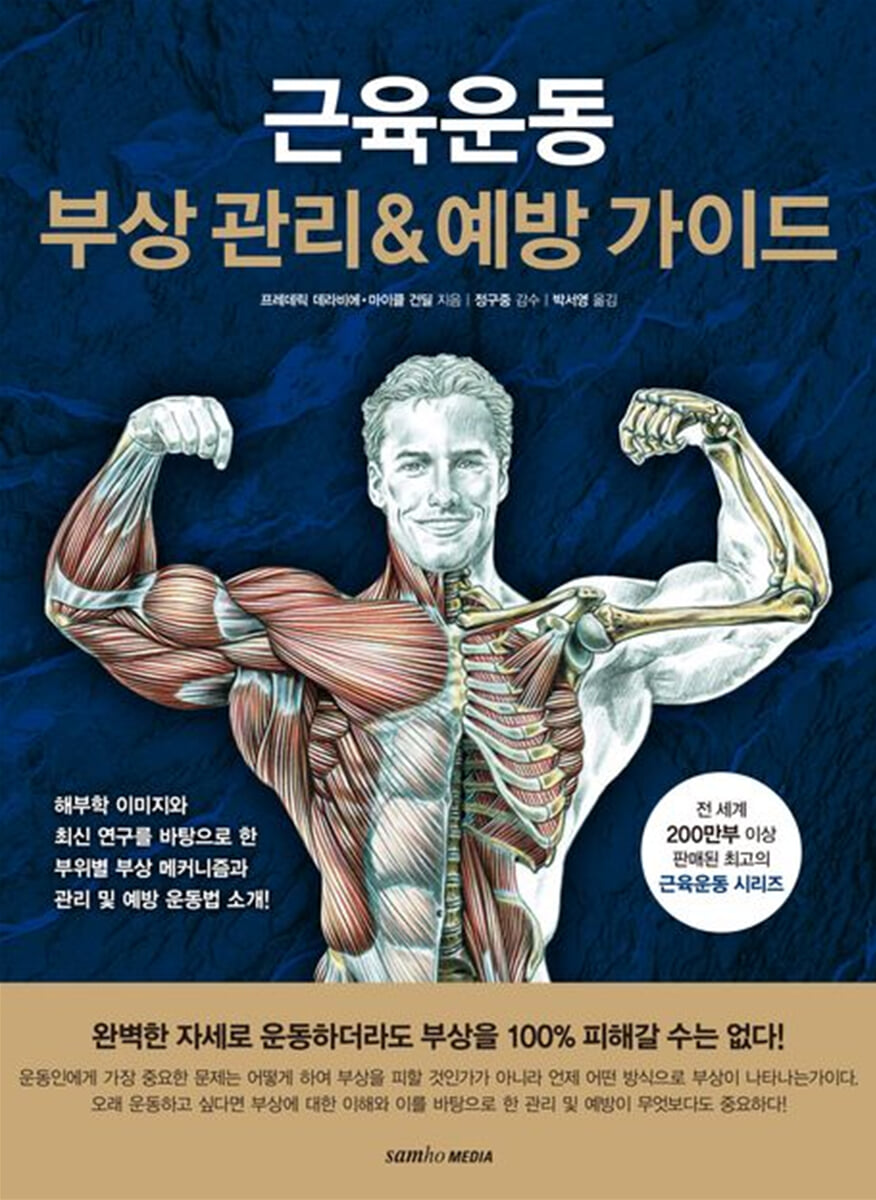
Muscle Exercise Injury Management Prevention Guide
 |
Description
Book Introduction
Even if you exercise with perfect form, you can't 100% avoid injuries!
The most important issue that athletes should keep in mind is
The question is not 'how to avoid injury' but 'when and how will injury occur?'
If you want to stay strong and healthy for a long time, you need to have a clear understanding of injury mechanisms.
Management and prevention based on this are of utmost importance!
When exercising, the pain experienced by the body is often simply interpreted as a normal response to intense training.
We tend to apply this logic not only to muscle pain but also to discomfort in joints or tendons.
As a result, most people fail to start proper injury management and prevention in a timely manner, and only realize the need for it after suffering a serious injury.
Nearly half of people who regularly engage in strength training have at least one injury.
Especially for advanced players, it is rare to maintain perfect physical condition.
Although strength training offers benefits in terms of muscle development and improved physical function, it also carries pathological risks that can have long-term, short-term, and long-term effects on the body.
Therefore, the longer the exercise period, the more attention must be paid to how to manage physical safety.
?Muscle Strength Training Injury Management & Prevention Guide》 examines the causes and processes of injuries that occur during strength training, and suggests ways to manage and recover from them so that they do not become serious.
Among the numerous injuries, we will focus on injuries that commonly occur in the field of strength training, which will be of great help to athletes who regularly engage in muscle training.
The most important issue that athletes should keep in mind is
The question is not 'how to avoid injury' but 'when and how will injury occur?'
If you want to stay strong and healthy for a long time, you need to have a clear understanding of injury mechanisms.
Management and prevention based on this are of utmost importance!
When exercising, the pain experienced by the body is often simply interpreted as a normal response to intense training.
We tend to apply this logic not only to muscle pain but also to discomfort in joints or tendons.
As a result, most people fail to start proper injury management and prevention in a timely manner, and only realize the need for it after suffering a serious injury.
Nearly half of people who regularly engage in strength training have at least one injury.
Especially for advanced players, it is rare to maintain perfect physical condition.
Although strength training offers benefits in terms of muscle development and improved physical function, it also carries pathological risks that can have long-term, short-term, and long-term effects on the body.
Therefore, the longer the exercise period, the more attention must be paid to how to manage physical safety.
?Muscle Strength Training Injury Management & Prevention Guide》 examines the causes and processes of injuries that occur during strength training, and suggests ways to manage and recover from them so that they do not become serious.
Among the numerous injuries, we will focus on injuries that commonly occur in the field of strength training, which will be of great help to athletes who regularly engage in muscle training.
index
PART 1 The Problem with Injuries
01 Injury incidence in strength training
02 What is an injury?
PART 2 INJURIES AFFECTING EACH ORGANISATION
03 Myofascial Disease
04 Muscle pain
05 Tendon Disease
06 Ligament Disease
07 Joint Diseases
08 Bone Disease
09 Various effects on the nervous system
PART 03 Various diseases affecting each muscle group
10 Shoulder Conditions
11 Biceps and labrum disorders
12 Triceps and Elbow Conditions
13 Pathological abnormalities of the forearm, wrist, and hand
14 Pathological abnormalities related to the pectoralis major muscle
15 Understanding Upper Back (Thoracic) Disorders
16 Various pathological problems related to the spine
17 Pathological phenomena related to the abdomen
18 Hip Problems: Impact on the Lumbar Spine and Kneecap
19 Pathological problems of the quadriceps femoris, knee, and adductor muscles
20 Pathological Problems of the Hamstrings: Effects on the Patella and Lumbar Spine
21 Pathological Problems Related to the Calf and Foot
anatomy chart
01 Injury incidence in strength training
02 What is an injury?
PART 2 INJURIES AFFECTING EACH ORGANISATION
03 Myofascial Disease
04 Muscle pain
05 Tendon Disease
06 Ligament Disease
07 Joint Diseases
08 Bone Disease
09 Various effects on the nervous system
PART 03 Various diseases affecting each muscle group
10 Shoulder Conditions
11 Biceps and labrum disorders
12 Triceps and Elbow Conditions
13 Pathological abnormalities of the forearm, wrist, and hand
14 Pathological abnormalities related to the pectoralis major muscle
15 Understanding Upper Back (Thoracic) Disorders
16 Various pathological problems related to the spine
17 Pathological phenomena related to the abdomen
18 Hip Problems: Impact on the Lumbar Spine and Kneecap
19 Pathological problems of the quadriceps femoris, knee, and adductor muscles
20 Pathological Problems of the Hamstrings: Effects on the Patella and Lumbar Spine
21 Pathological Problems Related to the Calf and Foot
anatomy chart
Detailed image

GOODS SPECIFICS
- Date of issue: November 28, 2025
- Page count, weight, size: 286 pages | 884g | 188*257*16mm
- ISBN13: 9788978497237
- ISBN10: 8978497233
You may also like
카테고리
korean


korean

![ELLE 엘르 스페셜 에디션 A형 : 12월 [2025]](http://librairie.coreenne.fr/cdn/shop/files/b8e27a3de6c9538896439686c6b0e8fb.jpg?v=1766436872&width=3840)


