

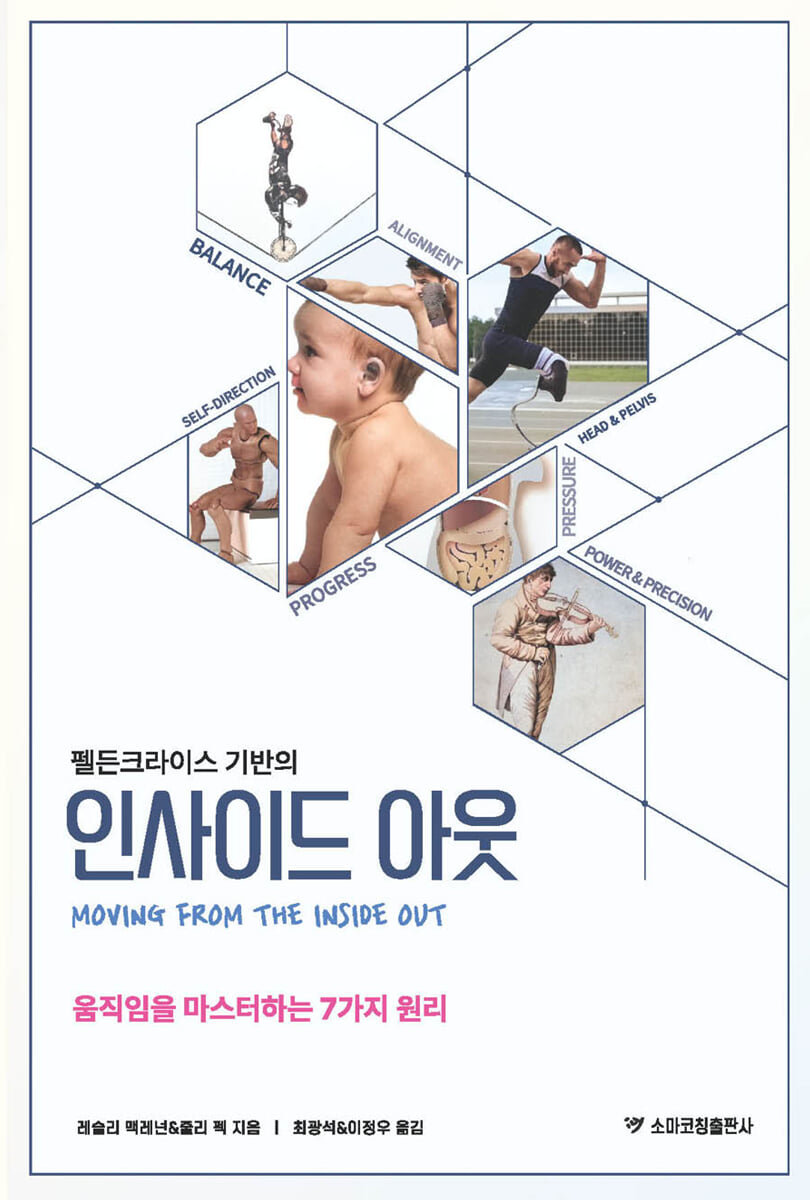
Inside Out based on Feldenkrais
 |
Description
Book Introduction
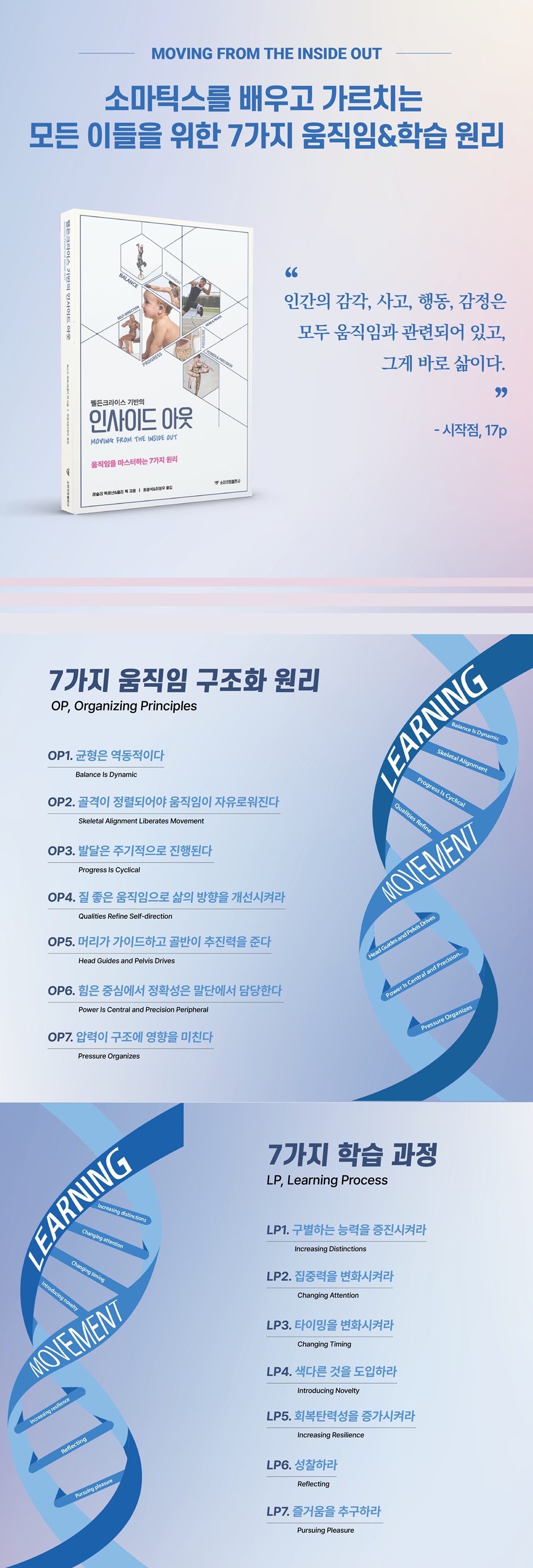
This book introduces the seven principles of movement and learning for all those learning and teaching somatics.
This book is based on the "Feldenkrais Method," one of the important techniques in the field of somatics.
Because this book provides a standard for those who want to live a healthy life by understanding their body and movement patterns, its range of applications is endless, from the general public to experts.
One of the strengths of this book is that it clearly defines the terminology that is key to exploring somatic movement.
How to maintain dynamic balance, how to align the skeleton to allow free movement, how to improve the quality of life by understanding developmental movement patterns, and how to move strongly and clearly through the head, pelvis, trunk, and limbs are also introduced with specific examples.
The two authors, both Feldenkrais Method experts, introduce the seven Organizing Principles (OP), along with 28 carefully selected movement explorations, or TIYs (Try It Yourself), that you can practice and embody.
It also introduces seven learning processes (LP) that can help you reach a higher level more efficiently when learning something.
A must-read for anyone who wants to take initiative in improving their own health.
This book is based on the "Feldenkrais Method," one of the important techniques in the field of somatics.
Because this book provides a standard for those who want to live a healthy life by understanding their body and movement patterns, its range of applications is endless, from the general public to experts.
One of the strengths of this book is that it clearly defines the terminology that is key to exploring somatic movement.
How to maintain dynamic balance, how to align the skeleton to allow free movement, how to improve the quality of life by understanding developmental movement patterns, and how to move strongly and clearly through the head, pelvis, trunk, and limbs are also introduced with specific examples.
The two authors, both Feldenkrais Method experts, introduce the seven Organizing Principles (OP), along with 28 carefully selected movement explorations, or TIYs (Try It Yourself), that you can practice and embody.
It also introduces seven learning processes (LP) that can help you reach a higher level more efficiently when learning something.
A must-read for anyone who wants to take initiative in improving their own health.
- You can preview some of the book's contents.
Preview
index
Starting point
The power of principles
The power of distinction
The power of story
7 Movement Structuring Principles
Reclaiming the Potential of Movement through Awareness
neuroplasticity
How to Use This Book
OP1.
Balance is dynamic
The beginning of balance
Move across the ground
Detect
Movement and Balance
OP2.
The skeleton must be aligned for free movement.
Alignment and Action
Defying gravity
Power and Alignment
OP3.
Development proceeds in cycles
Spinal movement
movement of the same kind
unilateral movement
Contralateral movement
Continuous reevaluation of movement development patterns is necessary.
OP4.
Improve the direction of your life with quality movement.
Don't try hard
Don't resist
Allowing reversibility
freedom of breathing
Exploring the Quality of Movement
OP5.
The head guides and the pelvis propels
The head guides
Connection through the spine
Source of propulsion: pelvis
Rediscover the relationship between the whole and the part
OP6.
Power comes from the center, accuracy comes from the ends.
Movement occurs through coordination between the proximal and distal parts.
The center provides strength, and the limbs provide direction.
Free the body
OP7.
Pressure affects structure
Interaction between the diaphragm and the pelvic floor
What happens when strong muscles surround weak structures?
The relationship between pressure and strength
Pressure and anxiety
Pressure generated by contact
Learning from the inside out
The power of process
7 learning processes
Practicing based on principles
Feldenkrais: A Framework for Learning
Start over
References
Translator's Note
About the Author
TIY (Try It Yourself) List
TIY1-1.
Try sucking and swallowing again
TIY1-2.
Detecting how to stand and walk
TIY1-3.
Finding mobility in your torso
TIY2-1.
Alignment of the hands, wrists, and forearms
TIY2-2.
Exploring the shift in weight from sitting to standing
TIY3-1.
Exploring Spinal Movement
TIY3-2.
Device with homologous movement patterns
TIY3-3.
Device retraining with unilateral patterns
TIY3-4.
Observing people walking
TIY4-1.
Check out the effects of effort on your body
TIY4-2.
Check out your efforts in the mirror
TIY4-3.
Rotational Exploration
TIY4-4.
Sitting with reversibility
TIY4-5.
Breathe
TIY4-6.
Finding clues in unconventional ways
TIY5-1.
Finding the axis of rotation of the head
TIY5-2.
Eye, head, and shoulder coordination training
TIY5-3.
Setting up an image for the spine
TIY5-4.
Reset the spine image
TIY5-5.
See what your spine actually looks like
TIY5-6.
Pelvic Exploration
TIY5-7.
Exploring three-dimensional pelvic movements using a broom
TIY5-8.
How to coordinate your pelvis, spine, and head
TIY6-1.
Lifting objects while concentrating
TIY6-2.
Lift your feet and point them towards your torso
TIY7-1.
What happens when you support your body with your large muscles?
TIY7-2.
Prevent large muscles from supporting the body
TIY7-3.
Relationship between distal pressure and proximal structure
TRY IT YOURSELF.
The practice of self-awareness
The power of principles
The power of distinction
The power of story
7 Movement Structuring Principles
Reclaiming the Potential of Movement through Awareness
neuroplasticity
How to Use This Book
OP1.
Balance is dynamic
The beginning of balance
Move across the ground
Detect
Movement and Balance
OP2.
The skeleton must be aligned for free movement.
Alignment and Action
Defying gravity
Power and Alignment
OP3.
Development proceeds in cycles
Spinal movement
movement of the same kind
unilateral movement
Contralateral movement
Continuous reevaluation of movement development patterns is necessary.
OP4.
Improve the direction of your life with quality movement.
Don't try hard
Don't resist
Allowing reversibility
freedom of breathing
Exploring the Quality of Movement
OP5.
The head guides and the pelvis propels
The head guides
Connection through the spine
Source of propulsion: pelvis
Rediscover the relationship between the whole and the part
OP6.
Power comes from the center, accuracy comes from the ends.
Movement occurs through coordination between the proximal and distal parts.
The center provides strength, and the limbs provide direction.
Free the body
OP7.
Pressure affects structure
Interaction between the diaphragm and the pelvic floor
What happens when strong muscles surround weak structures?
The relationship between pressure and strength
Pressure and anxiety
Pressure generated by contact
Learning from the inside out
The power of process
7 learning processes
Practicing based on principles
Feldenkrais: A Framework for Learning
Start over
References
Translator's Note
About the Author
TIY (Try It Yourself) List
TIY1-1.
Try sucking and swallowing again
TIY1-2.
Detecting how to stand and walk
TIY1-3.
Finding mobility in your torso
TIY2-1.
Alignment of the hands, wrists, and forearms
TIY2-2.
Exploring the shift in weight from sitting to standing
TIY3-1.
Exploring Spinal Movement
TIY3-2.
Device with homologous movement patterns
TIY3-3.
Device retraining with unilateral patterns
TIY3-4.
Observing people walking
TIY4-1.
Check out the effects of effort on your body
TIY4-2.
Check out your efforts in the mirror
TIY4-3.
Rotational Exploration
TIY4-4.
Sitting with reversibility
TIY4-5.
Breathe
TIY4-6.
Finding clues in unconventional ways
TIY5-1.
Finding the axis of rotation of the head
TIY5-2.
Eye, head, and shoulder coordination training
TIY5-3.
Setting up an image for the spine
TIY5-4.
Reset the spine image
TIY5-5.
See what your spine actually looks like
TIY5-6.
Pelvic Exploration
TIY5-7.
Exploring three-dimensional pelvic movements using a broom
TIY5-8.
How to coordinate your pelvis, spine, and head
TIY6-1.
Lifting objects while concentrating
TIY6-2.
Lift your feet and point them towards your torso
TIY7-1.
What happens when you support your body with your large muscles?
TIY7-2.
Prevent large muscles from supporting the body
TIY7-3.
Relationship between distal pressure and proximal structure
TRY IT YOURSELF.
The practice of self-awareness
Detailed image
Into the book
The theme of this book is movement.
In other words, the content of this book is related to life.
From the moment a fetus first stirs in the womb until the final flicker of the nervous system at death, our lives are full of movement.
Human senses, thoughts, actions, and emotions are all related to movement, and that is life.
--- p.17 From "Starting Point"
Humans are the only mammals that have adopted an unstable upright posture.
So, from the moment a child is born, he or she must have the balance necessary to stand and walk on two legs.
This balancing act starts in the head.
--- p.42 「OP1.
From “Balance is Dynamic”
Consider a person whose head is turned forward.
The person lives in a tremendous struggle every day to maintain the balance of his head on the top of his spine.
The shoulder girdle cannot help but become unstable as it tries to support the weight of the head that has been thrust forward.
Additionally, the arms hanging from the shoulder girdle are constantly adapting and moving, and the ribs (ribs) that form joints with the spine are also deformed and structurally weakened to achieve a counterbalance.
This is just one part of the struggle that the musculoskeletal system, under the control of the nervous system within the gravitational field, wages every moment of our daily lives to maintain some semblance of stability within its collapsed structure.
--- p.79 「OP2.
“Movement becomes freer when the skeleton is aligned.”
Our nervous system is incredibly flexible, so it doesn't have a preference for "best practices."
Humans learn through imitation, socialization, and traumas both large and small.
However, this process delays the most efficient movements and inhibits some of the best movement patterns acquired during early development.
Therefore, humans must constantly reevaluate their movements and rediscover the joy they can derive from fully realizing their potential.
--- p.114 「OP3.
From “Development proceeds in cycles”
To return to a childlike state of pure exploration, adults must train themselves to unravel some of the movements they have learned.
Fast, habitual, goal-oriented movements make it very difficult to focus on the qualitative aspects of movement, thus preventing us from becoming aware of our own sensory world.
--- p.118 「OP4.
From “Improving the direction of your life with quality movement”
Among animals that walk on the ground, humans have a unique relationship between their head and pelvis.
The head is connected to the pelvis through the spine, which not only allows us to stand and walk, but also provides direction and propulsion as we move through three-dimensional space.
--- p.144 「OP5.
“The head guides and the pelvis propels”
Westerners have culturally prioritized the image they project outward, neglecting the inner sense of flexibility that can provide strength.
A variety of physical problems, such as chronic pain and repetitive strain injuries, can be attributed to this static concept of posture.
--- p.193 「OP6.
"Strength comes from the center, accuracy comes from the ends"
From the moment of birth, the human body has adapted to pressure through structures such as fluids, membranes, and valves.
The fluids (gases, liquids, and liquefied solids) in the body are usually thought of as elements of a transport system that transports nutrients, expels waste products, and transmits chemical signals, but their actual role is much broader.
Not only humans, but in fact all animals have a kind of hydraulic system, and the shape and movement of the human body are also based on this.
In other words, the content of this book is related to life.
From the moment a fetus first stirs in the womb until the final flicker of the nervous system at death, our lives are full of movement.
Human senses, thoughts, actions, and emotions are all related to movement, and that is life.
--- p.17 From "Starting Point"
Humans are the only mammals that have adopted an unstable upright posture.
So, from the moment a child is born, he or she must have the balance necessary to stand and walk on two legs.
This balancing act starts in the head.
--- p.42 「OP1.
From “Balance is Dynamic”
Consider a person whose head is turned forward.
The person lives in a tremendous struggle every day to maintain the balance of his head on the top of his spine.
The shoulder girdle cannot help but become unstable as it tries to support the weight of the head that has been thrust forward.
Additionally, the arms hanging from the shoulder girdle are constantly adapting and moving, and the ribs (ribs) that form joints with the spine are also deformed and structurally weakened to achieve a counterbalance.
This is just one part of the struggle that the musculoskeletal system, under the control of the nervous system within the gravitational field, wages every moment of our daily lives to maintain some semblance of stability within its collapsed structure.
--- p.79 「OP2.
“Movement becomes freer when the skeleton is aligned.”
Our nervous system is incredibly flexible, so it doesn't have a preference for "best practices."
Humans learn through imitation, socialization, and traumas both large and small.
However, this process delays the most efficient movements and inhibits some of the best movement patterns acquired during early development.
Therefore, humans must constantly reevaluate their movements and rediscover the joy they can derive from fully realizing their potential.
--- p.114 「OP3.
From “Development proceeds in cycles”
To return to a childlike state of pure exploration, adults must train themselves to unravel some of the movements they have learned.
Fast, habitual, goal-oriented movements make it very difficult to focus on the qualitative aspects of movement, thus preventing us from becoming aware of our own sensory world.
--- p.118 「OP4.
From “Improving the direction of your life with quality movement”
Among animals that walk on the ground, humans have a unique relationship between their head and pelvis.
The head is connected to the pelvis through the spine, which not only allows us to stand and walk, but also provides direction and propulsion as we move through three-dimensional space.
--- p.144 「OP5.
“The head guides and the pelvis propels”
Westerners have culturally prioritized the image they project outward, neglecting the inner sense of flexibility that can provide strength.
A variety of physical problems, such as chronic pain and repetitive strain injuries, can be attributed to this static concept of posture.
--- p.193 「OP6.
"Strength comes from the center, accuracy comes from the ends"
From the moment of birth, the human body has adapted to pressure through structures such as fluids, membranes, and valves.
The fluids (gases, liquids, and liquefied solids) in the body are usually thought of as elements of a transport system that transports nutrients, expels waste products, and transmits chemical signals, but their actual role is much broader.
Not only humans, but in fact all animals have a kind of hydraulic system, and the shape and movement of the human body are also based on this.
--- p.206 「OP7.
From “Pressure Affects Structure”
From “Pressure Affects Structure”
GOODS SPECIFICS
- Date of issue: May 31, 2024
- Page count, weight, size: 292 pages | 536g | 152*225*18mm
- ISBN13: 9791196681593
- ISBN10: 1196681597
- KC Certification: Certification Type: Conformity Confirmation
You may also like
카테고리
korean


korean

![ELLE 엘르 스페셜 에디션 A형 : 12월 [2025]](http://librairie.coreenne.fr/cdn/shop/files/b8e27a3de6c9538896439686c6b0e8fb.jpg?v=1766436872&width=3840)


