

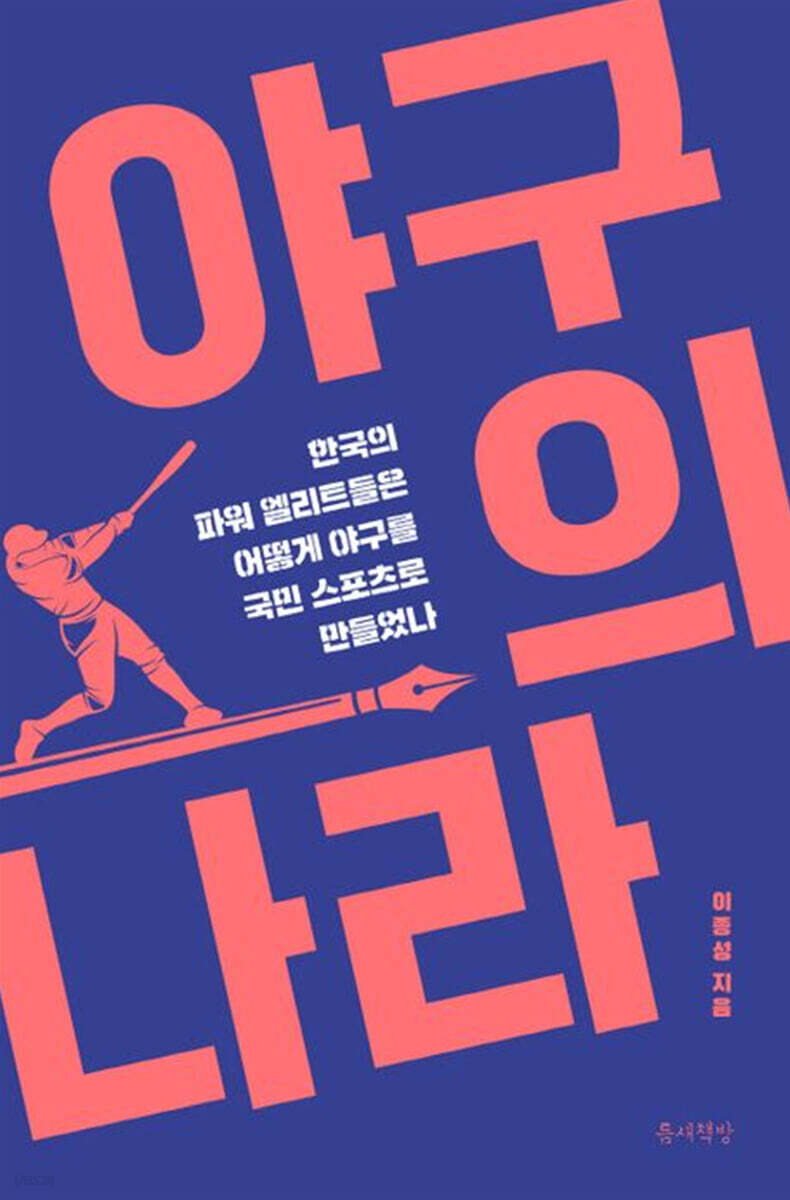
The land of baseball
 |
Description
Book Introduction
·How did baseball, once a "sport of the aristocracy" during the Japanese colonial period, become a sport enjoyed by the entire nation?
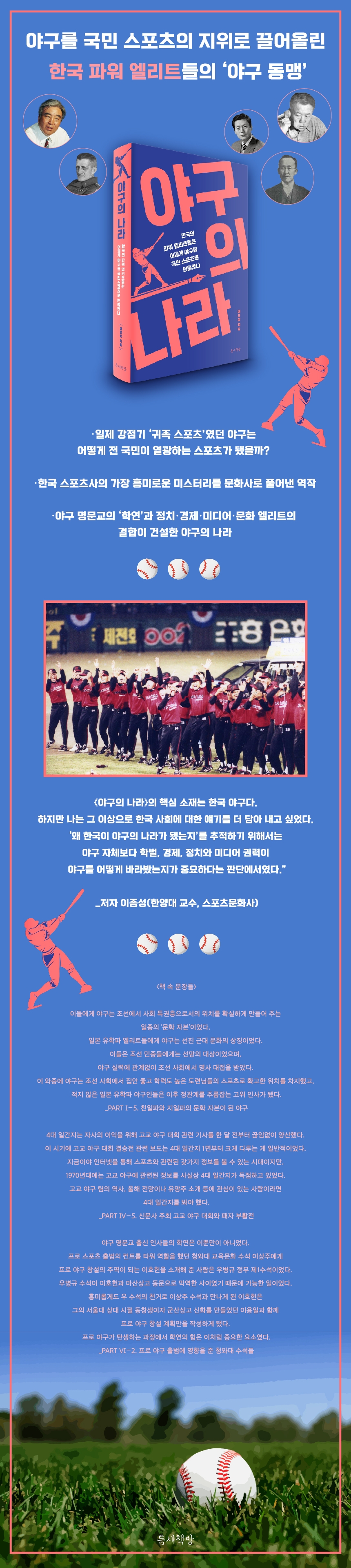
A masterpiece that unravels the most fascinating mysteries of Korean sports history through cultural history. A baseball nation built by the combination of elite political, economic, media, and cultural elites and the "school ties" of prestigious baseball schools. A must-read book for baseball enthusiasts has been published. "The Land of Baseball" is the answer to one of the most intriguing mysteries in our country's sports history: "Why did baseball surpass soccer to become the most popular sport?" Professor Lee Jong-seong, who studies sports culture history at Hanyang University, traced the process by which baseball became a national sport from the Japanese colonial period to the 2000s. The elite's school ties were absolutely crucial in making baseball a national sport. During the Japanese colonial period, baseball, which was a school sport at prestigious schools, was an object of envy. Unlike soccer, which requires only a ball, baseball, which requires expensive equipment, was a sport for the nobility. In addition, Japan also attempted to achieve internal harmony through baseball. In Korea, preliminaries for the Koshien tournament were held, and when a Korean team performed well, it was praised as evidence of domestic harmony. But baseball was also an object of envy. Baseball, a symbol of the elite and the nobility, became a sport symbolizing prestigious local schools even after liberation. Prestigious local schools such as Gyeonggi High School, Gyeongbok High School, Whimoon High School, Paichai High School, Gyeongnam High School, Gyeongbuk High School, Gwangju Ilgo High School, and Jeonju High School, as well as commercial high schools such as Seonrin Commercial High School, Gunsan Commercial High School, and Masan Commercial High School, and emerging prestigious schools such as Sinil High School and Chungam High School, competed with each other using baseball as their school sport. The elite who were crazy about baseball during their school days supported their alma mater's baseball team, and the media world, also dominated by the elite, held baseball tournaments to promote their newspapers. The popularity of high school baseball in the 1970s was no accident. The power of the elite was absolute even in the launch of professional baseball. Elite baseball graduates who studied abroad in the United States were dominating the political and financial worlds. This was the reason why baseball was one step ahead of soccer, which had its roots in Europe. Here, the regionalism that emerged through high school baseball was directly transferred to professional baseball, making baseball the most popular sport in Korea. Professional baseball, born in this way, became a cultural icon of the 1980s, and this in turn became cultural capital, engraved in the DNA of the cultural elite. In this way, baseball exerted a wide-ranging influence, starting from school ties and extending to politics, economy, media, and culture, and this was then expanded and reproduced, turning Korea into a nation of baseball. Professor Lee Jong-seong's "The Country of Baseball" shows that sports are the result of social interaction, not simply a product of capital or entertainment. Like Indonesia's badminton or India's cricket, Korea's rise to baseball has historical and cultural roots. Like all other social spheres, sports require multiple perspectives to be viewed and interpreted clearly. In this respect, "Baseball Country" is a book that presents a new methodology for viewing the sports field. |
- You can preview some of the book's contents.
Preview
index
prolog
PART I.
The Birth of Joseon Baseball's Elite
1.
Reading Baseball During the Japanese Colonial Period: "Aristocratic Sport" or "Japanese Sport"
2.
The Koshien Tournament and Joseon's Elite Assimilation Policy
3.
Japan introduced baseball to public high schools, the cradle of Joseon's elite.
4.
The baseball tradition of commercial schools, a role model for internal and external integration
5.
Baseball, the cultural capital of pro-Japanese and pro-Japanese factions
6.
The Secret Behind Whimoon High School's Koshien Quarterfinal Advance
7.
The sad reality of a 'tilted playing field'
8.
The "Eat-and-Live" Ethics of Joseon's Baseball Elite
PART II.
Baseball digs into the liberated space
1.
How did yakyu become baseball?
2.
The rise of "school baseball" and the emergence of prestigious baseball schools.
PART III.
Boosters of Korean Baseball: Zainichi Korean Players and the Bank Baseball Team
1.
Politics reflected in the visiting game of a Korean student baseball team in Japan
2.
The North Korean Repatriation Project and Korean Baseball Players in Japan
3.
Why Park Chung-hee was delighted by the Korea-Japan baseball victory in 1963
4.
The emergence of a commercial high school alumni and a bank baseball team
5.
The contributions of Korean-Japanese players who shined in the Asian Baseball Championship and on the Bank Team
PART IV.
The Golden Age of High School Baseball
1.
High school baseball is a competitive stage for prestigious high schools.
2.
Why did the Republican Party host the Yeongnam-Honam Friendship Baseball Tournament?
3.
Gunsan and Masan, baseball cities created by commercial high schools
4.
Busan, the capital of the globe, and the border crossing
5.
Newspaper-sponsored high school baseball tournament and loser's bracket
6.
High school baseball broadcasts dominate radio and TV
PART V.
Overseas Koreans who presented the prototype of professional baseball
1.
Hong Yun-hee, a Korean-American who laid the foundation for professional baseball
2.
Shin Kyuk-ho, a Korean resident in Japan who led the creation of a conglomerate baseball team
PART VI.
The era of professional baseball
1.
The Chun Doo-hwan regime and baseball nationalism
2.
Blue House secretaries who influenced the launch of professional baseball
3.
The story of a conglomerate entering professional baseball
4.
Baseball regionalism at its peak (feat.
Kim Dae-jung, Kim Young-sam, Kim Jong-pil, and Roh Tae-woo)
5.
The Haitai Tigers' nationwide fandom and the "Jeolla-do Exodus"
6.
Why did Korea's cultural elite love baseball?
7.
Professional baseball broadcasting rights jackpot and the WBC
Epilogue
PART I.
The Birth of Joseon Baseball's Elite
1.
Reading Baseball During the Japanese Colonial Period: "Aristocratic Sport" or "Japanese Sport"
2.
The Koshien Tournament and Joseon's Elite Assimilation Policy
3.
Japan introduced baseball to public high schools, the cradle of Joseon's elite.
4.
The baseball tradition of commercial schools, a role model for internal and external integration
5.
Baseball, the cultural capital of pro-Japanese and pro-Japanese factions
6.
The Secret Behind Whimoon High School's Koshien Quarterfinal Advance
7.
The sad reality of a 'tilted playing field'
8.
The "Eat-and-Live" Ethics of Joseon's Baseball Elite
PART II.
Baseball digs into the liberated space
1.
How did yakyu become baseball?
2.
The rise of "school baseball" and the emergence of prestigious baseball schools.
PART III.
Boosters of Korean Baseball: Zainichi Korean Players and the Bank Baseball Team
1.
Politics reflected in the visiting game of a Korean student baseball team in Japan
2.
The North Korean Repatriation Project and Korean Baseball Players in Japan
3.
Why Park Chung-hee was delighted by the Korea-Japan baseball victory in 1963
4.
The emergence of a commercial high school alumni and a bank baseball team
5.
The contributions of Korean-Japanese players who shined in the Asian Baseball Championship and on the Bank Team
PART IV.
The Golden Age of High School Baseball
1.
High school baseball is a competitive stage for prestigious high schools.
2.
Why did the Republican Party host the Yeongnam-Honam Friendship Baseball Tournament?
3.
Gunsan and Masan, baseball cities created by commercial high schools
4.
Busan, the capital of the globe, and the border crossing
5.
Newspaper-sponsored high school baseball tournament and loser's bracket
6.
High school baseball broadcasts dominate radio and TV
PART V.
Overseas Koreans who presented the prototype of professional baseball
1.
Hong Yun-hee, a Korean-American who laid the foundation for professional baseball
2.
Shin Kyuk-ho, a Korean resident in Japan who led the creation of a conglomerate baseball team
PART VI.
The era of professional baseball
1.
The Chun Doo-hwan regime and baseball nationalism
2.
Blue House secretaries who influenced the launch of professional baseball
3.
The story of a conglomerate entering professional baseball
4.
Baseball regionalism at its peak (feat.
Kim Dae-jung, Kim Young-sam, Kim Jong-pil, and Roh Tae-woo)
5.
The Haitai Tigers' nationwide fandom and the "Jeolla-do Exodus"
6.
Why did Korea's cultural elite love baseball?
7.
Professional baseball broadcasting rights jackpot and the WBC
Epilogue
Detailed image
Into the book
Considering that the most important thing for sports in Joseon during the Japanese colonial period to attract the public's attention was to "overcome Japan," baseball was not suitable for colonial Joseon.
The Korean people showed little interest in baseball games.
There was no need to pay to watch a baseball game where the Japanese team ended up winning.
Naturally, baseball was considered a "Japanese sport" by Koreans and failed to generate any social resonance.
---「PART I―1.
From "Reading Baseball During the Japanese Colonial Period: 'Aristocratic Sport' or 'Japanese Sport'"
At the time, student baseball players were the envy of many women for their fancy uniforms and expensive equipment.
Above all, student baseball players were very rare in Joseon at the time.
It would not be an exaggeration to say that they were the chosen 'baseball aristocrats' in a time when most Koreans could not even attend elementary school.
---「PART I―2.
From “Koshien Tournament and Joseon Elite Assimilation Policy”
Of course, the number of Koreans who attended public high schools was extremely small.
As of 1937, the Korean population was approximately 22 million, but the total number of Koreans who attended public and private high schools was only 15,454.
In this respect, it can be said that the popularization of baseball in Joseon society through public high schools was limited.
However, the baseball tradition of public high schools attended by talented students representing the region had a huge influence on baseball becoming established as a sport of prestigious schools in Korean society.
This was because baseball often became the school motto at these schools after liberation.
---「PART I―3.
From "Japan, which introduced baseball to public high schools, the cradle of Joseon's elite"
For them, baseball was a kind of 'cultural capital' that solidified their position as a privileged class in Joseon.
For the elite who studied abroad in Japan, baseball was a symbol of advanced modern culture.
They were objects of admiration for the Joseon people, and were treated as celebrities in Joseon society regardless of their baseball skills.
During this time, baseball gained a firm position in Joseon society as a sport for the well-off and highly educated young men, and many of the baseball players who studied in Japan later became high-ranking figures who dominated the political world.
---「PART I―5.
From “Baseball, the Cultural Capital of Pro-Japanese and Pro-Japanese Factions”
The fact that the Whimoon High School baseball team, comprised entirely of Koreans, advanced to the quarterfinals of the Koshien tournament was a great feat that bolstered Korean pride.
The power that made this possible came from Min Young-hwi, the founder of the school with enormous wealth, and Park Seok-yoon, a talent recognized by the Japanese baseball world.
Koreans cheered enthusiastically when Whimoon High School defeated a Japanese school in the Korean preliminaries, and during the finals, Koreans in Japan flocked to the stadium to cheer Whimoon High School's success.
However, during the colonial period, Joseon baseball was able to develop further under the support and guidance of pro-Japanese figures like Whimoon High School.
This is because the money and skills that form the foundation for playing baseball well mainly come from these people.
---「PART I―6.
From "The Secret of Whimoon High School, the 'Aristocratic School,' Advancing to the Koshien Quarterfinals"
The case of Gyeongnam Middle School, which achieved the status of a prestigious school through baseball in the liberated space, concisely shows that baseball during this period developed through a mixture of the experiences of the Japanese colonial period and the special characteristics of the US military government era.
Thanks to the dedicated efforts of coach Jang Jong-gi, who had experienced advanced baseball in Japan and worked for the US military government after liberation, Gyeongnam Middle School became the best baseball team of its time, laying the foundation for becoming a prestigious school that attracted talented students from the Gyeongnam region and Busan.
---「PART II―2.
From "The Fever of 'Academy Baseball' and the Emergence of Prestigious Baseball Schools"
Chairman Park Chung-hee was greatly delighted by the great achievements of Korean baseball.
There was a good reason for that.
Two days before the match against Japan, the Kyunghyang Shinmun ran a front-page article on the suspicion that Chairman Park Chung-hee had accepted a check worth 40 million won from a Japanese company instead of significantly reflecting Japan's position during the Korea-Japan talks.
This article, published with only two weeks left until the presidential election, left Chairman Park Chung-hee and his associates in a state of panic.
Regardless of the facts, this could only be bad news in a situation where Park Chung-hee's pro-Japanese activities were already causing controversy ahead of the presidential election.
---「PART III―3.
From "Why Park Chung-hee was delighted with the Korea-Japan baseball victory in 1963"
Baseball was different from soccer.
Even during the Japanese colonial period, banks and commercial schools formed the central axis of Korean baseball.
Commercial schools with Japanese principals and teachers and banks established by the Japanese were very interested in developing baseball teams.
The status of commercial school baseball at the time can be clearly seen from the fact that the commercial school won the first place 9 times in the 20 Koshien Baseball Tournament Joseon Preliminary Rounds held from 1921 to 1940.
_PART III―4.
The emergence of a commercial high school alumni and a bank baseball team
The four major daily newspapers have been churning out articles about the high school baseball tournament for a month straight to further their own interests.
During this period, it was common for the four major daily newspapers to cover the high school baseball tournament finals on the front page.
Nowadays, we can access all kinds of sports-related information through the Internet, but in the 1970s, the four major daily newspapers had a virtual monopoly on information related to high school baseball.
Anyone interested in the history of high school baseball teams, this year's prospects, or prospect profiles had to read the four major daily newspapers.
---「PART IV―5.
From "High School Baseball Tournament and Loser's Round Hosted by a Newspaper"
The Asian Baseball Championship was significant in terms of baseball broadcasting.
This tournament was the first in Korean broadcasting history to have a broadcast fee for sports broadcasting.
The Korea Baseball Association charged broadcasters 10,000 won for each game of this tournament.
At that time, 10,000 won was equivalent to 10 don of gold.
---「PART IV―6.
From "High School Baseball Broadcasts That Dominated Radio and TV"
In the late 1960s, Lotte's core business was chewing gum.
At that time, as the Japanese cabinet pursued a trade liberalization policy, the entry of American chewing gum manufacturers into the Japanese market became visible.
The advance of American companies into Japan was likely to lead to a decline in Lotte's sales.
Nagata emphasized that the owner of Wrigley, a chewing gum manufacturer that was seeking to enter the Japanese market, also owns the Chicago Cubs, a professional baseball team in the United States.
For this reason, Chairman Shin Kyuk-ho accepted Nagata's request.
Former Prime Minister Kishi pressured the Ministry of Agriculture, Forestry and Fisheries through the Ministry of Finance (now the Ministry of Finance), delaying Wrigley's entry into Japan by two years.
---「PART V―2.
From "Shin Kyuk-ho, a Korean resident in Japan who led the creation of a conglomerate's baseball team"
The school ties of those from prestigious baseball schools were not limited to this.
It was Woo Byung-kyu, the first senior secretary for political affairs, who introduced Lee Ho-heon, who would become a key figure in the creation of professional baseball, to Lee Sang-joo, the senior secretary for education and culture at the Blue House, who served as the control tower for the launch of professional sports.
This was possible because Chief Woo Byeong-gyu and Lee Ho-heon were close friends and alumni of Masan Commercial High School.
Interestingly, Lee Ho-heon, who met Chief Lee Sang-ju through Chief Woo's recommendation, ended up drafting a plan to establish a professional baseball team together with Lee Yong-il, a classmate of Lee Ho-heon's from Seoul National University and the man who created the legend of Gunsan Commercial High School.
In the process of the birth of professional baseball, the power of school ties was such an important factor.
---「PART VI―2.
Among the Blue House secretaries who influenced the launch of professional baseball
Professional baseball is the most successful league among Korean professional sports in terms of increasing broadcasting rights fees.
Professional baseball broadcasting rights fees, which started at 300 million won in 1982, have risen to 76 billion won annually as of 2023. TV broadcasters pay 54 billion won annually for broadcasting rights, while telecommunications companies and internet portals pay 22 billion won per season for wired and wireless broadcasting rights.
The combined broadcasting rights fees for one season of professional soccer, professional basketball, and professional volleyball are less than the broadcasting rights fees for professional baseball.
---「PART VI―7.
From "Professional Baseball Broadcasting Rights Jackpot and the WBC"
The keyword that runs through “Baseball Nation” is “school ties,” which was the starting point for mainstream Korean society’s love of baseball.
The elite's 'baseball alliance' based on 'school ties' played a decisive role in the creation of the Cheongryonggi Baseball Tournament immediately after liberation, and also played a midwife role in the establishment of the Bank Dan baseball team and the launch of professional baseball.
The reason high school baseball reached its golden age in the 1970s was also school ties.
High school baseball, sponsored by alumni of prestigious high schools, soon developed into a competition between regions beyond the school walls, and professional baseball followed suit.
Ah, it was able to rise to become the best professional sport in Korea.
The Korean people showed little interest in baseball games.
There was no need to pay to watch a baseball game where the Japanese team ended up winning.
Naturally, baseball was considered a "Japanese sport" by Koreans and failed to generate any social resonance.
---「PART I―1.
From "Reading Baseball During the Japanese Colonial Period: 'Aristocratic Sport' or 'Japanese Sport'"
At the time, student baseball players were the envy of many women for their fancy uniforms and expensive equipment.
Above all, student baseball players were very rare in Joseon at the time.
It would not be an exaggeration to say that they were the chosen 'baseball aristocrats' in a time when most Koreans could not even attend elementary school.
---「PART I―2.
From “Koshien Tournament and Joseon Elite Assimilation Policy”
Of course, the number of Koreans who attended public high schools was extremely small.
As of 1937, the Korean population was approximately 22 million, but the total number of Koreans who attended public and private high schools was only 15,454.
In this respect, it can be said that the popularization of baseball in Joseon society through public high schools was limited.
However, the baseball tradition of public high schools attended by talented students representing the region had a huge influence on baseball becoming established as a sport of prestigious schools in Korean society.
This was because baseball often became the school motto at these schools after liberation.
---「PART I―3.
From "Japan, which introduced baseball to public high schools, the cradle of Joseon's elite"
For them, baseball was a kind of 'cultural capital' that solidified their position as a privileged class in Joseon.
For the elite who studied abroad in Japan, baseball was a symbol of advanced modern culture.
They were objects of admiration for the Joseon people, and were treated as celebrities in Joseon society regardless of their baseball skills.
During this time, baseball gained a firm position in Joseon society as a sport for the well-off and highly educated young men, and many of the baseball players who studied in Japan later became high-ranking figures who dominated the political world.
---「PART I―5.
From “Baseball, the Cultural Capital of Pro-Japanese and Pro-Japanese Factions”
The fact that the Whimoon High School baseball team, comprised entirely of Koreans, advanced to the quarterfinals of the Koshien tournament was a great feat that bolstered Korean pride.
The power that made this possible came from Min Young-hwi, the founder of the school with enormous wealth, and Park Seok-yoon, a talent recognized by the Japanese baseball world.
Koreans cheered enthusiastically when Whimoon High School defeated a Japanese school in the Korean preliminaries, and during the finals, Koreans in Japan flocked to the stadium to cheer Whimoon High School's success.
However, during the colonial period, Joseon baseball was able to develop further under the support and guidance of pro-Japanese figures like Whimoon High School.
This is because the money and skills that form the foundation for playing baseball well mainly come from these people.
---「PART I―6.
From "The Secret of Whimoon High School, the 'Aristocratic School,' Advancing to the Koshien Quarterfinals"
The case of Gyeongnam Middle School, which achieved the status of a prestigious school through baseball in the liberated space, concisely shows that baseball during this period developed through a mixture of the experiences of the Japanese colonial period and the special characteristics of the US military government era.
Thanks to the dedicated efforts of coach Jang Jong-gi, who had experienced advanced baseball in Japan and worked for the US military government after liberation, Gyeongnam Middle School became the best baseball team of its time, laying the foundation for becoming a prestigious school that attracted talented students from the Gyeongnam region and Busan.
---「PART II―2.
From "The Fever of 'Academy Baseball' and the Emergence of Prestigious Baseball Schools"
Chairman Park Chung-hee was greatly delighted by the great achievements of Korean baseball.
There was a good reason for that.
Two days before the match against Japan, the Kyunghyang Shinmun ran a front-page article on the suspicion that Chairman Park Chung-hee had accepted a check worth 40 million won from a Japanese company instead of significantly reflecting Japan's position during the Korea-Japan talks.
This article, published with only two weeks left until the presidential election, left Chairman Park Chung-hee and his associates in a state of panic.
Regardless of the facts, this could only be bad news in a situation where Park Chung-hee's pro-Japanese activities were already causing controversy ahead of the presidential election.
---「PART III―3.
From "Why Park Chung-hee was delighted with the Korea-Japan baseball victory in 1963"
Baseball was different from soccer.
Even during the Japanese colonial period, banks and commercial schools formed the central axis of Korean baseball.
Commercial schools with Japanese principals and teachers and banks established by the Japanese were very interested in developing baseball teams.
The status of commercial school baseball at the time can be clearly seen from the fact that the commercial school won the first place 9 times in the 20 Koshien Baseball Tournament Joseon Preliminary Rounds held from 1921 to 1940.
_PART III―4.
The emergence of a commercial high school alumni and a bank baseball team
The four major daily newspapers have been churning out articles about the high school baseball tournament for a month straight to further their own interests.
During this period, it was common for the four major daily newspapers to cover the high school baseball tournament finals on the front page.
Nowadays, we can access all kinds of sports-related information through the Internet, but in the 1970s, the four major daily newspapers had a virtual monopoly on information related to high school baseball.
Anyone interested in the history of high school baseball teams, this year's prospects, or prospect profiles had to read the four major daily newspapers.
---「PART IV―5.
From "High School Baseball Tournament and Loser's Round Hosted by a Newspaper"
The Asian Baseball Championship was significant in terms of baseball broadcasting.
This tournament was the first in Korean broadcasting history to have a broadcast fee for sports broadcasting.
The Korea Baseball Association charged broadcasters 10,000 won for each game of this tournament.
At that time, 10,000 won was equivalent to 10 don of gold.
---「PART IV―6.
From "High School Baseball Broadcasts That Dominated Radio and TV"
In the late 1960s, Lotte's core business was chewing gum.
At that time, as the Japanese cabinet pursued a trade liberalization policy, the entry of American chewing gum manufacturers into the Japanese market became visible.
The advance of American companies into Japan was likely to lead to a decline in Lotte's sales.
Nagata emphasized that the owner of Wrigley, a chewing gum manufacturer that was seeking to enter the Japanese market, also owns the Chicago Cubs, a professional baseball team in the United States.
For this reason, Chairman Shin Kyuk-ho accepted Nagata's request.
Former Prime Minister Kishi pressured the Ministry of Agriculture, Forestry and Fisheries through the Ministry of Finance (now the Ministry of Finance), delaying Wrigley's entry into Japan by two years.
---「PART V―2.
From "Shin Kyuk-ho, a Korean resident in Japan who led the creation of a conglomerate's baseball team"
The school ties of those from prestigious baseball schools were not limited to this.
It was Woo Byung-kyu, the first senior secretary for political affairs, who introduced Lee Ho-heon, who would become a key figure in the creation of professional baseball, to Lee Sang-joo, the senior secretary for education and culture at the Blue House, who served as the control tower for the launch of professional sports.
This was possible because Chief Woo Byeong-gyu and Lee Ho-heon were close friends and alumni of Masan Commercial High School.
Interestingly, Lee Ho-heon, who met Chief Lee Sang-ju through Chief Woo's recommendation, ended up drafting a plan to establish a professional baseball team together with Lee Yong-il, a classmate of Lee Ho-heon's from Seoul National University and the man who created the legend of Gunsan Commercial High School.
In the process of the birth of professional baseball, the power of school ties was such an important factor.
---「PART VI―2.
Among the Blue House secretaries who influenced the launch of professional baseball
Professional baseball is the most successful league among Korean professional sports in terms of increasing broadcasting rights fees.
Professional baseball broadcasting rights fees, which started at 300 million won in 1982, have risen to 76 billion won annually as of 2023. TV broadcasters pay 54 billion won annually for broadcasting rights, while telecommunications companies and internet portals pay 22 billion won per season for wired and wireless broadcasting rights.
The combined broadcasting rights fees for one season of professional soccer, professional basketball, and professional volleyball are less than the broadcasting rights fees for professional baseball.
---「PART VI―7.
From "Professional Baseball Broadcasting Rights Jackpot and the WBC"
The keyword that runs through “Baseball Nation” is “school ties,” which was the starting point for mainstream Korean society’s love of baseball.
The elite's 'baseball alliance' based on 'school ties' played a decisive role in the creation of the Cheongryonggi Baseball Tournament immediately after liberation, and also played a midwife role in the establishment of the Bank Dan baseball team and the launch of professional baseball.
The reason high school baseball reached its golden age in the 1970s was also school ties.
High school baseball, sponsored by alumni of prestigious high schools, soon developed into a competition between regions beyond the school walls, and professional baseball followed suit.
Ah, it was able to rise to become the best professional sport in Korea.
---From the "Epilogue"
Publisher's Review
The most outstanding work showing how Korean sports relate to society
“Baseball Country” is a book that started from a simple question.
Why is baseball, not soccer, the most popular sport? As of 2023, professional baseball broadcasting rights fees amount to 76 billion won annually.
Among them, the broadcasting rights fee paid by TV broadcasters is 54 billion won per year, and the wired and wireless broadcasting rights fee paid by telecommunication companies and internet portals is 22 billion won.
Even if you add up the broadcasting rights fees for one season of other professional sports, such as soccer, basketball, and volleyball, they don't even come close to the broadcasting rights fees for professional baseball.
This overwhelming gap proves that professional baseball is the most popular sport in South Korea.
So, one cannot help but wonder why baseball has become so successful.
This is because baseball was inherently disadvantaged in becoming a national sport.
No matter what anyone says, our country's 'national' sport is soccer.
Soccer has been a source of national pride since the Japanese colonial period, defeating Japan.
On the other hand, baseball was a typical 'golden spoon', 'aristocratic' sport played in elite schools created by Japan.
The barrier to entry was high for Koreans, and they had little chance of winning against Japan.
Yet, baseball was actually an object of envy.
Although it was a sport that showed the inevitable inferiority complex caused by colonial rule, being good at baseball was the way to be recognized as a modern boy and an elite.
Also, the catharsis was that much greater when Japan was suppressed through baseball, a Japanese sport.
This was the reason why many Koreans showed interest and cheered for Whimoon when the Whimoon High School baseball team, which was composed entirely of Koreans, advanced to the quarterfinals of the Koshien tournament in 1923.
After liberation, baseball underwent dramatic changes.
During the US military government, baseball became an American sport, not a Japanese sport.
Now baseball no longer has to face the criticism.
Prestigious schools established during the Japanese colonial period once again made their presence known through baseball.
Newspapers, many of which were composed of elites, competed to create high school baseball tournaments.
The competition between prestigious schools representing the region became a spectacle and soothed the homesickness of the 'immigrants' who came to Seoul in search of jobs.
The attention of the elite and the media has been a driving force in the further development of baseball.
The first game for which Korea received broadcasting rights fees was the 1963 Asian Baseball Championship.
On the other hand, soccer was not receiving much attention due to the media's neglect.
Soccer didn't receive much attention except for North-South matches, but baseball had already laid the foundation for success with the support of elites based on academic ties and the media.
As regionalism took root in politics, high school baseball teams representing the region and the professional baseball teams that succeeded them became symbols representing the region.
It's no wonder that baseball, which has most quickly and deeply established regional identity as the foundation of professional sports, has become Korea's top sport.
The growth of Korean baseball has been dramatic.
The process of going from being shunned as a noble sport in Japan to becoming Korea's top sport seems like a surprising turnaround.
But behind the scenes, there were several factors that made baseball the best sport.
If we follow these processes one by one, we can see our society.
Baseball is not simply a sport; it is a crystallization of the historical, cultural, and political context of our society.
《Baseball Country》 shows us the dark side of society that we have difficulty seeing through the context of baseball.
Readers who follow this fascinating process will learn what to look for in order to understand a phenomenon, and will also develop an eye for enjoyment.
“Baseball Country” is a book that started from a simple question.
Why is baseball, not soccer, the most popular sport? As of 2023, professional baseball broadcasting rights fees amount to 76 billion won annually.
Among them, the broadcasting rights fee paid by TV broadcasters is 54 billion won per year, and the wired and wireless broadcasting rights fee paid by telecommunication companies and internet portals is 22 billion won.
Even if you add up the broadcasting rights fees for one season of other professional sports, such as soccer, basketball, and volleyball, they don't even come close to the broadcasting rights fees for professional baseball.
This overwhelming gap proves that professional baseball is the most popular sport in South Korea.
So, one cannot help but wonder why baseball has become so successful.
This is because baseball was inherently disadvantaged in becoming a national sport.
No matter what anyone says, our country's 'national' sport is soccer.
Soccer has been a source of national pride since the Japanese colonial period, defeating Japan.
On the other hand, baseball was a typical 'golden spoon', 'aristocratic' sport played in elite schools created by Japan.
The barrier to entry was high for Koreans, and they had little chance of winning against Japan.
Yet, baseball was actually an object of envy.
Although it was a sport that showed the inevitable inferiority complex caused by colonial rule, being good at baseball was the way to be recognized as a modern boy and an elite.
Also, the catharsis was that much greater when Japan was suppressed through baseball, a Japanese sport.
This was the reason why many Koreans showed interest and cheered for Whimoon when the Whimoon High School baseball team, which was composed entirely of Koreans, advanced to the quarterfinals of the Koshien tournament in 1923.
After liberation, baseball underwent dramatic changes.
During the US military government, baseball became an American sport, not a Japanese sport.
Now baseball no longer has to face the criticism.
Prestigious schools established during the Japanese colonial period once again made their presence known through baseball.
Newspapers, many of which were composed of elites, competed to create high school baseball tournaments.
The competition between prestigious schools representing the region became a spectacle and soothed the homesickness of the 'immigrants' who came to Seoul in search of jobs.
The attention of the elite and the media has been a driving force in the further development of baseball.
The first game for which Korea received broadcasting rights fees was the 1963 Asian Baseball Championship.
On the other hand, soccer was not receiving much attention due to the media's neglect.
Soccer didn't receive much attention except for North-South matches, but baseball had already laid the foundation for success with the support of elites based on academic ties and the media.
As regionalism took root in politics, high school baseball teams representing the region and the professional baseball teams that succeeded them became symbols representing the region.
It's no wonder that baseball, which has most quickly and deeply established regional identity as the foundation of professional sports, has become Korea's top sport.
The growth of Korean baseball has been dramatic.
The process of going from being shunned as a noble sport in Japan to becoming Korea's top sport seems like a surprising turnaround.
But behind the scenes, there were several factors that made baseball the best sport.
If we follow these processes one by one, we can see our society.
Baseball is not simply a sport; it is a crystallization of the historical, cultural, and political context of our society.
《Baseball Country》 shows us the dark side of society that we have difficulty seeing through the context of baseball.
Readers who follow this fascinating process will learn what to look for in order to understand a phenomenon, and will also develop an eye for enjoyment.
GOODS SPECIFICS
- Date of issue: February 29, 2024
- Page count, weight, size: 328 pages | 402g | 135*205*21mm
- ISBN13: 9791188949625
- ISBN10: 1188949624
You may also like
카테고리
korean


korean

![ELLE 엘르 스페셜 에디션 A형 : 12월 [2025]](http://librairie.coreenne.fr/cdn/shop/files/b8e27a3de6c9538896439686c6b0e8fb.jpg?v=1766436872&width=3840)


