

History Reading House: 29 History Books You Want to Know About Right Now
 |
Description
Book Introduction
The long-running podcast 'The House of Reading History Books' has returned as a book.
In 2013, Tangsuyuk, a graduate student majoring in modern Korean history, and Rajogi, a graduate student majoring in regional studies with a focus on international politics, joined forces to launch the "House of Reading History Books."
As of June 2025, the show has over 9,000 subscribers and over 230 episodes, averaging around 20,000 views per episode.
The authors suggest that we explore the use of 'history', which teaches us to look back on ourselves as individuals and gain insight into the world we call 'us', through the medium of 'books'.
“Just as each wine has a different aroma, each history book has a different kind of enjoyment,” he said confidently.
The SNS account profile of the podcast “The House of Reading History Books,” which was the starting point for this book, also includes the following words:
“We read history books to find the ‘roots’ of our lives.
It's funny, entertaining, and even informative.
“It’s true.”
In 2013, Tangsuyuk, a graduate student majoring in modern Korean history, and Rajogi, a graduate student majoring in regional studies with a focus on international politics, joined forces to launch the "House of Reading History Books."
As of June 2025, the show has over 9,000 subscribers and over 230 episodes, averaging around 20,000 views per episode.
The authors suggest that we explore the use of 'history', which teaches us to look back on ourselves as individuals and gain insight into the world we call 'us', through the medium of 'books'.
“Just as each wine has a different aroma, each history book has a different kind of enjoyment,” he said confidently.
The SNS account profile of the podcast “The House of Reading History Books,” which was the starting point for this book, also includes the following words:
“We read history books to find the ‘roots’ of our lives.
It's funny, entertaining, and even informative.
“It’s true.”
- You can preview some of the book's contents.
Preview
index
Introduction
Part 1 is more interesting than the drama
1.
Murder without a victim: Find the culprit.
Making a Fake Husband: Mrs. Baek's Survival Strategy in 1564, Yuyu's Return Home, Joseon's Inheritance
2.
The Chronicle of Subong's 200-Year Rise in Social Status
From Slave to Nobleman: The Long Journey
3.
People who escaped to North Korea
Exodus to North Korea
4.
Immediately after liberation, we too had a chance.
26 Days of Liberation
5.
The full story of the 1972 Asama Mountain Lodge mass murders in Japan
『Red Army Faction』
As tense as a second-tier martial arts match
1.
Are you talking about the same person?
『Gwanghaegun』, 『Gwanghaegun, That Dangerous Mirror』
2.
A fight against the dark desires surrounding history
Critique of Pseudohistory
3 World's Best Historian Conference
Emperor Gojong's Historical Hearing
Splitting into four parts and starting a fight is not a good idea.
"We didn't know much"
Part 3: A history book that asks if you eat rice
1.
Reports on our ancestors' overseas business trips
Sad Asia, Following the Envoy to the Qing Dynasty
2.
The Korean War in Your Pocket
The Korean War in the Village
3.
Same faith, different paths
Yun Chi-ho and Kim Kyo-shin
4.
The Divorce Court Struggles of Kim Ji-young, Born in 1882
Colonial Korean Women in Divorce Court
5.
The history we made with me
My Modern Korean History
6.
About the incident where the seeds of a certain fish dried up
"daegu"
7.
A history of exchange in a glass of soju
The World History of Soju
Part 4: Into the Historian's Questions
1.
Why did Hong Taiji withdraw so early?
The Second Manchu Invasion of Korea, Hong Taiji's War
2.
Why are Koreans so particular about etiquette?
Hiroshi Miyajima's Gentleman
3.
Where on earth did that country come from, something I can't understand?
North Korea
4.
Why hasn't North Korea collapsed yet?
North Korea, the Theater State
5.
Why were people so enthusiastic about Manchukuo back then?
Chimera: Portrait of Manchukuo
6.
Why did those Koreans sacrifice their lives for the Japanese Empire?
"I am a Korean kamikaze"
Part 5: A Crooked Reading of Bestsellers
1.
A palace with rotten pillars and rafters
『The Annals of the Joseon Dynasty in One Volume』
2.
Anti-Westernism as much as the West can accept
Guns, Germs, and Steel
3.
A vaguely unpleasant aftertaste
Sapiens
4.
So Brave Summary
『History of History』
Conclusion
Part 1 is more interesting than the drama
1.
Murder without a victim: Find the culprit.
Making a Fake Husband: Mrs. Baek's Survival Strategy in 1564, Yuyu's Return Home, Joseon's Inheritance
2.
The Chronicle of Subong's 200-Year Rise in Social Status
From Slave to Nobleman: The Long Journey
3.
People who escaped to North Korea
Exodus to North Korea
4.
Immediately after liberation, we too had a chance.
26 Days of Liberation
5.
The full story of the 1972 Asama Mountain Lodge mass murders in Japan
『Red Army Faction』
As tense as a second-tier martial arts match
1.
Are you talking about the same person?
『Gwanghaegun』, 『Gwanghaegun, That Dangerous Mirror』
2.
A fight against the dark desires surrounding history
Critique of Pseudohistory
3 World's Best Historian Conference
Emperor Gojong's Historical Hearing
Splitting into four parts and starting a fight is not a good idea.
"We didn't know much"
Part 3: A history book that asks if you eat rice
1.
Reports on our ancestors' overseas business trips
Sad Asia, Following the Envoy to the Qing Dynasty
2.
The Korean War in Your Pocket
The Korean War in the Village
3.
Same faith, different paths
Yun Chi-ho and Kim Kyo-shin
4.
The Divorce Court Struggles of Kim Ji-young, Born in 1882
Colonial Korean Women in Divorce Court
5.
The history we made with me
My Modern Korean History
6.
About the incident where the seeds of a certain fish dried up
"daegu"
7.
A history of exchange in a glass of soju
The World History of Soju
Part 4: Into the Historian's Questions
1.
Why did Hong Taiji withdraw so early?
The Second Manchu Invasion of Korea, Hong Taiji's War
2.
Why are Koreans so particular about etiquette?
Hiroshi Miyajima's Gentleman
3.
Where on earth did that country come from, something I can't understand?
North Korea
4.
Why hasn't North Korea collapsed yet?
North Korea, the Theater State
5.
Why were people so enthusiastic about Manchukuo back then?
Chimera: Portrait of Manchukuo
6.
Why did those Koreans sacrifice their lives for the Japanese Empire?
"I am a Korean kamikaze"
Part 5: A Crooked Reading of Bestsellers
1.
A palace with rotten pillars and rafters
『The Annals of the Joseon Dynasty in One Volume』
2.
Anti-Westernism as much as the West can accept
Guns, Germs, and Steel
3.
A vaguely unpleasant aftertaste
Sapiens
4.
So Brave Summary
『History of History』
Conclusion
Into the book
What the author seeks to uncover over 200 pages is the process by which Subong, a former slave, became a commoner, and his descendants were even able to act as noblemen.
Rising status.
It is a subject that has attracted the attention of many people regardless of time and place.
Many of our favorite novels, movies, and TV shows deal with social mobility.
Whether a work is set in a time when class differences based on birth were clear, or in today's world where money, not bloodlines, subtly determines class, the drama that unfolds as the protagonist's social status rises always excites us.
It also goes well with popular keywords like romance and revenge.
--- p.35
This book deals with the exodus to North Korea, literally the 'Great Escape to North Korea', which began in the late 1950s.
For those of us who know the economic hardships North Korea has endured over the past several decades, the idea of escaping to North Korea sounds quite strange.
What was the story? Faced with the unfamiliar topic of the repatriation of Koreans in Japan to North Korea 60 years ago, readers are excited to learn something new, but also anxious, with a premonition that something bad might happen. They cautiously turn the pages.
The first sentence of this book is:
“As the train emerged from the long tunnel, it was a snowy night.” This is the same as the first sentence of the novel “Snow Country” by Yasunari Kawabata, winner of the Nobel Prize in Literature.
Not only is the material in the book interesting, but the pleasure of reading is doubled by the delicious sentences found throughout, which are typical of high-quality essays.
--- p.42~43
It is not easy for non-majors who do not have a deep understanding of the research results or historical materials of ancient history to confront pseudohistory.
I have a feeling that it's a joke, but it's not as easy as I thought to actually refute it.
For such people, there is no book more appropriate than 『Critique of Pseudohistory』.
The book devotes the largest portion of its space to empirical rebuttals of the arguments that pseudo-historians often cling to, such as the story of Chiyou, well known as the symbol of the "Red Devils," the theory that the Gwanggaeto Stele was fabricated, and the self-serving interpretation of the Hongshan Culture (a Neolithic culture in northeastern China).
--- p.93
The modern history of Korea that “My Modern History of Korea” tells is no different from the footsteps of those people.
So, history wasn't something where 'Neo' (the protagonist of the movie 'The Matrix') suddenly appeared and created a liberated world, nor was it something where the army of justice, such as the 'working class' or the 'people', appeared and solved problems by defeating the enemy.
It was the result of the everyday choices and expressions of opinions of ordinary citizens living their daily lives.
Therefore, the title of this book, “My Modern Korean History,” should be read not as “Yoo Si-min’s Modern Korean History,” but as “The Modern Korean History Each of Us Has Created.”
--- p.167
Since I'm neither a researcher nor involved in policymaking, reading a few books about the North Korean political system won't suddenly change anything.
This is especially true for those who live a busy life, going to work and coming home from work every morning and evening.
But, to put it a bit grandly, I think this kind of reading can be an opportunity for me, as a citizen born in a divided country, to avoid being swept away by the wave of anti-intellectualism.
This may be a more important issue than you think.
No matter when, whether I like it or not, North Korea's problem will likely soon become my problem, and when that happens, the 'attitude' of ordinary people like you and me, number 1 and number 2, will ultimately become important.
--- p.227
As someone who studies history as a profession, I hope that the research findings of academia will reach consumers directly.
However, it is not always a good idea to directly expose non-specialist readers to academic books written in strict and concise language.
It is equally bad to blindly urge researchers to write 'popular books'.
Because a clumsy attempt at ‘popularization’ could only result in strengthening the pressure to marketize academia.
In that respect, I think this book has value and strength.
The very fact that it has concisely summarized 500 years of extensive history is already a great achievement.
(...) But if the reader asks again, 'How much does this book match the research results of the historical community? ', I can never give a good answer.
--- p.261~262
Since history books rarely become bestsellers, there aren't many people with whom you can read the book, ask questions, and discuss it.
Even among those who pride themselves on reading books, few have read many history books.
Reading history books is a lonely task.
That's why we wrote this book.
I wanted to read the book with other people and exchange ideas.
We hoped that sharing the information we found first would help others read the book more comfortably.
While sharing my thoughts on the book, I also wanted to ask what other people felt and whether there was anything we might have overlooked.
So, what you read is a conversation and a question we are asking you.
Now we await your answers.
Keep reading and enjoy the book.
Rising status.
It is a subject that has attracted the attention of many people regardless of time and place.
Many of our favorite novels, movies, and TV shows deal with social mobility.
Whether a work is set in a time when class differences based on birth were clear, or in today's world where money, not bloodlines, subtly determines class, the drama that unfolds as the protagonist's social status rises always excites us.
It also goes well with popular keywords like romance and revenge.
--- p.35
This book deals with the exodus to North Korea, literally the 'Great Escape to North Korea', which began in the late 1950s.
For those of us who know the economic hardships North Korea has endured over the past several decades, the idea of escaping to North Korea sounds quite strange.
What was the story? Faced with the unfamiliar topic of the repatriation of Koreans in Japan to North Korea 60 years ago, readers are excited to learn something new, but also anxious, with a premonition that something bad might happen. They cautiously turn the pages.
The first sentence of this book is:
“As the train emerged from the long tunnel, it was a snowy night.” This is the same as the first sentence of the novel “Snow Country” by Yasunari Kawabata, winner of the Nobel Prize in Literature.
Not only is the material in the book interesting, but the pleasure of reading is doubled by the delicious sentences found throughout, which are typical of high-quality essays.
--- p.42~43
It is not easy for non-majors who do not have a deep understanding of the research results or historical materials of ancient history to confront pseudohistory.
I have a feeling that it's a joke, but it's not as easy as I thought to actually refute it.
For such people, there is no book more appropriate than 『Critique of Pseudohistory』.
The book devotes the largest portion of its space to empirical rebuttals of the arguments that pseudo-historians often cling to, such as the story of Chiyou, well known as the symbol of the "Red Devils," the theory that the Gwanggaeto Stele was fabricated, and the self-serving interpretation of the Hongshan Culture (a Neolithic culture in northeastern China).
--- p.93
The modern history of Korea that “My Modern History of Korea” tells is no different from the footsteps of those people.
So, history wasn't something where 'Neo' (the protagonist of the movie 'The Matrix') suddenly appeared and created a liberated world, nor was it something where the army of justice, such as the 'working class' or the 'people', appeared and solved problems by defeating the enemy.
It was the result of the everyday choices and expressions of opinions of ordinary citizens living their daily lives.
Therefore, the title of this book, “My Modern Korean History,” should be read not as “Yoo Si-min’s Modern Korean History,” but as “The Modern Korean History Each of Us Has Created.”
--- p.167
Since I'm neither a researcher nor involved in policymaking, reading a few books about the North Korean political system won't suddenly change anything.
This is especially true for those who live a busy life, going to work and coming home from work every morning and evening.
But, to put it a bit grandly, I think this kind of reading can be an opportunity for me, as a citizen born in a divided country, to avoid being swept away by the wave of anti-intellectualism.
This may be a more important issue than you think.
No matter when, whether I like it or not, North Korea's problem will likely soon become my problem, and when that happens, the 'attitude' of ordinary people like you and me, number 1 and number 2, will ultimately become important.
--- p.227
As someone who studies history as a profession, I hope that the research findings of academia will reach consumers directly.
However, it is not always a good idea to directly expose non-specialist readers to academic books written in strict and concise language.
It is equally bad to blindly urge researchers to write 'popular books'.
Because a clumsy attempt at ‘popularization’ could only result in strengthening the pressure to marketize academia.
In that respect, I think this book has value and strength.
The very fact that it has concisely summarized 500 years of extensive history is already a great achievement.
(...) But if the reader asks again, 'How much does this book match the research results of the historical community? ', I can never give a good answer.
--- p.261~262
Since history books rarely become bestsellers, there aren't many people with whom you can read the book, ask questions, and discuss it.
Even among those who pride themselves on reading books, few have read many history books.
Reading history books is a lonely task.
That's why we wrote this book.
I wanted to read the book with other people and exchange ideas.
We hoped that sharing the information we found first would help others read the book more comfortably.
While sharing my thoughts on the book, I also wanted to ask what other people felt and whether there was anything we might have overlooked.
So, what you read is a conversation and a question we are asking you.
Now we await your answers.
Keep reading and enjoy the book.
--- p.299~300
Publisher's Review
Useful History Reading Tips from a History Communicator
There is a concept called 'public history'.
It refers to historical reenactment and historical practice in which both historical experts and non-experts participate and communicate outside of academia.
There is also a word called 'reverse otaku'.
Short for history nerd, it is introduced as 'history enthusiast' on Namuwiki.
The keyword that immediately comes to mind when thinking of these two is 'popularization of history', but the inner edge of popularization's double-edged sword is always targeting us.
For example, there is a controversy over historical distortion, or history is being simplified into a collection of pieces of knowledge and consumed as entertainment for the sake of interest.
That is why the existence of a "historical communicator" who connects the inside and outside of historical studies while not easily pandering to the public and literally ensuring "publicness" is so valuable.
The long-running podcast "The House of History Reading" returns to books.
Twelve years ago, in 2013, two graduate students started the podcast “History Reading House.”
One of them is a researcher at a history-related institution, and the other is a salaryman in the finance team of a large corporation. However, they have given up their precious weekends as office workers and continue to record steadfastly.
Even in the age of YouTube, the reason they have survived, or rather, are still going strong, is their attitude of pursuing fun, their wit, and their chemistry.
Above all, they are supported by the constant publication of interesting history books.
“(The world of history) is closely related to my life and is worth paying attention to, and once you start learning about it, there is so much to enjoy that you can wander around here and there for a long time.
There's a Netflix drama that's rumored to be really fun, so I looked it up and found out that it has about 20 seasons, with each season having 100 episodes.
“Would you be able to not get excited?”
The twenty-nine history books they selected were categorized not by era or region, but by the nature of the pleasure they felt while reading them (at the end of each chapter, there are also recommendations for parallel reading related to the topic).
There are five categories: history books that captivate readers with their captivating stories, history books that engage in fierce debates with books on the same topic due to differences in perspective and interpretation, history books that examine our lives under a microscope, history books that ask weighty questions and provide sincere answers, and lastly, history books that are read by everyone and (rarely) become comprehensive bestsellers.
29 History Books You Want to Know About Right Now!
The joy of reading history in such a diverse way
We are generally more interested in dramatic stories that actually happened than in pure fiction that is the product of our imagination.
Part 1, “More Fun Than a Drama,” introduces a history book that unfolds an interesting plot with flowing sentences and an engaging narrative style.
If history is the result of interpreting stories from the past based on historical materials from a present-day perspective, then the books introduced in Part 1 are books that combine the historian's skillful narrative composition with exciting historical events.
The first chapter compares two books that take slightly different approaches to exploring the background and causes of the family drama “Yuyu’s Runaway Incident” (which also served as the motif for the drama “The Tale of Lady Ok”) that took place in 16th-century Joseon.
When introducing a book that traces the 200-year-long social advancement project of the Subong family, I read that the Subong family's rise in social status was due to their economic power, and I reflect on my own empathy as a working person, a "modern-day slave."
In front of a book about the repatriation of Koreans in Japan, which took place 60 years ago and is still remembered as a distant fantasy, I look back on the lives of individuals who were broken and wounded by the immense scale of history.
Through this book, which is vivid and exciting, like watching a political drama, you can also meet various political characters from the liberation period.
When discussing a book about the 1972 mass murders at the Asama Mountain Lodge by the Japanese Red Army, we are reminded of the violence inherent in us and the exclusion of minorities in the name of certainty.
Part 2, “As urgent as a martial arts match,” introduces a “fighting” history book.
What makes historical debates different from sports is that they don't end with one side winning or losing, and any argument is worth listening to, as long as it's not baseless.
Controversial history books offer a process of “constantly tearing down, revising, and rebuilding the knowledge and arguments I currently possess, thereby creating a better intellect than yesterday.”
Part 2 introduces thrilling books, including two books that portray King Gwanghaegun as a wise king and a wicked king, to the point where one wonders if he was really the same king; a book that confronts the origins and lineage of the dark desire surrounding history called “pseudo-history” and engages in a head-on confrontation; and even “Emperor Gojong’s Historical Hearing,” which creates a ring within a single book and opens up a field for heated debate.
Part 3 is “A history book that asks if you have eaten.”
These are history books that ask if life has gotten any better, books that somehow make you feel like your own story, and books that make you feel like you're reading an essay by a senior in life.
A representative example is reading my ancestors' overseas business trip reports while going on a business trip abroad as an office worker, along with the burden of earning a living.
In 『The Korean War in the Village』, the aspects of the Korean War experienced by the Jang Sam-isas are examined from the perspective of ‘histories’, which refer to the various ‘histories’ experienced by various subjects, rather than ‘history’, which is formalized as a single narrative.
In "Colonial Korean Women in Divorce Court," we remember the struggles of "new women" in divorce court amidst social indifference that broke the patriarchal order.
We name them 'Kim Ji-youngs, Born in 1882' so that we do not forget what we enjoy today thanks to their struggles.
There is also a chapter that introduces the eventful story of a thousand years centered around cod, a fish we only encountered on the dinner table in our lives.
It shows a new perspective on historical narrative that is created when a non-human subject called Daegu is placed at the center, rather than the typical human subject who is usually called by name such as human class or ethnicity.
Part 4, “Into the Historian’s Questions,” introduces a history book in which the author’s critical awareness and questions are clearly revealed.
This book invites readers into the world of reasoning by revealing the curiosity and reason for writing the book.
The author adds that the color of the world we see changes depending on the questions asked by historians.
“Broadening our perspective on the world by following the questions historians ask is the most profound joy we can experience while reading history books.”
The questions also vary in their conclusions.
During the Manchu invasion of Korea (1636-1697), why did Hong Taiji, the second emperor of the Qing Dynasty, withdraw so hastily after finally accepting King Injo's surrender? This question, which we had never even considered, presents a fascinating and unexpected experience (even for those of us who didn't even know who Hong Taiji was).
There are also questions that come to mind from time to time in my daily life.
"Why are Koreans so particular about etiquette?" We vaguely assumed it was because of Confucianism, but now we receive a more detailed diagnosis and analysis from a Japanese historian and former professor emeritus at the University of Tokyo who specializes in Korean economic history.
The same goes for our people in the upper village, who were once objects of 'knowledge' but are completely incomprehensible and cannot understand why they persist so tenaciously.
Published ten years apart, these two books offer a better understanding of North Korea's system and society through the concepts of "guerrilla state" and "theater state."
It also includes an introduction to a history book that answers questions that arise when looking back on modern history, such as the origins of the idealistic fervor surrounding the puppet state of Manchukuo and the mentality of the colonial Koreans who sacrificed their lives for the Japanese Empire.
The final part 5 is “Reading Bestsellers in a Twisted Way.”
Bestsellers definitely have their advantages, although not all of them.
The argument is so compelling, the author presents a unique perspective on the world, or the story is so compelling that the pages turn quickly.
The biggest attraction is the many opportunities to talk with others about the books you've read.
Yes, there are parts that I think people like, but on the other hand, there are also parts that I think are not right.
So, everyone says the book is good, interesting, and touching, but I suggest that I try to find out the fun of reading in a different way.
In the publishing world, there are definitely bestsellers even in the history section, which is not a major genre.
These are books that you would recognize just by hearing their names: 『Sapiens』, 『Guns, Germs, and Steel』, 『The Annals of the Joseon Dynasty in One Volume』, and 『History of History』.
We introduce the joy of 'critical reading', which involves reading best-selling history books in a somewhat crooked way and adding a sense of regret.
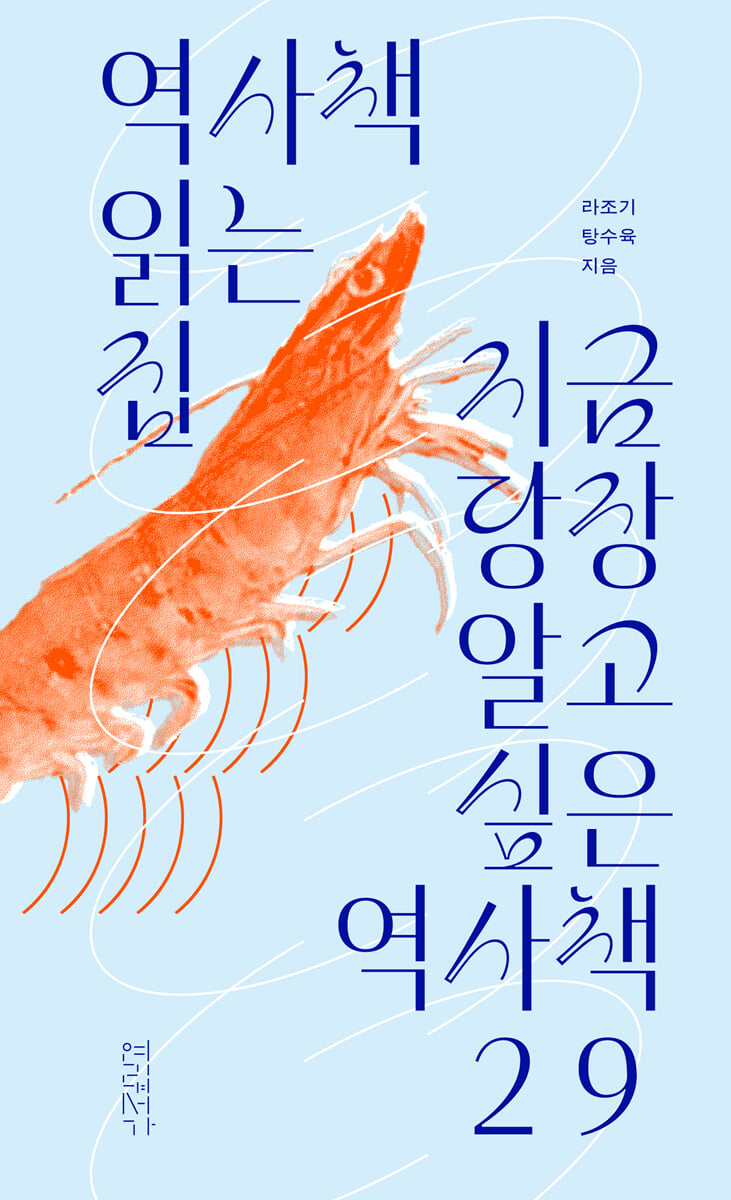
But why is there a 'shrimp' on the cover?
A shrimp that appeared on the cover rather unexpectedly!
Here's what designer Lee Ki-jun had to say:
“It was about ten years ago when I went to Sorae Port.
I looked into a cylindrical live fish tank installed in front of a sushi restaurant and saw hundreds of shrimps flapping their legs with all their might, either suckling or eating plankton, amidst the swirling current.
The sight of the shrimps moving backwards in unison, with movements so intense that even a sprinting Usain Bolt would look like slow motion, made people burst into laughter, but soon they became solemn.
The helplessness of human beings struggling against their own fate in the great flow of history was superimposed.
It seems like every being moves by its own will, but when you look from above, it looks like synchronized swimming······.
My promise to myself that I would definitely hire shrimp when I wrote a history book has finally come true.
“Shrimp, swimming as hard as we can is what we have to do!” The authors, hearing this concept, agreed.
“Should I say this is a reading diary of an office worker who struggles day by day to survive, but is actually swimming backwards like a shrimp?”
Book reviews and reading journals usually have a barrier to entry.
This is especially true if the book introduces a book I haven't read yet.
But if it's "funny, entertaining, and even informative," it can easily overcome the hurdles.
Moreover, it is an interesting suggestion from two office workers who have been reading books in their daily lives for over ten years and have created a space to share their thoughts with each other… .
You might even enjoy the pleasure of adding history books to your online bookstore cart, but it also comes with the side effect of making your wallet thinner.
There is a concept called 'public history'.
It refers to historical reenactment and historical practice in which both historical experts and non-experts participate and communicate outside of academia.
There is also a word called 'reverse otaku'.
Short for history nerd, it is introduced as 'history enthusiast' on Namuwiki.
The keyword that immediately comes to mind when thinking of these two is 'popularization of history', but the inner edge of popularization's double-edged sword is always targeting us.
For example, there is a controversy over historical distortion, or history is being simplified into a collection of pieces of knowledge and consumed as entertainment for the sake of interest.
That is why the existence of a "historical communicator" who connects the inside and outside of historical studies while not easily pandering to the public and literally ensuring "publicness" is so valuable.
The long-running podcast "The House of History Reading" returns to books.
Twelve years ago, in 2013, two graduate students started the podcast “History Reading House.”
One of them is a researcher at a history-related institution, and the other is a salaryman in the finance team of a large corporation. However, they have given up their precious weekends as office workers and continue to record steadfastly.
Even in the age of YouTube, the reason they have survived, or rather, are still going strong, is their attitude of pursuing fun, their wit, and their chemistry.
Above all, they are supported by the constant publication of interesting history books.
“(The world of history) is closely related to my life and is worth paying attention to, and once you start learning about it, there is so much to enjoy that you can wander around here and there for a long time.
There's a Netflix drama that's rumored to be really fun, so I looked it up and found out that it has about 20 seasons, with each season having 100 episodes.
“Would you be able to not get excited?”
The twenty-nine history books they selected were categorized not by era or region, but by the nature of the pleasure they felt while reading them (at the end of each chapter, there are also recommendations for parallel reading related to the topic).
There are five categories: history books that captivate readers with their captivating stories, history books that engage in fierce debates with books on the same topic due to differences in perspective and interpretation, history books that examine our lives under a microscope, history books that ask weighty questions and provide sincere answers, and lastly, history books that are read by everyone and (rarely) become comprehensive bestsellers.
29 History Books You Want to Know About Right Now!
The joy of reading history in such a diverse way
We are generally more interested in dramatic stories that actually happened than in pure fiction that is the product of our imagination.
Part 1, “More Fun Than a Drama,” introduces a history book that unfolds an interesting plot with flowing sentences and an engaging narrative style.
If history is the result of interpreting stories from the past based on historical materials from a present-day perspective, then the books introduced in Part 1 are books that combine the historian's skillful narrative composition with exciting historical events.
The first chapter compares two books that take slightly different approaches to exploring the background and causes of the family drama “Yuyu’s Runaway Incident” (which also served as the motif for the drama “The Tale of Lady Ok”) that took place in 16th-century Joseon.
When introducing a book that traces the 200-year-long social advancement project of the Subong family, I read that the Subong family's rise in social status was due to their economic power, and I reflect on my own empathy as a working person, a "modern-day slave."
In front of a book about the repatriation of Koreans in Japan, which took place 60 years ago and is still remembered as a distant fantasy, I look back on the lives of individuals who were broken and wounded by the immense scale of history.
Through this book, which is vivid and exciting, like watching a political drama, you can also meet various political characters from the liberation period.
When discussing a book about the 1972 mass murders at the Asama Mountain Lodge by the Japanese Red Army, we are reminded of the violence inherent in us and the exclusion of minorities in the name of certainty.
Part 2, “As urgent as a martial arts match,” introduces a “fighting” history book.
What makes historical debates different from sports is that they don't end with one side winning or losing, and any argument is worth listening to, as long as it's not baseless.
Controversial history books offer a process of “constantly tearing down, revising, and rebuilding the knowledge and arguments I currently possess, thereby creating a better intellect than yesterday.”
Part 2 introduces thrilling books, including two books that portray King Gwanghaegun as a wise king and a wicked king, to the point where one wonders if he was really the same king; a book that confronts the origins and lineage of the dark desire surrounding history called “pseudo-history” and engages in a head-on confrontation; and even “Emperor Gojong’s Historical Hearing,” which creates a ring within a single book and opens up a field for heated debate.
Part 3 is “A history book that asks if you have eaten.”
These are history books that ask if life has gotten any better, books that somehow make you feel like your own story, and books that make you feel like you're reading an essay by a senior in life.
A representative example is reading my ancestors' overseas business trip reports while going on a business trip abroad as an office worker, along with the burden of earning a living.
In 『The Korean War in the Village』, the aspects of the Korean War experienced by the Jang Sam-isas are examined from the perspective of ‘histories’, which refer to the various ‘histories’ experienced by various subjects, rather than ‘history’, which is formalized as a single narrative.
In "Colonial Korean Women in Divorce Court," we remember the struggles of "new women" in divorce court amidst social indifference that broke the patriarchal order.
We name them 'Kim Ji-youngs, Born in 1882' so that we do not forget what we enjoy today thanks to their struggles.
There is also a chapter that introduces the eventful story of a thousand years centered around cod, a fish we only encountered on the dinner table in our lives.
It shows a new perspective on historical narrative that is created when a non-human subject called Daegu is placed at the center, rather than the typical human subject who is usually called by name such as human class or ethnicity.
Part 4, “Into the Historian’s Questions,” introduces a history book in which the author’s critical awareness and questions are clearly revealed.
This book invites readers into the world of reasoning by revealing the curiosity and reason for writing the book.
The author adds that the color of the world we see changes depending on the questions asked by historians.
“Broadening our perspective on the world by following the questions historians ask is the most profound joy we can experience while reading history books.”
The questions also vary in their conclusions.
During the Manchu invasion of Korea (1636-1697), why did Hong Taiji, the second emperor of the Qing Dynasty, withdraw so hastily after finally accepting King Injo's surrender? This question, which we had never even considered, presents a fascinating and unexpected experience (even for those of us who didn't even know who Hong Taiji was).
There are also questions that come to mind from time to time in my daily life.
"Why are Koreans so particular about etiquette?" We vaguely assumed it was because of Confucianism, but now we receive a more detailed diagnosis and analysis from a Japanese historian and former professor emeritus at the University of Tokyo who specializes in Korean economic history.
The same goes for our people in the upper village, who were once objects of 'knowledge' but are completely incomprehensible and cannot understand why they persist so tenaciously.
Published ten years apart, these two books offer a better understanding of North Korea's system and society through the concepts of "guerrilla state" and "theater state."
It also includes an introduction to a history book that answers questions that arise when looking back on modern history, such as the origins of the idealistic fervor surrounding the puppet state of Manchukuo and the mentality of the colonial Koreans who sacrificed their lives for the Japanese Empire.
The final part 5 is “Reading Bestsellers in a Twisted Way.”
Bestsellers definitely have their advantages, although not all of them.
The argument is so compelling, the author presents a unique perspective on the world, or the story is so compelling that the pages turn quickly.
The biggest attraction is the many opportunities to talk with others about the books you've read.
Yes, there are parts that I think people like, but on the other hand, there are also parts that I think are not right.
So, everyone says the book is good, interesting, and touching, but I suggest that I try to find out the fun of reading in a different way.
In the publishing world, there are definitely bestsellers even in the history section, which is not a major genre.
These are books that you would recognize just by hearing their names: 『Sapiens』, 『Guns, Germs, and Steel』, 『The Annals of the Joseon Dynasty in One Volume』, and 『History of History』.
We introduce the joy of 'critical reading', which involves reading best-selling history books in a somewhat crooked way and adding a sense of regret.
But why is there a 'shrimp' on the cover?
A shrimp that appeared on the cover rather unexpectedly!
Here's what designer Lee Ki-jun had to say:
“It was about ten years ago when I went to Sorae Port.
I looked into a cylindrical live fish tank installed in front of a sushi restaurant and saw hundreds of shrimps flapping their legs with all their might, either suckling or eating plankton, amidst the swirling current.
The sight of the shrimps moving backwards in unison, with movements so intense that even a sprinting Usain Bolt would look like slow motion, made people burst into laughter, but soon they became solemn.
The helplessness of human beings struggling against their own fate in the great flow of history was superimposed.
It seems like every being moves by its own will, but when you look from above, it looks like synchronized swimming······.
My promise to myself that I would definitely hire shrimp when I wrote a history book has finally come true.
“Shrimp, swimming as hard as we can is what we have to do!” The authors, hearing this concept, agreed.
“Should I say this is a reading diary of an office worker who struggles day by day to survive, but is actually swimming backwards like a shrimp?”
Book reviews and reading journals usually have a barrier to entry.
This is especially true if the book introduces a book I haven't read yet.
But if it's "funny, entertaining, and even informative," it can easily overcome the hurdles.
Moreover, it is an interesting suggestion from two office workers who have been reading books in their daily lives for over ten years and have created a space to share their thoughts with each other… .
You might even enjoy the pleasure of adding history books to your online bookstore cart, but it also comes with the side effect of making your wallet thinner.
GOODS SPECIFICS
- Date of issue: June 18, 2025
- Page count, weight, size: 300 pages | 125*205*20mm
- ISBN13: 9791193598085
- ISBN10: 1193598087
You may also like
카테고리
korean


korean

![GQ KOREA Mark (Monthly): December [2025]](http://librairie.coreenne.fr/cdn/shop/files/8ef265dbbfbf186523ed75ba7319009d.jpg?v=1765340328&width=3840)


