

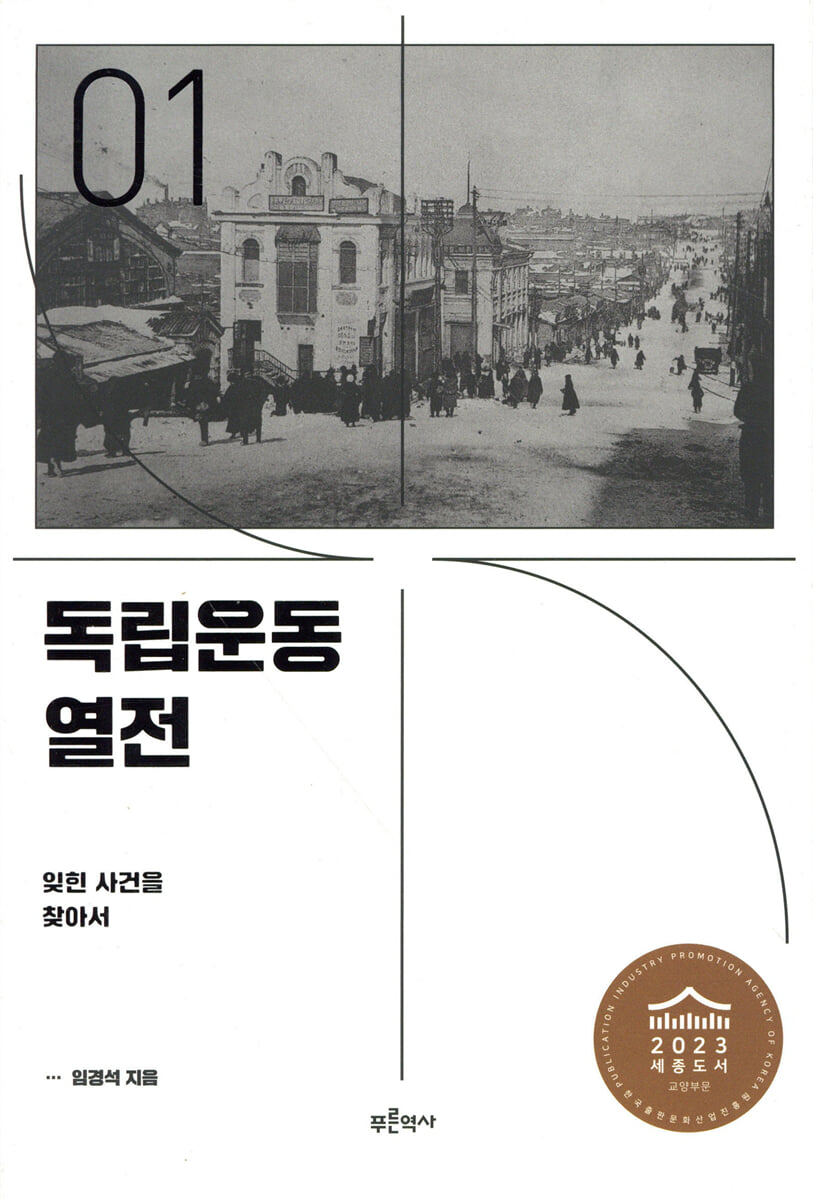
Independence Movement Chronicles 1
 |
Description
Book Introduction
Those who fought for Korea's independence
But forgotten
Independence movement events contained in 34 taps
『Independence Movement Chronicles 1 - In Search of Forgotten Events』 is a book that sets out to discover the people who devoted their utmost efforts to independence and liberation, the names that betrayed them for personal gain, and the various incidents that unfolded around them.
Professor Lim Gyeong-seok (Department of History, Sungkyunkwan University), who has devoted his research to comparing and reviewing Korean-related materials from the former Comintern Archives with the records of the Japanese Government-General of Korea's Higher Police, presents 34 forgotten events that should be remembered, among them "the story of the struggle for liberation by Koreans who lived during the era when their sovereignty was taken away by Japanese imperialism" (p. 5).
The author focuses particularly on people who devoted their entire lives to the independence movement but are less well known.
“We seek out people who were not in leadership positions or were known for their heroic achievements rather than those who were not” (p. 7).
It also gives primary status to socialist independence activists.
We do not exclude or diminish socialist independence activists, pointing out that many of those who dedicated themselves to the independence movement were socialists, yet they were excluded from official histories of the independence movement for a long time.
The author's efforts have brought us closer to the many previously unknown independence movement events and the dedication of unknown independence activists.
But forgotten
Independence movement events contained in 34 taps
『Independence Movement Chronicles 1 - In Search of Forgotten Events』 is a book that sets out to discover the people who devoted their utmost efforts to independence and liberation, the names that betrayed them for personal gain, and the various incidents that unfolded around them.
Professor Lim Gyeong-seok (Department of History, Sungkyunkwan University), who has devoted his research to comparing and reviewing Korean-related materials from the former Comintern Archives with the records of the Japanese Government-General of Korea's Higher Police, presents 34 forgotten events that should be remembered, among them "the story of the struggle for liberation by Koreans who lived during the era when their sovereignty was taken away by Japanese imperialism" (p. 5).
The author focuses particularly on people who devoted their entire lives to the independence movement but are less well known.
“We seek out people who were not in leadership positions or were known for their heroic achievements rather than those who were not” (p. 7).
It also gives primary status to socialist independence activists.
We do not exclude or diminish socialist independence activists, pointing out that many of those who dedicated themselves to the independence movement were socialists, yet they were excluded from official histories of the independence movement for a long time.
The author's efforts have brought us closer to the many previously unknown independence movement events and the dedication of unknown independence activists.
- You can preview some of the book's contents.
Preview
index
While publishing 『Biographies of the Independence Movement』
Chapter 1: Exile
01_The Secret of the Magazine Front Page of "Boy"
02_The exile of Imireuk, author of "The Yalu River Flows"
03_The Lives of Shanghai Exiles - Shim Hoon's Novel "The Lover of the East"
Chapter 2: The Assassination of Kim Lip
04_Who Shot the Independence Activist? - Kim Lip Assassination Case 1
05_Comrade Shot Comrade - Kim Lip Assassination 2
06_The Truth About Moscow's Support Funds - The Kim Lip Assassination Case 3
07_107 more independence army units could have been created - Kim Lip's assassination case 4
Chapter 3: 150,000 Won Case
08_Run away with Japanese money! - The '150,000 Won Incident' 1
09_The Dream of Obtaining a Weapon That Fell Through the Snitches - The '150,000 Won Incident' Part 2
10_The Two Faces of Eom In-seop, a Giant of the Righteous Army Struggle: The "150,000 Won Incident" 3
Chapter 4: Righteous Struggle
11_Kim Sang-ok's gunfight that shook the Gyeongseong world
12_Why the Righteous Army Incident is Amazing
13_The Uiyoldan's Huangpo shell uprising ended in failure
14_Tanaka sniper Oh Seong-ryun's escape from prison
15_Where did Kim Ik-sang's daughter, whom he had raised to be a revolutionary, go?
Chapter 5: Vladivostok's Shinhan Village
16_Independence activist Jeong Sun-man and the Gaekyeo-ri murder case
17_The Aftermath of the Gaecheok-ri Murder Case: Lee Sang-seol and Ahn Chang-ho Turn Their Backs
18_Katsumi Kito, the Japanese secret police who captured independence activists
19_The First Independent Government Plan - The Korean Liberation Army Government and the Gwonuphoe
Chapter 6 Betrayal
20_Is there justice in history? Oh Hyun-joo, the informant
21_Kim Dal-ha, who took part in the sabotage of the Provisional Government
22_The betrayal of Kim Dae-woo, a student representative of the March 1st Movement
23_The story of Dokgo selling out a young female comrade
24_Kim Seong-geun, an independence activist who became a spy
Chapter 7 Secret Society
25_Kim Jae-bong, the executive secretary who tried his best to save the organization
26_A Day in the Life of Kang Dal-young, Second Secretary of the Communist Party of Korea
27_Kwon Oh-seol, the wanted man who resurrected the secret society
28_Chaeguri sleeping in a steel coffin engraved with the 'Star of Revolution'
29_The 4th Chief Secretary, Ahn Gwang-cheon, who is at odds with the public.
Chapter 8: The Prison Struggle
30_Park Heon-yeong, who defended himself boldly in court
31_Park Gil-yang, a socialist independence activist who was tortured
Lee Han-bin, who died in prison after a 105-day hunger strike against preventive detention.
Chapter 9 Internationalism
33_Comintern Special Envoy John Pepper's Trip to Korea
34_Discovery of a Korean manuscript of the December thesis
annotation
Search
Chapter 1: Exile
01_The Secret of the Magazine Front Page of "Boy"
02_The exile of Imireuk, author of "The Yalu River Flows"
03_The Lives of Shanghai Exiles - Shim Hoon's Novel "The Lover of the East"
Chapter 2: The Assassination of Kim Lip
04_Who Shot the Independence Activist? - Kim Lip Assassination Case 1
05_Comrade Shot Comrade - Kim Lip Assassination 2
06_The Truth About Moscow's Support Funds - The Kim Lip Assassination Case 3
07_107 more independence army units could have been created - Kim Lip's assassination case 4
Chapter 3: 150,000 Won Case
08_Run away with Japanese money! - The '150,000 Won Incident' 1
09_The Dream of Obtaining a Weapon That Fell Through the Snitches - The '150,000 Won Incident' Part 2
10_The Two Faces of Eom In-seop, a Giant of the Righteous Army Struggle: The "150,000 Won Incident" 3
Chapter 4: Righteous Struggle
11_Kim Sang-ok's gunfight that shook the Gyeongseong world
12_Why the Righteous Army Incident is Amazing
13_The Uiyoldan's Huangpo shell uprising ended in failure
14_Tanaka sniper Oh Seong-ryun's escape from prison
15_Where did Kim Ik-sang's daughter, whom he had raised to be a revolutionary, go?
Chapter 5: Vladivostok's Shinhan Village
16_Independence activist Jeong Sun-man and the Gaekyeo-ri murder case
17_The Aftermath of the Gaecheok-ri Murder Case: Lee Sang-seol and Ahn Chang-ho Turn Their Backs
18_Katsumi Kito, the Japanese secret police who captured independence activists
19_The First Independent Government Plan - The Korean Liberation Army Government and the Gwonuphoe
Chapter 6 Betrayal
20_Is there justice in history? Oh Hyun-joo, the informant
21_Kim Dal-ha, who took part in the sabotage of the Provisional Government
22_The betrayal of Kim Dae-woo, a student representative of the March 1st Movement
23_The story of Dokgo selling out a young female comrade
24_Kim Seong-geun, an independence activist who became a spy
Chapter 7 Secret Society
25_Kim Jae-bong, the executive secretary who tried his best to save the organization
26_A Day in the Life of Kang Dal-young, Second Secretary of the Communist Party of Korea
27_Kwon Oh-seol, the wanted man who resurrected the secret society
28_Chaeguri sleeping in a steel coffin engraved with the 'Star of Revolution'
29_The 4th Chief Secretary, Ahn Gwang-cheon, who is at odds with the public.
Chapter 8: The Prison Struggle
30_Park Heon-yeong, who defended himself boldly in court
31_Park Gil-yang, a socialist independence activist who was tortured
Lee Han-bin, who died in prison after a 105-day hunger strike against preventive detention.
Chapter 9 Internationalism
33_Comintern Special Envoy John Pepper's Trip to Korea
34_Discovery of a Korean manuscript of the December thesis
annotation
Search
Into the book
This book is about the people who fought for Korea's independence.
This is the story of the struggle of Korean people for liberation during a time when their national sovereignty was taken away by Japanese imperialism.
--- p.5
The opening poem of the magazine 『Boy』 was a song about the feelings of the Shinminhoe exiles.
… … As the young Choi Nam-seon watched his comrades embark on an indefinite journey into exile, a surge of passion and sorrow welled up in his heart.
He wrote two poems blessing the exiles.
These are "The Sorrow of Leaving the Country" and "Parting with the Lover of Taebaek."
--- p.20
Imireuk was able to go to Europe to study and settle in Germany.
But he never returned to his homeland again.
… … He devoted himself to the justice of the community without caring for his own personal interests.
Despite being a descendant of a large landowner and destined for a professional career as a doctor, he devoted himself to the fight for the liberation of oppressed peoples.
Every Korean living today owes a debt of gratitude to his sacrifice and dedication.
We must not forget Imireuk, who willingly sacrificed his precious family for the public good.
--- p.29
Author Sim Hoon lived in Shanghai from 1920 to 1921.
Shim Hoon himself was an exile in Shanghai.
He wrote this novel (『The Lover of the East』) based on his own experiences.
Consider the descriptions of Shanghai's street scenes, the acceptance of socialist ideas that were just beginning to sprout in Shanghai, and the nature of group activities.
It conveys historical truth more vividly than any other source material.
… … In this way, “The Lover of the East” meticulously depicts the inner workings of the Korean exile community in Shanghai in 1920, particularly the process by which socialism was first embraced.
--- p.37
The people who pulled the trigger on Kim Lip were… Oh Myung-jik and Noh Jong-gyun.
They were 'bodyguards' belonging to the provisional government.
… … At that time in Shanghai … … Bodyguards were employees of the Provisional Government’s Ministry of Internal Affairs who worked under the direction of the Director of the Police Bureau, and were none other than the police.
--- p.51
Why, and for what reason? Police Chief Kim Gu addressed this issue in his "Baekbeom Ilji."
The 400,000 rubles in Moscow funds were paid by the Soviet Russian government to the Provisional Government of the Republic of Korea, but it is said that the Provisional Government's Prime Minister Lee Dong-hwi and Secretary-General Kim Lip conspired to embezzle them.
Lee Dong-hwi and Kim Lip were ‘embezzlers of public funds’ of the provisional government.
Moreover, Kim Lip was accused of embezzling public funds for personal use.
According to Kim Gu, Kim Lip committed corruption.
Kim Gu criticized Kim Lip for "purchasing land in North Gando for his family" and "secretly living in Shanghai, taking Guangdong women as concubines and enjoying themselves."
--- p.53
Kim Lip's life was taken by an enemy within.
His death brought great loss to the independence movement.
It shattered the comradely bond that existed among the Shanghai exiles.
Differences in views and organization have created widespread suspicion and fear that one may lose one's life at the hands of one's former colleagues.
… … Is that all?
… … Kim Lip’s death made further receipt of Moscow funds impossible.
The assassination of Kim Lip raised suspicions about the execution of Moscow's funds, and the Comintern, taking these suspicions seriously, conducted its own investigation.
As a result, it was decided to suspend payment of the remaining amount of the promised total support.
--- p.79
The assassination of Kim Lip was a form of state violence.
This incident, carried out by the Police Department based on the decision of the Provisional Government of the Republic of Korea cabinet, was an unfortunate event that brought great harm to the Korean independence movement.
… … Kim Lip is still stuck in the ignominy of being labeled a ‘public fund embezzler’ today.
Even though nearly a hundred years have passed since his death, he still remains in the shadow of the policy mistakes made by the Provisional Government of the Republic of Korea.
… … It is time to erase the false stigma that has been oppressing him and place a bouquet of flowers in his place to honor his dedication and sacrifice.
--- p.80
It was three days after the incident that the four main characters in the 150,000 won incident crossed the China-Russia border along with Kim Ha-seok.
… … The four young men aboard the ship felt relieved.
The seemingly reckless and impossible plan to arm the Korean independence army with funds obtained by raiding a Japanese bank convoy appeared to have succeeded.
--- p.93
It was Eom In-seop.
This is the person who informed the Japanese Consulate General of the whereabouts of the main characters in the 150,000 won incident.
--- p.107
The main characters in the '150,000 Won Incident', who were arrested after Eom In-seop reported them, were taken to the Japanese warship Chikuzen Maru, which was anchored at the Kinkaku Bay dock.
… … Even though the young men were subjected to severe torture, they did not give up obediently.
They wanted to protect those who had helped and supported them, but had not yet been revealed.
--- p.112
The three people directly involved in the 150,000 won incident, Yoon Jun-hee, Lim Guk-jeong, and Han Sang-ho, were sentenced to death, and Jeon Hong-seop, an clerk at the Yongjeong branch of the Bank of Korea who provided information on cash transportation, was sentenced to life imprisonment.
It was four months and twenty days after the sentencing.
The death penalty was carried out.
It was August 25, 1921.
… … In the execution grounds located deep inside Seodaemun Prison, three young men closed their eyes forever.
The bodies of the three men were buried in the Sinsa-ri public cemetery outside Hongje-dong, where death row inmates from Seodaemun Prison are usually buried.
--- p.113
Kim Sang-ok held the pistol tightly in both hands until the moment of his death.
The coroner wrote that Kim Sang-ok was gripping the trigger with his right index finger.
--- p.127
It was revealed that large quantities of explosives had been hidden in two cities: the border city of Sinuiju and the colonial capital of Gyeongseong.
The Sinuiju Police Department launched a simultaneous arrest operation on the night of March 14th, and the Gyeonggi Provincial Police Department launched a simultaneous arrest operation on the morning of the 15th.
As a result, the results far exceeded expectations.
They confiscated 36 bombs, 6 watches for explosive devices, 5 pistols, 155 rounds of live ammunition, 6 detonators, and approximately 900 copies of subversive documents titled “Declaration of the Korean Revolution” and “To the Government-General of Korea.”
Eighteen other Koreans were arrested as suspected accomplices.
--- p.130~31
On March 28, 1922, the assassination of Japanese Army General Tanaka occurred.
This incident is called the 'Hwangpo Bomb Incident'.
Immediately after the incident, two of the main figures in the uprising were arrested.
They were Kim Ik-sang (28) and Oh Seong-ryun (23).
--- p.145
Did Kim Ik-sang ever reunite with his family? It seems the last words of an independence activist who sacrificed himself and his family to liberate his oppressed compatriots were never carried out.
“I ask that you educate my daughter and guide her to become a female revolutionary.” The person who must carry out this will is no longer limited to Kim Won-bong, the leader of the Uiyoldan.
It is a moral duty that members of a community living in a liberated world must observe and fulfill.
--- p.164
The two murders in Gaekyeo-ri dealt a fatal blow to the independence movement.
It wasn't just that two leading figures in the student movement lost their lives.
It had a much more serious negative impact.
This was precisely what dashed the hopes for the independence movement.
A grand effort to build a broad network of overseas Koreans across the United States, Russia, and China has been thwarted.
The movement to form national associations in various regions and unify anti-Japanese forces through them was divided and weakened.
--- p.184
There was a special secret to how Katsumi Kito was able to become an excellent secret police officer.
It was all thanks to the spy.
He showed extraordinary talent in selecting and utilizing spies.
He was adept at the shady business of organizing spy networks.
--- p.192
It is true that war broke out in the year of Gapin.
But the war was not between Russia and Japan.
It was World War I.
The situation has changed rapidly.
Russia, which declared war on Germany on August 1, 1914, mobilized all means to win the war.
Russia and Japan became members of the Allied Powers.
We are no longer enemies, but on the same side.
Russia accepted Japan's demands and began blocking the Primorsky Krai from becoming a base for anti-Japanese movements.
Any person or group that had the potential to launch an anti-Japanese independence movement within Russian territory was subject to repression.
… … The secret society, the Korean Liberation Army, and the government's plan for an independence war ran into an insurmountable obstacle.
--- p.204
Oh Hyun-joo eventually accepted her husband and the detective's offer.
He agreed to hand over the secret documents of the Patriotic Women's Association in exchange for guaranteeing the safety of his wife, his older sister Oh Hyeon-gwan, and his wife.
… … It was November 28, 1919.
A mass arrest of members of the Patriotic Women's Association has begun.
Led by President Maria Kim, 70 members of the Patriotic Women's Association were arrested across the country.
--- p.213
The Kim Dal-ha incident refers to a murder that occurred on March 30, 1925, in a residential area near Anjeongmun, north of Beijing, the capital of China.
This is the case of a 57-year-old man known as a prominent figure in the anti-Japanese Korean community who was murdered by his former comrades on suspicion of being a Japanese spy.
--- p.218
The birth of Kim Dae-woo, an anti-nationalist, occurred on April 9th, during an interrogation by a preliminary judge, while the March 1st Movement was in full swing.
Born from a confession that he no longer hoped for Joseon's independence, he resolved to conform to the existing power relations and pursue only his own interests, regardless of the well-being of the community.
--- p.237
It is said that Dokgo Jeon... ... handed over information about the secret contact to a Japanese detective, and a comrade who had gone to the meeting place was arrested.
Who is the 'comrade' arrested at this time?
It was Kim Myeong-si.
A 25-year-old woman who graduated from the Communist University of the Eastern Toilers in Moscow and jumped into the struggle for independence and freedom in colonial Korea. She was a giant who, despite enduring a long imprisonment, refused to yield and went into exile overseas to join the armed struggle against Japan.
--- p.242
Kim Seong-geun lived until after liberation.
… … It seems that he was never held accountable for his role as a spy for the Japanese consulate police department until his death.
On the contrary, he received the Order of Merit for Independence after his death.
On March 1, 1963, he was awarded the Order of Merit for National Foundation, Short Medal by the Independence Meritorious Service Medal Review Council.
It was a high decoration equivalent to today's Order of Merit for National Foundation, Independence Medal.
… … Kim Seong-geun is still listed as a person with meritorious service to independence.
--- p.253
It was the night of December 19, 1925.
Kim Jae-bong, who had been busy with his duties after setting up a hideout in Donui-dong, Gyeongseong, came out to Jongno to make a phone call and was arrested by detectives from Jongno Police Station.
… … But there was one thing that was fortunate.
He had managed to organize a successor executive a few days before his arrest.
Kim Jae-bong by-elected the Central Executive Committee to fill the vacancy caused by his arrest and exile.
Kang Dal-young, a fervent revolutionary and socialist from Jinju, Gyeongnam, was selected as the successor secretary.
--- p.262~63
When the Japanese police's decryption technology broke the algorithm, his (Kang Dal-young's) resolve to keep the secret at risk of his life crumbled.
He couldn't maintain his sanity.
I'm going crazy.
I ended up going crazy.
The symptoms were the same while I was in prison, and they did not improve after I was released.
He lived a lonely life like that until he passed away on July 12, 1940, at the age of 54.
A man of merit for the March 1st Movement in Jinju, a leader of the Korean labor movement, and a revolutionary who dedicated his life but failed to achieve success. May his soul rest in peace.
--- p.271
Thanks to Kwon Oh-seol, the secret society Goryeo Gongcheong suffered the imprisonment of 12 members, but quickly recovered its strength without significant disruption.
--- p.281
The photo remains.
A life-size iron coffin was erected, and seven young men surrounded it and took a commemorative photo.
They appear to be colleagues who worked together in a secret society with Chaeguri.
The iron coffin head was engraved with a star symbolizing the revolution.
--- p.291
The period when An Gwang-cheon was the chief secretary was one of the golden ages in the history of the Korean socialist movement.
During his tenure, the socialist movement was able to unite, but with his resignation, the Korean Communist Party was split again.
In that respect, An Gwang-cheon was a barometer of the rise and fall of the Korean Communist Party.
The period of Secretary Ahn Gwang-cheon's tenure was also a turning point.
If the previous internal diversity was represented by the conflict between the Tuesday and Seoul factions, after Ahn Gwang-cheon, it was expressed as the conflict between the ML and BML factions.
--- p.300
Park Heon-yeong's legal struggle was dignified from beginning to end.
It restored the self-esteem of the defendants who had been psychologically crushed by torture and oppression.
From then on, he began to be talked about among his comrades as a trustworthy and reliable leader.
But harsh retaliation followed.
Park Heon-yeong was brutally assaulted after the trial.
… … Park Heon-yeong's 'mental disorder', such as attempting suicide and eating his own excrement, was caused by this assault.
--- p.314
Park Gil-yang died in prison.
Thirty-four years old, in the prime of life.
He died in the cold iron bars of Seodaemun Prison at 6:00 AM on a winter day, January 19, 1928.
… … He was a defendant in the ‘Korean Communist Party Trial.’
The Korean Communist Party Trial was a criminal trial conducted by the Gyeongseong District Court of the Government-General of Korea, lasting five months from September 13, 1927, to February 13 of the following year.
It is also called the '101-person case' because there are 101 defendants.
--- p.316~17
After fasting for 105 days, there was a man who gave his life to the community.
He is a man who fought against the ironclad ruling system through a desperate hunger strike.
… … This is Lee Han-bin, a young Korean man who devoted himself to the liberation movement of an oppressed people during the Japanese colonial period and was sacrificed at the hands of Japanese officials.
--- p.325
Pepper pointed out that it was difficult to obtain up-to-date, accurate information about North Korea in Moscow.
The information available to the International Party was outdated and did not reflect reality.
… … He criticized the International Party’s decision to send Europeans to Joseon as being unreasonable from the beginning.
… … It was a sharp self-criticism of the reality of the International Party.
--- p.342~43
The December Theses refer to the decision on the Korean question adopted by the Comintern Political Secretariat on December 10, 1928.
It was called a ‘thesis’ because it was a programmatic document discussing the basic policy of the Korean revolutionary movement.
This thesis is a monumental document that had the greatest influence on the Korean socialist movement under Japanese colonial rule.
This is the story of the struggle of Korean people for liberation during a time when their national sovereignty was taken away by Japanese imperialism.
--- p.5
The opening poem of the magazine 『Boy』 was a song about the feelings of the Shinminhoe exiles.
… … As the young Choi Nam-seon watched his comrades embark on an indefinite journey into exile, a surge of passion and sorrow welled up in his heart.
He wrote two poems blessing the exiles.
These are "The Sorrow of Leaving the Country" and "Parting with the Lover of Taebaek."
--- p.20
Imireuk was able to go to Europe to study and settle in Germany.
But he never returned to his homeland again.
… … He devoted himself to the justice of the community without caring for his own personal interests.
Despite being a descendant of a large landowner and destined for a professional career as a doctor, he devoted himself to the fight for the liberation of oppressed peoples.
Every Korean living today owes a debt of gratitude to his sacrifice and dedication.
We must not forget Imireuk, who willingly sacrificed his precious family for the public good.
--- p.29
Author Sim Hoon lived in Shanghai from 1920 to 1921.
Shim Hoon himself was an exile in Shanghai.
He wrote this novel (『The Lover of the East』) based on his own experiences.
Consider the descriptions of Shanghai's street scenes, the acceptance of socialist ideas that were just beginning to sprout in Shanghai, and the nature of group activities.
It conveys historical truth more vividly than any other source material.
… … In this way, “The Lover of the East” meticulously depicts the inner workings of the Korean exile community in Shanghai in 1920, particularly the process by which socialism was first embraced.
--- p.37
The people who pulled the trigger on Kim Lip were… Oh Myung-jik and Noh Jong-gyun.
They were 'bodyguards' belonging to the provisional government.
… … At that time in Shanghai … … Bodyguards were employees of the Provisional Government’s Ministry of Internal Affairs who worked under the direction of the Director of the Police Bureau, and were none other than the police.
--- p.51
Why, and for what reason? Police Chief Kim Gu addressed this issue in his "Baekbeom Ilji."
The 400,000 rubles in Moscow funds were paid by the Soviet Russian government to the Provisional Government of the Republic of Korea, but it is said that the Provisional Government's Prime Minister Lee Dong-hwi and Secretary-General Kim Lip conspired to embezzle them.
Lee Dong-hwi and Kim Lip were ‘embezzlers of public funds’ of the provisional government.
Moreover, Kim Lip was accused of embezzling public funds for personal use.
According to Kim Gu, Kim Lip committed corruption.
Kim Gu criticized Kim Lip for "purchasing land in North Gando for his family" and "secretly living in Shanghai, taking Guangdong women as concubines and enjoying themselves."
--- p.53
Kim Lip's life was taken by an enemy within.
His death brought great loss to the independence movement.
It shattered the comradely bond that existed among the Shanghai exiles.
Differences in views and organization have created widespread suspicion and fear that one may lose one's life at the hands of one's former colleagues.
… … Is that all?
… … Kim Lip’s death made further receipt of Moscow funds impossible.
The assassination of Kim Lip raised suspicions about the execution of Moscow's funds, and the Comintern, taking these suspicions seriously, conducted its own investigation.
As a result, it was decided to suspend payment of the remaining amount of the promised total support.
--- p.79
The assassination of Kim Lip was a form of state violence.
This incident, carried out by the Police Department based on the decision of the Provisional Government of the Republic of Korea cabinet, was an unfortunate event that brought great harm to the Korean independence movement.
… … Kim Lip is still stuck in the ignominy of being labeled a ‘public fund embezzler’ today.
Even though nearly a hundred years have passed since his death, he still remains in the shadow of the policy mistakes made by the Provisional Government of the Republic of Korea.
… … It is time to erase the false stigma that has been oppressing him and place a bouquet of flowers in his place to honor his dedication and sacrifice.
--- p.80
It was three days after the incident that the four main characters in the 150,000 won incident crossed the China-Russia border along with Kim Ha-seok.
… … The four young men aboard the ship felt relieved.
The seemingly reckless and impossible plan to arm the Korean independence army with funds obtained by raiding a Japanese bank convoy appeared to have succeeded.
--- p.93
It was Eom In-seop.
This is the person who informed the Japanese Consulate General of the whereabouts of the main characters in the 150,000 won incident.
--- p.107
The main characters in the '150,000 Won Incident', who were arrested after Eom In-seop reported them, were taken to the Japanese warship Chikuzen Maru, which was anchored at the Kinkaku Bay dock.
… … Even though the young men were subjected to severe torture, they did not give up obediently.
They wanted to protect those who had helped and supported them, but had not yet been revealed.
--- p.112
The three people directly involved in the 150,000 won incident, Yoon Jun-hee, Lim Guk-jeong, and Han Sang-ho, were sentenced to death, and Jeon Hong-seop, an clerk at the Yongjeong branch of the Bank of Korea who provided information on cash transportation, was sentenced to life imprisonment.
It was four months and twenty days after the sentencing.
The death penalty was carried out.
It was August 25, 1921.
… … In the execution grounds located deep inside Seodaemun Prison, three young men closed their eyes forever.
The bodies of the three men were buried in the Sinsa-ri public cemetery outside Hongje-dong, where death row inmates from Seodaemun Prison are usually buried.
--- p.113
Kim Sang-ok held the pistol tightly in both hands until the moment of his death.
The coroner wrote that Kim Sang-ok was gripping the trigger with his right index finger.
--- p.127
It was revealed that large quantities of explosives had been hidden in two cities: the border city of Sinuiju and the colonial capital of Gyeongseong.
The Sinuiju Police Department launched a simultaneous arrest operation on the night of March 14th, and the Gyeonggi Provincial Police Department launched a simultaneous arrest operation on the morning of the 15th.
As a result, the results far exceeded expectations.
They confiscated 36 bombs, 6 watches for explosive devices, 5 pistols, 155 rounds of live ammunition, 6 detonators, and approximately 900 copies of subversive documents titled “Declaration of the Korean Revolution” and “To the Government-General of Korea.”
Eighteen other Koreans were arrested as suspected accomplices.
--- p.130~31
On March 28, 1922, the assassination of Japanese Army General Tanaka occurred.
This incident is called the 'Hwangpo Bomb Incident'.
Immediately after the incident, two of the main figures in the uprising were arrested.
They were Kim Ik-sang (28) and Oh Seong-ryun (23).
--- p.145
Did Kim Ik-sang ever reunite with his family? It seems the last words of an independence activist who sacrificed himself and his family to liberate his oppressed compatriots were never carried out.
“I ask that you educate my daughter and guide her to become a female revolutionary.” The person who must carry out this will is no longer limited to Kim Won-bong, the leader of the Uiyoldan.
It is a moral duty that members of a community living in a liberated world must observe and fulfill.
--- p.164
The two murders in Gaekyeo-ri dealt a fatal blow to the independence movement.
It wasn't just that two leading figures in the student movement lost their lives.
It had a much more serious negative impact.
This was precisely what dashed the hopes for the independence movement.
A grand effort to build a broad network of overseas Koreans across the United States, Russia, and China has been thwarted.
The movement to form national associations in various regions and unify anti-Japanese forces through them was divided and weakened.
--- p.184
There was a special secret to how Katsumi Kito was able to become an excellent secret police officer.
It was all thanks to the spy.
He showed extraordinary talent in selecting and utilizing spies.
He was adept at the shady business of organizing spy networks.
--- p.192
It is true that war broke out in the year of Gapin.
But the war was not between Russia and Japan.
It was World War I.
The situation has changed rapidly.
Russia, which declared war on Germany on August 1, 1914, mobilized all means to win the war.
Russia and Japan became members of the Allied Powers.
We are no longer enemies, but on the same side.
Russia accepted Japan's demands and began blocking the Primorsky Krai from becoming a base for anti-Japanese movements.
Any person or group that had the potential to launch an anti-Japanese independence movement within Russian territory was subject to repression.
… … The secret society, the Korean Liberation Army, and the government's plan for an independence war ran into an insurmountable obstacle.
--- p.204
Oh Hyun-joo eventually accepted her husband and the detective's offer.
He agreed to hand over the secret documents of the Patriotic Women's Association in exchange for guaranteeing the safety of his wife, his older sister Oh Hyeon-gwan, and his wife.
… … It was November 28, 1919.
A mass arrest of members of the Patriotic Women's Association has begun.
Led by President Maria Kim, 70 members of the Patriotic Women's Association were arrested across the country.
--- p.213
The Kim Dal-ha incident refers to a murder that occurred on March 30, 1925, in a residential area near Anjeongmun, north of Beijing, the capital of China.
This is the case of a 57-year-old man known as a prominent figure in the anti-Japanese Korean community who was murdered by his former comrades on suspicion of being a Japanese spy.
--- p.218
The birth of Kim Dae-woo, an anti-nationalist, occurred on April 9th, during an interrogation by a preliminary judge, while the March 1st Movement was in full swing.
Born from a confession that he no longer hoped for Joseon's independence, he resolved to conform to the existing power relations and pursue only his own interests, regardless of the well-being of the community.
--- p.237
It is said that Dokgo Jeon... ... handed over information about the secret contact to a Japanese detective, and a comrade who had gone to the meeting place was arrested.
Who is the 'comrade' arrested at this time?
It was Kim Myeong-si.
A 25-year-old woman who graduated from the Communist University of the Eastern Toilers in Moscow and jumped into the struggle for independence and freedom in colonial Korea. She was a giant who, despite enduring a long imprisonment, refused to yield and went into exile overseas to join the armed struggle against Japan.
--- p.242
Kim Seong-geun lived until after liberation.
… … It seems that he was never held accountable for his role as a spy for the Japanese consulate police department until his death.
On the contrary, he received the Order of Merit for Independence after his death.
On March 1, 1963, he was awarded the Order of Merit for National Foundation, Short Medal by the Independence Meritorious Service Medal Review Council.
It was a high decoration equivalent to today's Order of Merit for National Foundation, Independence Medal.
… … Kim Seong-geun is still listed as a person with meritorious service to independence.
--- p.253
It was the night of December 19, 1925.
Kim Jae-bong, who had been busy with his duties after setting up a hideout in Donui-dong, Gyeongseong, came out to Jongno to make a phone call and was arrested by detectives from Jongno Police Station.
… … But there was one thing that was fortunate.
He had managed to organize a successor executive a few days before his arrest.
Kim Jae-bong by-elected the Central Executive Committee to fill the vacancy caused by his arrest and exile.
Kang Dal-young, a fervent revolutionary and socialist from Jinju, Gyeongnam, was selected as the successor secretary.
--- p.262~63
When the Japanese police's decryption technology broke the algorithm, his (Kang Dal-young's) resolve to keep the secret at risk of his life crumbled.
He couldn't maintain his sanity.
I'm going crazy.
I ended up going crazy.
The symptoms were the same while I was in prison, and they did not improve after I was released.
He lived a lonely life like that until he passed away on July 12, 1940, at the age of 54.
A man of merit for the March 1st Movement in Jinju, a leader of the Korean labor movement, and a revolutionary who dedicated his life but failed to achieve success. May his soul rest in peace.
--- p.271
Thanks to Kwon Oh-seol, the secret society Goryeo Gongcheong suffered the imprisonment of 12 members, but quickly recovered its strength without significant disruption.
--- p.281
The photo remains.
A life-size iron coffin was erected, and seven young men surrounded it and took a commemorative photo.
They appear to be colleagues who worked together in a secret society with Chaeguri.
The iron coffin head was engraved with a star symbolizing the revolution.
--- p.291
The period when An Gwang-cheon was the chief secretary was one of the golden ages in the history of the Korean socialist movement.
During his tenure, the socialist movement was able to unite, but with his resignation, the Korean Communist Party was split again.
In that respect, An Gwang-cheon was a barometer of the rise and fall of the Korean Communist Party.
The period of Secretary Ahn Gwang-cheon's tenure was also a turning point.
If the previous internal diversity was represented by the conflict between the Tuesday and Seoul factions, after Ahn Gwang-cheon, it was expressed as the conflict between the ML and BML factions.
--- p.300
Park Heon-yeong's legal struggle was dignified from beginning to end.
It restored the self-esteem of the defendants who had been psychologically crushed by torture and oppression.
From then on, he began to be talked about among his comrades as a trustworthy and reliable leader.
But harsh retaliation followed.
Park Heon-yeong was brutally assaulted after the trial.
… … Park Heon-yeong's 'mental disorder', such as attempting suicide and eating his own excrement, was caused by this assault.
--- p.314
Park Gil-yang died in prison.
Thirty-four years old, in the prime of life.
He died in the cold iron bars of Seodaemun Prison at 6:00 AM on a winter day, January 19, 1928.
… … He was a defendant in the ‘Korean Communist Party Trial.’
The Korean Communist Party Trial was a criminal trial conducted by the Gyeongseong District Court of the Government-General of Korea, lasting five months from September 13, 1927, to February 13 of the following year.
It is also called the '101-person case' because there are 101 defendants.
--- p.316~17
After fasting for 105 days, there was a man who gave his life to the community.
He is a man who fought against the ironclad ruling system through a desperate hunger strike.
… … This is Lee Han-bin, a young Korean man who devoted himself to the liberation movement of an oppressed people during the Japanese colonial period and was sacrificed at the hands of Japanese officials.
--- p.325
Pepper pointed out that it was difficult to obtain up-to-date, accurate information about North Korea in Moscow.
The information available to the International Party was outdated and did not reflect reality.
… … He criticized the International Party’s decision to send Europeans to Joseon as being unreasonable from the beginning.
… … It was a sharp self-criticism of the reality of the International Party.
--- p.342~43
The December Theses refer to the decision on the Korean question adopted by the Comintern Political Secretariat on December 10, 1928.
It was called a ‘thesis’ because it was a programmatic document discussing the basic policy of the Korean revolutionary movement.
This thesis is a monumental document that had the greatest influence on the Korean socialist movement under Japanese colonial rule.
--- p.344~46
Publisher's Review
In search of forgotten independence movement events
Through Sim Hoon's novel, "The Lover of the East," the author examines the difficult lives of exiles who left their homeland for Shanghai to fight for independence, and reveals the truth about the unfortunate incident of "Kim Lip's Assassination," in which a comrade shot a comrade, and the "150,000 Won Incident," in which a dream of armed struggle with Japanese money was thwarted by a tip-off.
We will look at the various aspects of the righteous struggle through the gunfight of Kim Sang-ok that shook the Gyeongseong world and the yellow cannonball incident of the Uiyoldan that attempted to shoot Army General Tanaka. We will also look into the desperate prison struggles of independence activists through Park Heon-yeong, who bravely protested in court, Park Gil-yang, a socialist independence activist who was tortured and sacrificed, and Lee Han-bin, who died in prison after a 105-day hunger strike against preventive detention.
The truth about the spies who betrayed independence activists, including Kim Dal-ha, who participated in the sabotage of the Provisional Government; Oh Hyeon-ju, the first president of the Patriotic Women's Association of the Republic of Korea, who passed on information on secret activities and was guaranteed her safety; and Dokgo Jeon, a first-generation member of the Joseon socialist movement who sold out a young female comrade, Kim Myeong-si, to the Japanese, is also uncovered.
The Boundary of Taxidermy and Heroic Narratives… Focusing on the Nameless Devotion
What the author pays particular attention to is “Anonymous Devotion” (p. 8).
The author points out that most books and papers on the history of the independence movement today have been striving for “plaque and heroic narratives” (p. 8) that “highlight only the positive aspects of individual independence activists or independence movement groups in order to make them stand out,” and criticizes such efforts as boring and tedious.
To overcome this weakness, the author focuses on “nameless fighters who dedicated themselves to justice but were forgotten” (p. 7).
When examining the '150,000 Won Incident', in which funds obtained by raiding a cash convoy from the Bank of Japan were used to arm the Korean Independence Army, the story mentions the exploits of Jeon Hong-seop, an employee of the Yongjeong branch of the Bank of Korea who was not a key player in the incident but was ultimately sentenced to life imprisonment for providing information on the cash transport. It also describes how Chae Gye-bok, the president of the Vladivostok Patriotic Women's Association, provided help to Choi Bong-seol, the key player in the incident, who desperately escaped from the Japanese police's arrest operation.
It also sheds new light on the lives of unfamiliar independence activists, such as Lee Han-bin, who was a promising executive who had studied abroad in Moscow, participated in a secret society movement, was arrested by the Japanese police, and went on a hunger strike for 105 days to protest preventive detention (an administrative measure that allows for the imprisonment of a person with a history of violating the National Security Preservation Act based solely on the suspicion that there is a risk of reoffending), ultimately dying in prison.
Living as a family of independence activists
The author focuses not only on those who suffered hardships after throwing themselves into the independence movement without regard for personal interests, but also on their families: young children who had to grow up without fathers, wives who had to raise their young children alone without husbands, and elderly parents who grieved over the loss of their children.
When examining the '150,000 Won Incident', we focus not only on the incident itself, but also on 'Im Boe-boe', the mother of Im Guk-jeong, the main character in the incident, who was caught after being reported by spy Eom In-seop and eventually disappeared into the morning dew on the execution ground.
When we look into the 'Hwangpo Bullet Incident' of the Uiyoldan, which attempted to assassinate Japanese General Tanaka, we highlight the miserable life endured by the remaining family members of Kim Ik-sang, who participated in the incident.
When we look back on the miserable life of Park Gil-yang, a socialist independence activist who died in prison at the age of 34 due to Japanese torture, we also mention the courageous actions of Park Gil-yang's wife, Ms. Kim, who clearly conveyed her demands regarding the funeral in defiance of the Japanese police, who were engaging in all sorts of sabotage efforts to prevent it from becoming a symbol of the anti-Japanese movement.
Finding the Place of the Socialist Independence Movement
The author emphasizes that “excluding or minimizing socialism from the history of the independence movement is completely inconsistent with historical truth,” and “in fact, it directly contradicts it” (p. 7).
“The socialist movement under Japanese colonial rule should not only be included in the history of the independence movement, but should also be given the proper status and weight commensurate with its historical contribution” (p. 7).
From this perspective, the author meticulously examines the activities of the successive secretaries of the Korean Communist Party and the socialist independence activists who devoted themselves to the socialist movement.
The lives of the first responsible secretary Kim Jae-bong, who worked tirelessly to save the Korean Communist Party organization; the second responsible secretary Kang Dal-yeong, who maintained communication with the international communist party through the Soviet consulate general and kept a “cipher diary” to hand over work, but attempted suicide after the Japanese police deciphered the code after his arrest and eventually became mentally unstable; the fourth responsible secretary An Gwang-cheon, who achieved remarkable results, including the unification of the socialist camp, as a powerful responsible secretary elected at the party convention, but resigned voluntarily after his leadership was damaged by his participation in the Yeongnam Friendship Association; Kwon O-seol, who as a member of the Central Executive Committee of the secret society Koryo Communist Youth Association, successfully restored communication with the Comintern despite widespread arrests by the Japanese police and quickly restored the Koryo Communist Youth Association’s capabilities without much decline; and Chae Grigori, a third-generation Koryoin who is buried in a steel coffin engraved with the “Star of Revolution” as a leader of the non-mainstream socialist movement. These are another aspect of the history of the independence movement that has been overlooked but must not be forgotten.
Betrayal and Apostasy: Is There Justice in History?
The author also casts a harsh eye on the lives of spies and informers who, on the other side of the lives of independence activists, committed betrayal and treason.
Oh Hyeon-ju, who served as the president of the Patriotic Women's Association of the Republic of Korea, but accepted her husband Kang Nak-won's offer and agreed to hand over the secret documents of the Patriotic Women's Association in exchange for guaranteeing the safety of herself, her husband, and her older sister Oh Hyeon-gwan, and caused the arrest of 70 members of the Patriotic Women's Association, including Kim Maria, and in return received 300 million won in today's money, avoided punishment by the Special Committee on Anti-National Activities, and lived a long life; Kim Dal-ha, who enjoyed a smooth career in government and participated in the Patriotic Enlightenment Movement, but became a spy for Japan and participated in the destruction of the Provisional Government, and was eventually executed by members of the secret society Damuldan; Kim Dae-woo, who was a student representative of the March 1st Movement but betrayed his father, who was a pro-Japanese collaborator and a large landowner; Dokgo Jeon, a first-generation member of the Joseon Socialist Movement who was imprisoned in Seodaemun Prison during the Joseon Communist Party Incident in 1928, but while in charge of border liaison, handed over information about secret contacts to Japanese detectives, which led to the arrest of his young female comrade Kim Myeong-si; and Dokgo Jeon, who had a hot head enough to jump into the 'radical independence movement' but later became a Japanese spy. The life of Kim Seong-geun, who worked as a police spy, yet was not held accountable but instead received a medal and became a person of merit for independence, makes us question whether there is justice in history.
Through Sim Hoon's novel, "The Lover of the East," the author examines the difficult lives of exiles who left their homeland for Shanghai to fight for independence, and reveals the truth about the unfortunate incident of "Kim Lip's Assassination," in which a comrade shot a comrade, and the "150,000 Won Incident," in which a dream of armed struggle with Japanese money was thwarted by a tip-off.
We will look at the various aspects of the righteous struggle through the gunfight of Kim Sang-ok that shook the Gyeongseong world and the yellow cannonball incident of the Uiyoldan that attempted to shoot Army General Tanaka. We will also look into the desperate prison struggles of independence activists through Park Heon-yeong, who bravely protested in court, Park Gil-yang, a socialist independence activist who was tortured and sacrificed, and Lee Han-bin, who died in prison after a 105-day hunger strike against preventive detention.
The truth about the spies who betrayed independence activists, including Kim Dal-ha, who participated in the sabotage of the Provisional Government; Oh Hyeon-ju, the first president of the Patriotic Women's Association of the Republic of Korea, who passed on information on secret activities and was guaranteed her safety; and Dokgo Jeon, a first-generation member of the Joseon socialist movement who sold out a young female comrade, Kim Myeong-si, to the Japanese, is also uncovered.
The Boundary of Taxidermy and Heroic Narratives… Focusing on the Nameless Devotion
What the author pays particular attention to is “Anonymous Devotion” (p. 8).
The author points out that most books and papers on the history of the independence movement today have been striving for “plaque and heroic narratives” (p. 8) that “highlight only the positive aspects of individual independence activists or independence movement groups in order to make them stand out,” and criticizes such efforts as boring and tedious.
To overcome this weakness, the author focuses on “nameless fighters who dedicated themselves to justice but were forgotten” (p. 7).
When examining the '150,000 Won Incident', in which funds obtained by raiding a cash convoy from the Bank of Japan were used to arm the Korean Independence Army, the story mentions the exploits of Jeon Hong-seop, an employee of the Yongjeong branch of the Bank of Korea who was not a key player in the incident but was ultimately sentenced to life imprisonment for providing information on the cash transport. It also describes how Chae Gye-bok, the president of the Vladivostok Patriotic Women's Association, provided help to Choi Bong-seol, the key player in the incident, who desperately escaped from the Japanese police's arrest operation.
It also sheds new light on the lives of unfamiliar independence activists, such as Lee Han-bin, who was a promising executive who had studied abroad in Moscow, participated in a secret society movement, was arrested by the Japanese police, and went on a hunger strike for 105 days to protest preventive detention (an administrative measure that allows for the imprisonment of a person with a history of violating the National Security Preservation Act based solely on the suspicion that there is a risk of reoffending), ultimately dying in prison.
Living as a family of independence activists
The author focuses not only on those who suffered hardships after throwing themselves into the independence movement without regard for personal interests, but also on their families: young children who had to grow up without fathers, wives who had to raise their young children alone without husbands, and elderly parents who grieved over the loss of their children.
When examining the '150,000 Won Incident', we focus not only on the incident itself, but also on 'Im Boe-boe', the mother of Im Guk-jeong, the main character in the incident, who was caught after being reported by spy Eom In-seop and eventually disappeared into the morning dew on the execution ground.
When we look into the 'Hwangpo Bullet Incident' of the Uiyoldan, which attempted to assassinate Japanese General Tanaka, we highlight the miserable life endured by the remaining family members of Kim Ik-sang, who participated in the incident.
When we look back on the miserable life of Park Gil-yang, a socialist independence activist who died in prison at the age of 34 due to Japanese torture, we also mention the courageous actions of Park Gil-yang's wife, Ms. Kim, who clearly conveyed her demands regarding the funeral in defiance of the Japanese police, who were engaging in all sorts of sabotage efforts to prevent it from becoming a symbol of the anti-Japanese movement.
Finding the Place of the Socialist Independence Movement
The author emphasizes that “excluding or minimizing socialism from the history of the independence movement is completely inconsistent with historical truth,” and “in fact, it directly contradicts it” (p. 7).
“The socialist movement under Japanese colonial rule should not only be included in the history of the independence movement, but should also be given the proper status and weight commensurate with its historical contribution” (p. 7).
From this perspective, the author meticulously examines the activities of the successive secretaries of the Korean Communist Party and the socialist independence activists who devoted themselves to the socialist movement.
The lives of the first responsible secretary Kim Jae-bong, who worked tirelessly to save the Korean Communist Party organization; the second responsible secretary Kang Dal-yeong, who maintained communication with the international communist party through the Soviet consulate general and kept a “cipher diary” to hand over work, but attempted suicide after the Japanese police deciphered the code after his arrest and eventually became mentally unstable; the fourth responsible secretary An Gwang-cheon, who achieved remarkable results, including the unification of the socialist camp, as a powerful responsible secretary elected at the party convention, but resigned voluntarily after his leadership was damaged by his participation in the Yeongnam Friendship Association; Kwon O-seol, who as a member of the Central Executive Committee of the secret society Koryo Communist Youth Association, successfully restored communication with the Comintern despite widespread arrests by the Japanese police and quickly restored the Koryo Communist Youth Association’s capabilities without much decline; and Chae Grigori, a third-generation Koryoin who is buried in a steel coffin engraved with the “Star of Revolution” as a leader of the non-mainstream socialist movement. These are another aspect of the history of the independence movement that has been overlooked but must not be forgotten.
Betrayal and Apostasy: Is There Justice in History?
The author also casts a harsh eye on the lives of spies and informers who, on the other side of the lives of independence activists, committed betrayal and treason.
Oh Hyeon-ju, who served as the president of the Patriotic Women's Association of the Republic of Korea, but accepted her husband Kang Nak-won's offer and agreed to hand over the secret documents of the Patriotic Women's Association in exchange for guaranteeing the safety of herself, her husband, and her older sister Oh Hyeon-gwan, and caused the arrest of 70 members of the Patriotic Women's Association, including Kim Maria, and in return received 300 million won in today's money, avoided punishment by the Special Committee on Anti-National Activities, and lived a long life; Kim Dal-ha, who enjoyed a smooth career in government and participated in the Patriotic Enlightenment Movement, but became a spy for Japan and participated in the destruction of the Provisional Government, and was eventually executed by members of the secret society Damuldan; Kim Dae-woo, who was a student representative of the March 1st Movement but betrayed his father, who was a pro-Japanese collaborator and a large landowner; Dokgo Jeon, a first-generation member of the Joseon Socialist Movement who was imprisoned in Seodaemun Prison during the Joseon Communist Party Incident in 1928, but while in charge of border liaison, handed over information about secret contacts to Japanese detectives, which led to the arrest of his young female comrade Kim Myeong-si; and Dokgo Jeon, who had a hot head enough to jump into the 'radical independence movement' but later became a Japanese spy. The life of Kim Seong-geun, who worked as a police spy, yet was not held accountable but instead received a medal and became a person of merit for independence, makes us question whether there is justice in history.
GOODS SPECIFICS
- Date of issue: September 9, 2022
- Page count, weight, size: 380 pages | 694g | 153*224*25mm
- ISBN13: 9791156122265
- ISBN10: 1156122260
You may also like
카테고리
korean


korean

![GQ KOREA Mark (Monthly): December [2025]](http://librairie.coreenne.fr/cdn/shop/files/8ef265dbbfbf186523ed75ba7319009d.jpg?v=1765340328&width=3840)


