

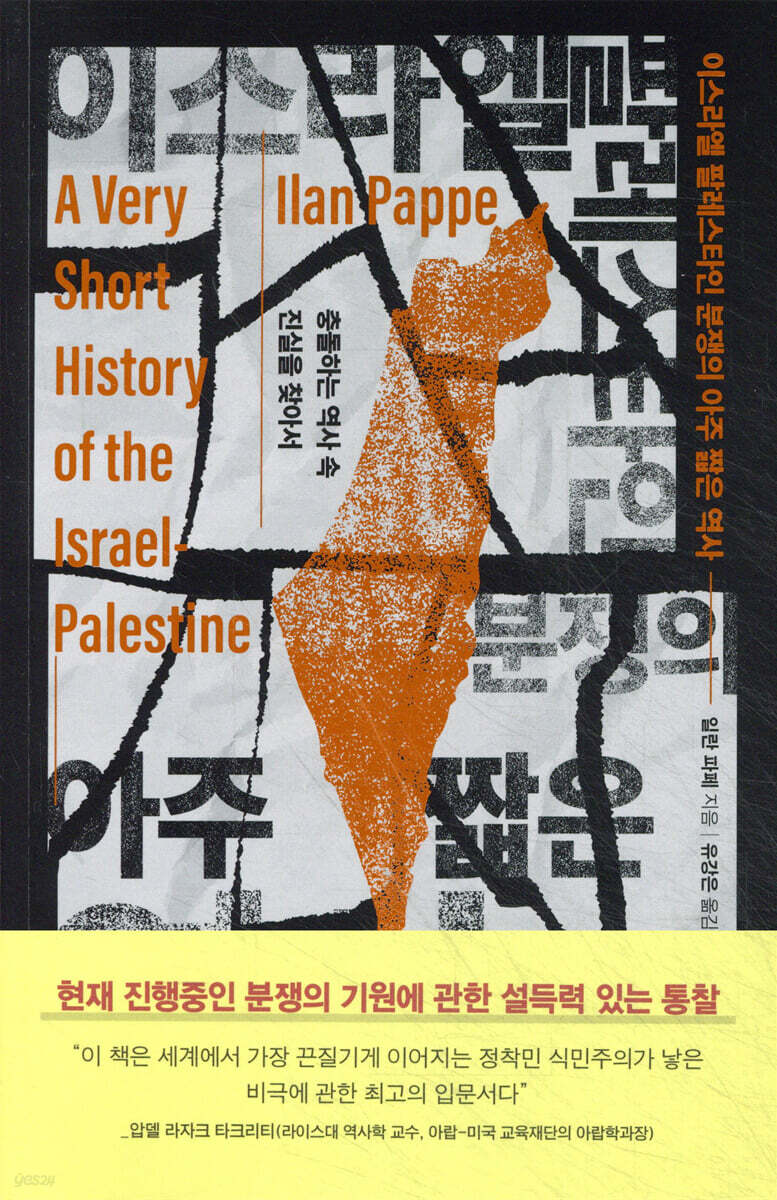
A Very Brief History of the Israeli-Palestinian Conflict
 |
Description
Book Introduction
The history of the Israeli-Palestinian conflict
Injustice inflicted on Palestinians for over a century
―How can we find a way out of this tragedy?
An introductory guide to the Israeli-Palestinian conflict from the 19th century to the present day.
On October 7, 2023, Hamas launched Operation Al-Aqsa flooding into Israel, killing approximately 1,200 Israelis.
The majority were civilians.
Israel has killed more than 30,000 Palestinians so far in retaliation, dubbed "Operation Iron Sword."
About a third are children.
Ilan Pape, Israel's most original and radical historian, has already harshly criticized Israel's brutality and selfishness in his previous works, its policies that ignore neighboring countries and pursue only its own interests, and its policies that subtly exclude Arab Jews.
"A Very Short History of the Israeli-Palestinian Conflict" is Pape's latest work that continues the vein of his previous works. Pape boldly wields a pen sharper than a sword, citing historical facts as evidence, to explain when and how the conflict between Israel and Palestine began and led to the current killings and tragedy, who intervened and who intentionally did not, and how we should view this tragic history.
The author says Israel wants us all to forget the tragic history that began with its intervention, and to view any violence on the Palestinian side as a grotesque atrocity aimed at exterminating the Jewish people.
Israel sees Palestinian violence as a blank check to justify its selfish policies, and so do Western governments.
So, Israel also used Hamas's October 7 attack as a pretext for implementing a policy of annihilation in the Gaza Strip, the United States used it as a pretext to reassert its presence in the Middle East, and some European countries used it as a pretext to restrict democratic freedoms in the name of a new "war on terror."
Injustice inflicted on Palestinians for over a century
―How can we find a way out of this tragedy?
An introductory guide to the Israeli-Palestinian conflict from the 19th century to the present day.
On October 7, 2023, Hamas launched Operation Al-Aqsa flooding into Israel, killing approximately 1,200 Israelis.
The majority were civilians.
Israel has killed more than 30,000 Palestinians so far in retaliation, dubbed "Operation Iron Sword."
About a third are children.
Ilan Pape, Israel's most original and radical historian, has already harshly criticized Israel's brutality and selfishness in his previous works, its policies that ignore neighboring countries and pursue only its own interests, and its policies that subtly exclude Arab Jews.
"A Very Short History of the Israeli-Palestinian Conflict" is Pape's latest work that continues the vein of his previous works. Pape boldly wields a pen sharper than a sword, citing historical facts as evidence, to explain when and how the conflict between Israel and Palestine began and led to the current killings and tragedy, who intervened and who intentionally did not, and how we should view this tragic history.
The author says Israel wants us all to forget the tragic history that began with its intervention, and to view any violence on the Palestinian side as a grotesque atrocity aimed at exterminating the Jewish people.
Israel sees Palestinian violence as a blank check to justify its selfish policies, and so do Western governments.
So, Israel also used Hamas's October 7 attack as a pretext for implementing a policy of annihilation in the Gaza Strip, the United States used it as a pretext to reassert its presence in the Middle East, and some European countries used it as a pretext to restrict democratic freedoms in the name of a new "war on terror."
index
introduction
1.
When and where did the conflict begin?
2.
The Quiet Years, 1918-1926
3.
Why did the Zionist movement begin ethnic cleansing?
4.
Events of 1929
5.
Arab Struggle, 1936–1939
6.
The Road to Nakba, 1945-1947
7.
The partition resolution and its aftermath
8.
Palestinian ethnic cleansing
9.
After the Nakba: Israel and Palestine, 1948–1967
10.
The Road to the Six-Day War, 1967
11.
The Birth of Two of the World's Largest Prisons, 1967-2000
12.
Between the two intifadas, 1987–2000
13.
Second Intifada, 2000
14.
Israel and Palestine in the 21st Century
15.
The Historical and Moral Context of October 7, 2023
conclusion
Further Reading
Translator's Note
1.
When and where did the conflict begin?
2.
The Quiet Years, 1918-1926
3.
Why did the Zionist movement begin ethnic cleansing?
4.
Events of 1929
5.
Arab Struggle, 1936–1939
6.
The Road to Nakba, 1945-1947
7.
The partition resolution and its aftermath
8.
Palestinian ethnic cleansing
9.
After the Nakba: Israel and Palestine, 1948–1967
10.
The Road to the Six-Day War, 1967
11.
The Birth of Two of the World's Largest Prisons, 1967-2000
12.
Between the two intifadas, 1987–2000
13.
Second Intifada, 2000
14.
Israel and Palestine in the 21st Century
15.
The Historical and Moral Context of October 7, 2023
conclusion
Further Reading
Translator's Note
Into the book
The British were unwilling to respect the principle of mandate, that is, the principle that the majority of a country has the right to determine its future, as was the case in their Arab neighbors.
And even when the Palestinian leadership was willing to accept the presence of Jewish settlers in a future Palestine, Britain did not forcefully push the Zionist movement for any solution that did not include a Jewish state in part or all of Palestine.
--- p.28~29
Palestine was never a desert, and the Palestinians were not nomads or primitive people.
--- p.45
After the Holocaust, which killed over six million Jews across Europe, the European powers, desperate to cleanse their consciences, felt no sympathy for the Palestinians.
It wasn't because I was particularly interested in Jews.
Long after the war, at least 250,000 Jews remained in refugee camps throughout Central Europe.
From the British and American perspectives, the future of the Jews had to be decided anyway.
Many Holocaust survivors now had no homes to return to in Europe.
--- p.62
Most of the political activity of Palestinians in the West Bank, Gaza Strip, and outside Palestine has taken place in refugee camps.
Despite the poverty and harsh living conditions, it was a place where refugee Palestinian activists could provide education, welfare, and solidarity.
They clearly did not achieve liberation.
But he never gave up on the Palestinian cause and refused to give up his stand for justice.
--- p.108
Judaization is not simply a policy of acquiring territory and building settlements in the West Bank and Jerusalem.
It is a policy that extends throughout Israel.
--- p.168
The one opposing them is the 'State of Israel'.
This old Israel prides itself on being a secular and pluralistic society, the 'only democracy in the Middle East'.
The fact that this is true only for Jews does not greatly trouble their conscience.
And even when the Palestinian leadership was willing to accept the presence of Jewish settlers in a future Palestine, Britain did not forcefully push the Zionist movement for any solution that did not include a Jewish state in part or all of Palestine.
--- p.28~29
Palestine was never a desert, and the Palestinians were not nomads or primitive people.
--- p.45
After the Holocaust, which killed over six million Jews across Europe, the European powers, desperate to cleanse their consciences, felt no sympathy for the Palestinians.
It wasn't because I was particularly interested in Jews.
Long after the war, at least 250,000 Jews remained in refugee camps throughout Central Europe.
From the British and American perspectives, the future of the Jews had to be decided anyway.
Many Holocaust survivors now had no homes to return to in Europe.
--- p.62
Most of the political activity of Palestinians in the West Bank, Gaza Strip, and outside Palestine has taken place in refugee camps.
Despite the poverty and harsh living conditions, it was a place where refugee Palestinian activists could provide education, welfare, and solidarity.
They clearly did not achieve liberation.
But he never gave up on the Palestinian cause and refused to give up his stand for justice.
--- p.108
Judaization is not simply a policy of acquiring territory and building settlements in the West Bank and Jerusalem.
It is a policy that extends throughout Israel.
--- p.168
The one opposing them is the 'State of Israel'.
This old Israel prides itself on being a secular and pluralistic society, the 'only democracy in the Middle East'.
The fact that this is true only for Jews does not greatly trouble their conscience.
--- p.180
Publisher's Review
The history of tragedy is much older than you might think.
According to Pape, today's tragedy began much earlier than the creation of the State of Israel in 1948, with the arrival of Zionist Jews in Ottoman Palestine in the late 19th century.
It was already home to about 500,000 Arabs, with a majority Muslim and minority Christian and Jewish populations living together.
As Palestine was on the verge of modernization, Jews began immigrating to escape violent anti-Semitism.
British arrogance deepened the Palestinian tragedy.
During World War I, the British government promised the Hashemites, a pan-Arab power, that if they fought against Germany and the Austro-Hungarian Empire, it would hand over Arab territories, including Palestine, and at the same time, promised through the Balfour Declaration that Palestine would become a "national homeland for the Jews."
After World War I, Britain took over Palestine as a mandate and established a legislature, accepting the Balfour Declaration.
As a result, up to 90 percent of Palestinians were treated as a minority in their own country, while the Jews were promised Palestine as their future homeland.
Coexistence of Two Communities: A Disaster Could Have Been Averted
It is a mistake to think that the conflict that continues to this day is between Muslims and Jews, and that Palestine had no distinct national identity before the establishment of the Jewish state in 1948.
By the early 20th century, a new civil society was already growing in Palestine, which considered itself part of an independent Arab Syria.
Britain stood by as Zionist right-wing groups disrupted Muslim festivals and encouraged the destruction of Islamic holy sites, ultimately leading to violence.
While the Jewish community was free to form the infrastructure of the state, the Palestinians were treated as a colonized people.
With British acquiescence, the Zionist movement created its own paramilitary group, the Haganah, but the Palestinians were unable to arm themselves or organize themselves on a significant scale.
Palestine was not an empty land, and Palestinians are not nomads.
In Palestine, it has long been customary for the purchase of land to bring with it the village and its inhabitants.
However, in the 1920s, when Zionists purchased the land, they evicted the villagers and farmers who had farmed the land for generations.
Even Jewish employers who resisted such policies were subjected to attacks and public humiliation until they complied.
Zionists describe Palestinians as "nomads" despite the existence of villages that have existed for thousands of years, and claim that Palestine was a vast desert before they arrived.
These large-scale land acquisitions and the resulting ethnic cleansing led to more frequent violent conflicts.
The Palestinian Revolution of Al-Buraq: The Beginning of the Palestinian Military Organization
In August 1929, violent clashes broke out between Muslims and Jews in Jerusalem, and within a week, 133 Jews and 116 Palestinians were killed.
In Hebron, where a small Jewish community and a Muslim community had lived peacefully for hundreds of years, Muslims from a village outside the city attacked the city and massacred 67 people.
The clashes continued, and this series of events was called the Al-Buraq Revolution by Palestinians and the uprising by Zionists.
Ethnic cleansing and deliberate impoverishment gave rise to shantytowns in the cities and gave rise to a new form of resistance: guerrilla warfare.
The Age of Arab Struggle: The Zionist State Declaration
In 1936, the Palestinian leadership led a general strike, and peasants and youth launched an all-out uprising against British and Jewish forces.
British forces bombed the old town of Jaffa to suppress the rebellion.
Thousands of Palestinians were killed, and military leaders accused of being behind the uprising were mercilessly murdered.
In May 1942, Zionists, judging by the rise of the United States as a world power, declared at a Baltimore Hotel in New York that they would make all of historic Palestine a Jewish state and agitated for the de-Arabization of Palestine.
The European powers had no interest in Palestine, and were solely concerned with determining the fate of the 250,000 Jews living in refugee camps in each country.
The Displacement and Tragedy of the Palestinian People: The Beginning of the Nakba
The response of the then-young United Nations and the international community to the Zionist attempts to establish a Jewish state was inadequate.
While the Palestinians struggled to secure international legitimacy, Zionist leaders forged a powerful Haganah, the regular army of a yet-to-exist state.
On November 29, 1947, Resolution 181 was passed in favor of partitioning Palestine.
For Zionists, it was the day they received the promised Jewish state; for Palestinians, it was the day the Nakba catastrophe began, a warning shot sounding for the horrors that still continue in our time.
The Aftermath of the Partition Resolution: The International Community Opens the Way to Disaster
Zionist pressure groups pressured the U.S. government to pass a partition plan that would divide Palestine into a Jewish state and a Palestinian state, with infrastructure and resources included in the Jewish state.
The U.S. government secured support from several countries by pledging national development funds or threatening to withdraw support already committed.
Stalin viewed Zionism as a means of weakening British influence in the Middle East, and Britain believed that the establishment of an Arab state in Palestine would not serve British interests.
The international community's complacent attitude, the strange alliance that unanimously supported the Zionist cause at the UN, and the way the Jewish state was treated as if it were already established sent a message that Palestinians' right to self-determination would not be applied.
The international community, which signed the UN Charter, which promises the rule of law, justice, and equal rights for all nations, has opened the way to disaster.
The world watched the ethnic cleansing of Palestine: the Nakba continued with the international community's acquiescence.
Jewish community leader Ben-Gurion and his collaborators used Palestinian anger and violence over the partition plan as a pretext to begin ethnic cleansing of the Arab part of Palestine in the future Jewish state.
Initially, Zionist forces justified the ethnic cleansing by saying that it was a justified retaliation for Palestinian attacks on Jewish settlements and infrastructure.
However, from late February 1948, they began an operation to remove as many Palestinians as possible from Palestine without giving any reason.
When the mandate officially ended, about 250,000 Palestinians were already refugees.
By the time Arab states sent troops to stop the genocide, it was already too late.
By the end of 1948, half of the Palestinian Arab population had been driven out, over 500 villages had been destroyed, and most of the towns and cities were in ruins.
The world watched Israel's ethnic cleansing, yet no one condemned Israel for its blatant crimes against humanity.
The international community's silence amounted to tacit approval for the continued use of ethnic cleansing as a means of establishing the Israeli state and strengthening its national security.
The ethnic cleansing of Palestine, which has been ongoing since 1948, continues today and is referred to by Palestinians as the "Ongoing Nakba."
The Myth of Israel Surrounded by Nations Seeking Its Own Extermination: The Six-Day War
Jordan, which maintained a strategic alliance with Egyptian President Nasser and was concerned about a possible invasion by Syria and Israel, signed a defense agreement with Egypt in May 1967, and in June 1967, Nasser deployed troops to the Sinai Peninsula and blocked the Straits of Tiran.
On June 5, 1967, Israel took advantage of the tensions and launched a war, conquering the West Bank, Gaza Strip, Sinai Peninsula, and Golan Heights in just six days, achieving its goal of controlling all of historic Palestine.
And they carried out ethnic cleansing of nearly 100 villages in the area, expelling their inhabitants to Syria.
The First Intifada: The Beginning of the Palestinian Resistance
The Israeli government has created illegal settlements in the Jordan River basin, Bethlehem, the Greater Jerusalem area, areas it intended to cede to Jordan, and the Gaza Strip.
In the Galilee region, Arab lands were confiscated and military bases and Jewish settlements were built.
When the Palestinian community in Galilee declared a strike in protest, Israel responded mercilessly, killing six Palestinian civilians.
In December 1987, the first intifada erupted.
A non-violent protest movement was launched, but the Israeli military responded with full force.
By 1993, Israel had killed over 1,000 Palestinians, detained them without trial, and inflicted collective punishment.
In 1996, the Israeli government erected a barbed wire fence around the Gaza Strip, turning the entire area into a prison, and subjecting any form of resistance to brutal collective punishment.
The UN promised to protect the Palestinians, but it caved to Israeli pressure, leaving them vulnerable and vulnerable.
The Second Intifada of 2000, provoked by Israel
The Second Intifada began in the summer of 2000 with Israeli opposition leader Ariel Sharon's visit to the Muslim holy site of Haram al-Sharif, in an attempt to incite unrest and force negotiations that would have resulted in Israel and the United States abandoning the Palestinian state and refugee issue.
Thirteen Palestinian civilians were shot dead by Israeli soldiers and police across Israel.
When Hamas bombed the Park Hotel in Netanya, where Jews were celebrating Passover, killing 30 people and wounding 140, Israel used its air force to bomb the city, massacre people in refugee camps, and detained Arafat.
Israel and Palestine in the 21st Century
Israel has expanded settlements and oppressed Palestinians.
Settler vigilantes indiscriminately attacked Palestinians, but the Israeli army did not protect Palestinian civilians.
In May 2021, Palestinians took part in 11 days of united action to end the siege of Gaza, the occupation of the West Bank, and discriminatory policies within Israel, but 260 Palestinians were killed in Israeli retaliation.
This ethnic cleansing continued without a single day of rest until October 2023.
On October 7, 2023, Hamas invaded the border.
Israel was furious when UN Secretary-General António Guterres criticized Israel's policies on October 7, 2023, pointing out the reality of people living under occupation for 56 years.
Pape saw Israel's response as a declaration that any questioning of Israel and its policies would be met with increased censorship and labeled anti-Semitic.
The majority of Gaza's population are refugees from ethnic cleansing since 1948, and Israel has turned Gaza into a kind of detention center to facilitate the ethnic cleansing of other parts of historic Palestine, turning this strip of land, which covers just 2 percent of historic Palestine, into the world's largest refugee camp.
Gaza has been under a long and difficult siege.
Palestinians under the age of 21, for whom siege and bombing are all they know in the world, make up half of the population of Gaza.
Thus, the author concludes with a warning that we should not forget that the Hamas fighters who raided Israel on October 7 were mostly young people who learned the language of violence through bombs dropped by Israel, and that we raised them.
(On January 7, 2025, after lengthy negotiations, Israel and Hamas finally agreed to a ceasefire.
Some Israeli forces decided to withdraw and exchange prisoners.
Since October 7, 2023, over 46,000 people have died.
The majority of the dead are civilians, a quarter of them children.
Ninety percent of the homes in the Gaza Strip have been destroyed, and 90 percent of the 2.3 million residents have become refugees.
On March 1, 2025, Israel resumed large-scale airstrikes on the Gaza Strip.
In just two days after the airstrikes resumed, more than 470 people were killed, and casualties among UN workers engaged in relief work continued.
According to Pape, today's tragedy began much earlier than the creation of the State of Israel in 1948, with the arrival of Zionist Jews in Ottoman Palestine in the late 19th century.
It was already home to about 500,000 Arabs, with a majority Muslim and minority Christian and Jewish populations living together.
As Palestine was on the verge of modernization, Jews began immigrating to escape violent anti-Semitism.
British arrogance deepened the Palestinian tragedy.
During World War I, the British government promised the Hashemites, a pan-Arab power, that if they fought against Germany and the Austro-Hungarian Empire, it would hand over Arab territories, including Palestine, and at the same time, promised through the Balfour Declaration that Palestine would become a "national homeland for the Jews."
After World War I, Britain took over Palestine as a mandate and established a legislature, accepting the Balfour Declaration.
As a result, up to 90 percent of Palestinians were treated as a minority in their own country, while the Jews were promised Palestine as their future homeland.
Coexistence of Two Communities: A Disaster Could Have Been Averted
It is a mistake to think that the conflict that continues to this day is between Muslims and Jews, and that Palestine had no distinct national identity before the establishment of the Jewish state in 1948.
By the early 20th century, a new civil society was already growing in Palestine, which considered itself part of an independent Arab Syria.
Britain stood by as Zionist right-wing groups disrupted Muslim festivals and encouraged the destruction of Islamic holy sites, ultimately leading to violence.
While the Jewish community was free to form the infrastructure of the state, the Palestinians were treated as a colonized people.
With British acquiescence, the Zionist movement created its own paramilitary group, the Haganah, but the Palestinians were unable to arm themselves or organize themselves on a significant scale.
Palestine was not an empty land, and Palestinians are not nomads.
In Palestine, it has long been customary for the purchase of land to bring with it the village and its inhabitants.
However, in the 1920s, when Zionists purchased the land, they evicted the villagers and farmers who had farmed the land for generations.
Even Jewish employers who resisted such policies were subjected to attacks and public humiliation until they complied.
Zionists describe Palestinians as "nomads" despite the existence of villages that have existed for thousands of years, and claim that Palestine was a vast desert before they arrived.
These large-scale land acquisitions and the resulting ethnic cleansing led to more frequent violent conflicts.
The Palestinian Revolution of Al-Buraq: The Beginning of the Palestinian Military Organization
In August 1929, violent clashes broke out between Muslims and Jews in Jerusalem, and within a week, 133 Jews and 116 Palestinians were killed.
In Hebron, where a small Jewish community and a Muslim community had lived peacefully for hundreds of years, Muslims from a village outside the city attacked the city and massacred 67 people.
The clashes continued, and this series of events was called the Al-Buraq Revolution by Palestinians and the uprising by Zionists.
Ethnic cleansing and deliberate impoverishment gave rise to shantytowns in the cities and gave rise to a new form of resistance: guerrilla warfare.
The Age of Arab Struggle: The Zionist State Declaration
In 1936, the Palestinian leadership led a general strike, and peasants and youth launched an all-out uprising against British and Jewish forces.
British forces bombed the old town of Jaffa to suppress the rebellion.
Thousands of Palestinians were killed, and military leaders accused of being behind the uprising were mercilessly murdered.
In May 1942, Zionists, judging by the rise of the United States as a world power, declared at a Baltimore Hotel in New York that they would make all of historic Palestine a Jewish state and agitated for the de-Arabization of Palestine.
The European powers had no interest in Palestine, and were solely concerned with determining the fate of the 250,000 Jews living in refugee camps in each country.
The Displacement and Tragedy of the Palestinian People: The Beginning of the Nakba
The response of the then-young United Nations and the international community to the Zionist attempts to establish a Jewish state was inadequate.
While the Palestinians struggled to secure international legitimacy, Zionist leaders forged a powerful Haganah, the regular army of a yet-to-exist state.
On November 29, 1947, Resolution 181 was passed in favor of partitioning Palestine.
For Zionists, it was the day they received the promised Jewish state; for Palestinians, it was the day the Nakba catastrophe began, a warning shot sounding for the horrors that still continue in our time.
The Aftermath of the Partition Resolution: The International Community Opens the Way to Disaster
Zionist pressure groups pressured the U.S. government to pass a partition plan that would divide Palestine into a Jewish state and a Palestinian state, with infrastructure and resources included in the Jewish state.
The U.S. government secured support from several countries by pledging national development funds or threatening to withdraw support already committed.
Stalin viewed Zionism as a means of weakening British influence in the Middle East, and Britain believed that the establishment of an Arab state in Palestine would not serve British interests.
The international community's complacent attitude, the strange alliance that unanimously supported the Zionist cause at the UN, and the way the Jewish state was treated as if it were already established sent a message that Palestinians' right to self-determination would not be applied.
The international community, which signed the UN Charter, which promises the rule of law, justice, and equal rights for all nations, has opened the way to disaster.
The world watched the ethnic cleansing of Palestine: the Nakba continued with the international community's acquiescence.
Jewish community leader Ben-Gurion and his collaborators used Palestinian anger and violence over the partition plan as a pretext to begin ethnic cleansing of the Arab part of Palestine in the future Jewish state.
Initially, Zionist forces justified the ethnic cleansing by saying that it was a justified retaliation for Palestinian attacks on Jewish settlements and infrastructure.
However, from late February 1948, they began an operation to remove as many Palestinians as possible from Palestine without giving any reason.
When the mandate officially ended, about 250,000 Palestinians were already refugees.
By the time Arab states sent troops to stop the genocide, it was already too late.
By the end of 1948, half of the Palestinian Arab population had been driven out, over 500 villages had been destroyed, and most of the towns and cities were in ruins.
The world watched Israel's ethnic cleansing, yet no one condemned Israel for its blatant crimes against humanity.
The international community's silence amounted to tacit approval for the continued use of ethnic cleansing as a means of establishing the Israeli state and strengthening its national security.
The ethnic cleansing of Palestine, which has been ongoing since 1948, continues today and is referred to by Palestinians as the "Ongoing Nakba."
The Myth of Israel Surrounded by Nations Seeking Its Own Extermination: The Six-Day War
Jordan, which maintained a strategic alliance with Egyptian President Nasser and was concerned about a possible invasion by Syria and Israel, signed a defense agreement with Egypt in May 1967, and in June 1967, Nasser deployed troops to the Sinai Peninsula and blocked the Straits of Tiran.
On June 5, 1967, Israel took advantage of the tensions and launched a war, conquering the West Bank, Gaza Strip, Sinai Peninsula, and Golan Heights in just six days, achieving its goal of controlling all of historic Palestine.
And they carried out ethnic cleansing of nearly 100 villages in the area, expelling their inhabitants to Syria.
The First Intifada: The Beginning of the Palestinian Resistance
The Israeli government has created illegal settlements in the Jordan River basin, Bethlehem, the Greater Jerusalem area, areas it intended to cede to Jordan, and the Gaza Strip.
In the Galilee region, Arab lands were confiscated and military bases and Jewish settlements were built.
When the Palestinian community in Galilee declared a strike in protest, Israel responded mercilessly, killing six Palestinian civilians.
In December 1987, the first intifada erupted.
A non-violent protest movement was launched, but the Israeli military responded with full force.
By 1993, Israel had killed over 1,000 Palestinians, detained them without trial, and inflicted collective punishment.
In 1996, the Israeli government erected a barbed wire fence around the Gaza Strip, turning the entire area into a prison, and subjecting any form of resistance to brutal collective punishment.
The UN promised to protect the Palestinians, but it caved to Israeli pressure, leaving them vulnerable and vulnerable.
The Second Intifada of 2000, provoked by Israel
The Second Intifada began in the summer of 2000 with Israeli opposition leader Ariel Sharon's visit to the Muslim holy site of Haram al-Sharif, in an attempt to incite unrest and force negotiations that would have resulted in Israel and the United States abandoning the Palestinian state and refugee issue.
Thirteen Palestinian civilians were shot dead by Israeli soldiers and police across Israel.
When Hamas bombed the Park Hotel in Netanya, where Jews were celebrating Passover, killing 30 people and wounding 140, Israel used its air force to bomb the city, massacre people in refugee camps, and detained Arafat.
Israel and Palestine in the 21st Century
Israel has expanded settlements and oppressed Palestinians.
Settler vigilantes indiscriminately attacked Palestinians, but the Israeli army did not protect Palestinian civilians.
In May 2021, Palestinians took part in 11 days of united action to end the siege of Gaza, the occupation of the West Bank, and discriminatory policies within Israel, but 260 Palestinians were killed in Israeli retaliation.
This ethnic cleansing continued without a single day of rest until October 2023.
On October 7, 2023, Hamas invaded the border.
Israel was furious when UN Secretary-General António Guterres criticized Israel's policies on October 7, 2023, pointing out the reality of people living under occupation for 56 years.
Pape saw Israel's response as a declaration that any questioning of Israel and its policies would be met with increased censorship and labeled anti-Semitic.
The majority of Gaza's population are refugees from ethnic cleansing since 1948, and Israel has turned Gaza into a kind of detention center to facilitate the ethnic cleansing of other parts of historic Palestine, turning this strip of land, which covers just 2 percent of historic Palestine, into the world's largest refugee camp.
Gaza has been under a long and difficult siege.
Palestinians under the age of 21, for whom siege and bombing are all they know in the world, make up half of the population of Gaza.
Thus, the author concludes with a warning that we should not forget that the Hamas fighters who raided Israel on October 7 were mostly young people who learned the language of violence through bombs dropped by Israel, and that we raised them.
(On January 7, 2025, after lengthy negotiations, Israel and Hamas finally agreed to a ceasefire.
Some Israeli forces decided to withdraw and exchange prisoners.
Since October 7, 2023, over 46,000 people have died.
The majority of the dead are civilians, a quarter of them children.
Ninety percent of the homes in the Gaza Strip have been destroyed, and 90 percent of the 2.3 million residents have become refugees.
On March 1, 2025, Israel resumed large-scale airstrikes on the Gaza Strip.
In just two days after the airstrikes resumed, more than 470 people were killed, and casualties among UN workers engaged in relief work continued.
GOODS SPECIFICS
- Date of issue: July 1, 2025
- Page count, weight, size: 203 pages | 254g | 130*200*13mm
- ISBN13: 9791194523338
- ISBN10: 1194523331
You may also like
카테고리
korean


korean

![GQ KOREA Mark (Monthly): December [2025]](http://librairie.coreenne.fr/cdn/shop/files/8ef265dbbfbf186523ed75ba7319009d.jpg?v=1765340328&width=3840)


