

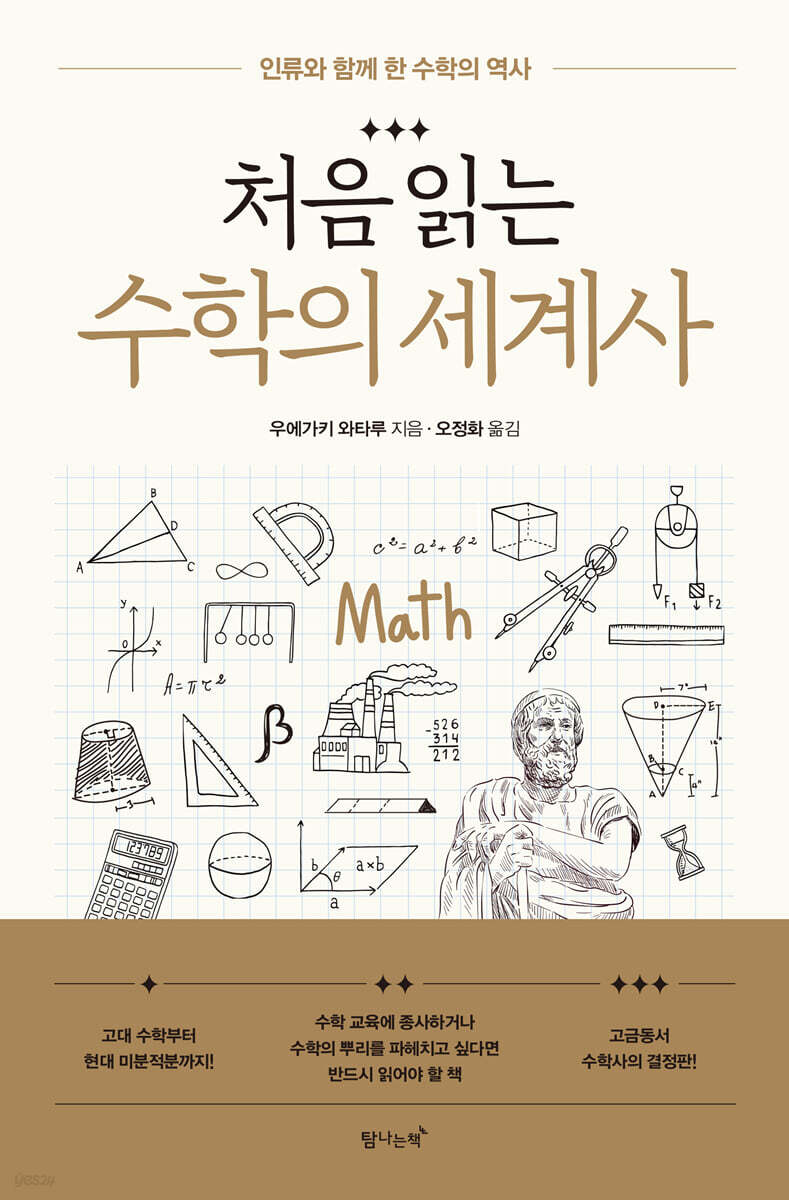
A World History of Mathematics for Beginners
 |
Description
Book Introduction
The history of mathematics with humanity
The development of mathematics from ancient Oriental mathematics to differential and integral calculus
The definitive edition of the history of mathematics, written in meticulous detail!
“If you are interested in mathematics education or want to dig into the roots of mathematics,
“A must-read for everyone”
Beginning with the Oriental mathematics accumulated in the Egyptian and Mesopotamian regions, the entire development of mathematics unfolds like a panorama, from the establishment of symbolic algebra to the discovery of calculus.
This book, “A World History of Mathematics for Beginners,” is composed of three parts.
Part 1, which deals with 'Ancient Mathematics', begins with an explanation of Oriental mathematics accumulated in the Egyptian and Mesopotamian regions, and organizes it around ancient Greek mathematics.
Part 2, 'Medieval Mathematics', covers mathematics from India, Arabia, China, Japan, and medieval Europe.
Although there are some contents that cannot be clearly said to be medieval mathematics, it would be good to understand it as a convenient composition based on the medieval era.
Part 3 discusses 'modern mathematics', explaining everything from the establishment of symbolic algebra to the discovery of calculus.
Even those who dislike math will find themselves immediately immersed in intellectual pleasure as soon as they open this book.
The development of mathematics from ancient Oriental mathematics to differential and integral calculus
The definitive edition of the history of mathematics, written in meticulous detail!
“If you are interested in mathematics education or want to dig into the roots of mathematics,
“A must-read for everyone”
Beginning with the Oriental mathematics accumulated in the Egyptian and Mesopotamian regions, the entire development of mathematics unfolds like a panorama, from the establishment of symbolic algebra to the discovery of calculus.
This book, “A World History of Mathematics for Beginners,” is composed of three parts.
Part 1, which deals with 'Ancient Mathematics', begins with an explanation of Oriental mathematics accumulated in the Egyptian and Mesopotamian regions, and organizes it around ancient Greek mathematics.
Part 2, 'Medieval Mathematics', covers mathematics from India, Arabia, China, Japan, and medieval Europe.
Although there are some contents that cannot be clearly said to be medieval mathematics, it would be good to understand it as a convenient composition based on the medieval era.
Part 3 discusses 'modern mathematics', explaining everything from the establishment of symbolic algebra to the discovery of calculus.
Even those who dislike math will find themselves immediately immersed in intellectual pleasure as soon as they open this book.
- You can preview some of the book's contents.
Preview
index
prolog
Chapter 1: Ancient Mathematics
1.
Ancient Oriental Mathematics
Numbers and Arithmetic: 14
Arithmetic Problem: 18
Aha's Problem: 19
Seked's Problem: 20
Diagonal length of a square: 21
Area of a circle: 23
Characteristics of Ancient Oriental Mathematics: 25
2.
Thales and the Pythagoreans
From Myth to Reason: 31
Two Traditions of Natural Philosophy: 37
Derivation from Principles: 42
Invention of the Law of Absurdity: 45
Quadrivium of the Pythagoreans: 47
Discovery of the ratio of consonant intervals: 49
Pythagorean scale: 54
Pythagorean theorem: 55
Symbols of the Pythagorean School: 57
Discovery of a large number of objects: 60
3.
Plato's Mathematics
The Birth of the Theory of Ideas - Phaedo: 66
The Completion of the Theory of Ideas - The Republic: 70
Platonic view of mathematics: 74
Platonic Solids: 79
Greece's Three Great Challenges: 83
4.
The establishment of argumentative mathematics
Early Greek concept of proof: 86
Euclid's Elements: 89
Definition, Postulates, and Axioms: 90
Plane Geometry: 95
Geometric Algebra: 97
Proportionality and its Applications: 99
5.
Number theory and its development
Pythagorean Number Theory: 102
Euclid, Elements, Books 7-9: 107
Nicomachean Number Theory: 110
Diophantus's Arithmetic - Abridged Algebra: 114
6.
Mathematics in the Hellenistic Period
Eudoxus's Method of Exhaustion: 117
Quadrature of a circle by Archimedes: 121
Calculating Pi: 124
Archimedes' Quadrature: 125
Studies on the Center: 131
Apollonius's Conic Sections: 134
7.
Greek trigonometry
Size of the Sun and Moon: 138
Earth's size: 141
Menelaus' theorem: 143
Ptolemy's "Hypophysis": 146
Ptolemy's theorem: 151
8.
The End of Greek Mathematics
Heron's Formula and Heron's Triangle: 155
Paphos's "Composition of Mathematics": 159
Schematic representation of the average: 161
Abelus's Problem: 162
Semi-regular polyhedron: 164
Analysis and Synthesis: 166
Several definitions of Paphos: 168
Chapter 2 Medieval Mathematics
1.
Indian mathematics
Mathematics of the Altar: 172
Discovery of 0: 175
Aryabhata's Mathematics: 179
Brahmagupta's Mathematics: 182
Bhaskara's Mathematics: 183
2.
Arabic mathematics
Arabic Arithmetic: 190
Arabic Algebra: 192
Arabian Trigonometry: 195
Geometry of Arabia: 198
Arabic Number Theory: 201
3.
Chinese mathematics
Yu Hui and the Nine Chapters of Sansul: 205
Jo Chung-ji and Jo Geung-ji: 211
The establishment of the "Sangyeongsipseo": 215
Tajik and Cheonwon techniques: 218
Joo Se-geol and Jeong Dae-wi: 224
4.
Japanese mathematics
The Introduction of Chinese Mathematics and the Spread of the Abacus: 228
The World's Best Division Master, Mori Shigeyoshi: 233
The Jin-Geop-Gi and the Succession of Emperor Yu: 241
Seki Takakazu and Sekiryu Wasan: 252
Sangaku dedication: 257
5.
Mathematics in Medieval Europe
Fibonacci's "The Book of Mountains": 260
Aristotle's Theory of Motion: 264
Philoponus's theory of motion: 268
Impetus Theory: 270
Quantitative and graphical representations of the query: 274
Chapter 3 Modern Mathematics
1.
Establishment of symbolic algebra
Solutions to Cubic and Quartile Equations: 278
Invention of algebraic symbols: 284
Viet's symbolic algebra: 286
2.
The formation of modern mechanics
Early Galilean Kinetics: 290
Learning from Archimedes: 293
Downward Moment: 296
Discovery of the Second Law of Falling Gravitations - The Square Law of Time: 300
The Second Law of Falling Gravitations: Discovery of the Law of Velocity-Time Proportionality: 305
Discovery of the First Law of Falling Objects: 309
3.
The beginning of probability theory
Cardano and Galileo: 313
De Meret's Question: 317
The Two Gamblers' Distribution Problem (1): 319
The Two Gamblers' Distribution Problem (2): 321
The Two Gamblers' Distribution Problem (3): 321
Fermat's solution: 322
The Three Gamblers' Distribution Problem: 325
Pascal's discovery of mathematical induction: 328
4.
The Birth of Analytical Geometry
Descartes' Rules for the Direction of the Mind: 334
Breaking Free from the Law of Dimensional Homogeneity: 337
Algebraic Operations and Geometric Constructions: 339
Descartes's semiotics: 341
Descartes' Interpretive Geometry: 342
Fermat's Analytic Geometry: 344
A Comparison of Descartes and Fermat: 346
5.
Tangent and quadrature problems
Descartes's tangent method: 349
Fermat's tangent method: 353
Descartes' New Tangent Method: 357
Kepler's Quadrature: 359
Cavalieri's Indivisibles: 364
Pascal's Quadrature: 370
6.
Infinite Arithmetic
How to find the sum of powers: 377
Quadrature of a Circle Problem: 380
7.
The Path to Unification of Tangent and Quadrature Methods
Kinematic Approach to Fundamental Theorem: 390
Geometric Approach to Fundamental Theorems: 393
8.
Discovery of calculus
Newton's discovery of the general binomial theorem: 403
Newton's tangent method: 407
The emergence of the concept of fluidity by Newton: 408
Newton's October 1666 paper: 411
Leibniz's Transformation Theorem: 414
Leibniz's "Quadrature Analysis, Part II": 421
A Unified Understanding of Differentiation and Integration in Leibniz: 423
Search: 425
Chapter 1: Ancient Mathematics
1.
Ancient Oriental Mathematics
Numbers and Arithmetic: 14
Arithmetic Problem: 18
Aha's Problem: 19
Seked's Problem: 20
Diagonal length of a square: 21
Area of a circle: 23
Characteristics of Ancient Oriental Mathematics: 25
2.
Thales and the Pythagoreans
From Myth to Reason: 31
Two Traditions of Natural Philosophy: 37
Derivation from Principles: 42
Invention of the Law of Absurdity: 45
Quadrivium of the Pythagoreans: 47
Discovery of the ratio of consonant intervals: 49
Pythagorean scale: 54
Pythagorean theorem: 55
Symbols of the Pythagorean School: 57
Discovery of a large number of objects: 60
3.
Plato's Mathematics
The Birth of the Theory of Ideas - Phaedo: 66
The Completion of the Theory of Ideas - The Republic: 70
Platonic view of mathematics: 74
Platonic Solids: 79
Greece's Three Great Challenges: 83
4.
The establishment of argumentative mathematics
Early Greek concept of proof: 86
Euclid's Elements: 89
Definition, Postulates, and Axioms: 90
Plane Geometry: 95
Geometric Algebra: 97
Proportionality and its Applications: 99
5.
Number theory and its development
Pythagorean Number Theory: 102
Euclid, Elements, Books 7-9: 107
Nicomachean Number Theory: 110
Diophantus's Arithmetic - Abridged Algebra: 114
6.
Mathematics in the Hellenistic Period
Eudoxus's Method of Exhaustion: 117
Quadrature of a circle by Archimedes: 121
Calculating Pi: 124
Archimedes' Quadrature: 125
Studies on the Center: 131
Apollonius's Conic Sections: 134
7.
Greek trigonometry
Size of the Sun and Moon: 138
Earth's size: 141
Menelaus' theorem: 143
Ptolemy's "Hypophysis": 146
Ptolemy's theorem: 151
8.
The End of Greek Mathematics
Heron's Formula and Heron's Triangle: 155
Paphos's "Composition of Mathematics": 159
Schematic representation of the average: 161
Abelus's Problem: 162
Semi-regular polyhedron: 164
Analysis and Synthesis: 166
Several definitions of Paphos: 168
Chapter 2 Medieval Mathematics
1.
Indian mathematics
Mathematics of the Altar: 172
Discovery of 0: 175
Aryabhata's Mathematics: 179
Brahmagupta's Mathematics: 182
Bhaskara's Mathematics: 183
2.
Arabic mathematics
Arabic Arithmetic: 190
Arabic Algebra: 192
Arabian Trigonometry: 195
Geometry of Arabia: 198
Arabic Number Theory: 201
3.
Chinese mathematics
Yu Hui and the Nine Chapters of Sansul: 205
Jo Chung-ji and Jo Geung-ji: 211
The establishment of the "Sangyeongsipseo": 215
Tajik and Cheonwon techniques: 218
Joo Se-geol and Jeong Dae-wi: 224
4.
Japanese mathematics
The Introduction of Chinese Mathematics and the Spread of the Abacus: 228
The World's Best Division Master, Mori Shigeyoshi: 233
The Jin-Geop-Gi and the Succession of Emperor Yu: 241
Seki Takakazu and Sekiryu Wasan: 252
Sangaku dedication: 257
5.
Mathematics in Medieval Europe
Fibonacci's "The Book of Mountains": 260
Aristotle's Theory of Motion: 264
Philoponus's theory of motion: 268
Impetus Theory: 270
Quantitative and graphical representations of the query: 274
Chapter 3 Modern Mathematics
1.
Establishment of symbolic algebra
Solutions to Cubic and Quartile Equations: 278
Invention of algebraic symbols: 284
Viet's symbolic algebra: 286
2.
The formation of modern mechanics
Early Galilean Kinetics: 290
Learning from Archimedes: 293
Downward Moment: 296
Discovery of the Second Law of Falling Gravitations - The Square Law of Time: 300
The Second Law of Falling Gravitations: Discovery of the Law of Velocity-Time Proportionality: 305
Discovery of the First Law of Falling Objects: 309
3.
The beginning of probability theory
Cardano and Galileo: 313
De Meret's Question: 317
The Two Gamblers' Distribution Problem (1): 319
The Two Gamblers' Distribution Problem (2): 321
The Two Gamblers' Distribution Problem (3): 321
Fermat's solution: 322
The Three Gamblers' Distribution Problem: 325
Pascal's discovery of mathematical induction: 328
4.
The Birth of Analytical Geometry
Descartes' Rules for the Direction of the Mind: 334
Breaking Free from the Law of Dimensional Homogeneity: 337
Algebraic Operations and Geometric Constructions: 339
Descartes's semiotics: 341
Descartes' Interpretive Geometry: 342
Fermat's Analytic Geometry: 344
A Comparison of Descartes and Fermat: 346
5.
Tangent and quadrature problems
Descartes's tangent method: 349
Fermat's tangent method: 353
Descartes' New Tangent Method: 357
Kepler's Quadrature: 359
Cavalieri's Indivisibles: 364
Pascal's Quadrature: 370
6.
Infinite Arithmetic
How to find the sum of powers: 377
Quadrature of a Circle Problem: 380
7.
The Path to Unification of Tangent and Quadrature Methods
Kinematic Approach to Fundamental Theorem: 390
Geometric Approach to Fundamental Theorems: 393
8.
Discovery of calculus
Newton's discovery of the general binomial theorem: 403
Newton's tangent method: 407
The emergence of the concept of fluidity by Newton: 408
Newton's October 1666 paper: 411
Leibniz's Transformation Theorem: 414
Leibniz's "Quadrature Analysis, Part II": 421
A Unified Understanding of Differentiation and Integration in Leibniz: 423
Search: 425
Into the book
In Mesopotamia and Egypt, letters and numbers were invented and advanced mathematical knowledge was also accumulated.
Also, because understanding the changes of seasons was essential to agricultural life, astronomical observations have been conducted consistently since long ago.
The Babylonians divided the year into 360 days, which were then divided into 12 months of 30 days each. They also divided the day into 12 two-hour periods, an hour into 60 minutes, and a minute into 60 seconds.
Also, in Egypt, they knew that a year had 365 days.
In this way, the first place in human history where many mathematical sciences appeared was in the Mesopotamia and Egypt regions, which are today called the 'Orient'.
--- p.13~14
There are several documents on mathematics from ancient Egypt, most notably the Rhind Papyrus, a mathematical document held in the British Museum.
The Rhind Papyrus, believed to have been created around 1650 BC, was discovered in the ruins near the Ramesseum in Thebes and was given its name when it was purchased by the Englishman Henry Rhind.
However, this mathematical document is known to have been written by the ancient Egyptian scribe, Aahmess, and is therefore also called the Aahmes Papyrus.
--- p.18
Pythagoras, considered the founder of the Pythagorean school, was born on the island of Samos in the Ionian region as the son of Mnesarchus, a jeweler.
And around the age of 18, he received the teachings of Thales, and upon the recommendation of his already old teacher Thales, Pythagoras traveled to Egypt, Babylonia, and other places, and after gaining experience, returned to the island of Samos.
However, Pythagoras thought that the island of Samos, where Polycrates was ruling as a tyranny at the time, was not a suitable environment for philosophy, so he headed to southern Italy.
Pythagoras settled in Croton, founded an anti-religious and anti-political society, and devoted himself to the study of various disciplines there.
--- p.100
Today's mathematics has the aspect of constructing a system by developing theories deductively and logically from a few axioms. This method is believed to have begun in Euclid's Elements, compiled around 300 BC.
It can be said that the background to the creation of monumental works such as Elements in the ancient Greek world was the tradition of knowledge called 'derivation from principles' by Thales.
--- p.44
Euclid's Elements, Book 12, Proposition 2, states that "the area of a circle is proportional to the square formed by its diameter," but Archimedes goes a step further and directly mentions a method for calculating the area of a circle.
This is the proposition 1 from "On the Measurement of Circles": "Every circle is a right triangle whose radius is equal to the side containing the right angle, and whose circumference is equal to the base."
--- p.121
Because Eratosthenes served as librarian, he had extensive experience accessing a variety of important records related to calendars.
As he looked through many records, he realized that at noon on a certain day of the year, the sun shines and illuminates the water of a deep well in a village called Syene, near the Aswan Dam in present-day Egypt.
The saying that the sun shines on the well means that the sun is directly above the well, that is, perpendicular to the horizon.
And at noon on the same day in Alexandria, 5,000 stadia north of Syene, a stick cast a short shadow, and Eratosthenes realized that the angle between the sun's rays and the shadow of a vertical stick was 7.2 degrees.
Also, because understanding the changes of seasons was essential to agricultural life, astronomical observations have been conducted consistently since long ago.
The Babylonians divided the year into 360 days, which were then divided into 12 months of 30 days each. They also divided the day into 12 two-hour periods, an hour into 60 minutes, and a minute into 60 seconds.
Also, in Egypt, they knew that a year had 365 days.
In this way, the first place in human history where many mathematical sciences appeared was in the Mesopotamia and Egypt regions, which are today called the 'Orient'.
--- p.13~14
There are several documents on mathematics from ancient Egypt, most notably the Rhind Papyrus, a mathematical document held in the British Museum.
The Rhind Papyrus, believed to have been created around 1650 BC, was discovered in the ruins near the Ramesseum in Thebes and was given its name when it was purchased by the Englishman Henry Rhind.
However, this mathematical document is known to have been written by the ancient Egyptian scribe, Aahmess, and is therefore also called the Aahmes Papyrus.
--- p.18
Pythagoras, considered the founder of the Pythagorean school, was born on the island of Samos in the Ionian region as the son of Mnesarchus, a jeweler.
And around the age of 18, he received the teachings of Thales, and upon the recommendation of his already old teacher Thales, Pythagoras traveled to Egypt, Babylonia, and other places, and after gaining experience, returned to the island of Samos.
However, Pythagoras thought that the island of Samos, where Polycrates was ruling as a tyranny at the time, was not a suitable environment for philosophy, so he headed to southern Italy.
Pythagoras settled in Croton, founded an anti-religious and anti-political society, and devoted himself to the study of various disciplines there.
--- p.100
Today's mathematics has the aspect of constructing a system by developing theories deductively and logically from a few axioms. This method is believed to have begun in Euclid's Elements, compiled around 300 BC.
It can be said that the background to the creation of monumental works such as Elements in the ancient Greek world was the tradition of knowledge called 'derivation from principles' by Thales.
--- p.44
Euclid's Elements, Book 12, Proposition 2, states that "the area of a circle is proportional to the square formed by its diameter," but Archimedes goes a step further and directly mentions a method for calculating the area of a circle.
This is the proposition 1 from "On the Measurement of Circles": "Every circle is a right triangle whose radius is equal to the side containing the right angle, and whose circumference is equal to the base."
--- p.121
Because Eratosthenes served as librarian, he had extensive experience accessing a variety of important records related to calendars.
As he looked through many records, he realized that at noon on a certain day of the year, the sun shines and illuminates the water of a deep well in a village called Syene, near the Aswan Dam in present-day Egypt.
The saying that the sun shines on the well means that the sun is directly above the well, that is, perpendicular to the horizon.
And at noon on the same day in Alexandria, 5,000 stadia north of Syene, a stick cast a short shadow, and Eratosthenes realized that the angle between the sun's rays and the shadow of a vertical stick was 7.2 degrees.
--- p.142
Publisher's Review
When did humans first become interested in mathematics and apply it to real life?
Who discovered mathematics and how, and through what process has humanity developed mathematics?
Explore the history of mathematics across the East and the West at a glance! This detailed account details the origins of mathematics, from ancient Orient to medieval mathematics in India, Japan, and Europe, and modern mathematics, including symbolic algebra, probability theory, analytic geometry, and calculus.
In large river basins such as ancient Egypt and Mesopotamia, as nations were formed and irrigated agriculture became a way of life, various activities related to mathematics and astronomy were carried out.
Early mathematics was formed to solve practical problems essential to maintaining agricultural life and various administrative problems for maintaining the state.
And the act of recording it by letters or numbers also came to be done.
Mathematics, which developed in ancient Egypt and Mesopotamia, was transmitted to the Ionian region of Asia Minor (Anatolia) and southern Italy by Thales, Pythagoras, and others, and achieved a qualitative shift beyond solving practical problems to human mental behavior.
A clear example is the establishment of the concept of ‘proof’.
In the Mediterranean world, mathematical activity moved to mainland Greece and then to Alexandria during the Hellenistic period, beginning around 300 BC.
That era was one of the most active and prosperous periods in the history of science, and is considered the 'Age of the First Scientific Revolution.'
By the 4th century, the original mathematical research of ancient Greece was in decline, and the major research achievements were passed from the Greek civilization to the Byzantine civilization and then to the Syrian civilization.
Moreover, many of the sciences of Syrian Hellenism were translated into Arabic and introduced into the Arabian civilization, ushering in an era of the rise of Arabian academic culture.
Arabian scholarly culture reached its golden age in the 11th century, and this time it was accepted by the Western world.
Thus, in the 12th century, a period of great translation arrived in the Western world, which is often called the '12th-century Renaissance'.
The Islamic empire, which began with Muhammad, stretched from the Arabian Peninsula to northern Africa along the Mediterranean coast and the Iberian Peninsula. The centers of the 12th-century Renaissance were northeastern Spain, including Catalonia, central Spain centered around Toledo, Sicily centered around Palermo, and northern Italy.
In this region, translations of Arabic and Greek literature into Latin were actively carried out.
These Latin translations allowed the Western world to flourish as a scholarly culture.
In regions such as Italy, France, Germany, and England, the solution of cubic and quartic equations, the invention of symbolic algebra, the birth of analytic geometry, the emergence of probability theory, and the discovery of calculus by Newton and Leibniz were developed.
Today, this era is called the 'Age of the Second Scientific Revolution'.
This book is divided into three parts, the first of which focuses on Oriental mathematics accumulated in the Egyptian and Mesopotamian regions and ancient Greek mathematics.
Part 2 is 'Medieval Mathematics', which covers mathematics from India, Arabia, China, Japan, and medieval Europe, and Part 3 is 'Modern Mathematics', which explains everything from the establishment of symbolic algebra to the discovery of calculus.
This book will allow readers to discover a new side of mathematics and immerse themselves in intellectual pleasure.
Who discovered mathematics and how, and through what process has humanity developed mathematics?
Explore the history of mathematics across the East and the West at a glance! This detailed account details the origins of mathematics, from ancient Orient to medieval mathematics in India, Japan, and Europe, and modern mathematics, including symbolic algebra, probability theory, analytic geometry, and calculus.
In large river basins such as ancient Egypt and Mesopotamia, as nations were formed and irrigated agriculture became a way of life, various activities related to mathematics and astronomy were carried out.
Early mathematics was formed to solve practical problems essential to maintaining agricultural life and various administrative problems for maintaining the state.
And the act of recording it by letters or numbers also came to be done.
Mathematics, which developed in ancient Egypt and Mesopotamia, was transmitted to the Ionian region of Asia Minor (Anatolia) and southern Italy by Thales, Pythagoras, and others, and achieved a qualitative shift beyond solving practical problems to human mental behavior.
A clear example is the establishment of the concept of ‘proof’.
In the Mediterranean world, mathematical activity moved to mainland Greece and then to Alexandria during the Hellenistic period, beginning around 300 BC.
That era was one of the most active and prosperous periods in the history of science, and is considered the 'Age of the First Scientific Revolution.'
By the 4th century, the original mathematical research of ancient Greece was in decline, and the major research achievements were passed from the Greek civilization to the Byzantine civilization and then to the Syrian civilization.
Moreover, many of the sciences of Syrian Hellenism were translated into Arabic and introduced into the Arabian civilization, ushering in an era of the rise of Arabian academic culture.
Arabian scholarly culture reached its golden age in the 11th century, and this time it was accepted by the Western world.
Thus, in the 12th century, a period of great translation arrived in the Western world, which is often called the '12th-century Renaissance'.
The Islamic empire, which began with Muhammad, stretched from the Arabian Peninsula to northern Africa along the Mediterranean coast and the Iberian Peninsula. The centers of the 12th-century Renaissance were northeastern Spain, including Catalonia, central Spain centered around Toledo, Sicily centered around Palermo, and northern Italy.
In this region, translations of Arabic and Greek literature into Latin were actively carried out.
These Latin translations allowed the Western world to flourish as a scholarly culture.
In regions such as Italy, France, Germany, and England, the solution of cubic and quartic equations, the invention of symbolic algebra, the birth of analytic geometry, the emergence of probability theory, and the discovery of calculus by Newton and Leibniz were developed.
Today, this era is called the 'Age of the Second Scientific Revolution'.
This book is divided into three parts, the first of which focuses on Oriental mathematics accumulated in the Egyptian and Mesopotamian regions and ancient Greek mathematics.
Part 2 is 'Medieval Mathematics', which covers mathematics from India, Arabia, China, Japan, and medieval Europe, and Part 3 is 'Modern Mathematics', which explains everything from the establishment of symbolic algebra to the discovery of calculus.
This book will allow readers to discover a new side of mathematics and immerse themselves in intellectual pleasure.
GOODS SPECIFICS
- Date of issue: February 28, 2023
- Page count, weight, size: 432 pages | 662g | 140*214*20mm
- ISBN13: 9791189550875
- ISBN10: 1189550873
You may also like
카테고리
korean


korean

![GQ KOREA Mark (Monthly): December [2025]](http://librairie.coreenne.fr/cdn/shop/files/8ef265dbbfbf186523ed75ba7319009d.jpg?v=1765340328&width=3840)


