

Jessie's Diary
 |
Description
Book Introduction
In commemoration of the 100th anniversary of the March 1st Movement and the establishment of the Provisional Government of the Republic of Korea,
Reopening a diary from 80 years ago
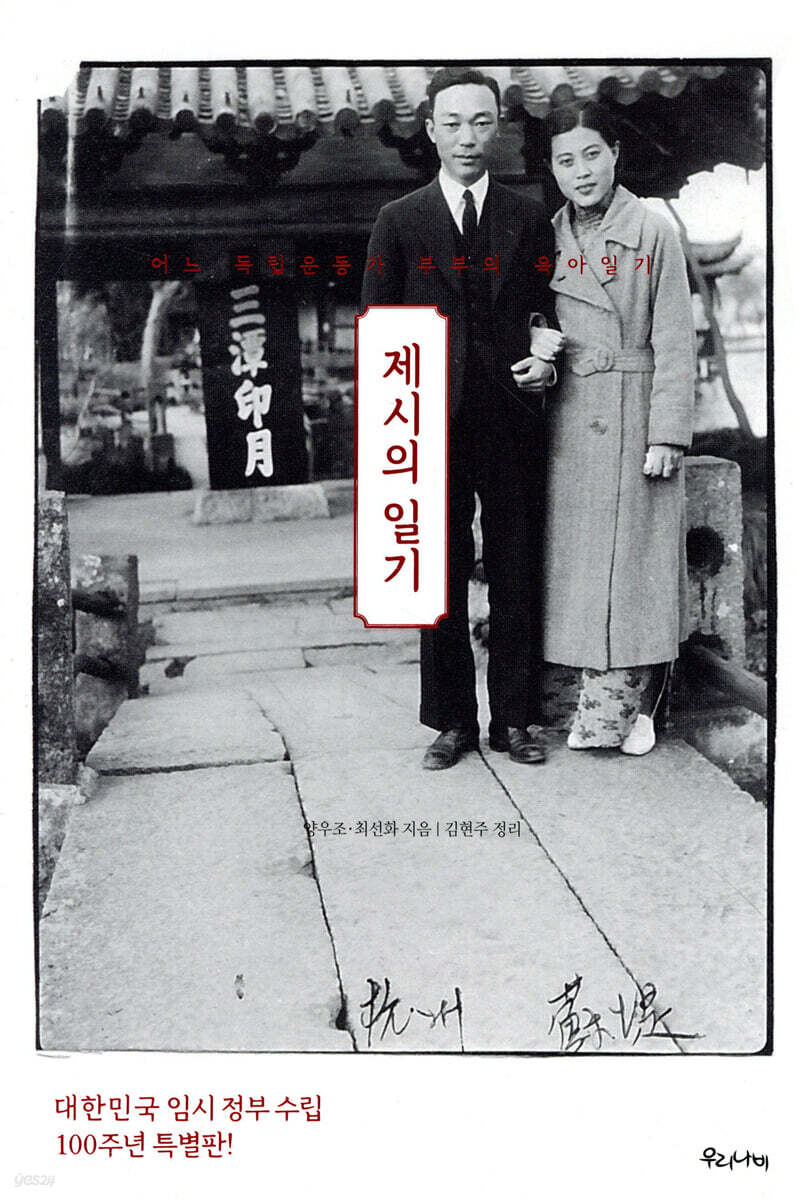
『Jessi's Diary』 is a collection of diaries written by Yang Woo-jo and Choi Seon-hwa, who fought for independence under the Provisional Government (their wedding was officiated by Baekbeom Kim Gu), from 1938 to 1946, when they gave birth to their eldest daughter, Jessi, in China and kept for eight years until their return to Korea.
This diary was previously compiled by her granddaughter, Kim Hyun-joo, and published under the same title by the publisher 'Hye-yum' in 1999, but it naturally went out of print when the publisher went out of business.
In 2016, while the original diary was out of print, it was published as a graphic novel titled “Jessie’s Story” by cartoonist Park Geon-woong, winner of the Today’s Cartoon Award (Minister of Culture, Sports and Tourism Award).
It has already been 20 years since the diary was first published and made known to the public, 60 years after it was first written. Now, in 2019, to commemorate the 100th anniversary of the March 1st Movement and the Provisional Government of the Republic of Korea, 『Jessi's Diary』 has been reborn in a new form.
Reopening a diary from 80 years ago
『Jessi's Diary』 is a collection of diaries written by Yang Woo-jo and Choi Seon-hwa, who fought for independence under the Provisional Government (their wedding was officiated by Baekbeom Kim Gu), from 1938 to 1946, when they gave birth to their eldest daughter, Jessi, in China and kept for eight years until their return to Korea.
This diary was previously compiled by her granddaughter, Kim Hyun-joo, and published under the same title by the publisher 'Hye-yum' in 1999, but it naturally went out of print when the publisher went out of business.
In 2016, while the original diary was out of print, it was published as a graphic novel titled “Jessie’s Story” by cartoonist Park Geon-woong, winner of the Today’s Cartoon Award (Minister of Culture, Sports and Tourism Award).
It has already been 20 years since the diary was first published and made known to the public, 60 years after it was first written. Now, in 2019, to commemorate the 100th anniversary of the March 1st Movement and the Provisional Government of the Republic of Korea, 『Jessi's Diary』 has been reborn in a new form.
- You can preview some of the book's contents.
Preview
index
Prologue, I meet you from a hundred years ago.
1999, opening a diary from 60 years ago, page 13
Recommendation: Dr. Han Si-jun (Professor of History, Dankook University) p. 16
When He Met Her, page 18
1.
China, become a floating island wandering across the continent
(July 4, 1938 - April 30, 1939)
The Birth of Baby Jessie, page 33
45 South to South
After a long voyage to a new land, page 54
Raising a Baby, page 61
Jessie's Refuge, page 66
The Escape Route, Page 72
2.
Still holding hope in my heart
(May 3, 1939 - November 12, 1940)
Page 85 of the presentation of the disciplined land
"The Blue Sky and the Milky Way" in China, p. 118
Air Raid Warning and Outdoor Walk, p. 123
The Fatherless House, page 127
Page 134 of the new city of Chongqing
3.
My second hometown, Chongqing
(November 13, 1940 - January 31, 1943)
Making a Nest, page 143
A New Year of Hope for Jessie! Page 147
Meeting My Sister Jenny, page 158
Chongqing, the time of ceaseless air raids, page 162
Declaring war on Japan, page 176
Two Sisters, Jessie and Jevi, p. 189
4.
Missing you
(July 2018)
5.
Continued trials and pain
(February 3, 1943 - August 9, 1945)
Page 209 from Gangbuk to downtown Chongqing
Separated Family, page 219
Becoming a Father's 'Mom', p. 226
A Worried Guest, a Sick Horse Stays, p. 231
6.
My wish came true, but...
(August 10, 1945 - April 29, 1946)
The Day of Liberation Comes, p. 245
Page 252 of "Back to the Homeland"
The Unfinished Story (The Story After) Page 268
Today's Words, p. 271
Drawing father, mother, and older sister, page 274
Epilogue, History Continues, p. 279
About the people who appear in the diary, page 282
1999, opening a diary from 60 years ago, page 13
Recommendation: Dr. Han Si-jun (Professor of History, Dankook University) p. 16
When He Met Her, page 18
1.
China, become a floating island wandering across the continent
(July 4, 1938 - April 30, 1939)
The Birth of Baby Jessie, page 33
45 South to South
After a long voyage to a new land, page 54
Raising a Baby, page 61
Jessie's Refuge, page 66
The Escape Route, Page 72
2.
Still holding hope in my heart
(May 3, 1939 - November 12, 1940)
Page 85 of the presentation of the disciplined land
"The Blue Sky and the Milky Way" in China, p. 118
Air Raid Warning and Outdoor Walk, p. 123
The Fatherless House, page 127
Page 134 of the new city of Chongqing
3.
My second hometown, Chongqing
(November 13, 1940 - January 31, 1943)
Making a Nest, page 143
A New Year of Hope for Jessie! Page 147
Meeting My Sister Jenny, page 158
Chongqing, the time of ceaseless air raids, page 162
Declaring war on Japan, page 176
Two Sisters, Jessie and Jevi, p. 189
4.
Missing you
(July 2018)
5.
Continued trials and pain
(February 3, 1943 - August 9, 1945)
Page 209 from Gangbuk to downtown Chongqing
Separated Family, page 219
Becoming a Father's 'Mom', p. 226
A Worried Guest, a Sick Horse Stays, p. 231
6.
My wish came true, but...
(August 10, 1945 - April 29, 1946)
The Day of Liberation Comes, p. 245
Page 252 of "Back to the Homeland"
The Unfinished Story (The Story After) Page 268
Today's Words, p. 271
Drawing father, mother, and older sister, page 274
Epilogue, History Continues, p. 279
About the people who appear in the diary, page 282
Publisher's Review
Through the life of an independence activist, his daily life, and his warm humanity
Depicting the reality of the Provisional Government of the Republic of Korea!
In the couple's diary, we can see the parents' longing for their young daughter Jessie, who was born in the midst of war, to grow up well, even as they fled the Japanese air raids that poured down every day during the height of the Second Sino-Japanese War, going in and out of the air-raid shelter as if it were their own home.
In addition, you can feel the strong will to never give up hope while fighting for independence under difficult conditions, as well as the close bond between Koreans.
The book contains exotic stories about the Chinese people he met during his anti-Japanese activities in various parts of China, including Changsha, Guangzhou, Foshan, Liuzhou, Qijiang, and Chongqing, as well as heartwarming stories of them helping and caring for one another while fighting against the common enemy, Japan.
March 14, 1939, Yuzhou
Now, I start preparing one by one to eat on my own.
Now, your child will be chewing more than just food.
By chewing on the knowledge in textbooks, by mixing and matching the diverse aspects of the various people in the world, by chewing on the duality of people and the world that is sometimes incredibly incomprehensible, and by chewing on the life in the world that is too complex to be divided into success and failure, Jessie will make it her own flesh. - From the text
The diary begins on July 4, 1938, in Changsha, China, and continues for eight years.
This record, which can be considered a Korean version of Anne Frank's diary, opens with the birth of her eldest daughter, Jessie.
Yang Woo-jo is a “baby born in China, away from his homeland.
“I named my daughter ‘Jessi’ using the family name ‘Je’ in the hope that when she grows up, our country will proudly play its part in the world,” he said, writing in his diary.
The earnest love of the independence activist couple for their country can be seen in the way they gave their child the English name Jessie.
If my child were to ask me one day why I wandered and lived in a foreign land, would I be able to explain it with a simple phrase: "It was for your future"? Would that truly capture our fervent desire to achieve independence? Would that truly capture our family's time together? - Excerpt from the text
Even as we live in a dark age where we don't know when we will die and where we cannot see even an inch ahead, the story of ordinary daily life continues.
Even while fleeing or hiding from air raids, I had to cook and eat, suffer from illness and undergo multiple surgeries, and smile at the sight of my growing child's talents.
Even in such daily life, the records of their worries about the country and their hope for independence confirm their unwavering will.
Furthermore, this book adds to the fun by introducing small anecdotes about intellectuals of the time, such as Baekbeom Kim Gu and Dosan Ahn Chang-ho, who are familiar to any Korean citizen, even if they are not necessarily history textbooks.
Even in the midst of war, children are born and grow up.
Dreaming of hope for tomorrow in the simple daily life of a family
An ordinary family that smiled at their daughter's antics and was anxious at the slightest sneeze, but as a nation that had lost its country, they wandered in a foreign land amidst the ravages of war, their feelings while struggling between life and death were indescribable.
This work vividly depicts the coexistence of life and death in the midst of the Sino-Japanese War. It contains stories of the parents' deep love for Jessie growing up in a foreign country, China, the uprightness that does not lose hope even in the difficult circumstances of the independence movement, the warm feelings between Korean compatriots, the friendship between Korean and Chinese politicians, and the help and consideration of the Chinese people for Koreans.
Furthermore, through the provisional government's journey, life in China, and the small daily lives filled with hopes for independence, we can see how passion for life blossomed despite the life-or-death struggles of wartime.
A treasure trove of high historical value!
As the title of the book suggests, this couple's diary is a kind of 'parenting diary' that focuses on the growth of their daughter Jessie.
Nonetheless, this diary holds great value in the history of the independence movement.
As most of the records about the provisional government at that time were lost, this diary, written over a period of about eight years from July 1938 to April 1946, is the only historical document that accurately tells the story of the provisional government's move from Changsha to Guangzhou to Liuzhou to Qijiang to Chongqing to avoid Japanese air raids during the Second Sino-Japanese War.
This book is also historically significant.
There are very few documents left today about the provisional government during the Second Sino-Japanese War when this diary was written. This is especially true because these records are the only diary that tells the story of the provisional government moving to Chongqing via Changsha, Gwangju, Youzhou, and Jijiang while being bombed by Japanese air force aircraft.
And what is more important is that the diaries are filled with the lives of independence activists and their human touch.
That's what makes this book hard to put down.
-Han Si-jun, Professor of History, College of Humanities, Dankook University
Yang Woo-jo, who is he?
Yang Woo-jo was born in 1897 in Kangseo, South Pyongan Province and grew up in Pyongyang.
His nickname is Sobyeok (少碧), and his real name is Yang Myeongjin (楊明鎭).
At the age of 19, he went into exile in Shanghai, China, and with the help of independence activist Shin Gyu-sik, he went to study in the United States and graduated from the Textile School in New Bedford, Massachusetts.
The reason he studied textile engineering was because he wanted to clothe his fellow countrymen with his own hands.
After completing his studies, he joined the American Heungsadan and worked there. He then moved to Shanghai and participated in anti-Japanese activities as a member of the Provisional Legislative Assembly of the Provisional Government of the Republic of Korea, a member of the Central Executive Committee of the Korean Independence Party, and the Deputy Director of the Livelihood Department of the Provisional Government.
In recognition of his achievements by the government, he was posthumously awarded the Order of Merit for National Foundation, Independence Medal in 1963.
Choi Seon-hwa, who is she?
Choi Seon-hwa, the wife of Yang Woo-jo and mother of Jessie, was born in Gaeseong, Gyeonggi Province and graduated from the Department of English Literature at Ewha Womans University in 1931.
As a new woman who taught at her alma mater, she moved to Shanghai in 1936 and formed the Korean Revolutionary Women's League in the Provisional Government. She was later elected as the secretary-general of the Korean Patriotic Women's Association.
She was also recognized for her achievements by the government and was posthumously awarded the Order of Merit for National Foundation in 1991.
An epic chronicle of an independence activist's child-rearing diary and a record of the provisional government at the time.
Mr. Yang Woo-jo was an intellectual who majored in textile engineering in the United States and was a man of political insight and vision who prepared for the construction of a nation-state, including by translating Sun Yat-sen's "Three Principles of the People."
He came to his home country to start a textile business, but he gave up his comfortable life and went into exile in China, thinking that independence was the priority.
Mrs. Choi Seon-hwa, a new woman who graduated from the English Literature Department of Ewha Womans University, overcomes the fourteen-year age difference and goes into exile in China alone in search of her comrade and lover.
Moved by his sincerity, Baekbeom Kim Gu officiated the wedding of this unusual couple.
Yang Woo-jo passed away in 1964, Choi Seon-hwa passed away in 2003, and Jessi, the main character in Jessi's Diary, which contains precious evidence of our country's independence movement history, passed away on September 10, 2010.
This record begins with the birth date of Jessie, the first daughter of independence activists Yang Woo-jo and Choi Seon-hwa.
In the everyday happiness of children being born and growing up, one can feel the solemn yet extraordinary footsteps and breath of history of the Provisional Government of the Republic of Korea returning to their homeland after an arduous march.
And every record gives us the wonder of becoming history.
- Dr. Lee Myeong-hwa, former senior researcher at the Institute for Korean Independence Movement History at the Independence Hall of Korea and president of the Dosan Society
The lives of Yang Woo-jo and Choi Seon-hwa in 『Jessi's Diary』 in China were not free from Japanese air raids.
The Japanese air raid that began as soon as their baby Jesse was born is a vivid portrayal of Jesse's childhood.
This book contains the stories of those who, despite fear, walked the thorny path to independence and rebuilt their lost homeland with their young children.
- Kim Joo-yong, Professor at the Institute of Korea-China Relations and the Institute of Northeast Asian Humanities and Social Sciences, Wonkwang University
Kim Hyun-joo, the granddaughter of Yang Woo-jo and Choi Seon-hwa, who edited "Jessie's Diary," and Jessie's daughter, graduated from the Department of Educational Psychology at Ewha Womans University and worked as a writer for TV educational programs and children's programs.
In 2000, she moved to the United States and raised two children, working as a teacher, vice principal, and principal at a Korean school in Silicon Valley, and as a documentary writer for KEMS-TV.
He currently serves as a school board member for the Fremont Unified School District, working to improve education in local public schools.
In addition, we are carrying out a movement to have Jessie's Diary designated as an official book by the U.S. Department of Education in order to correct the autobiographical novel "Yoko's Story" by Japanese author Yoko Kawashima, which has been embroiled in controversy due to her disparaging remarks about Korea and distortion of history.
"Yoko's Story" is a controversial work that was adopted as a history textbook in American elementary and middle schools, and which drew criticism for portraying Koreans as perpetrators without explaining the historical background of Japan's colonization of Korea.
Although Korean parents in the United States began demanding the removal of "Yoko's Story" in 2006, the book is still used as a history textbook for students in several states.
In short, if 『Yoko's Story』 distorted the facts, 『Jessie's Diary』 can be said to have accurately reflected historical facts.
Depicting the reality of the Provisional Government of the Republic of Korea!
In the couple's diary, we can see the parents' longing for their young daughter Jessie, who was born in the midst of war, to grow up well, even as they fled the Japanese air raids that poured down every day during the height of the Second Sino-Japanese War, going in and out of the air-raid shelter as if it were their own home.
In addition, you can feel the strong will to never give up hope while fighting for independence under difficult conditions, as well as the close bond between Koreans.
The book contains exotic stories about the Chinese people he met during his anti-Japanese activities in various parts of China, including Changsha, Guangzhou, Foshan, Liuzhou, Qijiang, and Chongqing, as well as heartwarming stories of them helping and caring for one another while fighting against the common enemy, Japan.
March 14, 1939, Yuzhou
Now, I start preparing one by one to eat on my own.
Now, your child will be chewing more than just food.
By chewing on the knowledge in textbooks, by mixing and matching the diverse aspects of the various people in the world, by chewing on the duality of people and the world that is sometimes incredibly incomprehensible, and by chewing on the life in the world that is too complex to be divided into success and failure, Jessie will make it her own flesh. - From the text
The diary begins on July 4, 1938, in Changsha, China, and continues for eight years.
This record, which can be considered a Korean version of Anne Frank's diary, opens with the birth of her eldest daughter, Jessie.
Yang Woo-jo is a “baby born in China, away from his homeland.
“I named my daughter ‘Jessi’ using the family name ‘Je’ in the hope that when she grows up, our country will proudly play its part in the world,” he said, writing in his diary.
The earnest love of the independence activist couple for their country can be seen in the way they gave their child the English name Jessie.
If my child were to ask me one day why I wandered and lived in a foreign land, would I be able to explain it with a simple phrase: "It was for your future"? Would that truly capture our fervent desire to achieve independence? Would that truly capture our family's time together? - Excerpt from the text
Even as we live in a dark age where we don't know when we will die and where we cannot see even an inch ahead, the story of ordinary daily life continues.
Even while fleeing or hiding from air raids, I had to cook and eat, suffer from illness and undergo multiple surgeries, and smile at the sight of my growing child's talents.
Even in such daily life, the records of their worries about the country and their hope for independence confirm their unwavering will.
Furthermore, this book adds to the fun by introducing small anecdotes about intellectuals of the time, such as Baekbeom Kim Gu and Dosan Ahn Chang-ho, who are familiar to any Korean citizen, even if they are not necessarily history textbooks.
Even in the midst of war, children are born and grow up.
Dreaming of hope for tomorrow in the simple daily life of a family
An ordinary family that smiled at their daughter's antics and was anxious at the slightest sneeze, but as a nation that had lost its country, they wandered in a foreign land amidst the ravages of war, their feelings while struggling between life and death were indescribable.
This work vividly depicts the coexistence of life and death in the midst of the Sino-Japanese War. It contains stories of the parents' deep love for Jessie growing up in a foreign country, China, the uprightness that does not lose hope even in the difficult circumstances of the independence movement, the warm feelings between Korean compatriots, the friendship between Korean and Chinese politicians, and the help and consideration of the Chinese people for Koreans.
Furthermore, through the provisional government's journey, life in China, and the small daily lives filled with hopes for independence, we can see how passion for life blossomed despite the life-or-death struggles of wartime.
A treasure trove of high historical value!
As the title of the book suggests, this couple's diary is a kind of 'parenting diary' that focuses on the growth of their daughter Jessie.
Nonetheless, this diary holds great value in the history of the independence movement.
As most of the records about the provisional government at that time were lost, this diary, written over a period of about eight years from July 1938 to April 1946, is the only historical document that accurately tells the story of the provisional government's move from Changsha to Guangzhou to Liuzhou to Qijiang to Chongqing to avoid Japanese air raids during the Second Sino-Japanese War.
This book is also historically significant.
There are very few documents left today about the provisional government during the Second Sino-Japanese War when this diary was written. This is especially true because these records are the only diary that tells the story of the provisional government moving to Chongqing via Changsha, Gwangju, Youzhou, and Jijiang while being bombed by Japanese air force aircraft.
And what is more important is that the diaries are filled with the lives of independence activists and their human touch.
That's what makes this book hard to put down.
-Han Si-jun, Professor of History, College of Humanities, Dankook University
Yang Woo-jo, who is he?
Yang Woo-jo was born in 1897 in Kangseo, South Pyongan Province and grew up in Pyongyang.
His nickname is Sobyeok (少碧), and his real name is Yang Myeongjin (楊明鎭).
At the age of 19, he went into exile in Shanghai, China, and with the help of independence activist Shin Gyu-sik, he went to study in the United States and graduated from the Textile School in New Bedford, Massachusetts.
The reason he studied textile engineering was because he wanted to clothe his fellow countrymen with his own hands.
After completing his studies, he joined the American Heungsadan and worked there. He then moved to Shanghai and participated in anti-Japanese activities as a member of the Provisional Legislative Assembly of the Provisional Government of the Republic of Korea, a member of the Central Executive Committee of the Korean Independence Party, and the Deputy Director of the Livelihood Department of the Provisional Government.
In recognition of his achievements by the government, he was posthumously awarded the Order of Merit for National Foundation, Independence Medal in 1963.
Choi Seon-hwa, who is she?
Choi Seon-hwa, the wife of Yang Woo-jo and mother of Jessie, was born in Gaeseong, Gyeonggi Province and graduated from the Department of English Literature at Ewha Womans University in 1931.
As a new woman who taught at her alma mater, she moved to Shanghai in 1936 and formed the Korean Revolutionary Women's League in the Provisional Government. She was later elected as the secretary-general of the Korean Patriotic Women's Association.
She was also recognized for her achievements by the government and was posthumously awarded the Order of Merit for National Foundation in 1991.
An epic chronicle of an independence activist's child-rearing diary and a record of the provisional government at the time.
Mr. Yang Woo-jo was an intellectual who majored in textile engineering in the United States and was a man of political insight and vision who prepared for the construction of a nation-state, including by translating Sun Yat-sen's "Three Principles of the People."
He came to his home country to start a textile business, but he gave up his comfortable life and went into exile in China, thinking that independence was the priority.
Mrs. Choi Seon-hwa, a new woman who graduated from the English Literature Department of Ewha Womans University, overcomes the fourteen-year age difference and goes into exile in China alone in search of her comrade and lover.
Moved by his sincerity, Baekbeom Kim Gu officiated the wedding of this unusual couple.
Yang Woo-jo passed away in 1964, Choi Seon-hwa passed away in 2003, and Jessi, the main character in Jessi's Diary, which contains precious evidence of our country's independence movement history, passed away on September 10, 2010.
This record begins with the birth date of Jessie, the first daughter of independence activists Yang Woo-jo and Choi Seon-hwa.
In the everyday happiness of children being born and growing up, one can feel the solemn yet extraordinary footsteps and breath of history of the Provisional Government of the Republic of Korea returning to their homeland after an arduous march.
And every record gives us the wonder of becoming history.
- Dr. Lee Myeong-hwa, former senior researcher at the Institute for Korean Independence Movement History at the Independence Hall of Korea and president of the Dosan Society
The lives of Yang Woo-jo and Choi Seon-hwa in 『Jessi's Diary』 in China were not free from Japanese air raids.
The Japanese air raid that began as soon as their baby Jesse was born is a vivid portrayal of Jesse's childhood.
This book contains the stories of those who, despite fear, walked the thorny path to independence and rebuilt their lost homeland with their young children.
- Kim Joo-yong, Professor at the Institute of Korea-China Relations and the Institute of Northeast Asian Humanities and Social Sciences, Wonkwang University
Kim Hyun-joo, the granddaughter of Yang Woo-jo and Choi Seon-hwa, who edited "Jessie's Diary," and Jessie's daughter, graduated from the Department of Educational Psychology at Ewha Womans University and worked as a writer for TV educational programs and children's programs.
In 2000, she moved to the United States and raised two children, working as a teacher, vice principal, and principal at a Korean school in Silicon Valley, and as a documentary writer for KEMS-TV.
He currently serves as a school board member for the Fremont Unified School District, working to improve education in local public schools.
In addition, we are carrying out a movement to have Jessie's Diary designated as an official book by the U.S. Department of Education in order to correct the autobiographical novel "Yoko's Story" by Japanese author Yoko Kawashima, which has been embroiled in controversy due to her disparaging remarks about Korea and distortion of history.
"Yoko's Story" is a controversial work that was adopted as a history textbook in American elementary and middle schools, and which drew criticism for portraying Koreans as perpetrators without explaining the historical background of Japan's colonization of Korea.
Although Korean parents in the United States began demanding the removal of "Yoko's Story" in 2006, the book is still used as a history textbook for students in several states.
In short, if 『Yoko's Story』 distorted the facts, 『Jessie's Diary』 can be said to have accurately reflected historical facts.
GOODS SPECIFICS
- Date of publication: February 28, 2019
- Page count, weight, size: 289 pages | 538g | 155*255*20mm
- ISBN13: 9791186843352
- ISBN10: 1186843357
You may also like
카테고리
korean


korean

![GQ KOREA Mark (Monthly): December [2025]](http://librairie.coreenne.fr/cdn/shop/files/8ef265dbbfbf186523ed75ba7319009d.jpg?v=1765340328&width=3840)


