

Flower Moon
 |
Description
Book Introduction
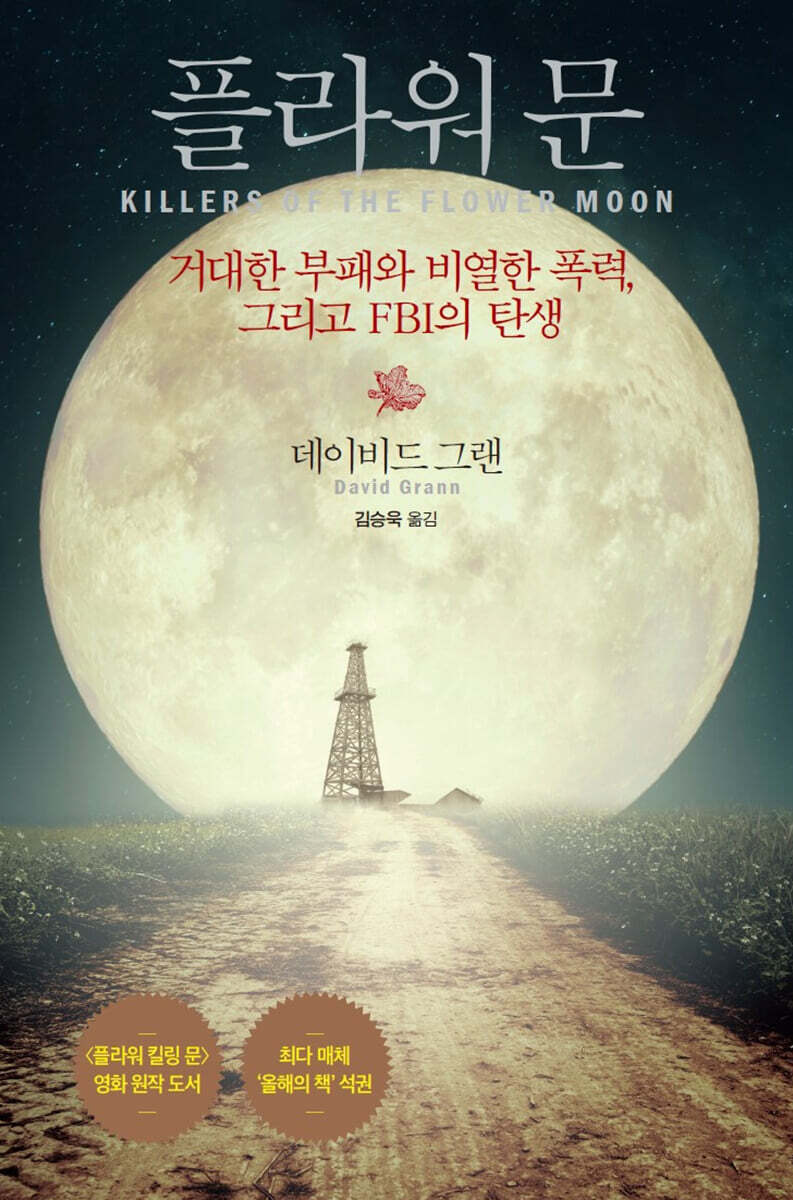
The original book of the film "Flower Killing Moon"
Selected as a 'Best Book of the Year' by the largest American media outlet
The hit novel “Flower Moon” has been published.
This is the original book for the film Flower Killing Moon, directed by Martin Scorsese and starring Leonardo DiCaprio, Robert De Niro, and Lily Gladstone.
A city in the American South in the 1920s, where 'black gold' oil was gushing out.
Wealthy Indians, who had the highest per capita income in the world, were murdered over the years.
But even as dozens of people die, the investigation remains stagnant.
Can a city ruled by anxiety and fear find justice?
This book was ranked #1 overall in Amazon's "Book of the Year" (2017) and set a record for being selected as the "Best Book of the Year" (non-fiction) by the most media outlets.
It has been a bestseller in the United States for several years.
The three elements of solid storytelling, meticulous research, and a weighty sense of theme came together to capture both popularity and artistic value.
It was also a finalist for the National Book Award.
Selected as a 'Best Book of the Year' by the largest American media outlet
The hit novel “Flower Moon” has been published.
This is the original book for the film Flower Killing Moon, directed by Martin Scorsese and starring Leonardo DiCaprio, Robert De Niro, and Lily Gladstone.
A city in the American South in the 1920s, where 'black gold' oil was gushing out.
Wealthy Indians, who had the highest per capita income in the world, were murdered over the years.
But even as dozens of people die, the investigation remains stagnant.
Can a city ruled by anxiety and fear find justice?
This book was ranked #1 overall in Amazon's "Book of the Year" (2017) and set a record for being selected as the "Best Book of the Year" (non-fiction) by the most media outlets.
It has been a bestseller in the United States for several years.
The three elements of solid storytelling, meticulous research, and a weighty sense of theme came together to capture both popularity and artistic value.
It was also a finalist for the National Book Award.
- You can preview some of the book's contents.
Preview
index
Chronicle 1: The Targeted Woman
Chapter 1: Missing
Chapter 2: Is it God's call or man's work?
Chapter 3 The King of the Osage Hills
Chapter 4 Underground Sanctuary
Chapter 5: The Devil's Apostles
Chapter 6: The Million Dollar Elm
Chapter 7: This is Darkness
Chronicles 2 Modern Investigator
Chapter 8: Hef and Indulgence
Chapter 9 Secret Agent Cowboy
Chapter 10: Eliminate the Impossible
Chapter 11 The Third Man
Chapter 12: The Wilderness of Mirrors
Chapter 13 The Executioner's Son
Chapter 14: Words Left Behind Before Death
Chapter 15: The Hidden Face
Chapter 16: For the Development of the Investigation Bureau
Chapter 17: Quick Draw Pistol Technician, Hitman, Soup Man
Chapter 18: Best Games
Chapter 19: Traitor of the Clan
Chapter 20 I swear!
Chapter 21 Greenhouse
Chronicle 3 Reporter
Chapter 22: The Land of Ghosts
Chapter 23: The Case Not Yet Over
Chapter 24 In Two Worlds
Chapter 25: The Lost Manuscript
Chapter 26: Blood Cries Out
Acknowledgements
About the data
Archives and unpublished materials
main
References
Source of the illustration
Chapter 1: Missing
Chapter 2: Is it God's call or man's work?
Chapter 3 The King of the Osage Hills
Chapter 4 Underground Sanctuary
Chapter 5: The Devil's Apostles
Chapter 6: The Million Dollar Elm
Chapter 7: This is Darkness
Chronicles 2 Modern Investigator
Chapter 8: Hef and Indulgence
Chapter 9 Secret Agent Cowboy
Chapter 10: Eliminate the Impossible
Chapter 11 The Third Man
Chapter 12: The Wilderness of Mirrors
Chapter 13 The Executioner's Son
Chapter 14: Words Left Behind Before Death
Chapter 15: The Hidden Face
Chapter 16: For the Development of the Investigation Bureau
Chapter 17: Quick Draw Pistol Technician, Hitman, Soup Man
Chapter 18: Best Games
Chapter 19: Traitor of the Clan
Chapter 20 I swear!
Chapter 21 Greenhouse
Chronicle 3 Reporter
Chapter 22: The Land of Ghosts
Chapter 23: The Case Not Yet Over
Chapter 24 In Two Worlds
Chapter 25: The Lost Manuscript
Chapter 26: Blood Cries Out
Acknowledgements
About the data
Archives and unpublished materials
main
References
Source of the illustration
Detailed image
.jpg)
Into the book
People on page 11 couldn't take their eyes off the Osage's wealth.
The Osage were very different from the image of American Indians that had been established from the time they first encountered white people and suffered atrocities (from this original sin America was born).
Journalists tantalized readers with stories about the "Osage tycoon" and the "red millionaires," their brick and terracotta mansions, chandeliers, diamond rings, fur coats, and chauffeured cars.
The boy said, pointing to the stream where moss was growing on pages 23-24.
“There’s a dead person.” The corpse, which appeared to be an Indian woman, was bloated and rotting.
(…) Rita's husband Bill came forward and opened the corpse's mouth with a stick.
I saw teeth filled with gold.
“It’s definitely Anna,” said Bill.
Page 67 The Osage believed that many clans descended from the moon and stars.
Molly became a traveler in the fog.
The forces of the night surrounded her, but she could only hear them and not see them.
The sound of coyotes chattering, wolves howling, and the shrieking hoots of owls, said to be possessed by evil spirits.
The oil, which was scattered like large black wings, drawing arcs in the air on page 79, looked like an angel of death.
Oil settled layer by layer on the fields and flowers, leaving stains on the faces of the workers and onlookers.
Still, people were happy, hugging each other and throwing their hats into the air.
Big Heart, who died shortly after the land division was implemented, was praised as “the Moses of the Osage.”
This black, slippery, smelly mineral seemed to be the most beautiful thing in the world.
“It’s a mysterious phone call,” wrote Detective 10 on pages 88-89.
He suspected that Ralston's phone number was actually acting as a 'blockade'.
There was talk that some operators had taken bribes and destroyed the original records revealing the identity of the person who had initially requested the call.
In other words, it seemed as if someone was trying to erase their traces.
The case, which the Washington Post described as “one of the most brutal in this city’s criminal history,” seemed to be more than just a murder.
It was clear that the criminal was trying to convey some kind of warning.
The Washington Post ran a headline expressing the growing suspicion.
“It seems there is a conspiracy to kill the rich Indians.”
Page 136 The people with the highest per capita income in the world were also the most murdered in the world.
The press later described these murders as "as dark and vile as any murder this century" and "the bloodiest pages in American criminal history."
Page 149 Tom White hated shooting guns so much that he almost seemed like a nerd.
So he was proud of the fact that he had not killed anyone.
He seemed to be afraid of his own dark inner instincts.
In his view, the line separating good people from bad people was very thin.
To solve the Osage murders and preserve Hoover's head, one of the few experienced agents was needed: White, one of the cowboys.
“I would like you to take charge of the investigation,” Hoover said.
Page 189: There were spies and double agents within the investigation team.
There was even a possibility that there might be a triple threat.
Page 218 White realized that the so-called Indian business was an elaborate crime.
Various sectors of society were complicit in this.
The con artists' guardians and administrators were usually drawn from the white elite, including businessmen, ranchers, lawyers, and politicians.
The same goes for the sheriffs, prosecutors, and judges who helped and covered up their theft.
With each murder, it became clear that more and more of the equity stakes were in the hands of one person: Molly Burkhart.
Pages 250-251 With his bow tie on and his chin held high, he looked like the embodiment of the criminals the White brothers and his father had spent their lives chasing and capturing.
He seemed to think “the whole world was his.”
Page 314 For Hoover, the Osage murder investigation was a prime example of a modern investigative agency.
As he hoped, the case demonstrated to many that a professional, scientific, nationwide investigative body was needed.
Page 345 “We don’t easily talk about what happened in the Age of Terror,” she explained.
“Because there are so many Osage people who have lost their mothers, fathers, sisters, brothers, cousins.
“That pain never goes away.”
Page 410 “This land is full of blood,” Webb said.
Then there was silence for a moment.
The oak leaves continued to rustle in the wind.
After Cain killed Abel, the web repeated what God said to Cain.
“Blood cries out from the ground.”
The Osage were very different from the image of American Indians that had been established from the time they first encountered white people and suffered atrocities (from this original sin America was born).
Journalists tantalized readers with stories about the "Osage tycoon" and the "red millionaires," their brick and terracotta mansions, chandeliers, diamond rings, fur coats, and chauffeured cars.
The boy said, pointing to the stream where moss was growing on pages 23-24.
“There’s a dead person.” The corpse, which appeared to be an Indian woman, was bloated and rotting.
(…) Rita's husband Bill came forward and opened the corpse's mouth with a stick.
I saw teeth filled with gold.
“It’s definitely Anna,” said Bill.
Page 67 The Osage believed that many clans descended from the moon and stars.
Molly became a traveler in the fog.
The forces of the night surrounded her, but she could only hear them and not see them.
The sound of coyotes chattering, wolves howling, and the shrieking hoots of owls, said to be possessed by evil spirits.
The oil, which was scattered like large black wings, drawing arcs in the air on page 79, looked like an angel of death.
Oil settled layer by layer on the fields and flowers, leaving stains on the faces of the workers and onlookers.
Still, people were happy, hugging each other and throwing their hats into the air.
Big Heart, who died shortly after the land division was implemented, was praised as “the Moses of the Osage.”
This black, slippery, smelly mineral seemed to be the most beautiful thing in the world.
“It’s a mysterious phone call,” wrote Detective 10 on pages 88-89.
He suspected that Ralston's phone number was actually acting as a 'blockade'.
There was talk that some operators had taken bribes and destroyed the original records revealing the identity of the person who had initially requested the call.
In other words, it seemed as if someone was trying to erase their traces.
The case, which the Washington Post described as “one of the most brutal in this city’s criminal history,” seemed to be more than just a murder.
It was clear that the criminal was trying to convey some kind of warning.
The Washington Post ran a headline expressing the growing suspicion.
“It seems there is a conspiracy to kill the rich Indians.”
Page 136 The people with the highest per capita income in the world were also the most murdered in the world.
The press later described these murders as "as dark and vile as any murder this century" and "the bloodiest pages in American criminal history."
Page 149 Tom White hated shooting guns so much that he almost seemed like a nerd.
So he was proud of the fact that he had not killed anyone.
He seemed to be afraid of his own dark inner instincts.
In his view, the line separating good people from bad people was very thin.
To solve the Osage murders and preserve Hoover's head, one of the few experienced agents was needed: White, one of the cowboys.
“I would like you to take charge of the investigation,” Hoover said.
Page 189: There were spies and double agents within the investigation team.
There was even a possibility that there might be a triple threat.
Page 218 White realized that the so-called Indian business was an elaborate crime.
Various sectors of society were complicit in this.
The con artists' guardians and administrators were usually drawn from the white elite, including businessmen, ranchers, lawyers, and politicians.
The same goes for the sheriffs, prosecutors, and judges who helped and covered up their theft.
With each murder, it became clear that more and more of the equity stakes were in the hands of one person: Molly Burkhart.
Pages 250-251 With his bow tie on and his chin held high, he looked like the embodiment of the criminals the White brothers and his father had spent their lives chasing and capturing.
He seemed to think “the whole world was his.”
Page 314 For Hoover, the Osage murder investigation was a prime example of a modern investigative agency.
As he hoped, the case demonstrated to many that a professional, scientific, nationwide investigative body was needed.
Page 345 “We don’t easily talk about what happened in the Age of Terror,” she explained.
“Because there are so many Osage people who have lost their mothers, fathers, sisters, brothers, cousins.
“That pain never goes away.”
Page 410 “This land is full of blood,” Webb said.
Then there was silence for a moment.
The oak leaves continued to rustle in the wind.
After Cain killed Abel, the web repeated what God said to Cain.
“Blood cries out from the ground.”
--- From the text
Publisher's Review
The original book of the film "Flower Killing Moon"
Director Martin Scorsese, Leonardo DiCaprio,
Starring Robert De Niro and Lily Gladstone
★ Amazon's Best Book of the Year (2017)
★ Most media outlets have selected this book as one of the "Best Books of 2017" (nonfiction).
★ National Book Award Finalist
Police, lawyers, doctors, politicians, organized crime…
Don't trust anyone in this city.
“The author is a master of the suspenseful, multi-layered mystery.
“It will take your soul away.”_[New York Times]
Author David Grann is an American author and journalist.
I have written for several leading media outlets about people and events that have left a special mark on history.
Since joining The New Yorker as a staff writer in 2003, he has won awards including the Michael Kelly Award (2005) and the George Polk Award (2009).
In "Flower Moon," the author masterfully captures the landscape of America at the threshold of the modern world. He captivatingly portrays the formation of a nationwide investigative system, epitomized by the FBI, and meticulously exposes the violence against Native Americans.
Along the way, it portrays a colorful cast of characters, including a stoic Texas Ranger, a corrupt private detective, and a terrifying gang of robbers.
The 1920s, the setting of this book, was a time when today's American system was beginning to be established, and the central and southern regions in particular were a place where the most American customs remained stubbornly strong.
The author reads America in this time and space where the past order and the modern world clashed most fiercely.
This provides a wealth of inspiration for understanding today's America in a three-dimensional way.
Above all, this book is full of themes that still resonate universally today.
How can a crime be committed in the name of law?
How fragile is the judicial system when political power and organized crime collude?
How does hatred toward minorities justify mob violence?
These questions linger heavily throughout the story, which is full of twists and turns.
death of a family member,
A city ruled by anxiety and fear
Molly Burkhart, one of the wealthiest people in the city.
When "black gold" oil gushes out of Osage land, Molly and her family become wealthy.
Molly married a white man and had a huge bank account.
There seemed to be nothing lacking in her life.
Until my sister Anna went missing.
My pretty and confident older sister became addicted to nightlife after her divorce.
He drank bootleg whiskey without fail and was “unruly” to the white men in the neighborhood.
Then one night, my sister disappeared without a trace.
Her husband, Ernest, stayed by Molly's side as she grieved.
But my sister never came back.
No, I did come back.
A horrific corpse, shot in the head.
“I will be by your side.
“I will definitely catch the culprit,” said her husband Ernest, offering Molly heartfelt consolation.
But this wasn't just a personal tragedy.
As time went by, suspicious deaths increased.
There were twenty-four deaths for which the culprit was not found.
They were all rich, and they were all Indian.
When FBI Special Agent Tom White, just emerging from the shadows, was deployed to this bizarre city of death, things were already going as wrong as they could be.
Who on earth is the culprit? Can Agent Tom White solve the case? Can justice be restored to a city gripped by anxiety and fear?
What is 'Flower Moon'?
“In May, when coyotes howl beneath a moon so large it’s unsettling, taller plants like daylilies and yellow daisies creep over the smaller flowers, stealing light and water from them.
The necks of the small flowers break and the petals flutter and fly away.
And before long it is buried in the ground.
That is why the Osage Indians call May the time of the 'flower-killing moon.'”_From the text
'Flower Moon' is a shortened form of 'Flower Killing Moon', which is what the Osage Indians call the month of May.
In this book, the word 'flower moon' is used to implicitly symbolize the ironic situation where light and shadow, brightness and darkness intersect, and to poetically capture the tragic era.
Director Martin Scorsese, Leonardo DiCaprio,
Starring Robert De Niro and Lily Gladstone
★ Amazon's Best Book of the Year (2017)
★ Most media outlets have selected this book as one of the "Best Books of 2017" (nonfiction).
★ National Book Award Finalist
Police, lawyers, doctors, politicians, organized crime…
Don't trust anyone in this city.
“The author is a master of the suspenseful, multi-layered mystery.
“It will take your soul away.”_[New York Times]
Author David Grann is an American author and journalist.
I have written for several leading media outlets about people and events that have left a special mark on history.
Since joining The New Yorker as a staff writer in 2003, he has won awards including the Michael Kelly Award (2005) and the George Polk Award (2009).
In "Flower Moon," the author masterfully captures the landscape of America at the threshold of the modern world. He captivatingly portrays the formation of a nationwide investigative system, epitomized by the FBI, and meticulously exposes the violence against Native Americans.
Along the way, it portrays a colorful cast of characters, including a stoic Texas Ranger, a corrupt private detective, and a terrifying gang of robbers.
The 1920s, the setting of this book, was a time when today's American system was beginning to be established, and the central and southern regions in particular were a place where the most American customs remained stubbornly strong.
The author reads America in this time and space where the past order and the modern world clashed most fiercely.
This provides a wealth of inspiration for understanding today's America in a three-dimensional way.
Above all, this book is full of themes that still resonate universally today.
How can a crime be committed in the name of law?
How fragile is the judicial system when political power and organized crime collude?
How does hatred toward minorities justify mob violence?
These questions linger heavily throughout the story, which is full of twists and turns.
death of a family member,
A city ruled by anxiety and fear
Molly Burkhart, one of the wealthiest people in the city.
When "black gold" oil gushes out of Osage land, Molly and her family become wealthy.
Molly married a white man and had a huge bank account.
There seemed to be nothing lacking in her life.
Until my sister Anna went missing.
My pretty and confident older sister became addicted to nightlife after her divorce.
He drank bootleg whiskey without fail and was “unruly” to the white men in the neighborhood.
Then one night, my sister disappeared without a trace.
Her husband, Ernest, stayed by Molly's side as she grieved.
But my sister never came back.
No, I did come back.
A horrific corpse, shot in the head.
“I will be by your side.
“I will definitely catch the culprit,” said her husband Ernest, offering Molly heartfelt consolation.
But this wasn't just a personal tragedy.
As time went by, suspicious deaths increased.
There were twenty-four deaths for which the culprit was not found.
They were all rich, and they were all Indian.
When FBI Special Agent Tom White, just emerging from the shadows, was deployed to this bizarre city of death, things were already going as wrong as they could be.
Who on earth is the culprit? Can Agent Tom White solve the case? Can justice be restored to a city gripped by anxiety and fear?
What is 'Flower Moon'?
“In May, when coyotes howl beneath a moon so large it’s unsettling, taller plants like daylilies and yellow daisies creep over the smaller flowers, stealing light and water from them.
The necks of the small flowers break and the petals flutter and fly away.
And before long it is buried in the ground.
That is why the Osage Indians call May the time of the 'flower-killing moon.'”_From the text
'Flower Moon' is a shortened form of 'Flower Killing Moon', which is what the Osage Indians call the month of May.
In this book, the word 'flower moon' is used to implicitly symbolize the ironic situation where light and shadow, brightness and darkness intersect, and to poetically capture the tragic era.
GOODS SPECIFICS
- Date of publication: October 10, 2018
- Page count, weight, size: 464 pages | 616g | 140*210*24mm
- ISBN13: 9791189336011
- ISBN10: 1189336014
You may also like
카테고리
korean


korean

![GQ KOREA Mark (Monthly): December [2025]](http://librairie.coreenne.fr/cdn/shop/files/8ef265dbbfbf186523ed75ba7319009d.jpg?v=1765340328&width=3840)


