

History of history
 |
Description
Book Introduction
After "What is a Nation?", Asking "What is History?" Finding the crossroads of history with Yoo Si-min! Thirty years after 『Reading World History Backwards』, a new beginning for author Yoo Si-min's writing. From Herodotus's "History" and Thucydides' "History of the Peloponnesian War" to Yuval Harari's "Sapiens," the book explores 18 historical books that have captivated history from ancient times to the present day, divided into nine chapters, and explores the topic of "history." The main contents of each historical book, the historical context, the new focus and interpretation of the narrative, and the historian's life were summarized in Yu Si-min's own language. Here, he conveys the historian's inner thoughts, checks the parts that should not be missed, and even takes on the role of a guide who comforts and encourages readers even if they do not understand. He personally demonstrates his love for history and the importance of studying it, and reveals his own method of studying history. As we share the power and logic of history, the thoughts and emotions of historians, and the joy and enlightenment of studying history, we each move toward the question, "How should we live?" |
- You can preview some of the book's contents.
Preview
index
Introduction - What is History?
Prologue - Records, Science, Literature
Chapter 1: Herodotus and Thucydides, the Founders of Western History
Herodotus, the Street Storyteller | The Persian Wars and Histories | The Peloponnesian War and the Fall of the Greek World | The Simultaneous Birth of World History and National History | Fact and Imagination | The Power of Narrative and the Allure of History
Chapter 2: Sima Qian's Landscapes of People, Power, and the Age
The Historian's Elegant Revenge | Landscapes of the Ages Painted in Mechanical Form | Gaps in Historical Data and Literary Imagination | The Cosmos of History
Chapter 3: Ibn Khaldun, Writing the First History of Humanity
The First Encounter between Science and History | The Book of Reflections and the Introduction to History | The Rise and Fall of Dynasties and the "Assabiyya" Theory | The Shackles of Historians and Religion | Jesus Becomes King | The Unity and Division of the Islamic World | A Warning to Monarchs
Chapter 4, "History as It Was," Ranke
A born historian
The Age of the Professional Historian | Masters of "Breaking the Archives" | History and Theology | The Lifeless History of "As It Was"
Chapter 5: Marx's Law of History, Which Bypassed History
From Interpretation to Transformation | Materialism, Dialectics, and Historical Materialism | Communist Revolution and the End of History | Fukuyama's Variant of Historical Eschatology
Chapter 6: The Hard Journey of Nationalist Historiography: Park Eun-sik, Shin Chae-ho, and Baek Nam-un
Nationalist Historiography in the Age of Imperialism | Park Eun-sik's "A Comprehensive History of Korea" | From a Civilized Confucian to a Democrat | Record of the Struggle between Asia and the Pacific: "Ancient History of Joseon" | Shin Chae-ho, the Outstanding Historical Researcher | Kim Bu-sik's Historical Distortion | Baek Nam-un's Four-Stage Development Theory of Joseon History | Colonial and Materialist Views of History
Chapter 7 Edward H.
A historical theory book that became the history of the car
Why "What is History" is Difficult | Historians and Facts | All History is Modern History | Individuals, Society, and the Progress of History
Chapter 8: A History of Civilization: Spengler? Toynbee? Huntington
Spengler's "The Decline of the West" | "A Study of History," Encyclopedia of Civilizations | A Record of Challenges and Responses | Creative Minorities and the Internal and External Proletariat | The Clash of Civilizations | Fault Line Disputes
Chapter 9: Diamonds and Harari: Integrating History and Science
From Tribal Humans to Sapiens | A History Written by Scientists | The Cognitive Revolution and the Birth of History | The Agricultural Revolution: "History's Greatest Fraud" | Humans Aiming to Become Gods
Epilogue - The Power of Narrative
References
Search
Prologue - Records, Science, Literature
Chapter 1: Herodotus and Thucydides, the Founders of Western History
Herodotus, the Street Storyteller | The Persian Wars and Histories | The Peloponnesian War and the Fall of the Greek World | The Simultaneous Birth of World History and National History | Fact and Imagination | The Power of Narrative and the Allure of History
Chapter 2: Sima Qian's Landscapes of People, Power, and the Age
The Historian's Elegant Revenge | Landscapes of the Ages Painted in Mechanical Form | Gaps in Historical Data and Literary Imagination | The Cosmos of History
Chapter 3: Ibn Khaldun, Writing the First History of Humanity
The First Encounter between Science and History | The Book of Reflections and the Introduction to History | The Rise and Fall of Dynasties and the "Assabiyya" Theory | The Shackles of Historians and Religion | Jesus Becomes King | The Unity and Division of the Islamic World | A Warning to Monarchs
Chapter 4, "History as It Was," Ranke
A born historian
The Age of the Professional Historian | Masters of "Breaking the Archives" | History and Theology | The Lifeless History of "As It Was"
Chapter 5: Marx's Law of History, Which Bypassed History
From Interpretation to Transformation | Materialism, Dialectics, and Historical Materialism | Communist Revolution and the End of History | Fukuyama's Variant of Historical Eschatology
Chapter 6: The Hard Journey of Nationalist Historiography: Park Eun-sik, Shin Chae-ho, and Baek Nam-un
Nationalist Historiography in the Age of Imperialism | Park Eun-sik's "A Comprehensive History of Korea" | From a Civilized Confucian to a Democrat | Record of the Struggle between Asia and the Pacific: "Ancient History of Joseon" | Shin Chae-ho, the Outstanding Historical Researcher | Kim Bu-sik's Historical Distortion | Baek Nam-un's Four-Stage Development Theory of Joseon History | Colonial and Materialist Views of History
Chapter 7 Edward H.
A historical theory book that became the history of the car
Why "What is History" is Difficult | Historians and Facts | All History is Modern History | Individuals, Society, and the Progress of History
Chapter 8: A History of Civilization: Spengler? Toynbee? Huntington
Spengler's "The Decline of the West" | "A Study of History," Encyclopedia of Civilizations | A Record of Challenges and Responses | Creative Minorities and the Internal and External Proletariat | The Clash of Civilizations | Fault Line Disputes
Chapter 9: Diamonds and Harari: Integrating History and Science
From Tribal Humans to Sapiens | A History Written by Scientists | The Cognitive Revolution and the Birth of History | The Agricultural Revolution: "History's Greatest Fraud" | Humans Aiming to Become Gods
Epilogue - The Power of Narrative
References
Search
Into the book
History is a written story of facts and the past recreated in language. To empathize with and feel interest in someone else's past recreated in someone else's language, you need to know the basic information contained in the book.
That doesn't mean you have to search and read all that unfamiliar information.
It is enough to read while focusing on the narrative.
We read ancient history books not to gain new information or knowledge, but because we can see ourselves in the stories they leave behind.
---p.51~52, Chapter 1
If one were to choose just one history book as the greatest in all of human history, the Records of the Grand Historian would undoubtedly be the strongest candidate.
Sima Qian was the first historian in Chinese civilization to write history as history.
Although the Records of the Grand Historian was written by referencing folk history books and various national records, the Records of the Grand Historian surpassed them all.
If previous history books each depicted a single star, Sima Qian depicted the universe.
『The Records of the Grand Historian』 was a ‘complete history’ that reconstructed the past of an era and civilization through language.
In the history of mankind, only one historian has ever accomplished such a feat on his own.
---p.76, Chapter 2
The reason why 『Introduction to History』 is still recognized as a valuable historical book today is not because it reveals universal historical laws, but because it leaves behind valuable historical records.
In the process of arguing the laws of history he believed he had discovered, he recorded the current state and characteristics of the Islamic civilization and Arab society that emerged in the 7th century, and described in detail how Arab intellectuals of the time viewed humanity and civilization.
Thanks to this information, 『Historical Introduction』 has become a valuable guide for scholars studying the history of the emergence of Islamic civilization.
This book also contains scientific thinking and humanistic imagination that were far ahead of their time, making it a truly enjoyable read.
---p.85, Chapter 3
There are two reasons why Ranke, whose writing was terribly boring, became an indispensable figure in the history of history: one is his academic achievements, and the other is his fatal and serious error in perception.
Ranke's achievements shine because of his errors, and his errors stand out because of his achievements.
Since the mid-19th century, Western historiography has branched out and blossomed, building on the foundation of his achievements and overcoming the errors he committed.
It is impossible to talk about the history of history without mentioning this person.
---p.126~127, Chapter 4
For Herodotus, writing history was a lucrative business, for Sima Qian it was proof of the existence of real human beings, and for Khaldun it was academic research.
For Marx, it was an activity to produce weapons of revolution, and for Park Eun-sik and Shin Chae-ho, it was a struggle for national liberation.
The Sapiens brain is a product of biological evolution, but the philosophical self that resides within it reflects the social environment.
They lived in different times, had different experiences, and left behind different stories.
---p.212~213, Chapter 6
Toynbee knew well that the historian's job was to create stories, and he believed that history should be a record, a science, and an art.
As we saw in the previous chapter, 『A Study of History』 is a single story about the process and principles of the birth, growth, decline, and disintegration of civilization.
He favored literary expressions when describing details, and despite criticism that he mixed history and literature, he maintained his own prose style. (Chapter 8, pp. 256-257)
The history of history tells me, “Know thyself.”
He advised that if we knew human nature and the meaning of existence, we would become less attached to all the fleeting things that would fade away without a trace in the kingdom of oblivion ruled by time.
Rather than trying to become someone who leaves a mark on history, he encouraged people to live a life that has meaning and expresses its own unique colors.
I hope that what I learned and felt was fully conveyed to the readers!
That doesn't mean you have to search and read all that unfamiliar information.
It is enough to read while focusing on the narrative.
We read ancient history books not to gain new information or knowledge, but because we can see ourselves in the stories they leave behind.
---p.51~52, Chapter 1
If one were to choose just one history book as the greatest in all of human history, the Records of the Grand Historian would undoubtedly be the strongest candidate.
Sima Qian was the first historian in Chinese civilization to write history as history.
Although the Records of the Grand Historian was written by referencing folk history books and various national records, the Records of the Grand Historian surpassed them all.
If previous history books each depicted a single star, Sima Qian depicted the universe.
『The Records of the Grand Historian』 was a ‘complete history’ that reconstructed the past of an era and civilization through language.
In the history of mankind, only one historian has ever accomplished such a feat on his own.
---p.76, Chapter 2
The reason why 『Introduction to History』 is still recognized as a valuable historical book today is not because it reveals universal historical laws, but because it leaves behind valuable historical records.
In the process of arguing the laws of history he believed he had discovered, he recorded the current state and characteristics of the Islamic civilization and Arab society that emerged in the 7th century, and described in detail how Arab intellectuals of the time viewed humanity and civilization.
Thanks to this information, 『Historical Introduction』 has become a valuable guide for scholars studying the history of the emergence of Islamic civilization.
This book also contains scientific thinking and humanistic imagination that were far ahead of their time, making it a truly enjoyable read.
---p.85, Chapter 3
There are two reasons why Ranke, whose writing was terribly boring, became an indispensable figure in the history of history: one is his academic achievements, and the other is his fatal and serious error in perception.
Ranke's achievements shine because of his errors, and his errors stand out because of his achievements.
Since the mid-19th century, Western historiography has branched out and blossomed, building on the foundation of his achievements and overcoming the errors he committed.
It is impossible to talk about the history of history without mentioning this person.
---p.126~127, Chapter 4
For Herodotus, writing history was a lucrative business, for Sima Qian it was proof of the existence of real human beings, and for Khaldun it was academic research.
For Marx, it was an activity to produce weapons of revolution, and for Park Eun-sik and Shin Chae-ho, it was a struggle for national liberation.
The Sapiens brain is a product of biological evolution, but the philosophical self that resides within it reflects the social environment.
They lived in different times, had different experiences, and left behind different stories.
---p.212~213, Chapter 6
Toynbee knew well that the historian's job was to create stories, and he believed that history should be a record, a science, and an art.
As we saw in the previous chapter, 『A Study of History』 is a single story about the process and principles of the birth, growth, decline, and disintegration of civilization.
He favored literary expressions when describing details, and despite criticism that he mixed history and literature, he maintained his own prose style. (Chapter 8, pp. 256-257)
The history of history tells me, “Know thyself.”
He advised that if we knew human nature and the meaning of existence, we would become less attached to all the fleeting things that would fade away without a trace in the kingdom of oblivion ruled by time.
Rather than trying to become someone who leaves a mark on history, he encouraged people to live a life that has meaning and expresses its own unique colors.
I hope that what I learned and felt was fully conveyed to the readers!
---p.320, "Epilogue"
Publisher's Review
Writer Yoo Si-min, a master of the times, asks, "What is history?"
In June 2018, Yoo Si-min came back with a new book.
Writer Yoo Si-min, who has worked extensively as an economist, politician, 'knowledge retailer', and recently as a broadcaster, has returned to history, the origin of his long-time reading and writing.
After receiving an enthusiastic response from readers in 2017 with "What is a State?", which explored the image of a just state and the role of its citizens, Yoo Si-min shifted his focus of study and devoured Eastern and Western history books, asking the question "What is history?" and searching for an answer.
『History of History』, which contains this intellectual exploration, is a study notebook on history made public by Yu Si-min and an invitation to read history together with readers.
■ Knowledge Reportage in Search of Historians and History Books that Made History
The writing of 『History of History』 began in the winter of 2016.
As Yoo Si-min faced the controversy over nationalizing history textbooks and the subsequent "Candlelight Revolution," he once again turned his attention to how historical events are recorded and transmitted.
He has repeatedly revealed his book of life, What is History? (Edward.
H. Carr) and returned to the original question, ‘What is history?’
In order to properly answer this question, I decided that it was necessary to deeply understand the origins of history, that is, the ‘history of history.’
I have been searching for and organizing representative historical books that have long been loved by readers as classics of history or have recently attracted attention.
From Herodotus's "History" and Thucydides' "History of the Peloponnesian Wars" to Yuval Harari's "Sapiens," I was immersed in the stories left behind by historians across 2,500 years.
A certain lineage and coordinates were drawn for how they wrote history and why they had to write it that way.
Although the subjects and methods of historical narratives were different, each great history book attempted to speak to us today in its own way.
Yoo Si-min believed that listening to those voices was the most honest way to approach history.
I thought that if I humbly followed the thoughts and feelings of historians, and the context and appeal of historical books, and captured them in reportage, I would be able to share with readers a "free" perspective on history.
In this way, 『History of Writing History』 is a “history reportage” that traces “history books and historians, the times in which they lived, and the stories of historical events they described” that remain in human history.
Yoo Si-min, a "public intellectual" who used to organize issues and draw conclusions with his sharp and blunt speech, avoids defining history or exalting his own opinions in this book.
Instead, we focus on telling the stories of historians and resonating with the messages and emotions underlying them.
It is a faithful 'history tour guide' that finds clues that will help us uncover what history is by "listening to and feeling the thoughts and feelings that great historians tried to convey to us" (p. 6).
In the summer of 2018, a new wind of history is blowing across the Korean Peninsula.
This book aims to provide readers with a time to reflect on their own attitudes toward reading and living history, along with "The History of History."
■ Yoo Si-min, Studying History anew! Reading "The History of History"
1.
“The history of history said to me, ‘Know thyself.’”
For Yoo Si-min, the question, “What is history?” is a question he has long pondered and a lifelong intellectual pursuit.
The reason he persistently explores history is probably to find a deeper answer to the question, 'How should we live?'
"The History of History," which extracts the meaning and method of reading and writing history from the lives of historians and their texts, can also be said to be a reflection on how people have interpreted, thought about, felt, and lived their lives.
In the face of life's changes and difficulties, history can be a reliable compass, and in particular, the study of history teaches us about the changeable (“the ephemeral”) and the unchanging (“human nature and the meaning of existence”) behind the present.
This book, which resonates with the emotions and expressions of history rather than being obsessed with the abstract definition or direction of history, is also Yoo Si-min's historical essay.
2.
16 historians and 18 historical books that “have made a distinct presence in the history of history”
"History of History" explores 16 historians from the East and the West and 18 historical books they wrote (10 of which are covered in more depth and detail).
The history books are divided into nine chapters in chronological order from ancient times to the present, and each chapter is sometimes read by one historian and one book, and sometimes by multiple historians and several books together.
I also reread books I have already read, and sometimes I overlap the voices of one historian with the thoughts of another.
The message I want to convey in each chapter is sometimes clear, and sometimes hidden.
However, all history (historians) seeks to write about the 'present' (modern history, contemporary history), and the author's position that history is a story and a conversation is constantly reaffirmed.
In 『History of History』, photographs created using the books read together as objects are included at the beginning of each chapter.
This is a collaboration with photographer Kim Kyung-tae (EH), who overwhelmingly brings the presence of the subject to life on a flat surface.
This brilliant observer makes history books seem like a firsthand experience.
All the books in the photo are either open or overlapping each other.
It seems to express a close connection with the details of reading history.
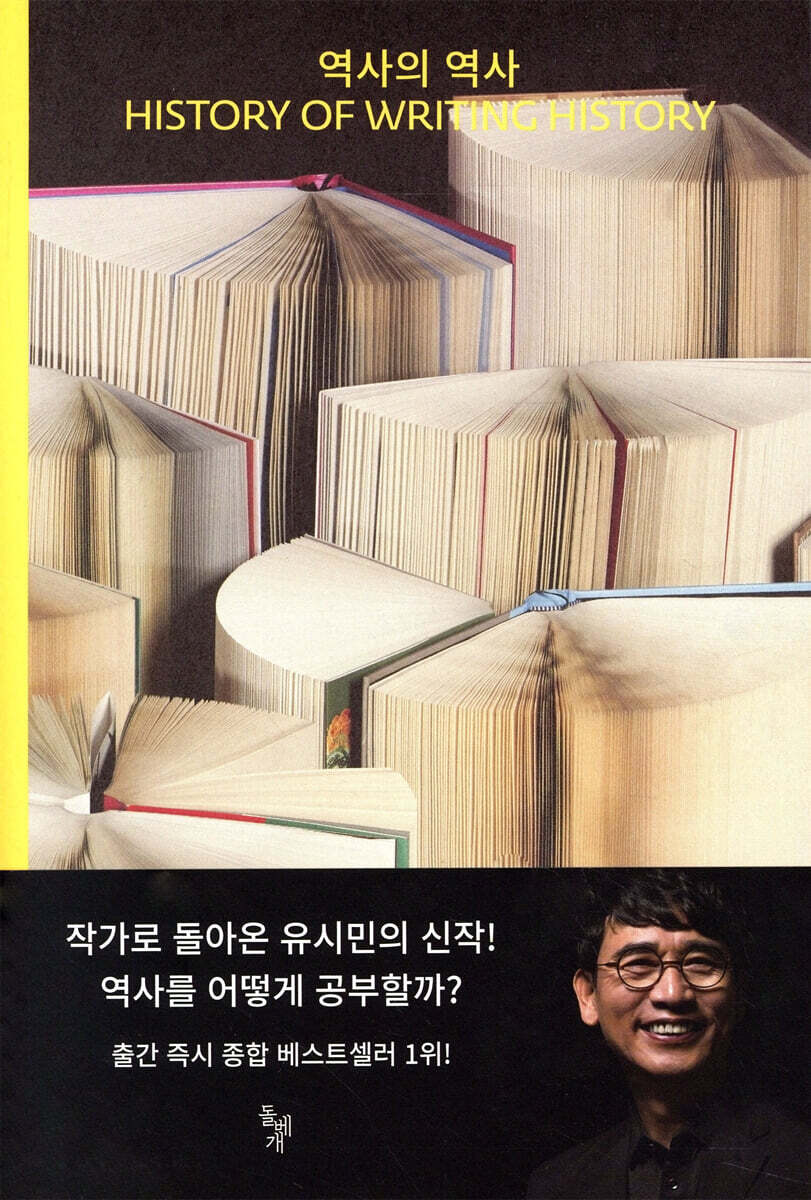
Also, on the cover, the history books form a forest, as if leading the reader to the crossroads and paths of history.
I hoped that each book would truly convey its "contemporaneity" (sense of the present) by breaking away from the image of historical classics as old and hackneyed.
3.
A friendly history study with Yoo Si-min!
As is well known, historical classics are not easy to read and digest on one's own.
In “History of History,” Yoo Si-min examines the main contents of each history book, the historical context of the time in which the book was written, as well as the subject and method of the narrative, and summarizes them in his own words.
Here, it checks the parts that should not be missed, and even acts as a guide to comfort and encourage even if you do not understand.
He personally demonstrates his love for history and the importance of studying it, and reveals his own method of studying history as he reads it.
In particular, due to the nature of this book as a 'reportage', it is inevitable that it will introduce and quote a considerable amount of original texts from historical books. To alleviate the limitations of space and the inconvenience of translation, Yoo Si-min personally undertook the excerpts, summaries, and translations.
Yoo Si-min's strength of kindly delivering books on a variety of topics, including the nation, modern history, and writing, is also evident in this book.
4.
History is a 'story' that conveys human emotions and thoughts.
What characteristics does Yoo Si-min envision as a "great history book"? He writes in the introduction, "I believe that great history can be literature, and that great history cannot but be literature" (p. 16).
History goes beyond simply recording facts to capture the thoughts and feelings of the people of the time.
Therefore, a good history book has the potential to resonate with new readers regardless of the era.
Throughout this book, Yoo Si-min expresses his thoughts and feelings as if answering questions from historians.
For example, Sima Qian's Records of the Grand Historian (Biographies) is highly praised as a book that exquisitely combines historical materials and literary imagination, reaching an unparalleled level (Chapter 2).
When reading the texts of Shin Chae-ho and Park Eun-sik, one feels regret for the arduous life journey and writing of these nationalist historians (Chapter 6).
The author's intellectual curiosity in reading the possibilities and limitations of human history is cautious yet active (Chapter 9).
5.
Studying History in the Digital Age: "The History of History" Now Available on Video
『History of History』 is a paper book written after reading a paper book, but it seeks to meet new readers in the digital age in various ways.
Dolbegae and Korea's only comprehensive content platform, Kakao Page, have jointly produced a special interview video with Yoo Si-min for the generation more familiar with mobile devices than books, and for the public who may find history difficult, and will provide it exclusively through the Kakao Page app for four weeks starting June 25th.
In this video, the author shares his thoughts and feelings while writing the book.
In June 2018, Yoo Si-min came back with a new book.
Writer Yoo Si-min, who has worked extensively as an economist, politician, 'knowledge retailer', and recently as a broadcaster, has returned to history, the origin of his long-time reading and writing.
After receiving an enthusiastic response from readers in 2017 with "What is a State?", which explored the image of a just state and the role of its citizens, Yoo Si-min shifted his focus of study and devoured Eastern and Western history books, asking the question "What is history?" and searching for an answer.
『History of History』, which contains this intellectual exploration, is a study notebook on history made public by Yu Si-min and an invitation to read history together with readers.
■ Knowledge Reportage in Search of Historians and History Books that Made History
The writing of 『History of History』 began in the winter of 2016.
As Yoo Si-min faced the controversy over nationalizing history textbooks and the subsequent "Candlelight Revolution," he once again turned his attention to how historical events are recorded and transmitted.
He has repeatedly revealed his book of life, What is History? (Edward.
H. Carr) and returned to the original question, ‘What is history?’
In order to properly answer this question, I decided that it was necessary to deeply understand the origins of history, that is, the ‘history of history.’
I have been searching for and organizing representative historical books that have long been loved by readers as classics of history or have recently attracted attention.
From Herodotus's "History" and Thucydides' "History of the Peloponnesian Wars" to Yuval Harari's "Sapiens," I was immersed in the stories left behind by historians across 2,500 years.
A certain lineage and coordinates were drawn for how they wrote history and why they had to write it that way.
Although the subjects and methods of historical narratives were different, each great history book attempted to speak to us today in its own way.
Yoo Si-min believed that listening to those voices was the most honest way to approach history.
I thought that if I humbly followed the thoughts and feelings of historians, and the context and appeal of historical books, and captured them in reportage, I would be able to share with readers a "free" perspective on history.
In this way, 『History of Writing History』 is a “history reportage” that traces “history books and historians, the times in which they lived, and the stories of historical events they described” that remain in human history.
Yoo Si-min, a "public intellectual" who used to organize issues and draw conclusions with his sharp and blunt speech, avoids defining history or exalting his own opinions in this book.
Instead, we focus on telling the stories of historians and resonating with the messages and emotions underlying them.
It is a faithful 'history tour guide' that finds clues that will help us uncover what history is by "listening to and feeling the thoughts and feelings that great historians tried to convey to us" (p. 6).
In the summer of 2018, a new wind of history is blowing across the Korean Peninsula.
This book aims to provide readers with a time to reflect on their own attitudes toward reading and living history, along with "The History of History."
■ Yoo Si-min, Studying History anew! Reading "The History of History"
1.
“The history of history said to me, ‘Know thyself.’”
For Yoo Si-min, the question, “What is history?” is a question he has long pondered and a lifelong intellectual pursuit.
The reason he persistently explores history is probably to find a deeper answer to the question, 'How should we live?'
"The History of History," which extracts the meaning and method of reading and writing history from the lives of historians and their texts, can also be said to be a reflection on how people have interpreted, thought about, felt, and lived their lives.
In the face of life's changes and difficulties, history can be a reliable compass, and in particular, the study of history teaches us about the changeable (“the ephemeral”) and the unchanging (“human nature and the meaning of existence”) behind the present.
This book, which resonates with the emotions and expressions of history rather than being obsessed with the abstract definition or direction of history, is also Yoo Si-min's historical essay.
2.
16 historians and 18 historical books that “have made a distinct presence in the history of history”
"History of History" explores 16 historians from the East and the West and 18 historical books they wrote (10 of which are covered in more depth and detail).
The history books are divided into nine chapters in chronological order from ancient times to the present, and each chapter is sometimes read by one historian and one book, and sometimes by multiple historians and several books together.
I also reread books I have already read, and sometimes I overlap the voices of one historian with the thoughts of another.
The message I want to convey in each chapter is sometimes clear, and sometimes hidden.
However, all history (historians) seeks to write about the 'present' (modern history, contemporary history), and the author's position that history is a story and a conversation is constantly reaffirmed.
In 『History of History』, photographs created using the books read together as objects are included at the beginning of each chapter.
This is a collaboration with photographer Kim Kyung-tae (EH), who overwhelmingly brings the presence of the subject to life on a flat surface.
This brilliant observer makes history books seem like a firsthand experience.
All the books in the photo are either open or overlapping each other.
It seems to express a close connection with the details of reading history.
Also, on the cover, the history books form a forest, as if leading the reader to the crossroads and paths of history.
I hoped that each book would truly convey its "contemporaneity" (sense of the present) by breaking away from the image of historical classics as old and hackneyed.
3.
A friendly history study with Yoo Si-min!
As is well known, historical classics are not easy to read and digest on one's own.
In “History of History,” Yoo Si-min examines the main contents of each history book, the historical context of the time in which the book was written, as well as the subject and method of the narrative, and summarizes them in his own words.
Here, it checks the parts that should not be missed, and even acts as a guide to comfort and encourage even if you do not understand.
He personally demonstrates his love for history and the importance of studying it, and reveals his own method of studying history as he reads it.
In particular, due to the nature of this book as a 'reportage', it is inevitable that it will introduce and quote a considerable amount of original texts from historical books. To alleviate the limitations of space and the inconvenience of translation, Yoo Si-min personally undertook the excerpts, summaries, and translations.
Yoo Si-min's strength of kindly delivering books on a variety of topics, including the nation, modern history, and writing, is also evident in this book.
4.
History is a 'story' that conveys human emotions and thoughts.
What characteristics does Yoo Si-min envision as a "great history book"? He writes in the introduction, "I believe that great history can be literature, and that great history cannot but be literature" (p. 16).
History goes beyond simply recording facts to capture the thoughts and feelings of the people of the time.
Therefore, a good history book has the potential to resonate with new readers regardless of the era.
Throughout this book, Yoo Si-min expresses his thoughts and feelings as if answering questions from historians.
For example, Sima Qian's Records of the Grand Historian (Biographies) is highly praised as a book that exquisitely combines historical materials and literary imagination, reaching an unparalleled level (Chapter 2).
When reading the texts of Shin Chae-ho and Park Eun-sik, one feels regret for the arduous life journey and writing of these nationalist historians (Chapter 6).
The author's intellectual curiosity in reading the possibilities and limitations of human history is cautious yet active (Chapter 9).
5.
Studying History in the Digital Age: "The History of History" Now Available on Video
『History of History』 is a paper book written after reading a paper book, but it seeks to meet new readers in the digital age in various ways.
Dolbegae and Korea's only comprehensive content platform, Kakao Page, have jointly produced a special interview video with Yoo Si-min for the generation more familiar with mobile devices than books, and for the public who may find history difficult, and will provide it exclusively through the Kakao Page app for four weeks starting June 25th.
In this video, the author shares his thoughts and feelings while writing the book.
GOODS SPECIFICS
- Date of issue: June 25, 2018
- Page count, weight, size: 340 pages | 580g | 148*225*20mm
- ISBN13: 9788971998557
- ISBN10: 8971998555
You may also like
카테고리
korean


korean

![GQ KOREA Mark (Monthly): December [2025]](http://librairie.coreenne.fr/cdn/shop/files/8ef265dbbfbf186523ed75ba7319009d.jpg?v=1765340328&width=3840)


