

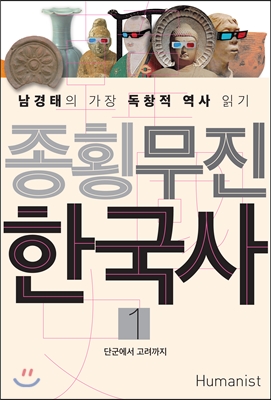
Korean History: A Journey Through the Ages 1
 |
Description
Book Introduction
Reading Korean History Critically: Shaking Up My Understanding of History
Unlike general historians who are out of breath just chasing the flow of time, this book shows the 'broadness' of history by transcending time and space, and the final revised edition of Nam Gyeong-tae's "Broadness" series (5 volumes in total), which has been consistently loved by readers for revealing a critical and sharp historical awareness that is more than anyone else's in a humorous narrative style rarely found in history books.
Korean History (2 volumes) captures the major trends of our history and covers even lesser-known aspects in detail.
The author's stern assessment of our history, which is sometimes heartbreaking, sometimes poignant, and sometimes even sigh-inducing, provides us with a new standard for how we should view history.
Moreover, Korean history is not viewed solely as the history of a single ethnic group called the Korean people, but is described within the regional framework of the Korean Peninsula.
From the perspective of a “critical Korean history” that differs from the conventional historical narrative, it tenaciously traces the distorted parts of our history across all eras.
Volume 1 covers the period from Dangun to Goryeo, and Volume 2 covers the period from the founding of Joseon to the establishment of the Republic of Korea government.
Unlike general historians who are out of breath just chasing the flow of time, this book shows the 'broadness' of history by transcending time and space, and the final revised edition of Nam Gyeong-tae's "Broadness" series (5 volumes in total), which has been consistently loved by readers for revealing a critical and sharp historical awareness that is more than anyone else's in a humorous narrative style rarely found in history books.
Korean History (2 volumes) captures the major trends of our history and covers even lesser-known aspects in detail.
The author's stern assessment of our history, which is sometimes heartbreaking, sometimes poignant, and sometimes even sigh-inducing, provides us with a new standard for how we should view history.
Moreover, Korean history is not viewed solely as the history of a single ethnic group called the Korean people, but is described within the regional framework of the Korean Peninsula.
From the perspective of a “critical Korean history” that differs from the conventional historical narrative, it tenaciously traces the distorted parts of our history across all eras.
Volume 1 covers the period from Dangun to Goryeo, and Volume 2 covers the period from the founding of Joseon to the establishment of the Republic of Korea government.
- You can preview some of the book's contents.
Preview
index
At the beginning of the book
Prologue: Why Critical Korean History Is Needed Now
Part 1: Awakening History
Chapter 1: From Myth to History
Chapter 2: The Beginning of the Dynastic Era
Part 2: A Splendid Division
Chapter 3: Goguryeo's Role
Chapter 4: The South Wakes Up
Chapter 5: The Three Kingdoms Intertwined
Chapter 6: The Real Three Kingdoms Period
Part 3: The Wind of Unification
Chapter 7: History Turned Around
Chapter 8: Unification Scenario
Chapter 9: The Stage of Unification
Part 4: Sole Regime on the Korean Peninsula
Chapter 10: A New Order and an Era of Prosperity
Chapter 11: Northeast Asia in the Whirlwind
Chapter 12: The Beginning of the Single Dynasty
Part 5: Goryeo in the Age of Globalization
Chapter 13: A Contradictory Start
Chapter 14: A Difficult Debut
Chapter 15: The Price of Stability
Part 6: Drifting Goryeo
Chapter 16: A Kingdom Not Ruled by a King
Chapter 17: The First Barbarian Rule
Chapter 18: Liberation, Reconstruction, and Destruction
Prologue: Why Critical Korean History Is Needed Now
Part 1: Awakening History
Chapter 1: From Myth to History
Chapter 2: The Beginning of the Dynastic Era
Part 2: A Splendid Division
Chapter 3: Goguryeo's Role
Chapter 4: The South Wakes Up
Chapter 5: The Three Kingdoms Intertwined
Chapter 6: The Real Three Kingdoms Period
Part 3: The Wind of Unification
Chapter 7: History Turned Around
Chapter 8: Unification Scenario
Chapter 9: The Stage of Unification
Part 4: Sole Regime on the Korean Peninsula
Chapter 10: A New Order and an Era of Prosperity
Chapter 11: Northeast Asia in the Whirlwind
Chapter 12: The Beginning of the Single Dynasty
Part 5: Goryeo in the Age of Globalization
Chapter 13: A Contradictory Start
Chapter 14: A Difficult Debut
Chapter 15: The Price of Stability
Part 6: Drifting Goryeo
Chapter 16: A Kingdom Not Ruled by a King
Chapter 17: The First Barbarian Rule
Chapter 18: Liberation, Reconstruction, and Destruction
Publisher's Review
1.
Korean history not covered in textbooks
― The bare face of Korean history stripped of its exaggeration
Is everything we learn about Korean history in school true? Because it's textbook material, we often don't even suspect its truthfulness, or even consider such doubts disrespectful.
For example, regarding the fact that Dangun is the progenitor of our people who have maintained a single bloodline for half a millennium - there was even a debate in academic circles about his existence - the author reports that Dangun was entirely Chinese.
It is an unacceptable claim that the ancestors of the people who founded our first country, Gojoseon, were Chinese.
However, if we carefully examine the Dangun myth that serves as the basis for the author's story, we can see that it is not an entirely far-fetched story.
Another example is the Manjeok Rebellion.
During the chaotic military regime of Goryeo, many civil unrests occurred, the most representative of which was the Manjeok Rebellion.
Manjeok's cry, "Is there a separate seed for the queen and ministers?" instantly elevated him to the forefront of the movement for liberation of social classes.
However, in fact, this Manjeok Rebellion was discovered during the mock stage, and Manjeok and all of his associates were punished, so it was not strictly speaking a 'rebellion'.
Textbooks portray Manjeok as a progressive liberator of social status, but perhaps this is an exaggeration based on later ideology.
This author's criticism may feel uncomfortable, but perhaps that discomfort stems from our accustomed to describing our nation's history from a positive perspective.
This book breaks away from a nationalistic perspective and exposes the bare face of Korean history by dissecting the distorted parts of our history, even to the point of being unpleasant.
2.
The history behind every current event
― Even at this very moment, history is repeating itself. What we gain and what we lose through history.
The author's words, "Behind every current event, there is a history," are poignantly revealed throughout this book.
The history of incompetent ruling classes repeats itself tirelessly.
When the Korean War broke out, Syngman Rhee declared that he would defend the capital city of Seoul, but three days later, he cut down the Han River Bridge and fled. This reminds me of my ancestors who fled to Uiju as soon as the Japanese invasions of Korea broke out 400 years ago.
Going back further in time, the same goes for the military regime that fled to Ganghwa Island to save itself first, without any regard for the people during the Mongol invasion.
The death of Jeong Mong-ju, who stood up to the forces of Yi Seong-gye, is compared to that of a certain president who handed over power to the coup forces in 1979 and remained silent throughout his life.
He harshly criticizes Gojong and Sunjong, who marked the end of the Joseon Dynasty.
The Japan-Korea annexation on August 29, 1910 was by no means inevitable.
If, as the king of a country, he had opposed the ratification of the annexation treaty at the risk of his life, Korean history might have turned out a little differently.
Meanwhile, the author emphasizes that while the country's turmoil is primarily the fault of the ruling class, the people who were tolerant of their mistakes cannot escape responsibility either.
The warning that “the Japan-Korea annexation was a historical and national shame, but the true shame is not the fact that we became a Japanese colony, but the fact that we had such a poor ruler” clearly tells us what lessons we should learn from history.
We cannot change the past, but if we do not learn from the mistakes of history, we will continue to make the same mistakes in the future.
From now on, we must be able to recognize at least what is wrong in history, and furthermore, we must be able to criticize it.
The author presents point by point why a critical perspective on history is more necessary than ever.
3.
The most original historical reading by Nam Gyeong-tae, a versatile humanist.
-What Nam Gyeong-tae, a humanist who aspired to become the conductor of the orchestra of history, left behind
Nam Kyung-tae is a trusted and respected humanities translator and author, and it is no exaggeration to say that he has covered almost every field of the humanities.
In particular, it is very rare for one person to consistently describe the history and philosophy that form the basis of the humanities. However, he presented both the history of philosophy, which is the history of thought ("Everyone Thinks About Philosophy at Least Once"), and the history of the world, which is the history of reality ("A History of the Journey"), thereby presenting the two great currents of human civilization at a glance.
Rather than staying there, the series “Jonghongmujin”, in which one author reads and writes about Korean history, Eastern history, and Western history with a consistent historical perspective, is most strongly imbued with the scent of Nam Gyeong-tae.
This book, with its vivid critical perspective on history, can be considered the strongest critical Korean history.
Even events and people that are simply overlooked in textbooks are illuminated in a three-dimensional way through the history he has uncovered.
Rather than simply listing and organizing historical events, he constantly reinterpreted them like an orchestra conductor, clearly suggesting what we can learn from history and what we can discard today.
As the title suggests, "Jonghongmujin," suggests, this book describes history in a free and unconventional way, while incorporating as much knowledge and information as possible from textbooks.
I hope that readers will read the consistent historical perspective and narrative of one author in this series and offer sympathy or criticism based on it.
Although this will be the final installment in the series, readers' comments, both sympathetic and critical, will be the driving force that keeps this book alive.
That is what the author, who revised the introduction to this series until the end of his life, hopes for.
Korean history not covered in textbooks
― The bare face of Korean history stripped of its exaggeration
Is everything we learn about Korean history in school true? Because it's textbook material, we often don't even suspect its truthfulness, or even consider such doubts disrespectful.
For example, regarding the fact that Dangun is the progenitor of our people who have maintained a single bloodline for half a millennium - there was even a debate in academic circles about his existence - the author reports that Dangun was entirely Chinese.
It is an unacceptable claim that the ancestors of the people who founded our first country, Gojoseon, were Chinese.
However, if we carefully examine the Dangun myth that serves as the basis for the author's story, we can see that it is not an entirely far-fetched story.
Another example is the Manjeok Rebellion.
During the chaotic military regime of Goryeo, many civil unrests occurred, the most representative of which was the Manjeok Rebellion.
Manjeok's cry, "Is there a separate seed for the queen and ministers?" instantly elevated him to the forefront of the movement for liberation of social classes.
However, in fact, this Manjeok Rebellion was discovered during the mock stage, and Manjeok and all of his associates were punished, so it was not strictly speaking a 'rebellion'.
Textbooks portray Manjeok as a progressive liberator of social status, but perhaps this is an exaggeration based on later ideology.
This author's criticism may feel uncomfortable, but perhaps that discomfort stems from our accustomed to describing our nation's history from a positive perspective.
This book breaks away from a nationalistic perspective and exposes the bare face of Korean history by dissecting the distorted parts of our history, even to the point of being unpleasant.
2.
The history behind every current event
― Even at this very moment, history is repeating itself. What we gain and what we lose through history.
The author's words, "Behind every current event, there is a history," are poignantly revealed throughout this book.
The history of incompetent ruling classes repeats itself tirelessly.
When the Korean War broke out, Syngman Rhee declared that he would defend the capital city of Seoul, but three days later, he cut down the Han River Bridge and fled. This reminds me of my ancestors who fled to Uiju as soon as the Japanese invasions of Korea broke out 400 years ago.
Going back further in time, the same goes for the military regime that fled to Ganghwa Island to save itself first, without any regard for the people during the Mongol invasion.
The death of Jeong Mong-ju, who stood up to the forces of Yi Seong-gye, is compared to that of a certain president who handed over power to the coup forces in 1979 and remained silent throughout his life.
He harshly criticizes Gojong and Sunjong, who marked the end of the Joseon Dynasty.
The Japan-Korea annexation on August 29, 1910 was by no means inevitable.
If, as the king of a country, he had opposed the ratification of the annexation treaty at the risk of his life, Korean history might have turned out a little differently.
Meanwhile, the author emphasizes that while the country's turmoil is primarily the fault of the ruling class, the people who were tolerant of their mistakes cannot escape responsibility either.
The warning that “the Japan-Korea annexation was a historical and national shame, but the true shame is not the fact that we became a Japanese colony, but the fact that we had such a poor ruler” clearly tells us what lessons we should learn from history.
We cannot change the past, but if we do not learn from the mistakes of history, we will continue to make the same mistakes in the future.
From now on, we must be able to recognize at least what is wrong in history, and furthermore, we must be able to criticize it.
The author presents point by point why a critical perspective on history is more necessary than ever.
3.
The most original historical reading by Nam Gyeong-tae, a versatile humanist.
-What Nam Gyeong-tae, a humanist who aspired to become the conductor of the orchestra of history, left behind
Nam Kyung-tae is a trusted and respected humanities translator and author, and it is no exaggeration to say that he has covered almost every field of the humanities.
In particular, it is very rare for one person to consistently describe the history and philosophy that form the basis of the humanities. However, he presented both the history of philosophy, which is the history of thought ("Everyone Thinks About Philosophy at Least Once"), and the history of the world, which is the history of reality ("A History of the Journey"), thereby presenting the two great currents of human civilization at a glance.
Rather than staying there, the series “Jonghongmujin”, in which one author reads and writes about Korean history, Eastern history, and Western history with a consistent historical perspective, is most strongly imbued with the scent of Nam Gyeong-tae.
This book, with its vivid critical perspective on history, can be considered the strongest critical Korean history.
Even events and people that are simply overlooked in textbooks are illuminated in a three-dimensional way through the history he has uncovered.
Rather than simply listing and organizing historical events, he constantly reinterpreted them like an orchestra conductor, clearly suggesting what we can learn from history and what we can discard today.
As the title suggests, "Jonghongmujin," suggests, this book describes history in a free and unconventional way, while incorporating as much knowledge and information as possible from textbooks.
I hope that readers will read the consistent historical perspective and narrative of one author in this series and offer sympathy or criticism based on it.
Although this will be the final installment in the series, readers' comments, both sympathetic and critical, will be the driving force that keeps this book alive.
That is what the author, who revised the introduction to this series until the end of his life, hopes for.
GOODS SPECIFICS
- Date of issue: April 7, 2015
- Page count, weight, size: 536 pages | 908g | 153*224*30mm
- ISBN13: 9788958627821
- ISBN10: 8958627824
You may also like
카테고리
korean


korean

![GQ KOREA Mark (Monthly): December [2025]](http://librairie.coreenne.fr/cdn/shop/files/8ef265dbbfbf186523ed75ba7319009d.jpg?v=1765340328&width=3840)


