

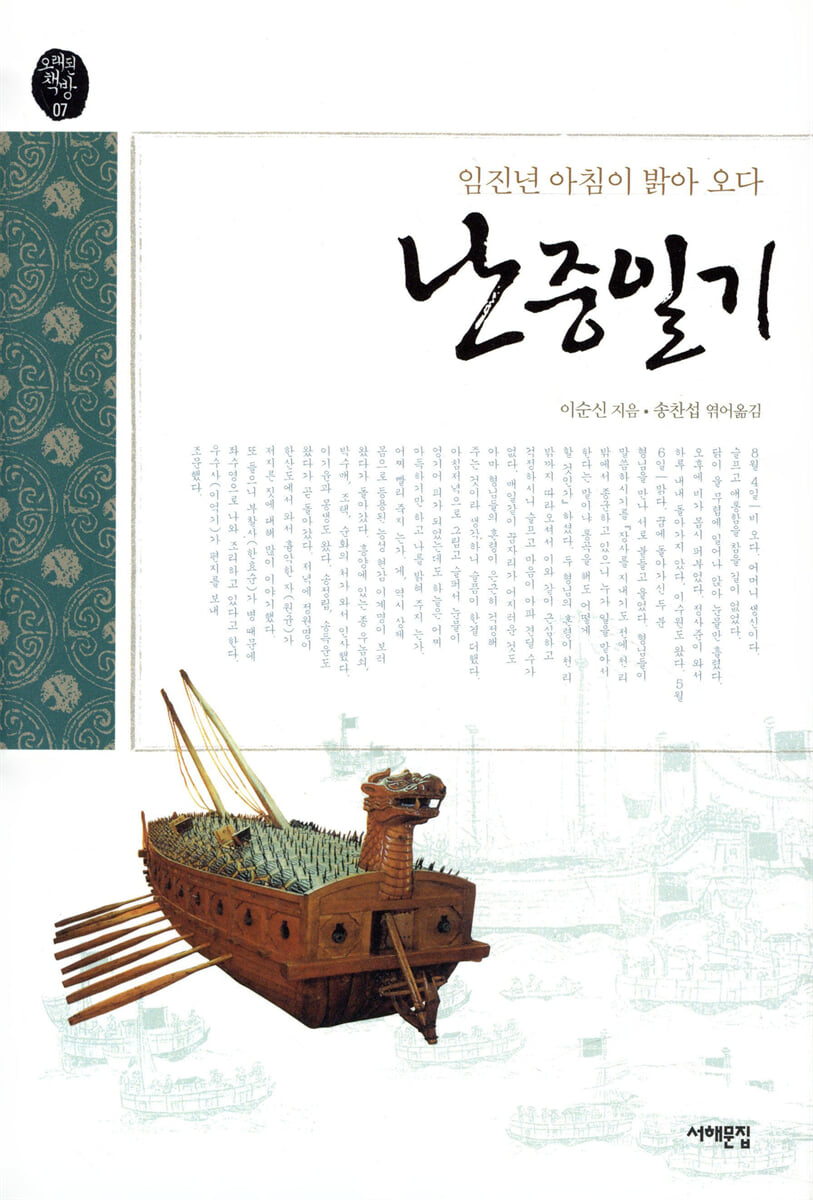
Nanjung Diary
 |
Description
Book Introduction
According to the article, "What was Yi Sun-sin doing on the day the Imjin War broke out?", he went to Dongheon, performed official duties, and shot arrows, just like the day before.
Yi Sun-sin was guarding his jurisdiction as the Jeolla Left Naval Commander, while Gyeongsang Left Naval Commander Park Hong and Gyeongsang Right Naval Commander Won Gyun were defeated by the Japanese in Busan and fled.
So, what kind of person was Yi Sun-sin, known as the famous general of the Imjin War?
This is a book that lets you meet ‘the human Yi Sun-sin’ rather than ‘the holy hero Yi Sun-sin’.
Therein lies the true meaning of this book.
Yi Sun-sin in the story was not simply an undefeated general who commanded his troops, led his fleet, and defeated the Japanese.
Yi Sun-sin was a man who willingly gave up his clothes for the poverty of a subordinate, wept over the death of his son, listened to his subordinates insulting other generals, and even fell ill after a long battle.
Yi Sun-sin was guarding his jurisdiction as the Jeolla Left Naval Commander, while Gyeongsang Left Naval Commander Park Hong and Gyeongsang Right Naval Commander Won Gyun were defeated by the Japanese in Busan and fled.
So, what kind of person was Yi Sun-sin, known as the famous general of the Imjin War?
This is a book that lets you meet ‘the human Yi Sun-sin’ rather than ‘the holy hero Yi Sun-sin’.
Therein lies the true meaning of this book.
Yi Sun-sin in the story was not simply an undefeated general who commanded his troops, led his fleet, and defeated the Japanese.
Yi Sun-sin was a man who willingly gave up his clothes for the poverty of a subordinate, wept over the death of his son, listened to his subordinates insulting other generals, and even fell ill after a long battle.
- You can preview some of the book's contents.
Preview
index
Before starting writing
About the Nanjung Ilgi and Yi Sun-sin
Note
The Japanese invasion began in 1592.
In 1593, he became the commander of the three provinces' naval forces.
Peace was reached between the Ming and Japanese in 1594.
In 1595, while the truce continued,
The Japanese finally withdrew in 1596.
1597: Embarking on a military expedition
Going into the final battle in 1598
Chronology of major events during the Imjin War
References
About the Nanjung Ilgi and Yi Sun-sin
Note
The Japanese invasion began in 1592.
In 1593, he became the commander of the three provinces' naval forces.
Peace was reached between the Ming and Japanese in 1594.
In 1595, while the truce continued,
The Japanese finally withdrew in 1596.
1597: Embarking on a military expedition
Going into the final battle in 1598
Chronology of major events during the Imjin War
References
Publisher's Review
How well does it capture the naval battles of the Imjin War?
The battles that everyone is looking forward to are the Battle of Dangpo, the Battle of Hansando, the Battle of Myeongnyang, and the Battle of Noryang.
How vividly do diaries portray the war? However, the naval battles are often omitted or overly brief.
That's probably to be expected.
Would a general facing a major battle have the leisure to keep a detailed diary?
So, I added Yi Sun-sin's report to the main naval battle section, a section that was missing from the diary for a long time.
Yi Sun-sin's report to the king contains detailed information on the start and progress of each battle, who achieved merit and who did wrong in the battle, and the enemy's movements.
In fact, Song Chan-seop, who translated this book, had already introduced it in a daily newspaper about 10 years ago.
At that time, Song Chan-seop, while searching for and reading , unexpectedly discovered that there were not enough translated versions that the public could enjoy reading.
In the 1960s, Lee Eun-sang took the lead in publishing a Korean translation, and several books following this were also published.
Although Mr. Lee Eun-sang's translation is quite good, there are some parts of the content that need to be revised or unified, and it is a book that leaves something to be desired as it fails to properly utilize the book's importance or its resourceful nature.
So, with the idea of publishing a new version, I obtained the original diary manuscript (1977) and started working on it.
The magazine, which was created in this way, gave the public a title for each month's major events to make it easier to read, and included photos and maps of naval battle situations.
Also, when a major battle was imminent or when Yi Sun-sin was unable to write a diary for a long period of time during a battle, reports and notes were inserted appropriately to help readers understand.
The first value of historical materials
It is a diary that provides the most detailed information on the situation during the seven years of the Imjin War, and is a historical source that examines the entire war.
This is a record of the political, economic, social, and military affairs of the Imjin War, as well as research on the Joseon navy, strategy, and tactics.
The system of government connecting the central government, the military camp, the swimming, and the township, the military command system including the Chechalsa, Patrolsa, Sunbyeonsa, Susas, and Manho, and the reality of the dispatch and control of various central officials such as the royal inspectors, Seonjeongwan, and Uigeumbu Dosa are recorded, and through this, we can also see the national defense operation system at the time and the wartime activities of Yu Seong-ryong, Yi Won-ik, Yi Su-gwang, Yu Mong-in, Yun Du-su, Nam I-gong, and Park Hong-ro, who were responsible for such work.
We can also get a glimpse into the activities of ordinary soldiers who led the war to victory.
As the navy itself was a lowly force at the time, many of the soldiers were from the lowest classes.
Yi Sun-sin meticulously recorded the activities of the craftsmen who made the turtle ship, bows, arrows, guns, and other military equipment, and even the subordinates who consoled him by playing the geomungo and flute when he couldn't sleep due to his worries.
There were also volunteers who participated regardless of their official position or status.
It features several volunteer army units, including the Buddhist monks who were looked down upon during the Joseon Dynasty (the monks Samhye and Uineung) and Seongeungji.
The method of securing the finances of the Suyeong, such as procuring military supplies and managing military farms, is also described in detail.
To wage war, you need finances, and especially to calm the people, you need to provide them with a means of food and shelter.
In this respect, the Dunjeon was very necessary.
For the same reason, it can be seen that activities such as collecting abalone and seaweed from the sea and catching fish were also very important.
The second value, literary quality
Yi Sun-sin is a man with strong self-awareness.
Such aspects are revealed through his writings.
His diary records that during his military life, Yi Sun-sin would sometimes enjoy the moonlight in the sutterance or immerse himself in his thoughts alone.
Looking at the diary entry for July 15, 1593, it says, “The autumn air has entered the sea, and the traveler’s heart is in turmoil.
Sitting alone under the stern of a boat, my mind becomes very distracted.
The moonlight was shining on the bow of the ship, and my mind was clear, so I couldn't sleep even when I lay down.
It is written, “The rooster crowed before we knew it.”
Also, on September 14, 1595, a poem presented to the monk Seon Su-sa, who had shared joys and sorrows with him in Hamgyeong-do, reads as follows:
“When we go north, we share joys and sorrows, and when we come south, we share life and death.”
“After sharing a drink under the moonlight tonight, I will regret parting tomorrow.”
Even without reciting the poem “Sitting alone on the sluice pavilion on a bright moonlit night in Hansan Island…” that hangs on the signboard of the Jeseungdang sluice pavilion in Hansan Island, his concise and lyrical diary is sufficiently literary and artistic.
The third value of Yi Sun-sin
The greatest value of this book is that it is ‘Yi Sun-sin’s diary written by Yi Sun-sin.’
It's also a start to seeing them as heroes or as people who are a little more self-conscious than others.
The Yi Sun-sin that is being noticed is a ‘human’.
He carefully prepares for battle with his subordinates, worries about his parents and cannot sleep all day, practices archery every day, and does not back down when going into battle.
In the dream, the story reaches the king's escape, and he sheds tears and sighs, worries about sending his son away, and weeps alone thinking of his mother.
However, when fighting against the enemy, there is a saying in the art of war that if you want to die, you will live, and if you want to live, you will die. There is also a saying that if one man guards a crossroads, he can make a thousand men fear him. These are all words that are said about us today.
“If any of you generals disobey my orders even a little, I will enforce military discipline and will not forgive you, no matter how small the matter.” He shouted, showing no opening to the enemy who outnumbered his allies by more than ten times.
The inside vividly depicts many aspects of Yi Sun-sin.
In the camp, Yi Sun-sin was always worried about his mother's health and waited for news.
Yi Sun-sin wrote in his diary on the 4th of May 1593, “Today is my mother’s birthday, but I regret that I cannot go and offer her a congratulatory drink because I am busy with the task of subduing the enemy.”
The diary entry for April 19, 1597, when he was on the verge of death due to false accusations and was released, and his mother passed away while he was serving in Baekui Jonggun, is as follows.
Yi Sun-sin was always concerned about his son and nephew and took warm care of them.
The same was true for his soldiers, his comrades, and the poor.
Diary entry for January 23, 1596: “In the morning, I gave clothes to 17 soldiers who had no clothes and gave them each an extra set.
“The wind blew hard all day long.” This can be known from entries such as the diary entry on May 13, 1597, the day he set out on his military journey in Baekui Jonggun, “I took off my clothes for Lee Jung-ik because he spoke a lot of vulgar language.”
It's not like he only had this kind side.
He was also a thorough Joseon official who severely punished and even paid for the people's stolen goods when his soldiers stole from them.
Also, while living a serious life, fortune telling is often done.
Perhaps he was trying to console himself in the midst of hardship and loneliness.
According to his diary, Yi Sun-sin was delighted when he received a fortune telling after hearing news of his son Myeon's illness, and received readings such as "It's like meeting the king" or "It's like finding a light at night."
The same was true for the war situation.
He dreamed of someone shooting arrows far away at dawn and another kicking a hat to break it. He consoled himself by interpreting the dream as follows: shooting arrows far away meant that the enemies would run away, and kicking a hat meant that all the enemy monsters would be captured and destroyed.
He also listened to his subordinates gossiping about other generals or disapproving of others.
According to the diary, several commanders repeatedly reported Won Gyun's mistakes and shortcomings, and Yi Sun-sin described Won Gyun as 'ridiculous'.
This expression was used as an insult when Yi Sun-sin was very displeased, and was mostly used against Won Gyun.
Yi Sun-sin's bravery and strategy when going into battle were not innate.
It comes from thorough preparation.
Before the Imjin War in April 1592, he had already made thorough preparations.
According to his diary, he repaired defensive forts, beacon towers, and other forts, and inspected warships and weapons while patrolling the five camps of Nokdo, Balpo, Heungyang, Yeodo, and Bangdap in the Jeolla Left Province.
Military training was also thorough, and officers were made to practice archery almost every day except when the weather was particularly bad.
He himself practiced archery frequently after completing his official duties.
Because archery is one of the most important fighting methods in naval battles.
Also, knowing that firearms would play a major role in determining victory or defeat, they worked hard to develop weapons both before and during the war.
The construction of the turtle ship, which is absolutely inseparable from Yi Sun-sin, was also possible through such preparation.
When he became the Jeolla Left Naval Commander in 1591, Yi Sun-sin sensed the coming of war and devoted himself to building new ships.
The ship was covered with an iron lid on a single ship like a panokseon, so its shape resembled a turtle lying face down.
The ship's name naturally became Geobukseon.
The turtle-shaped assault front actually first appeared in the early Joseon Dynasty.
However, it was Yi Sun-sin who improved the traditional turtle ship into an ironclad ship and put it to practical use.
And when it came to war, there was no retreat.
In 1597, Yi Sun-sin, who became the commander again, rallied his navy, which had been devastated by the crushing defeat at the Battle of Chilcheollyang, and went into the Battle of Myeongnyang with only 13 warships, without a single turtle ship.
At that time, when An Wi, the magistrate of Geoje, was frightened by the sight of hundreds of enemy ships and tried to flee, Yi Sun-sin called him from the deck of the ship and scolded him harshly.
"Anwi, do you want to die by military law? Do you want to die by military law? If you run away, where will you go to live?"
The battles that everyone is looking forward to are the Battle of Dangpo, the Battle of Hansando, the Battle of Myeongnyang, and the Battle of Noryang.
How vividly do diaries portray the war? However, the naval battles are often omitted or overly brief.
That's probably to be expected.
Would a general facing a major battle have the leisure to keep a detailed diary?
So, I added Yi Sun-sin's report to the main naval battle section, a section that was missing from the diary for a long time.
Yi Sun-sin's report to the king contains detailed information on the start and progress of each battle, who achieved merit and who did wrong in the battle, and the enemy's movements.
In fact, Song Chan-seop, who translated this book, had already introduced it in a daily newspaper about 10 years ago.
At that time, Song Chan-seop, while searching for and reading , unexpectedly discovered that there were not enough translated versions that the public could enjoy reading.
In the 1960s, Lee Eun-sang took the lead in publishing a Korean translation, and several books following this were also published.
Although Mr. Lee Eun-sang's translation is quite good, there are some parts of the content that need to be revised or unified, and it is a book that leaves something to be desired as it fails to properly utilize the book's importance or its resourceful nature.
So, with the idea of publishing a new version, I obtained the original diary manuscript (1977) and started working on it.
The magazine, which was created in this way, gave the public a title for each month's major events to make it easier to read, and included photos and maps of naval battle situations.
Also, when a major battle was imminent or when Yi Sun-sin was unable to write a diary for a long period of time during a battle, reports and notes were inserted appropriately to help readers understand.
The first value of historical materials
It is a diary that provides the most detailed information on the situation during the seven years of the Imjin War, and is a historical source that examines the entire war.
This is a record of the political, economic, social, and military affairs of the Imjin War, as well as research on the Joseon navy, strategy, and tactics.
The system of government connecting the central government, the military camp, the swimming, and the township, the military command system including the Chechalsa, Patrolsa, Sunbyeonsa, Susas, and Manho, and the reality of the dispatch and control of various central officials such as the royal inspectors, Seonjeongwan, and Uigeumbu Dosa are recorded, and through this, we can also see the national defense operation system at the time and the wartime activities of Yu Seong-ryong, Yi Won-ik, Yi Su-gwang, Yu Mong-in, Yun Du-su, Nam I-gong, and Park Hong-ro, who were responsible for such work.
We can also get a glimpse into the activities of ordinary soldiers who led the war to victory.
As the navy itself was a lowly force at the time, many of the soldiers were from the lowest classes.
Yi Sun-sin meticulously recorded the activities of the craftsmen who made the turtle ship, bows, arrows, guns, and other military equipment, and even the subordinates who consoled him by playing the geomungo and flute when he couldn't sleep due to his worries.
There were also volunteers who participated regardless of their official position or status.
It features several volunteer army units, including the Buddhist monks who were looked down upon during the Joseon Dynasty (the monks Samhye and Uineung) and Seongeungji.
The method of securing the finances of the Suyeong, such as procuring military supplies and managing military farms, is also described in detail.
To wage war, you need finances, and especially to calm the people, you need to provide them with a means of food and shelter.
In this respect, the Dunjeon was very necessary.
For the same reason, it can be seen that activities such as collecting abalone and seaweed from the sea and catching fish were also very important.
The second value, literary quality
Yi Sun-sin is a man with strong self-awareness.
Such aspects are revealed through his writings.
His diary records that during his military life, Yi Sun-sin would sometimes enjoy the moonlight in the sutterance or immerse himself in his thoughts alone.
Looking at the diary entry for July 15, 1593, it says, “The autumn air has entered the sea, and the traveler’s heart is in turmoil.
Sitting alone under the stern of a boat, my mind becomes very distracted.
The moonlight was shining on the bow of the ship, and my mind was clear, so I couldn't sleep even when I lay down.
It is written, “The rooster crowed before we knew it.”
Also, on September 14, 1595, a poem presented to the monk Seon Su-sa, who had shared joys and sorrows with him in Hamgyeong-do, reads as follows:
“When we go north, we share joys and sorrows, and when we come south, we share life and death.”
“After sharing a drink under the moonlight tonight, I will regret parting tomorrow.”
Even without reciting the poem “Sitting alone on the sluice pavilion on a bright moonlit night in Hansan Island…” that hangs on the signboard of the Jeseungdang sluice pavilion in Hansan Island, his concise and lyrical diary is sufficiently literary and artistic.
The third value of Yi Sun-sin
The greatest value of this book is that it is ‘Yi Sun-sin’s diary written by Yi Sun-sin.’
It's also a start to seeing them as heroes or as people who are a little more self-conscious than others.
The Yi Sun-sin that is being noticed is a ‘human’.
He carefully prepares for battle with his subordinates, worries about his parents and cannot sleep all day, practices archery every day, and does not back down when going into battle.
In the dream, the story reaches the king's escape, and he sheds tears and sighs, worries about sending his son away, and weeps alone thinking of his mother.
However, when fighting against the enemy, there is a saying in the art of war that if you want to die, you will live, and if you want to live, you will die. There is also a saying that if one man guards a crossroads, he can make a thousand men fear him. These are all words that are said about us today.
“If any of you generals disobey my orders even a little, I will enforce military discipline and will not forgive you, no matter how small the matter.” He shouted, showing no opening to the enemy who outnumbered his allies by more than ten times.
The inside vividly depicts many aspects of Yi Sun-sin.
In the camp, Yi Sun-sin was always worried about his mother's health and waited for news.
Yi Sun-sin wrote in his diary on the 4th of May 1593, “Today is my mother’s birthday, but I regret that I cannot go and offer her a congratulatory drink because I am busy with the task of subduing the enemy.”
The diary entry for April 19, 1597, when he was on the verge of death due to false accusations and was released, and his mother passed away while he was serving in Baekui Jonggun, is as follows.
Yi Sun-sin was always concerned about his son and nephew and took warm care of them.
The same was true for his soldiers, his comrades, and the poor.
Diary entry for January 23, 1596: “In the morning, I gave clothes to 17 soldiers who had no clothes and gave them each an extra set.
“The wind blew hard all day long.” This can be known from entries such as the diary entry on May 13, 1597, the day he set out on his military journey in Baekui Jonggun, “I took off my clothes for Lee Jung-ik because he spoke a lot of vulgar language.”
It's not like he only had this kind side.
He was also a thorough Joseon official who severely punished and even paid for the people's stolen goods when his soldiers stole from them.
Also, while living a serious life, fortune telling is often done.
Perhaps he was trying to console himself in the midst of hardship and loneliness.
According to his diary, Yi Sun-sin was delighted when he received a fortune telling after hearing news of his son Myeon's illness, and received readings such as "It's like meeting the king" or "It's like finding a light at night."
The same was true for the war situation.
He dreamed of someone shooting arrows far away at dawn and another kicking a hat to break it. He consoled himself by interpreting the dream as follows: shooting arrows far away meant that the enemies would run away, and kicking a hat meant that all the enemy monsters would be captured and destroyed.
He also listened to his subordinates gossiping about other generals or disapproving of others.
According to the diary, several commanders repeatedly reported Won Gyun's mistakes and shortcomings, and Yi Sun-sin described Won Gyun as 'ridiculous'.
This expression was used as an insult when Yi Sun-sin was very displeased, and was mostly used against Won Gyun.
Yi Sun-sin's bravery and strategy when going into battle were not innate.
It comes from thorough preparation.
Before the Imjin War in April 1592, he had already made thorough preparations.
According to his diary, he repaired defensive forts, beacon towers, and other forts, and inspected warships and weapons while patrolling the five camps of Nokdo, Balpo, Heungyang, Yeodo, and Bangdap in the Jeolla Left Province.
Military training was also thorough, and officers were made to practice archery almost every day except when the weather was particularly bad.
He himself practiced archery frequently after completing his official duties.
Because archery is one of the most important fighting methods in naval battles.
Also, knowing that firearms would play a major role in determining victory or defeat, they worked hard to develop weapons both before and during the war.
The construction of the turtle ship, which is absolutely inseparable from Yi Sun-sin, was also possible through such preparation.
When he became the Jeolla Left Naval Commander in 1591, Yi Sun-sin sensed the coming of war and devoted himself to building new ships.
The ship was covered with an iron lid on a single ship like a panokseon, so its shape resembled a turtle lying face down.
The ship's name naturally became Geobukseon.
The turtle-shaped assault front actually first appeared in the early Joseon Dynasty.
However, it was Yi Sun-sin who improved the traditional turtle ship into an ironclad ship and put it to practical use.
And when it came to war, there was no retreat.
In 1597, Yi Sun-sin, who became the commander again, rallied his navy, which had been devastated by the crushing defeat at the Battle of Chilcheollyang, and went into the Battle of Myeongnyang with only 13 warships, without a single turtle ship.
At that time, when An Wi, the magistrate of Geoje, was frightened by the sight of hundreds of enemy ships and tried to flee, Yi Sun-sin called him from the deck of the ship and scolded him harshly.
"Anwi, do you want to die by military law? Do you want to die by military law? If you run away, where will you go to live?"
GOODS SPECIFICS
- Date of issue: August 17, 2004
- Page count, weight, size: 424 pages | 614g | 127*195*30mm
- ISBN13: 9788974832230
- ISBN10: 8974832232
You may also like
카테고리
korean


korean

![GQ KOREA Mark (Monthly): December [2025]](http://librairie.coreenne.fr/cdn/shop/files/8ef265dbbfbf186523ed75ba7319009d.jpg?v=1765340328&width=3840)


