

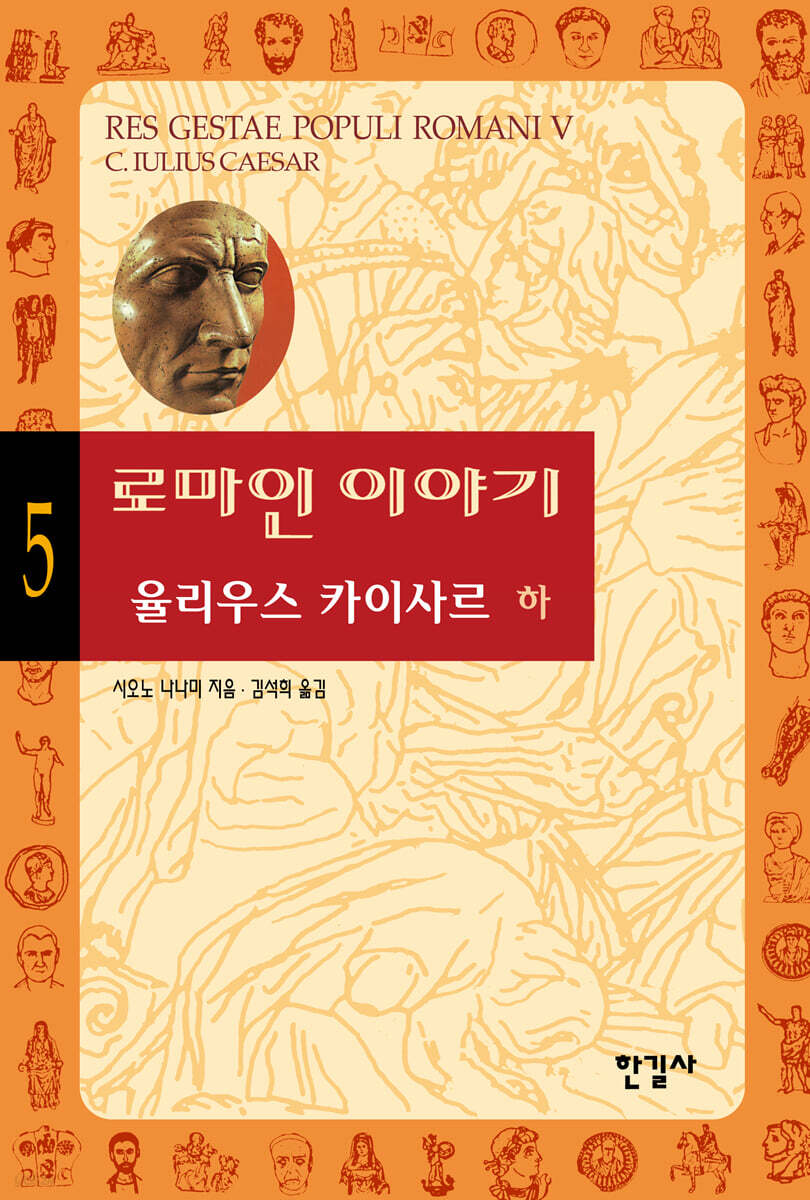
Roman Tales 5
 |
Description
Book Introduction
Julius Caesar, a Roman among the Romans.
Caesar, the hero who became a legend because of his unprecedented feats and amazing human charm.
A must-read for both business leaders and politicians.
Caesar, the hero who became a legend because of his unprecedented feats and amazing human charm.
A must-read for both business leaders and politicians.
- You can preview some of the book's contents.
Preview
index
1.
Childhood
2.
Youth
3.
middle age
4.
middle age
5.
Maturity
6.
March 15th
7.
Antony and Cleopatra vs. Octavian
8.
Caesar's Annals
9.
References
Childhood
2.
Youth
3.
middle age
4.
middle age
5.
Maturity
6.
March 15th
7.
Antony and Cleopatra vs. Octavian
8.
Caesar's Annals
9.
References
Into the book
When she appeared before Caesar, she suddenly appeared as a lively 21-year-old girl on a mat that had been transported to Caesar's residence.
For Caesar, who was born into a noble family and was the embodiment of the aristocratic spirit, a witty and cheerful method was more effective than blinding him with money.
As can be seen from the fact that he only had two names, Mark Antony was from the common class.
However, like Gracchus and Pompey, they were originally plebeians but were influential members of the plebeian aristocracy who had long ago entered the senatorial ranks.
Therefore, the nouveau riche hobbies seen in Antony are based on his personal taste rather than his class origins.
Since it is an impeachment speech, there may be some exaggeration, but Cicero calls Antony 'greedy and vulgar.'
For Caesar, who was born into a noble family and was the embodiment of the aristocratic spirit, a witty and cheerful method was more effective than blinding him with money.
As can be seen from the fact that he only had two names, Mark Antony was from the common class.
However, like Gracchus and Pompey, they were originally plebeians but were influential members of the plebeian aristocracy who had long ago entered the senatorial ranks.
Therefore, the nouveau riche hobbies seen in Antony are based on his personal taste rather than his class origins.
Since it is an impeachment speech, there may be some exaggeration, but Cicero calls Antony 'greedy and vulgar.'
--- p.459
Italian high school history textbooks also define 'March 15' in this way.
'A useless and harmful tragedy brought about by the narcissism of the memoirists' 'Wasn't March 15th more of a tragedy of Brutus than of Caesar?
It is not a tragedy of a noble spirit rejected by the times, but a tragedy of a noble spirit blind to the changing times.
Italian high school history textbooks also define 'March 15' in this way.
'A useless and harmful tragedy brought about by the narcissism of the memoirists' 'Wasn't March 15th more of a tragedy of Brutus than of Caesar?
It is not a tragedy of a noble spirit rejected by the times, but a tragedy of a noble spirit blind to the changing times.
'A useless and harmful tragedy brought about by the narcissism of the memoirists' 'Wasn't March 15th more of a tragedy of Brutus than of Caesar?
It is not a tragedy of a noble spirit rejected by the times, but a tragedy of a noble spirit blind to the changing times.
Italian high school history textbooks also define 'March 15' in this way.
'A useless and harmful tragedy brought about by the narcissism of the memoirists' 'Wasn't March 15th more of a tragedy of Brutus than of Caesar?
It is not a tragedy of a noble spirit rejected by the times, but a tragedy of a noble spirit blind to the changing times.
--- p.451
Caesar, appearing on the podium, spoke bluntly and without hesitation.
What do you wish for?
The soldiers each shouted for discharge.
They also knew that the North African front awaited them next.
Caesar also knew that he needed them to fight in North Africa.
Therefore, if they demanded a discharge, Caesar would have no choice but to compromise by promising a lump sum payment or a pay raise.
Originally, they had no intention of being discharged as long as Caesar continued the war.
But the answer that came back from Caesar was completely unexpected.
'I grant you my discharge.' Caesar, appearing on the podium, spoke bluntly and without hesitation.
What do you wish for?
The soldiers each shouted for discharge.
They also knew that the North African front awaited them next.
Caesar also knew that he needed them to fight in North Africa.
Therefore, if they demanded a discharge, Caesar would have no choice but to compromise by promising a lump sum payment or a pay raise.
Originally, they had no intention of being discharged as long as Caesar continued the war.
But the answer that came back from Caesar was completely unexpected.
'I permit you to be discharged.'
What do you wish for?
The soldiers each shouted for discharge.
They also knew that the North African front awaited them next.
Caesar also knew that he needed them to fight in North Africa.
Therefore, if they demanded a discharge, Caesar would have no choice but to compromise by promising a lump sum payment or a pay raise.
Originally, they had no intention of being discharged as long as Caesar continued the war.
But the answer that came back from Caesar was completely unexpected.
'I grant you my discharge.' Caesar, appearing on the podium, spoke bluntly and without hesitation.
What do you wish for?
The soldiers each shouted for discharge.
They also knew that the North African front awaited them next.
Caesar also knew that he needed them to fight in North Africa.
Therefore, if they demanded a discharge, Caesar would have no choice but to compromise by promising a lump sum payment or a pay raise.
Originally, they had no intention of being discharged as long as Caesar continued the war.
But the answer that came back from Caesar was completely unexpected.
'I permit you to be discharged.'
--- p.234
Soldiers of the 9th Army Corps, who went on strike in the northern Italian city of Piacenza, demanded immediate discharge.
They knew that now that Caesar had secured control of the western front and was finally able to confront Pompey, he did not want to discharge a single soldier.
Although he demanded immediate discharge, his real goal was actually a pay raise.
Arriving at Piacenza and appearing before his soldiers, Caesar spoke directly to the point as usual.
'Comrades (Commilites), I want to be your beloved commander.
No one lives more concerned about your safety than I do, and no one lives more concerned about your financial well-being and your honor as a warrior.
But that doesn't mean the soldiers are left to their own devices (continued)' The soldiers of the 9th Army Corps, who went on strike in the northern Italian city of Piacenza, demanded immediate discharge.
They knew that now that Caesar had secured control of the western front and was finally able to confront Pompey, he did not want to discharge a single soldier.
Although he demanded immediate discharge, his real goal was actually a pay raise.
Arriving at Piacenza and appearing before his soldiers, Caesar spoke directly to the point as usual.
'Comrades (Commilites), I want to be your beloved commander.
No one lives more concerned about your safety than I do, and no one lives more concerned about your financial well-being and your honor as a warrior.
But that doesn't mean that the soldiers are left to do whatever they want (omitted)'
They knew that now that Caesar had secured control of the western front and was finally able to confront Pompey, he did not want to discharge a single soldier.
Although he demanded immediate discharge, his real goal was actually a pay raise.
Arriving at Piacenza and appearing before his soldiers, Caesar spoke directly to the point as usual.
'Comrades (Commilites), I want to be your beloved commander.
No one lives more concerned about your safety than I do, and no one lives more concerned about your financial well-being and your honor as a warrior.
But that doesn't mean the soldiers are left to their own devices (continued)' The soldiers of the 9th Army Corps, who went on strike in the northern Italian city of Piacenza, demanded immediate discharge.
They knew that now that Caesar had secured control of the western front and was finally able to confront Pompey, he did not want to discharge a single soldier.
Although he demanded immediate discharge, his real goal was actually a pay raise.
Arriving at Piacenza and appearing before his soldiers, Caesar spoke directly to the point as usual.
'Comrades (Commilites), I want to be your beloved commander.
No one lives more concerned about your safety than I do, and no one lives more concerned about your financial well-being and your honor as a warrior.
But that doesn't mean that the soldiers are left to do whatever they want (omitted)'
--- p.79-80
Even if the people I released turn their swords on me again, I don't want to be disturbed by such things.
What I demand of myself above all else is to live true to my own thoughts.
So I think it's natural for other people to live true to their own thoughts.
How happy I would be if you or others would come to Rome and help me complete the work I am aiming for.
Even if the people I released turn their swords on me again, I don't want to be disturbed by such things.
What I demand of myself above all else is to live true to my own thoughts.
So I think it's natural for other people to live true to their own thoughts.
How happy I would be if you or others would come to Rome and help me complete the work I am aiming for.
What I demand of myself above all else is to live true to my own thoughts.
So I think it's natural for other people to live true to their own thoughts.
How happy I would be if you or others would come to Rome and help me complete the work I am aiming for.
Even if the people I released turn their swords on me again, I don't want to be disturbed by such things.
What I demand of myself above all else is to live true to my own thoughts.
So I think it's natural for other people to live true to their own thoughts.
How happy I would be if you or others would come to Rome and help me complete the work I am aiming for.
--- p.358
Mommsen, a German historian who wrote a history of Rome during the Republican period, described Caesar as "the only creative genius Rome has ever produced."
But this genius had to do it all alone in an era when the retrospectiveists, who wanted to return to a senatorial republic, were still dominant.
Augustus was not a creative genius, but he enjoyed two advantages that Caesar did not have.
First, the Reminiscenceists were all killed in the civil war that lasted from 49 BC to 30 BC.
Mommsen, a German historian who wrote a history of Rome during the Republican period, described Caesar as "the only creative genius Rome has ever produced."
But this genius had to do it all alone in an era when the retrospectiveists, who wanted to return to a senatorial republic, were still dominant.
Augustus was not a creative genius, but he enjoyed two advantages that Caesar did not have.
First, the Reminiscenceists were all killed in the civil war that lasted from 49 BC to 30 BC.
But this genius had to do it all alone in an era when the retrospectiveists, who wanted to return to a senatorial republic, were still dominant.
Augustus was not a creative genius, but he enjoyed two advantages that Caesar did not have.
First, the Reminiscenceists were all killed in the civil war that lasted from 49 BC to 30 BC.
Mommsen, a German historian who wrote a history of Rome during the Republican period, described Caesar as "the only creative genius Rome has ever produced."
But this genius had to do it all alone in an era when the retrospectiveists, who wanted to return to a senatorial republic, were still dominant.
Augustus was not a creative genius, but he enjoyed two advantages that Caesar did not have.
First, the Reminiscenceists were all killed in the civil war that lasted from 49 BC to 30 BC.
--- p.516
Two thousand years later, a British researcher said this:
'Pompey was the only general Caesar could face on the battlefield, but Caesar, defeated at Dyrrachium, was the last to leave the battlefield, while Pompey, defeated at Pharsalus, was the first to leave.
And what distinguishes a simply gifted person from a genius is the combination of intelligence and passion, which Pompey lacked. ------------------- P.194
People only see the reality they want to see---------------------P.202 Caesar, who turned 54, first raised 'Clementia' (tolerance) as the motto of the new order he wanted to establish.
Two thousand years later, a British researcher said this:
'Pompey was the only general Caesar could face on the battlefield, but Caesar, defeated at Dyrrachium, was the last to leave the battlefield, while Pompey, defeated at Pharsalus, was the first to leave.
And what distinguishes a simply gifted person from a genius is the combination of intelligence and passion, which Pompey lacked. ------------------- P.194
People only see the reality they want to see---------------------P.202 Caesar, who turned 54, first raised 'Clementia' (tolerance) as the motto of the new order he wanted to establish.
'Pompey was the only general Caesar could face on the battlefield, but Caesar, defeated at Dyrrachium, was the last to leave the battlefield, while Pompey, defeated at Pharsalus, was the first to leave.
And what distinguishes a simply gifted person from a genius is the combination of intelligence and passion, which Pompey lacked. ------------------- P.194
People only see the reality they want to see---------------------P.202 Caesar, who turned 54, first raised 'Clementia' (tolerance) as the motto of the new order he wanted to establish.
Two thousand years later, a British researcher said this:
'Pompey was the only general Caesar could face on the battlefield, but Caesar, defeated at Dyrrachium, was the last to leave the battlefield, while Pompey, defeated at Pharsalus, was the first to leave.
And what distinguishes a simply gifted person from a genius is the combination of intelligence and passion, which Pompey lacked. ------------------- P.194
People only see the reality they want to see---------------------P.202 Caesar, who turned 54, first raised 'Clementia' (tolerance) as the motto of the new order he wanted to establish.
---p.285
Publisher's Review
There is no doubt that Shiono Nanami is a sincere and diligent writer.
He has kept his promise to write a comprehensive history of the Roman Empire, one volume per year, totaling 15 volumes, by the year 2006.
Moreover, when we consider that this was not a promise made in a half-hearted manner, but rather a promise made through meticulous preparation and tenacious persistence, we realize anew that we cannot dismiss that slender Japanese woman as a writer.
Countless readers awaited the publication of "The Roman Story," and Shiono did not disappoint.
He has prepared a story that is perfect for today, when we are closing the millennium and opening the new one.
"A serious crisis befell the Roman Empire, which lasted five hundred years! How did the Romans overcome it?" This is the theme Shiono explores in Volume 8, "Crisis and Overcoming."
What Shiono possesses as a writer is, above all, his exquisite ability to capture the timeliness of his writing.
Shiono never neglects to read the present and look to the future using the meticulously revealed history of the Romans as a mirror.
He has kept his promise to write a comprehensive history of the Roman Empire, one volume per year, totaling 15 volumes, by the year 2006.
Moreover, when we consider that this was not a promise made in a half-hearted manner, but rather a promise made through meticulous preparation and tenacious persistence, we realize anew that we cannot dismiss that slender Japanese woman as a writer.
Countless readers awaited the publication of "The Roman Story," and Shiono did not disappoint.
He has prepared a story that is perfect for today, when we are closing the millennium and opening the new one.
"A serious crisis befell the Roman Empire, which lasted five hundred years! How did the Romans overcome it?" This is the theme Shiono explores in Volume 8, "Crisis and Overcoming."
What Shiono possesses as a writer is, above all, his exquisite ability to capture the timeliness of his writing.
Shiono never neglects to read the present and look to the future using the meticulously revealed history of the Romans as a mirror.
GOODS SPECIFICS
- Date of issue: August 10, 1996
- Page count, weight, size: 548 pages | 650g | 148*210*35mm
- ISBN13: 9788935610822
- ISBN10: 8935610828
You may also like
카테고리
korean


korean

![GQ KOREA Mark (Monthly): December [2025]](http://librairie.coreenne.fr/cdn/shop/files/8ef265dbbfbf186523ed75ba7319009d.jpg?v=1765340328&width=3840)


