

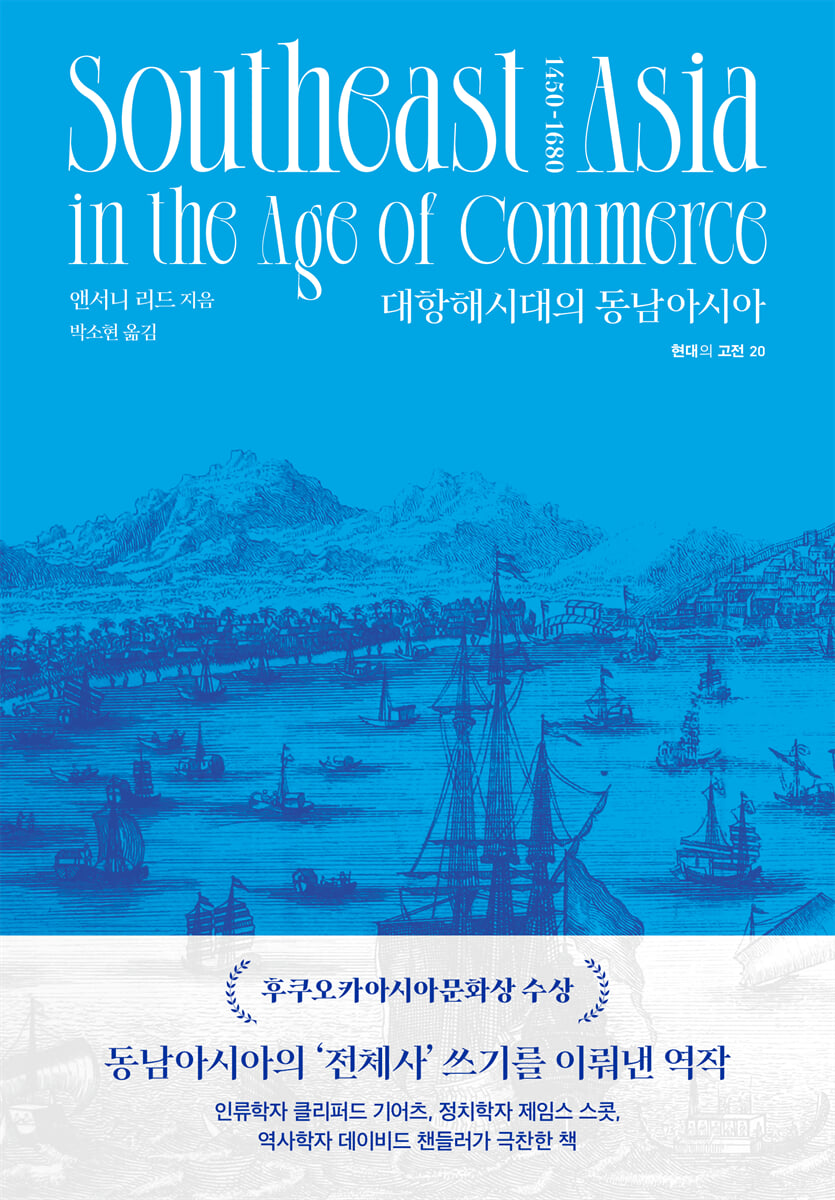
Southeast Asia in the Age of Exploration
 |
Description
Book Introduction
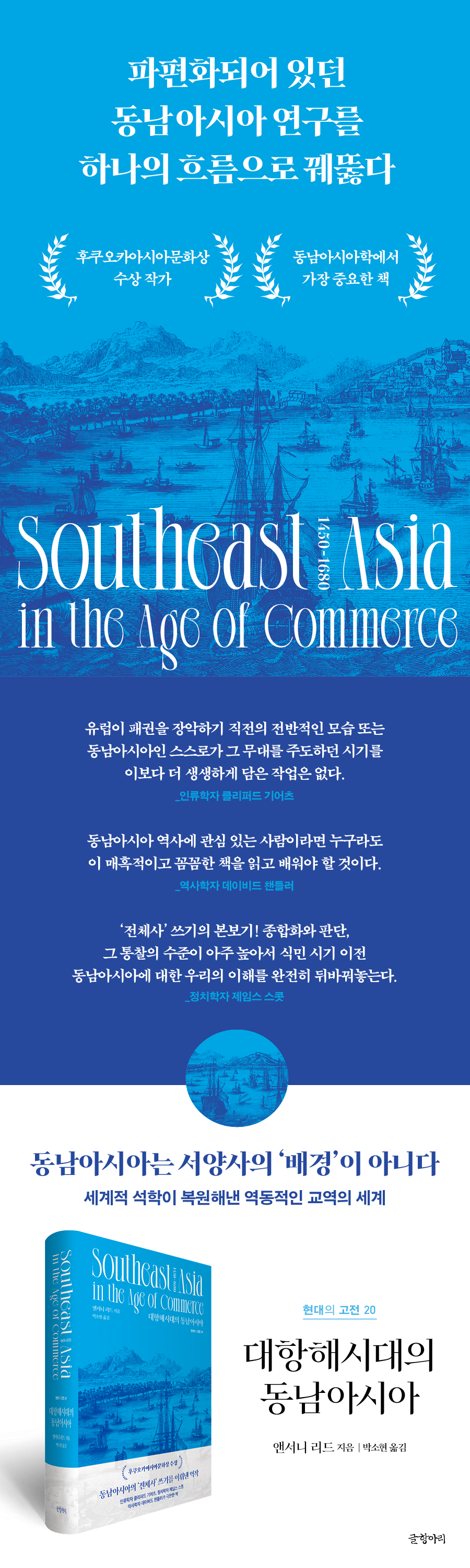
Unifying Fragmented Southeast Asian Studies into a Single Stream
Fukuoka Asian Culture Award Winner
Recommended by Clifford Geertz, James Scott, and David Chandler
When discussing the 'Age of Exploration', few people pay attention to 'Southeast Asia'.
Even when attention is paid, it is often distorted by being tied to a specific viewpoint.
Just as colonial history has relegated Southeast Asia to the background of Western history, nationalist history has depicted it as a land of sacrifice.
However, during this period, Southeast Asia was developing its own unique culture, and it could not be reduced to just 'one of the places Europe visited.'
The author proposes the term 'Age of Commerce' instead of 'Age of Discovery' and attempts to write a 'complete history' of Southeast Asia.
Before the author began his work, the history of this region was fragmented.
Not only was there a lack of materials, but attempts to study Southeast Asia as a single region were rare and scattered.
Within these limitations, the author sought to discover "a coherent picture of the regional way of life as a whole" by "reading the materials 'as they came' and finding connections."
Rather than theory, it utilized European travel records and colonial documents.
I summarized, organized, and analyzed the references, which were over 70 pages long, and completed the research by adding my insights as a historian.
This book is the result of over 20 years of research on Southeast Asia.
The author is a world-renowned scholar who has taught at UCLA's Southeast Asia Center, the National University of Singapore, and the Australian National University.
This book won the Fukuoka Asian Culture Award and earned the reputation of being a leading authority on Southeast Asian studies, even now, 40 years after its publication.
His sentences blur the old image of Southeast Asia.
It creates space for new perceptions and ultimately re-establishes a vivid and fascinating world in its place.
Now it's time to step into that world.
Fukuoka Asian Culture Award Winner
Recommended by Clifford Geertz, James Scott, and David Chandler
When discussing the 'Age of Exploration', few people pay attention to 'Southeast Asia'.
Even when attention is paid, it is often distorted by being tied to a specific viewpoint.
Just as colonial history has relegated Southeast Asia to the background of Western history, nationalist history has depicted it as a land of sacrifice.
However, during this period, Southeast Asia was developing its own unique culture, and it could not be reduced to just 'one of the places Europe visited.'
The author proposes the term 'Age of Commerce' instead of 'Age of Discovery' and attempts to write a 'complete history' of Southeast Asia.
Before the author began his work, the history of this region was fragmented.
Not only was there a lack of materials, but attempts to study Southeast Asia as a single region were rare and scattered.
Within these limitations, the author sought to discover "a coherent picture of the regional way of life as a whole" by "reading the materials 'as they came' and finding connections."
Rather than theory, it utilized European travel records and colonial documents.
I summarized, organized, and analyzed the references, which were over 70 pages long, and completed the research by adding my insights as a historian.
This book is the result of over 20 years of research on Southeast Asia.
The author is a world-renowned scholar who has taught at UCLA's Southeast Asia Center, the National University of Singapore, and the Australian National University.
This book won the Fukuoka Asian Culture Award and earned the reputation of being a leading authority on Southeast Asian studies, even now, 40 years after its publication.
His sentences blur the old image of Southeast Asia.
It creates space for new perceptions and ultimately re-establishes a vivid and fascinating world in its place.
Now it's time to step into that world.
- You can preview some of the book's contents.
Preview
index
Volume 1
introduction
Chapter 1 Introduction: The Land Beneath the Wind
Southeast Asia in Geography | Southeast Asia in Humanities
Chapter 2 Physical Health
Population | Agricultural practices | Land ownership and use rights | Farming tools | Diet and food supply | Ritual meat consumption | Water and alcohol | Feasts and food | Betel nuts and tobacco | Healthy people? | Hygiene | Medicine | Endemic diseases and epidemics
Chapter 3 Material Culture
Rumpy houses, magnificent temples | Furniture and lighting | Grooming | Hair | Clothing | Textile production and trade | Gold and silver crafts | Specialty crafts | Ceramics | Metalware: the keys to power | Iron | Copper, tin, lead
Chapter 4 Social Organization
War | Labor Mobilization: Slavery and Subordination | Law and Justice | Sexual Relations | Marriage | Child Brides? | Childbirth and Birth Rates | The Role of Women
Chapter 5 Festivals and Entertainment
Theater State | Games and Competitions | Popular Competitions | Drama, Dance, and Music | Broad Literacy? | Writing Instruments | Oral and Documentary Literature
Volume 2
introduction
Chapter 6: The Age of Trade, 1400–1650
Spices and pepper | The beginning of trade in the 1400s | The boom period 1570–1630 | Imports of gold and silver | Imports of Indian textiles | Cash crops | The heyday of Southeast Asian junks | Navigation | Shipbuilding | Inland transportation: rivers and land routes
Chapter 7: Cities and Trade
Port-Cities and Trade Networks | City Size | Southeast Asian Urban Structure | Markets | Currency and Commercialization: The Triumph of Silver | The Gold Standard | The Orangkaya: The Merchant Class | Urbanization and Capitalism
Chapter 8: Religious Revolution
Religion in Southeast Asia | Conversion or Ascension | 1540–1600: Polarization and Religious Boundaries | The Allure of Conversion | A Difficult Transition | The Special Case of Java | The Heyday of Islamic Scriptural Influence | The Challenge of Islam in Continental Southeast Asia | Buddhism and the State
Chapter 9: The Problems of Absolute State
The Crisis of the Classical State | The Port-State of the 15th Century | State Formation in the Long 16th Century | Trade Revenue | Military Revolutions | Diplomacy | The Lemon Squeeze | Absolutism and Its Competitors
Chapter 10: The Origins of Poverty in Southeast Asia
The Inherent Limits of Economic Growth? | Decisive Military Conflicts with Europe | The Decline of Mon and Javanese Cargo Transport | The "Crisis" of the 17th Century (Trade Decline, Climate) | Retreat from the Global Economy | Reactions to Loss of Trade Profits | Chinese Trade and Ethnic Polarization | The Last Stand of Islamic Trade, 1650–1688
Conclusion Continuity and Changes
References
Translator's Note
introduction
Chapter 1 Introduction: The Land Beneath the Wind
Southeast Asia in Geography | Southeast Asia in Humanities
Chapter 2 Physical Health
Population | Agricultural practices | Land ownership and use rights | Farming tools | Diet and food supply | Ritual meat consumption | Water and alcohol | Feasts and food | Betel nuts and tobacco | Healthy people? | Hygiene | Medicine | Endemic diseases and epidemics
Chapter 3 Material Culture
Rumpy houses, magnificent temples | Furniture and lighting | Grooming | Hair | Clothing | Textile production and trade | Gold and silver crafts | Specialty crafts | Ceramics | Metalware: the keys to power | Iron | Copper, tin, lead
Chapter 4 Social Organization
War | Labor Mobilization: Slavery and Subordination | Law and Justice | Sexual Relations | Marriage | Child Brides? | Childbirth and Birth Rates | The Role of Women
Chapter 5 Festivals and Entertainment
Theater State | Games and Competitions | Popular Competitions | Drama, Dance, and Music | Broad Literacy? | Writing Instruments | Oral and Documentary Literature
Volume 2
introduction
Chapter 6: The Age of Trade, 1400–1650
Spices and pepper | The beginning of trade in the 1400s | The boom period 1570–1630 | Imports of gold and silver | Imports of Indian textiles | Cash crops | The heyday of Southeast Asian junks | Navigation | Shipbuilding | Inland transportation: rivers and land routes
Chapter 7: Cities and Trade
Port-Cities and Trade Networks | City Size | Southeast Asian Urban Structure | Markets | Currency and Commercialization: The Triumph of Silver | The Gold Standard | The Orangkaya: The Merchant Class | Urbanization and Capitalism
Chapter 8: Religious Revolution
Religion in Southeast Asia | Conversion or Ascension | 1540–1600: Polarization and Religious Boundaries | The Allure of Conversion | A Difficult Transition | The Special Case of Java | The Heyday of Islamic Scriptural Influence | The Challenge of Islam in Continental Southeast Asia | Buddhism and the State
Chapter 9: The Problems of Absolute State
The Crisis of the Classical State | The Port-State of the 15th Century | State Formation in the Long 16th Century | Trade Revenue | Military Revolutions | Diplomacy | The Lemon Squeeze | Absolutism and Its Competitors
Chapter 10: The Origins of Poverty in Southeast Asia
The Inherent Limits of Economic Growth? | Decisive Military Conflicts with Europe | The Decline of Mon and Javanese Cargo Transport | The "Crisis" of the 17th Century (Trade Decline, Climate) | Retreat from the Global Economy | Reactions to Loss of Trade Profits | Chinese Trade and Ethnic Polarization | The Last Stand of Islamic Trade, 1650–1688
Conclusion Continuity and Changes
References
Translator's Note
Detailed image
Into the book
The Chinese have viewed Southeast Asia (with the exception of Vietnam, which is a special case) as one mass and have called it the South Sea, or Nanyang.
Meanwhile, Indians, Persians, Arabs, and Malays called Southeast Asia "the land below the winds" because of the monsoon winds that moved ships across the Indian Ocean.
Both names emphasize the fact that Southeast Asia can only be reached by sea.
--- p.32
Chewing betel nut and offering betel and betel leaves separately or together were an integral part of all rituals related to birth, death, and healing.
It was especially important in ceremonies related to love and marriage, and was considered a natural prerequisite for sex because it sweetens breath and calms the mind and body.
(…) In eastern Indonesia, this sexual symbolism was more explicit.
This is because the long, slender pods of the local betel vine, used instead of betel leaves, were considered a symbol of masculinity, and the round areca nut was paired with it as a symbol of femininity.
--- p.85
When it comes to hair, which Southeast Asians consider the most variable part of the body, there are two characteristics.
There is no significant difference in the hairstyles of men and women, and hair has been a very important symbol and expression of self for both men and women.
Hair was often used in witchcraft because it was believed to contain some of a person's power.
The king's headdress was treated with great care, as it contained a certain degree of inherited power.
I put a lot of effort into keeping my hair always black, shiny, full, and smelling good.
--- p.128
The most vivid proof of women's superior position in sexual relations is the fact that men have undergone painful penile implants to enhance women's sexual pleasure.
(…) The authors cite evidence from the Tausug people, stating that although female circumcision is widely practiced in Indonesia today and was present in 17th-century Makassar, some women underwent clitoridectomy, but it was kept secret from men and the purpose was to enhance female sexual pleasure.
The purpose of genital mutilation in Southeast Asia in the past was the opposite of that of surgeries performed in parts of Africa to enhance male sexual pleasure or suppress female sexual pleasure.
--- p.219
Southeast Asia has a warm climate and it is easier to obtain staple foods such as rice, fish, and fruit than anywhere else in the world.
Thanks to this, I enjoyed the natural advantage of not having to struggle to make a living.
Therefore, they would have had relatively more time to spend on activities that we would classify as leisure today than people who lived in the same period.
Southeast Asians seem to have a surprising amount of leisure time, much to the European eye, and it seems clear that they enjoyed spending their evenings singing, eating, drinking, and playing games.
--- p.253
Van Leur's image of a "small peddler" carrying only "a few rolls of silk and a few sacks of pepper" completely underestimates the diversity of Asian trade and the enormous quantities of staples such as rice, vegetables, palm wine, pepper, and sugar that traders carried.
--- p.410
The relatively high urbanization rate at that time was possible thanks to Southeast Asia's affluent environment in three dimensions.
First (a factor shared by the entire Asian monsoon belt), it was much easier to produce significant amounts of marketable surplus rice with appropriate technology than wheat or meat.
Second, all the cities except Mataram (like Ingwa and Thang Long, which were in the heart of intensive rice-growing areas) were easily accessible by water, which was much more efficient than by land cart.
Third, trade played a relatively large role in the economies of most Southeast Asian countries.
Port cities were not parasitic entities, forced to squeeze surpluses from their hinterlands, but rather buyers who reaped a significant portion of their wealth from trade and purchased food supplies on the free market.
--- pp.439-441
A novel from Sumatran, written around 1900 to recreate the conflicts that arose among the southern Batak people as they embraced Islam over three generations, presents a modern example of the type of debate that must have recurred when 'religion' was based on 'custom'.
At the meeting, a Muslim spokesman argued that adolescent girls should be "confined to their homes so that they do not commit great sins" and should not be given any education beyond the recitation of the Quran.
In response, a mother with a teenage daughter strongly objects, saying that farm work should be shared between men and women and that a man can never do it alone.
Moreover, “the ‘custom’ of this town is to let the girls socialize freely.
(…) You can only get to know the behavior, manners, and customs of young people by interacting with them.
(…) You can also see how strong the love you have for the other person is.”
--- p.557
Southeast Asian rulers have always said that their power base is so weak that they cannot afford to let their guard down.
The master's power over his servants was strong, and the king had the power of life and death over his subjects whom he ruled directly.
However, all nations were in the process of being formed through conquest or alliance between local chieftains or chieftains.
(…) The trade boom of the 15th and 16th centuries completely transformed the political landscape of Southeast Asia.
Not only did it provide some rulers with unprecedented disposable income, it also allowed them to gain an edge through ideological and technological innovation.
--- pp.609-610
As we examine the preceding material, the idea that the East remained unchanged while the dynamic elements of capitalist growth and technological development were concentrated in Europe will have disappeared.
The rapid development of Europe in the 16th century fundamentally changed the way Europe interacted with the rest of the world.
This also includes the way Europeans understand Asians.
The same social elements that seemed natural or impressive to a Portuguese person in 1510 might have seemed backward to a Dutch person a century later.
Nonetheless, Southeast Asia itself has undergone fundamental changes, and these changes should be understood as a sign of Southeast Asia's entry into the modern era.
Meanwhile, Indians, Persians, Arabs, and Malays called Southeast Asia "the land below the winds" because of the monsoon winds that moved ships across the Indian Ocean.
Both names emphasize the fact that Southeast Asia can only be reached by sea.
--- p.32
Chewing betel nut and offering betel and betel leaves separately or together were an integral part of all rituals related to birth, death, and healing.
It was especially important in ceremonies related to love and marriage, and was considered a natural prerequisite for sex because it sweetens breath and calms the mind and body.
(…) In eastern Indonesia, this sexual symbolism was more explicit.
This is because the long, slender pods of the local betel vine, used instead of betel leaves, were considered a symbol of masculinity, and the round areca nut was paired with it as a symbol of femininity.
--- p.85
When it comes to hair, which Southeast Asians consider the most variable part of the body, there are two characteristics.
There is no significant difference in the hairstyles of men and women, and hair has been a very important symbol and expression of self for both men and women.
Hair was often used in witchcraft because it was believed to contain some of a person's power.
The king's headdress was treated with great care, as it contained a certain degree of inherited power.
I put a lot of effort into keeping my hair always black, shiny, full, and smelling good.
--- p.128
The most vivid proof of women's superior position in sexual relations is the fact that men have undergone painful penile implants to enhance women's sexual pleasure.
(…) The authors cite evidence from the Tausug people, stating that although female circumcision is widely practiced in Indonesia today and was present in 17th-century Makassar, some women underwent clitoridectomy, but it was kept secret from men and the purpose was to enhance female sexual pleasure.
The purpose of genital mutilation in Southeast Asia in the past was the opposite of that of surgeries performed in parts of Africa to enhance male sexual pleasure or suppress female sexual pleasure.
--- p.219
Southeast Asia has a warm climate and it is easier to obtain staple foods such as rice, fish, and fruit than anywhere else in the world.
Thanks to this, I enjoyed the natural advantage of not having to struggle to make a living.
Therefore, they would have had relatively more time to spend on activities that we would classify as leisure today than people who lived in the same period.
Southeast Asians seem to have a surprising amount of leisure time, much to the European eye, and it seems clear that they enjoyed spending their evenings singing, eating, drinking, and playing games.
--- p.253
Van Leur's image of a "small peddler" carrying only "a few rolls of silk and a few sacks of pepper" completely underestimates the diversity of Asian trade and the enormous quantities of staples such as rice, vegetables, palm wine, pepper, and sugar that traders carried.
--- p.410
The relatively high urbanization rate at that time was possible thanks to Southeast Asia's affluent environment in three dimensions.
First (a factor shared by the entire Asian monsoon belt), it was much easier to produce significant amounts of marketable surplus rice with appropriate technology than wheat or meat.
Second, all the cities except Mataram (like Ingwa and Thang Long, which were in the heart of intensive rice-growing areas) were easily accessible by water, which was much more efficient than by land cart.
Third, trade played a relatively large role in the economies of most Southeast Asian countries.
Port cities were not parasitic entities, forced to squeeze surpluses from their hinterlands, but rather buyers who reaped a significant portion of their wealth from trade and purchased food supplies on the free market.
--- pp.439-441
A novel from Sumatran, written around 1900 to recreate the conflicts that arose among the southern Batak people as they embraced Islam over three generations, presents a modern example of the type of debate that must have recurred when 'religion' was based on 'custom'.
At the meeting, a Muslim spokesman argued that adolescent girls should be "confined to their homes so that they do not commit great sins" and should not be given any education beyond the recitation of the Quran.
In response, a mother with a teenage daughter strongly objects, saying that farm work should be shared between men and women and that a man can never do it alone.
Moreover, “the ‘custom’ of this town is to let the girls socialize freely.
(…) You can only get to know the behavior, manners, and customs of young people by interacting with them.
(…) You can also see how strong the love you have for the other person is.”
--- p.557
Southeast Asian rulers have always said that their power base is so weak that they cannot afford to let their guard down.
The master's power over his servants was strong, and the king had the power of life and death over his subjects whom he ruled directly.
However, all nations were in the process of being formed through conquest or alliance between local chieftains or chieftains.
(…) The trade boom of the 15th and 16th centuries completely transformed the political landscape of Southeast Asia.
Not only did it provide some rulers with unprecedented disposable income, it also allowed them to gain an edge through ideological and technological innovation.
--- pp.609-610
As we examine the preceding material, the idea that the East remained unchanged while the dynamic elements of capitalist growth and technological development were concentrated in Europe will have disappeared.
The rapid development of Europe in the 16th century fundamentally changed the way Europe interacted with the rest of the world.
This also includes the way Europeans understand Asians.
The same social elements that seemed natural or impressive to a Portuguese person in 1510 might have seemed backward to a Dutch person a century later.
Nonetheless, Southeast Asia itself has undergone fundamental changes, and these changes should be understood as a sign of Southeast Asia's entry into the modern era.
--- p.695
Publisher's Review
Why Study Southeast Asia Together?
Women who led society at the time
At first glance, Southeast Asia seems like an impossible region to unify.
The languages, cultures, and religions are so diverse that they don't even seem like the same region.
But if we look away from the dynasties and great religions and examine the lives of ordinary Southeast Asians, we see more similarities.
First, Southeast Asia has clearly defined geographical boundaries.
To the east, the Philippines and to the west, Indonesia draw a parabolic curve formed by volcanic activity.
To the south, there is a parabolic curve created by the simultaneous expansion of the Pacific and Indian Ocean plates, and to the north, the Himalayas stand tall.
Land access was difficult, but waterways were open everywhere.
The winds were calm, the monsoons pushed the ships, the threat of storms was rare, and the water temperature was constant.
Another thing they have in common is the forest.
The high temperatures and abundant rainfall make the area densely forested, and this remains untamed even after the industrialization period.
We can also find commonalities in the humanities.
First is language.
Although Southeast Asians speak a variety of languages, more than half speak languages that come from a common ancestor called Austronesian.
Second, the physical environment.
Because there were many forests and water, they mainly ate rice, fish, and various types of coconuts, and lived in houses with raised floors made of wooden pillars.
Third, there is intra-regional trade.
This trade has strengthened the bonds between Southeast Asian peoples rather than bringing in outside influences.
Especially during the 15th to 17th centuries, which the author calls the "age of trade," the bond reached its peak, and different languages of Southeast Asia were even used in different countries.
After establishing the justification for studying Southeast Asia as a single region, the author moves on to various detailed topics.
For example, in 'Physical Health', it covers everything from population to eating habits, food supply methods, the context in which meat, water, and alcohol are consumed, the Southeast Asian sedative 'betel nut', life expectancy, and infectious diseases.
In addition, under the topic of 'material culture', we look at housing, clothing, and crafts, while under 'social organization', we look at war, slavery, and trials, and under 'festivals and entertainment', we look at competitions, plays, and literacy.
As the analysis continues, the connections between once disparate countries become clearer, and unfamiliar pieces fit together into a single puzzle.
What is particularly impressive is the life of women during this period.
Before Western intervention, Southeast Asian women were the main players in society.
Women were better at business, better at handling issues of national reconciliation, and more prominent in entertainment and recreation.
Countries where trade was important also had a fair number of female rulers.
Women also enjoyed greater autonomy in relationships between men and women.
Marriage and divorce were free, and living with one's wife's family was more common than living with one's in-laws.
Even bells and pins were inserted into men's genitals to enhance women's sexual pleasure.
According to European accounts from the time, 'men said they wanted women to do so, or else they would refuse to have sex with them.'
This atmosphere gradually disappeared as Western ships brought Islam and Christianity.
A scriptural religion in which a male-identified god is worshipped by an all-male clergy.
Even women, who used to play a leading role in Southeast Asian religions, are now left with no role to play in scriptural religions.
Eventually, the women slowly moved away from the text, sometimes being 'completely covered from head to toe so that you couldn't even see their faces.'
There is a widespread perception that Southeast Asia has historically had low levels of women's rights and that progress has been made only thanks to Western intervention.
But this is a backward view of actual history.
Southeast Asian women have been leading their own lives, and it was Western religion that diminished them.
What the West brought to Southeast Asia
The Rise and Fall of the Land Beneath the Wind
It is estimated that large ships first appeared on the coasts of Southeast Asia around 1400.
Around this time, Maluku spices began to be imported into Europe.
Chinese fleets were sent to Southeast Asia and bought pepper from all over the world.
The trade that began in this way gradually prospered and reached its peak in the late 16th century and early 17th century.
In the 1620s, Europe's annual purchases of spices were close to 300 tons of cloves, 200 tons of nutmeg, and 80 tons of mace.
At every stage, there was a profit of more than 100 percent.
Southeast Asia amassed a lot of wealth through new ways of making money, and it gradually became dependent on them.
Soon, an elaborate and dynamic system emerged on the sea.
Huge 'junk ships' commanded the major trade routes.
It was made in a traditional Southeast Asian way without using nails, and Europeans were always amazed at how large and sturdy it was made of wood alone.
On board the ship, the nakoda (ship owner) enjoyed power equal to that of a king on land.
Some wealthy merchants even entered into consignment sales contracts with them, leaving their goods on land.
Meanwhile, goods brought in across the sea had to be transported deep inland by land, which entailed much greater costs and risks than maritime trade.
When passing through the jungle, you had to worry about tigers, and if you wanted to use a cart, you had to take a long detour.
A distance that a person could cover in two weeks alone became a painful five-month journey with a cart.
The impact of trade did not remain confined to the ports but spread throughout the island nations.
The most striking thing is the development of the city.
According to the accounts of Europeans visiting Burma at the time, one city had "the largest and broadest streets I have ever seen", which were "wide enough to allow ten or twelve men to stand abreast."
As the city prospered, trade also became active.
Gold and silver coins were used, as well as coins with a hole in the middle, such as 'peaches'.
The concepts of credit, interest, and debt were also clearly defined, and intermediaries were active in preventing the circulation of bad currency or coordinating foreign trade.
Some people earned so much money that they became 'orangkaya', the ruling class of merchants.
The native nobles, feeling threatened by them, tried to prove their superiority, and eventually earned the notoriety of being 'more arrogant than anywhere else on earth.'
The glorious era of trade came to an end in the 17th century.
Trade indicators, which had been soaring at a frightening rate until the 1620s, then plummeted, and finally died down completely in 1680.
There are several reasons.
The countries that had been buying goods suffered economic crises, and the Dutch East India Company monopolized the main products, nutmeg, mace, and cloves.
Even climate issues had an impact, with the Little Ice Age, a period of global temperature drops, making crop cultivation difficult.
The fate of the countries that had been active in trade was one of two things.
Either be annihilated or become impoverished to death.
This is because the Dutch East India Company would start wars to monopolize the remaining crops.
They also raised the price of rice fivefold, taking advantage of the fact that these countries imported rice.
In this way, Southeast Asia, once the 'greatest trading center in the Orient,' ended up being reduced to a 'land of the damned.'
They became so poor that they had no other way to survive than by stealing.
According to one account, the people of Banton, who were once so extravagantly dressed and extravagantly spent, have become so poor and miserable.
Southeast Asia is still synonymous with underdevelopment.
People explain their poverty by giving various reasons: being lazy, not working hard, not being interested in accumulating wealth...
But Southeast Asia also had its dazzlingly brilliant times, and it was the Western powers that brought an end to these times and left behind massive poverty.
*
The numerous languages and unfamiliar place names in Southeast Asia were a great burden to both the author and the translator.
The author reviewed all sources in English, French, and Malay-Indonesian.
Among these, there were some for which the National Institute of the Korean Language had not even established notation principles, so the translator had to ask local researchers for their opinions.
It was hard work, but I kept going because it was such an important story.
In the age of trade, Southeast Asians quickly adapted to change and responded creatively.
No matter what the ending was, this fact remains unchanged.
So, instead of regarding the past as a failure, the author and translator wholeheartedly urge us to move forward by using it as a historical resource.
That's why this book is both a great scholarly work and a powerful voice.
Women who led society at the time
At first glance, Southeast Asia seems like an impossible region to unify.
The languages, cultures, and religions are so diverse that they don't even seem like the same region.
But if we look away from the dynasties and great religions and examine the lives of ordinary Southeast Asians, we see more similarities.
First, Southeast Asia has clearly defined geographical boundaries.
To the east, the Philippines and to the west, Indonesia draw a parabolic curve formed by volcanic activity.
To the south, there is a parabolic curve created by the simultaneous expansion of the Pacific and Indian Ocean plates, and to the north, the Himalayas stand tall.
Land access was difficult, but waterways were open everywhere.
The winds were calm, the monsoons pushed the ships, the threat of storms was rare, and the water temperature was constant.
Another thing they have in common is the forest.
The high temperatures and abundant rainfall make the area densely forested, and this remains untamed even after the industrialization period.
We can also find commonalities in the humanities.
First is language.
Although Southeast Asians speak a variety of languages, more than half speak languages that come from a common ancestor called Austronesian.
Second, the physical environment.
Because there were many forests and water, they mainly ate rice, fish, and various types of coconuts, and lived in houses with raised floors made of wooden pillars.
Third, there is intra-regional trade.
This trade has strengthened the bonds between Southeast Asian peoples rather than bringing in outside influences.
Especially during the 15th to 17th centuries, which the author calls the "age of trade," the bond reached its peak, and different languages of Southeast Asia were even used in different countries.
After establishing the justification for studying Southeast Asia as a single region, the author moves on to various detailed topics.
For example, in 'Physical Health', it covers everything from population to eating habits, food supply methods, the context in which meat, water, and alcohol are consumed, the Southeast Asian sedative 'betel nut', life expectancy, and infectious diseases.
In addition, under the topic of 'material culture', we look at housing, clothing, and crafts, while under 'social organization', we look at war, slavery, and trials, and under 'festivals and entertainment', we look at competitions, plays, and literacy.
As the analysis continues, the connections between once disparate countries become clearer, and unfamiliar pieces fit together into a single puzzle.
What is particularly impressive is the life of women during this period.
Before Western intervention, Southeast Asian women were the main players in society.
Women were better at business, better at handling issues of national reconciliation, and more prominent in entertainment and recreation.
Countries where trade was important also had a fair number of female rulers.
Women also enjoyed greater autonomy in relationships between men and women.
Marriage and divorce were free, and living with one's wife's family was more common than living with one's in-laws.
Even bells and pins were inserted into men's genitals to enhance women's sexual pleasure.
According to European accounts from the time, 'men said they wanted women to do so, or else they would refuse to have sex with them.'
This atmosphere gradually disappeared as Western ships brought Islam and Christianity.
A scriptural religion in which a male-identified god is worshipped by an all-male clergy.
Even women, who used to play a leading role in Southeast Asian religions, are now left with no role to play in scriptural religions.
Eventually, the women slowly moved away from the text, sometimes being 'completely covered from head to toe so that you couldn't even see their faces.'
There is a widespread perception that Southeast Asia has historically had low levels of women's rights and that progress has been made only thanks to Western intervention.
But this is a backward view of actual history.
Southeast Asian women have been leading their own lives, and it was Western religion that diminished them.
What the West brought to Southeast Asia
The Rise and Fall of the Land Beneath the Wind
It is estimated that large ships first appeared on the coasts of Southeast Asia around 1400.
Around this time, Maluku spices began to be imported into Europe.
Chinese fleets were sent to Southeast Asia and bought pepper from all over the world.
The trade that began in this way gradually prospered and reached its peak in the late 16th century and early 17th century.
In the 1620s, Europe's annual purchases of spices were close to 300 tons of cloves, 200 tons of nutmeg, and 80 tons of mace.
At every stage, there was a profit of more than 100 percent.
Southeast Asia amassed a lot of wealth through new ways of making money, and it gradually became dependent on them.
Soon, an elaborate and dynamic system emerged on the sea.
Huge 'junk ships' commanded the major trade routes.
It was made in a traditional Southeast Asian way without using nails, and Europeans were always amazed at how large and sturdy it was made of wood alone.
On board the ship, the nakoda (ship owner) enjoyed power equal to that of a king on land.
Some wealthy merchants even entered into consignment sales contracts with them, leaving their goods on land.
Meanwhile, goods brought in across the sea had to be transported deep inland by land, which entailed much greater costs and risks than maritime trade.
When passing through the jungle, you had to worry about tigers, and if you wanted to use a cart, you had to take a long detour.
A distance that a person could cover in two weeks alone became a painful five-month journey with a cart.
The impact of trade did not remain confined to the ports but spread throughout the island nations.
The most striking thing is the development of the city.
According to the accounts of Europeans visiting Burma at the time, one city had "the largest and broadest streets I have ever seen", which were "wide enough to allow ten or twelve men to stand abreast."
As the city prospered, trade also became active.
Gold and silver coins were used, as well as coins with a hole in the middle, such as 'peaches'.
The concepts of credit, interest, and debt were also clearly defined, and intermediaries were active in preventing the circulation of bad currency or coordinating foreign trade.
Some people earned so much money that they became 'orangkaya', the ruling class of merchants.
The native nobles, feeling threatened by them, tried to prove their superiority, and eventually earned the notoriety of being 'more arrogant than anywhere else on earth.'
The glorious era of trade came to an end in the 17th century.
Trade indicators, which had been soaring at a frightening rate until the 1620s, then plummeted, and finally died down completely in 1680.
There are several reasons.
The countries that had been buying goods suffered economic crises, and the Dutch East India Company monopolized the main products, nutmeg, mace, and cloves.
Even climate issues had an impact, with the Little Ice Age, a period of global temperature drops, making crop cultivation difficult.
The fate of the countries that had been active in trade was one of two things.
Either be annihilated or become impoverished to death.
This is because the Dutch East India Company would start wars to monopolize the remaining crops.
They also raised the price of rice fivefold, taking advantage of the fact that these countries imported rice.
In this way, Southeast Asia, once the 'greatest trading center in the Orient,' ended up being reduced to a 'land of the damned.'
They became so poor that they had no other way to survive than by stealing.
According to one account, the people of Banton, who were once so extravagantly dressed and extravagantly spent, have become so poor and miserable.
Southeast Asia is still synonymous with underdevelopment.
People explain their poverty by giving various reasons: being lazy, not working hard, not being interested in accumulating wealth...
But Southeast Asia also had its dazzlingly brilliant times, and it was the Western powers that brought an end to these times and left behind massive poverty.
*
The numerous languages and unfamiliar place names in Southeast Asia were a great burden to both the author and the translator.
The author reviewed all sources in English, French, and Malay-Indonesian.
Among these, there were some for which the National Institute of the Korean Language had not even established notation principles, so the translator had to ask local researchers for their opinions.
It was hard work, but I kept going because it was such an important story.
In the age of trade, Southeast Asians quickly adapted to change and responded creatively.
No matter what the ending was, this fact remains unchanged.
So, instead of regarding the past as a failure, the author and translator wholeheartedly urge us to move forward by using it as a historical resource.
That's why this book is both a great scholarly work and a powerful voice.
GOODS SPECIFICS
- Date of issue: September 24, 2025
- Format: Hardcover book binding method guide
- Page count, weight, size: 976 pages | 1,452g | 158*228*51mm
- ISBN13: 9791169094245
You may also like
카테고리
korean


korean

![GQ KOREA Mark (Monthly): December [2025]](http://librairie.coreenne.fr/cdn/shop/files/8ef265dbbfbf186523ed75ba7319009d.jpg?v=1765340328&width=3840)


