

A tightly wrapped bundle
 |
Description
Book Introduction
The heartbreaking record of anti-Japanese resistance by Buddhists during the Japanese colonial period
80 years since liberation, we raise a topic for today.
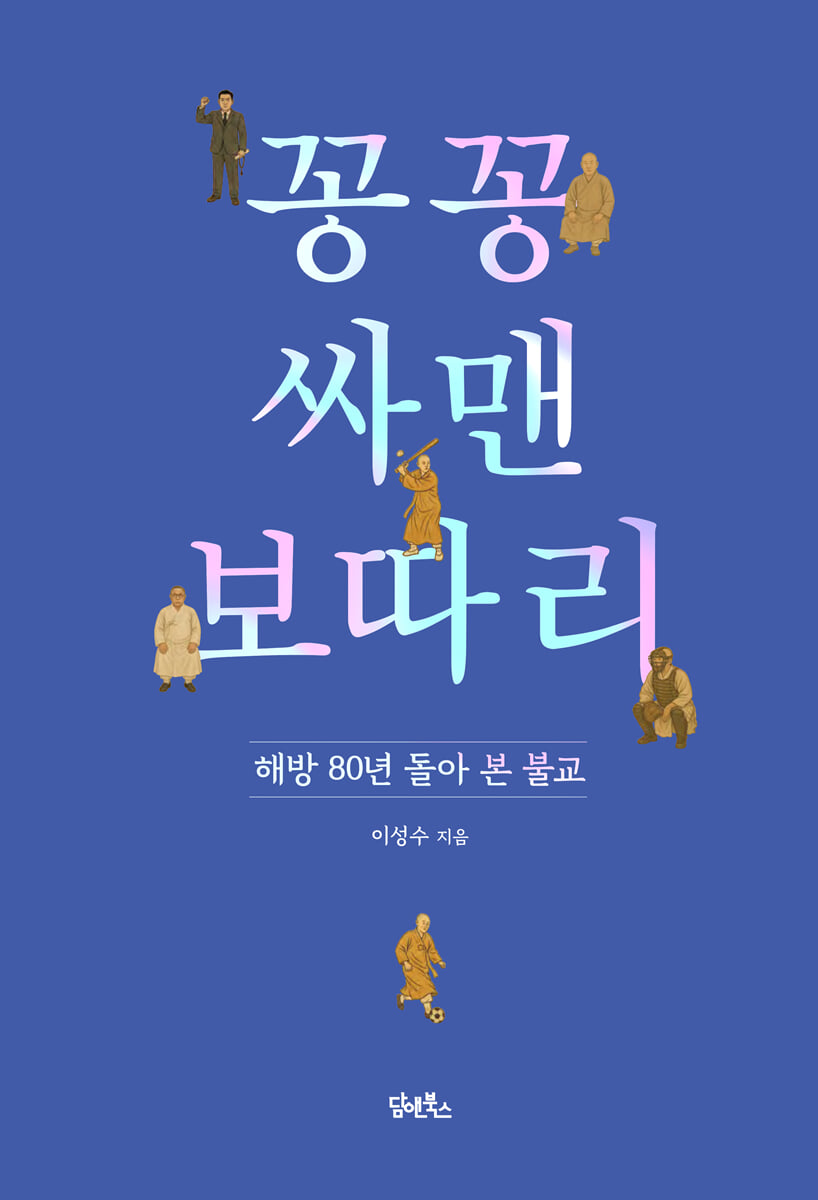
"A Tightly Wrapped Bundle - Buddhism Reflected on 80 Years of Liberation" is a masterpiece that comprehensively illuminates the truth behind the shocking and passionate anti-Japanese independence movement and modernization efforts hidden behind the scenes of Korean Buddhism during the Japanese colonial period, commemorating the 80th anniversary of liberation.
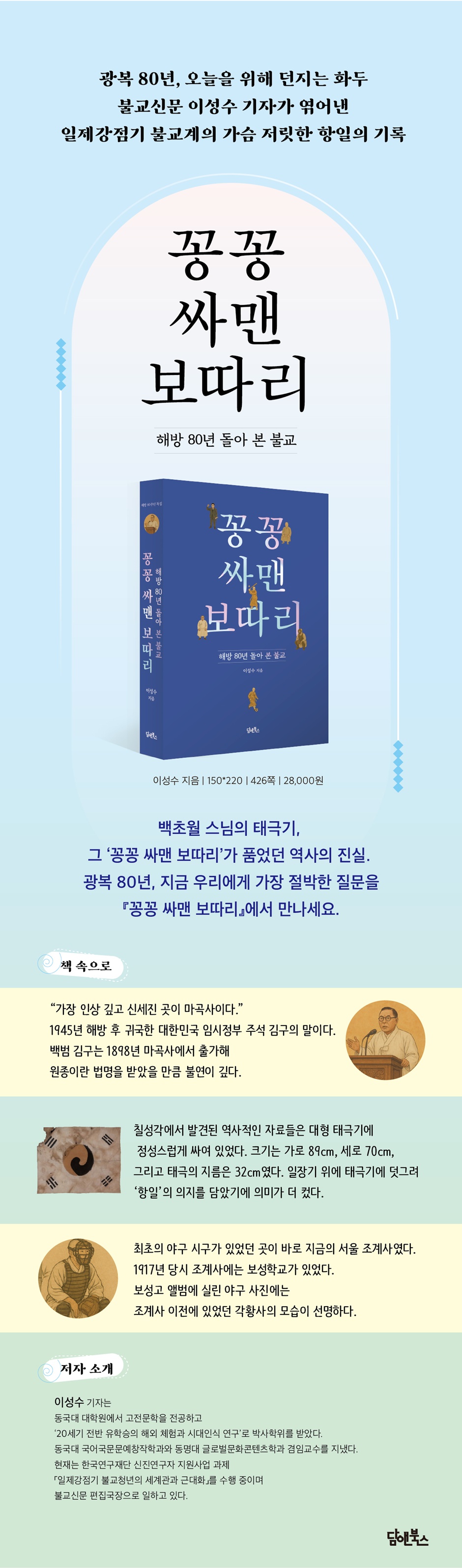
As symbolized by the 'Taegeukgi of Monk Baekcho-wol' discovered at Chilseonggak in Jinwansa Temple in 2009, this book, based on valuable materials unearthed through nationwide field research and years of dedication, restores the history of the Buddhist community's fierce resistance to protect national identity and prepare for the future in the four areas of independence, culture, education, and practice, with vivid testimony.
Beyond mere historical records, it offers a profound resonance and enlightenment, offering us today a true sense of independence and a pressing question that permeates our times, through the heartbreaking, hidden struggles of the Buddhist community, which defended the national spirit by calling for mercy and justice even in the dark ages.
80 years since liberation, we raise a topic for today.
"A Tightly Wrapped Bundle - Buddhism Reflected on 80 Years of Liberation" is a masterpiece that comprehensively illuminates the truth behind the shocking and passionate anti-Japanese independence movement and modernization efforts hidden behind the scenes of Korean Buddhism during the Japanese colonial period, commemorating the 80th anniversary of liberation.
As symbolized by the 'Taegeukgi of Monk Baekcho-wol' discovered at Chilseonggak in Jinwansa Temple in 2009, this book, based on valuable materials unearthed through nationwide field research and years of dedication, restores the history of the Buddhist community's fierce resistance to protect national identity and prepare for the future in the four areas of independence, culture, education, and practice, with vivid testimony.
Beyond mere historical records, it offers a profound resonance and enlightenment, offering us today a true sense of independence and a pressing question that permeates our times, through the heartbreaking, hidden struggles of the Buddhist community, which defended the national spirit by calling for mercy and justice even in the dark ages.
- You can preview some of the book's contents.
Preview
index
Recommendation
In publishing a book
1.
independence
Baekbeom Kim Gu visiting Daegaksa Temple immediately after liberation
Magoksa Temple in Gongju, where Baekbeom Kim Gu became a monk
After Kim Gu's death, monks at Magoksa Temple prayed all night.
Dr. Yun Bong-gil was a Buddhist
Sokcho Bogwangsa Temple honors 135 independence movement monks
Buddhists on the eve of forced annexation - confirming their patriotic character
Declaration of the Korean Buddhist Monks' Association
Declaration by Venerable Guha and the Korean Buddhist Monks' Association
Guha and Manhae, monks who divided their hearts on a blank sheet of paper
Beomeosa Temple Local Academy, Myeongjeong School Independence Movement
Monk Baek Yong-seong and Hamyang Hwagwawon
Monk Yongseong's "Dae Gak Gyo Gwan Jeong Sa Yu Heon"
Monk Dongam, who helped Monk Yongseong in the independence movement
Monk Oisan, who nurtured talent through education
2019: The 100th Anniversary of the March 1st Movement / Prologue
Central Academy students lead the March 1st Independence Movement
Dongwhasa Local Academy March 30th Independence Movement
Beomeosa Temple March 18th and March 19th Independence Movements
Bongseonsa Temple March 29th Incident
Shinreuksa Temple April 3rd Independence Movement
Tongdosa Temple Shinpyeong Market March 13th Protest
Tongdosa Temple Shinpyeong Market March 13th Independence Movement
Tongdosa Independence Movement
Haeinsa Temple March 31st Independence Movement
Pyochungsa April 4th Independence Movement
Ssanggyesa Temple April 6 and April 11 Independence Movements
Okcheonsa, who supported the independence movement
Monk Baekcho-wol and Jinkwansa Temple
Birthplace of Monk Manhae Han Yong-un
Jeju Beopjeongsa Temple Anti-Japanese Movement and Monk Bongryeongwan
Yongmunsa Temple, the base of the Jeongmi Righteous Army
Mungyeong Kimryongsa April 13 Incident
Shin Hwa-su, who dedicated his youth to Joseon's independence
Oh Taek-eon's independence movement
Governor Lee Gi-chan, leader of the Kimsan Righteous Army
Haedong Station Gyeongwon, which established national identity
The footsteps of Cheongdam Daejongsa's independence movement
2.
culture
The first baseball pitch was thrown at Jogyesa Temple.
Buddhist Boys' Baseball Team
Tongdosa Soccer
Tennis competition
Buddha's Birthday during the dark ages of national loss
The first super-high-resolution color photograph
Photos related to Buddhism during the Japanese colonial period
Park Bong-seok, the father of Korean libraries
Monk Park Han-yeong of Seokjeon, folding screen and poetry collection, part 1
Seokjeon Park Han-yeong's folding screen and poetry collection, Part 2
The "Standard of the Saints" by Monk Choeol
Seokjeon monk's 『Jeongjusasanbimyeong』
Seoul Chungmuro Hoguk Station Police Station
3.
education
Gwangseongsuk is out in the world after a century
More information on the Gwangseong School, a Korean school, has been released.
Cheongryong Elementary School in Busan in the 1910s
Gyeongseong Buddhist High School Diploma, etc.
Geumgangsan Yeongwonam Graduation Certificate Training Session Immediately After the War
Tongdosa Myeongsin School
Night school that raises public awareness and leads the way in equal education
Heo Yeong-ho's autograph of 『Theory of the Origin of the Korean Language』
Ewha Hakdang visited Gaeunsa Temple in 1923
Monks of Songgwangsa Temple forcibly conscripted
4.
commitment
Monk Lee Yeong-jae, the first monk to make a pilgrimage to India in modern times
Monk Haean, a director of both the new and old studies of the internal and external affairs
Mangong Seonsa, who helped refugees during the Japanese colonial period
Photo of Monk Chobujeokum in his 30s
Geumgangsan Yujeomsa Gyeongseong Propagation Center Flag
Buddhist believer certificate from the Japanese colonial period and Haeinsa Temple photo
Monks of Geumgangsan during the Japanese colonial period
Major temples in Geumgangsan during the Japanese colonial period
Revisiting Korean Buddhism during the Japanese Colonial Period
The propagation documents of Gakhwangsa Temple during the Japanese colonial period
1918 Wibongsa Jeonju Church membership certificate
Reviews
In publishing a book
1.
independence
Baekbeom Kim Gu visiting Daegaksa Temple immediately after liberation
Magoksa Temple in Gongju, where Baekbeom Kim Gu became a monk
After Kim Gu's death, monks at Magoksa Temple prayed all night.
Dr. Yun Bong-gil was a Buddhist
Sokcho Bogwangsa Temple honors 135 independence movement monks
Buddhists on the eve of forced annexation - confirming their patriotic character
Declaration of the Korean Buddhist Monks' Association
Declaration by Venerable Guha and the Korean Buddhist Monks' Association
Guha and Manhae, monks who divided their hearts on a blank sheet of paper
Beomeosa Temple Local Academy, Myeongjeong School Independence Movement
Monk Baek Yong-seong and Hamyang Hwagwawon
Monk Yongseong's "Dae Gak Gyo Gwan Jeong Sa Yu Heon"
Monk Dongam, who helped Monk Yongseong in the independence movement
Monk Oisan, who nurtured talent through education
2019: The 100th Anniversary of the March 1st Movement / Prologue
Central Academy students lead the March 1st Independence Movement
Dongwhasa Local Academy March 30th Independence Movement
Beomeosa Temple March 18th and March 19th Independence Movements
Bongseonsa Temple March 29th Incident
Shinreuksa Temple April 3rd Independence Movement
Tongdosa Temple Shinpyeong Market March 13th Protest
Tongdosa Temple Shinpyeong Market March 13th Independence Movement
Tongdosa Independence Movement
Haeinsa Temple March 31st Independence Movement
Pyochungsa April 4th Independence Movement
Ssanggyesa Temple April 6 and April 11 Independence Movements
Okcheonsa, who supported the independence movement
Monk Baekcho-wol and Jinkwansa Temple
Birthplace of Monk Manhae Han Yong-un
Jeju Beopjeongsa Temple Anti-Japanese Movement and Monk Bongryeongwan
Yongmunsa Temple, the base of the Jeongmi Righteous Army
Mungyeong Kimryongsa April 13 Incident
Shin Hwa-su, who dedicated his youth to Joseon's independence
Oh Taek-eon's independence movement
Governor Lee Gi-chan, leader of the Kimsan Righteous Army
Haedong Station Gyeongwon, which established national identity
The footsteps of Cheongdam Daejongsa's independence movement
2.
culture
The first baseball pitch was thrown at Jogyesa Temple.
Buddhist Boys' Baseball Team
Tongdosa Soccer
Tennis competition
Buddha's Birthday during the dark ages of national loss
The first super-high-resolution color photograph
Photos related to Buddhism during the Japanese colonial period
Park Bong-seok, the father of Korean libraries
Monk Park Han-yeong of Seokjeon, folding screen and poetry collection, part 1
Seokjeon Park Han-yeong's folding screen and poetry collection, Part 2
The "Standard of the Saints" by Monk Choeol
Seokjeon monk's 『Jeongjusasanbimyeong』
Seoul Chungmuro Hoguk Station Police Station
3.
education
Gwangseongsuk is out in the world after a century
More information on the Gwangseong School, a Korean school, has been released.
Cheongryong Elementary School in Busan in the 1910s
Gyeongseong Buddhist High School Diploma, etc.
Geumgangsan Yeongwonam Graduation Certificate Training Session Immediately After the War
Tongdosa Myeongsin School
Night school that raises public awareness and leads the way in equal education
Heo Yeong-ho's autograph of 『Theory of the Origin of the Korean Language』
Ewha Hakdang visited Gaeunsa Temple in 1923
Monks of Songgwangsa Temple forcibly conscripted
4.
commitment
Monk Lee Yeong-jae, the first monk to make a pilgrimage to India in modern times
Monk Haean, a director of both the new and old studies of the internal and external affairs
Mangong Seonsa, who helped refugees during the Japanese colonial period
Photo of Monk Chobujeokum in his 30s
Geumgangsan Yujeomsa Gyeongseong Propagation Center Flag
Buddhist believer certificate from the Japanese colonial period and Haeinsa Temple photo
Monks of Geumgangsan during the Japanese colonial period
Major temples in Geumgangsan during the Japanese colonial period
Revisiting Korean Buddhism during the Japanese Colonial Period
The propagation documents of Gakhwangsa Temple during the Japanese colonial period
1918 Wibongsa Jeonju Church membership certificate
Reviews
Detailed image
Publisher's Review
New book "A Tightly Wrapped Bundle" illuminates the history of Korean Buddhist independence movements.
To mark the 80th anniversary of liberation, a masterpiece has been published that illuminates the previously unknown history of Korean Buddhism's fierce independence movement during the Japanese colonial period.
The book “A Tightly Wrapped Bundle - Buddhism in Review 80 Years After Liberation,” written by Lee Seong-su, editor-in-chief of the Buddhist Newspaper, was published on August 15, 2025, Liberation Day.
This book symbolizes the historical evidence contained in the tightly wrapped bundle of the Taegeukgi (Korean flag) of Monk Baek Cho-wol, discovered in 2009 at Chilseonggak in Jinwansa Temple, Seoul, in which the Taegeukgi and the four trigrams were painted over the Japanese flag.
This shows that the fervent anti-Japanese independence spirit displayed by the Buddhist community at that time is of great significance and should be remembered today.
Reconstructing the History of the Buddhist Independence Movement through Excavation and Field Research in Four Fields
This book systematically illuminates the history of Korean Buddhism during the Japanese colonial period, dividing it into four areas: independence, culture, education, and practice.
We have unearthed and recorded in detail the passionate traces of independence hidden behind the Buddhist community, which has been remembered only as a history of pro-Japanese collaboration and submission.
The author personally visited historical sites across the country, from Daegaksa Temple, which Baekbeom Kim Gu visited immediately after liberation, to the site of the armed resistance at Beopjeongsa Temple in Jeju, and unearthed hidden stories.
These are the stories of how students at Joongang Academy led the independence movement during the March 1st Movement in 1919, and how cries for independence rang out from temples across the country, including Tongdosa Temple and Beomeosa Temple.
Instances where Buddhist educational institutions played a central role in the independence movement were also vividly restored.
It also includes interesting and surprising content, such as the connection between Baekbeom Kim Gu and the Buddhist community, and the new fact that Dr. Yun Bong-gil was a devout Buddhist.
Buddhists Protect National Spirit Through Culture, Education, and Practice
Although the Japanese attempted to control temples, Korean Buddhism resisted in various ways, preserving its national identity and sowing the seeds of modernization.
The publication of Korean scriptures by the Beomeosa Temple Haedong Station Scripture Institute, which preserved the soul of the nation, was a 'cultural independence movement' that went beyond mere religious activity.
Part 2 of the book, Culture, highlights the Buddhist community's efforts to raise the nation's spirit through sports even in dark times, including the first baseball ceremonial pitch in Korea held in the courtyard of Jogyesa Temple and the operation of a soccer team at Tongdosa Temple.
Part 3, Education, details the Buddhist community's efforts to teach new learning and awaken public consciousness, as well as the founding of the Gwangseong Middle School and Cheongryong Elementary School, and the night school movement, which ignited the flame of modern education.
The book emphasizes that all of these activities were a 'large independence movement' against Japan's policy of ethnic annihilation.
The final part, Part 4, on practice, shows the strong spirit of Buddhism through the story of monks who did not stop practicing and saving sentient beings even during the Japanese colonial period.
Beyond a Painful History, an Urgent Question for the Present
This book vividly conveys the harsh reality of the time, presenting painful historical records such as forced conscription and rare documents.
As the author confessed in his review, “A Tightly Wrapped Bundle - Buddhism in Review 80 Years After Liberation,” when he encountered the Taegeukgi of Jinkwansa Temple, is not a simple history book that records the past.
Through the hidden history of the Buddhist community, which cried out for mercy and justice and tried to preserve the spirit of the nation even in the dark ages when the country was taken away, it poses an urgent question to us living in the present.
As we mark the 80th anniversary of liberation, we will be reminded of the true meaning of independence that we must remember and carry on.
To mark the 80th anniversary of liberation, a masterpiece has been published that illuminates the previously unknown history of Korean Buddhism's fierce independence movement during the Japanese colonial period.
The book “A Tightly Wrapped Bundle - Buddhism in Review 80 Years After Liberation,” written by Lee Seong-su, editor-in-chief of the Buddhist Newspaper, was published on August 15, 2025, Liberation Day.
This book symbolizes the historical evidence contained in the tightly wrapped bundle of the Taegeukgi (Korean flag) of Monk Baek Cho-wol, discovered in 2009 at Chilseonggak in Jinwansa Temple, Seoul, in which the Taegeukgi and the four trigrams were painted over the Japanese flag.
This shows that the fervent anti-Japanese independence spirit displayed by the Buddhist community at that time is of great significance and should be remembered today.
Reconstructing the History of the Buddhist Independence Movement through Excavation and Field Research in Four Fields
This book systematically illuminates the history of Korean Buddhism during the Japanese colonial period, dividing it into four areas: independence, culture, education, and practice.
We have unearthed and recorded in detail the passionate traces of independence hidden behind the Buddhist community, which has been remembered only as a history of pro-Japanese collaboration and submission.
The author personally visited historical sites across the country, from Daegaksa Temple, which Baekbeom Kim Gu visited immediately after liberation, to the site of the armed resistance at Beopjeongsa Temple in Jeju, and unearthed hidden stories.
These are the stories of how students at Joongang Academy led the independence movement during the March 1st Movement in 1919, and how cries for independence rang out from temples across the country, including Tongdosa Temple and Beomeosa Temple.
Instances where Buddhist educational institutions played a central role in the independence movement were also vividly restored.
It also includes interesting and surprising content, such as the connection between Baekbeom Kim Gu and the Buddhist community, and the new fact that Dr. Yun Bong-gil was a devout Buddhist.
Buddhists Protect National Spirit Through Culture, Education, and Practice
Although the Japanese attempted to control temples, Korean Buddhism resisted in various ways, preserving its national identity and sowing the seeds of modernization.
The publication of Korean scriptures by the Beomeosa Temple Haedong Station Scripture Institute, which preserved the soul of the nation, was a 'cultural independence movement' that went beyond mere religious activity.
Part 2 of the book, Culture, highlights the Buddhist community's efforts to raise the nation's spirit through sports even in dark times, including the first baseball ceremonial pitch in Korea held in the courtyard of Jogyesa Temple and the operation of a soccer team at Tongdosa Temple.
Part 3, Education, details the Buddhist community's efforts to teach new learning and awaken public consciousness, as well as the founding of the Gwangseong Middle School and Cheongryong Elementary School, and the night school movement, which ignited the flame of modern education.
The book emphasizes that all of these activities were a 'large independence movement' against Japan's policy of ethnic annihilation.
The final part, Part 4, on practice, shows the strong spirit of Buddhism through the story of monks who did not stop practicing and saving sentient beings even during the Japanese colonial period.
Beyond a Painful History, an Urgent Question for the Present
This book vividly conveys the harsh reality of the time, presenting painful historical records such as forced conscription and rare documents.
As the author confessed in his review, “A Tightly Wrapped Bundle - Buddhism in Review 80 Years After Liberation,” when he encountered the Taegeukgi of Jinkwansa Temple, is not a simple history book that records the past.
Through the hidden history of the Buddhist community, which cried out for mercy and justice and tried to preserve the spirit of the nation even in the dark ages when the country was taken away, it poses an urgent question to us living in the present.
As we mark the 80th anniversary of liberation, we will be reminded of the true meaning of independence that we must remember and carry on.
GOODS SPECIFICS
- Date of issue: August 15, 2025
- Page count, weight, size: 426 pages | 738g | 150*220*26mm
- ISBN13: 9791162015568
- ISBN10: 116201556X
You may also like
카테고리
korean


korean

![GQ KOREA Mark (Monthly): December [2025]](http://librairie.coreenne.fr/cdn/shop/files/8ef265dbbfbf186523ed75ba7319009d.jpg?v=1765340328&width=3840)


